×
Request Free Sample ×

Kindly complete the form below to receive a free sample of this Report

* Please use a valid business email

Leading companies partner with us for data-driven Insights

clients tt-cursor
Hero Background

UK Managed Detection Response Market

ID: MRFR/ICT/58969-HCR
200 Pages
Aarti Dhapte
February 2026

UK Managed Detection Response Market Size, Share and Research Report: By Service Type (Threat Intelligence, Incident Management, Monitoring Services, Vulnerability Management), By Deployment Type (Cloud-based, On-premises), By End User (Small and Medium Enterprises, Large Enterprises, Government Agencies, Financial Institutions) and By Industry Vertical (Healthcare, Retail, Manufacturing, Telecommunications, Information Technology)- Industry Forecast to 2035

Share:
Download PDF ×

We do not share your information with anyone. However, we may send you emails based on your report interest from time to time. You may contact us at any time to opt-out.

UK Managed Detection Response Market Infographic
Purchase Options

UK Managed Detection Response Market Summary

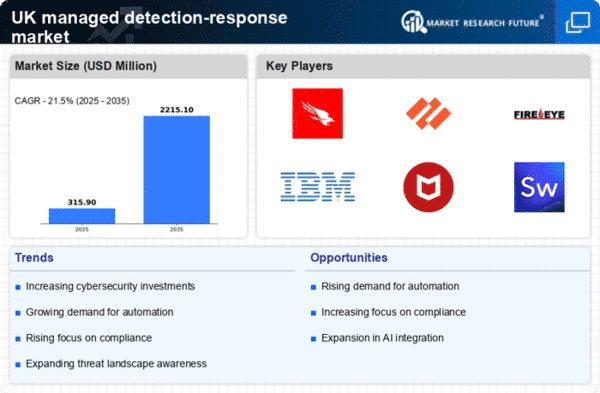
As per Market Research Future analysis, the UK managed detection-response market Size was estimated at 260.0 USD Million in 2024. The UK managed detection-response market is projected to grow from 315.9 USD Million in 2025 to 2215.1 USD Million by 2035, exhibiting a compound annual growth rate (CAGR) of 21% during the forecast period 2025 - 2035

Key Market Trends & Highlights

The UK managed detection-response market is experiencing robust growth driven by evolving security needs and technological advancements.

  • The demand for proactive security solutions is increasing as organizations seek to mitigate risks before they escalate.
  • Integration of advanced technologies, such as AI and machine learning, is becoming a focal point for enhancing detection capabilities.
  • Regulatory compliance is driving organizations to adopt managed detection-response services to meet stringent requirements.
  • The rising cyber threat landscape and increased regulatory pressures are key drivers propelling market growth.

Market Size & Forecast

2024 Market Size 260.0 (USD Million)
2035 Market Size 2215.1 (USD Million)
CAGR (2025 - 2035) 21.5%

Major Players

CrowdStrike (US), Palo Alto Networks (US), FireEye (US), IBM (US), McAfee (US), Secureworks (US), Rapid7 (US), Sumo Logic (US)

Our Impact
Enabled $4.3B Revenue Impact for Fortune 500 and Leading Multinationals
Partnering with 2000+ Global Organizations Each Year
30K+ Citations by Top-Tier Firms in the Industry

UK Managed Detection Response Market Trends

The managed detection-response market is currently experiencing a notable evolution, driven by the increasing complexity of cyber threats and the growing need for organizations to enhance their security posture. As businesses become more reliant on digital infrastructure, the demand for advanced security solutions has surged. This market is characterized by a shift towards proactive threat detection and response strategies, which are essential for mitigating risks associated with cyber incidents. Organizations are increasingly recognizing the importance of integrating managed services into their security frameworks, leading to a more collaborative approach between service providers and clients. In addition, the managed detection-response market is witnessing a rise in the adoption of artificial intelligence and machine learning technologies. These innovations are enabling more efficient threat detection and response capabilities, allowing organizations to stay ahead of potential attacks. Furthermore, regulatory compliance requirements are pushing businesses to invest in robust security measures, thereby fueling market growth. As the landscape continues to evolve, it appears that the managed detection-response market will play a crucial role in shaping the future of cybersecurity in the UK, fostering resilience against emerging threats.

Increased Demand for Proactive Security Solutions

Organizations are increasingly seeking proactive security measures to address the evolving threat landscape. This trend reflects a shift from traditional reactive approaches to more dynamic strategies that emphasize early detection and rapid response.

Integration of Advanced Technologies

The incorporation of artificial intelligence and machine learning into security operations is becoming more prevalent. These technologies enhance the ability to identify and respond to threats in real-time, improving overall security effectiveness.

Focus on Regulatory Compliance

As regulatory frameworks become more stringent, businesses are prioritizing compliance in their security strategies. This focus drives investment in managed detection-response services to ensure adherence to legal and industry standards.

UK Managed Detection Response Market Drivers

Rising Cyber Threat Landscape

The managed detection-response market is experiencing growth due to the escalating cyber threat landscape in the UK. With cyberattacks becoming increasingly sophisticated, businesses are compelled to adopt advanced security measures. Reports indicate that cybercrime costs the UK economy approximately £27 billion annually, highlighting the urgent need for effective detection and response solutions. As organizations face threats from ransomware, phishing, and other malicious activities, the demand for managed detection-response services is likely to surge. This trend suggests that companies are prioritizing cybersecurity investments to safeguard their assets and maintain customer trust. Consequently, the managed detection-response market is positioned to expand as firms seek to mitigate risks associated with cyber threats.

Increased Regulatory Pressures

The managed detection-response market is influenced by heightened regulatory pressures in the UK. Organizations are required to comply with various data protection regulations, such as the General Data Protection Regulation (GDPR) and the Data Protection Act 2018. Non-compliance can result in substantial fines, reaching up to £17.5 million or 4% of annual global turnover, whichever is higher. As a result, businesses are increasingly turning to managed detection-response services to ensure compliance and protect sensitive data. This trend indicates a growing recognition of the importance of robust cybersecurity measures in meeting regulatory requirements. The managed detection-response market is likely to benefit from this shift as companies seek to enhance their security posture and avoid potential penalties.

Shift Towards Cloud-Based Solutions

The managed detection-response market is witnessing a shift towards cloud-based solutions, driven by the increasing adoption of cloud technologies in the UK. As organizations migrate their operations to the cloud, they require specialized security services to protect their cloud environments. The cloud security market is projected to grow at a CAGR of 15% from 2025 to 2030, indicating a strong demand for managed detection-response services tailored for cloud infrastructures. This trend suggests that businesses are recognizing the need for comprehensive security strategies that encompass both on-premises and cloud environments. Consequently, the managed detection-response market is likely to expand as providers develop solutions that address the unique challenges associated with cloud security.

Emergence of Advanced Analytics and AI

The managed detection-response market is being shaped by the emergence of advanced analytics and artificial intelligence (AI) technologies. These innovations enable organizations to detect and respond to threats more effectively and efficiently. AI-driven solutions can analyze vast amounts of data in real-time, identifying patterns and anomalies that may indicate a security breach. The integration of AI in managed detection-response services is expected to enhance threat detection capabilities, potentially reducing response times by up to 50%. This trend indicates that businesses are increasingly seeking solutions that leverage cutting-edge technologies to improve their cybersecurity posture. As a result, the managed detection-response market is likely to experience growth as providers incorporate advanced analytics and AI into their offerings.

Growing Awareness of Cybersecurity Risks

The managed detection-response market is benefiting from a growing awareness of cybersecurity risks among UK businesses. As high-profile data breaches and cyber incidents make headlines, organizations are becoming more cognizant of the potential consequences of inadequate security measures. This heightened awareness is prompting companies to invest in managed detection-response services to enhance their security capabilities. Surveys indicate that approximately 60% of UK businesses consider cybersecurity a top priority, reflecting a shift in mindset towards proactive security measures. This trend suggests that the managed detection-response market is likely to see increased demand as organizations seek to bolster their defenses against evolving cyber threats.


Market Segment Insights

By Service Type: Incident Management (Largest) vs. Vulnerability Management (Fastest-Growing)

In the UK managed detection-response market, service type distribution reflects an evolving landscape where Incident Management holds a significant share due to its critical role in addressing security incidents. Following closely are Monitoring Services and Threat Intelligence, which are vital in proactive threat detection and intelligence gathering. Vulnerability Management, while smaller in share, is rapidly gaining traction as organizations prioritize risk assessments and vulnerability remediation strategies. Growth trends indicate a substantial shift towards Vulnerability Management as organizations seek to bolster their security frameworks amidst increasing cyber threats. This segment's focus on proactive measures and adherence to compliance standards is driving its expansion. Additionally, advancements in automated vulnerability scanning and patch management tools are propelling its growth, making it a key player in the overall service offerings within the UK managed detection-response market.

Incident Management: Dominant vs. Vulnerability Management: Emerging

Incident Management is the dominant force in the UK managed detection-response market, characterized by its comprehensive approach to managing and responding to security incidents. It encompasses detection, analysis, and mitigation strategies, ensuring that organizations can swiftly address threats and minimize damage. In contrast, Vulnerability Management is emerging as a critical component as businesses understand the need to identify and remediate vulnerabilities before they can be exploited. Its growth is accelerated by technological advancements and increased awareness of cybersecurity risks, making it an essential service that complements existing incident response strategies.

By Deployment Type: Cloud-based (Largest) vs. On-premises (Fastest-Growing)

Cloud-based solutions dominate the deployment type segment in the UK managed detection-response market, capturing a significant portion of overall market share. This dominance is driven by the increasing attractiveness of cloud solutions, which offer scalability, flexibility, and cost efficiency to businesses. Cloud-based deployments are particularly appealing to small and medium-sized enterprises that require robust security solutions without heavy upfront investments. On-premises solutions, while a smaller segment, are gaining traction as organizations prioritize data sovereignty and enhanced control over their security frameworks, leading to a gradual increase in their adoption. The growth trends within the deployment type segment reveal a dynamic shift towards cloud-based deployments, primarily fueled by the rising prevalence of remote work and the adoption of digital transformation initiatives across various sectors. Meanwhile, on-premises solutions are witnessing a resurgence as enterprises look to minimize risks associated with data breaches and ensure compliance with regulatory requirements. The continuous evolution of hybrid security models, which integrate both cloud and on-premises solutions, further illustrates the adaptive nature of organizations in response to changing threat landscapes and operational needs.

Cloud-based (Dominant) vs. On-premises (Emerging)

In the UK managed detection-response market, cloud-based deployment is characterized by its leading position, offering unparalleled flexibility and scalability that appeals to a broad range of businesses. Organizations benefit from lower infrastructure costs and the ability to rapidly deploy security measures without extensive hardware investments. Conversely, on-premises solutions are emerging as a preferred choice for enterprises seeking heightened security control and compliance, particularly within regulated industries. This segment appeals to larger organizations that require customizable security measures tailored to specific operational needs. As regulatory pressures increase, the on-premises solutions are becoming more attractive, but it is the cloud-based deployments that currently dominate due to their modern capabilities and adaptability.

By End User: Small and Medium Enterprises (Largest) vs. Large Enterprises (Fastest-Growing)

In the UK managed detection-response market, Small and Medium Enterprises (SMEs) hold a significant market share, driven by their increasing adoption of advanced security solutions. These businesses recognize the critical need for robust cyber defenses and have been prioritizing investments in detection and response capabilities to protect their operations. In contrast, Large Enterprises, while also substantial players, are currently experiencing the fastest growth in demand as they face heightened threats from sophisticated cyberattacks, prompting increased budget allocation for managed detection and response services. The growth trends in this segment are being fueled by several factors, including the rising incidence of cyber threats and the complexity of security challenges faced by organizations of all sizes. Government Agencies and Financial Institutions are also contributing to market dynamics, as regulatory pressures and compliance requirements push these entities to seek specialized managed detection solutions. As such, the focus on cybersecurity continues to drive innovation and investments, with SMEs leading in market presence and Large Enterprises swiftly catching up in growth pace.

Small and Medium Enterprises (Dominant) vs. Large Enterprises (Emerging)

Small and Medium Enterprises (SMEs) represent a dominant force in the UK managed detection-response market, characterized by their agility and willingness to adopt innovative security measures against evolving cyber threats. With limited resources, SMEs tend to leverage managed services to enhance their security postures while minimizing operational complexities. On the other hand, Large Enterprises are emerging as formidable players, increasingly recognizing the necessity for advanced detection and response strategies amidst a growing landscape of cyber risks. These enterprises typically have larger IT budgets, enabling them to invest more heavily in cutting-edge technologies and services, reflecting a shift towards proactive security measures that complement their expansive operations. Together, these segments create a dynamic landscape, propelling the overall market forward.
By Industry Vertical: Healthcare (Largest) vs. Retail (Fastest-Growing)

In the UK managed detection-response market, the distribution of market share among different industry verticals reveals significant insights. Healthcare emerges as the largest segment, driven by the critical need for robust cybersecurity due to the sensitive nature of patient data. Retail also holds a substantial share but showcases a more dynamic growth trajectory, influenced by the increasing threat landscape, especially in e-commerce environments. The growth trends for these segments indicate a rising awareness and prioritization of cybersecurity measures. The healthcare sector's growth is largely propelled by regulatory requirements and the necessity to protect patient information, whereas the retail sector's expansion is fueled by the boom in online shopping and the integration of digital technologies. Overall, both sectors are witnessing enhanced investments in managed detection and response solutions to mitigate risks.

Healthcare: Dominant vs. Retail: Emerging

The healthcare segment stands as a dominant force in the managed detection-response landscape, characterized by its stringent compliance requirements and high-stakes environment where data breaches can have dire consequences. This sector focuses on comprehensive security protocols to safeguard sensitive health information against cyber threats. On the other hand, retail is an emerging segment that demonstrates rapid growth due to the surge in online transactions and digital customer interactions. Retailers are increasingly adopting advanced detection-response solutions to address the vulnerabilities inherent in their operations, especially as consumer expectations for seamless and secure shopping experiences rise. Both segments play crucial roles in shaping the dynamics of the managed detection-response market.

Get more detailed insights about UK Managed Detection Response Market

Key Players and Competitive Insights

The managed detection-response market is currently characterized by a dynamic competitive landscape, driven by the increasing demand for advanced cybersecurity solutions. Key players are actively engaging in strategies that emphasize innovation, partnerships, and regional expansion to enhance their market presence. For instance, CrowdStrike (US) has positioned itself as a leader through its cloud-native platform, focusing on AI-driven threat detection and response capabilities. Similarly, Palo Alto Networks (US) is leveraging its extensive portfolio of security solutions to integrate advanced analytics and machine learning, thereby enhancing its operational focus on proactive threat management. These strategies collectively shape a competitive environment that is increasingly reliant on technological advancements and strategic collaborations.In terms of business tactics, companies are increasingly localizing their operations to better serve regional markets, optimizing supply chains to enhance efficiency and responsiveness. The market structure appears moderately fragmented, with several key players exerting influence over various segments. This fragmentation allows for a diverse range of offerings, yet the collective impact of major companies like FireEye (US) and IBM (US) is significant, as they continue to innovate and expand their service capabilities.

In October FireEye (US) announced a strategic partnership with a leading cloud service provider to enhance its managed detection-response offerings. This collaboration is expected to bolster FireEye's capabilities in threat intelligence and incident response, allowing it to deliver more comprehensive solutions to its clients. The strategic importance of this partnership lies in its potential to leverage cloud infrastructure, thereby improving scalability and responsiveness to emerging threats.

In September IBM (US) unveiled a new AI-driven security platform aimed at automating threat detection and response processes. This initiative reflects IBM's commitment to integrating cutting-edge technology into its service offerings, positioning the company to better address the evolving cybersecurity landscape. The strategic significance of this development is underscored by the growing need for organizations to adopt automated solutions that can efficiently manage complex security environments.

In August McAfee (US) expanded its managed detection-response services by acquiring a cybersecurity analytics firm. This acquisition is likely to enhance McAfee's analytical capabilities, enabling it to provide more robust threat detection and response services. The strategic move indicates a trend towards consolidation in the market, as companies seek to bolster their technological capabilities through acquisitions.

As of November the competitive trends in the managed detection-response market are increasingly defined by digitalization, AI integration, and a focus on sustainability. Strategic alliances are playing a crucial role in shaping the current landscape, as companies collaborate to enhance their service offerings and technological capabilities. Looking ahead, competitive differentiation is expected to evolve, with a shift from price-based competition towards innovation, technology, and supply chain reliability. This transition suggests that companies that prioritize technological advancements and strategic partnerships will likely emerge as leaders in the market.

Key Companies in the UK Managed Detection Response Market include

Industry Developments

Sophos has developed a distinctive MDR service that is capable of absorbing telemetry from third-party security tools, such as identity, firewall, endpoint, and cloud sources. This capability enables accelerated threat detection and response. Within six months of its debut, its customer base expanded by 33%, with the assistance of a specialized team of MDR analysts in Germany who assisted European clients in relocating to the United Kingdom.In the 2024 IDC MarketScape for European MDR Services, Sophos was acknowledged as a Leader. 

The company was commended for its human-led incident response, unlimited IR offering, and compliance with UK/EU data residency requirements, which serves as a strong trust signal for UK adoption.Darktrace has launched its Managed Detection & Response service, which combines its self-learning AI-powered detection platform with 24/7 global analyst support to assist UK enterprises in containing advanced threats through real-time visibility and human-led triage.

Future Outlook

UK Managed Detection Response Market Future Outlook

The Managed Detection Response Market is projected to grow at a 21.5% CAGR from 2025 to 2035, driven by increasing cyber threats and demand for advanced security solutions.

New opportunities lie in:

  • Development of AI-driven threat detection algorithms
  • Expansion of subscription-based service models
  • Integration of managed detection with cloud security solutions

By 2035, the market is expected to achieve substantial growth, positioning itself as a leader in cybersecurity solutions.

Market Segmentation

UK Managed Detection Response Market End User Outlook

  • Small and Medium Enterprises
  • Large Enterprises
  • Government Agencies
  • Financial Institutions

UK Managed Detection Response Market Service Type Outlook

  • Threat Intelligence
  • Incident Management
  • Monitoring Services
  • Vulnerability Management

UK Managed Detection Response Market Deployment Type Outlook

  • Cloud-based
  • On-premises

UK Managed Detection Response Market Industry Vertical Outlook

  • Healthcare
  • Retail
  • Manufacturing
  • Telecommunications
  • Information Technology

Report Scope

MARKET SIZE 2024 260.0(USD Million)
MARKET SIZE 2025 315.9(USD Million)
MARKET SIZE 2035 2215.1(USD Million)
COMPOUND ANNUAL GROWTH RATE (CAGR) 21.5% (2025 - 2035)
REPORT COVERAGE Revenue Forecast, Competitive Landscape, Growth Factors, and Trends
BASE YEAR 2024
Market Forecast Period 2025 - 2035
Historical Data 2019 - 2024
Market Forecast Units USD Million
Key Companies Profiled CrowdStrike (US), Palo Alto Networks (US), FireEye (US), IBM (US), McAfee (US), Secureworks (US), Rapid7 (US), Sumo Logic (US)
Segments Covered Service Type, Deployment Type, End User, Industry Vertical
Key Market Opportunities Integration of artificial intelligence enhances threat detection in the managed detection-response market.
Key Market Dynamics Rising demand for advanced threat detection solutions drives innovation and competition in the managed detection-response market.
Countries Covered UK
Leave a Comment

FAQs

What is the expected market size of the UK Managed Detection Response Market in 2024?

The UK Managed Detection Response Market is expected to be valued at 167.5 million USD in 2024.

What is the projected market growth rate for the UK Managed Detection Response Market from 2025 to 2035?

The market is expected to experience a compound annual growth rate (CAGR) of 13.884 percent from 2025 to 2035.

How much will the UK Managed Detection Response Market be worth by 2035?

By 2035, the UK Managed Detection Response Market is projected to reach a value of 700.0 million USD.

Which service type is projected to have the highest market value in 2035 within the UK Managed Detection Response Market?

Monitoring Services is projected to have the highest market value at 220.0 million USD in 2035.

What is the estimated market value for Threat Intelligence in the UK Managed Detection Response Market in 2024?

Threat Intelligence is estimated to have a market value of 25.0 million USD in 2024.

What is the expected market size for Incident Management in the UK Managed Detection Response Market by 2035?

Incident Management is expected to reach a market size of 150.0 million USD by 2035.

Who are the key players in the UK Managed Detection Response Market?

Major players include Sophos, AT&T Cybersecurity, Cisco, CrowdStrike, and Palo Alto Networks.

What is the market value for Vulnerability Management in the UK Managed Detection Response Market in 2024?

The market value for Vulnerability Management is anticipated to be 57.5 million USD in 2024.

What are the opportunities driving growth in the UK Managed Detection Response Market?

Increased cyber threats and the need for enhanced security measures are key growth drivers.

What challenges might impact the growth of the UK Managed Detection Response Market?

Challenges include the rising sophistication of cyber threats and the shortage of skilled security professionals.

Download Free Sample

Kindly complete the form below to receive a free sample of this Report

Compare Licence

×
Features License Type
Single User Multiuser License Enterprise User
Price $4,950 $5,950 $7,250
Maximum User Access Limit 1 User Upto 10 Users Unrestricted Access Throughout the Organization
Free Customization
Direct Access to Analyst
Deliverable Format
Platform Access
Discount on Next Purchase 10% 15% 15%
Printable Versions