×
Request Free Sample ×

Kindly complete the form below to receive a free sample of this Report

* Please use a valid business email

Leading companies partner with us for data-driven Insights

clients tt-cursor
Hero Background

UK Denim Market

ID: MRFR/CG/44653-HCR
128 Pages
Pradeep Nandi
February 2026

UK Denim Market Size, Share, Industry Trend & Analysis Research Report: By Distribution Channel (Online, Offline) and By End User (Men, Women, Children)- Forecast to 2035

Share:
Download PDF ×

We do not share your information with anyone. However, we may send you emails based on your report interest from time to time. You may contact us at any time to opt-out.

UK Denim Market Infographic
Purchase Options

UK Denim Market Summary

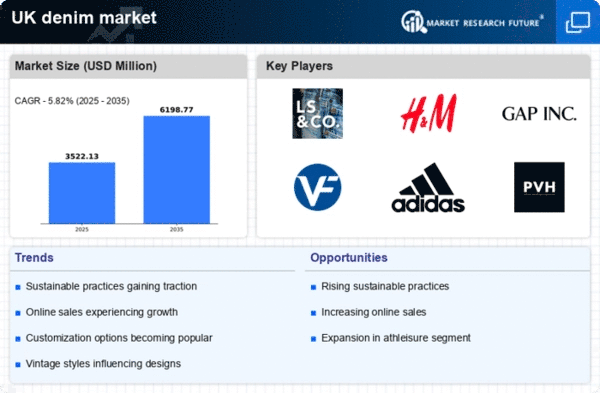
As per Market Research Future analysis, the UK denim market Size was estimated at 3328.42 USD Million in 2024. The UK denim market is projected to grow from 3522.13 USD Million in 2025 to 6198.77 USD Million by 2035, exhibiting a compound annual growth rate (CAGR) of 5.8% during the forecast period 2025 - 2035

Key Market Trends & Highlights

The UK denim market is experiencing a shift towards sustainability and technological innovation.

  • Sustainability initiatives are becoming increasingly prominent, reflecting a broader consumer demand for ethical production practices.
  • The largest segment in the UK denim market is casual wear, while the fastest-growing segment is activewear, driven by changing lifestyle preferences.
  • Technological advancements in manufacturing are enhancing product quality and efficiency, contributing to market growth.
  • Evolving consumer preferences and the rise of e-commerce are key drivers influencing the UK denim market's trajectory.

Market Size & Forecast

2024 Market Size 3328.42 (USD Million)
2035 Market Size 6198.77 (USD Million)
CAGR (2025 - 2035) 5.82%

Major Players

Levi Strauss & Co (US), H&M (SE), Gap Inc (US), VF Corporation (US), Adidas AG (DE), PVH Corp (US), American Eagle Outfitters (US), Diesel S.p.A. (IT)

Our Impact
Enabled $4.3B Revenue Impact for Fortune 500 and Leading Multinationals
Partnering with 2000+ Global Organizations Each Year
30K+ Citations by Top-Tier Firms in the Industry

UK Denim Market Trends

The denim market in the UK is currently experiencing a dynamic transformation, driven by evolving consumer preferences and sustainability concerns. As individuals increasingly prioritize eco-friendly practices, brands are adapting their production methods to incorporate sustainable materials and processes. This shift not only reflects a growing awareness of environmental issues but also aligns with the values of a significant segment of the consumer base. Consequently, companies are investing in innovative technologies to enhance the durability and lifespan of denim products, which may lead to a more responsible consumption pattern. Moreover, the denim market is witnessing a rise in demand for diverse styles and fits, catering to a broader audience. This trend indicates a departure from traditional silhouettes, as consumers seek personalized options that resonate with their individual identities. Retailers are responding by expanding their offerings, which could potentially enhance customer engagement and loyalty. The interplay between sustainability and style appears to be shaping the future of the denim market, suggesting a promising outlook for brands that can effectively navigate these changes.

Sustainability Initiatives

Brands are increasingly adopting sustainable practices in their production processes. This includes using organic cotton, recycled materials, and eco-friendly dyes. Such initiatives not only appeal to environmentally conscious consumers but also help reduce the overall carbon footprint of denim manufacturing.

Diverse Product Offerings

There is a noticeable shift towards a wider variety of styles and fits in the denim market. Consumers are seeking unique designs that reflect their personal style, prompting brands to diversify their collections. This trend may enhance customer satisfaction and brand loyalty.

Technological Advancements

Innovations in fabric technology are becoming more prevalent, with brands exploring new materials that offer enhanced durability and comfort. These advancements could lead to longer-lasting products, aligning with consumer desires for quality and sustainability.

UK Denim Market Drivers

Rise of E-commerce

The expansion of e-commerce platforms has significantly impacted the denim market in the UK. With online shopping becoming increasingly popular, brands are investing in their digital presence to reach a broader audience. The convenience of online shopping has led to a surge in sales, with e-commerce accounting for nearly 30% of total apparel sales in the UK. This shift presents both challenges and opportunities for the denim market, as brands must enhance their online offerings and customer experience to capture this growing segment. The ability to leverage data analytics for targeted marketing could further bolster sales in this competitive landscape.

Influence of Fashion Trends

Fashion trends play a pivotal role in shaping the denim market in the UK. The cyclical nature of fashion means that styles such as high-waisted jeans, distressed denim, and wide-leg cuts frequently resurface, influencing consumer purchasing behavior. The denim market must remain agile to adapt to these trends, as failure to do so could result in lost market share. Recent data suggests that the popularity of vintage and retro styles has led to a 20% increase in sales for brands that effectively incorporate these elements into their collections. Staying attuned to fashion trends is essential for brands aiming to capture the attention of style-conscious consumers.

Evolving Consumer Preferences

The denim market in the UK is currently experiencing a shift in consumer preferences, with a growing inclination towards casual and comfortable clothing. This trend is reflected in the increasing demand for relaxed-fit jeans and sustainable denim options. As consumers become more conscious of their purchasing decisions, brands that align with these preferences are likely to thrive. The market data indicates that the casual wear segment has seen a growth of approximately 15% in the last year, suggesting a robust opportunity for brands to innovate and cater to this evolving demand. The denim market must adapt to these changing preferences to remain competitive.

Sustainability and Ethical Production

Sustainability has emerged as a critical driver in the denim market in the UK, with consumers increasingly prioritizing ethical production practices. Brands that adopt sustainable practices, such as using organic cotton and reducing water consumption, are likely to resonate with environmentally conscious shoppers. The denim market is witnessing a rise in certifications and transparency initiatives, which are becoming essential for brand credibility. Recent surveys indicate that approximately 70% of consumers are willing to pay a premium for sustainably produced denim. This trend underscores the importance of integrating sustainability into business models to meet consumer expectations and enhance brand loyalty.

Technological Innovations in Manufacturing

Technological advancements in manufacturing processes are transforming the denim market in the UK. Innovations such as laser technology and waterless dyeing techniques are not only improving efficiency but also reducing environmental impact. These technologies enable brands to produce high-quality denim while minimizing waste and resource consumption. The denim market is likely to benefit from these advancements, as they can lead to cost savings and improved product quality. Furthermore, brands that adopt these technologies may gain a competitive edge by appealing to consumers who value sustainability and innovation. The integration of technology into production processes is becoming increasingly vital for success in this dynamic market.


Market Segment Insights

By Fabric Type: Cotton Denim (Largest) vs. Stretch Denim (Fastest-Growing)

In the UK denim market, Cotton Denim remains the dominant fabric type, holding a significant share due to its comfort and durability. Stretch Denim is catching up as it appeals to a growing segment of consumers who prioritize flexibility and style, contributing to a vibrant distribution across various demographics. The growth trends in the fabric type segment indicate a rising preference for sustainable and innovative materials. Stretch Denim is witnessing rapid growth, driven by changing consumer lifestyles and fashion trends that favor comfort. Emerging segments like Recycled and Organic Denim are also gaining traction as consumers become more environmentally conscious, although they currently hold a smaller market share compared to the more established Cotton and Stretch Denims.

Cotton Denim (Dominant) vs. Recycled Denim (Emerging)

Cotton Denim stands out as the dominant fabric in the UK denim market, characterized by its natural fibers that offer breathability and comfort, making it a staple in many wardrobes. Its extensive use in traditional and contemporary styles ensures its ongoing popularity. On the other hand, Recycled Denim is emerging as a noteworthy alternative, appealing to eco-conscious consumers. This segment emphasizes sustainability, utilizing post-consumer waste to create new denim products, thus attracting a niche customer base that prioritizes environmental responsibility. Although still growing, Recycled Denim holds considerable potential in reshaping consumer behavior towards sustainable fashion.

By Product Type: Jeans (Largest) vs. Jackets (Fastest-Growing)

In the UK denim market, jeans hold the largest share of the product type segment, accounting for a significant portion of overall sales. Meanwhile, jackets are emerging as a notable category, capturing an increasing part of the market as consumer preferences shift towards versatile and stylish outerwear. The growth of jackets is fueled by changing fashion trends and increased demand for sustainable options. Many brands are innovating with eco-friendly materials, appealing to a growing base of environmentally-conscious consumers. This trend is expected to continue, driving further growth in this segment, while jeans maintain their dominant position through enduring popularity and versatility in everyday wear.

Jeans (Dominant) vs. Jackets (Emerging)

Jeans are established as the dominant product type within the UK denim market, recognized for their durability and classic appeal. They are available in various styles and fits, catering to a wide audience ranging from casual wearers to fashion enthusiasts. On the other hand, jackets represent an emerging segment, capturing the interest of fashion-forward consumers looking for stylish layering options. The appeal of jackets lies in their adaptability for both casual and formal occasions, thus expanding their market appeal. Brands are increasingly focusing on innovative designs and sustainable practices, enhancing the attractiveness of jackets in the competitive landscape.

By End Use: Men (Largest) vs. Kids (Fastest-Growing)

In the UK denim market, the distribution of market share among the end-use segments reveals that the men’s denim segment holds the largest share, reflecting the consistent demand for denim apparel among male consumers. The women’s segment follows closely, capitalizing on evolving fashion trends and preferences. Meanwhile, the kids’ segment is emerging rapidly, reflecting an increased interest from parents in stylish and durable denim options for children, which is driving growth in this area. Growth trends indicate that the men’s denim segment continues to be robust due to sustained consumer loyalty and a broad range of product offerings. The women’s segment is expected to grow due to a focus on sustainability and innovative designs. Notably, the kids’ denim segment is the fastest-growing, driven by trends in children’s fashion and an expanding range of options tailored to young consumers.

Men: Dominant vs. Kids: Emerging

The men’s denim segment is characterized by its robust selection of classic and contemporary styles, meeting the diverse needs of male consumers. This segment benefits from established brand loyalty and a wide variety of products, including jeans, jackets, and casual wear, which cater to different lifestyles and occasions. In contrast, the kids’ denim segment is emerging rapidly, characterized by playful designs and enhanced durability to withstand the active lifestyle of children. Brands are increasingly focusing on creating trendy denim options that appeal to both parents and kids, making this segment not only a responsive niche but also a significant growth driver in the UK denim market.

By Distribution Channel: Online (Largest) vs. Offline (Fastest-Growing)

In the UK denim market, the distribution of sales across channels reveals a significant dominance of online sales, capturing the largest market share. The convenience of e-commerce and the growing trend of consumers preferring to shop from home have solidified online as a leading channel. Offline channels, particularly those with a strong in-store experience, still play a crucial role, but their market share is gradually declining compared to their online counterparts. As the market evolves, the offline channel is experiencing growth fueled by a resurgence in consumer interest for in-store shopping experiences. Factors contributing to this trend include social interactions, personalized shopping services, and exclusive in-store promotions. The offline segment, especially department stores, is adapting by integrating online strategies, making it a dynamic and responsive channel within the UK denim market.

Online (Dominant) vs. Offline (Emerging)

Online distribution stands out as the dominant channel in the UK denim market, characterized by broad reach and accessibility, allowing consumers to explore a vast range of products from various brands. This segment's growth is driven by technological advancements, such as improved mobile shopping experiences and personalized recommendations, which enhance customer engagement. Conversely, the offline distribution channel, particularly department stores, represents an emerging segment. While traditionally strong, it faces challenges from online growth. However, department stores are uniquely positioned to provide exclusive in-store experiences, emerging as a preferred destination for consumers seeking immediate gratification and hands-on product interactions. The convergence of both channels signifies a developing landscape where each complements the other.

Get more detailed insights about UK Denim Market

Key Players and Competitive Insights

The UK denim market exhibits a dynamic competitive landscape characterized by a blend of established brands and emerging players. Key growth drivers include a rising consumer preference for sustainable fashion, digital transformation, and the increasing demand for personalized products. Major companies such as Levi Strauss & Co (US), H&M (SE), and VF Corporation (US) are strategically positioned to leverage these trends. Levi Strauss & Co (US) focuses on innovation in sustainable materials, while H&M (SE) emphasizes its commitment to circular fashion. VF Corporation (US) is enhancing its digital capabilities to improve customer engagement, collectively shaping a competitive environment that prioritizes sustainability and technological advancement.In terms of business tactics, companies are increasingly localizing manufacturing to reduce lead times and enhance supply chain resilience. The market structure appears moderately fragmented, with several key players exerting influence through strategic partnerships and collaborations. This fragmentation allows for niche brands to thrive alongside larger corporations, fostering a diverse range of offerings that cater to varying consumer preferences.

In October Levi Strauss & Co (US) announced a partnership with a leading sustainable fabric manufacturer to develop a new line of eco-friendly denim. This strategic move underscores the company's commitment to sustainability and positions it favorably in a market increasingly driven by environmentally conscious consumers. By integrating sustainable practices into its product development, Levi Strauss & Co (US) aims to enhance brand loyalty and attract a broader customer base.

In September H&M (SE) launched a digital platform aimed at enhancing customer experience through personalized shopping recommendations. This initiative reflects the company's focus on digital transformation and its efforts to engage consumers in a more meaningful way. By leveraging data analytics, H&M (SE) seeks to tailor its offerings to individual preferences, potentially increasing conversion rates and customer satisfaction.

In August VF Corporation (US) expanded its e-commerce capabilities by acquiring a technology startup specializing in AI-driven supply chain solutions. This acquisition is likely to enhance VF Corporation's operational efficiency and responsiveness to market demands. By integrating advanced technologies into its supply chain, the company aims to streamline operations and improve inventory management, which could lead to cost savings and increased profitability.

As of November current competitive trends in the UK denim market are heavily influenced by digitalization, sustainability, and the integration of AI technologies. Strategic alliances are becoming increasingly important, as companies collaborate to enhance their product offerings and operational efficiencies. Looking ahead, competitive differentiation is expected to evolve, shifting from price-based competition to a focus on innovation, technology, and supply chain reliability. This transition may redefine market dynamics, compelling brands to invest in sustainable practices and advanced technologies to maintain a competitive edge.

Key Companies in the UK Denim Market include

Industry Developments

Recent developments in the UK Denim Market have been marked by ongoing innovation and evolving consumer preferences. Companies like Mango and Primark are increasingly focusing on sustainable manufacturing practices in response to growing environmental concerns. River Island and Superdry continue to enhance their online retail platforms to cater to shifting shopping behaviors influenced by the pandemic. In terms of market valuation, UK denim brands have seen a noticeable improvement post-pandemic, with VF Corporation reporting a strong recovery in sales figures by mid-2023, while Next experienced an uptick in its denim product lines.

Mergers and acquisitions have been under scrutiny, with Zara parent company Inditex, announcing a partnership with Levi Strauss and Co. in April 2023 to collaborate on sustainable denim initiatives. Additionally, reports suggest that Boohoo Group's growth strategy may involve potential acquisition targets in the denim sector as part of its expansion plans. Major happenings over the past few years include the prominent shift towards ethical fashion practices initiated in early 2021, influencing consumer choices and company strategies across the market, emphasizing the significance of sustainability in the UK Denim Market.

Future Outlook

UK Denim Market Future Outlook

The Denim Market in the UK is projected to grow at a 5.82% CAGR from 2025 to 2035, driven by sustainability trends, technological advancements, and evolving consumer preferences.

New opportunities lie in:

  • Expansion of eco-friendly denim production methods
  • Investment in smart textile technologies for enhanced functionality
  • Development of direct-to-consumer online sales platforms

By 2035, the denim market is expected to achieve robust growth, reflecting evolving consumer demands and innovative practices.

Market Segmentation

UK Denim Market End Use Outlook

  • Men
  • Women
  • Kids

UK Denim Market Fabric Type Outlook

  • Cotton Denim
  • Stretch Denim
  • Recycled Denim
  • Organic Denim

UK Denim Market Product Type Outlook

  • Jeans
  • Jackets
  • Shirts
  • Skirts

UK Denim Market Distribution Channel Outlook

  • Online
  • Offline
  • Department Stores

Report Scope

MARKET SIZE 2024 3328.42(USD Million)
MARKET SIZE 2025 3522.13(USD Million)
MARKET SIZE 2035 6198.77(USD Million)
COMPOUND ANNUAL GROWTH RATE (CAGR) 5.82% (2025 - 2035)
REPORT COVERAGE Revenue Forecast, Competitive Landscape, Growth Factors, and Trends
BASE YEAR 2024
Market Forecast Period 2025 - 2035
Historical Data 2019 - 2024
Market Forecast Units USD Million
Key Companies Profiled Levi Strauss & Co (US), H&M (SE), Gap Inc (US), VF Corporation (US), Adidas AG (DE), PVH Corp (US), American Eagle Outfitters (US), Diesel S.p.A. (IT)
Segments Covered Fabric Type, Product Type, End Use, Distribution Channel
Key Market Opportunities Growing demand for sustainable and eco-friendly denim production methods presents a key opportunity.
Key Market Dynamics Shifting consumer preferences towards sustainable denim products drive innovation and competition in the UK market.
Countries Covered UK
Leave a Comment

FAQs

What is the market size of the UK Denim Market in 2024?

The UK Denim Market is expected to be valued at 3.5 billion USD in 2024.

What will be the projected market size of the UK Denim Market by 2035?

By 2035, the UK Denim Market is projected to reach a value of 6.1 billion USD.

What is the expected compound annual growth rate (CAGR) for the UK Denim Market from 2025 to 2035?

The expected CAGR for the UK Denim Market from 2025 to 2035 is 5.18 percent.

Which distribution channel is expected to dominate the UK Denim Market by 2035?

The offline distribution channel is expected to dominate, with an estimated value of 3.4 billion USD by 2035.

How much is the online segment of the UK Denim Market expected to be valued at in 2035?

The online segment of the UK Denim Market is expected to reach 2.7 billion USD in 2035.

Who are the major players in the UK Denim Market?

Some of the major players in the UK Denim Market include Mango, River Island, Jack and Jones, Primark, and Levi Strauss and Co.

What are some key growth drivers for the UK Denim Market?

Key growth drivers include rising consumer preferences for denim, increased online shopping, and evolving fashion trends.

What challenges does the UK Denim Market face in the coming years?

Challenges include intense competition among key players and fluctuating raw material prices impacting profitability.

What are the expected market trends for the UK Denim Market by 2025?

Expected trends include sustainability in denim production and a shift towards more casual wear among consumers.

How has the global economic scenario impacted the UK Denim Market recently?

The global economic situation has led to changes in consumer spending patterns and supply chain dynamics affecting the market.

Download Free Sample

Kindly complete the form below to receive a free sample of this Report

Compare Licence

×
Features License Type
Single User Multiuser License Enterprise User
Price $4,950 $5,950 $7,250
Maximum User Access Limit 1 User Upto 10 Users Unrestricted Access Throughout the Organization
Free Customization
Direct Access to Analyst
Deliverable Format
Platform Access
Discount on Next Purchase 10% 15% 15%
Printable Versions