×
Request Free Sample ×

Kindly complete the form below to receive a free sample of this Report

* Please use a valid business email

Leading companies partner with us for data-driven Insights

clients tt-cursor
Hero Background

UK Betaine Market

ID: MRFR/FnB/47140-HCR
128 Pages
Snehal Singh
February 2026

UK Betaine Market Size, Share, Industry Trend & Analysis Research Report By Type (Cocamidopropyl Betaine, Betaine Anhydrous, Others), By Category (Natural, Synthetic) and By Application (Personal Care, Animal Feed, Food & Beverages) - Forecast to 2035

Share:
Download PDF ×

We do not share your information with anyone. However, we may send you emails based on your report interest from time to time. You may contact us at any time to opt-out.

UK Betaine Market Infographic
Purchase Options

UK Betaine Market Summary

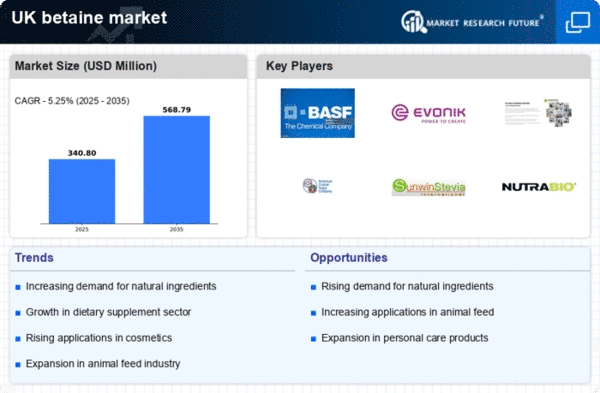
As per Market Research Future analysis, the UK betaine market Size was estimated at 323.8 $ Million in 2024. The UK betaine market is projected to grow from 340.8 $ Million in 2025 to 568.79 $ Million by 2035, exhibiting a compound annual growth rate (CAGR) of 5.2% during the forecast period 2025 - 2035

Key Market Trends & Highlights

The UK betaine market is experiencing a robust growth trajectory driven by health trends and natural ingredient preferences.

  • The health and wellness segment appears to be the largest contributor to the UK betaine market.
  • The fastest-growing segment is likely sports nutrition, reflecting a shift in consumer preferences.
  • Regulatory developments and safety standards are influencing market dynamics and product formulations.
  • Increasing application in animal feed and rising popularity of sports nutrition are key drivers propelling market growth.

Market Size & Forecast

2024 Market Size 323.8 (USD Million)
2035 Market Size 568.79 (USD Million)
CAGR (2025 - 2035) 5.25%

Major Players

BASF SE (DE), Evonik Industries AG (DE), Zhejiang Jianfeng Chemical Co Ltd (CN), American Crystal Sugar Company (US), Sunwin Stevia International Inc (US), NutraBio Labs Inc (US), Kemin Industries Inc (US), Ginkgo BioWorks Inc (US)

Our Impact
Enabled $4.3B Revenue Impact for Fortune 500 and Leading Multinationals
Partnering with 2000+ Global Organizations Each Year
30K+ Citations by Top-Tier Firms in the Industry

UK Betaine Market Trends

The betaine market in the UK is currently experiencing notable growth, driven by increasing demand across various sectors, including food and beverage, cosmetics, and animal feed. This compound, known for its ability to enhance hydration and support metabolic processes, is gaining traction among consumers who are becoming more health-conscious. The rising awareness of the benefits associated with betaine, such as its role in liver function and cardiovascular health, appears to be influencing purchasing decisions. Furthermore, the trend towards natural and clean-label products is likely to bolster the market, as betaine is often derived from natural sources, making it an appealing ingredient for manufacturers aiming to meet consumer preferences. In addition, the regulatory landscape in the UK is evolving, with authorities increasingly focusing on food safety and ingredient transparency. This shift may encourage manufacturers to incorporate betaine into their formulations, as it is recognized for its safety and efficacy. The betaine market is also witnessing innovation, with new applications being explored in dietary supplements and functional foods. As the market continues to expand, stakeholders are likely to invest in research and development to unlock the full potential of betaine, ensuring its relevance in a competitive landscape. Overall, the outlook for the betaine market in the UK appears promising, with various factors contributing to its growth trajectory.

Rising Demand in Health and Wellness

The betaine market is witnessing a surge in demand driven by the growing health and wellness trend. Consumers are increasingly seeking products that promote overall well-being, leading to a higher incorporation of betaine in dietary supplements and functional foods.

Shift Towards Natural Ingredients

There is a noticeable shift towards natural ingredients within the betaine market. As consumers become more discerning about product formulations, manufacturers are likely to prioritize betaine derived from natural sources, aligning with the clean-label movement.

Regulatory Developments and Safety Standards

The evolving regulatory landscape in the UK is impacting the betaine market. Stricter safety standards and transparency requirements are prompting manufacturers to adopt betaine in their products, as it is recognized for its safety and beneficial properties.

UK Betaine Market Drivers

Consumer Awareness and Education

Consumer awareness and education regarding the benefits of betaine are driving growth in the betaine market. As more individuals become informed about the health benefits associated with betaine, such as its role in liver function and metabolic health, the demand for products containing this ingredient is likely to increase. Educational campaigns and marketing efforts by manufacturers are helping to highlight the advantages of betaine, particularly in dietary supplements and functional foods. This heightened awareness is expected to contribute to a more informed consumer base that actively seeks out products enriched with betaine. Consequently, the betaine market may experience a boost as consumers prioritize health and wellness in their purchasing decisions. The ongoing dialogue around nutrition and ingredient transparency is likely to further enhance the visibility of betaine in the marketplace.

Expansion of the Personal Care Sector

The betaine market is also influenced by the expansion of the personal care sector in the UK. Betaine is increasingly utilized in cosmetic and personal care formulations due to its moisturizing and skin-conditioning properties. The UK personal care market is projected to reach £10 billion by 2026, with a growing emphasis on natural and effective ingredients. This trend suggests that betaine, with its mild and effective profile, is likely to see increased adoption in products such as shampoos, conditioners, and skincare items. As consumers become more discerning about the ingredients in their personal care products, the demand for formulations containing betaine may rise, thereby driving growth in the betaine market. This intersection of personal care and betaine usage indicates a promising avenue for market expansion.

Increasing Application in Animal Feed

The betaine market in the UK is experiencing a notable surge in demand due to its increasing application in animal feed. Betaine is recognized for its ability to enhance growth performance and feed efficiency in livestock, particularly in poultry and swine. The UK animal feed industry is projected to grow at a CAGR of approximately 3.5% from 2025 to 2030, which is likely to drive the consumption of betaine. As farmers seek to improve the health and productivity of their animals, the incorporation of betaine into feed formulations appears to be a strategic choice. This trend not only supports animal welfare but also aligns with the growing consumer preference for sustainably sourced animal products. Consequently, the betaine market is poised for expansion as it caters to the evolving needs of the agricultural sector.

Rising Popularity of Sports Nutrition

The betaine market is benefiting from the rising popularity of sports nutrition products in the UK. As more individuals engage in fitness and athletic activities, the demand for supplements containing betaine is increasing. Betaine is known for its potential to enhance exercise performance and improve muscle recovery, making it a sought-after ingredient in pre-workout and post-workout formulations. The sports nutrition sector in the UK is expected to grow by approximately 5% annually, which could significantly impact the betaine market. This growth is driven by a shift in consumer attitudes towards health and fitness, with many individuals seeking products that can support their active lifestyles. As a result, manufacturers are likely to innovate and expand their product lines to include betaine, further solidifying its position in the market.

Technological Advancements in Production

Technological advancements in the production of betaine are poised to impact the betaine market positively. Innovations in extraction and synthesis methods are likely to enhance the efficiency and cost-effectiveness of betaine production. For instance, the development of fermentation processes could lead to higher yields and purities of betaine, making it more accessible for various applications. As production costs decrease, manufacturers may be encouraged to incorporate betaine into a wider range of products, from food and beverages to dietary supplements. This trend aligns with the increasing consumer demand for high-quality ingredients and could potentially lead to a more competitive landscape within the betaine market. The ongoing research and development efforts in this area suggest a bright future for betaine as a versatile ingredient.


Market Segment Insights

By Category: Natural (Largest) vs. Synthetic (Fastest-Growing)

In the UK betaine market, the Natural segment accounts for the largest share, driven by consumer preferences for clean-label and naturally-derived ingredients. The Synthetic segment, while smaller, is rapidly growing due to advancements in production technologies and cost-effectiveness, appealing to various industrial applications. Growth trends indicate that the Natural segment will continue to thrive as demand for sustainable and organic products rises. Conversely, the Synthetic segment is experiencing accelerated growth, primarily spurred by innovations in chemical synthesis and rising demand from sectors such as personal care and animal feed, leading to a competitive market landscape.

Betaine: Natural (Dominant) vs. Synthetic (Emerging)

The Natural segment of the UK betaine market has established itself as a dominant player, primarily because of its acceptance among health-conscious consumers seeking natural alternatives. Characterized by its origin from beets and other plants, this segment caters to the food and beverage industry, emphasizing quality and authenticity. On the other hand, the Synthetic segment is emerging rapidly, characterized by its lower production costs and versatility for bulk applications across various sectors, including agriculture and personal care. This growing preference for synthetic betaine reflects the ongoing trend of balancing performance with cost-efficiency in the market.

By Type: Cocamidopropyl Betaine (Largest) vs. Betaine Anhydrous (Fastest-Growing)

In the UK betaine market, Cocamidopropyl Betaine holds the largest market share, primarily due to its extensive applications in personal care products and household cleaners. It is recognized for its mildness and effective performance as a surfactant, attracting a significant demand within various industries. In contrast, Betaine Anhydrous is gaining traction, reflecting a growing interest in multifunctional ingredients. While it currently holds a smaller market share, its applications in the food and pharmaceutical industries are expanding rapidly. Growth trends indicate a rising demand for natural and sustainable ingredients, which is driving investment in both Cocamidopropyl Betaine and Betaine Anhydrous. Factors such as increasing consumer awareness regarding skin health and environmental sustainability are bolstering the adoption of these products. Additionally, the versatility of betaine derivatives towards various applications is expected to lead to a robust growth trajectory in the coming years. Companies are likely to focus on innovation and sustainability to capitalize on these trends.

Cocamidopropyl Betaine (Dominant) vs. Betaine Anhydrous (Emerging)

Cocamidopropyl Betaine remains the dominant segment in the UK betaine market due to its established position as a key ingredient in formulations ranging from shampoos to household cleaners. Its effectiveness as a foam booster and thickener, combined with its gentle profile, makes it a popular choice among manufacturers. On the other hand, Betaine Anhydrous is emerging as a noteworthy segment, with an expanding use in nutritional supplements and as a functional ingredient in cosmetics. This segment is characterized by its appeal to health-conscious consumers looking for clean label products. The growth of Betaine Anhydrous is fueled by increasing demand in various end-use applications, positioning it for significant growth in the near future.

By Application: Personal Care (Largest) vs. Animal Feed (Fastest-Growing)

The UK betaine market exhibits diverse applications including Personal Care, Animal Feed, Food & Beverages, and Others. Among these, Personal Care holds the largest share due to the escalating demand for cosmetics and personal hygiene products. In contrast, the Animal Feed segment is rapidly gaining traction as more farmers recognize the benefits of betaine in enhancing animal growth and productivity. Growth trends within this segment are primarily driven by rising consumer awareness regarding health and wellness, propelling demand in the Food & Beverages category. Additionally, advancements in agricultural practices are boosting the Animal Feed sector. The increasing focus on sustainable and natural ingredients in personal care products further supports the burgeoning trend in Personal Care applications, thus amplifying the competitive dynamics within the UK betaine market.

Personal Care: Dominant vs. Animal Feed: Emerging

The Personal Care segment stands as a dominant force in the UK betaine market, characterized by its wide usage in various products including shampoos, lotions, and skincare items, thanks to betaine's natural moisturizing properties and compatibility with skin. Companies are heavily investing in R&D to introduce innovative formulations that meet the evolving preferences of consumers seeking safer and eco-friendly options. On the other hand, the Animal Feed sector is emerging robustly, leveraging betaine's qualities that improve feed efficiency and overall animal health. The segment's growth is fueled by increasing meat consumption and the push for higher productivity in livestock farming, making it an attractive area for investment and development in the coming years.

Get more detailed insights about UK Betaine Market

Key Players and Competitive Insights

The betaine market exhibits a dynamic competitive landscape characterized by a blend of innovation, strategic partnerships, and regional expansion. Key players such as BASF SE (DE), Evonik Industries AG (DE), and Kemin Industries Inc (US) are at the forefront, each employing distinct strategies to enhance their market presence. BASF SE (DE) focuses on innovation in product development, particularly in sustainable betaine solutions, while Evonik Industries AG (DE) emphasizes strategic partnerships to bolster its supply chain and expand its product offerings. Kemin Industries Inc (US) appears to be leveraging digital transformation to optimize its operations, thereby enhancing customer engagement and operational efficiency. Collectively, these strategies contribute to a competitive environment that is increasingly driven by technological advancements and sustainability initiatives.The market structure is moderately fragmented, with several players vying for market share through localized manufacturing and supply chain optimization. Companies are increasingly localizing their production to reduce costs and improve responsiveness to regional demands. This tactic not only enhances supply chain efficiency but also allows for better alignment with local regulatory requirements and consumer preferences. The collective influence of these key players shapes a competitive landscape where agility and innovation are paramount.
In October BASF SE (DE) announced the launch of a new line of sustainable betaine products aimed at the personal care sector. This strategic move underscores the company's commitment to sustainability and innovation, positioning it to capture a growing segment of environmentally conscious consumers. The introduction of these products is likely to enhance BASF's competitive edge, as it aligns with the increasing demand for sustainable ingredients in personal care formulations.
In September Evonik Industries AG (DE) entered into a strategic partnership with a leading biotechnology firm to develop bio-based betaine solutions. This collaboration is significant as it not only expands Evonik's product portfolio but also reinforces its commitment to sustainability. By integrating biotechnology into its production processes, Evonik is poised to meet the rising demand for eco-friendly ingredients, thereby strengthening its market position.
In August Kemin Industries Inc (US) implemented a new digital platform designed to streamline its supply chain operations. This initiative reflects Kemin's focus on digital transformation, which is increasingly vital in today's market. By enhancing operational efficiency and improving customer interactions, Kemin is likely to gain a competitive advantage, particularly in a market that values responsiveness and reliability.
As of November the betaine market is witnessing trends that emphasize digitalization, sustainability, and the integration of artificial intelligence. Strategic alliances are becoming increasingly important, as companies seek to leverage complementary strengths to enhance their market offerings. The competitive differentiation is expected to evolve, shifting from traditional price-based competition to a focus on innovation, technological advancements, and supply chain reliability. This transition suggests that companies that prioritize these aspects will likely emerge as leaders in the betaine market.

Key Companies in the UK Betaine Market include

Industry Developments

The UK Betaine Market has seen significant developments recently, particularly with a growing demand for bio-based products and advancements in agricultural biotechnology. Companies such as FMC Corporation and BASF are expanding their product lines to address sustainability, which is becoming increasingly essential in the agricultural and food sectors. In terms of mergers and acquisitions, Ashland Global Holdings announced the acquisition of a specialty chemical firm specializing in betaine derivatives in August 2023, enhancing its market presence in the UK.

Furthermore, Evonik Industries reported growth in its Betaine production capacity focusing on ecological and sustainable solutions, driven by rising consumer preference for natural ingredients. The market's value has reportedly increased, fueled by the rising applications of Betaine in cosmetics and animal feed; the UK government has recognized this growth, attributing part of it to the push for sustainable agricultural practices. Additionally, Stepan Company is collaborating with local firms to innovate biobased Betaine formulations, demonstrating the current trend towards eco-friendly ingredients.

The last few years have also seen a rising inclination towards plant-based alternatives, influencing multiple companies, including AkzoNobel and Solvay, to reevaluate their product strategies.


Future Outlook

UK Betaine Market Future Outlook

The Betaine Market is projected to grow at a 5.25% CAGR from 2025 to 2035, driven by increasing demand in food and beverage, cosmetics, and animal feed sectors.

New opportunities lie in:

  • Development of customized betaine formulations for specific industries. Expansion into emerging markets with tailored marketing strategies. Investment in R&D for innovative applications in health supplements.

By 2035, the betaine market is expected to achieve robust growth and diversification.

Market Segmentation

UK Betaine Market Type Outlook

  • Cocamidopropyl Betaine
  • Betaine Anhydrous
  • Others

UK Betaine Market Category Outlook

  • Natural
  • Synthetic

UK Betaine Market Application Outlook

  • Personal Care
  • Animal Feed
  • Food & Beverages
  • Others

Report Scope

MARKET SIZE 2024 323.8(USD Million)
MARKET SIZE 2025 340.8(USD Million)
MARKET SIZE 2035 568.79(USD Million)
COMPOUND ANNUAL GROWTH RATE (CAGR) 5.25% (2025 - 2035)
REPORT COVERAGE Revenue Forecast, Competitive Landscape, Growth Factors, and Trends
BASE YEAR 2024
Market Forecast Period 2025 - 2035
Historical Data 2019 - 2024
Market Forecast Units USD Million
Key Companies Profiled BASF SE (DE), Evonik Industries AG (DE), Zhejiang Jianfeng Chemical Co Ltd (CN), American Crystal Sugar Company (US), Sunwin Stevia International Inc (US), NutraBio Labs Inc (US), Kemin Industries Inc (US), Ginkgo BioWorks Inc (US)
Segments Covered Category, Type, Application
Key Market Opportunities Growing demand for plant-based betaine in food and beverage applications presents a lucrative opportunity.
Key Market Dynamics Rising demand for natural betaine in food and beverage sectors drives innovation and competition in the market.
Countries Covered UK
Leave a Comment

FAQs

What is the expected market size of the UK Betaine Market in 2024?

The UK Betaine Market is expected to be valued at 258.0 million USD in 2024.

What will be the market size of the UK Betaine Market by 2035?

By 2035, the UK Betaine Market is projected to reach a value of 622.0 million USD.

What is the expected CAGR for the UK Betaine Market from 2025 to 2035?

The expected compound annual growth rate (CAGR) for the UK Betaine Market from 2025 to 2035 is 8.329%.

What are the main types of Betaine in the UK Betaine Market?

The UK Betaine Market is primarily divided into Cocamidopropyl Betaine, Betaine Anhydrous, and Others.

What is the market value for Betaine Anhydrous in 2024?

The market value for Betaine Anhydrous is estimated to be 120.0 million USD in 2024.

How much is the Cocamidopropyl Betaine market expected to be worth in 2035?

The Cocamidopropyl Betaine market is expected to reach 185.0 million USD by 2035.

Who are the key players in the UK Betaine Market?

Significant competitors in the UK Betaine Market include FMC Corporation, BASF, and Evonik Industries among others.

What are the projected applications driving the UK Betaine Market?

The UK Betaine Market is driven by demand in personal care products, agriculture, and food industries.

What is the market value for 'Others' category in the UK Betaine Market in 2024?

The 'Others' category in the UK Betaine Market is valued at 58.0 million USD in 2024.

What challenges are currently affecting the UK Betaine Market?

Challenges such as fluctuating raw material prices and regulatory compliance are impacting the UK Betaine Market.

Download Free Sample

Kindly complete the form below to receive a free sample of this Report

Compare Licence

×
Features License Type
Single User Multiuser License Enterprise User
Price $4,950 $5,950 $7,250
Maximum User Access Limit 1 User Upto 10 Users Unrestricted Access Throughout the Organization
Free Customization
Direct Access to Analyst
Deliverable Format
Platform Access
Discount on Next Purchase 10% 15% 15%
Printable Versions