×
Request Free Sample ×

Kindly complete the form below to receive a free sample of this Report

* Please use a valid business email

Leading companies partner with us for data-driven Insights

clients tt-cursor
Hero Background

UK Almond Milk Market

ID: MRFR/FnB/63906-HCR
128 Pages
Snehal Singh
February 2026

UK Almond Milk Market Size, Share, Industry Trend & Analysis Research Report By Type (Plain, Flavored), By Category (Organic, Conventional), By Packaging Type (Carton, Glass, Others), By Application (Beverages, Frozen Desserts, Personal Care, Others) and By Distribution Channel (Hypermarkets & Supermarkets, Convenience Stores, Online Stores, Others) - Forecast to 2035

Share:
Download PDF ×

We do not share your information with anyone. However, we may send you emails based on your report interest from time to time. You may contact us at any time to opt-out.

UK Almond Milk Market Infographic
Purchase Options

UK Almond Milk Market Summary

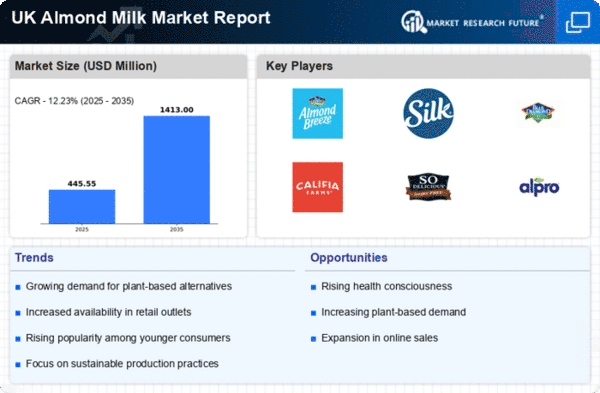
As per Market Research Future analysis, the UK almond milk market Size was estimated at 397.0 USD Million in 2024. The UK almond milk market is projected to grow from 445.55 USD Million in 2025 to 1413.0 USD Million by 2035, exhibiting a compound annual growth rate (CAGR) of 12.2% during the forecast period 2025 - 2035

Key Market Trends & Highlights

The UK almond milk market is experiencing robust growth driven by health trends and sustainability concerns.

  • Health consciousness among consumers is driving the demand for almond milk as a dairy alternative.
  • The largest segment in the UK almond milk market is the health-focused consumers, while the fastest-growing segment is the vegan demographic.
  • Sustainability focus is influencing product innovation, leading to a wider variety of almond milk offerings.
  • Rising demand for dairy alternatives and consumer preference for clean label products are key drivers of market growth.

Market Size & Forecast

2024 Market Size 397.0 (USD Million)
2035 Market Size 1413.0 (USD Million)
CAGR (2025 - 2035) 12.23%

Major Players

Almond Breeze (US), Silk (US), Blue Diamond Growers (US), Califia Farms (US), So Delicious (US), Alpro (GB), Oatly (SE), Nutty Life (AU)

Our Impact
Enabled $4.3B Revenue Impact for Fortune 500 and Leading Multinationals
Partnering with 2000+ Global Organizations Each Year
30K+ Citations by Top-Tier Firms in the Industry

UK Almond Milk Market Trends

The almond milk market is experiencing notable growth, driven by increasing consumer awareness regarding health and wellness. As individuals become more conscious of dietary choices, the demand for plant-based alternatives has surged. Almond milk, recognized for its low calorie content and lactose-free nature, appeals to a diverse demographic, including those with lactose intolerance and those seeking healthier lifestyles. This shift in consumer preferences is further supported by a rise in veganism and vegetarianism, which has led to a broader acceptance of non-dairy options. Additionally, the almond milk market benefits from innovative product offerings, including flavored varieties and fortified options, which enhance its appeal to a wider audience. Moreover, the almond milk market is influenced by sustainability concerns. Consumers are increasingly prioritizing environmentally friendly products, prompting manufacturers to adopt sustainable practices in sourcing and production. This trend aligns with the growing emphasis on reducing carbon footprints and promoting ethical consumption. As a result, brands that emphasize their commitment to sustainability are likely to gain a competitive edge. The almond milk market appears poised for continued expansion, as it adapts to evolving consumer demands and preferences, while also addressing environmental considerations.

Health Consciousness

The almond milk market is significantly influenced by rising health consciousness among consumers. Individuals are increasingly seeking alternatives to traditional dairy products, favoring options that align with their health goals. Almond milk, known for its low calorie and cholesterol-free profile, is often perceived as a healthier choice, appealing to those aiming to improve their diets.

Sustainability Focus

Sustainability is becoming a central theme within the almond milk market. Consumers are more inclined to support brands that demonstrate environmental responsibility. This trend encourages manufacturers to implement sustainable sourcing and production methods, which not only attract eco-conscious buyers but also enhance brand loyalty.

Product Innovation

Innovation plays a crucial role in the almond milk market, with brands continuously introducing new flavors and formulations. This trend caters to diverse consumer preferences, allowing for a broader range of choices. Enhanced product offerings, such as fortified almond milk with added vitamins and minerals, are likely to attract health-oriented consumers.

UK Almond Milk Market Drivers

Rising Demand for Dairy Alternatives

The almond milk market experiences a notable increase in demand as consumers shift towards dairy alternatives. This trend is driven by a growing awareness of lactose intolerance and the health benefits associated with plant-based diets. In the UK, the market for dairy alternatives, including almond milk, has expanded significantly, with sales reaching approximately £300 million in 2023. This shift reflects a broader movement towards healthier lifestyles, where almond milk is perceived as a nutritious option. The almond milk market is likely to continue benefiting from this trend, as more consumers seek out alternatives that align with their dietary preferences and health goals.

Increased Availability in Retail Channels

The almond milk market benefits from enhanced distribution channels, making products more accessible to consumers. Supermarkets and health food stores increasingly stock a variety of almond milk brands, catering to diverse consumer preferences. The rise of online shopping has further facilitated access, allowing consumers to purchase almond milk conveniently from home. In 2023, the UK retail sector reported a 15% increase in the availability of plant-based milk options, including almond milk. This expansion in retail presence is crucial for the almond milk market, as it enables brands to reach a wider audience and meet the growing demand for dairy alternatives.

Health Benefits Associated with Almond Milk

The almond milk market is bolstered by the perceived health benefits associated with almond milk consumption. Rich in vitamins and low in calories, almond milk is often marketed as a heart-healthy alternative to dairy. In the UK, health claims related to almond milk have resonated with consumers, leading to a 20% increase in sales over the past year. The almond milk market leverages these health benefits in marketing strategies, appealing to consumers who prioritize wellness. This focus on health not only drives consumption but also fosters a positive image of almond milk as a nutritious choice.

Consumer Preference for Clean Label Products

The almond milk market is influenced by a shift towards clean label products, where consumers prefer items with minimal ingredients and transparent sourcing. This trend aligns with the increasing demand for natural and organic products in the UK. Research indicates that over 60% of consumers are willing to pay a premium for products that are free from artificial additives. The almond milk market is responding by offering products that emphasize simplicity and quality, appealing to health-conscious consumers. This focus on clean labels not only enhances brand loyalty but also positions almond milk as a preferred choice among discerning shoppers.

Growing Interest in Vegan and Plant-Based Diets

The almond milk market is significantly impacted by the rising interest in vegan and plant-based diets. As more individuals adopt these lifestyles, the demand for almond milk as a dairy substitute continues to grow. In the UK, the number of vegans has increased by 40% over the past five years, contributing to a robust market for plant-based products. The almond milk market is well-positioned to capitalize on this trend, as consumers seek alternatives that align with their ethical and dietary choices. This growing interest not only drives sales but also encourages innovation within the sector.


Market Segment Insights

By Product Type: Sweetened Almond Milk (Largest) vs. Unsweetened Almond Milk (Fastest-Growing)

In the UK almond milk market, the segment values are distinctly characterized by varying consumer preferences. Sweetened almond milk holds the largest market share, appealing to consumers seeking a sweeter alternative to dairy. Conversely, unsweetened almond milk has seen a noteworthy increase in popularity thanks to the shift towards healthier options, carving a significant niche within the competitive landscape. The growth trends in this segment are influenced by rising health consciousness and dietary choices. Consumers are increasingly gravitating towards unsweetened variants, which are perceived as healthier choices with fewer additives and sugars. Additionally, flavored almond milk has emerged as a fun option, attracting younger demographics, while organic almond milk resonates with the clean-eating trend, contributing to robust growth opportunities in the UK almond milk market.

Sweetened Almond Milk (Dominant) vs. Unsweetened Almond Milk (Emerging)

Sweetened almond milk is a dominant player in the UK almond milk market, largely due to its palatable taste and widespread accessibility. This segment caters to a broad audience, including families and young adults who prefer a sweeter beverage. On the other hand, unsweetened almond milk is an emerging choice that appeals to health-focused consumers. It is favored for its lower calorie content and the absence of added sugars. The contrasting characteristics of these segments highlight a broader consumer trend towards personalized nutrition, as shoppers increasingly seek products that align with their taste preferences and health goals.

By Packaging Type: Bottle (Largest) vs. Pouch (Fastest-Growing)

In the UK almond milk market, the packaging type segment showcases a diverse distribution, with bottle packaging emerging as the largest choice among consumers, capturing a significant share. Following closely are cartons and Tetra packs, which also enjoy popularity but do not match the dominance of bottles. Pouches, while currently a smaller segment, are gaining traction for convenience and portability, appealing to a niche audience. The growth trends within the packaging type segment are notably driven by consumer preferences for sustainable and convenient packaging solutions. Bottles remain favored for their reusability and robust design, while pouches are catching up rapidly due to their lightweight nature and ease of use, positioning them as an emerging trend. This shift indicates a dynamic market, where innovation in packaging continues to drive consumer engagement and brand loyalty.

Bottle (Dominant) vs. Pouch (Emerging)

In the UK almond milk market, bottle packaging is distinguished by its strong consumer preference, offering an attractive balance of convenience and robustness. Bottles are typically chosen for their reusability and perceived quality, making them a staple in both retail and household settings. On the other hand, pouches are emerging as a compelling alternative, especially favored by on-the-go consumers seeking lightweight and portable options. The increasing availability of pouches in various sizes and flavors indicates a growing market segment, appealing to younger demographics inclined toward convenience and sustainability. As manufacturers innovate, pouches are beginning to carve out their niche, suggesting an evolving landscape within the packaging type segment.

By Distribution Channel: Supermarkets (Largest) vs. Online Retailers (Fastest-Growing)

In the UK almond milk market, supermarkets hold a significant share of the distribution channel, accounting for a large portion of total sales. Their well-established networks and extensive product offerings make them the go-to choice for many consumers. Following supermarkets, health food stores and convenience stores contribute as important players, but they do not match the sales scale of supermarkets. Online retailers, while currently smaller in market share, are rapidly gaining traction due to the rising preference for online shopping. Growth trends within this segment show that online retailers are poised to become the fastest-growing channel as consumers increasingly turn to e-commerce for their grocery needs, especially in the wake of digital transformation. Supermarkets continue to dominate, but the convenience and variety offered by online platforms are enticing consumers. This shift is driven by changing shopping habits, more consumers seeking plant-based products, and the ease of accessing multiple brands through a single online portal.

Supermarkets (Dominant) vs. Online Retailers (Emerging)

In the UK almond milk market, supermarkets are the dominant distribution channel, leveraging their extensive reach and established customer base to secure significant sales volumes. They provide consumers with easy access to a variety of almond milk brands, often at competitive prices. In contrast, online retailers represent an emerging segment, appealing to tech-savvy consumers who favor the convenience and accessibility of online shopping. This segment benefits from a growing emphasis on health and wellness, as consumers seek out specialty almond milk products. While supermarkets offer bulk purchases, online retailers excel at providing niche products and the flexibility of delivery, positioning them as a valuable alternative for health-conscious shoppers.

By End Use: Household (Largest) vs. Food Service (Fastest-Growing)

In the UK almond milk market, the distribution of market share among the end-use segments indicates that the Household segment dominates the landscape, accounting for a significant portion of overall consumption. This trend highlights a growing preference for non-dairy alternatives in home settings, as consumers shift towards healthier lifestyle choices. Meanwhile, the Food Service segment is gaining traction, characterized by an increasing demand in cafes, restaurants, and other food establishments that are adopting almond milk in their offerings. Growth trends reveal that the Food Service segment is the fastest-growing category, driven by the rising trend of plant-based diets and the expansion of vegan and vegetarian options in dining establishments. The increasing awareness of health benefits linked to almond milk consumption further propels this segment's growth. As more food service providers introduce almond milk into their menus, the overall demand continues to surge, solidifying its presence in the UK almond milk market.

Household (Dominant) vs. Food Service (Emerging)

The Household segment in the UK almond milk market is characterized by its strong consumer base, particularly among health-conscious and environmentally aware individuals. This segment enjoys a dominant position due to the convenience and versatility of almond milk in various home applications, from cooking to coffee. On the other hand, the Food Service segment is emerging as a key player, capturing the interest of dining establishments focused on catering to vegan and lactose-intolerant customers. While still developing, the Food Service segment is rapidly adapting to consumer trends, featuring almond milk in beverages and meals, establishing a footprint that complements the established Household segment.

Get more detailed insights about UK Almond Milk Market

Key Players and Competitive Insights

The almond milk market exhibits a dynamic competitive landscape characterized by a growing consumer preference for plant-based alternatives. Key growth drivers include increasing health consciousness, environmental sustainability, and the rise of veganism. Major players such as Almond Breeze (US), Alpro (GB), and Oatly (SE) are strategically positioned to capitalize on these trends. Almond Breeze (US) focuses on innovation in product formulations, while Alpro (GB) emphasizes regional expansion and sustainability initiatives. Oatly (SE) leverages its strong brand identity and digital marketing strategies to engage consumers, collectively shaping a competitive environment that prioritizes health and sustainability.In terms of business tactics, companies are increasingly localizing manufacturing to reduce carbon footprints and optimize supply chains. The market structure appears moderately fragmented, with several key players influencing overall dynamics. This fragmentation allows for niche brands to emerge, yet the collective influence of established companies like Silk (US) and Califia Farms (US) remains significant, as they continue to innovate and expand their product lines.
In October Almond Breeze (US) announced the launch of a new line of organic almond milk products aimed at health-conscious consumers. This strategic move is likely to enhance their market share by appealing to a demographic increasingly focused on organic and clean-label products. The introduction of these products may also serve to differentiate Almond Breeze in a crowded market, potentially attracting new customers seeking healthier options.
In September Alpro (GB) unveiled a partnership with a leading UK supermarket chain to promote its almond milk products through in-store promotions and digital campaigns. This collaboration is strategically important as it enhances Alpro's visibility and accessibility, likely driving sales growth. Such partnerships may also reflect a broader trend of brands seeking to align with retailers to bolster their market presence and consumer engagement.
In August Oatly (SE) expanded its distribution network by entering into a new agreement with a major food service provider in the UK. This expansion is significant as it allows Oatly to reach a wider audience, particularly in cafes and restaurants, where plant-based options are increasingly in demand. By enhancing its presence in the food service sector, Oatly may solidify its position as a leader in the almond milk market.
As of November current competitive trends indicate a strong focus on digitalization, sustainability, and the integration of AI technologies in product development and marketing strategies. Strategic alliances are shaping the landscape, enabling companies to leverage shared resources and expertise. Looking ahead, competitive differentiation is likely to evolve from traditional price-based competition to a focus on innovation, technology, and supply chain reliability, as brands strive to meet the growing consumer demand for quality and sustainability.

Key Companies in the UK Almond Milk Market include

Industry Developments

The UK Almond Milk Market is experiencing significant developments and growth trends. In 2023, the introduction of innovative products by brands like Califia Farms and Oatly is gaining traction, expanding consumer choices in the dairy alternative sector. The market valuation has seen a positive impact as the demand for plant-based milk options increases, driven by health-conscious consumers. Notably, Blue Diamond Growers and Almond Breeze continue to strengthen their market presence with competitive pricing strategies.

In terms of mergers and acquisitions, there have been no widely reported activities among major players like Goodful, Alpro, and Silk in the UK, indicating a stable market phase focused on organic growth and brand loyalty. Furthermore, the popularity of Almond Milk aligns with the UK government's initiatives promoting sustainability and healthy diets, influencing consumer preferences. Over the last two years, a significant rise in plant-based diets has been observed, with almond milk sales surging by more than 20 percent in 2022, reflecting a major shift in consumer behavior towards dairy alternatives.

Overall, the UK Almond Milk Market continues to evolve amidst changing dietary trends and an increasingly health-conscious population.


Future Outlook

UK Almond Milk Market Future Outlook

The Almond Milk Market is projected to grow at a 12.23% CAGR from 2025 to 2035, driven by rising health consciousness, innovative product offerings, and increasing demand for plant-based alternatives.

New opportunities lie in:

  • Expansion of almond milk product lines to include fortified and flavored variants. Development of subscription-based delivery services for almond milk products. Investment in sustainable almond sourcing to enhance brand reputation and consumer trust.

By 2035, the almond milk market is expected to achieve substantial growth, reflecting evolving consumer preferences.

Market Segmentation

UK Almond Milk Market End Use Outlook

  • Household
  • Food Service
  • Beverage Industry

UK Almond Milk Market Product Type Outlook

  • Sweetened Almond Milk
  • Unsweetened Almond Milk
  • Flavored Almond Milk
  • Organic Almond Milk

UK Almond Milk Market Packaging Type Outlook

  • Carton
  • Tetra Pack
  • Bottle
  • Pouch

UK Almond Milk Market Distribution Channel Outlook

  • Supermarkets
  • Health Food Stores
  • Online Retailers
  • Convenience Stores

Report Scope

MARKET SIZE 2024 397.0(USD Million)
MARKET SIZE 2025 445.55(USD Million)
MARKET SIZE 2035 1413.0(USD Million)
COMPOUND ANNUAL GROWTH RATE (CAGR) 12.23% (2025 - 2035)
REPORT COVERAGE Revenue Forecast, Competitive Landscape, Growth Factors, and Trends
BASE YEAR 2024
Market Forecast Period 2025 - 2035
Historical Data 2019 - 2024
Market Forecast Units USD Million
Key Companies Profiled Almond Breeze (US), Silk (US), Blue Diamond Growers (US), Califia Farms (US), So Delicious (US), Alpro (GB), Oatly (SE), Nutty Life (AU)
Segments Covered Product Type, Packaging Type, Distribution Channel, End Use
Key Market Opportunities Growing consumer preference for plant-based diets drives innovation in the almond milk market.
Key Market Dynamics Rising consumer preference for plant-based diets drives growth in the almond milk market amid increasing competition.
Countries Covered UK
Leave a Comment

FAQs

What is the projected market size of the UK Almond Milk Market by 2035?

The UK Almond Milk Market is expected to be valued at 1300.0 million USD by 2035.

What was the market size of the UK Almond Milk Market in 2024?

In 2024, the UK Almond Milk Market is valued at 397.0 million USD.

What is the expected compound annual growth rate (CAGR) for the UK Almond Milk Market from 2025 to 2035?

The market is expected to grow at a CAGR of 11.386 percent from 2025 to 2035.

What is the market size for Plain Almond Milk in 2024?

Plain Almond Milk is expected to be valued at 238.5 million USD in 2024.

What will be the market size for Flavored Almond Milk by 2035?

Flavored Almond Milk is projected to reach 520.0 million USD by 2035.

Who are the major players in the UK Almond Milk Market?

Key players in the market include Blue Diamond Growers, Califia Farms, Oatly, Almond Breeze, and Alpro.

What is the market size of the Plain Almond Milk segment by 2035?

The market size for Plain Almond Milk is expected to grow to 780.0 million USD by 2035.

How is the Flavored Almond Milk market segment expected to grow from 2024 to 2035?

Flavored Almond Milk is anticipated to increase from 158.5 million USD in 2024 to 520.0 million USD by 2035.

What are some key trends and growth drivers in the UK Almond Milk Market?

The market is driven by rising demand for plant-based products and increasing health consciousness among consumers.

What impact do the current global trends have on the UK Almond Milk Market?

Current global trends favor the growth of plant-based alternatives, positively impacting the UK Almond Milk Market.

Download Free Sample

Kindly complete the form below to receive a free sample of this Report

Compare Licence

×
Features License Type
Single User Multiuser License Enterprise User
Price $4,950 $5,950 $7,250
Maximum User Access Limit 1 User Upto 10 Users Unrestricted Access Throughout the Organization
Free Customization
Direct Access to Analyst
Deliverable Format
Platform Access
Discount on Next Purchase 10% 15% 15%
Printable Versions