×
Request Free Sample ×

Kindly complete the form below to receive a free sample of this Report

* Please use a valid business email

Leading companies partner with us for data-driven Insights

clients tt-cursor
Hero Background

Tile Adhesive Market

ID: MRFR/CnM/1199-CR
111 Pages
Anshula Mandaokar
February 2021

Tile Adhesive Market Research Report Information By Type (Cementitious, Dispersion, and Reactive Tile Adhesive), By Polymer Chemistry (Acrylic, Vinyl Acetate Ethylene, Have-Veova, Epoxy, Styrene Butadiene, Polyurethane, and Others), By Application (Ceramic Tile, Vitrified Tiles, Natural Stone, Mosaic, and Glass), And By Region (North America, Europe, Asia-Pacific, And Rest Of The World) – Market Forecast Till 2035

Share:
Download PDF ×

We do not share your information with anyone. However, we may send you emails based on your report interest from time to time. You may contact us at any time to opt-out.

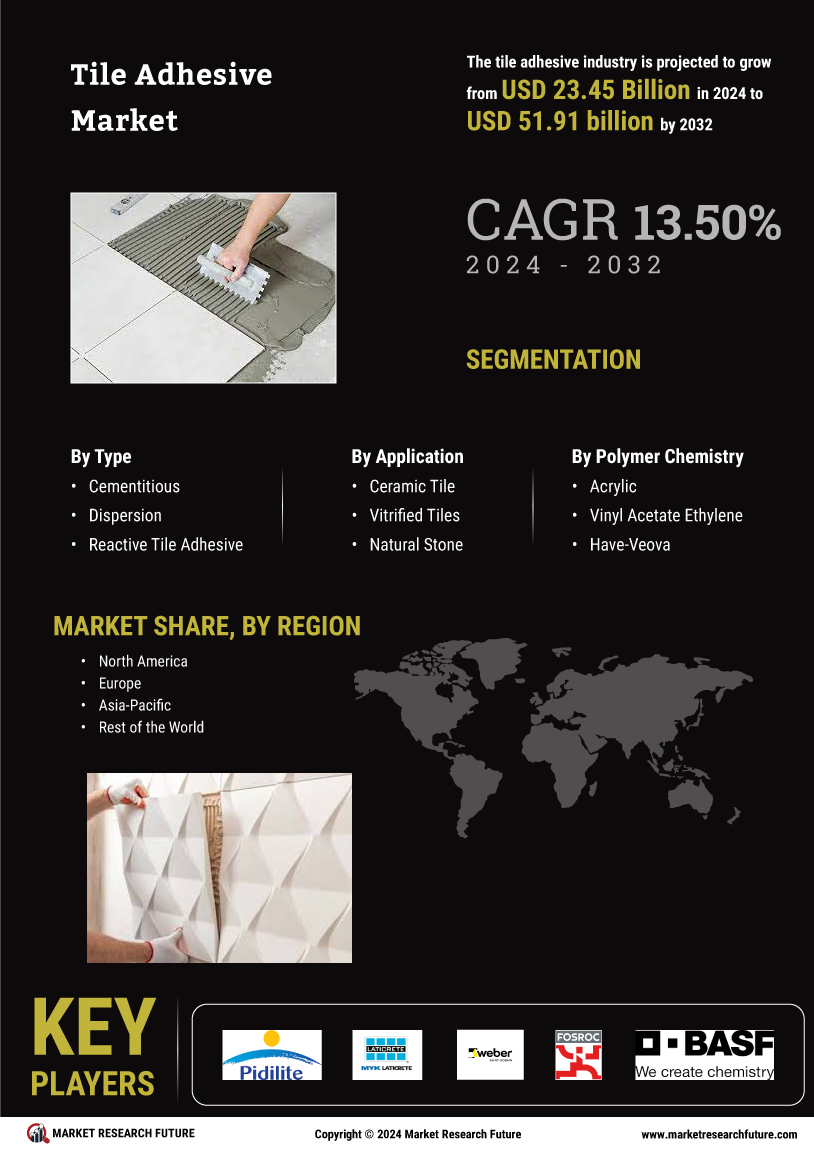
Tile Adhesive Market Infographic
Purchase Options

Tile Adhesive Market Summary

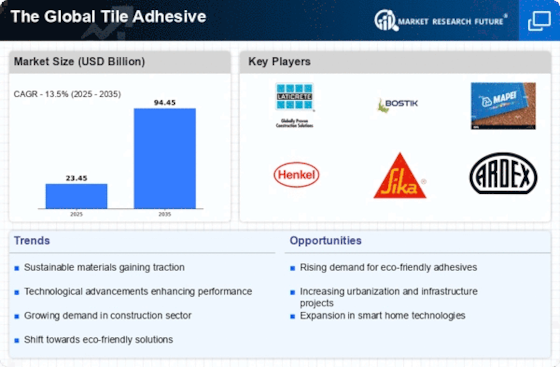
As per MRFR analysis, the Tile Adhesive Market Size was estimated at 23.45 USD Billion in 2024. The Tile Adhesive industry is projected to grow from 26.62 USD Billion in 2025 to 94.45 USD Billion by 2035, exhibiting a compound annual growth rate (CAGR) of 13.5 during the forecast period 2025 - 2035.

Key Market Trends & Highlights

The Tile Adhesive Market is experiencing a dynamic shift towards sustainability and innovation.

  • The market is increasingly driven by a focus on sustainability, with manufacturers prioritizing eco-friendly formulations.
  • Technological innovations are enhancing product performance, leading to the development of advanced adhesive solutions.
  • In North America, the demand for tile adhesives is robust, while the Asia-Pacific region is witnessing rapid growth due to urbanization.
  • Key market drivers include rising construction activities and the increasing demand for aesthetic solutions, which are shaping consumer preferences.

Market Size & Forecast

2024 Market Size 23.45 (USD Billion)
2035 Market Size 94.45 (USD Billion)
CAGR (2025 - 2035) 13.5%

Major Players

Laticrete International Inc (US), Bostik (FR), Mapei S.p.A. (IT), Henkel AG & Co. KGaA (DE), Sika AG (CH), Ardex GmbH (DE), Weber (FR), Fischer (DE), Dunlop Adhesives (GB), Raimondi (IT)

Our Impact
Enabled $4.3B Revenue Impact for Fortune 500 and Leading Multinationals
Partnering with 2000+ Global Organizations Each Year
30K+ Citations by Top-Tier Firms in the Industry

Tile Adhesive Market Trends

The Tile Adhesive Market is currently experiencing a dynamic evolution, driven by various factors that influence consumer preferences and industry standards. The increasing demand for durable and high-performance adhesives is evident, as construction and renovation activities continue to rise globally. This trend is further supported by the growing emphasis on sustainable building practices, which encourages the use of eco-friendly materials. As a result, manufacturers are innovating to develop products that not only meet performance criteria but also align with environmental regulations. Additionally, the expansion of the real estate sector, particularly in emerging economies, appears to bolster the market's growth potential. Moreover, advancements in technology are reshaping the Tile Adhesive Market landscape. The introduction of smart adhesives, which offer enhanced bonding capabilities and ease of application, is gaining traction among professionals in the construction industry. This shift towards innovation suggests that companies are likely to invest in research and development to stay competitive. Furthermore, the increasing popularity of DIY projects among consumers may also contribute to a rise in demand for user-friendly adhesive solutions. Overall, the Tile Adhesive Market seems poised for continued growth, driven by a combination of technological advancements and evolving consumer needs.

Sustainability Focus

The Tile Adhesive Market is witnessing a notable shift towards sustainable practices. Manufacturers are increasingly prioritizing eco-friendly materials and production processes, responding to consumer demand for environmentally responsible products. This trend not only aligns with global sustainability goals but also enhances brand reputation.

Technological Innovations

Technological advancements are significantly influencing the Tile Adhesive Market. The emergence of smart adhesives, which offer superior bonding properties and ease of use, is reshaping industry standards. This innovation is likely to attract both professionals and DIY enthusiasts, expanding the market's reach.

Rising DIY Culture

The growing popularity of DIY projects is impacting the Tile Adhesive Market positively. As more consumers engage in home improvement activities, the demand for accessible and effective adhesive solutions is increasing. This trend suggests a shift in purchasing behavior, favoring products that cater to non-professionals.

Tile Adhesive Market Drivers

Sustainability Initiatives

The Tile Adhesive Market is increasingly influenced by sustainability initiatives. As environmental concerns gain prominence, manufacturers are focusing on eco-friendly adhesive formulations. This shift is driven by regulatory pressures and consumer demand for sustainable products. For instance, the market for green building materials is projected to grow significantly, with tile adhesives being a key component. Companies are investing in research to develop adhesives that minimize environmental impact, such as those with low volatile organic compounds (VOCs). This trend not only aligns with global sustainability goals but also enhances brand reputation, potentially leading to increased market share in the Tile Adhesive Market.

Technological Advancements

Technological advancements play a crucial role in shaping the Tile Adhesive Market. Innovations in adhesive formulations and application techniques are enhancing performance characteristics, such as bond strength and curing time. For example, the introduction of polymer-modified adhesives has improved flexibility and durability, making them suitable for a variety of substrates. Additionally, automation in manufacturing processes is streamlining production, reducing costs, and improving product consistency. The integration of smart technologies, such as sensors for monitoring adhesive application, is also emerging. These advancements not only meet the evolving needs of consumers but also position companies competitively within the Tile Adhesive Market.

Expansion of Retail Channels

The Tile Adhesive Market is benefiting from the expansion of retail channels, which enhances product accessibility for consumers. The rise of e-commerce platforms and home improvement stores has made it easier for customers to purchase tile adhesives. This trend is particularly relevant as DIY projects gain popularity, with consumers increasingly opting for self-installation of tiles. Retailers are also offering a wider range of products, including specialized adhesives for different applications. This increased availability not only boosts sales but also encourages innovation within the Tile Adhesive Market, as companies strive to meet diverse consumer needs.

Rising Construction Activities

The Tile Adhesive Market is experiencing growth due to rising construction activities across various sectors. Urbanization and population growth are driving demand for residential and commercial buildings, which in turn increases the need for tile installations. According to recent data, the construction sector is expected to expand, with significant investments in infrastructure projects. This surge in construction activities directly correlates with the demand for tile adhesives, as they are essential for ensuring the durability and aesthetic appeal of tiled surfaces. Consequently, manufacturers in the Tile Adhesive Market are poised to benefit from this upward trend.

Increasing Demand for Aesthetic Solutions

The Tile Adhesive Market is witnessing an increasing demand for aesthetic solutions in interior and exterior design. Consumers are becoming more discerning about the visual appeal of their spaces, leading to a preference for high-quality tiles and adhesives that enhance overall aesthetics. This trend is particularly evident in the residential sector, where homeowners seek unique designs and finishes. As a result, manufacturers are developing specialized adhesives that cater to various tile types and applications, ensuring optimal performance while maintaining visual integrity. This focus on aesthetics is likely to drive growth in the Tile Adhesive Market.

Market Segment Insights

By Application: Flooring (Largest) vs. Wall Tiling (Fastest-Growing)

The Tile Adhesive Market displays a diverse application spectrum, with Flooring being the most substantial segment in terms of share. As a popular choice in residential and commercial spaces, Flooring adhesives cater to a broad range of materials, including ceramics, vinyl, and stone. Wall Tiling has established itself as a key player as well, especially in modern interior design, enhancing aesthetics and functionality in residential projects. As the market evolves, trends such as urbanization and increased construction activities are driving the demand for tile adhesives across applications. Wall Tiling is witnessing rapid growth, fueled by the rising preference for stylish and durable wall finishes. Outdoor applications, while smaller, are also gaining traction due to increasing consumer focus on exterior aesthetics and performance under varying weather conditions.

Flooring (Dominant) vs. Outdoor (Emerging)

In the Tile Adhesive Market, Flooring applications remain dominant due to their extensive use in various environments, encompassing residential and commercial settings. The versatility of flooring adhesives allows for compatibility with multiple substrate types, making them favorable among contractors and homeowners alike. Conversely, Outdoor applications are emerging as a significant segment, attributed to the growing consumer demand for well-designed patios, outdoor kitchens, and landscaping. These products are specifically formulated to endure temperature fluctuations and moisture, enhancing durability. As trends shift towards outdoor living spaces, the adhesive technologies for these applications are becoming increasingly sophisticated, providing strength and reliability necessary for external installations.

By Type: Cementitious (Largest) vs. Reactive (Fastest-Growing)

The Tile Adhesive Market showcases a diverse segment distribution with Cementitious adhesives holding the largest share. This segment's strength is attributed to its widespread application in both residential and commercial projects due to its strong bonding capabilities and long-lasting durability. Reactive and Dispersion types also contribute significantly, but their market presence is overshadowed by Cementitious options. The Hybrid segment, combining the features of both cementitious and reactive adhesives, is also gaining traction but remains a smaller portion of the overall market.

Cementitious (Dominant) vs. Reactive (Emerging)

Cementitious tile adhesives are recognized for their reliability and robust performance, making them a dominant choice in the tiling industry. They are extensively used in various settings, thanks to their excellent adhesion properties and resistance to moisture. Conversely, Reactive adhesives are emerging as a favored alternative, particularly in specialized applications where rapid curing and flexibility are essential. This segment is witnessing remarkable growth driven by innovations in formulations that enhance performance attributes and cater to modern tiling challenges. The shift towards sustainable and high-performance materials is further propelling the Reactive adhesives segment, indicating a dynamic evolution within the Tile Adhesive Market.

By End Use: Residential (Largest) vs. Commercial (Fastest-Growing)

In the Tile Adhesive Market, the end-use segmentation reveals a diverse landscape with varied applications. Residential use holds the largest share, driven by the growing demand for home renovations and improvements. This segment benefits from a rising trend in DIY projects and an increase in new housing constructions. Alternatives like commercial and institutional segments also contribute notably to the overall market, though they occupy smaller portions in comparison to the residential sector. As we look toward future growth trajectories, the commercial segment is poised to emerge as the fastest-growing sector, fueled by a surge in infrastructure projects and increased investments in public spaces. Institutional and industrial applications hold steady growth prospects as well, with sectors like healthcare and education driving demand for robust tile adhesives that enhance durability and functionality in high-traffic areas. Overall, the tile adhesive market is shifting towards innovations tailored to diverse end-use needs.

Residential (Dominant) vs. Commercial (Emerging)

The Residential tile adhesive segment is characterized by its vast applications in flooring, walls, and countertops, appealing primarily to homeowners and contractors. Its dominance is driven by a continuous influx of residential construction projects and the rising popularity of home improvement initiatives. Notably, the demand for eco-friendly and sustainable adhesive solutions is shaping this segment’s landscape as consumers increasingly prefer products that are low in volatile organic compounds (VOCs) and environmentally responsible. In contrast, the Commercial segment is emerging rapidly, propelled by expansive construction in retail, office spaces, and hospitality sectors. It often demands high-performance adhesives that can withstand heavy foot traffic and environmental stressors. The shift towards open spaces in commercial design further amplifies the need for versatile tile adhesives that cater to a variety of tile materials and substrates, positioning the commercial segment as a critical area for future innovation and growth.

Get more detailed insights about Tile Adhesive Market

Regional Insights

North America : Established Market with Growth Potential

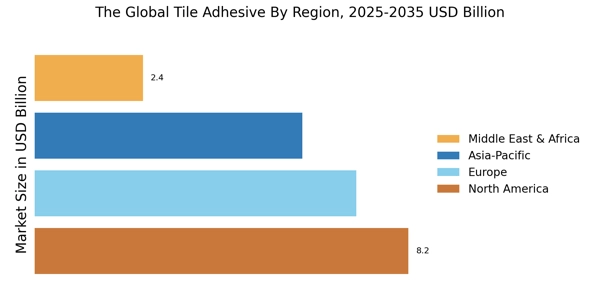
The North American tile adhesive market, valued at $4.69 billion, is driven by increasing construction activities and a growing trend towards home renovations. Regulatory support for sustainable building practices is also a catalyst for market growth. The demand for high-performance adhesives is rising, particularly in the residential sector, as consumers seek durable and eco-friendly options. Leading countries in this region include the US and Canada, where major players like Laticrete International Inc and Henkel AG & Co. KGaA dominate the market. The competitive landscape is characterized by innovation and strategic partnerships, with companies focusing on product development to meet evolving consumer needs. The presence of established brands ensures a robust supply chain and distribution network.

Europe : Diverse Market with Innovation Focus

Europe's tile adhesive market, valued at €6.98 billion, is characterized by a strong emphasis on innovation and sustainability. The region is witnessing a shift towards eco-friendly products, driven by stringent regulations and consumer demand for greener solutions. Countries like Germany and France are leading this trend, contributing significantly to market growth. The increasing adoption of advanced technologies in construction is also a key driver. Germany, France, and Italy are the leading countries in this market, with key players such as Mapei S.p.A. and Bostik at the forefront. The competitive landscape is marked by a focus on R&D, with companies investing heavily in developing new formulations that enhance performance and reduce environmental impact. This innovation-centric approach positions Europe as a leader in the tile adhesive market.

Asia-Pacific : Rapid Growth and Market Leadership

The Asia-Pacific region dominates the tile adhesive market with a valuation of $10.8 billion, driven by rapid urbanization and infrastructure development. Countries like China and India are experiencing significant growth in construction activities, leading to increased demand for tile adhesives. The region's market is also supported by favorable government policies aimed at boosting the construction sector. China is the largest market, followed by India and Japan, with key players like Sika AG and Ardex GmbH leading the competitive landscape. The presence of numerous local manufacturers further intensifies competition, driving innovation and price competitiveness. As the region continues to grow, the focus on high-quality and durable adhesive solutions is becoming increasingly important.

Middle East and Africa : Emerging Market with Growth Opportunities

The Middle East and Africa (MEA) tile adhesive market, valued at $1.98 billion, is on the rise due to increasing construction projects and urban development initiatives. The region is witnessing a surge in demand for tile adhesives, driven by infrastructure investments and a growing real estate sector. Regulatory frameworks promoting sustainable construction practices are also contributing to market growth. Leading countries in this region include the UAE and South Africa, where key players like Weber and Fischer are making significant inroads. The competitive landscape is evolving, with both international and local companies vying for market share. As the region continues to develop, the focus on innovative and high-performance adhesive solutions is expected to grow.

Tile Adhesive Market Regional Image

Key Players and Competitive Insights

The Tile Adhesive Market is currently characterized by a dynamic competitive landscape, driven by increasing construction activities and a growing demand for innovative adhesive solutions. Key players such as Laticrete International Inc (US), Mapei S.p.A. (IT), and Henkel AG & Co. KGaA (DE) are strategically positioned to leverage their extensive product portfolios and technological advancements. Laticrete International Inc (US) focuses on innovation, particularly in eco-friendly products, while Mapei S.p.A. (IT) emphasizes regional expansion and partnerships to enhance its market presence. Henkel AG & Co. KGaA (DE) is actively pursuing digital transformation initiatives to streamline operations and improve customer engagement. Collectively, these strategies contribute to a competitive environment that is increasingly centered around sustainability and technological integration.

In terms of business tactics, companies are localizing manufacturing to reduce lead times and optimize supply chains. The market structure appears moderately fragmented, with several key players holding substantial market shares. This fragmentation allows for a diverse range of products and innovations, fostering competition among established brands and new entrants alike. The collective influence of these key players shapes market dynamics, as they continuously adapt to evolving consumer preferences and regulatory requirements.

In January 2026, Laticrete International Inc (US) announced the launch of a new line of eco-friendly tile adhesives designed to meet stringent environmental standards. This strategic move not only aligns with global sustainability trends but also positions Laticrete as a leader in the green building materials sector. The introduction of these products is likely to enhance customer loyalty and attract environmentally conscious consumers, thereby strengthening the company's market position.

In December 2025, Mapei S.p.A. (IT) expanded its manufacturing capabilities in Eastern Europe by opening a new facility in Poland. This expansion is significant as it allows Mapei to better serve the growing demand in the region while reducing transportation costs. The strategic location of the new plant is expected to enhance operational efficiency and improve supply chain responsiveness, ultimately benefiting Mapei's competitive edge in the market.

In November 2025, Henkel AG & Co. KGaA (DE) entered into a strategic partnership with a leading technology firm to integrate AI-driven solutions into its production processes. This collaboration aims to enhance product quality and optimize resource management. By leveraging AI, Henkel is likely to improve its operational efficiency and reduce costs, which could translate into a stronger market position as competition intensifies.

As of February 2026, current trends in the Tile Adhesive Market indicate a pronounced shift towards digitalization, sustainability, and AI integration. Strategic alliances are increasingly shaping the competitive landscape, enabling companies to pool resources and expertise. The focus appears to be shifting from price-based competition to differentiation through innovation, technology, and supply chain reliability. As these trends continue to evolve, companies that prioritize sustainable practices and technological advancements are likely to emerge as leaders in the market.

Key Companies in the Tile Adhesive Market include

Industry Developments

In February 2021, Laticrete introduced a glass tile and mosaic tile adhesive mortar onto the market. Glass Tile Adhesive Market Lite has been specially formulated to provide excellent adhesion for all glass tile applications, whether indoors or outdoors, on pools, spas, showers, and so on. Glass Tile Adhesive Market Lite meets the highest standard for polymer-modified adhesives.

In 2022, Sika AG set the market with its ground-breaking No-Slake tile adhesives. Tile professionals can benefit from shorter project timelines for all of SikaTile's Dustless Technology affiliated with tile installation jobs when these two innovations come together.

In March 2022, Bostik concluded a distribution agreement with DGE for Europe, the Middle East and Africa. The agreement entered into force as of January 2022 includes the engineering adhesives by Born2BondTM designed to 'by-the-dot' bonding applications in selected areas such as automotive, electronics, luxury packaging, medical devices and MRO, as well as Bostik’s Industrial Adhesives & Sealants used in manufacturing and assembling of components in various industries.

In Feb 2022, Arkema completed the acquisition of the Performance Adhesives business of Ashland, a very strong player in the US high-performance adhesives market. This operation represents an important milestone in Arkema's expanding the Adhesive Solutions segment and fits well within the Group's roadmap to become a pure Specialty Materials player in 2024.

In August 2021, Sika completed the purchase of Bexel International S.A. de C.V., which has a commanding market share in the manufacture of tile adhesives and stuccos in Mexico. The acquisition enhanced Sika's existing strengths in the large, fast-developing Mexican construction industry and also greatly diversified its manufacturing base.

In January 2021, Mapei South Africa broadened its range of C2 tile adhesives, adding a new member to the Kerabond family. Kerabond Plus is a C2E class cementitious, improved adhesion-enhanced open-time adhesive for ceramic and porcelain tiles. It is suitable for bonding all kinds of tiles (ceramic, porcelain, single-fired, terracotta, double-fired, Klinker, etc.) and mosaics on internal and external substrates.

Future Outlook

Tile Adhesive Market Future Outlook

The Tile Adhesive Market is projected to grow at a 13.5% CAGR from 2024 to 2035, driven by increasing construction activities, technological advancements, and rising demand for eco-friendly products.

New opportunities lie in:

  • Expansion into emerging markets with tailored adhesive solutions.
  • Development of smart adhesive technologies for enhanced performance.
  • Partnerships with construction firms for integrated supply chain solutions.

By 2035, the Tile Adhesive Market is expected to achieve robust growth and innovation.

Market Segmentation

Tile Adhesive Market Type Outlook

  • Cementitious
  • Reactive
  • Dispersion
  • Hybrid
  • Others

Tile Adhesive Market End Use Outlook

  • Residential
  • Commercial
  • Industrial
  • Institutional
  • Infrastructure

Tile Adhesive Market Application Outlook

  • Flooring
  • Wall Tiling
  • Countertops
  • Ceiling
  • Outdoor

Report Scope

MARKET SIZE 202423.45(USD Billion)
MARKET SIZE 202526.62(USD Billion)
MARKET SIZE 203594.45(USD Billion)
COMPOUND ANNUAL GROWTH RATE (CAGR)13.5% (2024 - 2035)
REPORT COVERAGERevenue Forecast, Competitive Landscape, Growth Factors, and Trends
BASE YEAR2024
Market Forecast Period2025 - 2035
Historical Data2019 - 2024
Market Forecast UnitsUSD Billion
Key Companies ProfiledLaticrete International Inc (US), Bostik (FR), Mapei S.p.A. (IT), Henkel AG & Co. KGaA (DE), Sika AG (CH), Ardex GmbH (DE), Weber (FR), Fischer (DE), Dunlop Adhesives (GB), Raimondi (IT)
Segments CoveredApplication, Type, End Use
Key Market OpportunitiesGrowing demand for eco-friendly and high-performance tile adhesives presents significant opportunities in the Tile Adhesive Market.

Key Market DynamicsRising demand for eco-friendly tile adhesives drives innovation and competition among manufacturers in the market.
Countries CoveredNorth America, Europe, APAC, South America, MEA

Market Highlights

Author
Anshula Mandaokar
Team Lead - Research

Anshula Mandaokar holds an academic degree in Chemical Engineering and has been contributing to the field for more than 5 years. She has expertise in Market Research and Business Consulting and serves as a Team Lead for a reputed Market Research firm under the Chemicals and Materials domain spectrum. She has worked on multiple projects, generating explicit results in a quick turnaround time. Her understanding of data interpretation justifies her role as a leader.

Leave a Comment

FAQs

What is the current valuation of the US tile adhesive market?

The US tile adhesive market was valued at 3.52 USD Billion in 2024.

What is the projected market valuation for the US tile adhesive market by 2035?

The projected valuation for the US tile adhesive market is 12.48 USD Billion by 2035.

What is the expected CAGR for the US tile adhesive market during the forecast period?

The expected CAGR for the US tile adhesive market during the forecast period 2025 - 2035 is 12.2%.

Which segment of the US tile adhesive market had the highest valuation in 2024?

In 2024, the Flooring segment had the highest valuation at 1.05 USD Billion.

What are the key players in the US tile adhesive market?

Key players in the US tile adhesive market include Laticrete International, Mapei Corporation, and Custom Building Products.

How does the Commercial segment compare to the Residential segment in terms of market valuation?

In 2024, the Commercial segment was valued at 1.15 USD Billion, slightly higher than the Residential segment at 1.05 USD Billion.

What is the valuation of the Swimming Pool segment in 2024?

The Swimming Pool segment was valued at 0.47 USD Billion in 2024.

Download Free Sample

Kindly complete the form below to receive a free sample of this Report

Compare Licence

×
Features License Type
Single User Multiuser License Enterprise User
Price $4,950 $5,950 $7,250
Maximum User Access Limit 1 User Upto 10 Users Unrestricted Access Throughout the Organization
Free Customization
Direct Access to Analyst
Deliverable Format
Platform Access
Discount on Next Purchase 10% 15% 15%
Printable Versions