×
Request Free Sample ×

Kindly complete the form below to receive a free sample of this Report

* Please use a valid business email

Leading companies partner with us for data-driven Insights

clients tt-cursor
Hero Background
English
Chinese
French
Japanese
Korean
German
Spanish

Throat Cancer Market Trends

ID: MRFR/Pharma/1260-HCR
80 Pages
Kinjoll Dey
October 2025

Throat Cancer Market Research Report Information, by Types (Pharyngeal Cancer and Laryngeal Cancer), Treatments (Surgery, Radiation Therapy, Chemotherapy, Others) - Growth & Industry Forecast 2025 To 2035.

Share:
Download PDF ×

We do not share your information with anyone. However, we may send you emails based on your report interest from time to time. You may contact us at any time to opt-out.

Throat Cancer Market Infographic
×
Throat Cancer Market Infographic Full View
Purchase Options

Market Trends

Key Emerging Trends in the Throat Cancer Market

The throat cancer treatment market is growing due to rising global throat cancer diagnoses. Tobacco, alcohol, HPV infections, and environmental exposures increase throat cancer risk. Thus, effective and evolving therapy options are needed. Today, throat cancer surgery is advancing. Minimally invasive, robotic-assisted, and organ-preserving surgeries enhance patient outcomes by reducing complications, scarring, and recovery time. Radiation therapy innovations are changing throat cancer treatment. Advanced technologies like intensity-modulated radiation treatment (IMRT) and proton therapy may precisely target cancer cells without harming nearby healthy tissues. This enhances therapeutic effectiveness and lowers side effects. Immunotherapy for throat cancer seems promising. Checkpoint inhibitors and other immunotherapeutic medicines are being studied for their capacity to increase cancer cell detection and combat. New therapies would be available, particularly in cases when standard treatments are limited. Targeted throat cancer drugs are being studied and developed by pharmaceutical companies. These medicines target cancer-related cellular pathways, unlike traditional chemotherapy. Thus, they provide more effective, patient-specific, and safer therapeutic options. Multiple therapies are becoming increasingly prevalent for throat cancer treatment. Researchers are considering combining immunotherapy, chemotherapy, radiation therapy, and surgery to better treatment, results, and understanding throat cancer subtypes. Increased screening and early detection initiatives are affecting throat cancer treatment sales. Public health initiatives and awareness campaigns aim to diagnose throat cancer early, while it's treatable. This will enable early intervention and improve prognosis. In throat cancer therapy, patient-centered care and supportive therapies are becoming more important. Holistic therapy include food aid, pain management, and psychiatric counseling enhance patients' quality of life during and after treatment. Telemedicine and remote monitoring are being used to treat throat cancer. Digital health platforms, remote follow-ups, and virtual consultations increase patient access to healthcare. Patients in underserved or remote areas benefit from this. Genomic analysis and customized medication are being used to treat throat cancer. Tumor genetics uncover therapeutic targets, enabling customized cancer therapy. Research partnerships between hospitals and pharmaceutical businesses are improving throat cancer treatment. These partnerships seek to speed medication development, conduct large-scale clinical studies, and exchange information to advance throat cancer knowledge and treatment.

Author
Kinjoll Dey
Research Analyst Level I

He is an extremely curious individual currently working in Healthcare and Medical Devices Domain. Kinjoll is comfortably versed in data centric research backed by healthcare educational background. He leverages extensive data mining and analytics tools such as Primary and Secondary Research, Statistical Analysis, Machine Learning, Data Modelling. His key role also involves Technical Sales Support, Client Interaction and Project management within the Healthcare team. Lastly, he showcases extensive affinity towards learning new skills and remain fascinated in implementing them.

Leave a Comment

FAQs

How does the outlook of the throat cancer market look like?

The outlook of throat cancer market looks very promising.

What are the major tailwinds pushing the growth of the throat cancer market?

Rising prevalence of throat cancer and the emergence of new drugs and therapies for the treatment are the major tailwinds pushing the growth of the global throat cancer market.

Which region holds the largest share in the throat cancer market?

North America holds the largest share in the global throat cancer market, followed by Europe and the Asia Pacific, respectively.

Who are the top players in the throat cancer market?

Bristol-Myers Squibb, Amgen Inc., Celgene Corporation, Engeneic Ltd, Eli Lilly and Company, F. Hoffmann-la Roche AG, Novartis, Merck & Co., Inc., Pfizer Inc., and Teva Pharmaceutical Industries Ltd., are some of the major players operating in the throat cancer market.

What are the key growth strategies of throat cancer industry players?

Strategic initiatives such as mergers & acquisitions, collaborations, expansion, and technology/ product launch are some of the growth strategies that players operating in the global throat cancer market adopt to gain a larger competitive advantage.

Market Summary

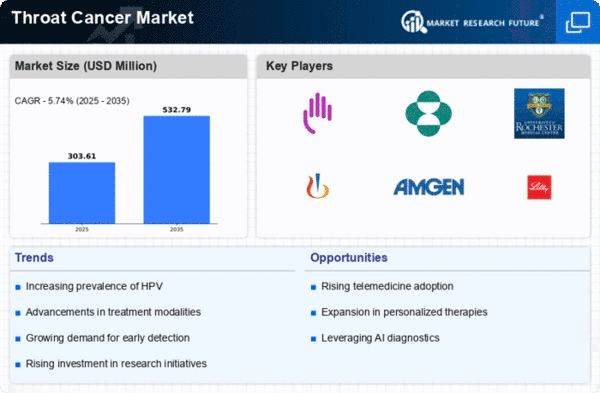
As per MRFR analysis, the Throat Cancer Market Size was estimated at 287.13 USD Million in 2024. The Throat Cancer industry is projected to grow from 306.9 USD Million in 2025 to 532.79 USD Million by 2035, exhibiting a compound annual growth rate (CAGR) of 5.74 during the forecast period 2025 - 2035.

Key Market Trends & Highlights

The Throat Cancer Market is experiencing significant growth driven by advancements in treatment and increasing awareness.

  • The market is witnessing advancements in treatment modalities, particularly in North America, which remains the largest market.
  • Integration of artificial intelligence is enhancing diagnostic accuracy and treatment planning across the Asia-Pacific region, the fastest-growing market.
  • There is a notable shift towards personalized medicine, especially in the squamous cell carcinoma segment, which dominates the market.
  • The rising incidence of throat cancer and increased funding for cancer research are key drivers propelling market expansion.

Market Size & Forecast

2024 Market Size 287.13 (USD Million)
2035 Market Size 532.79 (USD Million)
CAGR (2025 - 2035) 5.74%
Largest Regional Market Share in 2024 North America

Major Players

<p>Bristol-Myers Squibb (US), Merck & Co. (US), Roche (CH), Novartis (CH), Amgen (US), Eli Lilly and Company (US), AstraZeneca (GB), Pfizer (US), Sanofi (FR)</p>

Market Trends

The Throat Cancer Market is currently experiencing a notable evolution, driven by advancements in diagnostic techniques and treatment modalities. The increasing prevalence of throat cancer, attributed to factors such as tobacco use and human papillomavirus (HPV) infection, has prompted a surge in research and development efforts. Pharmaceutical companies are actively exploring innovative therapies, including targeted treatments and immunotherapies, which appear to enhance patient outcomes. Furthermore, the integration of artificial intelligence in diagnostic processes is likely to improve early detection rates, thereby potentially increasing survival rates among patients. In addition to therapeutic advancements, the Throat Cancer Market is witnessing a shift towards personalized medicine. This approach tailors treatment plans based on individual patient profiles, which may lead to more effective interventions. The growing awareness of throat cancer symptoms and risk factors among the general population is also contributing to earlier diagnoses. As healthcare systems worldwide adapt to these changes, the Throat Cancer Market is poised for continued growth, reflecting a commitment to improving patient care and outcomes.

Advancements in Treatment Modalities

The Throat Cancer Market is seeing a rise in innovative treatment options, including targeted therapies and immunotherapies. These advancements are designed to improve efficacy and minimize side effects, potentially leading to better patient outcomes.

Integration of Artificial Intelligence

The incorporation of artificial intelligence in diagnostic processes is transforming the Throat Cancer Market. AI technologies are enhancing early detection capabilities, which may significantly impact survival rates and treatment success.

Shift Towards Personalized Medicine

There is a growing trend towards personalized medicine within the Throat Cancer Market. Tailoring treatment plans to individual patient characteristics is likely to result in more effective interventions and improved patient satisfaction.

Throat Cancer Market Market Drivers

Growing Geriatric Population

The aging global population is a significant factor influencing the Global Throat Cancer Market Industry. As individuals age, the risk of developing throat cancer increases, particularly among those with a history of tobacco and alcohol use. According to demographic studies, the proportion of individuals aged 65 and older is expected to rise substantially in the coming years. This demographic shift is likely to result in a higher incidence of throat cancer, thereby driving market growth. The industry must adapt to cater to this growing population, ensuring access to appropriate care and treatment options.

Rising Incidence of Throat Cancer

The Global Throat Cancer Market Industry is experiencing growth due to the increasing incidence of throat cancer worldwide. Factors such as smoking, alcohol consumption, and the human papillomavirus (HPV) are contributing to this rise. For instance, the World Health Organization indicates that throat cancer cases are expected to increase, leading to a projected market value of 3.0 USD Billion in 2024. This growing prevalence necessitates enhanced diagnostic and therapeutic solutions, thereby driving demand within the industry.

Advancements in Treatment Modalities

Innovations in treatment modalities are significantly influencing the Global Throat Cancer Market Industry. The development of targeted therapies, immunotherapies, and minimally invasive surgical techniques has improved patient outcomes. For example, the introduction of immunotherapy has shown promising results in clinical trials, leading to higher survival rates. As these advanced treatments become more widely adopted, the market is projected to grow, potentially reaching 6.14 USD Billion by 2035. This evolution in treatment options is likely to attract investment and research, further propelling the industry forward.

Emerging Markets and Economic Growth

Emerging markets are becoming increasingly important in the Global Throat Cancer Market Industry. Countries with developing healthcare infrastructures are witnessing a rise in throat cancer cases due to lifestyle changes and increased exposure to risk factors. Economic growth in these regions is facilitating investments in healthcare, leading to improved access to diagnostics and treatment. As these markets expand, they present lucrative opportunities for industry stakeholders. The anticipated growth in these regions is expected to contribute to the overall market expansion, aligning with the projected increase in market value.

Market Trends and Growth Projections

Charts illustrating the projected growth trajectory of the Global Throat Cancer Market Industry indicate a steady increase in market value from 2024 to 2035. The market is expected to grow from 3.0 USD Billion in 2024 to 6.14 USD Billion by 2035, reflecting a compound annual growth rate of 6.71% during the period from 2025 to 2035. These trends highlight the industry's response to rising incidence rates, advancements in treatment options, and the growing awareness of throat cancer.

Increased Awareness and Screening Programs

Heightened awareness of throat cancer and the implementation of screening programs are pivotal drivers in the Global Throat Cancer Market Industry. Public health initiatives aimed at educating populations about risk factors and early detection are crucial. For instance, campaigns promoting HPV vaccinations and regular screenings have been shown to reduce incidence rates. As awareness grows, more individuals seek medical attention, leading to earlier diagnoses and improved treatment outcomes. This trend is expected to contribute to a compound annual growth rate of 6.71% from 2025 to 2035, reflecting the industry's response to increased demand.

Market Segment Insights

By Type of Throat Cancer: Squamous Cell Carcinoma (Largest) vs. Adenocarcinoma (Fastest-Growing)

<p>In the throat cancer market, Squamous Cell Carcinoma (SCC) stands out as the largest segment, primarily due to its high prevalence and aggressive nature. This type accounts for a significant majority of throat cancer cases, making it a focal point for treatment innovations and drug development. On the other hand, Adenocarcinoma, though less common than SCC, is rapidly gaining traction as a significant concern owing to its rising incidence rates, particularly among specific demographics and associated risk factors.</p>

<p>Squamous Cell Carcinoma (Dominant) vs. Adenocarcinoma (Emerging)</p>

<p>Squamous Cell Carcinoma (SCC) remains the dominant type of throat cancer, characterized by its origins in the squamous cells lining the throat and often linked to tobacco and alcohol use. Its aggressive nature necessitates advanced treatment approaches, including surgery, radiation, and chemotherapy, which fosters ongoing research and development. Conversely, Adenocarcinoma is emerging as a noteworthy type of throat cancer, originating from glandular tissue. This variant is increasingly recognized for its unique risk factors and treatment challenges, prompting a shift in clinical focus toward personalized therapies and improved diagnosis methods.</p>

By Treatment Modality: Surgery (Largest) vs. Radiation Therapy (Fastest-Growing)

<p>In the Throat Cancer Market, the treatment modality segment is primarily dominated by Surgery, which has secured a significant share due to its effectiveness in early-stage cancers. Following closely are Radiation Therapy and Chemotherapy, both essential in various treatment plans, especially for advanced and recurrent cases. Targeted Therapy, although smaller in share, is gaining traction as personalized medicine becomes more prevalent among oncologists.</p>

<p>Surgery (Dominant) vs. Targeted Therapy (Emerging)</p>

<p>Surgery remains the dominant treatment option in the Throat Cancer Market due to its immediate efficacy and potential for complete removal of tumors. This modality is often preferred for localized tumors and contributes significantly to patient survival rates. In contrast, Targeted Therapy is emerging as a promising and innovative approach, focusing on specific cancer cell abnormalities. This has led to improved outcomes for certain patient groups, particularly those with specific genetic markers. As research evolves, Targeted Therapy is increasingly integrated into treatment protocols, offering less invasive options with tailored approaches, making it an attractive alternative for patients seeking precision medicine.</p>

By Stage of Cancer: Localized (Largest) vs. Distant (Fastest-Growing)

<p>In the Throat Cancer Market, the distribution of cases by stage reveals that localized throat cancer holds the largest market share, largely due to early detection and increased awareness programs. Regional cases follow, reflecting the growing incidence rates attributed to environmental and lifestyle factors. Distant stage cases, while currently a smaller segment, are emerging as a crucial area for research and intervention given their rising prevalence in recent years.</p>

<p>Localized (Dominant) vs. Distant (Emerging)</p>

<p>Localized throat cancer represents the dominant segment in the market, benefiting from advancements in early diagnosis and targeted therapies that significantly improve patient outcomes. This category is often associated with lower severity, leading to more favorable treatment success rates. In contrast, distant throat cancer is an emerging segment with a growing focus from healthcare providers, driven by an increasing number of patients presenting with advanced disease. The complexity and urgency of treating distant cases have prompted innovation in therapeutic strategies, making it a key area for investment and research as demand for effective interventions rises.</p>

By Patient Demographics: Age Group (Largest) vs. Socioeconomic Status (Fastest-Growing)

<p>In the Throat Cancer Market, the distribution of patient demographics reveals distinct patterns among age groups, gender, and socioeconomic status. The largest share is held by older age groups, particularly those aged 50 and above, who account for a significant portion of throat cancer cases. Conversely, younger populations, while having a smaller representation, are increasingly being diagnosed, highlighting shifts in incidence rates across demographics. Gender-wise, there is a notable prevalence in males, yet an emerging trend shows increased awareness and diagnosis among females as healthcare access improves. Growth trends in the Throat Cancer Market are significantly influenced by changes in patient demographics. The aging population is a primary driver, as older individuals are more prone to throat cancer due to cumulative risk factors such as smoking and alcohol consumption. Meanwhile, the fastest-growing demographic segment appears to be younger individuals and women, driven by heightened public health campaigns and increased screenings. This evolving landscape requires healthcare providers to adapt their approaches to cater to these emerging patient demographics, ensuring that treatment and preventative strategies are appropriately targeted to all affected age groups and genders.</p>

<p>Age Group: 50+ (Dominant) vs. Gender: Female (Emerging)</p>

<p>In the Throat Cancer Market, individuals aged 50 and above represent the dominant demographic, characterized by higher incidence rates due to historical lifestyle factors such as smoking and alcohol use. This age group faces a higher burden of disease, necessitating specialized treatment approaches and supportive care tailored to their needs. On the other hand, the emerging female demographic is gaining attention as awareness around throat cancer increases. Younger women, in particular, are rapidly being diagnosed, reflecting not only improved detection methods but also changes in risk exposure. Female patients often seek early interventions, driven by greater health literacy and access to resources, making this group crucial for future market growth and targeted health initiatives.</p>

Get more detailed insights about Throat Cancer Market Research Report- Forecast to 2035

Regional Insights

North America : Market Leader in Innovation

North America is poised to maintain its leadership in the throat cancer market, holding a significant market share of $143.56 million as of 2024. The region benefits from advanced healthcare infrastructure, high R&D investments, and a growing prevalence of throat cancer, driven by lifestyle factors and increased awareness. Regulatory support for innovative therapies and a robust pipeline of new treatments further catalyze market growth, making it a focal point for stakeholders. The competitive landscape in North America is characterized by the presence of major pharmaceutical companies such as Bristol-Myers Squibb, Merck & Co., and Pfizer. These key players are actively engaged in developing novel therapies and expanding their market reach. The U.S. remains the leading country, supported by favorable reimbursement policies and a strong emphasis on clinical trials, ensuring a steady influx of innovative treatment options for patients.

Europe : Emerging Market with Potential

Europe's throat cancer market is valued at $85.0 million, reflecting a growing demand for effective treatment options. The region is witnessing an increase in throat cancer cases, attributed to factors such as smoking and HPV infections. Regulatory bodies are actively promoting research and development, which is expected to enhance treatment accessibility and affordability. Collaborative efforts among EU member states aim to streamline approval processes for new therapies, further driving market growth. Leading countries in Europe include Germany, France, and the UK, where significant investments in healthcare infrastructure are evident. The competitive landscape features key players like Roche and Novartis, who are focusing on innovative therapies and personalized medicine. The European market is also characterized by strategic partnerships and collaborations aimed at enhancing treatment outcomes and expanding patient access to cutting-edge therapies.

Asia-Pacific : Rapidly Growing Market

The Asia-Pacific throat cancer market, valued at $45.0 million, is experiencing rapid growth driven by increasing awareness and rising incidence rates. Factors such as urbanization, changing lifestyles, and dietary habits contribute to the rising prevalence of throat cancer. Governments in the region are implementing initiatives to improve healthcare access and promote early detection, which are crucial for market expansion. Regulatory frameworks are evolving to support the introduction of new therapies, enhancing the overall treatment landscape. Countries like China, India, and Japan are leading the market, with significant investments in healthcare infrastructure and research. The competitive landscape is marked by the presence of both global and local players, including Amgen and Eli Lilly. These companies are focusing on expanding their product portfolios and enhancing distribution networks to cater to the growing demand for effective throat cancer treatments.

Middle East and Africa : Untapped Market Potential

The Middle East and Africa (MEA) throat cancer market, valued at $13.57 million, presents untapped potential for growth. The region faces challenges such as limited healthcare access and varying levels of awareness regarding throat cancer. However, increasing government initiatives aimed at improving healthcare infrastructure and raising awareness about cancer prevention are expected to drive market growth. Regulatory bodies are beginning to focus on streamlining processes for new drug approvals, which will enhance treatment availability. Leading countries in the MEA region include South Africa and the UAE, where healthcare investments are on the rise. The competitive landscape is gradually evolving, with both local and international players looking to establish a foothold. Companies are focusing on educational campaigns and partnerships with healthcare providers to improve patient access to innovative therapies and treatment options.

Key Players and Competitive Insights

The throat cancer market is characterized by a dynamic competitive landscape, driven by advancements in treatment modalities and increasing awareness of the disease. Key players such as Bristol-Myers Squibb (US), Merck & Co. (US), and Roche (CH) are at the forefront, each adopting distinct strategies to enhance their market presence. Bristol-Myers Squibb (US) focuses on innovative immunotherapy solutions, while Merck & Co. (US) emphasizes its robust pipeline of targeted therapies. Roche (CH) is leveraging its expertise in diagnostics to complement its therapeutic offerings, thereby creating a comprehensive approach to throat cancer treatment. Collectively, these strategies contribute to a competitive environment that is increasingly centered on innovation and patient-centric solutions.

In terms of business tactics, companies are localizing manufacturing and optimizing supply chains to enhance efficiency and responsiveness to market demands. The throat cancer market appears moderately fragmented, with several players vying for market share. However, the influence of major companies is substantial, as they set trends in research and development, regulatory compliance, and market access strategies, thereby shaping the overall market structure.

In November 2025, Merck & Co. (US) announced a strategic partnership with a leading biotechnology firm to co-develop a novel immunotherapy for throat cancer. This collaboration is expected to accelerate the development timeline and enhance the therapeutic options available to patients. The strategic importance of this partnership lies in its potential to combine resources and expertise, thereby increasing the likelihood of successful clinical outcomes and market penetration.

In October 2025, Roche (CH) launched a new diagnostic tool aimed at early detection of throat cancer, which is anticipated to significantly improve patient outcomes. This initiative underscores Roche's commitment to integrating diagnostics with treatment, thereby positioning the company as a leader in comprehensive cancer care. The launch is likely to enhance Roche's competitive edge by providing healthcare professionals with critical tools for timely intervention.

In December 2025, Bristol-Myers Squibb (US) expanded its clinical trial program for a promising new therapy targeting throat cancer, reflecting its ongoing commitment to innovation. This expansion is strategically important as it not only broadens the company's research portfolio but also reinforces its position in the market as a pioneer in developing cutting-edge therapies. The focus on clinical trials may lead to breakthroughs that could redefine treatment paradigms in the coming years.

As of December 2025, current trends in the throat cancer market include a pronounced shift towards digitalization, sustainability, and the integration of artificial intelligence in treatment protocols. Strategic alliances are increasingly shaping the competitive landscape, enabling companies to pool resources and expertise. Looking ahead, competitive differentiation is likely to evolve from traditional price-based competition to a focus on innovation, technological advancements, and supply chain reliability. This shift suggests that companies that prioritize research and development, alongside strategic partnerships, will be better positioned to thrive in the evolving market.

Key Companies in the Throat Cancer Market include

Industry Developments

The European Commission awarded eTheRNA, a Belgian immunotherapy business, a EUR 6.9 million grant to speed the clinical development of mRNA-based vaccinations for throat cancer.

Moderna Inc. released interim results from the expansion cohort of its ongoing Phase 1 study of its mRNA personalized cancer vaccine (PCV) mRNA-4157 in combination with Merck's Keytruda, showing that the vaccine candidate is well tolerated at all dose levels and produces responses as measured by tumor shrinkage in HPV (-)Head and Neck Squamous Cell Carcinoma (HNSCC) patients.


Future Outlook

Throat Cancer Market Future Outlook

<p>The Throat Cancer Market is projected to grow at a 5.74% CAGR from 2024 to 2035, driven by advancements in treatment technologies and increasing awareness.</p>

New opportunities lie in:

  • <p>Development of personalized immunotherapy treatments for throat cancer patients.</p>
  • <p>Expansion of telemedicine services for remote patient monitoring and consultations.</p>
  • <p>Investment in AI-driven diagnostic tools to enhance early detection rates.</p>

<p>By 2035, the Throat Cancer Market is expected to achieve substantial growth and innovation.</p>

Market Segmentation

Throat Cancer Market Stage of Cancer Outlook

  • Localized
  • Regional
  • Distant

Throat Cancer Market Treatment Modality Outlook

  • Surgery
  • Radiation Therapy
  • Chemotherapy
  • Targeted Therapy

Throat Cancer Market Patient Demographics Outlook

  • Age Group
  • Gender
  • Socioeconomic Status

Throat Cancer Market Type of Throat Cancer Outlook

  • Squamous Cell Carcinoma
  • Adenocarcinoma
  • Lymphoma
  • Sarcoma

Report Scope

MARKET SIZE 2024287.13(USD Million)
MARKET SIZE 2025306.9(USD Million)
MARKET SIZE 2035532.79(USD Million)
COMPOUND ANNUAL GROWTH RATE (CAGR)5.74% (2024 - 2035)
REPORT COVERAGERevenue Forecast, Competitive Landscape, Growth Factors, and Trends
BASE YEAR2024
Market Forecast Period2025 - 2035
Historical Data2019 - 2024
Market Forecast UnitsUSD Million
Key Companies ProfiledBristol-Myers Squibb (US), Merck & Co. (US), Roche (CH), Novartis (CH), Amgen (US), Eli Lilly and Company (US), AstraZeneca (GB), Pfizer (US), Sanofi (FR)
Segments CoveredType of Throat Cancer, Treatment Modality, Stage of Cancer, Patient Demographics
Key Market OpportunitiesAdvancements in targeted therapies and immunotherapies enhance treatment options in the Throat Cancer Market.
Key Market DynamicsRising demand for innovative therapies drives competitive dynamics in the throat cancer treatment market.
Countries CoveredNorth America, Europe, APAC, South America, MEA

FAQs

How does the outlook of the throat cancer market look like?

The outlook of throat cancer market looks very promising.

What are the major tailwinds pushing the growth of the throat cancer market?

Rising prevalence of throat cancer and the emergence of new drugs and therapies for the treatment are the major tailwinds pushing the growth of the global throat cancer market.

Which region holds the largest share in the throat cancer market?

North America holds the largest share in the global throat cancer market, followed by Europe and the Asia Pacific, respectively.

Who are the top players in the throat cancer market?

Bristol-Myers Squibb, Amgen Inc., Celgene Corporation, Engeneic Ltd, Eli Lilly and Company, F. Hoffmann-la Roche AG, Novartis, Merck &amp; Co., Inc., Pfizer Inc., and Teva Pharmaceutical Industries Ltd., are some of the major players operating in the throat cancer market.

What are the key growth strategies of throat cancer industry players?

Strategic initiatives such as mergers &amp; acquisitions, collaborations, expansion, and technology/ product launch are some of the growth strategies that players operating in the global throat cancer market adopt to gain a larger competitive advantage.

  1. SECTION I: EXECUTIVE SUMMARY AND KEY HIGHLIGHTS
    1. | 1.1 EXECUTIVE SUMMARY
  2. SECTION II: SCOPING, METHODOLOGY AND MARKET STRUCTURE
    1. | 2.1 MARKET INTRODUCTION
    2. | 2.2 RESEARCH METHODOLOGY
  3. SECTION III: QUALITATIVE ANALYSIS
    1. | 3.1 MARKET DYNAMICS
    2. | 3.2 MARKET FACTOR ANALYSIS
  4. SECTION IV: QUANTITATIVE ANALYSIS
    1. | 4.1 Healthcare, BY Type of Throat Cancer (USD Million)
    2. | 4.2 Healthcare, BY Treatment Modality (USD Million)
    3. | 4.3 Healthcare, BY Stage of Cancer (USD Million)
    4. | 4.4 Healthcare, BY Patient Demographics (USD Million)
    5. | 4.5 Healthcare, BY Region (USD Million)
  5. SECTION V: COMPETITIVE ANALYSIS
    1. | 5.1 Competitive Landscape
    2. | 5.2 Company Profiles
    3. | 5.3 Appendix

Throat Cancer Market Segmentation

Market Segmentation Overview

  • Detailed segmentation data will be available in the full report
  • Comprehensive analysis by multiple parameters
  • Regional and country-level breakdowns
  • Market size forecasts by segment
Infographic

Free Sample Request

Kindly complete the form below to receive a free sample of this Report

Get Free Sample

Customer Strories

Compare Licence

×
Features License Type
Single User Multiuser License Enterprise User
Price $4,950 $5,950 $7,250
Maximum User Access Limit 1 User Upto 10 Users Unrestricted Access Throughout the Organization
Free Customization
Direct Access to Analyst
Deliverable Format
Platform Access
Discount on Next Purchase 10% 15% 15%
Printable Versions