×
Request Free Sample ×

Kindly complete the form below to receive a free sample of this Report

* Please use a valid business email

Leading companies partner with us for data-driven Insights

clients tt-cursor
Hero Background
English
Chinese
French
Japanese
Korean
German
Spanish

Structural Sealant Market Analysis

ID: MRFR/CnM/2907-CR
144 Pages
Anshula Mandaokar
January 2018

Structural Sealants Market Research Report Information by Resin Type (Silicon, PS, PU, Acrylic, and Others), End Use Industry (building & construction, automotive, marine & aerospace and general industry) by Region– Forecast till 2035

Share:
Download PDF ×

We do not share your information with anyone. However, we may send you emails based on your report interest from time to time. You may contact us at any time to opt-out.

Structural Sealant Market Infographic
×
Structural Sealant Market Infographic Full View
Purchase Options

Market Analysis

Structural Sealants Market (Global, 2023)

Introduction

The structural sealants market is slated to play a crucial role in a number of industries, such as construction, automobile, and aeronautics, as the demand for durable and efficient bonding solutions continues to rise. Structural sealants are the materials that are used to ensure that structures and products remain airtight and watertight. With the advent of new technology and material science, the market has witnessed a shift towards the use of high-performance sealants, which offer enhanced adhesion, flexibility, and resistance to the environment. The increasing focus on sustainable practices by manufacturers and consumers is influencing the development of green sealants. The interplay between regulatory standards, technological innovations, and changing consumer preferences is shaping the structural sealants market, making it a critical area of study for market players.

PESTLE Analysis

Political
In 2023, the global structural sealant market is expected to be influenced by various political factors, including government regulations and trade policies. In the United States, for example, the Buy American Act requires federal agencies to purchase American-made products, including construction materials such as sealants. This policy will affect an estimated $600 billion in annual federal procurements and the sourcing and costing strategies of sealant manufacturers. Also, geopolitical tensions have increased tariffs on imported raw materials. The highest tariff is 25%, which will affect the production costs and the market dynamics.
Economic
The year 2023 will be a time of both challenge and opportunity for the structural sealant market. The construction sector, a major consumer of sealants, will contribute about $1.8T to the US economy, and a high demand for building materials will be reflected in this. However, inflation is on the rise. The consumer price index has risen by 6.5% compared to the previous year. This may result in a rise in the cost of raw materials and a consequent squeeze on the profit margins of manufacturers. The unemployment rate in the construction industry has remained stable at around 4.5%, indicating a stable labor market that will support the ongoing construction projects.
Social
The trend in 2023 is to increase the focus on sustainable and eco-friendly products. A survey conducted early in 2024 showed that 72% of consumers prefer eco-friendly products. As a result, manufacturers are launching innovations such as low-VOC sealants. In addition, urbanization, with 55% of the population living in cities, will increase the demand for new buildings and renovations, and thus the need for effective sealants in buildings and structures.
Technological
The technological development is playing a crucial role in the structural sealants market in 2023. It is gaining ground by the introduction of smart sealants that can change their properties in response to the environment. For example, the companies are investing in R & D, with an estimated $200 million this year on the development of advanced sealant technology. In addition, the automation of the production process has increased the productivity of the industry. Some companies have reported a reduction of up to 30 percent in production time due to the implementation of robots and artificial intelligence-based quality control systems.
Legal
In the field of structural sealants, legal factors are becoming more and more important, especially in terms of compliance with safety and environmental regulations. The EPA, for example, has set more stringent limits on the use of toxic materials in construction products in 2023. About 40 percent of the sealant formulations are affected by these new regulations. In order to avoid fines of up to $ 50,000 per violation, companies must ensure compliance with the regulations. Intellectual property rights are also becoming increasingly important, and patent applications in this area have increased by 15 percent over the past year.
Environmental
In the market for sealing materials, the environment is paramount, especially with the growing awareness of climate change and sustainable development. The construction industry is expected to be responsible for 39% of global carbon emissions by 2023,1 so it is important to shift towards more sustainable practices. This has resulted in the development of more sustainable sealants. A reported quarter of the new products launched in the market this year are low-emission or biodegradable. Furthermore, the regulations on waste management and construction are becoming more and more stringent. In some regions, at least 30 per cent of construction waste has to be recycled. This has a significant impact on the production and disposal of sealants.

Porter's Five Forces

Threat of New Entrants
The barriers to entry in the market for structural sealants are moderate, owing to the need for special knowledge and technology. Although considerable capital investment is needed for the production plant and the requisite approvals, the growing demand for sealants in the construction and automobile industries could lure new players to the market. However, established brands with a strong market presence and customer loyalty could also deter new entrants.
Bargaining Power of Suppliers
The bargaining power of suppliers in the sealant market is relatively low. There are numerous suppliers of raw materials, such as polymers and additives, which makes the market for these raw materials very competitive. This makes it easy for manufacturers to change suppliers, which limits the influence of individual suppliers on prices and terms.
Bargaining Power of Buyers
The bargaining power of the buyers in the structural sealants market is very high, because there are many products and suppliers. However, large companies such as construction companies and car manufacturers can get better prices and terms, because they usually buy in large quantities. The suppliers are also faced with competition from other suppliers.
Threat of Substitutes
The threat of substitutes in the sealant market is moderate. Mechanical fasteners and other types of adhesives can be used to seal gaps, but sealants are preferred for some applications because of their unique properties. However, advances in alternative materials could eventually affect the market for traditional sealants.
Competitive Rivalry
The competition in the sealants market is high, with a large number of companies competing for market share. The competition is based on the quality of the products, their innovation, price and customer service. The rapid technological progress and the need for continuous product development increase the competition and the need for differentiation.

SWOT Analysis

Strengths

  • High demand in construction and automotive industries for durable and weather-resistant solutions.
  • Technological advancements leading to improved product performance and application methods.
  • Strong brand loyalty among established manufacturers with a reputation for quality.

Weaknesses

  • High production costs associated with advanced materials and formulations.
  • Limited awareness of the benefits of structural sealants among smaller contractors and DIY consumers.
  • Dependency on the cyclical nature of the construction industry, which can affect sales.

Opportunities

  • Growing trend towards sustainable building practices and eco-friendly materials.
  • Expansion into emerging markets with increasing infrastructure development.
  • Potential for innovation in product formulations to meet specific industry needs, such as energy efficiency.

Threats

  • Intense competition from low-cost alternatives and new entrants in the market.
  • Economic downturns that could lead to reduced construction activity and lower demand.
  • Regulatory changes that may impose stricter standards on chemical compositions and environmental impact.

Summary

STRUCTURAL SEALANTS MARKET IN 2023: Strong demand from key industries like construction and automobile is expected to drive the market growth in the coming years. However, the market is expected to face challenges such as high production costs and market fluctuations due to the construction cycle. Opportunities lie in the shift towards sustainable products and expansion into emerging economies. On the other hand, competition and economic instability may threaten the market's stability. Strategic focus on innovation and market education could help companies build resilience and capitalize on the opportunities.

Author
Anshula Mandaokar
Team Lead - Research

Anshula Mandaokar holds an academic degree in Chemical Engineering and has been contributing to the field for more than 5 years. She has expertise in Market Research and Business Consulting and serves as a Team Lead for a reputed Market Research firm under the Chemicals and Materials domain spectrum. She has worked on multiple projects, generating explicit results in a quick turnaround time. Her understanding of data interpretation justifies her role as a leader.

Leave a Comment

FAQs

How much is the structural sealant market worth in the future?

The structural sealant market is expected to grow up to USD 4,077 million by 2023.

Which region is expected to dominate the global structural sealants market?

The Asia Pacific region has the chance to retain its dominant position by fetching the maximum valuation.

Which is leading the type segment of the structural sealants market?

Silicon is leading the structural sealant market.

Which is leading the end user segment of the structural sealants market?

The construction and automotive industries have the chance to dominate the global structural sealant market.

Market Summary

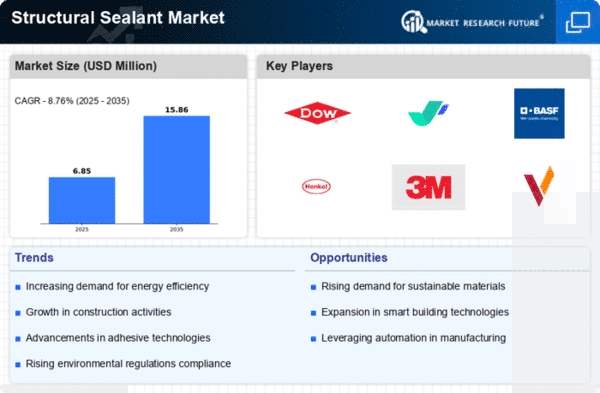
As per MRFR analysis, the Structural Sealant Market Size was estimated at 6.3 USD Million in 2024. The Structural Sealant industry is projected to grow from 6.85 in 2025 to 15.86 by 2035, exhibiting a compound annual growth rate (CAGR) of 8.76 during the forecast period 2025 - 2035.

Key Market Trends & Highlights

The Structural Sealant Market is poised for robust growth driven by technological advancements and sustainability initiatives.

  • Technological advancements in sealant formulations are reshaping the Structural Sealant Market.
  • The focus on sustainability and eco-friendly products is becoming increasingly prominent in market strategies.
  • North America remains the largest market, while the Asia-Pacific region is recognized as the fastest-growing area for structural sealants.
  • The expansion in the construction sector and rising demand in automotive applications are key drivers propelling market growth.

Market Size & Forecast

2024 Market Size 6.3 (USD Million)
2035 Market Size 15.86 (USD Million)
CAGR (2025 - 2035) 8.76%
Largest Regional Market Share in 2024 North America

Major Players

<p>Dow (US), Sika (CH), BASF (DE), Henkel (DE), 3M (US), Momentive (US), Saint-Gobain (FR), RPM International (US), Tremco (US)</p>

Market Trends

The Structural Sealant Market is currently experiencing a dynamic evolution, driven by various factors that influence its growth trajectory. The increasing demand for durable and efficient sealing solutions across multiple industries, including construction, automotive, and aerospace, appears to be a primary catalyst. As urbanization accelerates and infrastructure projects expand, the need for high-performance sealants that can withstand environmental stressors becomes more pronounced. Furthermore, advancements in technology and materials science are likely to enhance the performance characteristics of sealants, making them more appealing to end-users. This trend suggests a shift towards innovative formulations that offer improved adhesion, flexibility, and resistance to harsh conditions. In addition to technological advancements, sustainability considerations are gaining traction within the Structural Sealant Market. Manufacturers are increasingly focusing on eco-friendly products that minimize environmental impact while maintaining performance standards. This shift towards sustainable practices may not only cater to regulatory requirements but also align with consumer preferences for greener solutions. As the market continues to evolve, it is essential for stakeholders to remain attuned to these trends, as they could shape the future landscape of the industry. Overall, the Structural Sealant Market appears poised for growth, driven by innovation and a commitment to sustainability.

Technological Advancements

The Structural Sealant Market is witnessing a surge in innovative technologies that enhance product performance. New formulations are being developed to improve adhesion, flexibility, and resistance to environmental factors. These advancements are likely to attract a broader range of applications across various sectors.

Sustainability Focus

There is a growing emphasis on eco-friendly sealant solutions within the Structural Sealant Market. Manufacturers are increasingly prioritizing sustainable materials and production processes, responding to both regulatory pressures and consumer demand for environmentally responsible products.

Expansion in Construction Sector

The ongoing expansion of the construction sector is significantly influencing the Structural Sealant Market. As urban development projects proliferate, the need for reliable sealing solutions is expected to rise, driving demand for high-performance sealants that meet industry standards.

Structural Sealant Market Market Drivers

Market Growth Projections

The Global Structural Sealants Market Industry is poised for substantial growth, with projections indicating a market size of 12.5 USD Billion in 2024 and an anticipated increase to 20.3 USD Billion by 2035. This growth trajectory suggests a compound annual growth rate of 4.51% from 2025 to 2035. Such figures underscore the increasing reliance on structural sealants in various applications, driven by factors such as urbanization, technological advancements, and regulatory support for sustainable practices. The market's expansion reflects broader trends in construction and manufacturing, highlighting the critical role of sealants in modern infrastructure.

Technological Advancements

Innovations in sealant formulations and application techniques are transforming the Global Structural Sealants Market Industry. The introduction of advanced materials, such as silicone and polyurethane, has improved performance characteristics, including adhesion, flexibility, and resistance to environmental factors. These advancements not only enhance the longevity of structures but also align with sustainability goals, as many new sealants are designed to be eco-friendly. As a result, the market is likely to witness a compound annual growth rate of 4.51% from 2025 to 2035, reflecting the industry's adaptation to technological progress and environmental considerations.

Rising Construction Activities

The Global Structural Sealants Market Industry is experiencing a surge in demand driven by escalating construction activities worldwide. Urbanization and infrastructure development are at the forefront, with countries investing heavily in residential, commercial, and industrial projects. For instance, the construction sector is projected to contribute significantly to the global economy, with the market expected to reach 12.5 USD Billion in 2024. This growth is indicative of the increasing need for effective sealing solutions that enhance durability and energy efficiency in buildings, thereby propelling the demand for structural sealants.

Diverse Applications Across Industries

The versatility of structural sealants across various industries is a key driver for the Global Structural Sealants Market Industry. These sealants find applications in sectors such as automotive, aerospace, and electronics, in addition to construction. Their ability to provide waterproofing, bonding, and insulation makes them indispensable in numerous applications. As industries continue to evolve and innovate, the demand for high-performance sealants is expected to rise, further propelling market growth. This diversification not only stabilizes the market but also opens new avenues for manufacturers to explore.

Increased Demand for Energy Efficiency

The Global Structural Sealants Market Industry is significantly influenced by the growing emphasis on energy efficiency in building design and construction. As energy costs rise and environmental regulations tighten, builders and architects are increasingly seeking solutions that minimize energy loss. Structural sealants play a crucial role in enhancing insulation and reducing air leakage, which can lead to substantial energy savings. This trend is expected to drive the market's growth, with projections indicating a rise to 20.3 USD Billion by 2035, as more stakeholders recognize the importance of energy-efficient building practices.

Regulatory Support for Sustainable Practices

Government regulations promoting sustainable construction practices are bolstering the Global Structural Sealants Market Industry. Many countries are implementing stringent building codes that require the use of environmentally friendly materials and energy-efficient designs. This regulatory landscape encourages manufacturers to innovate and develop sealants that meet these standards. As a result, the market is likely to expand as compliance with these regulations becomes essential for construction projects. The increasing focus on sustainability is expected to further enhance the market's growth trajectory, aligning with global efforts to reduce carbon footprints.

Market Segment Insights

By Application: Construction (Largest) vs. Automotive (Fastest-Growing)

<p>The Structural Sealant Market exhibits varied applications where construction remains the largest segment, capturing significant market share owing to increasing infrastructure projects and renovations globally. Automotive follows as a robust application, rapidly gaining traction due to the rising demand for lightweight and fuel-efficient vehicles, further propelling adhesive solutions within this sector.</p>

<p>Construction: Dominant vs. Automotive: Emerging</p>

<p>Construction leads the Structural Sealant Market due to its essential role in bonding materials, ensuring structural integrity, and providing weatherproofing solutions in buildings and infrastructure. The sector benefits from ongoing urban development, sustainability initiatives, and a focus on energy-efficient designs. Conversely, the automotive segment, while currently smaller, is emerging rapidly driven by advancements in technologies focusing on electric vehicles and lightweight materials. Automotive applications require high-performance sealants for bonding and sealing, appealing to manufacturers seeking to improve vehicle efficiency and safety. This dual dynamic showcases a competitive landscape where construction is predominant, while automotive presents significant growth opportunities.</p>

By Type: Silicone Sealants (Largest) vs. Polyurethane Sealants (Fastest-Growing)

<p>The structural sealant market is primarily dominated by silicone sealants, attributed to their versatility and durability in various construction projects. This segment holds the largest market share due to its excellent weather resistance and adhesion properties across both residential and commercial applications. Polyurethane sealants, while currently smaller in market share, are experiencing significant growth driven by the increasing demand for high-performance materials in construction and automotive industries. Growth trends indicate a robust future for polyurethane sealants, bolstered by advancements in formulation and application techniques. Factors such as increased infrastructure development and the rising focus on energy-efficient building practices are effectively driving the demand for these sealants. Furthermore, the evolving preferences for sustainable and environmentally friendly materials are paving the way for both silicone and polyurethane sealants to thrive in diverse applications, enhancing their market potential in the coming years.</p>

<p>Silicone Sealants (Dominant) vs. Acrylic Sealants (Emerging)</p>

<p>Silicone sealants are recognized for their outstanding flexibility, durability, and adhesion, making them the dominant choice in the structural sealant market. Their ability to withstand extreme temperatures and conditions without losing performance places them at the forefront of residential and commercial construction projects. On the other hand, acrylic sealants are emerging as a competitive alternative, particularly favored for indoor applications due to their paintability and ease of use. While acrylics are generally less flexible than silicones, advancements in formulation are enhancing their characteristics, making them suitable for a broader range of applications. As the market shifts towards eco-friendly solutions, acrylic sealants are gaining traction among consumers seeking lower VOC emissions and improved sustainability.</p>

By End Use: Residential (Largest) vs. Commercial (Fastest-Growing)

<p>The Structural Sealant Market is primarily segmented into five end-use categories: Residential, Commercial, Industrial, Infrastructure, and Transportation. Among these, the Residential segment holds the largest market share due to the growing demand for construction and renovation of homes. The Commercial segment follows closely, being significant due to new commercial construction projects and refurbishments that require high-performance sealants. Other segments like Industrial, Infrastructure, and Transportation also hold viable shares but are comparatively lower in terms of market presence and growth potential.</p>

<p>Residential (Dominant) vs. Commercial (Emerging)</p>

<p>The Residential segment of the Structural Sealant Market is distinguished by its extensive applications in the construction and repair of homes, making it a dominant force in the market. This segment benefits from increased investment in housing and a shift towards energy-efficient building materials. On the other hand, the Commercial segment is emerging rapidly, driven by the rise in new commercial constructions and significant renovations. This segment witnesses rapid adaptation of innovative sealant technologies to enhance building durability and energy efficiency. The growing emphasis on sustainability in commercial buildings further propels the demand for advanced sealants, marking it as a critical area in the market.</p>

Get more detailed insights about Structural Sealant Market Research Report - Forecast to 2035

Regional Insights

Europe : Emerging Market Dynamics

Europe's structural sealant market is valued at €1.8 billion, driven by increasing construction activities and a shift towards sustainable building practices. The region benefits from stringent regulations that promote the use of high-performance sealants, enhancing energy efficiency in buildings. The demand for advanced materials is further supported by government initiatives aimed at reducing carbon footprints in construction. Germany and France are leading countries in this market, with major players like BASF and Sika playing pivotal roles. The competitive landscape is marked by innovation and a focus on product development to meet evolving regulatory requirements. As the market matures, companies are investing in R&D to create advanced sealant solutions that cater to diverse applications, ensuring sustained growth in the region.

Asia-Pacific : Rapid Growth Potential

The Asia-Pacific region, valued at $1.2 billion, is witnessing rapid growth in the structural sealant market, driven by urbanization and infrastructure development. Countries like China and India are experiencing a construction boom, leading to increased demand for advanced sealant solutions. Regulatory frameworks promoting sustainable construction practices are also contributing to market growth, as builders seek to comply with environmental standards. China is the largest market in the region, with significant contributions from local manufacturers and international players. The competitive landscape is evolving, with companies focusing on innovation and product differentiation to capture market share. As the region continues to develop, the demand for high-quality sealants is expected to rise, presenting opportunities for both established and emerging players.

Middle East and Africa : Niche Market Opportunities

The Middle East and Africa region, with a market size of $0.15 billion, presents niche opportunities in the structural sealant market. The growth is primarily driven by ongoing infrastructure projects and a rising focus on sustainable construction practices. Governments are increasingly investing in urban development, which is expected to boost demand for high-performance sealants that meet regulatory standards for durability and energy efficiency. Countries like the UAE and South Africa are at the forefront of this market, with a growing presence of international players. The competitive landscape is characterized by a mix of local and global manufacturers, each striving to innovate and meet the specific needs of the region. As the market matures, the emphasis on quality and compliance with international standards will shape the future of structural sealants in this region.

Key Players and Competitive Insights

The Structural Sealant Market is currently characterized by a dynamic competitive landscape, driven by increasing demand for durable and efficient sealing solutions across various industries, including construction, automotive, and aerospace. Key players such as Dow (US), Sika (CH), and BASF (DE) are strategically positioned to leverage their extensive product portfolios and innovative capabilities. Dow (US) focuses on enhancing its product offerings through continuous research and development, while Sika (CH) emphasizes regional expansion and sustainability initiatives. BASF (DE) adopts a multifaceted approach, integrating digital transformation into its operations to optimize supply chains and improve customer engagement. Collectively, these strategies contribute to a competitive environment that is increasingly focused on innovation and sustainability.

In terms of business tactics, companies are localizing manufacturing to reduce lead times and enhance responsiveness to market demands. Supply chain optimization remains a critical focus, particularly in light of recent global disruptions. The market structure appears moderately fragmented, with several key players exerting significant influence. This fragmentation allows for niche players to emerge, yet the collective strength of major companies shapes overall market dynamics.

In November 2025, Dow (US) announced the launch of a new line of eco-friendly structural sealants designed to meet stringent environmental regulations. This strategic move not only aligns with global sustainability trends but also positions Dow as a leader in the green sealant segment, potentially attracting environmentally conscious consumers and businesses.

In October 2025, Sika (CH) completed the acquisition of a regional sealant manufacturer, enhancing its market presence in Eastern Europe. This acquisition is likely to bolster Sika's distribution capabilities and expand its product offerings, thereby strengthening its competitive position in a rapidly growing market.

In September 2025, BASF (DE) unveiled a digital platform aimed at streamlining customer interactions and improving order fulfillment processes. This initiative reflects BASF's commitment to digitalization, which is increasingly vital in enhancing customer experience and operational efficiency in the structural sealant sector.

As of December 2025, current competitive trends indicate a pronounced shift towards digitalization, sustainability, and the integration of AI technologies. Strategic alliances are becoming more prevalent, as companies seek to enhance their capabilities and market reach. The competitive differentiation is likely to evolve from traditional price-based competition to a focus on innovation, technological advancements, and supply chain reliability, suggesting a transformative period ahead for the Structural Sealant Market.

Key Companies in the Structural Sealant Market include

Industry Developments

  • Q2 2024: Dow launches new DOWSIL™ 991 Silicone High-Performance Structural Glazing Sealant Dow announced the commercial launch of DOWSIL™ 991, a next-generation silicone structural glazing sealant designed for high-performance façade applications, offering improved durability and sustainability for modern building envelopes.
  • Q2 2024: Sika opens new adhesives and sealants production facility in the United States Sika inaugurated a new manufacturing plant in the U.S. dedicated to the production of structural adhesives and sealants, aiming to strengthen its supply chain and meet growing demand in the North American construction sector.
  • Q3 2024: Henkel acquires U.S.-based specialty sealant manufacturer for $250 million Henkel completed the acquisition of a U.S. company specializing in structural sealants for construction and industrial applications, expanding its product portfolio and market presence in North America.
  • Q2 2024: Saint-Gobain launches new eco-friendly structural glazing sealant for commercial buildings Saint-Gobain introduced a new low-VOC structural glazing sealant targeting green building projects, aligning with stricter environmental regulations and sustainability goals in the construction industry.
  • Q1 2025: 3M appoints new Vice President for Industrial Adhesives and Sealants Division 3M announced the appointment of a new executive to lead its Industrial Adhesives and Sealants Division, signaling a strategic focus on innovation and global expansion in the structural sealant market.
  • Q4 2024: BASF partners with Chinese construction giant to co-develop advanced structural sealant solutions BASF entered a strategic partnership with a major Chinese construction firm to jointly develop and commercialize advanced structural sealants tailored for high-rise and infrastructure projects in Asia.
  • Q3 2024: Guardian Glass unveils new structural silicone sealant for curtain wall systems Guardian Glass launched a new structural silicone sealant designed to enhance the performance and longevity of curtain wall systems in commercial buildings.
  • Q2 2025: AkzoNobel opens R&D center focused on next-generation structural adhesives and sealants AkzoNobel inaugurated a new research and development center dedicated to innovating structural adhesives and sealants, with a focus on sustainability and high-performance applications.
  • Q1 2025: H.B. Fuller wins major contract to supply structural sealants for Middle East airport expansion H.B. Fuller secured a multi-year contract to provide structural sealants for a large-scale airport expansion project in the Middle East, reinforcing its position in the global infrastructure market.
  • Q4 2024: PPG Industries launches new hybrid structural sealant for energy-efficient façades PPG Industries introduced a hybrid structural sealant engineered for use in energy-efficient building façades, supporting the construction sector’s shift toward sustainable solutions.
  • Q2 2024: Evonik debuts bio-based structural sealant for green building applications Evonik launched a bio-based structural sealant aimed at the green building market, offering reduced carbon footprint and compliance with international sustainability standards.
  • Q1 2025: Momentive Performance Materials announces expansion of silicone sealant production in South Korea Momentive Performance Materials revealed plans to expand its silicone sealant manufacturing capacity in South Korea to meet rising demand in the Asia-Pacific construction sector.

Future Outlook

Structural Sealant Market Future Outlook

<p>The Structural Sealant Market is projected to grow at an 8.76% CAGR from 2024 to 2035, driven by increasing construction activities, technological advancements, and rising demand for energy-efficient buildings.</p>

New opportunities lie in:

  • <p>Development of eco-friendly sealant formulations</p>
  • <p>Integration of smart technology in sealant applications</p>
  • <p>Expansion into emerging markets with tailored solutions</p>

<p>By 2035, the market is expected to achieve robust growth, positioning itself as a leader in innovative sealing solutions.</p>

Market Segmentation

Structural Sealant Market Type Outlook

  • Silicone Sealants
  • Polyurethane Sealants
  • Acrylic Sealants
  • Polysulfide Sealants
  • Butyl Sealants

Structural Sealant Market End Use Outlook

  • Residential
  • Commercial
  • Industrial
  • Infrastructure
  • Transportation

Structural Sealant Market Application Outlook

  • Construction
  • Automotive
  • Aerospace
  • Marine
  • Electronics

Report Scope

MARKET SIZE 20246.3(USD Million)
MARKET SIZE 20256.85(USD Million)
MARKET SIZE 203515.86(USD Million)
COMPOUND ANNUAL GROWTH RATE (CAGR)8.76% (2024 - 2035)
REPORT COVERAGERevenue Forecast, Competitive Landscape, Growth Factors, and Trends
BASE YEAR2024
Market Forecast Period2025 - 2035
Historical Data2019 - 2024
Market Forecast UnitsUSD Million
Key Companies ProfiledDow (US), Sika (CH), BASF (DE), Henkel (DE), 3M (US), Momentive (US), Saint-Gobain (FR), RPM International (US), Tremco (US)
Segments CoveredApplication, Type, End Use
Key Market OpportunitiesGrowing demand for eco-friendly formulations in the Structural Sealant Market presents significant opportunities for innovation.
Key Market DynamicsRising demand for eco-friendly materials drives innovation and competition in the structural sealant market.
Countries CoveredNorth America, Europe, APAC, South America, MEA

FAQs

How much is the structural sealant market worth in the future?

The structural sealant market is expected to grow up to USD 4,077 million by 2023.

Which region is expected to dominate the global structural sealants market?

The Asia Pacific region has the chance to retain its dominant position by fetching the maximum valuation.

Which is leading the type segment of the structural sealants market?

Silicon is leading the structural sealant market.

Which is leading the end user segment of the structural sealants market?

The construction and automotive industries have the chance to dominate the global structural sealant market.

  1. SECTION I: EXECUTIVE SUMMARY AND KEY HIGHLIGHTS
    1. | 1.1 EXECUTIVE SUMMARY
  2. SECTION II: SCOPING, METHODOLOGY AND MARKET STRUCTURE
    1. | 2.1 MARKET INTRODUCTION
    2. | 2.2 RESEARCH METHODOLOGY
  3. SECTION III: QUALITATIVE ANALYSIS
    1. | 3.1 MARKET DYNAMICS
    2. | 3.2 MARKET FACTOR ANALYSIS
  4. SECTION IV: QUANTITATIVE ANALYSIS
    1. | 4.1 Chemicals and Materials, BY Application (USD Million)
    2. | 4.2 Chemicals and Materials, BY Type (USD Million)
    3. | 4.3 Chemicals and Materials, BY End Use (USD Million)
    4. | 4.4 Chemicals and Materials, BY Region (USD Million)
  5. SECTION V: COMPETITIVE ANALYSIS
    1. | 5.1 Competitive Landscape
    2. | 5.2 Company Profiles
    3. | 5.3 Appendix

Structural Sealant Market Segmentation

Market Segmentation Overview

  • Detailed segmentation data will be available in the full report
  • Comprehensive analysis by multiple parameters
  • Regional and country-level breakdowns
  • Market size forecasts by segment
Infographic

Free Sample Request

Kindly complete the form below to receive a free sample of this Report

Get Free Sample

Customer Strories

Compare Licence

×
Features License Type
Single User Multiuser License Enterprise User
Price $4,950 $5,950 $7,250
Maximum User Access Limit 1 User Upto 10 Users Unrestricted Access Throughout the Organization
Free Customization
Direct Access to Analyst
Deliverable Format
Platform Access
Discount on Next Purchase 10% 15% 15%
Printable Versions