×
Request Free Sample ×

Kindly complete the form below to receive a free sample of this Report

* Please use a valid business email

Leading companies partner with us for data-driven Insights

clients tt-cursor
Hero Background

Spain Wearable Technology Market

ID: MRFR/SEM/42158-HCR
128 Pages
Aarti Dhapte
February 2026

Spain Wearable Technology Market Size, Share and Research Report By Product Type (Wristwear, Headwear Eyewear, Neckwear, Wearable Cameras), By Technology (Computing, Display, Networking, Sensor), By Components (Control, Memory, Battery, Sensing, Connectivity) and By Applications (Fitness Wellness, Consumer Electronics, Healthcare) - Industry Forecast Till 2035

Share:
Download PDF ×

We do not share your information with anyone. However, we may send you emails based on your report interest from time to time. You may contact us at any time to opt-out.

Spain Wearable Technology Market Infographic
Purchase Options

Spain Wearable Technology Market Summary

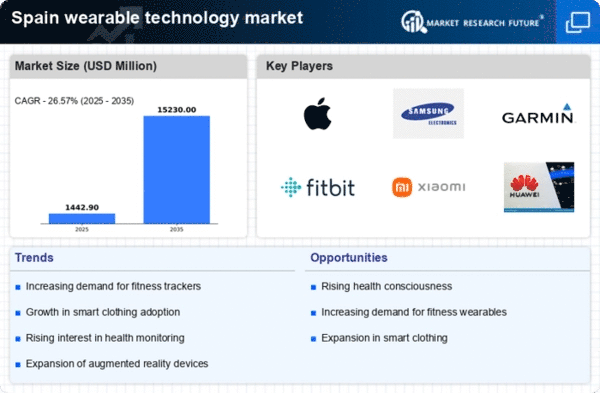
As per Market Research Future analysis, the Spain wearable technology market Size was estimated at 1140.0 USD Million in 2024. The Spain wearable technology market is projected to grow from 1442.9 USD Million in 2025 to 15230.0 USD Million by 2035, exhibiting a compound annual growth rate (CAGR) of 26.5% during the forecast period 2025 - 2035

Key Market Trends & Highlights

The Spain wearable technology market is experiencing robust growth driven by health awareness and technological advancements.

  • The health and fitness tracking segment remains the largest, reflecting a growing consumer focus on personal wellness.
  • Integration with mobile applications is enhancing user experience, thereby driving market engagement and adoption.
  • The rise of medical wearables indicates a shift towards more specialized health monitoring solutions..
  • Key market drivers include growing health awareness and increased adoption in sports, which are propelling overall market expansion.

Market Size & Forecast

2024 Market Size 1140.0 (USD Million)
2035 Market Size 15230.0 (USD Million)
CAGR (2025 - 2035) 26.57%

Major Players

Apple Inc (US), Samsung Electronics (KR), Garmin Ltd (US), Fitbit LLC (US), Xiaomi Corp (CN), Huawei Technologies (CN), Fossil Group Inc (US), Withings (FR), Polar Electro (FI)

Our Impact
Enabled $4.3B Revenue Impact for Fortune 500 and Leading Multinationals
Partnering with 2000+ Global Organizations Each Year
30K+ Citations by Top-Tier Firms in the Industry

Spain Wearable Technology Market Trends

The wearable technology market is experiencing notable growth, driven by increasing consumer interest in health and fitness tracking devices. In Spain, the adoption of smartwatches and fitness bands is particularly pronounced, as individuals seek to monitor their physical activity and overall well-being. This trend is further supported by advancements in technology, which enhance the functionality and appeal of these devices. Moreover, the integration of wearable technology with mobile applications allows users to access real-time data, fostering a more engaged and health-conscious population. Additionally, the wearable technology market is witnessing a shift towards more specialized devices, such as medical wearables that monitor chronic conditions. This evolution reflects a broader trend towards personalized healthcare solutions, which are becoming increasingly relevant in Spain's healthcare landscape. As the population ages and the demand for remote health monitoring rises, the market is likely to expand further. Furthermore, collaborations between technology firms and healthcare providers may lead to innovative solutions that enhance patient care and improve health outcomes. Overall, the future of the wearable technology market appears promising, with ongoing developments poised to reshape consumer experiences and healthcare delivery.

Health and Fitness Tracking

The wearable technology market is increasingly focused on health and fitness tracking devices. Consumers in Spain are adopting smartwatches and fitness bands to monitor their physical activity, heart rate, and sleep patterns. This trend indicates a growing awareness of personal health and wellness.

Integration with Mobile Applications

Wearable devices are becoming more integrated with mobile applications, allowing users to access real-time data and insights. This integration enhances user engagement and encourages healthier lifestyle choices, reflecting a shift towards a more connected health ecosystem.

Rise of Medical Wearables

There is a noticeable increase in the development of medical wearables designed to monitor chronic conditions. This trend suggests a move towards personalized healthcare solutions, which are becoming essential in Spain's healthcare system as the population ages.

Spain Wearable Technology Market Drivers

Growing Health Awareness

The increasing health consciousness among the Spanish population appears to be a primary driver for the wearable technology market. As individuals become more aware of the importance of maintaining a healthy lifestyle, the demand for devices that monitor health metrics, such as heart rate and physical activity, is likely to rise. Recent data indicates that approximately 60% of Spaniards are actively seeking ways to improve their health, which correlates with a growing interest in wearable devices. This trend suggests that the wearable technology market could experience substantial growth as consumers prioritize health and wellness. Furthermore, the integration of advanced features in wearables, such as sleep tracking and stress management, may further enhance their appeal, potentially leading to increased adoption rates across various demographics.

Technological Advancements

Rapid advancements in technology are significantly influencing the wearable technology market. Innovations in sensor technology, battery life, and connectivity options are making wearables more appealing to consumers. For instance, the introduction of more accurate biometric sensors has improved the reliability of health data collected by these devices. In Spain, the market for smartwatches and fitness trackers is projected to grow by approximately 15% annually, driven by these technological improvements. Additionally, the development of artificial intelligence and machine learning capabilities within wearables is enhancing user experience, allowing for personalized health insights. This evolution in technology not only attracts tech-savvy consumers but also encourages traditional users to explore the benefits of wearable devices, thereby expanding the market.

Increased Adoption in Sports

The growing popularity of sports and fitness activities in Spain is likely to propel the wearable technology market. Athletes and fitness enthusiasts are increasingly utilizing wearable devices to track performance metrics, monitor training progress, and prevent injuries. Recent statistics suggest that around 30% of Spaniards engage in regular sports activities, creating a substantial market for sports-oriented wearables. This trend indicates that manufacturers are focusing on developing specialized devices tailored for athletes, such as advanced heart rate monitors and GPS-enabled trackers. As the sports culture continues to thrive, the demand for wearables that enhance athletic performance is expected to rise, further driving growth in the wearable technology market.

Government Initiatives and Support

Government initiatives aimed at promoting health and technology integration are likely to bolster the wearable technology market. In Spain, various programs are being implemented to encourage the adoption of health-monitoring technologies among citizens. These initiatives may include subsidies for purchasing wearable devices or funding for research and development in health technology. Such support from the government could lead to increased awareness and acceptance of wearable technology, particularly in healthcare settings. As the government emphasizes the importance of preventive healthcare, the wearable technology market may see a surge in demand, especially among older populations who could benefit from health monitoring solutions.

Rising E-commerce and Retail Opportunities

The expansion of e-commerce platforms in Spain is facilitating greater access to wearable technology products. With the increasing trend of online shopping, consumers are more likely to explore and purchase wearable devices through digital channels. Recent data shows that online retail sales in Spain have surged by over 20% in the past year, indicating a shift in consumer purchasing behavior. This shift is likely to benefit the wearable technology market, as consumers can easily compare products, read reviews, and make informed decisions from the comfort of their homes. Additionally, retailers are increasingly offering exclusive online deals and promotions, which may further incentivize purchases of wearable devices, thereby enhancing market growth.


Market Segment Insights

By Product: Wristwear (Largest) vs. Headwear (Fastest-Growing)

The Spain wearable technology market displays a diverse product segmentation with wristwear leading in market share, followed closely by headwear, eyewear, neckwear, and wearable cameras. Wristwear holds a significant portion of the market, driven by consumer preference for fitness tracking and health monitoring devices. Other segments, while smaller in share, show potential for growth, particularly in niche markets like wearable cameras and neckwear. Growth trends in the segment indicate a shift towards multifunctional devices that not only serve a primary purpose but also integrate convenience features like communication and health monitoring. The demand for innovative designs and technological advancements will drive headwear as one of the fastest-growing segments. Factors such as increasing consumer awareness about health, active lifestyles, and technological advancements are propelling the growth in headwear and are expected to influence market dynamics positively.

Wristwear: Dominant vs. Headwear: Emerging

Wristwear is the dominant segment in the Spain wearable technology market, characterized by a robust range of fitness trackers and smartwatches that cater to health-conscious consumers. Its established market presence is largely due to high consumer engagement and brand loyalty, with advancements in health-tracking features enhancing user experiences. Conversely, headwear is emerging as a significant player, capturing attention with innovative designs that incorporate augmented reality and sound technology. The growth of headwear is fueled by advancements in audio capabilities and the rise of hands-free communication needs. As both segments evolve, they illustrate the dynamic nature of consumer preferences and technology integration within wearable devices.

By Technology: Sensor (Largest) vs. Display (Fastest-Growing)

In the Spain wearable technology market, the segment values of Computing, Display, Networking, and Sensor reveal interesting dynamics. The Sensor segment currently holds the largest market share, driven by the increasing demand for health monitoring devices and fitness trackers. Meanwhile, the Display segment, although smaller in comparison, is witnessing robust growth, attracting consumer interest due to innovations in screen technology and user interface design. Growth trends indicate that advancements in sensor technology will propel the Sensor segment further, with consumers seeking more comprehensive health insights. On the other hand, the Display segment is poised for rapid expansion, fueled by developments in augmented reality (AR) and virtual reality (VR) applications. This encourages manufacturers to invest in better display technologies that enhance user experiences, positioning the Display segment as a key player in future market trends.

Sensor: Dominant vs. Display: Emerging

The Sensor segment of the Spain wearable technology market stands out as the dominant force, primarily due to its integral role in health-tracking devices. Consumers increasingly prefer wearables equipped with advanced sensors that monitor vital signs, activity levels, and other health metrics. This functionality appeals to fitness enthusiasts and health-conscious individuals alike. In contrast, the Display segment, while emerging, rapidly adapts to consumer demands for better engagement through high-resolution screens and interactive features. Manufacturers are now focusing on enhancing the display experience, especially in smartwatches and fitness bands, making this segment a valuable area for future growth as users seek products that offer both functionality and visual appeal.

By Components: Control (Largest) vs. Sensing (Fastest-Growing)

In the Spain wearable technology market, the distribution of market share among the component values reveals a strong preference for Control technologies, which dominate the landscape. Control components facilitate user interaction and personalization, establishing themselves as essential for consumer satisfaction. Similarly, Sensing technologies are gaining traction, increasingly adopted in fitness trackers and health monitors, showing significant promise in terms of market penetration. The growth trends indicate a rising demand for advanced functionality and real-time data in wearable devices, driving the expansion of both Control and Sensing components. Continuous innovation in sensor technology, combined with consumer interest in health and fitness, fuels the rapid advancement of the Sensing segment while Control maintains its leadership through the integration of intuitive user interfaces and enhanced user experiences.

Control: Dominant vs. Sensing: Emerging

Control components, characterized by their ability to enhance user interaction through touch screens and voice commands, occupy a dominant position in the market. Their functionality leads to superior user engagement, making wearable devices more appealing to consumers. Meanwhile, Sensing technologies represent an emerging value within the industry, focused on collecting health metrics and environmental data. As consumers seek more connectivity and health insights, Sensing components are proving essential to the evolution of wearables, attracting substantial investment and driving innovation. The balance between Control as a staple of usability and Sensing as the future of data intelligence is shaping the trajectory of the wearable technology segment.

By Application: Fitness & Wellness (Largest) vs. Healthcare (Fastest-Growing)

In the Spain wearable technology market, the application segment is primarily dominated by Fitness & Wellness, which accounts for a significant share. This segment includes devices focused on health monitoring, physical activity tracking, and lifestyle enhancements, appealing to a broad consumer base. Conversely, the Healthcare segment, while smaller in comparison, is rapidly gaining traction, driven by increasing adoption of wearable devices for chronic disease management and telehealth services, revealing the diverse applications of wearable technology. Growth trends indicate a strong shift towards Health & Wellness, largely fueled by rising health consciousness among consumers and advancements in sensor technologies. Meanwhile, the Healthcare segment is experiencing accelerated growth, primarily due to the ongoing digital transformation in healthcare services and heightened demand for remote patient monitoring solutions. This dynamic is fostering innovation within both segments as stakeholders invest in research and development to cater to evolving consumer needs.

Fitness & Wellness (Dominant) vs. Healthcare (Emerging)

Fitness & Wellness stands as the dominant segment in the Spain wearable technology market, characterized by a diverse array of products such as smartwatches, fitness trackers, and health apps that cater to users keen on improving their physical fitness and overall well-being. This segment appeals to fitness enthusiasts and general consumers alike, contributing significantly to the revenue landscape. In contrast, the Healthcare segment is emerging as a pivotal player, focused on medical and preventive applications. With the increasing integration of AI and machine learning, wearable devices in this sector are evolving to provide accurate health diagnostics, remote monitoring, and personalized care, responding effectively to the urgent healthcare needs and regulatory support for innovative health solutions.

Get more detailed insights about Spain Wearable Technology Market

Key Players and Competitive Insights

The wearable technology market in Spain is characterized by a dynamic competitive landscape, driven by rapid technological advancements and evolving consumer preferences. Major players such as Apple Inc (US), Samsung Electronics (KR), and Xiaomi Corp (CN) are at the forefront, each adopting distinct strategies to enhance their market presence. Apple Inc (US) continues to focus on innovation, particularly in health monitoring features, which has positioned its products as premium offerings. Samsung Electronics (KR) emphasizes regional expansion and partnerships, enhancing its ecosystem through collaborations with health and fitness apps. Xiaomi Corp (CN) leverages cost-effective manufacturing and aggressive pricing strategies, appealing to a broader consumer base. Collectively, these strategies contribute to a competitive environment that is both fragmented and concentrated, with a few key players dominating market share while numerous smaller firms vie for attention.
Key business tactics within the market include localizing manufacturing and optimizing supply chains to reduce costs and improve responsiveness to consumer demands. The competitive structure appears moderately fragmented, with a mix of established brands and emerging players. This fragmentation allows for diverse product offerings, yet the influence of major companies remains substantial, shaping consumer expectations and driving innovation across the sector.
In October 2025, Garmin Ltd (US) announced the launch of its latest smartwatch, which integrates advanced health metrics and personalized coaching features. This strategic move underscores Garmin's commitment to enhancing user experience through technology, potentially attracting fitness enthusiasts and health-conscious consumers. The introduction of such innovative features may solidify Garmin's position in the competitive landscape, appealing to a niche market that prioritizes functionality and performance.
In September 2025, Fitbit LLC (US) unveiled a new subscription service that offers personalized health insights and coaching based on user data. This initiative reflects a shift towards a more service-oriented approach, aiming to foster long-term customer engagement and loyalty. By providing tailored health solutions, Fitbit LLC (US) may enhance its competitive edge, particularly among users seeking comprehensive health management tools.
In August 2025, Huawei Technologies (CN) expanded its wearable product line with the introduction of a budget-friendly smartwatch aimed at younger consumers. This strategic decision appears to be a response to the growing demand for affordable yet feature-rich devices. By targeting this demographic, Huawei Technologies (CN) could potentially capture a significant share of the market, further intensifying competition among existing players.
As of November 2025, current trends in the wearable technology market are increasingly defined by digitalization, sustainability, and the integration of artificial intelligence (AI). Strategic alliances among companies are shaping the landscape, fostering innovation and enhancing product offerings. The competitive differentiation is likely to evolve, moving away from price-based competition towards a focus on technological advancements, user experience, and supply chain reliability. This shift suggests that companies must prioritize innovation and sustainability to maintain relevance in an ever-evolving market.

Key Companies in the Spain Wearable Technology Market include

Industry Developments

The Spain Wearable Technology Market has seen significant developments recently, with a growing interest in fitness and health tracking among consumers. Major companies like Samsung Electronics and Fitbit have introduced new products tailored to the Spanish market, focusing on features such as heart rate monitoring and sleep tracking. In July 2023, Garmin expanded its range of smartwatches available in Spain, amplifying its competitive edge amidst rising demand. Additionally, Polar launched a campaign in Spain to raise awareness of its latest fitness trackers, targeting both athletes and the general wellness community.

Notably, in September 2023, a strategic partnership between Oura and a leading Spanish health organization aimed to enhance health monitoring solutions for users.

The overall market valuation has been positively impacted, with wearable technology experiencing a growth rate of 12% from 2022 to 2023 in Spain, driven by increasing health consciousness and technological advancements. Furthermore, in the last two years, Xiaomi has gained traction in Spain with its affordable wearable devices, reinforcing its presence amid established brands like Apple and Huawei. These developments highlight the dynamic nature of the wearable technology sector in Spain, reflecting evolving consumer preferences and technological integration.

Future Outlook

Spain Wearable Technology Market Future Outlook

The wearable technology market in Spain is projected to grow at a 26.57% CAGR from 2025 to 2035, driven by advancements in health monitoring, IoT integration, and consumer demand for convenience.

New opportunities lie in:

  • Development of AI-driven health analytics platforms
  • Expansion of smart clothing for fitness tracking
  • Partnerships with healthcare providers for remote patient monitoring

By 2035, the market is expected to be robust, driven by innovation and strategic partnerships.

Market Segmentation

Spain Wearable Technology Market Product Outlook

  • Wristwear
  • Headwear
  • Eyewear
  • Neckwear
  • Wearable Cameras

Spain Wearable Technology Market Components Outlook

  • Control
  • Memory
  • Battery
  • Sensing
  • Connectivity

Spain Wearable Technology Market Technology Outlook

  • Computing
  • Display
  • Networking
  • Sensor

Spain Wearable Technology Market Application Outlook

  • Fitness & Wellness
  • Consumer Electronics
  • Healthcare

Report Scope

MARKET SIZE 2024 1140.0(USD Million)
MARKET SIZE 2025 1442.9(USD Million)
MARKET SIZE 2035 15230.0(USD Million)
COMPOUND ANNUAL GROWTH RATE (CAGR) 26.57% (2025 - 2035)
REPORT COVERAGE Revenue Forecast, Competitive Landscape, Growth Factors, and Trends
BASE YEAR 2024
Market Forecast Period 2025 - 2035
Historical Data 2019 - 2024
Market Forecast Units USD Million
Key Companies Profiled Apple Inc (US), Samsung Electronics (KR), Garmin Ltd (US), Fitbit LLC (US), Xiaomi Corp (CN), Huawei Technologies (CN), Fossil Group Inc (US), Withings (FR), Polar Electro (FI)
Segments Covered Product, Technology, Components, Application
Key Market Opportunities Integration of advanced health monitoring features in wearable technology to meet rising consumer health awareness.
Key Market Dynamics Rising consumer demand for health monitoring devices drives innovation in wearable technology within the Spanish market.
Countries Covered Spain
Leave a Comment

FAQs

What is the expected market size of the Spain Wearable Technology Market in 2024?

The Spain Wearable Technology Market is expected to be valued at 1.74 USD Billion in 2024.

What is the projected market size for the Spain Wearable Technology Market by 2035?

By 2035, the Spain Wearable Technology Market is projected to reach approximately 23.79 USD Billion.

What is the expected compound annual growth rate (CAGR) for the Spain Wearable Technology Market from 2025 to 2035?

The market is expected to grow at a CAGR of 26.83% from 2025 to 2035.

Which product type is expected to dominate the Spain Wearable Technology Market by 2035?

Wristwear is expected to dominate the market with a valuation of 10.1 USD Billion by 2035.

What market value is expected for Headwear Eyewear in the Spain Wearable Technology Market by 2035?

Headwear Eyewear is anticipated to reach a market value of 6.25 USD Billion by 2035.

Who are some key players in the Spain Wearable Technology Market?

Major players include Polar, Oura, Samsung Electronics, Garmin, and Fitbit.

What is the expected market value for Neckwear in 2024 within the Spain Wearable Technology Market?

The market value for Neckwear is expected to be 0.2 USD Billion in 2024.

What growth drivers are impacting the Spain Wearable Technology Market?

The market growth is driven by increasing health consciousness and technological advancements.

What market value is predicted for Wearable Cameras in the Spain Wearable Technology Market by 2035?

Wearable Cameras are expected to have a market value of 4.59 USD Billion by 2035.

How does the Spain Wearable Technology Market growth rate compare across different segments?

Each segment is anticipated to experience significant growth, with wristwear leading the overall market growth.

What market value is expected for Headwear & Eyewear in the Spain Wearable Technology Market by 2035?

Headwear & Eyewear is anticipated to reach a market value of 6.25 USD Billion by 2035.

Download Free Sample

Kindly complete the form below to receive a free sample of this Report

Compare Licence

×
Features License Type
Single User Multiuser License Enterprise User
Price $4,950 $5,950 $7,250
Maximum User Access Limit 1 User Upto 10 Users Unrestricted Access Throughout the Organization
Free Customization
Direct Access to Analyst
Deliverable Format
Platform Access
Discount on Next Purchase 10% 15% 15%
Printable Versions