×
Request Free Sample ×

Kindly complete the form below to receive a free sample of this Report

* Please use a valid business email

Leading companies partner with us for data-driven Insights

clients tt-cursor
Hero Background

Spain Truck Rental Market

ID: MRFR/AT/44208-HCR
128 Pages
Sejal Akre
February 2026

Spain Truck Rental Market Research Report By Truck Type (Heavy Commercial Vehicle, Light Commercial Vehicle) and By Lease Type (Finance Lease, Full-Service Lease) - Growth & Industry Forecast 2025 To 2035

Share:
Download PDF ×

We do not share your information with anyone. However, we may send you emails based on your report interest from time to time. You may contact us at any time to opt-out.

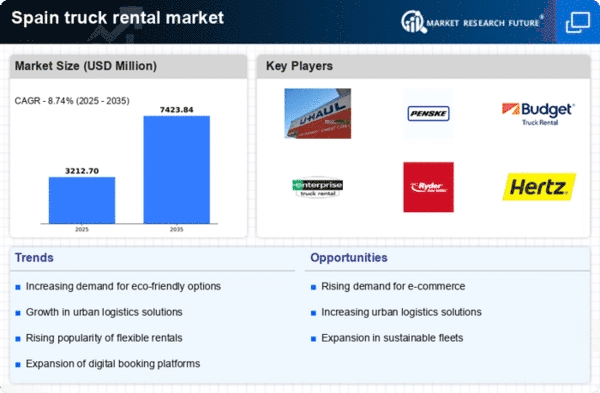
Spain Truck Rental Market Infographic
Purchase Options

Spain Truck Rental Market Summary

As per Market Research Future analysis, the Spain truck rental market size was estimated at 2954.47 USD Million in 2024. The Truck Rental market is projected to grow from 3212.7 USD Million in 2025 to 7423.84 USD Million by 2035, exhibiting a compound annual growth rate (CAGR) of 8.7% during the forecast period 2025 - 2035

Key Market Trends & Highlights

The Spain truck rental market is experiencing a shift towards sustainability and technological integration.

  • Sustainability initiatives are increasingly influencing rental practices across the market.
  • Technological advancements are enhancing fleet management and customer experience in the truck rental sector.
  • Flexible rental options are becoming more prevalent, catering to diverse customer needs and preferences.
  • Economic growth and e-commerce expansion are driving demand for truck rentals, particularly in urban areas.

Market Size & Forecast

2024 Market Size 2954.47 (USD Million)
2035 Market Size 7423.84 (USD Million)
CAGR (2025 - 2035) 8.74%

Major Players

U-Haul (US), Penske (US), Budget Truck Rental (US), Enterprise Truck Rental (US), Ryder (US), Hertz (US), Avis Budget Group (US), Sixt (DE)

Our Impact
Enabled $4.3B Revenue Impact for Fortune 500 and Leading Multinationals
Partnering with 2000+ Global Organizations Each Year
30K+ Citations by Top-Tier Firms in the Industry

Spain Truck Rental Market Trends

The truck rental market in Spain is currently experiencing a dynamic phase characterized by evolving consumer preferences and increasing demand for flexible transportation solutions. The rise of e-commerce and logistics services has significantly influenced the market, as businesses seek efficient ways to manage their supply chains. Additionally, the growing trend towards sustainability is prompting companies to consider eco-friendly options, such as electric trucks, which may reshape the competitive landscape. Furthermore, the regulatory environment is also adapting, with new policies aimed at reducing emissions and promoting greener practices in the transportation sector. In November 2025, the truck rental market appears to be on the cusp of transformation. The integration of technology, such as telematics and fleet management systems, is enhancing operational efficiency and customer experience. Moreover, the increasing popularity of short-term rentals among consumers suggests a shift in how individuals approach transportation needs. As urbanization continues to rise, the demand for truck rentals is likely to grow, driven by both commercial and personal use. This evolving landscape indicates that stakeholders must remain agile to capitalize on emerging opportunities and navigate potential challenges ahead.

Sustainability Initiatives

The truck rental market is witnessing a notable shift towards sustainability, with companies increasingly adopting eco-friendly practices. This trend includes the introduction of electric and hybrid vehicles into rental fleets, aimed at reducing carbon footprints. Additionally, businesses are exploring alternative fuels and optimizing routes to enhance fuel efficiency, reflecting a broader commitment to environmental responsibility.

Technological Advancements

Technological innovations are playing a crucial role in shaping the truck rental market. The implementation of telematics and advanced fleet management systems is streamlining operations, improving vehicle tracking, and enhancing customer service. These technologies enable companies to monitor vehicle performance in real-time, leading to better maintenance and reduced downtime.

Flexible Rental Options

There is a growing demand for flexible rental options within the truck rental market. Consumers are increasingly favoring short-term rentals over long-term commitments, driven by the need for adaptability in transportation solutions. This trend is particularly evident among businesses that require trucks for specific projects or seasonal demands, allowing for more efficient resource management.

Spain Truck Rental Market Drivers

Urbanization Trends

Urbanization in Spain is a significant driver of the truck rental market. As more people migrate to urban areas, the demand for transportation services increases, particularly for moving goods and materials. The urban population is projected to reach 85% by 2030, creating a pressing need for efficient logistics solutions. Rental trucks are often preferred for their flexibility and ability to navigate congested city environments. Additionally, urbanization leads to increased construction and renovation projects, further fueling the demand for truck rentals. The truck rental market is likely to benefit from this trend as businesses seek to adapt to the challenges posed by urban logistics.

E-commerce Expansion

The rapid expansion of e-commerce in Spain significantly impacts the truck rental market. As online shopping continues to gain traction, businesses require efficient logistics solutions to meet consumer demands. The e-commerce sector is expected to grow by around 15% annually, leading to an increased need for rental trucks to facilitate last-mile deliveries. Companies are increasingly opting for truck rentals to manage fluctuating demand without the burden of owning a fleet. This trend indicates a shift in logistics strategies, where flexibility and cost-effectiveness are prioritized, thereby bolstering the truck rental market. The ability to quickly scale operations in response to e-commerce growth is crucial for businesses aiming to remain competitive.

Seasonal Demand Fluctuations

Seasonal demand fluctuations play a crucial role in the dynamics of the truck rental market. In Spain, certain periods, such as summer and holiday seasons, witness a surge in demand for rental trucks due to increased moving activities and tourism-related logistics. Businesses often experience peak seasons where the need for transportation services spikes, making truck rentals an attractive option for managing temporary increases in demand. This variability encourages rental companies to offer tailored solutions that cater to seasonal needs, thereby enhancing their market position. The ability to provide flexible rental options during peak times is essential for companies aiming to capitalize on these seasonal trends.

Regulatory Changes and Compliance

Regulatory changes in Spain regarding transportation and logistics are shaping the truck rental market. Stricter emissions regulations and safety standards are prompting businesses to seek rental options that comply with these new requirements. The truck rental market is likely to see an increase in demand for newer, more environmentally friendly vehicles that meet regulatory standards. This shift not only helps companies avoid penalties but also aligns with broader sustainability goals. As regulations evolve, the truck rental market must adapt, offering compliant vehicles that cater to businesses looking to maintain operational efficiency while adhering to legal requirements.

Economic Growth and Infrastructure Development

The truck rental market in Spain appears to be positively influenced by the ongoing economic growth and infrastructure development initiatives. As the Spanish economy continues to recover and expand, there is an increasing demand for logistics and transportation services. The government has invested heavily in infrastructure projects, including road improvements and urban development, which necessitate the use of rental trucks for transporting materials and goods. In 2025, the construction sector is projected to grow by approximately 4.5%, further driving the need for truck rentals. This growth in infrastructure not only supports the truck rental market but also enhances the overall efficiency of supply chains across various industries.


Market Segment Insights

By Truck Type: Heavy Commercial Vehicle (Largest) vs. Light Commercial Vehicle (Fastest-Growing)

In the Spain truck rental market, the market share distribution reveals that Heavy Commercial Vehicles hold a significant portion, catering to a wide range of industries including logistics, construction, and transportation. Light Commercial Vehicles are gaining traction, primarily due to their versatility in urban settings and the increasing demand for last-mile delivery solutions. The growth trends indicate that while Heavy Commercial Vehicles remain dominant, Light Commercial Vehicles are emerging as the fastest-growing segment. Factors driving this growth include the rise in e-commerce demand, a shift towards more flexible transportation solutions, and regulatory changes favoring smaller vehicle types. The adaptability of Light Commercial Vehicles to urban logistics is positioning them well to capture market share moving forward.

Heavy Commercial Vehicle: Dominant vs. Light Commercial Vehicle: Emerging

Heavy Commercial Vehicles are characterized by their robustness and capacity to undertake substantial hauls, making them indispensable for large-scale operations. These vehicles typically include trucks used for freight transport across long distances, which makes them the backbone of supply chain logistics in various sectors. On the other hand, Light Commercial Vehicles, which are smaller and more efficient, are quickly becoming essential for urban logistics and deliveries. Their growing utilization is attributed to the increasing rise of e-commerce and consumer expectations for rapid delivery services, allowing them to secure a competitive advantage in the rental market. This dynamic reflects a significant trend where businesses are seeking both capacity and flexibility in their vehicle rentals.

By Lease Type: Finance Lease (Largest) vs. Full-Service Lease (Fastest-Growing)

In the Spain truck rental market, the distribution between Finance Lease and Full-Service Lease segments is notable. The Finance Lease holds a significant portion of the market, favored for its affordability and flexibility, making it the most utilized option among businesses. On the other hand, the Full-Service Lease is gaining traction, appealing to companies seeking comprehensive maintenance and service solutions, thus carving out a steady market share. Growth in the lease type segment is primarily driven by the evolving needs of businesses for strategic asset management. The trend towards mobility and decreasing upfront costs shifts preferences towards leasing, particularly the Full-Service option, which offers no-hassle maintenance and operational efficiency. Increased focus on operational cost reduction and flexibility in logistics management is further accelerating this growth trajectory, positioning Full-Service Lease as a rapidly emerging choice among companies.

Finance Lease (Dominant) vs. Full-Service Lease (Emerging)

The Finance Lease is recognized as the dominant model in the Spain truck rental market, primarily due to its cost-effectiveness and straightforward financing structure. Companies favor this option as it allows for asset use without large initial capital investment while facilitating budget management. Conversely, the Full-Service Lease is emerging as a competitive alternative, particularly appealing to businesses that prioritize convenience and reliability. This model encompasses all maintenance and operational services, relieving companies from unexpected costs and logistics challenges. As firms increasingly seek to optimize their operations and reduce exposure to capital risk, the Full-Service Lease is rapidly becoming a preferred choice, reflecting a significant shift in leasing preferences.

Get more detailed insights about Spain Truck Rental Market

Key Players and Competitive Insights

The truck rental market in Spain exhibits a competitive landscape characterized by a blend of established players and emerging challengers. Key growth drivers include the increasing demand for logistics and transportation services, spurred by e-commerce and urbanization trends. Major companies such as U-Haul (US), Penske (US), and Sixt (DE) are strategically positioned to leverage these trends. U-Haul (US) focuses on expanding its service offerings through innovative digital platforms, while Penske (US) emphasizes fleet optimization and sustainability initiatives. Sixt (DE) is enhancing its market presence through aggressive regional expansion and partnerships, collectively shaping a competitive environment that is increasingly dynamic and responsive to consumer needs. In terms of business tactics, companies are localizing their operations to better serve regional markets, optimizing supply chains to enhance efficiency, and investing in technology to improve customer experience. The market structure appears moderately fragmented, with several key players exerting influence over pricing and service standards. This fragmentation allows for a diverse range of offerings, yet the collective strength of these companies fosters a competitive atmosphere that encourages innovation and responsiveness to market demands. In October 2025, U-Haul (US) announced the launch of a new mobile app designed to streamline the rental process, enhancing customer convenience and engagement. This strategic move underscores U-Haul's commitment to digital transformation, aiming to attract a tech-savvy customer base while improving operational efficiency. The app's features, including real-time tracking and online reservations, are likely to enhance customer satisfaction and loyalty, positioning U-Haul favorably in a competitive market. In September 2025, Penske (US) unveiled a new sustainability initiative aimed at reducing its carbon footprint by 30% by 2030. This initiative includes investments in electric vehicles and alternative fuel technologies, reflecting a growing trend towards environmental responsibility in the truck rental sector. By prioritizing sustainability, Penske (US) not only addresses regulatory pressures but also appeals to environmentally conscious consumers, potentially gaining a competitive edge in a market increasingly focused on green practices. In August 2025, Sixt (DE) expanded its fleet with the addition of 1,000 electric trucks, marking a significant step in its commitment to sustainable mobility solutions. This expansion aligns with global trends towards electrification and positions Sixt (DE) as a leader in eco-friendly transportation options. The strategic importance of this move lies in its potential to attract a new customer segment that prioritizes sustainability, thereby enhancing Sixt's market share and brand reputation. As of November 2025, current competitive trends in the truck rental market are heavily influenced by digitalization, sustainability, and the integration of AI technologies. Strategic alliances among key players are shaping the landscape, fostering innovation and collaboration. The shift from price-based competition to a focus on technological advancement and supply chain reliability is evident, suggesting that future differentiation will hinge on the ability to innovate and adapt to evolving consumer preferences.

Key Companies in the Spain Truck Rental Market include

Industry Developments

In recent months, the Spain Truck Rental Market has seen significant developments, particularly with leading companies like Hertz, Sixt, and Europcar enhancing their service offerings to meet rising demand. As of September 2023, the truck rental sector has been buoyed by the recovery of logistics activities post-pandemic, with an increased focus on electric vehicle (EV) integration from companies like Renault Trucks and Volvo Trucks, catering to sustainability goals. Additionally, in July 2023, Green Motion announced an expansion of its fleet in Spain, emphasizing environmentally friendly vehicles to attract eco-conscious customers.

Meanwhile, significant market activity was marked in May 2023 when Ryder expanded its operations in Spain, resulting in heightened competition among incumbents. In the last couple of years, the market has experienced a steady growth valuation, driven by an uptrend in e-commerce and transportation needs, leading to increased demand for rental trucks. Mergers and acquisitions remain relatively stable, with no major public transactions reported among the leading players like DAF Trucks, Iveco, and Mercedes-Benz in 2023, suggesting a strategic focus on enhancing fleet capabilities rather than consolidation.


Future Outlook

Spain Truck Rental Market Future Outlook

The Truck Rental Market in Spain is projected to grow at an 8.74% CAGR from 2025 to 2035, driven by urbanization, e-commerce expansion, and logistics optimization.

New opportunities lie in:

  • Integration of telematics for real-time fleet management Expansion of electric truck rental options Development of subscription-based rental models for businesses

By 2035, the truck rental market is expected to achieve robust growth and enhanced service offerings.

Market Segmentation

Spain Truck Rental Market Lease Type Outlook

  • Finance Lease
  • Full-Service Lease

Spain Truck Rental Market Truck Type Outlook

  • Heavy Commercial Vehicle
  • Light Commercial Vehicle

Report Scope

MARKET SIZE 2024 2954.47(USD Million)
MARKET SIZE 2025 3212.7(USD Million)
MARKET SIZE 2035 7423.84(USD Million)
COMPOUND ANNUAL GROWTH RATE (CAGR) 8.74% (2025 - 2035)
REPORT COVERAGE Revenue Forecast, Competitive Landscape, Growth Factors, and Trends
BASE YEAR 2024
Market Forecast Period 2025 - 2035
Historical Data 2019 - 2024
Market Forecast Units USD Million
Key Companies Profiled U-Haul (US), Penske (US), Budget Truck Rental (US), Enterprise Truck Rental (US), Ryder (US), Hertz (US), Avis Budget Group (US), Sixt (DE)
Segments Covered Truck Type, Lease Type
Key Market Opportunities Adoption of electric trucks driven by sustainability regulations and consumer demand for eco-friendly options.
Key Market Dynamics Rising demand for eco-friendly trucks drives innovation and competition in the truck rental market.
Countries Covered Spain
Leave a Comment

FAQs

What is the market size of the Spain Truck Rental Market in 2024?

The Spain Truck Rental Market is expected to be valued at 1.64 billion USD in 2024.

What will the market size be in 2035?

By 2035, the Spain Truck Rental Market is projected to reach 2.82 billion USD.

What is the expected CAGR for the Spain Truck Rental Market from 2025 to 2035?

The expected compound annual growth rate (CAGR) for the Spain Truck Rental Market is 5.057% from 2025 to 2035.

Which segment is larger within the Spain Truck Rental Market?

The Heavy Commercial Vehicle segment is valued at 0.74 billion USD in 2024, making it a significant portion of the market.

What is the projected market value for Light Commercial Vehicles in 2035?

The Light Commercial Vehicle segment is expected to be valued at 1.56 billion USD by 2035.

Who are the key players in the Spain Truck Rental Market?

Major players include Green Motion, Hertz, Volvo Trucks, and Ryder among others.

What is the value of the Heavy Commercial Vehicle market in 2035?

The Heavy Commercial Vehicle segment is expected to be valued at 1.26 billion USD in 2035.

Are there any emerging trends in the Spain Truck Rental Market?

There is a growing demand for both heavy and light commercial vehicles, driven by increasing logistics needs.

How is the competition in the Spain Truck Rental Market?

The market is competitive with several established players, which contributes to innovation and service diversification.

What are the growth drivers for the Spain Truck Rental Market?

Key drivers include rising e-commerce activities and increasing demand for logistics services across various sectors.

Download Free Sample

Kindly complete the form below to receive a free sample of this Report

Compare Licence

×
Features License Type
Single User Multiuser License Enterprise User
Price $4,950 $5,950 $7,250
Maximum User Access Limit 1 User Upto 10 Users Unrestricted Access Throughout the Organization
Free Customization
Direct Access to Analyst
Deliverable Format
Platform Access
Discount on Next Purchase 10% 15% 15%
Printable Versions