×
Request Free Sample ×

Kindly complete the form below to receive a free sample of this Report

* Please use a valid business email

Leading companies partner with us for data-driven Insights

clients tt-cursor
Hero Background

Spain Precision Medical Devices Market

ID: MRFR/MED/42333-HCR
200 Pages
Rahul Gotadki
February 2026

Spain Precision Medical Device Market Research Report By Ecosystem Players Outlook (Pharmaceuticals and Biotechnology Companies Diagnostic Companies Healthcare IT Specialists/Big Data Companies Clinical Laboratories) By Sub-Markets Outlook (Companion Diagnostics Biomarker-Based Test Targeted Therapeutics Pharmacogenomics (PGX) Molecular Diagnostics) and By Therapeutics Outlook (Cancer/Oncology Cardiovascular Disease (CVD) Central Nervous System Infectious Diseases) - Growth & Industry Forecast 2025 To 2035

Share:
Download PDF ×

We do not share your information with anyone. However, we may send you emails based on your report interest from time to time. You may contact us at any time to opt-out.

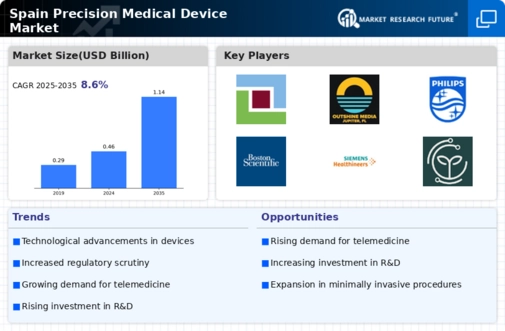
Spain Precision Medical Devices Market Infographic
Purchase Options

Spain Precision Medical Devices Market Summary

As per analysis, the Spain precision medical devices market is projected to grow from USD 0.963 Billion in 2024 to USD 1.58 Billion by 2035, exhibiting a compound annual growth rate (CAGR) of 4.62% during the forecast period (2025 - 2035).

Key Market Trends & Highlights

The Spain precision medical devices market is experiencing robust growth driven by technological advancements and a focus on personalized medicine.

  • Surgical instruments represent the largest segment in the Spain precision medical devices market, reflecting a strong demand in healthcare settings.
  • Diagnostic devices are the fastest-growing segment, indicating a shift towards early detection and preventive care.
  • Hospitals remain the largest end-user segment, while home care is emerging as the fastest-growing sector, driven by changing patient preferences.
  • Technological advancements and an aging population are key drivers propelling the market forward.

Market Size & Forecast

2024 Market Size 0.963 (USD Billion)
2035 Market Size 1.58 (USD Billion)
CAGR (2025 - 2035) 4.62%

Major Players

Siemens Healthineers (DE), Philips (NL), GE Healthcare (US), Medtronic (IE), Johnson & Johnson (US), B. Braun Melsungen AG (DE), Stryker Corporation (US), Boston Scientific (US), Abbott Laboratories (US)

Our Impact
Enabled $4.3B Revenue Impact for Fortune 500 and Leading Multinationals
Partnering with 2000+ Global Organizations Each Year
30K+ Citations by Top-Tier Firms in the Industry

Spain Precision Medical Devices Market Trends

The Spain precision medical devices market is currently experiencing a dynamic evolution, driven by advancements in technology and increasing healthcare demands. The integration of innovative solutions, such as artificial intelligence and robotics, is reshaping the landscape of medical devices. This transformation is not merely a trend but a fundamental shift that appears to enhance diagnostic accuracy and treatment efficacy. Furthermore, the regulatory environment in Spain is adapting to these changes, fostering an ecosystem that encourages innovation while ensuring patient safety. As a result, manufacturers are likely to invest in research and development to create cutting-edge products that meet the evolving needs of healthcare providers and patients alike. In addition, the growing emphasis on personalized medicine is influencing the Spain precision medical devices market. This approach tailors medical interventions to individual patient characteristics, which may lead to improved outcomes. The collaboration between healthcare professionals and device manufacturers is becoming increasingly vital, as it allows for the development of solutions that are not only effective but also user-friendly. Overall, the market appears poised for continued growth, with opportunities for stakeholders to engage in meaningful advancements that could redefine patient care in Spain.

Technological Advancements

The Spain precision medical devices market is witnessing a surge in technological innovations. The incorporation of advanced materials and smart technologies is enhancing device functionality and performance. This trend suggests a shift towards more sophisticated solutions that can provide real-time data and improve patient monitoring.

Regulatory Adaptations

The regulatory framework governing the Spain precision medical devices market is evolving to accommodate new technologies. Authorities are streamlining approval processes for innovative devices, which may encourage manufacturers to bring novel products to market more swiftly. This adaptation indicates a supportive environment for innovation.

Focus on Personalized Medicine

There is a growing trend towards personalized medicine within the Spain precision medical devices market. This approach emphasizes tailoring medical devices to meet the specific needs of individual patients. Such customization could lead to enhanced treatment outcomes and greater patient satisfaction.

Spain Precision Medical Devices Market Drivers

Aging Population

The demographic shift towards an aging population in Spain is a critical driver for the precision medical devices market. As the proportion of elderly individuals increases, there is a corresponding rise in the prevalence of chronic diseases, necessitating advanced medical interventions. The World Health Organization projects that by 2030, nearly 25% of Spain's population will be over 65 years old. This demographic trend is likely to spur demand for precision medical devices, particularly in areas such as orthopedic implants and cardiovascular devices. The market is expected to expand as healthcare providers seek innovative solutions to address the unique needs of older patients, thereby enhancing the overall quality of care.

Regulatory Adaptations

The regulatory landscape surrounding the Spain precision medical devices market is evolving, with new policies aimed at ensuring safety and efficacy. The Spanish Agency of Medicines and Medical Devices (AEMPS) has implemented stringent regulations that align with European Union directives. These adaptations are fostering a more transparent environment for manufacturers and consumers alike. As a result, companies are increasingly investing in compliance measures, which, while initially costly, are likely to enhance market credibility. The regulatory framework is expected to facilitate the entry of innovative devices, thereby expanding the market. In 2025, the total value of the medical devices market in Spain reached approximately 10 billion euros, reflecting the positive impact of these regulatory changes.

Technological Advancements

The Spain precision medical devices market is experiencing a notable surge due to rapid technological advancements. Innovations in imaging technologies, such as MRI and CT scans, have enhanced diagnostic accuracy, leading to improved patient outcomes. Furthermore, the integration of artificial intelligence in medical devices is streamlining processes and enabling real-time data analysis. According to recent data, the market for advanced imaging devices in Spain is projected to grow at a compound annual growth rate (CAGR) of 8% over the next five years. This growth is indicative of the increasing demand for precision in diagnostics and treatment, positioning Spain as a leader in the European medical technology landscape.

Focus on Personalized Medicine

The growing emphasis on personalized medicine is significantly influencing the Spain precision medical devices market. Tailored treatment approaches, which consider individual genetic profiles, are becoming more prevalent. This shift is driving demand for precision medical devices that can deliver customized therapies. For instance, advancements in genomics and biotechnology are enabling the development of devices that cater to specific patient needs. The market for personalized medical devices in Spain is anticipated to reach 2 billion euros by 2027, indicating a robust growth trajectory. This trend not only enhances patient satisfaction but also optimizes healthcare resources, making it a pivotal driver in the evolving landscape of the Spanish medical device sector.

Investment in Healthcare Infrastructure

Investment in healthcare infrastructure is a significant catalyst for the Spain precision medical devices market. The Spanish government has committed to enhancing healthcare facilities and technology, aiming to improve patient care and outcomes. Recent initiatives include funding for state-of-the-art medical equipment and the establishment of specialized centers for advanced treatments. In 2025, public and private investments in healthcare reached approximately 15 billion euros, reflecting a strong commitment to modernizing the sector. This influx of capital is likely to facilitate the adoption of precision medical devices, as healthcare providers seek to integrate cutting-edge technologies into their practices. Consequently, this investment trend is expected to bolster the market's growth in the coming years.

Market Segment Insights

By Application: Surgical Instruments (Largest) vs. Diagnostic Devices (Fastest-Growing)

In the Spain precision medical devices market, the application segment is diverse, comprising Surgical Instruments, Diagnostic Devices, Therapeutic Devices, Monitoring Devices, and Imaging Devices. Surgical Instruments hold the largest market share among these segments due to their vital role in various surgical procedures. Meanwhile, Diagnostic Devices are rapidly gaining traction, indicating a dynamic shift towards early detection and preventative healthcare solutions.

Application: Surgical Instruments (Dominant) vs. Diagnostic Devices (Emerging)

Surgical Instruments play a pivotal role in healthcare, encompassing an array of tools essential for surgical procedures, thus establishing their dominance in the Spain precision medical devices market. Their established usage and criticality in surgeries enhance their market position. On the other hand, Diagnostic Devices represent an emerging segment characterized by innovative technologies designed for efficient and accurate disease detection. With a growing focus on preventive healthcare, this segment is witnessing rapid advancements, making it increasingly vital for clinical practices. The integration of AI and digital technologies further fuels this growth, enhancing diagnostic accuracy and patient outcomes.

By End Use: Hospitals (Largest) vs. Home Care (Fastest-Growing)

In the Spain precision medical devices market, the segment distribution shows that Hospitals hold the largest market share, largely due to their extensive adoption of advanced medical technologies and significant budgets for precision devices. Clinics, Ambulatory Surgical Centers, and Research Laboratories also contribute to the market, but they represent smaller shares. Home Care is emerging significantly as a key player, driven by changing demographics and an emphasis on patient-centered care.

Hospitals (Dominant) vs. Home Care (Emerging)

In the Spain precision medical devices market, Hospitals dominate the end use segment due to their capability to invest in high-end medical technologies that require precision devices for improved patient care. They employ a vast range of precision instruments to enhance diagnostics and treatment outcomes, ensuring high-quality services. In contrast, Home Care represents an emerging segment, propelled by the demand for individualized care and the rise of chronic diseases. This shift towards Home Care presents opportunities for growth, as patients prefer receiving care in familiar environments, driving innovations in medical devices tailored for home use.

By Technology: Robotic Surgery (Largest) vs. Wearable Devices (Fastest-Growing)

In the Spain precision medical devices market, Robotic Surgery holds the largest share, driven by its increasing adoption in hospitals and surgical centers. The market for Wearable Devices, while smaller, is rapidly expanding as consumers demand more health monitoring solutions, creating a competitive landscape in which technological advancement plays a key role. Telemedicine Solutions and 3D Printing also contribute to this diverse market, with Nanotechnology providing innovative approaches to enhance device functionality and patient care. The growth trends in the technology segment are significantly influenced by factors such as rising investments in healthcare R&D and the demand for minimally invasive surgical procedures. The COVID-19 pandemic further accelerated the adoption of Telemedicine Solutions, while consumer interest in personal health tracking drives Wearable Devices' growth. As hospitals increasingly integrate these technologies, the competition among providers intensifies, fostering innovation and improved patient outcomes.

Robotic Surgery (Dominant) vs. Wearable Devices (Emerging)

Robotic Surgery has emerged as a dominant force in the Spain precision medical devices market, offering enhanced precision and control during surgical procedures. Its ability to reduce recovery times and improve patient outcomes has led to widespread acceptance among healthcare professionals and patients alike. In contrast, Wearable Devices represent an emerging segment characterized by their capacity to track and monitor various health metrics through smart technology. The increasing prevalence of chronic diseases and an aging population have spurred demand for these devices, which empower users to take charge of their health. As both segments advance, they complement each other, with Wearable Devices increasingly being integrated into surgical programs to monitor patient status pre and post-surgery.

By Product Type: Implants (Largest) vs. Diagnostic Equipment (Fastest-Growing)

In the Spain precision medical devices market, product type segmentation reveals that Implants hold the largest share, reflecting their critical role in surgical procedures. This segment is buoyed by an increasing elderly population and rising orthopedic and dental surgeries. Meanwhile, the Diagnostic Equipment segment is witnessing rapid growth, driven by technological advancements, increasing health awareness, and the rising prevalence of chronic diseases that necessitate early detection.

Diagnostic Equipment (Emerging) vs. Implants (Dominant)

Diagnostic Equipment is emerging powerfully within the Spain precision medical devices market due to ongoing innovations in imaging and lab technologies. As healthcare providers lean towards precise diagnosis for better patient outcomes, this segment is gaining traction. Implants, on the other hand, remain dominant, given their established role in maximizing patient recovery and enhancement of quality of life. Both segments are supported by robust research and development investments, ensuring they remain at the forefront of medical advancements.

By Patient Demographics: Adult (Largest) vs. Geriatric (Fastest-Growing)

In the Spain precision medical devices market, patient demographics play a critical role in shaping demand. The adult demographic currently holds the largest share of the market, attributed to the higher prevalence of health issues among this age group. Meanwhile, the geriatric segment, characterized by an increasing aging population, has emerged as the fastest-growing category, driven by advancements in technology tailored for elderly patients. The awareness and need for customized medical solutions are propelling this growth further. The growth trends in the Spanish market indicate a significant shift towards accommodating geriatric patients, with innovations in precision medical devices that focus on accessibility and ease of use. This segment's growth is primarily driven by the rise in chronic illnesses and a heightened emphasis on post-operative care for older adults. Manufacturers are increasingly investing in research and development to address specific needs in this demographic, creating opportunities for tailored solutions that enhance patient outcomes.

Adult (Dominant) vs. Geriatric (Emerging)

The adult demographic remains the dominant segment in the Spain precision medical devices market, representing a wide array of patients ranging from those with acute health issues to those seeking preventive care. This segment benefits from the established healthcare infrastructure and a broad acceptance of advanced medical technologies. On the other hand, the geriatric segment is emerging prominently amidst the increase in Spain's older population. This group demands specialized devices that cater to their unique health challenges, such as mobility assistance and chronic illness management. The competitive landscape is evolving, with companies striving to develop innovative solutions that enhance the quality of life for geriatric patients, positioning them well for growth in the coming years.

Get more detailed insights about Spain Precision Medical Devices Market

Key Players and Competitive Insights

The precision medical devices market in Spain is characterized by a dynamic competitive landscape, driven by technological advancements and increasing healthcare demands. Major players such as Siemens Healthineers (DE), Philips (NL), and Medtronic (IE) are at the forefront, each adopting distinct strategies to enhance their market presence. Siemens Healthineers (DE) focuses on innovation through the development of advanced imaging technologies, while Philips (NL) emphasizes digital transformation and integrated solutions. Medtronic (IE), on the other hand, is concentrating on expanding its product portfolio through strategic acquisitions, thereby enhancing its operational capabilities. Collectively, these strategies contribute to a competitive environment that is increasingly focused on innovation and technological integration.

Key business tactics within this market include localizing manufacturing and optimizing supply chains to enhance efficiency and responsiveness. The competitive structure appears moderately fragmented, with several key players exerting influence over various segments. This fragmentation allows for a diverse range of products and services, catering to the specific needs of healthcare providers across Spain. The collective influence of these major companies shapes market dynamics, fostering an environment where innovation and operational excellence are paramount.

In November 2025, Siemens Healthineers (DE) announced the launch of a new AI-driven imaging system designed to improve diagnostic accuracy and patient outcomes. This strategic move underscores the company's commitment to leveraging cutting-edge technology to enhance its product offerings. The introduction of AI capabilities not only positions Siemens Healthineers (DE) as a leader in the imaging sector but also reflects a broader trend towards the integration of artificial intelligence in medical devices, which is likely to redefine diagnostic processes.

In December 2025, Philips (NL) unveiled a partnership with a leading Spanish healthcare provider to implement a comprehensive telehealth platform. This initiative aims to enhance patient engagement and streamline healthcare delivery. By focusing on telehealth solutions, Philips (NL) is responding to the growing demand for remote healthcare services, which has become increasingly relevant in the current healthcare landscape. This partnership may serve as a model for future collaborations, emphasizing the importance of integrated healthcare solutions.

In January 2026, Medtronic (IE) completed the acquisition of a Spanish startup specializing in minimally invasive surgical technologies. This acquisition is strategically significant as it expands Medtronic's capabilities in a high-growth segment of the market. By integrating innovative technologies from the startup, Medtronic (IE) is likely to enhance its competitive positioning and address the evolving needs of healthcare providers seeking advanced surgical solutions.

As of January 2026, current trends in the precision medical devices market are increasingly defined by digitalization, sustainability, and the integration of AI technologies. Strategic alliances are becoming more prevalent, as companies recognize the value of collaboration in driving innovation and enhancing product offerings. Looking ahead, competitive differentiation is expected to evolve, with a shift from price-based competition towards a focus on innovation, technological advancement, and supply chain reliability. This transition may ultimately reshape the landscape of the precision medical devices market in Spain, fostering an environment where quality and innovation take precedence over cost.


Key Companies in the Spain Precision Medical Devices Market include

Industry Developments

The Spain Precision Medical Device Market has seen several significant developments recently. Medtronic has expanded its product offerings for minimally invasive surgical solutions, aligning with the increasing demand for higher precision in medical operations. In July 2023, Siemens Healthineers announced a partnership with local hospitals to integrate their AI technologies into diagnostic tools, enhancing the capabilities of precision medicine. Additionally, Johnson & Johnson has been actively investing in clinical trials to advance its surgical robotics division within Spain, aiming to cater to specific regional health needs.

Mergers and acquisitions have also occurred, as Terumo finalized its acquisition of a smaller Spanish medical device firm in February 2023, bolstering its presence in the local market. Growth projections indicate that the market valuation in Spain is expected to rise due to advancements in technology and increasing healthcare spending, which is estimated to reach over €3 billion by 2025. The trends indicate a healthy trajectory for companies like Abbott and Boston Scientific, which are also expanding their portfolios to meet evolving patient care demands.

Over the last few years, Spain's commitment to digital health initiatives has further accelerated the adoption of precision medical technologies.

Future Outlook

Spain Precision Medical Devices Market Future Outlook

The Spain precision medical devices market is projected to grow at a 4.62% CAGR from 2025 to 2035, driven by technological advancements, increasing healthcare investments, and rising demand for personalized medicine.

New opportunities lie in:

  • Development of AI-driven diagnostic tools for enhanced patient outcomes.
  • Expansion of telehealth platforms integrating precision devices.
  • Partnerships with biotech firms for innovative device solutions.

By 2035, the market is expected to be robust, characterized by innovation and strategic collaborations.

Market Segmentation

Spain Precision Medical Devices Market End Use Outlook

  • Hospitals
  • Clinics
  • Home Care
  • Research Laboratories
  • Ambulatory Surgical Centers

Spain Precision Medical Devices Market Technology Outlook

  • Robotic Surgery
  • Wearable Devices
  • Telemedicine Solutions
  • 3D Printing
  • Nanotechnology

Spain Precision Medical Devices Market Application Outlook

  • Surgical Instruments
  • Diagnostic Devices
  • Therapeutic Devices
  • Monitoring Devices
  • Imaging Devices

Spain Precision Medical Devices Market Product Type Outlook

  • Implants
  • Prosthetics
  • Diagnostic Equipment
  • Surgical Equipment
  • Monitoring Equipment

Spain Precision Medical Devices Market Patient Demographics Outlook

  • Pediatric
  • Adult
  • Geriatric
  • Chronic Illness
  • Post-operative Care

Report Scope

MARKET SIZE 20240.963(USD Billion)
MARKET SIZE 20251.01(USD Billion)
MARKET SIZE 20351.58(USD Billion)
COMPOUND ANNUAL GROWTH RATE (CAGR)4.62% (2024 - 2035)
REPORT COVERAGERevenue Forecast, Competitive Landscape, Growth Factors, and Trends
BASE YEAR2024
Market Forecast Period2025 - 2035
Historical Data2019 - 2024
Market Forecast UnitsUSD Billion
Key Companies ProfiledSiemens Healthineers (DE), Philips (NL), GE Healthcare (US), Medtronic (IE), Johnson & Johnson (US), B. Braun Melsungen AG (DE), Stryker Corporation (US), Boston Scientific (US), Abbott Laboratories (US)
Segments CoveredApplication, End Use, Technology, Product Type, Patient Demographics
Key Market OpportunitiesIntegration of artificial intelligence in diagnostics enhances efficiency in the Spain precision medical devices market.
Key Market DynamicsTechnological advancements drive innovation in Spain's precision medical devices market, enhancing patient outcomes and operational efficiency.
Countries CoveredSpain
Leave a Comment

FAQs

What is the current valuation of the Spain precision medical devices market?

As of 2024, the market valuation was 0.963 USD Billion.

What is the projected market size for the Spain precision medical devices market by 2035?

The market is projected to reach 1.58 USD Billion by 2035.

What is the expected CAGR for the Spain precision medical devices market during the forecast period?

The expected CAGR for the market from 2025 to 2035 is 4.62%.

Which companies are the key players in the Spain precision medical devices market?

Key players include Siemens Healthineers, Philips, GE Healthcare, Medtronic, and Johnson & Johnson.

What are the main segments of the Spain precision medical devices market?

The main segments include surgical instruments, diagnostic devices, therapeutic devices, monitoring devices, and imaging devices.

How did the surgical instruments segment perform in 2024?

In 2024, the surgical instruments segment was valued between 0.25 and 0.4 USD Billion.

What is the expected growth for the diagnostic devices segment by 2035?

The diagnostic devices segment is anticipated to grow from 0.3 to 0.5 USD Billion by 2035.

What is the valuation range for the home care segment in 2024?

The home care segment was valued between 0.125 and 0.215 USD Billion in 2024.

Which technology segments are expected to see growth in the Spain precision medical devices market?

Technologies such as robotic surgery, wearable devices, and telemedicine solutions are expected to grow significantly.

What is the valuation of the geriatric patient demographic segment in 2024?

The geriatric patient demographic segment was valued between 0.1926 and 0.313 USD Billion in 2024.

Download Free Sample

Kindly complete the form below to receive a free sample of this Report

Compare Licence

×
Features License Type
Single User Multiuser License Enterprise User
Price $4,950 $5,950 $7,250
Maximum User Access Limit 1 User Upto 10 Users Unrestricted Access Throughout the Organization
Free Customization
Direct Access to Analyst
Deliverable Format
Platform Access
Discount on Next Purchase 10% 15% 15%
Printable Versions