×
Request Free Sample ×

Kindly complete the form below to receive a free sample of this Report

* Please use a valid business email

Leading companies partner with us for data-driven Insights

clients tt-cursor
Hero Background

Spain Orthopedic Devices Market

ID: MRFR/HC/43184-HCR
200 Pages
Rahul Gotadki
February 2026

Spain Orthopedic Devices Market Research Report By Type (Trauma Fixation, Spinal Devices, Joint Replacement, Consumables Disposables, Bone Repair), By Application (Spine, Trauma and Extremities, Knee, Hip, Foot and Ankle) and By End User (Ambulatory Surgery Centers, Hospitals, Medical Research Center) - Growth & Industry Forecast 2025 To 2035

Share:
Download PDF ×

We do not share your information with anyone. However, we may send you emails based on your report interest from time to time. You may contact us at any time to opt-out.

Spain Orthopedic Devices Market Infographic
Purchase Options

Spain Orthopedic Devices Market Summary

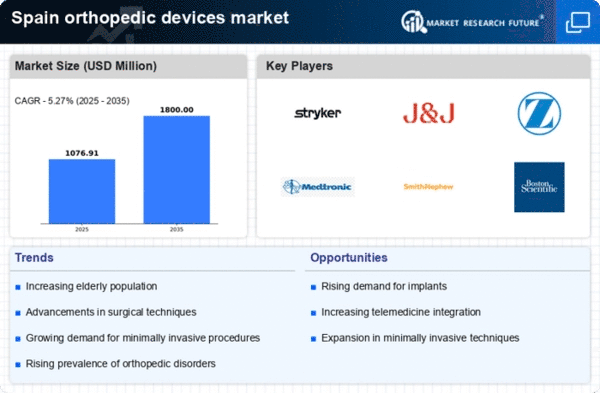
As per Market Research Future analysis, the Spain orthopedic devices market size was estimated at 1023.0 USD Million in 2024. The Spain orthopedic devices market is projected to grow from 1076.91 USD Million in 2025 to 1800.0 USD Million by 2035, exhibiting a compound annual growth rate (CAGR) of 5.2% during the forecast period 2025 - 2035

Key Market Trends & Highlights

The Spain orthopedic devices market is experiencing robust growth driven by technological advancements and demographic shifts.

  • Technological advancements are enhancing the efficacy and safety of orthopedic devices, leading to increased adoption.
  • The aging population in Spain is contributing to a higher demand for orthopedic solutions, particularly in joint replacement segments.
  • Outpatient care is becoming a focal point, with a shift towards minimally invasive procedures and shorter recovery times.
  • The rising incidence of musculoskeletal disorders and government initiatives are key drivers propelling market growth.

Market Size & Forecast

2024 Market Size 1023.0 (USD Million)
2035 Market Size 1800.0 (USD Million)
CAGR (2025 - 2035) 5.27%

Major Players

Stryker (US), DePuy Synthes (US), Zimmer Biomet (US), Medtronic (US), Smith & Nephew (GB), Boston Scientific (US), NuVasive (US), Amedica (US), Orthofix (US)

Our Impact
Enabled $4.3B Revenue Impact for Fortune 500 and Leading Multinationals
Partnering with 2000+ Global Organizations Each Year
30K+ Citations by Top-Tier Firms in the Industry

Spain Orthopedic Devices Market Trends

The orthopedic devices market in Spain is currently experiencing notable growth, driven by an increasing aging population and a rising prevalence of musculoskeletal disorders. The demand for innovative and effective orthopedic solutions is on the rise, as healthcare providers seek to enhance patient outcomes and improve quality of life. Technological advancements in materials and design are also contributing to the evolution of this market, with a focus on minimally invasive procedures and personalized treatment options. Furthermore, the Spanish government is actively investing in healthcare infrastructure, which may facilitate greater access to orthopedic devices and services across the country. In addition, the orthopedic devices market is witnessing a shift towards outpatient care, as patients increasingly prefer less invasive treatments that allow for quicker recovery times. This trend is likely to encourage the development of new products that cater to the needs of both patients and healthcare professionals. As the market continues to evolve, collaboration between manufacturers, healthcare providers, and regulatory bodies will be essential to ensure that innovations align with patient needs and safety standards. Overall, the orthopedic devices market in Spain appears poised for continued expansion, driven by demographic changes and advancements in technology.

Technological Advancements

The orthopedic devices market is seeing rapid technological innovations, particularly in the development of smart implants and robotics. These advancements aim to enhance surgical precision and improve patient outcomes. As a result, healthcare providers are increasingly adopting these technologies to offer better treatment options.

Aging Population

Spain's demographic shift towards an older population is significantly impacting the orthopedic devices market. With age-related conditions becoming more prevalent, there is a growing demand for orthopedic solutions tailored to the needs of elderly patients. This trend is likely to drive market growth in the coming years.

Outpatient Care Focus

There is a noticeable trend towards outpatient care within the orthopedic devices market. Patients are increasingly opting for less invasive procedures that allow for quicker recovery and reduced hospital stays. This shift is prompting manufacturers to develop products that cater to outpatient treatment protocols.

Spain Orthopedic Devices Market Drivers

Government Initiatives and Funding

Government initiatives aimed at improving healthcare infrastructure in Spain are significantly influencing the orthopedic devices market. Increased funding for healthcare services, particularly in the realm of orthopedic care, is facilitating access to advanced medical technologies. The Spanish government has allocated substantial budgets to enhance hospital facilities and promote research in orthopedic innovations. This financial support is likely to encourage the adoption of cutting-edge orthopedic devices, which can lead to better patient outcomes. Furthermore, public health campaigns aimed at raising awareness about musculoskeletal health are expected to drive demand for orthopedic solutions. As a result, the orthopedic devices market is poised for growth, supported by favorable government policies and investments.

Technological Integration in Healthcare

The integration of technology into healthcare practices is transforming the orthopedic devices market in Spain. Innovations such as 3D printing, robotics, and telemedicine are enhancing the design and functionality of orthopedic devices. For instance, 3D printing allows for the customization of implants and prosthetics, catering to individual patient needs. Additionally, robotic-assisted surgeries are improving precision and reducing recovery times, which is appealing to both patients and healthcare providers. The orthopedic devices market is likely to benefit from these advancements, as they not only improve surgical outcomes but also increase patient satisfaction. As technology continues to evolve, the market may see a surge in demand for these sophisticated orthopedic solutions.

Growing Awareness of Preventive Healthcare

There is a notable shift towards preventive healthcare in Spain, which is positively impacting the orthopedic devices market. As individuals become more health-conscious, there is an increasing emphasis on early diagnosis and preventive measures for musculoskeletal issues. Educational programs and community health initiatives are promoting the importance of maintaining bone and joint health, leading to a rise in preventive orthopedic treatments. This trend is likely to drive demand for orthopedic devices that support rehabilitation and injury prevention. The orthopedic devices market may experience growth as more people seek proactive solutions to avoid serious conditions, thereby enhancing their overall well-being.

Rising Incidence of Musculoskeletal Disorders

The increasing prevalence of musculoskeletal disorders in Spain is a primary driver for the orthopedic devices market. Conditions such as arthritis, osteoporosis, and sports-related injuries are becoming more common, affecting a significant portion of the population. According to recent health statistics, approximately 20% of adults in Spain suffer from some form of musculoskeletal disorder, leading to a heightened demand for orthopedic solutions. This trend is likely to continue as the population ages and lifestyle factors contribute to these conditions. Consequently, healthcare providers are investing in advanced orthopedic devices to address these issues, thereby propelling market growth. The orthopedic devices market is expected to expand as more patients seek effective treatments and surgical interventions to improve their quality of life.

Increase in Sports Participation and Activity Levels

The rise in sports participation and physical activity levels among the Spanish population is a significant driver for the orthopedic devices market. As more individuals engage in recreational and competitive sports, the incidence of sports-related injuries is also increasing. This trend necessitates the availability of effective orthopedic devices for treatment and rehabilitation. According to recent surveys, nearly 40% of Spaniards participate in regular physical activities, which correlates with a higher demand for orthopedic solutions. Consequently, healthcare providers are focusing on developing specialized devices tailored for athletes and active individuals. The orthopedic devices market is expected to grow as the need for injury prevention and recovery solutions becomes more pronounced.


Market Segment Insights

By Type: Joint Reconstruction Devices (Largest) vs. Spinal Devices (Fastest-Growing)

In the Spain orthopedic devices market, Joint Reconstruction Devices command the largest market share due to their critical role in orthopedic surgeries. This segment encompasses a variety of products that address joint-related issues, contributing significantly to the overall revenue. In contrast, Spinal Devices are witnessing rapid growth as advancements in technology and increased spinal surgeries drive demand for innovative solutions. The growth trends in these segments are influenced by various factors, including an aging population, rising incidence of sports injuries, and increasing awareness about orthopedic treatments. Joint Reconstruction Devices benefit from established procedures and a steady demand, while Spinal Devices are rapidly evolving with new technologies that enhance surgical outcomes, making them an attractive segment for investment and innovation in the coming years.

Joint Reconstruction Devices (Dominant) vs. Orthobiologics (Emerging)

Joint Reconstruction Devices are recognized as the dominant segment in the Spain orthopedic devices market, offering a wide range of solutions for patients needing joint repair or replacement. These devices are particularly favored due to their established efficacy and extensive clinical application. On the other hand, Orthobiologics represent an emerging segment, gaining traction through the rising interest in regenerative medicine and minimally invasive procedures. This segment includes products such as stem cell therapies and growth factors that aim to promote healing and tissue regeneration, positioning them as a complementary option alongside traditional surgical treatments. As healthcare practices evolve, the integration of Orthobiologics could potentially reshape treatment paradigms in orthopedic care.

By Material: Metal (Largest) vs. Biodegradable Materials (Fastest-Growing)

In the Spain orthopedic devices market, the material segment is characterized by a diverse distribution among five key categories: Metal, Plastic, Ceramics, Composite, and Biodegradable Materials. Currently, Metal holds the largest market share, attributed to its strength and durability, commonly used in implants and surgical instruments. Plastic and Ceramics follow in terms of share, while Composite and Biodegradable Materials are gaining traction due to their specific applications and innovative properties. The growth trends within this segment are significantly shaped by advancements in material science and increasing demand for minimally invasive surgeries. Biodegradable Materials are emerging as the fastest-growing category, driven by a shift towards sustainable practices in healthcare. The need for lighter and stronger materials for orthopedic implants is also pushing the adoption of Composite materials, indicating a robust trajectory for these segments in the coming years.

Metal (Dominant) vs. Biodegradable Materials (Emerging)

Metal remains the dominant material in the orthopedic devices market due to its exceptional mechanical properties, such as strength, hardness, and resistance to fatigue, making it a preferred choice for various implants and instruments. Its well-established production processes and widespread acceptance in clinical settings contribute to its leadership position. In contrast, Biodegradable Materials are seen as an emerging solution, appealing to the growing preference for environmentally friendly options in medical applications. These materials offer the advantage of reducing long-term implant-related complications, thereby enhancing patient outcomes. As healthcare providers increasingly prioritize sustainability, Biodegradable Materials are expected to capture a larger share of the market, driven by ongoing innovations and regulatory support.

By End User: Hospitals (Largest) vs. Orthopedic Clinics (Fastest-Growing)

The Spain orthopedic devices market reveals a diverse distribution among its end user segments. Hospitals remain the largest segment, capturing significant market share due to their extensive infrastructure and resources, which facilitate a wide range of orthopedic procedures. Orthopedic clinics, while smaller in share, are quickly gaining traction with increasing patient preference for specialized care. Both segments play crucial roles in the overall market dynamics. In recent years, growth trends have been propelled by technological advancements and increasing orthopedic procedures across various age groups. Rehabilitation centers and ambulatory surgical centers are also contributing to growth, driven by an aging population and rising awareness about physical fitness. With evolving healthcare policies and rising investment in healthcare infrastructure, these segments are poised for substantial expansion in the coming years.

Hospitals (Dominant) vs. Orthopedic Clinics (Emerging)

Hospitals have long been the dominant force in the Spain orthopedic devices market, offering comprehensive services and access to advanced technologies. Their ability to perform complex surgeries and their established reputation contribute to their leading market position. Conversely, orthopedic clinics are emerging as significant players due to their focus on specialized care and shorter wait times, appealing to patients seeking targeted treatment options. As consumer behavior shifts towards seeking outpatient care and personalized services, orthopedic clinics are expected to grow rapidly, potentially reshaping the competitive landscape in the orthopedic devices domain.

By Indication: Osteoarthritis (Largest) vs. Sports Injuries (Fastest-Growing)

The Spain orthopedic devices market sees a significant distribution of market share among various indication segments. Osteoarthritis remains the largest segment, driven by the aging population and increasing prevalence of joint-related disorders. Trauma, spinal disorders, and fractures also contribute substantially to the market, indicating a diverse demand for orthopedic solutions. In contrast, sports injuries are emerging as a key segment, reflecting the rising participation in physical activities and sports. Growth trends in the Spain orthopedic devices market are influenced by several factors, including advancements in technology, increasing healthcare expenditure, and a greater focus on preventive care. The awareness of sports-related injuries and the need for effective rehabilitation solutions drive the demand for sports injury-related devices, showcasing the evolving landscape of orthopedic care. As the population ages and active lifestyles become more prevalent, the market for orthopedic devices, particularly in major segments like osteoarthritis and sports injuries, is poised for substantial growth.

Osteoarthritis (Dominant) vs. Sports Injuries (Emerging)

Osteoarthritis represents a dominant market segment characterized by its widespread impact on the aging population, leading to a high demand for orthopedic devices aimed at joint support and pain relief. The segment benefits from a range of treatment options, including implants and braces. In contrast, the emerging segment of sports injuries is rapidly gaining traction, fueled by the increasing engagement in sports and fitness activities. Products in this segment include advanced supports and rehabilitation tools that specifically address acute injuries. The juxtaposition of these two segments highlights the focus on both chronic conditions like osteoarthritis and the need for innovative solutions to cater to trauma incurred during sports activities.

Get more detailed insights about Spain Orthopedic Devices Market

Key Players and Competitive Insights

The orthopedic devices market in Spain exhibits a dynamic competitive landscape characterized by rapid innovation and strategic collaborations among key players. Major companies such as Stryker (US), DePuy Synthes (US), and Zimmer Biomet (US) are at the forefront, focusing on advanced technologies and expanding their product portfolios. Stryker (US) emphasizes innovation in minimally invasive surgical solutions, while DePuy Synthes (US) leverages its extensive research capabilities to enhance joint reconstruction products. Zimmer Biomet (US) is actively pursuing partnerships to bolster its digital health initiatives, collectively shaping a competitive environment that prioritizes technological advancement and patient-centric solutions.Key business tactics within the orthopedic devices market include localizing manufacturing and optimizing supply chains to enhance efficiency and responsiveness. The market structure appears moderately fragmented, with several players vying for market share. However, the collective influence of major companies creates a competitive atmosphere where innovation and strategic positioning are paramount. This fragmentation allows for niche players to emerge, yet the dominance of established firms remains a significant factor in shaping market dynamics.

In October Stryker (US) announced the launch of a new robotic-assisted surgical system aimed at improving precision in orthopedic procedures. This strategic move underscores Stryker's commitment to integrating cutting-edge technology into its offerings, potentially enhancing surgical outcomes and patient satisfaction. The introduction of such advanced systems may also serve to differentiate Stryker in a crowded marketplace, aligning with the growing trend towards automation in healthcare.

In September DePuy Synthes (US) expanded its product line with the introduction of a new range of orthopedic implants designed for enhanced biocompatibility. This initiative reflects the company's focus on innovation and addressing the evolving needs of healthcare providers. By prioritizing biocompatibility, DePuy Synthes (US) positions itself as a leader in patient safety and satisfaction, which could lead to increased market share in the competitive landscape.

In August Zimmer Biomet (US) entered into a strategic partnership with a leading digital health company to develop integrated solutions for orthopedic care. This collaboration aims to leverage data analytics and AI to improve patient outcomes and streamline surgical workflows. Such partnerships are indicative of a broader trend towards digital transformation in the orthopedic devices market, where technology plays a crucial role in enhancing operational efficiency and patient care.

As of November current competitive trends in the orthopedic devices market are increasingly defined by digitalization, sustainability, and the integration of AI technologies. Strategic alliances among key players are shaping the landscape, fostering innovation and enhancing product offerings. The shift from price-based competition to a focus on technological advancement and supply chain reliability is evident, suggesting that future competitive differentiation will hinge on the ability to innovate and adapt to changing market demands.

Key Companies in the Spain Orthopedic Devices Market include

Industry Developments

Spain's Orthopedic Devices Market has witnessed significant developments recently, particularly in July 2023, when Johnson Johnson announced an expansion in its orthopedic portfolio in Spain to cater to the growing elderly demographic, which requires advanced orthopedic solutions. 

Similarly, in June 2023, Stryker launched a new surgical navigation system aimed at enhancing precision in orthopedic surgeries, further boosting their competitive edge in the Spanish market. Meanwhile, in August 2023, Zimmer Biomet reported a notable increase in market share following its introduction of a novel implant technology specifically designed for knee replacements. As for mergers and acquisitions, in September 2023, Conmed finalized its acquisition of a local orthopedic device manufacturer, enhancing its operational capabilities in Spain. 

Growth in the market has also been reflected through America's reported 15% revenue increase in Q3 of 2023, attributed to heightened demand for its silicon nitride implants. Over the past two years, the orthopedic devices market in Spain has evolved with these strategic moves aligning with the government’s emphasis on improving healthcare services in the country, thus presenting a dynamic landscape for existing and new players in the sector.

Future Outlook

Spain Orthopedic Devices Market Future Outlook

The Orthopedic Devices Market is projected to grow at a 5.27% CAGR from 2025 to 2035, driven by technological advancements, an aging population, and increasing healthcare expenditure.

New opportunities lie in:

  • Development of smart orthopedic implants with integrated monitoring systems.
  • Expansion of telehealth services for remote orthopedic consultations.
  • Investment in biodegradable orthopedic devices for sustainable practices.

By 2035, the orthopedic devices market is expected to achieve substantial growth, driven by innovation and evolving healthcare needs.

Market Segmentation

Spain Orthopedic Devices Market Type Outlook

  • Joint Reconstruction Devices
  • Spinal Devices
  • Cranial Orthoses
  • Orthobiologics
  • Support Devices

Spain Orthopedic Devices Market End User Outlook

  • Hospitals
  • Orthopedic Clinics
  • Rehabilitation Centers
  • Ambulatory Surgical Centers

Spain Orthopedic Devices Market Material Outlook

  • Metal
  • Plastic
  • Ceramics
  • Composite
  • Biodegradable Materials

Spain Orthopedic Devices Market Indication Outlook

  • Osteoarthritis
  • Trauma
  • Spinal Disorders
  • Fractures
  • Sports Injuries

Report Scope

MARKET SIZE 2024 1023.0(USD Million)
MARKET SIZE 2025 1076.91(USD Million)
MARKET SIZE 2035 1800.0(USD Million)
COMPOUND ANNUAL GROWTH RATE (CAGR) 5.27% (2025 - 2035)
REPORT COVERAGE Revenue Forecast, Competitive Landscape, Growth Factors, and Trends
BASE YEAR 2024
Market Forecast Period 2025 - 2035
Historical Data 2019 - 2024
Market Forecast Units USD Million
Key Companies Profiled Stryker (US), DePuy Synthes (US), Zimmer Biomet (US), Medtronic (US), Smith & Nephew (GB), Boston Scientific (US), NuVasive (US), Amedica (US), Orthofix (US)
Segments Covered Type, Material, End User, Indication
Key Market Opportunities Integration of advanced materials and smart technologies in orthopedic devices enhances patient outcomes and market growth.
Key Market Dynamics Technological advancements and regulatory changes drive innovation in the orthopedic devices market, enhancing patient outcomes.
Countries Covered Spain
Leave a Comment

FAQs

What is the expected market size of the Spain Orthopedic Devices Market in 2024?

The Spain Orthopedic Devices Market is expected to be valued at 981.6 million USD in 2024.

What is the projected market size for the Spain Orthopedic Devices Market by 2035?

By 2035, the Spain Orthopedic Devices Market is expected to grow to 2012 million USD.

What is the expected CAGR for the Spain Orthopedic Devices Market from 2025 to 2035?

The expected CAGR for the Spain Orthopedic Devices Market from 2025 to 2035 is 6.742%.

Which segment of the Spain Orthopedic Devices Market will have the largest market share in 2024?

In 2024, the Joint Replacement segment will hold the largest market share valued at 393.8 million USD.

What will be the market size of the Trauma Fixation segment in 2035?

The Trauma Fixation segment is projected to be valued at 402.2 million USD in 2035.

Who are the key players in the Spain Orthopedic Devices Market?

Major players in the Spain Orthopedic Devices Market include Smith and Nephew, Johnson and Johnson, and DePuy Synthes.

What is the projected market size for Spinal Devices in 2024?

The Spinal Devices segment is expected to be valued at 230.5 million USD in 2024.

What will be the expected market value of Consumables & Disposables by 2035?

By 2035, the Consumables & Disposables segment is expected to reach a market value of 305.1 million USD.

What are the growth drivers for the Spain Orthopedic Devices Market?

Key growth drivers include an aging population and advances in orthopedic technology.

What challenges might the Spain Orthopedic Devices Market face in the coming years?

The market may face challenges such as regulatory hurdles and high costs of advanced orthopedic devices.

Download Free Sample

Kindly complete the form below to receive a free sample of this Report

Compare Licence

×
Features License Type
Single User Multiuser License Enterprise User
Price $4,950 $5,950 $7,250
Maximum User Access Limit 1 User Upto 10 Users Unrestricted Access Throughout the Organization
Free Customization
Direct Access to Analyst
Deliverable Format
Platform Access
Discount on Next Purchase 10% 15% 15%
Printable Versions