×
Request Free Sample ×

Kindly complete the form below to receive a free sample of this Report

* Please use a valid business email

Leading companies partner with us for data-driven Insights

clients tt-cursor
Hero Background

Spain Logistics Software Market

ID: MRFR/ICT/44814-HCR
200 Pages
Garvit Vyas
February 2026

Spain Logistics Software Market Research Report By Software Type (Warehouse Management, Labor Management, Transportation Management, Data Management) and By End User (Automotive, Government and Defense, Healthcare, Telecommunication and IT, Industrial, Engineering and manufacturing, Oil and Gas, Others)- Forecast to 2035

Share:
Download PDF ×

We do not share your information with anyone. However, we may send you emails based on your report interest from time to time. You may contact us at any time to opt-out.

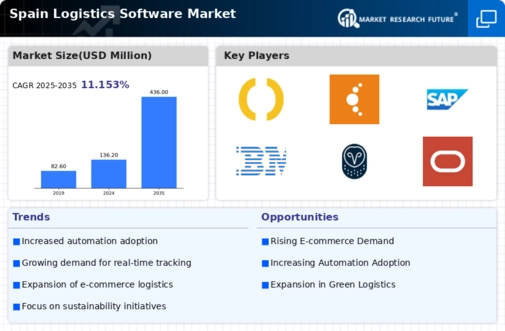
Spain Logistics Software Market Infographic
Purchase Options

Spain Logistics Software Market Summary

As per analysis, the Spain logistics software market is projected to grow from USD 0.136 Billion in 2024 to USD 0.147 Billion in 2025, ultimately reaching USD 0.294 Billion by 2035, exhibiting a compound annual growth rate (CAGR) of 7.25% during the forecast period (2025 - 2035).

Key Market Trends & Highlights

The Spain logistics software market is experiencing a transformative shift towards advanced technological integration and sustainability.

  • The Supply Chain Management segment remains the largest, driven by the need for enhanced operational efficiency.
  • Transportation Management is the fastest-growing segment, reflecting the increasing demand for optimized logistics solutions.
  • Cloud-based solutions dominate the market, while on-premises systems are witnessing rapid growth due to specific enterprise needs.
  • Key market drivers include the growing e-commerce sector and rising demand for real-time data analytics, which are shaping logistics strategies.

Market Size & Forecast

2024 Market Size 0.136 (USD Billion)
2035 Market Size 0.294 (USD Billion)
CAGR (2025 - 2035) 7.25%

Major Players

SAP (DE), Oracle (US), Infor (US), Manhattan Associates (US), Blue Yonder (US), Descartes Systems Group (CA), Transporeon (DE), Kuebix (US), Locus (IN), Shippeo (FR)

Our Impact
Enabled $4.3B Revenue Impact for Fortune 500 and Leading Multinationals
Partnering with 2000+ Global Organizations Each Year
30K+ Citations by Top-Tier Firms in the Industry

Spain Logistics Software Market Trends

The Spain logistics software market is currently experiencing a transformative phase, driven by advancements in technology and the increasing demand for efficiency in supply chain operations. Companies are increasingly adopting software solutions that enhance visibility, streamline processes, and improve overall logistics management. This shift appears to be influenced by the growing emphasis on sustainability and the need for real-time data analytics, which enable businesses to make informed decisions. Furthermore, the integration of artificial intelligence and machine learning into logistics software is likely to enhance predictive capabilities, thereby optimizing inventory management and reducing operational costs. In addition, the regulatory landscape in Spain is evolving, with new policies aimed at promoting digitalization within the logistics sector. This regulatory support may encourage more businesses to invest in logistics software, as they seek to comply with new standards and improve their competitive edge. The collaboration between logistics providers and technology firms is also becoming more pronounced, suggesting a trend towards customized solutions that cater to specific industry needs. Overall, the Spain logistics software market appears poised for growth, with various factors converging to create a dynamic environment for innovation and development.

Increased Adoption of Cloud-Based Solutions

The trend towards cloud-based logistics software is gaining traction in Spain, as businesses seek to enhance flexibility and scalability. This shift allows companies to access their logistics systems from anywhere, facilitating remote work and real-time collaboration.

Focus on Sustainability and Green Logistics

There is a growing emphasis on sustainability within the Spain logistics software market. Companies are increasingly seeking software solutions that help reduce carbon footprints and optimize resource usage, aligning with broader environmental goals.

Integration of Advanced Technologies

The incorporation of advanced technologies such as artificial intelligence and machine learning is becoming prevalent in logistics software. These technologies enable better data analysis, predictive modeling, and automation, enhancing overall operational efficiency.

Spain Logistics Software Market Drivers

Growing E-commerce Sector

The burgeoning e-commerce sector in Spain is a pivotal driver for the Spain logistics software market. As online shopping continues to gain traction, logistics software solutions are increasingly essential for managing complex supply chains and ensuring timely deliveries. In 2025, e-commerce sales in Spain reached approximately 50 billion euros, reflecting a significant growth trajectory. This surge necessitates advanced logistics software to optimize inventory management, order fulfillment, and last-mile delivery. Companies are investing in software that can seamlessly integrate with e-commerce platforms, thereby enhancing operational efficiency. The demand for real-time tracking and analytics further propels the need for sophisticated logistics solutions, as businesses strive to meet consumer expectations for transparency and speed. Consequently, the growth of the e-commerce sector is likely to remain a driving force in shaping the logistics software landscape in Spain.

Focus on Supply Chain Resilience

The emphasis on supply chain resilience is emerging as a critical driver for the Spain logistics software market. Recent disruptions in global supply chains have highlighted the need for robust logistics solutions that can withstand unforeseen challenges. Spanish companies are increasingly prioritizing software that enhances visibility and flexibility within their supply chains. This focus on resilience is reflected in the growing investment in logistics software that offers features such as risk assessment, scenario planning, and contingency management. In 2025, approximately 70% of logistics firms in Spain reported plans to enhance their supply chain resilience through technology adoption. As businesses seek to mitigate risks and ensure continuity, the demand for logistics software that supports resilient supply chain strategies is expected to rise, shaping the future landscape of the industry.

Government Initiatives and Regulations

Government initiatives aimed at enhancing logistics efficiency and sustainability are influencing the Spain logistics software market. The Spanish government has implemented various policies to promote digital transformation within the logistics sector. For instance, the National Logistics Strategy emphasizes the importance of adopting innovative technologies to improve supply chain performance. Additionally, regulations surrounding emissions and environmental impact are pushing logistics companies to adopt software solutions that facilitate compliance. The European Union's Green Deal also plays a role, as it encourages member states, including Spain, to invest in sustainable logistics practices. As a result, logistics software that incorporates features for emissions tracking and reporting is becoming increasingly relevant. These government-driven initiatives not only foster a more competitive logistics environment but also stimulate demand for advanced software solutions that align with regulatory requirements.

Rising Demand for Real-Time Data Analytics

The increasing demand for real-time data analytics is a significant driver of the Spain logistics software market. Companies are recognizing the value of data-driven decision-making in optimizing logistics operations. The ability to analyze data in real-time allows businesses to respond swiftly to market changes, manage inventory levels effectively, and enhance customer satisfaction. In Spain, logistics firms are increasingly adopting software solutions that provide comprehensive analytics capabilities, enabling them to track performance metrics and identify areas for improvement. This trend is underscored by the fact that logistics costs in Spain accounted for approximately 10% of GDP in 2025, highlighting the need for efficiency. As organizations seek to reduce costs and improve service levels, the demand for logistics software that offers robust analytics features is expected to grow, driving innovation and competition within the market.

Integration of Artificial Intelligence and Automation

The integration of artificial intelligence (AI) and automation technologies is transforming the Spain logistics software market. AI-driven solutions are being utilized to enhance various aspects of logistics, including route optimization, demand forecasting, and warehouse management. In Spain, logistics companies are increasingly investing in software that leverages AI to streamline operations and reduce human error. Automation technologies, such as robotics in warehousing, are also gaining traction, further driving the need for sophisticated logistics software. The potential for cost savings and improved efficiency is substantial, as AI can analyze vast amounts of data to make informed decisions quickly. As the logistics sector in Spain continues to evolve, the adoption of AI and automation is likely to play a crucial role in shaping the future of logistics software, enabling companies to remain competitive in a rapidly changing market.


Market Segment Insights

By Application: Supply Chain Management (Largest) vs. Transportation Management (Fastest-Growing)

In the Spain logistics software market, the application segment is significantly influenced by various components including Supply Chain Management (SCM), Warehouse Management, Transportation Management, and Inventory Management. Among these, SCM holds the largest market share, driven by increased demand for efficiency and transparency in supply chains. Furthermore, Transportation Management is also emerging robustly, capturing the attention of companies striving to optimize their logistics operations, thus demonstrating notable market presence.

Supply Chain Management (Dominant) vs. Transportation Management (Emerging)

Supply Chain Management (SCM) in the Spain logistics software market is characterized by its extensive capabilities in enhancing operational efficiency and visibility, effectively coordinating activities across the supply chain. Being the dominant player, it focuses on integrating various logistics functions, often leveraging advanced analytics and cloud-based solutions. On the other hand, Transportation Management, labeled as an emerging segment, is gaining momentum due to the rising e-commerce sector. Companies are increasingly investing in technology to streamline transportation processes, contributing to cost reduction and improved service levels. The emphasis on real-time tracking and data-driven decision-making further accelerates the growth of this segment.

By Deployment Type: Cloud-Based (Largest) vs. On-Premises (Fastest-Growing)

In the Spain logistics software market, the deployment type segment is primarily dominated by cloud-based solutions, which have become increasingly preferred due to their scalability, flexibility, and overall lower maintenance costs. While on-premises solutions still account for a significant share, their popularity is being challenged by the rapidly growing adoption of hybrid models that offer a balance between traditional setups and modern cloud capabilities. These preferences are driving continual shifts in market dynamics as companies look to optimize their logistics operations. Recent trends show a robust increase in cloud-based deployments, propelled by factors such as the need for real-time data accessibility and remote operation capabilities. The hybrid deployment model is also emerging, gaining traction particularly in industries where data security and customization are paramount, thus enabling businesses to leverage the best of both worlds. On-premises solutions are experiencing growth, but not at the same rate as their cloud counterparts as organizations increasingly prioritize agility and cost-efficiency in their logistics management.

Deployment Type: Cloud-Based (Dominant) vs. On-Premises (Emerging)

Cloud-based logistics software has established itself as the dominant deployment type in the Spain logistics market, favored for its ability to facilitate easier updates, enhance collaboration, and allow users real-time access from anywhere. Its growing market presence is attributed to businesses seeking improved operational efficiency and cost savings through subscription-based models. On-premises solutions, while still relevant, are seen as less agile due to the need for substantial infrastructure investments and ongoing maintenance. However, they maintain a loyal customer base, particularly among enterprises demanding stringent data security and regulatory compliance. As a result, while cloud-based solutions lead the market, on-premises systems are adapting and evolving to meet modern demands.

By End User: Retail (Largest) vs. E-commerce (Fastest-Growing)

In the Spain logistics software market, the Retail sector holds the largest market share among different end-user segments, primarily driven by traditional brick-and-mortar businesses seeking to enhance their supply chain efficiency. The Retail segment's reliance on logistics software is critical for inventory management, order fulfillment, and demand forecasting, positioning it at the forefront of market inquiries. On the other hand, the E-commerce segment has emerged as the fastest-growing end-user category. The increasing trend towards online shopping, exacerbated by recent global events, has propelled E-commerce companies to adopt sophisticated logistics solutions for seamless operations throughout their supply chain.

Manufacturing (Dominant) vs. Third-Party Logistics (Emerging)

The Manufacturing sector is a dominant player in Spain's logistics software market, characterized by complex supply chains and the need for precise production planning. This segment benefits from logistics software that streamlines operations, reduces downtime, and enhances traceability of materials and products. Conversely, Third-Party Logistics (3PL) providers are emerging as significant players, as more businesses outsource their logistics needs to specialized firms. This segment is rapidly evolving, driven by the demand for scalable logistics solutions and technological advancements that allow 3PL providers to offer integrated services, making them vital to the logistics landscape.

By Functionality: Order Processing (Largest) vs. Tracking and Visibility (Fastest-Growing)

In the Spain logistics software market, the 'Functionality' segment showcases diverse capabilities that are essential for efficient logistics management. Order Processing remains the largest segment, driven by its critical role in streamlining operations and ensuring timely delivery. Tracking and Visibility, while currently smaller in market share, is witnessing rapid growth as businesses increasingly prioritize the need for real-time updates and transparency in their supply chains. The growth trends in this segment are largely influenced by the digital transformation of logistics operations. Companies are investing heavily in technologies that enhance tracking capabilities and real-time visibility to meet customer expectations. This emphasis on efficiency and transparency is driving innovation in Reporting and Analytics functionalities, making it a key driver of enhanced operational effectiveness in the logistics landscape.

Order Processing (Dominant) vs. Tracking and Visibility (Emerging)

Order Processing functions are central to the logistics software landscape in Spain, providing businesses with the tools needed to manage orders efficiently from initiation to fulfillment. This functionality is characterized by seamless integration with inventory management, billing systems, and shipping solutions, thus optimizing the overall workflow. On the other hand, Tracking and Visibility represents an emerging trend where logistics operators seek enhanced insight into their supply chains. This functionality focuses on real-time tracking, allowing businesses to improve their responsiveness and customer service. As the market evolves, the demand for solutions that merge these functionalities will likely increase, as brands look to combine the efficiency of Order Processing with the transparency of Tracking and Visibility.

Get more detailed insights about Spain Logistics Software Market

Key Players and Competitive Insights

The logistics software market in Spain is characterized by a dynamic competitive landscape, driven by the increasing demand for efficiency and transparency in supply chain operations. Key players such as SAP (DE), Oracle (US), and Blue Yonder (US) are at the forefront, leveraging advanced technologies to enhance their offerings. SAP (DE) focuses on integrating AI and machine learning into its logistics solutions, aiming to optimize inventory management and reduce operational costs. Oracle (US), on the other hand, emphasizes cloud-based solutions, facilitating real-time data access and analytics for better decision-making. Blue Yonder (US) is notable for its commitment to sustainability, integrating eco-friendly practices into its logistics software, which resonates well with the growing emphasis on environmental responsibility among businesses.

The competitive structure of the market appears moderately fragmented, with several players vying for market share. This fragmentation is indicative of a diverse range of solutions available, catering to various segments of the logistics industry. Companies are increasingly adopting tactics such as localizing their software solutions to meet specific regional needs and optimizing supply chains to enhance efficiency. The collective influence of these key players shapes a competitive environment where innovation and customer-centric strategies are paramount.

In November 2025, SAP (DE) announced a strategic partnership with a leading Spanish logistics provider to enhance its cloud-based logistics solutions. This collaboration is expected to facilitate the integration of localized features tailored to the Spanish market, thereby improving user experience and operational efficiency. Such partnerships are crucial as they allow SAP to leverage local expertise while expanding its footprint in the region.

In December 2025, Oracle (US) launched a new suite of AI-driven logistics tools aimed at small to medium-sized enterprises (SMEs) in Spain. This initiative is significant as it democratizes access to advanced logistics capabilities, enabling SMEs to compete more effectively in a challenging market. By focusing on this segment, Oracle is likely to capture a growing customer base that seeks affordable yet sophisticated logistics solutions.

In January 2026, Blue Yonder (US) unveiled its latest sustainability-focused logistics platform, which incorporates real-time carbon footprint tracking for supply chain operations. This move aligns with the increasing regulatory pressures and consumer expectations for sustainable practices. By prioritizing sustainability, Blue Yonder positions itself as a leader in eco-conscious logistics solutions, potentially attracting environmentally aware clients.

As of January 2026, the logistics software market is witnessing trends such as digitalization, AI integration, and a heightened focus on sustainability. Strategic alliances among key players are shaping the competitive landscape, fostering innovation and collaboration. The shift from price-based competition to a focus on technological advancement and supply chain reliability is evident. Companies that prioritize innovation and sustainability are likely to differentiate themselves in this evolving market, suggesting a future where competitive advantage hinges on the ability to adapt to changing consumer demands and regulatory environments.

Key Companies in the Spain Logistics Software Market include

Industry Developments

Recent developments in the Spain Logistics Software Market indicate a vibrant landscape marked by technological advancements and strategic collaborations. Companies like SAP, IBM, and Oracle have been enhancing their product offerings, focusing on integrating Artificial Intelligence and machine learning for better supply chain optimization.

Additionally, in April 2023, Transporeon announced a partnership with other logistics firms to improve real-time transportation visibility solutions in Spain, highlighting the growing emphasis on digital transformation. In the area of mergers and acquisitions, Cargowise completed the acquisition of a regional logistics provider in February 2023, strengthening its presence in the Spanish market and expanding its service capabilities.

Alpega also recently merged with a European software company to offer more comprehensive logistics solutions in the region. The market valuation for key players is on an upward trend, with growth driven by increased demand for automation and efficiency in logistics operations.

In recent years, particularly in 2021 and 2022, the logistics software sector in Spain has been influenced by heightened e-commerce activity, prompting firms such as Manhattan Associates and JDA Software to enhance their warehousing and inventory management systems significantly.

Future Outlook

Spain Logistics Software Market Future Outlook

The Spain logistics software market is projected to grow at a 7.25% CAGR from 2025 to 2035, driven by digital transformation, e-commerce expansion, and supply chain optimization.

New opportunities lie in:

  • Integration of AI-driven predictive analytics for inventory management.
  • Development of blockchain solutions for enhanced supply chain transparency.
  • Implementation of IoT-enabled tracking systems for real-time logistics monitoring.

By 2035, the market is expected to be robust, driven by technological advancements and increased demand.

Market Segmentation

Spain Logistics Software Market End User Outlook

  • Retail
  • Manufacturing
  • E-commerce
  • Third-Party Logistics

Spain Logistics Software Market Application Outlook

  • Supply Chain Management
  • Warehouse Management
  • Transportation Management
  • Inventory Management

Spain Logistics Software Market Functionality Outlook

  • Order Processing
  • Tracking and Visibility
  • Reporting and Analytics

Spain Logistics Software Market Deployment Type Outlook

  • On-Premises
  • Cloud-Based
  • Hybrid

Report Scope

MARKET SIZE 20240.136(USD Billion)
MARKET SIZE 20250.147(USD Billion)
MARKET SIZE 20350.294(USD Billion)
COMPOUND ANNUAL GROWTH RATE (CAGR)7.25% (2024 - 2035)
REPORT COVERAGERevenue Forecast, Competitive Landscape, Growth Factors, and Trends
BASE YEAR2024
Market Forecast Period2025 - 2035
Historical Data2019 - 2024
Market Forecast UnitsUSD Billion
Key Companies ProfiledSAP (DE), Oracle (US), Infor (US), Manhattan Associates (US), Blue Yonder (US), Descartes Systems Group (CA), Transporeon (DE), Kuebix (US), Locus (IN), Shippeo (FR)
Segments CoveredApplication, Deployment Type, End User, Functionality
Key Market OpportunitiesIntegration of artificial intelligence and automation in the Spain logistics software market enhances operational efficiency.
Key Market DynamicsGrowing demand for integrated logistics solutions drives innovation and competition in Spain's logistics software market.

Countries CoveredSpain
Leave a Comment

FAQs

What is the current valuation of the Spain logistics software market?

As of 2024, the Spain logistics software market was valued at 0.136 USD Billion.

What is the projected market valuation for the Spain logistics software market in 2035?

The market is projected to reach a valuation of 0.294 USD Billion by 2035.

What is the expected CAGR for the Spain logistics software market during the forecast period?

The expected CAGR for the Spain logistics software market from 2025 to 2035 is 7.25%.

Which companies are considered key players in the Spain logistics software market?

Key players include SAP, Oracle, Infor, Manhattan Associates, Blue Yonder, Descartes Systems Group, Transporeon, Kuebix, Locus, and Shippeo.

What are the main application segments in the Spain logistics software market?

The main application segments include Supply Chain Management, Warehouse Management, Transportation Management, and Inventory Management.

How did the cloud-based deployment type perform in the Spain logistics software market?

The cloud-based deployment type was valued at 0.065 USD Billion in 2024 and is expected to grow significantly.

What end-user segments are present in the Spain logistics software market?

End-user segments include Retail, Manufacturing, E-commerce, and Third-Party Logistics.

What functionalities are prioritized in the Spain logistics software market?

Key functionalities include Order Processing, Tracking and Visibility, and Reporting and Analytics.

How did the transportation management segment perform in 2024?

The transportation management segment was valued at 0.030 USD Billion in 2024.

What is the expected growth trend for the warehouse management segment by 2035?

The warehouse management segment is projected to grow from 0.035 USD Billion in 2024 to a higher valuation by 2035.

Download Free Sample

Kindly complete the form below to receive a free sample of this Report

Compare Licence

×
Features License Type
Single User Multiuser License Enterprise User
Price $4,950 $5,950 $7,250
Maximum User Access Limit 1 User Upto 10 Users Unrestricted Access Throughout the Organization
Free Customization
Direct Access to Analyst
Deliverable Format
Platform Access
Discount on Next Purchase 10% 15% 15%
Printable Versions