×
Request Free Sample ×

Kindly complete the form below to receive a free sample of this Report

* Please use a valid business email

Leading companies partner with us for data-driven Insights

clients tt-cursor
Hero Background

South Korea Nutricosmetics Market

ID: MRFR/FnB/45038-HCR
200 Pages
Snehal Singh
February 2026

South Korea Nutricosmetics Market Size, Share, Industry Trend & Analysis Research Report By Type (Capsules, Tablets and Softgels, Drinks, Powders, Gummies and Candies, Others), By Distribution Channel (Store-Based, Non-Store-Based) and By End-User (Skincare, Haircare, Nailcare, Others) - Forecast to 2035

Share:
Download PDF ×

We do not share your information with anyone. However, we may send you emails based on your report interest from time to time. You may contact us at any time to opt-out.

South Korea Nutricosmetics Market Infographic
Purchase Options

South Korea Nutricosmetics Market Summary

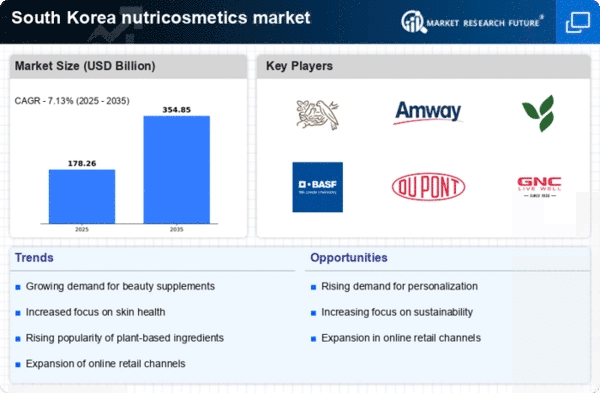
As per Market Research Future analysis, the South Korea nutricosmetics market Size was estimated at 166.4 USD Billion in 2024. The South Korea nutricosmetics market is projected to grow from 178.26 USD Billion in 2025 to 354.85 USD Billion by 2035, exhibiting a compound annual growth rate (CAGR) of 7.1% during the forecast period 2025 - 2035

Key Market Trends & Highlights

The South Korea nutricosmetics market is experiencing a robust growth trajectory driven by evolving consumer preferences and technological advancements.

  • The market is witnessing a rising demand for natural ingredients, reflecting a shift towards cleaner beauty products.
  • Integration of technology in product development is becoming increasingly prevalent, enhancing product efficacy and consumer engagement.
  • The focus on holistic wellness is gaining traction, with consumers seeking solutions that address both beauty and health.
  • Key market drivers include increasing consumer awareness of skin health and the influence of social media and beauty trends.

Market Size & Forecast

2024 Market Size 166.4 (USD Billion)
2035 Market Size 354.85 (USD Billion)
CAGR (2025 - 2035) 7.13%

Major Players

Nestle (CH), Amway (US), Herbalife (US), BASF (DE), DuPont (US), GNC (US), Youngevity (US), Shiseido (JP), Collagen Solutions (GB)

Our Impact
Enabled $4.3B Revenue Impact for Fortune 500 and Leading Multinationals
Partnering with 2000+ Global Organizations Each Year
30K+ Citations by Top-Tier Firms in the Industry

South Korea Nutricosmetics Market Trends

The nutricosmetics market in South Korea is experiencing notable growth, driven by increasing consumer awareness regarding health and beauty. This market encompasses a range of products that combine nutritional benefits with cosmetic effects, appealing to a demographic that values both inner wellness and outer beauty. The rise of social media and beauty influencers has further propelled interest in these products, as consumers seek solutions that promise enhanced skin health, hair vitality, and overall aesthetic improvement. Additionally, the South Korean culture places a strong emphasis on skincare, which aligns well with the principles of nutricosmetics, making it a natural fit for the local market. Moreover, the regulatory environment in South Korea supports innovation in the nutricosmetics market. The government has established guidelines that encourage the development of safe and effective products, fostering a competitive landscape. As consumers become more discerning, they are likely to gravitate towards brands that offer transparency in ingredient sourcing and product efficacy. This trend suggests a shift towards premium offerings, where quality and scientific backing play crucial roles in consumer decision-making. Overall, the nutricosmetics market in South Korea appears poised for continued expansion, driven by evolving consumer preferences and a supportive regulatory framework.

Rising Demand for Natural Ingredients

There is a growing preference among consumers for products that contain natural and organic ingredients. This trend reflects a broader shift towards health-conscious choices, as individuals seek formulations that are perceived as safer and more effective. Brands that emphasize clean labels and sustainable sourcing are likely to gain traction in the market.

Integration of Technology in Product Development

The incorporation of advanced technology in product formulation is becoming increasingly prevalent. Innovations such as personalized nutrition and targeted delivery systems are enhancing the effectiveness of nutricosmetics. This trend indicates a move towards more tailored solutions that cater to individual beauty and health needs.

Focus on Holistic Wellness

Consumers are increasingly viewing beauty as an extension of overall wellness. This perspective encourages the consumption of nutricosmetics that not only improve appearance but also support mental and physical health. Products that promote stress relief, energy enhancement, and skin health are gaining popularity, reflecting this holistic approach.

South Korea Nutricosmetics Market Drivers

Expansion of E-commerce Platforms

The rapid expansion of e-commerce platforms is transforming the nutricosmetics market landscape in South Korea. With the increasing penetration of the internet and mobile devices, consumers are turning to online shopping for convenience and variety. E-commerce sales of nutricosmetic products have surged, with estimates indicating a growth rate of 12% annually. This shift allows consumers to access a wider range of products and brands, often at competitive prices. Additionally, online platforms provide valuable consumer insights and feedback, enabling brands to tailor their offerings more effectively. As e-commerce continues to thrive, it is likely to play a crucial role in the growth of the nutricosmetics market.

Influence of Social Media and Beauty Trends

The impact of social media on beauty trends is a significant driver for the nutricosmetics market in South Korea. Platforms such as Instagram and TikTok have become vital in shaping consumer perceptions and preferences. Influencers and beauty enthusiasts frequently promote nutricosmetic products, showcasing their benefits and effectiveness. This has led to a notable increase in product visibility and consumer interest. Recent statistics indicate that approximately 60% of South Korean consumers are influenced by social media when making beauty-related purchases. As a result, brands are increasingly investing in social media marketing strategies to capture the attention of potential customers, thereby driving growth in the nutricosmetics market.

Increasing Consumer Awareness of Skin Health

The growing awareness among consumers regarding skin health is a pivotal driver for the nutricosmetics market. In South Korea, individuals are increasingly informed about the benefits of nutrition for skin vitality. This trend is reflected in the rising sales of nutricosmetic products, which are perceived as effective solutions for skin issues. According to recent data, the market is projected to grow at a CAGR of 8.5% from 2025 to 2030. Consumers are now more inclined to seek products that not only enhance beauty but also promote overall skin health, leading to a surge in demand for nutricosmetics that combine beauty and wellness. This shift in consumer behavior is likely to propel the nutricosmetics market forward, as brands adapt to meet these evolving preferences.

Rising Interest in Preventive Health Solutions

The increasing focus on preventive health solutions is a notable driver for the nutricosmetics market. South Korean consumers are becoming more proactive about their health, seeking products that not only enhance beauty but also contribute to overall well-being. This trend is evident in the growing popularity of supplements that support skin health, hair vitality, and nail strength. Market Research Future suggests that the nutricosmetics market is expected to reach a valuation of $1.5 billion by 2027, driven by this preventive health approach. Consumers are likely to prioritize products that offer dual benefits, thus encouraging brands to innovate and expand their offerings in the nutricosmetics market.

Regulatory Support for Health and Beauty Products

Regulatory support for health and beauty products is an essential driver for the nutricosmetics market in South Korea. The government has implemented policies that encourage innovation and safety in the beauty and health sectors. This regulatory framework fosters consumer trust and confidence in nutricosmetic products, which is vital for market growth. Recent initiatives have streamlined the approval process for new ingredients and formulations, allowing brands to introduce innovative products more swiftly. As a result, the nutricosmetics market is likely to benefit from a more dynamic and competitive environment, with an increasing number of products entering the market to meet consumer demands.


Market Segment Insights

By Type: Capsules (Largest) vs. Powders (Fastest-Growing)

The South Korea nutricosmetics market exhibits a diverse range of product types, with capsules holding the largest share among segment values. Following closely are tablets and softgels, which have garnered significant market attention due to their convenience and bioavailability. Products like drinks and gummies have also gained traction, reflecting changing consumer preferences towards more enjoyable and easily consumable formats. This segment distribution highlights the varied consumer demand that shapes the market landscape. Currently, powders are identified as the fastest-growing segment within the South Korea nutricosmetics market, driven by an increasing trend towards fitness and health-oriented products. The rise in health consciousness among consumers, particularly among younger demographics, is propelling the demand for innovative delivery formats like powders. Additionally, as brands invest in product development to enhance flavor and solubility, powders are increasingly appealing, suggesting a significant shift in consumer behavior towards functional and versatile nutricosmetics.

Capsules: Dominant vs. Powders: Emerging

Capsules stand as the dominant format in the South Korea nutricosmetics market, favored for their ease of consumption and effective ingredient delivery. They are often perceived as a reliable choice for consumers seeking specific health benefits without the need for flavor masking, allowing manufacturers to deliver concentrated formulations seamlessly. On the flip side, powders are emerging rapidly, capitalizing on the growing trend towards customizable nutrition. They are favored for their versatility, enabling incorporation into various food and beverage applications, and are especially popular among fitness enthusiasts who seek to enhance their dietary intake. As brands innovate to create appealing and functional powder formulations, this segment is expected to continue its upward trajectory.

By End-Use: Skincare (Largest) vs. Haircare (Fastest-Growing)

In the South Korea nutricosmetics market, the distribution of market share among the end-use segments reveals that skincare is the largest segment, accounting for a significant portion. Haircare is also noteworthy as it is rapidly gaining traction, positioning itself as the fastest-growing segment within the market. Nailcare and other segments, while present, hold comparatively smaller shares and show slower growth rates. Over recent years, the growth trends in the South Korea nutricosmetics market have been propelled by increasing consumer awareness regarding the importance of holistic beauty solutions. The rise of social media influencers and beauty enthusiasts has significantly contributed to the popularity of nutricosmetics, particularly in skincare and haircare. Innovations in product formulations and a growing trend towards natural ingredients are expected to further accelerate growth in these segments, with consumers increasingly seeking products that provide both beauty and health benefits.

Skincare (Dominant) vs. Haircare (Emerging)

Skincare has established itself as the dominant segment in the South Korea nutricosmetics market, driven by factors such as the increasing demand for anti-aging products and the emphasis on skin health among consumers. The segment includes various products like dietary supplements that claim to enhance skin conditions from within. These products focus on delivering nutrients that support skin hydration, elasticity, and overall appearance. In contrast, haircare, while currently an emerging segment, shows great potential for growth as consumers are becoming more aware of the impacts of nutrition on hair health. Haircare products are crafted to address concerns like hair loss and shine, with many formulations incorporating vitamins and minerals specifically aimed at improving hair quality. As consumers navigate the balance between diet and beauty, these two segments complement each other well, showcasing the diverse landscape of the nutricosmetics market.

By Distribution Channel: Store-Based (Largest) vs. Non-Store-Based (Fastest-Growing)

In the South Korea nutricosmetics market, Store-Based distribution channels dominate, accounting for a significant share of the overall market. They leverage the strong presence of retail chains, beauty stores, and pharmacies which cater to consumers seeking trust and quality in nutricosmetics products. The convenience of in-store shopping, coupled with attractive visual merchandising, enhances consumer engagement and purchasing decisions, ensuring Store-Based remains a pivotal channel. Conversely, Non-Store-Based channels, including online retailing, are gaining traction as the fastest-growing segment in the South Korea nutricosmetics market. The rise of digital platforms offers consumers enhanced access to a variety of products and the convenience of home shopping. Factors such as shifting consumer preferences toward e-commerce, social media influence, and increased investments by companies in online marketing are driving this growth trend, indicating a significant and dynamic shift in buying behaviors.

Store-Based (Dominant) vs. Non-Store-Based (Emerging)

Store-Based channels, such as pharmacies and dedicated beauty stores, have established a robust foundation in the South Korea nutricosmetics market. Their dominance is fueled by consumer trust in physical shopping experiences, where customers can evaluate product quality and benefit from in-person consultations. These outlets often provide promotions and engage in brand partnerships that enhance product visibility. On the other hand, Non-Store-Based channels are emerging rapidly, primarily driven by the expansion of e-commerce platforms. This segment caters to tech-savvy consumers who prefer the convenience of online shopping. Enhanced product offerings, competitive pricing, and the flexibility of delivery options support Non-Store-Based as a viable alternative, making it an attractive growth area for nutricosmetic brands.

Get more detailed insights about South Korea Nutricosmetics Market

Key Players and Competitive Insights

The nutricosmetics market in South Korea is characterized by a dynamic competitive landscape, driven by increasing consumer awareness regarding health and beauty, alongside a growing demand for products that offer both aesthetic and wellness benefits. Key players such as Nestle (CH), Amway (US), and Shiseido (JP) are strategically positioned to leverage innovation and regional expansion to capture market share. Nestle (CH) focuses on integrating nutritional science with beauty, while Amway (US) emphasizes personalized health solutions. Shiseido (JP) is enhancing its product offerings through advanced research in skin health, indicating a collective shift towards holistic beauty solutions that intertwine nutrition and cosmetics.The market structure appears moderately fragmented, with several players vying for dominance. Companies are increasingly localizing manufacturing to reduce costs and optimize supply chains, which enhances their competitive edge. This localized approach not only caters to regional preferences but also allows for quicker response times to market demands. The influence of major players is significant, as they set trends that smaller companies often follow, thereby shaping the overall market dynamics.

In October Nestle (CH) announced the launch of a new line of nutricosmetic supplements aimed at enhancing skin hydration and elasticity. This strategic move underscores Nestle's commitment to innovation in the beauty nutrition sector, potentially positioning the company as a leader in this niche. By leveraging its extensive research capabilities, Nestle (CH) aims to meet the rising consumer demand for scientifically-backed beauty solutions, which could significantly enhance its market presence.

In September Shiseido (JP) entered a partnership with a leading biotechnology firm to develop advanced collagen peptides for its nutricosmetic range. This collaboration is likely to bolster Shiseido's product efficacy and appeal, as it combines cutting-edge technology with traditional beauty practices. Such strategic alliances may enhance brand credibility and attract a more health-conscious consumer base, thereby expanding Shiseido's market reach.

In August Amway (US) launched a digital platform that offers personalized beauty and wellness recommendations based on individual health data. This initiative reflects a growing trend towards digitalization in the nutricosmetics market, allowing Amway (US) to engage consumers more effectively. By utilizing data analytics, the company can tailor its offerings, potentially increasing customer loyalty and driving sales.

As of November the competitive trends in the nutricosmetics market are increasingly defined by digitalization, sustainability, and the integration of artificial intelligence. Strategic alliances are becoming more prevalent, as companies recognize the value of collaboration in enhancing product offerings and market reach. Looking ahead, competitive differentiation is likely to evolve from traditional price-based strategies to a focus on innovation, technological advancements, and supply chain reliability. This shift suggests that companies that prioritize research and development, alongside sustainable practices, will be better positioned to thrive in the evolving landscape.

Key Companies in the South Korea Nutricosmetics Market include

Industry Developments

The South Korea Nutricosmetics Market has recently seen a surge in consumer interest owing to the growing awareness of health and wellness. Companies like Mediheal and Laneige are expanding their product lines to include new functional ingredients that appeal to health-conscious consumers.

The market valuation of these companies has improved significantly, reflecting the rise in demand for innovative beauty supplements. DHC and Isntree are focusing on plant-based formulations to attract environmentally conscious customers.

In September 2023, LG Household and Health Care announced an investment to enhance Research and Development in nutricosmetics, further underlining the sector's growth potential.

Notably, in August 2023, Amorepacific acquired a small-scale Korean Herbal Medicine startup that specializes in holistic beauty products. This acquisition aims to integrate traditional herbal remedies with modern nutricosmetic solutions.

The past two years have also seen significant shifts in consumer preferences towards sustainable and organic ingredients, prompting companies like Belif and Missha to adapt their strategies accordingly. The South Korean government has supported these initiatives through funding programs, encouraging innovation and global expansion in the nutricosmetics market.

Future Outlook

South Korea Nutricosmetics Market Future Outlook

The Nutricosmetics Market in South Korea is projected to grow at a 7.13% CAGR from 2025 to 2035, driven by increasing consumer awareness and demand for beauty-from-within solutions.

New opportunities lie in:

  • Develop subscription-based delivery services for personalized nutricosmetic products.
  • Invest in R&D for innovative formulations targeting specific skin concerns.
  • Expand distribution channels through partnerships with wellness and beauty retailers.

By 2035, the nutricosmetics market is expected to achieve substantial growth and diversification.

Market Segmentation

South Korea Nutricosmetics Market Type Outlook

  • Capsules
  • Tablets & Softgels
  • Drinks
  • Powders
  • Gummies & Candies
  • Others

South Korea Nutricosmetics Market End-Use Outlook

  • Skincare
  • Haircare
  • Nailcare
  • Others

South Korea Nutricosmetics Market Distribution Channel Outlook

  • Store-Based
  • Non-Store-Based

Report Scope

MARKET SIZE 2024 166.4(USD Billion)
MARKET SIZE 2025 178.26(USD Billion)
MARKET SIZE 2035 354.85(USD Billion)
COMPOUND ANNUAL GROWTH RATE (CAGR) 7.13% (2025 - 2035)
REPORT COVERAGE Revenue Forecast, Competitive Landscape, Growth Factors, and Trends
BASE YEAR 2024
Market Forecast Period 2025 - 2035
Historical Data 2019 - 2024
Market Forecast Units USD Billion
Key Companies Profiled Nestle (CH), Amway (US), Herbalife (US), BASF (DE), DuPont (US), GNC (US), Youngevity (US), Shiseido (JP), Collagen Solutions (GB)
Segments Covered Type, End-Use, Distribution Channel
Key Market Opportunities Growing consumer interest in holistic beauty solutions drives innovation in the nutricosmetics market.
Key Market Dynamics Rising consumer demand for natural ingredients drives innovation and competition in the nutricosmetics market.
Countries Covered South Korea
Leave a Comment

FAQs

What was the market size of the South Korea Nutricosmetics Market in 2024?

The South Korea Nutricosmetics Market was valued at 249.6 USD Billion in 2024.

What is the projected market value of the South Korea Nutricosmetics Market by 2035?

By 2035, the market is expected to reach a value of 557.0 USD Billion.

What is the expected CAGR for the South Korea Nutricosmetics Market from 2025 to 2035?

The market is expected to grow at a CAGR of 7.57% during the period from 2025 to 2035.

Which type of nutricosmetics held the largest market share in 2024?

In 2024, gummies and candies held a market value of 60.0 USD Billion in the nutricosmetics sector.

What is the estimated market value of nutricosmetic drinks in 2035?

The market for nutricosmetic drinks is projected to reach 85.5 USD Billion by 2035.

Who are the key players in the South Korea Nutricosmetics Market?

Major players include Mediheal, DHC, Hydra B, Laneige, and Amorepacific, among others.

How much was the capsules segment valued in 2024?

The capsules segment of the South Korea Nutricosmetics Market was valued at 48.0 USD Billion in 2024.

What is the projected market size for nutricosmetic powders by 2035?

The market size for nutricosmetic powders is expected to be 130.0 USD Billion by 2035.

What trends are driving the growth of the South Korea Nutricosmetics Market?

The growth is driven by increasing consumer awareness of health and wellness and demand for beauty enhancement products.

What are the key challenges facing the South Korea Nutricosmetics Market?

Challenges include intense competition and regulatory compliance in the nutricosmetics industry.

Download Free Sample

Kindly complete the form below to receive a free sample of this Report

Compare Licence

×
Features License Type
Single User Multiuser License Enterprise User
Price $4,950 $5,950 $7,250
Maximum User Access Limit 1 User Upto 10 Users Unrestricted Access Throughout the Organization
Free Customization
Direct Access to Analyst
Deliverable Format
Platform Access
Discount on Next Purchase 10% 15% 15%
Printable Versions