×
Request Free Sample ×

Kindly complete the form below to receive a free sample of this Report

* Please use a valid business email

Leading companies partner with us for data-driven Insights

clients tt-cursor
Hero Background

South America Security Operations Center Market

ID: MRFR/ICT/44505-HCR
200 Pages
Aarti Dhapte
February 2026

South America Security Operations Center (SOC) Market Research Report By Service (Security Monitoring Service, Information Security Incident Response Service, Threat and Vulnerability Identification, Digital Forensics and Malware Analysis Service, Risk Reporting and Analytics Service, Others), By Model (In-House SOC, Outsourced SOC), By Organization Size (Large Enterprises, SMEs) and By Industry Vertical (IT and Telecom, Government, BFSI, Oil and Gas, Aerospace and Defense, Healthcare, Retail, Travel and Tourism, Others)-Forecast to 2035

Share:
Download PDF ×

We do not share your information with anyone. However, we may send you emails based on your report interest from time to time. You may contact us at any time to opt-out.

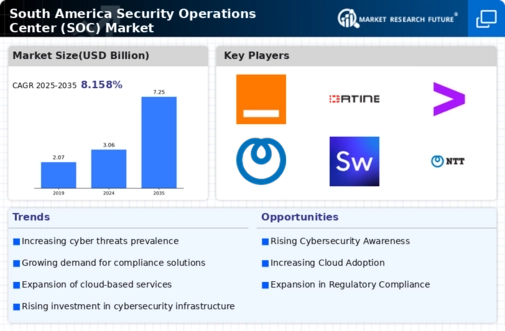
South America Security Operations Center Market Infographic
Purchase Options

South America Security Operations Center Market Summary

As per analysis, the South America Security Operation Center Market is projected to grow from USD 3.31 Billion in 2025 to USD 6.74 Billion by 2035, exhibiting a compound annual growth rate (CAGR) of 7.45% during the forecast period (2025 - 2035).

Key Market Trends & Highlights

The South America Security Operation Center Market is poised for substantial growth driven by increasing cybersecurity investments and evolving threats.

  • Brazil remains the largest market for Security Operation Centers, reflecting a robust demand for cybersecurity solutions.
  • Mexico is emerging as the fastest-growing region, indicating a rising focus on enhancing security measures.
  • The Threat Detection segment continues to dominate the market, while the Incident Response segment is experiencing rapid growth.
  • Key market drivers include the growing cyber threat landscape and the need for regulatory compliance and data protection laws.

Market Size & Forecast

2024 Market Size 3.06 (USD Billion)
2035 Market Size 6.74 (USD Billion)
CAGR (2025 - 2035) 7.45%

Major Players

IBM (BR), Cisco Systems (BR), Fortinet (BR), Palo Alto Networks (BR), Check Point Software (BR), FireEye (BR), McAfee (BR), Splunk (BR), Trend Micro (BR)

Our Impact
Enabled $4.3B Revenue Impact for Fortune 500 and Leading Multinationals
Partnering with 2000+ Global Organizations Each Year
30K+ Citations by Top-Tier Firms in the Industry

South America Security Operations Center Market Trends

The South America Security Operation Center Market is currently experiencing a notable evolution, driven by the increasing demand for enhanced cybersecurity measures across various sectors. Organizations in South America are recognizing the necessity of establishing robust security frameworks to protect sensitive data and critical infrastructure. This shift is largely influenced by the rising frequency of cyber threats, which has prompted businesses to invest in advanced security solutions. As a result, the market is witnessing a surge in the establishment of Security Operation Centers (SOCs) that are equipped to monitor, detect, and respond to security incidents in real-time. Moreover, the South America Security Operation Center Market is characterized by a growing emphasis on collaboration between public and private sectors. Governments are actively promoting initiatives aimed at strengthening national cybersecurity capabilities, which in turn fosters a conducive environment for SOC development. This collaborative approach not only enhances the overall security posture of the region but also encourages knowledge sharing and resource pooling among various stakeholders. As the market continues to mature, it appears poised for further growth, driven by technological advancements and an increasing awareness of the importance of cybersecurity in safeguarding economic stability and national security.

Increased Investment in Cybersecurity Infrastructure

Organizations in South America are allocating more resources towards building and upgrading their cybersecurity infrastructure. This trend reflects a growing recognition of the importance of protecting sensitive information and critical systems from cyber threats. As businesses face evolving risks, the establishment of advanced Security Operation Centers becomes a priority.

Collaboration Between Public and Private Sectors

There is a noticeable trend towards collaboration between government entities and private organizations in the South America Security Operation Center Market. This partnership aims to enhance national cybersecurity strategies, leading to improved information sharing and resource allocation. Such collaboration is essential for developing a unified approach to tackling cyber threats.

Adoption of Advanced Technologies

The South America Security Operation Center Market is witnessing a shift towards the adoption of advanced technologies such as artificial intelligence and machine learning. These technologies are being integrated into SOC operations to improve threat detection and response capabilities. This trend indicates a move towards more proactive security measures, enhancing the overall effectiveness of security operations.

South America Security Operations Center Market Drivers

Growing Cyber Threat Landscape

The South America Security Operation Center Market is experiencing a surge in demand due to the escalating cyber threat landscape. Cyberattacks have become increasingly sophisticated, targeting both public and private sectors. In 2025, it was reported that cybercrime costs in South America reached approximately 30 billion USD, highlighting the urgent need for robust security measures. Organizations are compelled to invest in Security Operation Centers (SOCs) to enhance their threat detection and response capabilities. This trend is likely to continue as businesses recognize the necessity of protecting sensitive data and maintaining operational integrity. The growing awareness of cyber risks among enterprises is driving the establishment of SOCs, which are essential for monitoring, detecting, and responding to security incidents in real-time.

Increased Awareness of Cybersecurity Risks

The South America Security Operation Center Market is witnessing a heightened awareness of cybersecurity risks among organizations. As businesses increasingly rely on digital platforms, the potential for cyber threats has become more pronounced. Surveys indicate that over 70% of companies in South America acknowledge the importance of cybersecurity, leading to a surge in investments in Security Operation Centers. This awareness is not limited to large enterprises; small and medium-sized businesses are also recognizing the necessity of implementing SOCs to protect their assets. The growing understanding of the financial and operational impacts of cyber incidents is driving organizations to prioritize cybersecurity, thereby fostering the growth of the SOC market in the region.

Rising Demand for Managed Security Services

The South America Security Operation Center Market is experiencing a rising demand for managed security services. Many organizations, particularly small and medium-sized enterprises, lack the resources to establish in-house SOCs. Consequently, they are turning to managed security service providers (MSSPs) to fulfill their cybersecurity needs. This trend is evident as the managed security services market in South America is projected to grow at a compound annual growth rate (CAGR) of 15% from 2025 to 2030. MSSPs offer comprehensive security solutions, including threat monitoring, incident response, and compliance management, which are essential for organizations aiming to bolster their cybersecurity defenses. The increasing reliance on external expertise is likely to further drive the growth of the SOC market in the region.

Regulatory Compliance and Data Protection Laws

The South America Security Operation Center Market is significantly influenced by the implementation of stringent regulatory compliance and data protection laws. Countries such as Brazil have enacted the General Data Protection Law (LGPD), which mandates organizations to adopt comprehensive data protection measures. Compliance with such regulations necessitates the establishment of Security Operation Centers to ensure that data handling practices meet legal requirements. As organizations strive to avoid hefty fines and reputational damage, the demand for SOCs is expected to rise. The need for continuous monitoring and incident response capabilities to adhere to these regulations is propelling investments in SOC infrastructure across South America. This trend underscores the critical role of SOCs in facilitating compliance and safeguarding sensitive information.

Technological Advancements in Security Solutions

The South America Security Operation Center Market is being propelled by rapid technological advancements in security solutions. Innovations such as artificial intelligence, machine learning, and automation are transforming the capabilities of Security Operation Centers. These technologies enable SOCs to analyze vast amounts of data, identify threats more efficiently, and respond to incidents in real-time. In 2025, it was estimated that the adoption of AI-driven security solutions in South America increased by 40%, reflecting a growing trend towards advanced security measures. As organizations seek to enhance their cybersecurity posture, the integration of cutting-edge technologies into SOC operations is becoming increasingly prevalent, thereby driving market growth.


Market Segment Insights

By Application: Threat Detection (Largest) vs. Incident Response (Fastest-Growing)

In the South America Security Operation Center Market, the application segment is witnessing a distinctive market share distribution. Threat Detection stands out as the largest segment, capturing significant interest due to an increase in cyber threats and vulnerabilities. This segment typically includes technologies and solutions designed to identify potential security breaches before they can cause harm. Incident Response, on the other hand, is emerging rapidly, gaining traction as organizations recognize the necessity of having robust mechanisms to respond to security incidents promptly.

Threat Detection (Dominant) vs. Incident Response (Emerging)

Threat Detection remains the dominant force within the South America Security Operation Center Market due to its essential role in preemptive security measures. Organizations are increasingly investing in advanced analytics and machine learning tools to enhance their threat detection capabilities. Meanwhile, Incident Response is gaining momentum as an emerging segment, highlighted by the rising number of incidents that require swift corrective measures. This segment is also characterized by the growing adoption of automated response systems and incident management solutions, which streamline operations and minimize damage post-incident.

By Deployment Type: Cloud-Based (Largest) vs. Hybrid (Fastest-Growing)

In the South America Security Operation Center Market, deployment types are categorized into On-Premises, Cloud-Based, and Hybrid models. Among these, Cloud-Based solutions dominate the market due to their flexibility, scalability, and lower infrastructure costs. These solutions are increasingly favored by organizations looking to enhance their security posture without the burden of managing physical infrastructure, thereby capturing a significant market share. On the other hand, the Hybrid deployment model is gaining traction as a compelling alternative. This model combines the benefits of both On-Premises and Cloud-Based solutions, allowing firms to enjoy increased security while retaining some degree of control over their data. The growing demand for flexible security arrangements and the shift towards digital transformation across industries are substantial drivers for the Hybrid model's rapid growth.

Cloud-Based (Dominant) vs. Hybrid (Emerging)

In the South America Security Operation Center Market, Cloud-Based deployment is characterized by its capability to provide comprehensive security solutions that are both cost-effective and easy to implement. Organizations increasingly opt for this dominant model due to its ability to accommodate varying security needs without requiring significant upfront investments. Conversely, the Hybrid deployment model is emerging as a strong contender in the market, as it enables businesses to leverage both on-premises solutions and cloud technology. This approach helps organizations achieve higher security levels while enjoying operational flexibility. The appeal of Hybrid deployments lies in their ability to facilitate compliance with local data regulations while offering the agility required to address dynamic security threats.

By End User: Government (Largest) vs. Healthcare (Fastest-Growing)

In the South America Security Operation Center Market, the Government sector holds a dominant position, leveraging significant investments in cybersecurity infrastructure. This sector's large share is driven by heightened cyber threats to national security and the need for robust surveillance systems. Following closely, the Healthcare sector, while smaller, is rapidly gaining importance due to increasing reliance on digital health technologies and the burgeoning need to protect sensitive patient data from cyberattacks.

Government: Security Infrastructure (Dominant) vs. Healthcare: Data Protection (Emerging)

The Government sector in the South America Security Operation Center Market is characterized by its extensive investment in security infrastructure, providing a solid foundation for cybersecurity initiatives. This dominance stems from the critical need to protect national interests and public sector data from escalating cyber threats. Conversely, the Healthcare segment, being an emerging yet vital player, is increasingly focused on data protection solutions, spurred by regulatory requirements and the need to secure sensitive health information. As organizations modernize their operations, healthcare providers are prioritizing cybersecurity measures, creating a significant opportunity for growth in this domain, particularly within the context of telemedicine and electronic health records.

By Service Type: Managed Services (Largest) vs. Professional Services (Fastest-Growing)

The South America Security Operation Center Market shows a diverse distribution among the service types, with Managed Services holding a predominant share. This segment benefits from organizations increasingly outsourcing their security operations to specialized providers, allowing them to focus on core business functions. On the other hand, Professional Services, while smaller in comparison, are witnessing accelerated growth as businesses seek expert assistance to navigate complex security challenges and compliance requirements. Consulting Services also contribute to the landscape, albeit at a slower pace, offering tailored solutions for specific security demands.

Managed Services (Dominant) vs. Professional Services (Emerging)

Managed Services are characterized by comprehensive security solutions provided by third-party vendors, enabling businesses to enhance their security posture while minimizing operational costs. This segment is marked by long-term contracts and a focus on ongoing support and monitoring. In contrast, Professional Services are on the rise, characterized by short-term engagements focused on consultancy and implementation, driven by the need for customized solutions to specific security challenges. This growth is attributed to the dynamic threat landscape, where organizations require agile and expert support to adapt to emerging risks.

By Security Type: Network Security (Largest) vs. Endpoint Security (Fastest-Growing)

In the South America Security Operation Center Market, Network Security holds the largest market share, reflecting the critical need for organizations to protect their infrastructure from various cyber threats. Meanwhile, Endpoint Security is rapidly gaining traction, emerging as a pivotal segment in response to the increasing number of remote workers and sophisticated cyberattacks. Organizations prioritize securing their endpoints as they become primary targets for threats, causing a shift in resource allocation towards this segment.

Security Measures: Network Security (Dominant) vs. Endpoint Security (Emerging)

Network Security is established as the dominant force in the South American landscape, providing comprehensive solutions that protect data integrity and ensure compliance. Its robust frameworks address various attack vectors, making it essential for large enterprises and government sectors. Conversely, Endpoint Security is an emerging powerhouse, adapting to modern challenges posed by remote operations. It focuses on safeguarding individual devices, such as laptops and smartphones, and has become increasingly relevant as remote work flourishes. This segment is characterized by innovative approaches leveraging AI and machine learning to enhance security protocols, indicating its potential for rapid growth in the coming years.

Get more detailed insights about South America Security Operations Center Market

Regional Insights

Brazil : Brazil's Robust Market Growth

São Paulo, Rio de Janeiro, and Brasília are pivotal markets for SOC services, showcasing a competitive landscape dominated by major players like IBM, Cisco Systems, and Fortinet. The local business environment is characterized by a mix of established firms and emerging startups, fostering innovation in cybersecurity. Industries such as finance, healthcare, and e-commerce are increasingly adopting SOC solutions to mitigate risks, making Brazil a vibrant hub for security operations.

Mexico : Mexico's Growing SOC Demand

Key markets include Mexico City, Guadalajara, and Monterrey, where the competitive landscape features significant players like Palo Alto Networks and Check Point Software. The local market dynamics are influenced by a mix of multinational corporations and local firms, creating a diverse business environment. Industries such as telecommunications, finance, and retail are increasingly investing in SOC services to enhance their security posture, reflecting a growing trend towards digital transformation.

Argentina : Argentina's SOC Market Potential

Buenos Aires and Córdoba are central to Argentina's SOC market, where major players like McAfee and Trend Micro have established a presence. The competitive landscape is evolving, with both local and international firms vying for market share. The business environment is characterized by a growing emphasis on cybersecurity across sectors such as finance, healthcare, and government, as organizations seek to protect sensitive data and comply with regulatory requirements.

Rest of South America : Emerging Markets in SOC Sector

Key cities such as Santiago, Bogotá, and Lima are emerging as important markets for SOC solutions, with a competitive landscape featuring both local and international players. The business environment is dynamic, with various sectors, including finance, energy, and telecommunications, increasingly adopting SOC services to safeguard their operations. The growing awareness of cybersecurity risks is driving demand for innovative security solutions across the region.

Key Players and Competitive Insights

The Security Operation Center Market in South America is characterized by a dynamic competitive landscape, driven by increasing cyber threats and the growing need for robust security solutions. Major players such as IBM (BR), Cisco Systems (BR), and Fortinet (BR) are actively shaping the market through strategic initiatives focused on innovation and regional expansion. IBM (BR) emphasizes its commitment to artificial intelligence and machine learning, enhancing its security offerings to address evolving threats. Cisco Systems (BR) leverages its extensive networking expertise to integrate security solutions seamlessly, while Fortinet (BR) focuses on delivering high-performance security appliances tailored to local market needs. Collectively, these strategies foster a competitive environment that prioritizes technological advancement and customer-centric solutions.

Key business tactics within the market include localizing manufacturing and optimizing supply chains to enhance responsiveness to regional demands. The competitive structure appears moderately fragmented, with several key players vying for market share. This fragmentation allows for diverse offerings, yet the influence of major companies remains substantial, as they set benchmarks for innovation and service quality.

In December 2025, IBM (BR) announced a partnership with a leading local telecommunications provider to enhance its managed security services. This collaboration aims to leverage the telecommunications infrastructure to deliver more efficient and scalable security solutions, indicating IBM's strategy to deepen its market penetration and improve service delivery in South America. Such partnerships are likely to enhance customer trust and expand IBM's footprint in the region.

In November 2025, Cisco Systems (BR) launched a new suite of security solutions specifically designed for small and medium-sized enterprises (SMEs) in South America. This initiative reflects Cisco's strategic focus on addressing the unique security challenges faced by SMEs, which are often under-resourced yet increasingly targeted by cybercriminals. By tailoring solutions to this segment, Cisco positions itself as a key player in a rapidly growing market niche.

In October 2025, Fortinet (BR) unveiled its latest security appliance, which integrates advanced threat detection capabilities powered by AI. This launch underscores Fortinet's commitment to innovation and its proactive approach to cybersecurity. By enhancing its product offerings, Fortinet not only strengthens its competitive position but also addresses the pressing need for advanced security measures in an increasingly digital landscape.

As of January 2026, current trends in the Security Operation Center Market are heavily influenced by digitalization, AI integration, and sustainability initiatives. Strategic alliances are becoming increasingly vital, as companies recognize the need for collaborative approaches to tackle complex security challenges. The competitive differentiation is likely to evolve from traditional price-based competition to a focus on innovation, technology, and supply chain reliability. This shift suggests that companies that prioritize technological advancements and strategic partnerships will be better positioned to thrive in the future.

Key Companies in the South America Security Operations Center Market include

Industry Developments

The South America Security Operations Center Market (SOC) Market has seen significant developments in recent months, driven by increasing cybersecurity threats in the region. Companies such as Orange CyberDefense and Fortinet are ramping up their offerings to address the growing demand for enhanced security measures.

In August 2023, Accenture expanded its cybersecurity capabilities in Brazil, reflecting a strategic move to bolster its presence in the evolving market. Additionally, NTT Security has been focusing on partnerships to enhance its services, particularly in countries like Argentina and Chile, where cyber threats have escalated.

In terms of acquisitions, IBM announced the acquisition of a local cybersecurity firm in July 2023, aiming to integrate its technology into the existing SOC framework, thereby strengthening its position in the South American market.

The SOC market is witnessing a notable growth in valuation, particularly with major players like Cisco and Dimension Data investing heavily in local infrastructure to meet rising demands.

Recent government initiatives in countries such as Colombia are also focusing on promoting cybersecurity awareness, contributing to a more favorable environment for SOC growth in South America. These trends indicate a vibrant but challenging landscape for cybersecurity operations in the region.

Future Outlook

South America Security Operations Center Market Future Outlook

The South America Security Operation Center Market is projected to grow at a 7.45% CAGR from 2025 to 2035, driven by increasing cyber threats, regulatory compliance, and technological advancements.

New opportunities lie in:

  • Expansion of managed security services for SMEs
  • Development of AI-driven threat detection solutions
  • Integration of IoT security protocols in SOC operations

By 2035, the market is expected to be robust, reflecting substantial growth and innovation.

Market Segmentation

South America Security Operations Center Market End User Outlook

  • Government
  • Healthcare
  • Financial Services
  • Retail
  • Telecommunications

South America Security Operations Center Market Application Outlook

  • Threat Detection
  • Incident Response
  • Compliance Management
  • Network Security
  • Data Protection

South America Security Operations Center Market Service Type Outlook

  • Managed Services
  • Professional Services
  • Consulting Services

South America Security Operations Center Market Security Type Outlook

  • Network Security
  • Endpoint Security
  • Application Security
  • Cloud Security

South America Security Operations Center Market Deployment Type Outlook

  • On-Premises
  • Cloud-Based
  • Hybrid

Report Scope

MARKET SIZE 20243.06(USD Billion)
MARKET SIZE 20253.31(USD Billion)
MARKET SIZE 20356.74(USD Billion)
COMPOUND ANNUAL GROWTH RATE (CAGR)7.45% (2024 - 2035)
REPORT COVERAGERevenue Forecast, Competitive Landscape, Growth Factors, and Trends
BASE YEAR2024
Market Forecast Period2025 - 2035
Historical Data2019 - 2024
Market Forecast UnitsUSD Billion
Key Companies ProfiledIBM (BR), Cisco Systems (BR), Fortinet (BR), Palo Alto Networks (BR), Check Point Software (BR), FireEye (BR), McAfee (BR), Splunk (BR), Trend Micro (BR)
Segments CoveredApplication, Deployment Type, End User, Service Type, Security Type
Key Market OpportunitiesGrowing demand for advanced cybersecurity solutions amid increasing regulatory scrutiny in the South America Security Operation Center Market.
Key Market DynamicsRising cybersecurity threats drive demand for advanced Security Operation Centers across South America.
Countries CoveredBrazil, Mexico, Argentina, Rest of South America
Leave a Comment

FAQs

What is the current valuation of the South America Security Operation Center Market?

The market valuation was 3.06 USD Billion in 2024.

What is the projected market size for the South America Security Operation Center Market by 2035?

The market is projected to reach 6.74 USD Billion by 2035.

What is the expected CAGR for the South America Security Operation Center Market during the forecast period 2025 - 2035?

The expected CAGR is 7.45% during the forecast period 2025 - 2035.

Which application segment is anticipated to have the highest growth in the South America Security Operation Center Market?

Threat Detection is expected to grow from 0.76 USD Billion in 2024 to 1.68 USD Billion by 2035.

How does the deployment type of On-Premises compare to Cloud-Based solutions in the market?

On-Premises solutions were valued at 1.22 USD Billion in 2024 and are projected to reach 2.67 USD Billion by 2035, while Cloud-Based solutions are expected to grow from 1.14 USD Billion to 2.54 USD Billion.

Which end-user segment is projected to experience the most significant growth?

The Financial Services sector is likely to grow from 0.84 USD Billion in 2024 to 1.92 USD Billion by 2035.

What are the key service types driving the South America Security Operation Center Market?

Managed Services, Professional Services, and Consulting Services are key, with Managed Services projected to grow from 1.22 USD Billion to 2.73 USD Billion.

Which security type is expected to see the highest increase in valuation?

Network Security is anticipated to grow from 0.92 USD Billion in 2024 to 1.98 USD Billion by 2035.

Who are the leading players in the South America Security Operation Center Market?

Key players include IBM, Cisco Systems, Fortinet, Palo Alto Networks, and Check Point Software.

What trends are influencing the growth of the South America Security Operation Center Market?

Increasing cyber threats and the need for compliance management are driving growth in the market.

Download Free Sample

Kindly complete the form below to receive a free sample of this Report

Compare Licence

×
Features License Type
Single User Multiuser License Enterprise User
Price $4,950 $5,950 $7,250
Maximum User Access Limit 1 User Upto 10 Users Unrestricted Access Throughout the Organization
Free Customization
Direct Access to Analyst
Deliverable Format
Platform Access
Discount on Next Purchase 10% 15% 15%
Printable Versions