×
Request Free Sample ×

Kindly complete the form below to receive a free sample of this Report

* Please use a valid business email

Leading companies partner with us for data-driven Insights

clients tt-cursor
Hero Background
English
Chinese
French
Japanese
Korean
German
Spanish

Silicone Additives Market Trends

ID: MRFR/CnM/4344-HCR
111 Pages
Chitranshi Jaiswal
October 2025

Silicone Additives Market Research Report Information by Function (Surfactants, Lubricating Agent, Rheology Modifiers, Adhesion, Defoamers,  Wetting and Dispersing Agents, and Others), By End-Use Industry (Food & Beverage, Personal Care, Plastics, Construction, Paints &  Coatings, Paper & Pulp,  Oil & Gas, and Others), and Region (North America, Europe, Asia-Pacific, Latin America, and the Middle East & Africa)—Forecast till 2035

Share:
Download PDF ×

We do not share your information with anyone. However, we may send you emails based on your report interest from time to time. You may contact us at any time to opt-out.

Silicone Additives Market Infographic
×
Silicone Additives Market Infographic Full View
Purchase Options

Market Trends

Key Emerging Trends in the Silicone Additives Market

The Silicone Additives market has seen critical development as of late, determined by a heap of variables that highlight the flexible applications and expanding request across different enterprises. Starting around 2022, the market patterns demonstrate a vigorous direction, with a consistent ascent in the reception of silicone additives across areas like development, car, and individual consideration.

One prominent pattern molding the Silicone Additives market is the raising interest for silicone-based items in the development business. Silicone additives assume a significant part in upgrading the exhibition and strength of development materials. These additives are integrated into sealants, glues, and coatings to confer water repellency, climate obstruction, and further developed bond. As worldwide development exercises flood, particularly in arising economies, the interest for silicone additives is supposed to forge ahead with a vertical direction.

The auto area is one more key driver of market patterns in silicone additives. As car makers endeavor to improve vehicle execution, eco-friendliness, and in general maintainability, silicone additives track down broad use in ointments, lubes, and elastic parts. The prevalent warm security, low instability, and magnificent enemy of maturing properties of silicone additives pursue them favored decisions for car applications. With the car business going through a change in outlook towards electric vehicles and feasible practices, the interest for silicone additives is probably going to observe supported development.

The individual consideration and makeup industry likewise contribute essentially to the market patterns of silicone additives. Silicone-based fixings are generally used in skincare, haircare, and corrective definitions because of their remarkable properties, including smooth surface, water opposition, and enduring impacts. Buyers are progressively disposed towards items that proposition upgraded tangible encounters, and silicone additives assume a urgent part in accomplishing these positive qualities. The corrective business' attention on development and item separation further fills the interest for silicone additives.

Additionally, natural worries and administrative movements are affecting market elements. The Silicone Additives market is seeing a shift towards eco-accommodating and feasible arrangements. Producers are putting resources into innovative work to make silicone additives with decreased natural effect. This pattern lines up with the developing mindfulness and inclination for maintainable practices across enterprises, provoking organizations to embrace greener choices in their plans.

As far as topographical patterns, Asia-Pacific stands apart as an unmistakable player in the Silicone Additives market. The area's quick industrialization, urbanization, and infrastructural improvement add to the raising interest for silicone additives. China, specifically, assumes a vital part in driving market development, being a significant customer and maker of silicone-based items. As arising economies in the district keep on growing, the Silicone Additives market is ready for significant open doors.

Author
Chitranshi Jaiswal
Research Analyst Level I

In her 3 years of experience in the market research field, she has handled critical cross-domain projects. She has an in-depth knowledge of market estimation & analysis, problem-solving, primary as well as secondary research, and team management.She holds an engineering degree and is an MBA professional from a well-known university, capable of evaluating the market and competitive conditions. An exceptional strategist with excellent communication skills and a passion for delivering cutting-edge & practical insights for the market. Proficient in multi-tasking, and can successfully deal with competing demands, while maintaining complete confidentiality. Generated business through active client and project development, networking, and high-quality responses. Her knowledge and skills have helped in making solid business decisions, securing funding from investors, and avoiding business failures.

Leave a Comment

FAQs

What is the valuation of the silicone additives market?

The global silicone additives market is expected to be valued at USD 2.5 billion by 2035.

What is the global silicone additives market’s expected CAGR?

The global silicone additives market is expected to exhibit a solid 7.34% CAGR over the forecast period from 2025-2035.

What are the major end uses of silicone additives?

Paints and coatings, plastics, and construction are the leading end uses of silicone additives.

What is the major driver for the silicone additives market?

The major driver for the global silicone additives market is the growing demand for paints and coatings in the automotive industry.

What are the major players in the silicone additives market?

Leading players in the silicone additives market include Evonik, KCC Corporation, Wacker Chemie AG, Siltech, Dow, Akrochem Corporation, Shin-Etsu, BRB International, and Supreme Silicones.

Market Summary

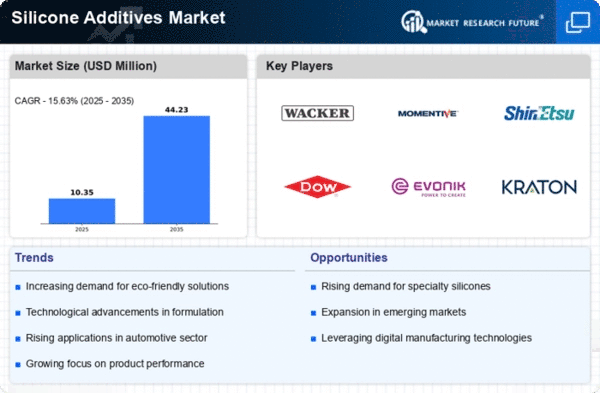
As per MRFR analysis, the Silicone Additives Market Size was estimated at 8.95 USD Million in 2024. The Silicone Additives industry is projected to grow from 10.35 USD Million in 2025 to 44.23 USD Million by 2035, exhibiting a compound annual growth rate (CAGR) of 15.63 during the forecast period 2025 - 2035.

Key Market Trends & Highlights

The Silicone Additives Market is poised for robust growth driven by sustainability and technological advancements.

  • The market is witnessing a pronounced shift towards sustainability, influencing product development and consumer preferences. Customization and specialization in silicone additives are becoming increasingly prevalent, catering to diverse industry needs. North America remains the largest market, while the Asia-Pacific region is emerging as the fastest-growing area for silicone additives. Key drivers include rising demand in the construction sector and an increased focus on sustainable solutions, particularly in coatings and personal care segments.

Market Size & Forecast

2024 Market Size 8.95 (USD Million)
2035 Market Size 44.23 (USD Million)
CAGR (2025 - 2035) 15.63%
Largest Regional Market Share in 2024 North America

Major Players

Wacker Chemie AG (DE), Momentive Performance Materials Inc. (US), Shin-Etsu Chemical Co. Ltd. (JP), Dow Inc. (US), Evonik Industries AG (DE), Kraton Corporation (US), Silicone Solutions (US), Huntsman Corporation (US), KCC Corporation (KR)

Market Trends

The Silicone Additives Market is currently experiencing a notable transformation, driven by the increasing demand for high-performance materials across various industries. This market encompasses a diverse range of products, including emulsifiers, defoamers, and surfactants, which are utilized in applications such as coatings, adhesives, and sealants. The growing emphasis on sustainability and eco-friendly solutions appears to be influencing the development of innovative silicone additives that enhance product performance while minimizing environmental impact. Furthermore, advancements in technology and manufacturing processes are likely to play a crucial role in shaping the future landscape of this market. In addition, the Silicone Additives Market is witnessing a shift towards customization and specialization, as manufacturers strive to meet the unique requirements of different sectors. Industries such as automotive, construction, and consumer goods are increasingly seeking tailored solutions that offer enhanced durability, flexibility, and resistance to extreme conditions. This trend suggests a potential for growth as companies invest in research and development to create specialized silicone additives that cater to specific applications. Overall, the Silicone Additives Market appears poised for continued expansion, driven by innovation and a focus on meeting evolving consumer needs.

Sustainability Focus

The trend towards sustainability is becoming increasingly prominent within the Silicone Additives Market. Manufacturers are exploring eco-friendly formulations and production methods that reduce environmental impact. This shift not only aligns with global sustainability goals but also meets the growing consumer demand for greener products.

Customization and Specialization

Customization is emerging as a key trend in the Silicone Additives Market. Companies are recognizing the need for specialized additives tailored to specific applications across various industries. This focus on bespoke solutions enhances product performance and meets the unique demands of diverse sectors.

Technological Advancements

Technological advancements are significantly influencing the Silicone Additives Market. Innovations in manufacturing processes and product formulations are enabling the development of high-performance additives. These advancements are likely to enhance the efficiency and effectiveness of silicone additives in various applications.

Silicone Additives Market Market Drivers

Market Growth Projections

The Global Silicone Additives Market Industry is poised for substantial growth, with projections indicating a rise from 2.5 USD Billion in 2024 to 5.45 USD Billion by 2035. This growth trajectory reflects a compound annual growth rate of 7.34% from 2025 to 2035. Various factors contribute to this expansion, including increasing demand across multiple sectors such as automotive, construction, and consumer electronics. The ongoing innovations in silicone formulations and the growing emphasis on sustainability further enhance the market's potential. As industries continue to recognize the benefits of silicone additives, the market is likely to experience robust growth in the coming years.

Rising Consumer Electronics Market

The Global Silicone Additives Market Industry benefits from the burgeoning consumer electronics market. Silicone additives are essential in manufacturing electronic components, providing thermal management and electrical insulation. With the increasing demand for high-performance electronics, such as smartphones and wearable devices, silicone additives play a critical role in ensuring product reliability and efficiency. The integration of silicone materials in these devices enhances their performance, which is vital in a competitive market. This trend is expected to support the market's growth trajectory, with projections indicating a rise to 2.5 USD Billion in 2024 and further expansion to 5.45 USD Billion by 2035.

Growing Demand in Automotive Sector

The Global Silicone Additives Market Industry experiences a notable surge in demand from the automotive sector. Silicone additives are increasingly utilized in automotive applications due to their superior thermal stability and resistance to extreme conditions. For instance, silicone-based lubricants and sealants enhance vehicle performance and longevity. As the automotive industry continues to innovate, particularly with electric vehicles, the need for high-performance materials is expected to rise. This trend contributes to the overall growth of the market, which is projected to reach 2.5 USD Billion in 2024 and potentially expand to 5.45 USD Billion by 2035, reflecting a compound annual growth rate of 7.34% from 2025 to 2035.

Innovations in Personal Care Products

The Global Silicone Additives Market Industry is propelled by innovations in personal care products. Silicone additives are widely used in cosmetics and personal care formulations, enhancing product texture and performance. For example, silicone-based ingredients provide a smooth application and long-lasting effects in skincare and haircare products. As consumer preferences shift towards high-quality and effective personal care solutions, the demand for silicone additives is expected to rise. This trend aligns with the overall market growth, which is projected to reach 2.5 USD Billion in 2024 and potentially expand to 5.45 USD Billion by 2035.

Advancements in Construction Materials

The Global Silicone Additives Market Industry is significantly influenced by advancements in construction materials. Silicone additives are increasingly incorporated into sealants, coatings, and adhesives, enhancing their durability and weather resistance. The construction sector's shift towards sustainable and high-performance materials drives the demand for silicone additives. For example, silicone-based coatings provide superior protection against environmental factors, which is crucial for infrastructure longevity. As urbanization continues to rise globally, the construction industry's reliance on innovative materials is likely to bolster the market, contributing to its projected growth to 5.45 USD Billion by 2035.

Environmental Regulations and Sustainability

The Global Silicone Additives Market Industry is shaped by stringent environmental regulations and a growing emphasis on sustainability. Manufacturers are increasingly adopting silicone additives as eco-friendly alternatives to traditional materials, aligning with global sustainability goals. For instance, silicone-based products often exhibit lower environmental impact during production and disposal. This shift towards sustainable practices is not only beneficial for compliance with regulations but also appeals to environmentally conscious consumers. As industries seek to reduce their carbon footprint, the demand for silicone additives is likely to increase, contributing to the market's anticipated growth to 5.45 USD Billion by 2035.

Market Segment Insights

By Application: Coatings (Largest) vs. Personal Care (Fastest-Growing)

In the Silicone Additives Market, the application segment is prominently led by Coatings, which holds the largest market share. Coatings utilize silicone additives for their superior properties, enhancing durability, water resistance, and surface finish. Following Coatings, <a href="https://www.marketresearchfuture.com/reports/adhesives-sealants-market-792">Adhesives and Sealants</a> also contribute significantly to the market, providing essential bonding solutions across various industries. Personal Care and Textiles, while smaller in comparison, show potential for growth as they leverage the unique benefits of silicone additives for improved product performance. The growth trends within this segment reflect a shift towards innovative applications. Personal Care is rapidly emerging as the fastest-growing application, driven by rising consumer demand for high-quality personal care products, which benefit from silicone's conditioning properties. Additionally, the booming construction and automotive sectors are propelling the demand for Coatings, Adhesives, and Sealants, as manufacturers prioritize durability and environmental resistance in their products.

Coatings: Dominant vs. Personal Care: Emerging

Coatings are a dominant player in the Silicone Additives Market, known for their exceptional properties that enhance performance in various applications, including automotive and industrial finishes. The use of <a href="https://www.marketresearchfuture.com/reports/silicone-market-7449">silicone</a> additives in coatings offers advantages such as improved water repellency and UV resistance, making them preferable for manufacturers aiming for longevity and aesthetic appeal. On the other hand, Personal Care is identified as an emerging segment due to growing trends in personal grooming and skincare that prioritize silicone's sensory benefits and moisturizing properties. The Personal Care sector is rapidly expanding, with manufacturers seeking innovative formulations that incorporate silicone additives to create smoother and more effective products, driving the sector's growth in a competitive market.

By End Use Industry: Construction (Largest) vs. Consumer Goods (Fastest-Growing)

The Silicone Additives Market is significantly influenced by various end use industries, with construction being the largest segment. This industry demands silicone additives for applications in sealants, adhesives, and coatings due to their unique properties such as weather resistance and durability. The automotive and electronics segments also hold substantial shares, catering to the needs for high-performance materials that enhance product longevity and functionality. Overall, each segment's contribution is crucial in shaping the market landscape while driving competition among suppliers.

Healthcare: Pharmaceuticals (Dominant) vs. Electronics: Gadgets (Emerging)

In the Silicone Additives Market, the healthcare sector, particularly pharmaceuticals, stands out as a dominant segment due to the critical role silicone additives play in drug formulation and medical device manufacturing. These additives ensure safety, stability, and efficacy of pharmaceutical products. On the other hand, the electronics segment, particularly in gadgets, is emerging rapidly as a key player. The increasing use of silicone additives for insulation and protective coatings showcases the shift towards high-performance, reliable electronics. The innovation in both sectors illustrates the broader trend towards enhanced product quality and performance.

By Product Type: Emulsions (Largest) vs. Gels (Fastest-Growing)

The Silicone Additives Market exhibits a diverse portfolio of product types, among which Emulsions command the largest market share. This dominance can be attributed to their extensive application in various industries, particularly in coatings and personal care products, where they enhance texture and stability. Gels and Fluids follow as essential components, while Powders and Additive Masterbatches offer niche applications. Together, these segments create a competitive landscape that drives innovation and growth within the market. In terms of growth trends, Gels have emerged as the fastest-growing segment within the Silicone Additives Market, fueled by increasing demand in the cosmetics and pharmaceuticals sectors. The versatility and multifunctional properties of Gels enable them to meet evolving consumer preferences for high-performance, sustainable products. Additionally, Emulsions continue to expand their reach, adapting to new formulations and applications, thus sustaining a strong competitive edge in the market.

Emulsions (Dominant) vs. Additive Masterbatches (Emerging)

Emulsions are recognized as the dominant product type within the Silicone Additives Market due to their widespread usage and effectiveness in providing enhanced performance in various formulations. They are favored for their ability to provide stability and improve the sensory attributes of products, especially in personal care and industrial applications. On the other hand, Additive Masterbatches are considered an emerging segment, gaining traction for their role in facilitating the incorporation of silicone additives into different polymer matrices. Their adaptability and efficiency in enhancing the properties of thermoplastics make them an attractive option for manufacturers looking to innovate in the sustainable materials space. As both segments evolve, their characteristics highlight the increasing sophistication and customization within silicone formulations.

Get more detailed insights about Silicone Additives Market Report - Global Forecast till 2035

Regional Insights

North America : Market Leader in Silicone Additives

North America is poised to maintain its leadership in the silicone additives market, holding a significant share of 3.58 in 2024. The region's growth is driven by robust demand from industries such as automotive, construction, and electronics, alongside increasing regulatory support for sustainable materials. The push for eco-friendly products is further catalyzing market expansion, as companies seek to innovate and comply with environmental standards. The United States stands out as the primary market, with key players like Dow Inc. and Momentive Performance Materials Inc. leading the charge. The competitive landscape is characterized by continuous innovation and strategic partnerships among major companies. This dynamic environment fosters a strong presence of both established and emerging players, ensuring a vibrant market that is responsive to evolving consumer needs.

Key Players and Competitive Insights

The Silicone Additives Market is currently characterized by a dynamic competitive landscape, driven by innovation, sustainability, and strategic partnerships. Key players such as Wacker Chemie AG (Germany), Momentive Performance Materials Inc. (US), and Dow Inc. (US) are actively shaping the market through their distinct operational focuses. Wacker Chemie AG (Germany) emphasizes innovation in product development, particularly in eco-friendly silicone additives, which aligns with the growing demand for sustainable solutions. Momentive Performance Materials Inc. (US) has adopted a strategy of regional expansion, enhancing its presence in emerging markets, while Dow Inc. (US) focuses on digital transformation to optimize its supply chain and improve customer engagement. Collectively, these strategies contribute to a competitive environment that is increasingly focused on sustainability and technological advancement.
The business tactics employed by these companies include localizing manufacturing and optimizing supply chains to enhance efficiency and responsiveness to market demands. The market structure appears moderately fragmented, with several key players exerting influence over various segments. This fragmentation allows for niche players to thrive, while larger corporations leverage their resources to maintain competitive advantages. The collective influence of these key players fosters a competitive atmosphere where innovation and operational efficiency are paramount.
In November 2025, Wacker Chemie AG (Germany) announced the launch of a new line of bio-based silicone additives aimed at reducing environmental impact. This strategic move not only reinforces Wacker's commitment to sustainability but also positions the company favorably in a market increasingly driven by eco-conscious consumers. The introduction of these products is likely to enhance Wacker's market share and appeal to a broader customer base seeking sustainable alternatives.
In October 2025, Momentive Performance Materials Inc. (US) entered into a strategic partnership with a leading automotive manufacturer to develop advanced silicone solutions for electric vehicles. This collaboration is significant as it aligns with the automotive industry's shift towards electrification, potentially opening new revenue streams for Momentive. By integrating its silicone additives into electric vehicle production, Momentive is likely to strengthen its position in a rapidly evolving market.
In September 2025, Dow Inc. (US) unveiled a new digital platform designed to streamline customer interactions and enhance supply chain transparency. This initiative reflects Dow's commitment to digital transformation, which is increasingly vital in today's market. By leveraging technology to improve customer engagement and operational efficiency, Dow is poised to gain a competitive edge in the Silicone Additives Market.
As of December 2025, current competitive trends indicate a strong emphasis on digitalization, sustainability, and the integration of AI technologies. Strategic alliances are becoming increasingly important, as companies seek to leverage complementary strengths to enhance their market positions. The competitive landscape is shifting from traditional price-based competition to a focus on innovation, technology, and supply chain reliability. This evolution suggests that companies that prioritize these aspects will likely emerge as leaders in the Silicone Additives Market.

Key Companies in the Silicone Additives Market include

Industry Developments

Future Outlook

Silicone Additives Market Future Outlook

The Silicone Additives Market is projected to grow at a 15.63% CAGR from 2025 to 2035, driven by increasing demand in automotive, construction, and consumer goods sectors.

New opportunities lie in:

  • Development of bio-based silicone additives for sustainable applications.
  • Expansion into emerging markets with tailored product offerings.
  • Investment in R&amp;D for innovative silicone formulations enhancing performance.

By 2035, the market is expected to solidify its position as a leader in specialty additives.

Market Segmentation

Silicone Additives Market Application Outlook

  • Coatings
  • Adhesives
  • Sealants
  • Personal Care
  • Textiles

Silicone Additives Market Product Type Outlook

  • Emulsions
  • Gels
  • Fluids
  • Powders
  • Additive Masterbatches

Silicone Additives Market End Use Industry Outlook

  • Construction
  • Automotive
  • Electronics
  • Healthcare
  • Consumer Goods

Report Scope

MARKET SIZE 2024 8.95(USD Million)
MARKET SIZE 2025 10.35(USD Million)
MARKET SIZE 2035 44.23(USD Million)
COMPOUND ANNUAL GROWTH RATE (CAGR) 15.63% (2025 - 2035)
REPORT COVERAGE Revenue Forecast, Competitive Landscape, Growth Factors, and Trends
BASE YEAR 2024
Market Forecast Period 2025 - 2035
Historical Data 2019 - 2024
Market Forecast Units USD Million
Key Companies Profiled Wacker Chemie AG (DE), Momentive Performance Materials Inc. (US), Shin-Etsu Chemical Co. Ltd. (JP), Dow Inc. (US), Evonik Industries AG (DE), Kraton Corporation (US), Silicone Solutions (US), Huntsman Corporation (US), KCC Corporation (KR)
Segments Covered Application, End Use Industry, Product Type
Key Market Opportunities Growing demand for eco-friendly silicone additives in various industries presents significant market opportunities.
Key Market Dynamics Rising demand for eco-friendly silicone additives drives innovation and competition among manufacturers in diverse industries.
Countries Covered North America, Europe, APAC, South America, MEA

FAQs

What is the valuation of the silicone additives market?

The global silicone additives market is expected to be valued at USD 2.5 billion by 2035.

What is the global silicone additives market’s expected CAGR?

The global silicone additives market is expected to exhibit a solid 7.34% CAGR over the forecast period from 2025-2035.

What are the major end uses of silicone additives?

Paints and coatings, plastics, and construction are the leading end uses of silicone additives.

What is the major driver for the silicone additives market?

The major driver for the global silicone additives market is the growing demand for paints and coatings in the automotive industry.

What are the major players in the silicone additives market?

Leading players in the silicone additives market include Evonik, KCC Corporation, Wacker Chemie AG, Siltech, Dow, Akrochem Corporation, Shin-Etsu, BRB International, and Supreme Silicones.

  1. SECTION I: EXECUTIVE SUMMARY AND KEY HIGHLIGHTS
    1. | 1.1 EXECUTIVE SUMMARY
    2. | 1.1.1 Market Overview
    3. | 1.1.2 Key Findings
    4. | 1.1.3 Market Segmentation
    5. | 1.1.4 Competitive Landscape
    6. | 1.1.5 Challenges and Opportunities
    7. | 1.1.6 Future Outlook
  2. SECTION II: SCOPING, METHODOLOGY AND MARKET STRUCTURE
    1. | 2.1 MARKET INTRODUCTION
    2. | 2.1.1 Definition
    3. | 2.1.2 Scope of the study
    4. |-- 2.1.2.1 Research Objective
    5. |-- 2.1.2.2 Assumption
    6. |-- 2.1.2.3 Limitations
    7. | 2.2 RESEARCH METHODOLOGY
    8. | 2.2.1 Overview
    9. | 2.2.2 Data Mining
    10. | 2.2.3 Secondary Research
    11. | 2.2.4 Primary Research
    12. |-- 2.2.4.1 Primary Interviews and Information Gathering Process
    13. |-- 2.2.4.2 Breakdown of Primary Respondents
    14. | 2.2.5 Forecasting Model
    15. | 2.2.6 Market Size Estimation
    16. |-- 2.2.6.1 Bottom-Up Approach
    17. |-- 2.2.6.2 Top-Down Approach
    18. | 2.2.7 Data Triangulation
    19. | 2.2.8 Validation
  3. SECTION III: QUALITATIVE ANALYSIS
    1. | 3.1 MARKET DYNAMICS
    2. | 3.1.1 Overview
    3. | 3.1.2 Drivers
    4. | 3.1.3 Restraints
    5. | 3.1.4 Opportunities
    6. | 3.2 MARKET FACTOR ANALYSIS
    7. | 3.2.1 Value chain Analysis
    8. | 3.2.2 Porter's Five Forces Analysis
    9. |-- 3.2.2.1 Bargaining Power of Suppliers
    10. |-- 3.2.2.2 Bargaining Power of Buyers
    11. |-- 3.2.2.3 Threat of New Entrants
    12. |-- 3.2.2.4 Threat of Substitutes
    13. |-- 3.2.2.5 Intensity of Rivalry
    14. | 3.2.3 COVID-19 Impact Analysis
    15. |-- 3.2.3.1 Market Impact Analysis
    16. |-- 3.2.3.2 Regional Impact
    17. |-- 3.2.3.3 Opportunity and Threat Analysis
  4. SECTION IV: QUANTITATIVE ANALYSIS
    1. | 4.1 Chemicals and Materials, BY Application (USD Million)
    2. | 4.1.1 Coatings
    3. | 4.1.2 Adhesives
    4. | 4.1.3 Sealants
    5. | 4.1.4 Personal Care
    6. | 4.1.5 Textiles
    7. | 4.2 Chemicals and Materials, BY End Use Industry (USD Million)
    8. | 4.2.1 Construction
    9. | 4.2.2 Automotive
    10. | 4.2.3 Electronics
    11. | 4.2.4 Healthcare
    12. | 4.2.5 Consumer Goods
    13. | 4.3 Chemicals and Materials, BY Product Type (USD Million)
    14. | 4.3.1 Emulsions
    15. | 4.3.2 Gels
    16. | 4.3.3 Fluids
    17. | 4.3.4 Powders
    18. | 4.3.5 Additive Masterbatches
    19. | 4.4 Chemicals and Materials, BY Region (USD Million)
    20. | 4.4.1 North America
    21. |-- 4.4.1.1 US
    22. |-- 4.4.1.2 Canada
    23. | 4.4.2 Europe
    24. |-- 4.4.2.1 Germany
    25. |-- 4.4.2.2 UK
    26. |-- 4.4.2.3 France
    27. |-- 4.4.2.4 Russia
    28. |-- 4.4.2.5 Italy
    29. |-- 4.4.2.6 Spain
    30. |-- 4.4.2.7 Rest of Europe
    31. | 4.4.3 APAC
    32. |-- 4.4.3.1 China
    33. |-- 4.4.3.2 India
    34. |-- 4.4.3.3 Japan
    35. |-- 4.4.3.4 South Korea
    36. |-- 4.4.3.5 Malaysia
    37. |-- 4.4.3.6 Thailand
    38. |-- 4.4.3.7 Indonesia
    39. |-- 4.4.3.8 Rest of APAC
    40. | 4.4.4 South America
    41. |-- 4.4.4.1 Brazil
    42. |-- 4.4.4.2 Mexico
    43. |-- 4.4.4.3 Argentina
    44. |-- 4.4.4.4 Rest of South America
    45. | 4.4.5 MEA
    46. |-- 4.4.5.1 GCC Countries
    47. |-- 4.4.5.2 South Africa
    48. |-- 4.4.5.3 Rest of MEA
  5. SECTION V: COMPETITIVE ANALYSIS
    1. | 5.1 Competitive Landscape
    2. | 5.1.1 Overview
    3. | 5.1.2 Competitive Analysis
    4. | 5.1.3 Market share Analysis
    5. | 5.1.4 Major Growth Strategy in the Chemicals and Materials
    6. | 5.1.5 Competitive Benchmarking
    7. | 5.1.6 Leading Players in Terms of Number of Developments in the Chemicals and Materials
    8. | 5.1.7 Key developments and growth strategies
    9. |-- 5.1.7.1 New Product Launch/Service Deployment
    10. |-- 5.1.7.2 Merger & Acquisitions
    11. |-- 5.1.7.3 Joint Ventures
    12. | 5.1.8 Major Players Financial Matrix
    13. |-- 5.1.8.1 Sales and Operating Income
    14. |-- 5.1.8.2 Major Players R&D Expenditure. 2023
    15. | 5.2 Company Profiles
    16. | 5.2.1 Wacker Chemie AG (DE)
    17. |-- 5.2.1.1 Financial Overview
    18. |-- 5.2.1.2 Products Offered
    19. |-- 5.2.1.3 Key Developments
    20. |-- 5.2.1.4 SWOT Analysis
    21. |-- 5.2.1.5 Key Strategies
    22. | 5.2.2 Momentive Performance Materials Inc. (US)
    23. |-- 5.2.2.1 Financial Overview
    24. |-- 5.2.2.2 Products Offered
    25. |-- 5.2.2.3 Key Developments
    26. |-- 5.2.2.4 SWOT Analysis
    27. |-- 5.2.2.5 Key Strategies
    28. | 5.2.3 Shin-Etsu Chemical Co. Ltd. (JP)
    29. |-- 5.2.3.1 Financial Overview
    30. |-- 5.2.3.2 Products Offered
    31. |-- 5.2.3.3 Key Developments
    32. |-- 5.2.3.4 SWOT Analysis
    33. |-- 5.2.3.5 Key Strategies
    34. | 5.2.4 Dow Inc. (US)
    35. |-- 5.2.4.1 Financial Overview
    36. |-- 5.2.4.2 Products Offered
    37. |-- 5.2.4.3 Key Developments
    38. |-- 5.2.4.4 SWOT Analysis
    39. |-- 5.2.4.5 Key Strategies
    40. | 5.2.5 Evonik Industries AG (DE)
    41. |-- 5.2.5.1 Financial Overview
    42. |-- 5.2.5.2 Products Offered
    43. |-- 5.2.5.3 Key Developments
    44. |-- 5.2.5.4 SWOT Analysis
    45. |-- 5.2.5.5 Key Strategies
    46. | 5.2.6 Kraton Corporation (US)
    47. |-- 5.2.6.1 Financial Overview
    48. |-- 5.2.6.2 Products Offered
    49. |-- 5.2.6.3 Key Developments
    50. |-- 5.2.6.4 SWOT Analysis
    51. |-- 5.2.6.5 Key Strategies
    52. | 5.2.7 Silicone Solutions (US)
    53. |-- 5.2.7.1 Financial Overview
    54. |-- 5.2.7.2 Products Offered
    55. |-- 5.2.7.3 Key Developments
    56. |-- 5.2.7.4 SWOT Analysis
    57. |-- 5.2.7.5 Key Strategies
    58. | 5.2.8 Huntsman Corporation (US)
    59. |-- 5.2.8.1 Financial Overview
    60. |-- 5.2.8.2 Products Offered
    61. |-- 5.2.8.3 Key Developments
    62. |-- 5.2.8.4 SWOT Analysis
    63. |-- 5.2.8.5 Key Strategies
    64. | 5.2.9 KCC Corporation (KR)
    65. |-- 5.2.9.1 Financial Overview
    66. |-- 5.2.9.2 Products Offered
    67. |-- 5.2.9.3 Key Developments
    68. |-- 5.2.9.4 SWOT Analysis
    69. |-- 5.2.9.5 Key Strategies
    70. | 5.3 Appendix
    71. | 5.3.1 References
    72. | 5.3.2 Related Reports

Chemicals and Materials Market Segmentation

Chemicals and Materials By Application (USD Million, 2025-2035)

  • Coatings
  • Adhesives
  • Sealants
  • Personal Care
  • Textiles

Chemicals and Materials By End Use Industry (USD Million, 2025-2035)

  • Construction
  • Automotive
  • Electronics
  • Healthcare
  • Consumer Goods

Chemicals and Materials By Product Type (USD Million, 2025-2035)

  • Emulsions
  • Gels
  • Fluids
  • Powders
  • Additive Masterbatches
Infographic

Free Sample Request

Kindly complete the form below to receive a free sample of this Report

Get Free Sample

Customer Strories

Compare Licence

×
Features License Type
Single User Multiuser License Enterprise User
Price $4,950 $5,950 $7,250
Maximum User Access Limit 1 User Upto 10 Users Unrestricted Access Throughout the Organization
Free Customization
Direct Access to Analyst
Deliverable Format
Platform Access
Discount on Next Purchase 10% 15% 15%
Printable Versions