×
Request Free Sample ×

Kindly complete the form below to receive a free sample of this Report

* Please use a valid business email

Leading companies partner with us for data-driven Insights

clients tt-cursor
Hero Background

Semiconductor Memory IP Market

ID: MRFR/SEM/5984-CR
95 Pages
Ankit Gupta
January 2025

Semiconductor Memory IP Market Size, Share and Research Report By Type (Dynamic Random Access Memory, Static Random Access Memory, Read-Only Memory, Flash Memory), By Technology (DRAM, SRAM, NAND, NOR), By Application (Consumer Electronics, Automotive, Telecommunications, Industrial), By End Use (Personal Use, Commercial Use, Military Use) and By Regional (North America, Europe, South America, Asia Pacific, Middle East and Africa) - Industry Forecast Till 2035

Share:
Download PDF ×

We do not share your information with anyone. However, we may send you emails based on your report interest from time to time. You may contact us at any time to opt-out.

Semiconductor Memory IP Market Infographic
Purchase Options

Semiconductor Memory IP Market Summary

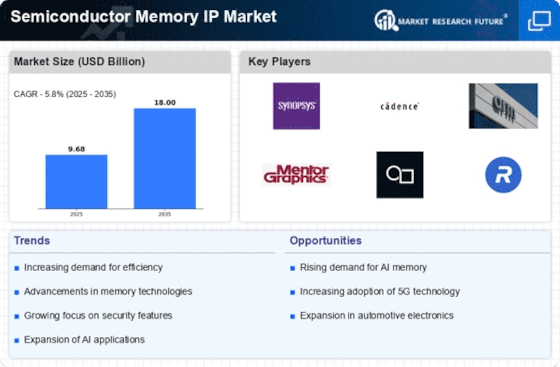
As per Market Research Future analysis, the Semiconductor Memory IP Market Size was estimated at 9.681 USD Billion in 2024. The Semiconductor Memory IP industry is projected to grow from 10.24 USD Billion in 2025 to 18.0 USD Billion by 2035, exhibiting a compound annual growth rate (CAGR) of 5.8% during the forecast period 2025 - 2035

Key Market Trends & Highlights

The Semiconductor Memory IP Market is poised for substantial growth driven by technological advancements and increasing demand across various sectors.

  • The market experiences rising demand for advanced memory solutions, particularly in North America, which remains the largest market.
  • Energy efficiency is becoming a focal point for innovation, especially in the Asia-Pacific region, recognized as the fastest-growing market.
  • Dynamic Random Access Memory (DRAM) continues to dominate the market, while Flash Memory, particularly NAND, is witnessing rapid growth.
  • The increasing adoption of AI and machine learning, alongside the growth in consumer electronics, serves as a major driver for the market.

Market Size & Forecast

2024 Market Size 9.681 (USD Billion)
2035 Market Size 18.0 (USD Billion)
CAGR (2025 - 2035) 5.8%

Major Players

Synopsys (US), Cadence Design Systems (US), Arm Holdings (GB), Mentor Graphics (US), Imagination Technologies (GB), Rambus (US), Silicon Labs (US), STMicroelectronics (FR), NXP Semiconductors (NL)

Our Impact
Enabled $4.3B Revenue Impact for Fortune 500 and Leading Multinationals
Partnering with 2000+ Global Organizations Each Year
30K+ Citations by Top-Tier Firms in the Industry

Semiconductor Memory IP Market Trends

The Semiconductor Memory IP Market is currently experiencing a dynamic evolution, driven by the increasing demand for advanced memory solutions across various sectors. This market encompasses a wide range of intellectual property cores that facilitate the design and integration of memory components in semiconductor devices. As technology progresses, the need for high-performance, energy-efficient memory solutions becomes more pronounced, particularly in applications such as artificial intelligence, machine learning, and the Internet of Things. The ongoing advancements in semiconductor fabrication processes further enhance the capabilities of memory IP, allowing for greater integration and miniaturization of devices. Moreover, the competitive landscape of the Semiconductor Memory IP Market is characterized by a surge in innovation and collaboration among key players. Companies are increasingly focusing on developing proprietary technologies that offer unique advantages in terms of speed, efficiency, and scalability. This trend is likely to foster a more robust ecosystem, where partnerships between semiconductor manufacturers and IP providers become commonplace. As the market continues to mature, it appears poised for sustained growth, with emerging applications and technologies driving demand for sophisticated memory solutions.

Rising Demand for Advanced Memory Solutions

The Semiconductor Memory IP Market is witnessing a notable increase in the need for advanced memory solutions. This trend is largely attributed to the proliferation of applications requiring high-speed data processing and storage capabilities. Industries such as automotive, telecommunications, and consumer electronics are particularly driving this demand, as they seek to enhance performance and efficiency in their products.

Focus on Energy Efficiency

There is a growing emphasis on energy efficiency within the Semiconductor Memory IP Market. As environmental concerns gain prominence, manufacturers are prioritizing the development of memory solutions that consume less power while maintaining high performance. This shift not only aligns with global sustainability goals but also addresses the operational costs associated with energy consumption in semiconductor devices.

Collaboration and Innovation

The Semiconductor Memory IP Market is increasingly characterized by collaboration and innovation among industry players. Companies are forming strategic partnerships to leverage complementary strengths, fostering the development of cutting-edge memory technologies. This collaborative approach is likely to accelerate advancements in memory IP, enabling faster time-to-market for new products and solutions.

Semiconductor Memory IP Market Drivers

Emergence of 5G Technology

The rollout of 5G technology is poised to have a profound impact on the Semiconductor Memory IP Market. As 5G networks become more prevalent, the demand for high-speed data transmission and low-latency communication is increasing. This technological advancement necessitates the development of memory solutions that can handle the increased data flow and support advanced applications such as augmented reality and the Internet of Things (IoT). Industry analysts suggest that the 5G market could reach significant valuations, thereby creating opportunities for memory IP providers to innovate and adapt their offerings. The Semiconductor Memory IP Market is likely to see a shift towards solutions that cater specifically to the requirements of 5G technology.

Growth in Consumer Electronics

The Semiconductor Memory IP Market is significantly influenced by the growth in consumer electronics, which continues to expand at a rapid pace. With the proliferation of smart devices, including smartphones, tablets, and wearables, the demand for advanced memory solutions is on the rise. According to recent data, the consumer electronics sector is expected to witness a compound annual growth rate (CAGR) of over 5% in the coming years. This growth directly correlates with the need for efficient and high-capacity memory IP, as manufacturers seek to enhance device performance and user experience. Consequently, the Semiconductor Memory IP Market stands to benefit from this ongoing trend, as companies strive to meet the evolving demands of consumers.

Focus on Automotive Electronics

The Semiconductor Memory IP Market is also experiencing growth due to the increasing focus on automotive electronics. As vehicles become more technologically advanced, the demand for memory solutions that support features such as autonomous driving, infotainment systems, and advanced driver-assistance systems (ADAS) is rising. The automotive sector is projected to invest heavily in electronic components, with estimates suggesting a significant increase in the market size over the next few years. This trend indicates that memory IP providers who can deliver high-performance, reliable solutions tailored for automotive applications may find substantial opportunities within the Semiconductor Memory IP Market.

Rising Need for Data Storage Solutions

The Semiconductor Memory IP Market is witnessing a rising need for efficient data storage solutions, driven by the exponential growth of data generation across various sectors. As businesses and consumers alike generate vast amounts of data, the demand for reliable and scalable memory solutions becomes increasingly critical. Reports indicate that the global data sphere is expected to reach several zettabytes in the near future, highlighting the urgency for advanced memory IP that can accommodate this growth. Companies that specialize in developing innovative storage solutions are likely to thrive in this environment, as the Semiconductor Memory IP Market adapts to meet the challenges posed by data proliferation.

Increasing Adoption of AI and Machine Learning

The Semiconductor Memory IP Market is experiencing a notable surge in demand due to the increasing adoption of artificial intelligence (AI) and machine learning technologies. These advanced applications require high-performance memory solutions to process vast amounts of data efficiently. As organizations integrate AI into their operations, the need for specialized memory IP that can support complex algorithms and real-time data processing becomes critical. Reports indicate that the AI market is projected to reach substantial figures, further driving the Semiconductor Memory IP Market. This trend suggests that companies focusing on developing memory solutions tailored for AI applications may find lucrative opportunities in the evolving landscape.


Market Segment Insights

By Type: Dynamic Random Access Memory (Largest) vs. Flash Memory (Fastest-Growing)

In the Semiconductor Memory IP Market, Dynamic Random Access Memory (DRAM) holds the largest share, largely due to its widespread use in consumer electronics, computers, and servers. Static Random Access Memory (SRAM) and Read-Only Memory (ROM) have stable but less significant shares, catering to specific applications where speed and reliability are crucial. Flash Memory, initially a smaller part of the market, has gained momentum, driven by the increasing demand for mobile devices and data storage solutions. Growth trends indicate that Flash Memory is the fastest-growing segment within the market, propelled by advancements in technology and a surge in demand for high-capacity, low-latency storage solutions. The rise of Internet of Things (IoT) devices and the ongoing digital transformation across industries further fuel its adoption. DRAM continues to thrive, supported by the increasing complexity of computing tasks and the need for efficient memory solutions.

Dynamic Random Access Memory (Dominant) vs. Flash Memory (Emerging)

Dynamic Random Access Memory (DRAM) is the dominant player in the Semiconductor Memory IP Market due to its ability to store data transiently and access it quickly, making it essential for applications that require high-speed data processing. Its prevalent application in personal computers, mobile devices, and servers underscores its market strength. Conversely, Flash Memory, characterized by non-volatile data storage and faster data access speeds, is emerging as a formidable alternative. It is particularly favored in mobile devices and SSDs, where its ability to retain data without power is crucial. As technological advancements continue, Flash Memory's versatility and performance enhancements position it as a compelling option for next-generation data storage needs.

By Technology: DRAM (Largest) vs. NAND (Fastest-Growing)

In the Semiconductor Memory IP Market, the market share distribution reveals that DRAM holds the largest portion due to its extensive applications in consumer electronics and computing systems. This dominance is bolstered by continuous advancements in DRAM technology, driving widespread adoption across various industries, including mobile, automotive, and data centers. Meanwhile, NAND technology has emerged as a significant player, gaining traction for its increasing use in storage applications, particularly in SSDs and mobile devices, reflecting growing consumer demands for high-capacity storage solutions.

Technology: DRAM (Dominant) vs. NAND (Emerging)

DRAM is well-established as the dominant memory technology in the Semiconductor Memory IP market, characterized by its volatility and high density. It is widely used in dynamic applications that require rapid data access and processing. As technology evolves, DRAM continues to innovate, becoming increasingly efficient and cost-effective for manufacturers. On the other hand, NAND has surged as an emerging technology due to its non-volatile nature, making it ideal for flash memory applications. Its rapid adoption in smartphones and solid-state drives makes it the fastest-growing segment, catering to the demand for faster data retrieval speeds and higher storage capacities.

By Application: Consumer Electronics (Largest) vs. Automotive (Fastest-Growing)

In the Semiconductor Memory IP Market, the application segment is primarily dominated by Consumer Electronics, which accounts for a significant portion of market share. This category encompasses devices like smartphones, tablets, and laptops that are critical in daily consumer interactions. The robust demand for advanced consumer gadgets and IoT devices has solidified its leading role in the market distribution.

Consumer Electronics (Dominant) vs. Automotive (Emerging)

Consumer Electronics represents the dominant force in the Semiconductor Memory IP Market, driven by relentless innovation and the launch of cutting-edge devices. It is characterized by high-volume production and a strong emphasis on efficiency and miniaturization of memory solutions. In contrast, the Automotive sector is emerging rapidly, fueled by the rising adoption of electric and autonomous vehicles. The demand for advanced memory solutions suited for real-time processing and high reliability is increasing, making Automotive one of the fastest-growing applications. This sector's growth is a testament to the increasing integration of smart technologies within vehicles.

By End Use: Personal Use (Largest) vs. Commercial Use (Fastest-Growing)

The Semiconductor Memory IP Market is predominantly driven by personal use applications, accounting for the largest share of market demand. This segment includes various consumer electronics that utilize semiconductor memory IP, such as smartphones, tablets, and personal computers. In contrast, commercial use, which encompasses applications in enterprise servers, data centers, and cloud computing platforms, is rapidly gaining momentum, reflecting its significance in the overall market landscape.

Personal Use (Dominant) vs. Commercial Use (Emerging)

Personal use in the Semiconductor Memory IP Market remains a dominant segment due to its extensive integration in everyday consumer electronics. Devices such as smartphones and laptops are becoming increasingly dependent on advanced memory IPs to enhance performance and efficiency. Meanwhile, the commercial use segment is emerging with high growth potential, driven by the increased demand for data center efficiency and the expansion of cloud services. This sector's agility in adopting innovative memory solutions, coupled with soaring data storage needs, positions it as a key player in the market.

Get more detailed insights about Semiconductor Memory IP Market

Regional Insights

North America : Innovation and Leadership Hub

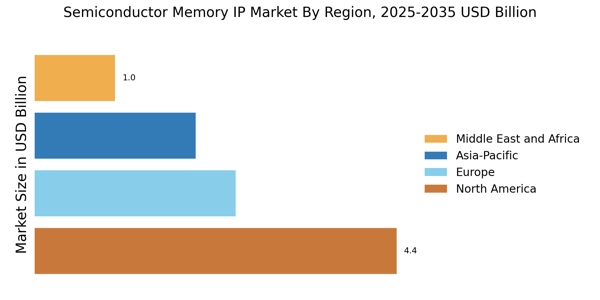
North America leads the Semiconductor Memory IP Market, holding approximately 45% of the global share, driven by robust demand from tech giants and a strong focus on R&D. The region benefits from favorable regulations and government initiatives aimed at fostering innovation in semiconductor technologies. The increasing adoption of AI and IoT applications further propels market growth, making it a key player in the global landscape. The United States is the largest market, followed by Canada, with major companies like Synopsys, Cadence Design Systems, and Rambus headquartered here. The competitive landscape is characterized by continuous innovation and strategic partnerships among key players. The presence of leading universities and research institutions also contributes to a vibrant ecosystem, ensuring a steady pipeline of talent and technological advancements.

Europe : Emerging Technology Powerhouse

Europe is witnessing significant growth in the Semiconductor Memory IP Market, accounting for around 25% of the global share. The region's growth is fueled by increasing investments in semiconductor manufacturing and a strong push towards digital transformation across various industries. Regulatory support from the European Union, including initiatives to enhance semiconductor production, plays a crucial role in this growth trajectory. Leading countries in this region include Germany, France, and the Netherlands, with key players like STMicroelectronics and NXP Semiconductors making substantial contributions. The competitive landscape is evolving, with a focus on collaboration between industry and academia to drive innovation. The presence of various tech hubs across Europe fosters a conducive environment for the development of advanced semiconductor technologies.

Asia-Pacific : Rapid Growth and Adoption

Asia-Pacific is rapidly emerging as a significant player in the Semiconductor Memory IP Market, holding approximately 20% of the global share. The region's growth is driven by the increasing demand for consumer electronics and the expansion of data centers. Countries like China and South Korea are at the forefront, supported by government initiatives aimed at boosting semiconductor production and innovation in technology. China is the largest market in this region, followed by South Korea and Japan. The competitive landscape is marked by the presence of both established players and new entrants, fostering a dynamic environment for innovation. Companies like Arm Holdings and Imagination Technologies are key contributors, leveraging the region's manufacturing capabilities to enhance their market presence and drive technological advancements.

Middle East and Africa : Emerging Market Potential

The Middle East and Africa region is gradually emerging in the Semiconductor Memory IP Market, currently holding about 10% of the global share. The growth is primarily driven by increasing investments in technology infrastructure and a rising demand for digital solutions across various sectors. Governments in the region are actively promoting initiatives to enhance local semiconductor capabilities, which is expected to catalyze market growth in the coming years. Leading countries include South Africa and the United Arab Emirates, where there is a growing interest in developing local semiconductor industries. The competitive landscape is still developing, with opportunities for both local and international players to establish a foothold. As the region continues to invest in technology and innovation, it is poised for significant growth in the Semiconductor Memory IP Market.

Semiconductor Memory IP Market Regional Image

Key Players and Competitive Insights

The Semiconductor Memory IP Market is an expansive and rapidly evolving sector that serves as a critical foundation for various electronic applications and innovations. With the increasing demand for memory solutions across diverse industries such as consumer electronics, automotive, telecommunications, and computing, the competitive landscape has become increasingly dynamic. Numerous players are striving to secure market share by enhancing their technology offerings, developing advanced intellectual property, and establishing strategic partnerships. Competition intensifies with an ongoing push toward miniaturization, higher performance metrics, and the integration of emerging technologies such as artificial intelligence and machine learning into memory systems.
Companies focus on research and development to cater to the demand for innovative memory solutions that can facilitate improved data storage and processing capabilities. The ability to provide proprietary memory IP that is both efficient and reliable has become a key differentiator among market participants, driving the need to adapt quickly to changing consumer demands and technological advancements.STMicroelectronics holds a prominent position within the Semiconductor Memory IP Market, leveraging its significant technical expertise and extensive portfolio of products.
The company's strengths lie in its deep-rooted experience in semiconductor technology, which allows it to develop a wide range of memory IP solutions that cater to both consumer and industrial applications. STMicroelectronics has established its reputation through consistent innovation, high-quality design, and a commitment to meeting the needs of diverse markets. Its dedication to research and development ensures that the company remains ahead of technological trends, allowing for the timely introduction of cutting-edge memory IP solutions.
Furthermore, STMicroelectronics benefits from a well-integrated supply chain and strong customer relationships, providing it with a competitive edge that enhances its market presence and reputation within the memory IP domain.Analog Devices excels in delivering high-performance memory IP solutions, contributing significantly to the Semiconductor Memory IP Market. With a focus on precision and reliability, Analog Devices has developed a range of products that are highly regarded for their superior performance in challenging applications.
The company’s strengths are evident in its extensive technological know-how, which allows it to create innovative memory solutions that address the specific needs of various industries, including automotive, healthcare, and communications. With a commitment to advancing technology, Analog Devices invests heavily in research and development, which facilitates the ongoing enhancement of its memory IP offerings. This comprehensive approach not only solidifies Analog Devices' position within the market but also ensures it remains competitive amidst the rapidly shifting landscape of semiconductor technology. The company’s emphasis on customer collaboration further enhances its capability to meet evolving market demands effectively.

Key Companies in the Semiconductor Memory IP Market include

Industry Developments

Recent developments in the Semiconductor Memory IP Market have highlighted significant activity among key players, including STMicroelectronics, Analog Devices, and Micron Technology, focusing on innovations in-memory solutions to meet rising data demands. Current affairs indicate a surge in market valuation, with companies like Samsung Electronics and SK Hynix capitalizing on advancements in-memory technologies. There has been notable merger and acquisition activity, particularly with companies such as Qualcomm and NXP Semiconductors seeking to enhance their IP portfolios through strategic collaborations. Intel and Broadcom are also pursuing partnerships to solidify their positions.

Growth patterns indicate a shift toward high-performance memory applications, fostering competitive advancements among Infineon Technologies and Marvell Technology. These dynamics are influencing the pricing and availability of semiconductor memory IP products, reflecting increased demand in sectors such as automotive and consumer electronics. As companies adapt to technological shifts, investments in research and development are ramping up, further positioning the market for continuous growth. The strategic moves by these leading firms underscore their commitment to maintaining competitive advantages and responding to emerging market needs.

Future Outlook

Semiconductor Memory IP Market Future Outlook

The Semiconductor Memory IP Market is projected to grow at a 5.8% CAGR from 2025 to 2035, driven by advancements in AI, IoT, and data storage technologies.

New opportunities lie in:

  • Development of specialized memory IP for AI applications
  • Expansion into emerging markets with tailored solutions
  • Partnerships with cloud service providers for integrated memory solutions

By 2035, the market is expected to be robust, driven by innovation and strategic partnerships.

Market Segmentation

Semiconductor Memory IP Market Type Outlook

  • Dynamic Random Access Memory
  • Static Random Access Memory
  • Read-Only Memory
  • Flash Memory

Semiconductor Memory IP Market End Use Outlook

  • Personal Use
  • Commercial Use
  • Military Use

Semiconductor Memory IP Market Technology Outlook

  • DRAM
  • SRAM
  • NAND
  • NOR

Semiconductor Memory IP Market Application Outlook

  • Consumer Electronics
  • Automotive
  • Telecommunications
  • Industrial

Report Scope

MARKET SIZE 2024 9.681(USD Billion)
MARKET SIZE 2025 10.24(USD Billion)
MARKET SIZE 2035 18.0(USD Billion)
COMPOUND ANNUAL GROWTH RATE (CAGR) 5.8% (2025 - 2035)
REPORT COVERAGE Revenue Forecast, Competitive Landscape, Growth Factors, and Trends
BASE YEAR 2024
Market Forecast Period 2025 - 2035
Historical Data 2019 - 2024
Market Forecast Units USD Billion
Key Companies Profiled Synopsys (US), Cadence Design Systems (US), Arm Holdings (GB), Mentor Graphics (US), Imagination Technologies (GB), Rambus (US), Silicon Labs (US), STMicroelectronics (FR), NXP Semiconductors (NL)
Segments Covered Type, Technology, Application, End Use, Regional
Key Market Opportunities Integration of advanced memory technologies in artificial intelligence applications drives growth in the Semiconductor Memory IP Market.
Key Market Dynamics Rising demand for advanced memory solutions drives innovation and competition in the Semiconductor Memory Intellectual Property Market.
Countries Covered North America, Europe, APAC, South America, MEA

Market Highlights

Author
Ankit Gupta
Senior Research Analyst

Ankit Gupta is an analyst in market research industry in ICT and SEMI industry. With post-graduation in "Telecom and Marketing Management" and graduation in "Electronics and Telecommunication" vertical he is well versed with recent development in ICT industry as a whole. Having worked on more than 150+ reports including consultation for fortune 500 companies such as Microsoft and Rio Tinto in identifying solutions with respect to business problems his opinions are inclined towards mixture of technical and managerial aspects.

Leave a Comment

FAQs

What is the projected market valuation of the Semiconductor Memory IP Market by 2035?

The projected market valuation for the Semiconductor Memory IP Market by 2035 is 18.0 USD Billion.

What was the overall market valuation of the Semiconductor Memory IP Market in 2024?

The overall market valuation of the Semiconductor Memory IP Market in 2024 was 9.681 USD Billion.

What is the expected CAGR for the Semiconductor Memory IP Market during the forecast period 2025 - 2035?

The expected CAGR for the Semiconductor Memory IP Market during the forecast period 2025 - 2035 is 5.8%.

Which companies are considered key players in the Semiconductor Memory IP Market?

Key players in the Semiconductor Memory IP Market include Synopsys, Cadence Design Systems, Arm Holdings, and others.

What are the projected valuations for Dynamic Random Access Memory (DRAM) by 2035?

The projected valuation for Dynamic Random Access Memory (DRAM) by 2035 is 6.5 USD Billion.

How does the valuation of Flash Memory change from 2024 to 2035?

The valuation of Flash Memory is expected to increase from 2.681 USD Billion in 2024 to 5.0 USD Billion by 2035.

What is the expected market size for Consumer Electronics applications in 2035?

The expected market size for Consumer Electronics applications in 2035 is 6.5 USD Billion.

What are the projected valuations for Static Random Access Memory (SRAM) by 2035?

The projected valuation for Static Random Access Memory (SRAM) by 2035 is 4.0 USD Billion.

What is the anticipated growth in the Automotive segment of the Semiconductor Memory IP Market by 2035?

The anticipated growth in the Automotive segment of the Semiconductor Memory IP Market is expected to reach 3.0 USD Billion by 2035.

How does the market for Military Use in the Semiconductor Memory IP Market evolve by 2035?

The market for Military Use in the Semiconductor Memory IP Market is projected to grow from 3.181 USD Billion in 2024 to 5.5 USD Billion by 2035.

Download Free Sample

Kindly complete the form below to receive a free sample of this Report

Compare Licence

×
Features License Type
Single User Multiuser License Enterprise User
Price $4,950 $5,950 $7,250
Maximum User Access Limit 1 User Upto 10 Users Unrestricted Access Throughout the Organization
Free Customization
Direct Access to Analyst
Deliverable Format
Platform Access
Discount on Next Purchase 10% 15% 15%
Printable Versions