×
Request Free Sample ×

Kindly complete the form below to receive a free sample of this Report

* Please use a valid business email

Leading companies partner with us for data-driven Insights

clients tt-cursor
Hero Background

Green Hydrogen Market

ID: MRFR/EnP/8605-CR
188 Pages
Chitranshi Jaiswal
February 2021

Green Hydrogen Market Size, Share & Growth Analysis Report By Application (Power Generation, Hydrogen Fuel Cell Vehicles, Industrial Processes, Transportation, Aerospace), By Technology (Electrolysis, Thermochemical Water Splitting, Biomass Gasification, Photoelectrochemical Water Splitting), By End Use (Transportation, Chemical Production, Energy Storage, Heating, Refineries), By Production Method (Proton Exchange Membrane Electrolysis, Alkaline Electrolysis, Solid Oxide Electrolysis) and By Regional - Outlook & Industry Forecast to 2035

Share:
Download PDF ×

We do not share your information with anyone. However, we may send you emails based on your report interest from time to time. You may contact us at any time to opt-out.

Green Hydrogen Market Infographic
Purchase Options

Green Hydrogen Market Summary

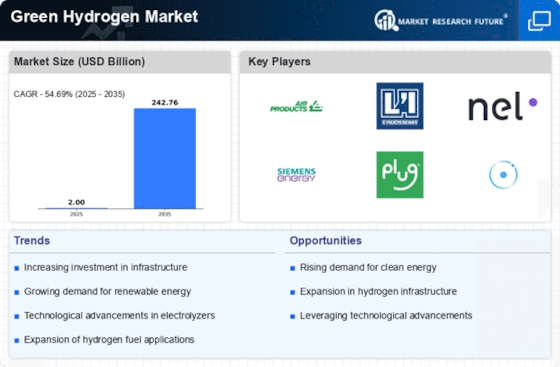
As per MRFR analysis, the Green Hydrogen Market Size was estimated at 2000.0 USD Million in 2024. The Green Hydrogen industry is projected to grow from 3093.84 in 2025 to 242760.01 by 2035, exhibiting a compound annual growth rate (CAGR) of 54.69 during the forecast period 2025 - 2035.

Key Market Trends & Highlights

The Green Hydrogen Market is poised for substantial growth driven by technological advancements and supportive policies.

  • Technological innovations in production processes are enhancing the efficiency of green hydrogen generation.
  • North America remains the largest market, while Asia-Pacific is emerging as the fastest-growing region for green hydrogen applications.
  • The industrial sector, particularly in manufacturing and transportation, is increasingly adopting green hydrogen solutions.
  • Rising demand for clean energy solutions and government incentives are key drivers propelling market expansion.

Market Size & Forecast

2024 Market Size 2000.0 (USD Million)
2035 Market Size 242760.01 (USD Million)
CAGR (2025 - 2035) 54.69%

Major Players

Air Products (US), Linde (DE), Nel ASA (NO), Siemens Energy (DE), Plug Power (US), ITM Power (GB), Hydrogenics (CA), Ballard Power Systems (CA), McPhy Energy (FR)

Our Impact
Enabled $4.3B Revenue Impact for Fortune 500 and Leading Multinationals
Partnering with 2000+ Global Organizations Each Year
30K+ Citations by Top-Tier Firms in the Industry

Green Hydrogen Market Trends

The Green Hydrogen Market is currently experiencing a transformative phase, driven by a confluence of technological advancements and increasing environmental awareness. As nations strive to meet ambitious climate goals, the demand for clean energy solutions has surged. Green hydrogen, produced through renewable energy sources, emerges as a viable alternative to fossil fuels, offering a pathway to decarbonize various sectors, including transportation, industry, and power generation. This market's growth is further bolstered by supportive government policies and investments aimed at fostering innovation and infrastructure development. In February 2026, the landscape of the Green Hydrogen Market appears to be evolving rapidly, with numerous stakeholders, including private enterprises and public institutions, actively engaging in research and development initiatives. The potential for green hydrogen to serve as a key component in energy storage and grid stability is becoming increasingly recognized. Moreover, collaborations between different sectors, such as automotive and energy, suggest a holistic approach to integrating green hydrogen into existing systems, thereby enhancing its overall viability and acceptance.

Technological Innovations in Production

Recent advancements in electrolysis and other production methods are enhancing the efficiency and cost-effectiveness of green hydrogen generation. These innovations may lead to broader adoption across various industries, potentially transforming energy landscapes.

Policy Support and Regulatory Frameworks

Governments worldwide are implementing supportive policies and regulatory measures to promote the development of the Green Hydrogen Market. This trend indicates a commitment to sustainable energy solutions and may encourage private sector investments.

Integration with Renewable Energy Sources

The synergy between green hydrogen and renewable energy sources, such as wind and solar, is becoming increasingly apparent. This integration could facilitate energy storage solutions and enhance grid reliability, thereby reinforcing the market's growth.

Green Hydrogen Market Drivers

Government Incentives and Support

Government incentives and support mechanisms are increasingly shaping the landscape of the Green Hydrogen Market. Various countries have introduced policies aimed at promoting the adoption of green hydrogen technologies, including subsidies, tax breaks, and research funding. For example, several nations have committed to investing billions in hydrogen infrastructure as part of their energy transition strategies. This financial backing is expected to accelerate the deployment of green hydrogen projects, thereby fostering market growth. The Green Hydrogen Market stands to gain from these initiatives, as they not only lower the barriers to entry for new players but also stimulate innovation and collaboration across sectors.

Advancements in Electrolysis Technology

Technological advancements in electrolysis, the primary method for producing green hydrogen, are likely to play a crucial role in the Green Hydrogen Market. Innovations in electrolyzer efficiency and cost reduction have the potential to make green hydrogen production more economically viable. For instance, the cost of electrolyzers has decreased significantly, with projections suggesting a further reduction of up to 50% by 2030. This trend may enhance the competitiveness of green hydrogen against conventional hydrogen production methods. As a result, the Green Hydrogen Market could witness increased investment and development, leading to a more robust infrastructure for hydrogen production and distribution.

Growing Interest from Industrial Sectors

The industrial sector's growing interest in green hydrogen as a feedstock for various applications is likely to drive the Green Hydrogen Market forward. Industries such as steel, cement, and chemicals are exploring hydrogen as a means to decarbonize their operations. For instance, the steel industry, which accounts for approximately 7% of global CO2 emissions, is increasingly looking at hydrogen-based direct reduction methods. This shift could lead to a substantial increase in demand for green hydrogen, with projections indicating that the industrial sector could account for over 30% of total hydrogen consumption by 2030. The Green Hydrogen Market is thus poised to benefit from this trend, as companies seek sustainable alternatives to traditional fossil fuel-based processes.

Rising Demand for Clean Energy Solutions

The increasing The Green Hydrogen Industry. As nations strive to meet their climate goals, the demand for hydrogen as a clean fuel source is likely to surge. According to recent estimates, the hydrogen market could reach a valuation of over 200 billion USD by 2030, with green hydrogen accounting for a substantial share. This shift is driven by the need to decarbonize various sectors, including transportation and industrial processes, which traditionally rely on fossil fuels. The Green Hydrogen Market is thus positioned to benefit from this growing demand, as stakeholders seek to invest in technologies that facilitate the production and utilization of hydrogen in a sustainable manner.

Integration with Energy Storage Solutions

The integration of green hydrogen with energy storage solutions is emerging as a pivotal driver for the Green Hydrogen Market. As renewable energy sources like wind and solar become more prevalent, the need for effective energy storage solutions is becoming increasingly critical. Green hydrogen can serve as a versatile energy carrier, enabling the storage of excess renewable energy for later use. This capability may enhance grid stability and facilitate the transition to a more resilient energy system. The Green Hydrogen Market could see significant growth as energy storage technologies evolve, allowing for greater adoption of hydrogen in various applications, including transportation and power generation.


Market Segment Insights

By Application: Transportation (Largest) vs. Industrial Processes (Fastest-Growing)

In the Green Hydrogen Market, the application segment shows a diverse distribution of focus areas. The transportation sector holds the largest share as industries seek cleaner alternatives for fueling vehicles, which is crucial for reducing greenhouse gas emissions. Industrial processes are gaining momentum, driven by their potential to decarbonize sectors like steel and fertilizers, thus showing significant promise in market share.

Transportation (Dominant) vs. Industrial Processes (Emerging)

Transportation serves as the dominant application in the Green Hydrogen Market due to its ability to replace fossil fuels in various modes of transport, including buses, trucks, and trains. Its market position is strongly supported by governmental policies and incentives promoting clean mobility solutions. Conversely, industrial processes are emerging as a significant application, with companies investing heavily in hydrogen technology to lower their carbon footprints. Their growth is spurred by increasing regulations on emissions and a shift towards more sustainable production methods.

By End Use: Fuel Cells (Largest) vs. Ammonia Production (Fastest-Growing)

In the Green Hydrogen Market, the end-use segment is diversifying, with fuel cells maintaining the largest share due to their established applications in transport and stationary power generation. Following closely are ammonia production and refinery uses, both showing significant interest from innovative hydrogen technologies. Metal processing is a smaller yet crucial part of this segment, focusing on reducing carbon emissions in industrial processes. Each of these categories plays a vital role in the overall demand for green hydrogen, highlighting the variety of applications supported by recent technological advancements. Ammonia production is emerging as a fast-growing application segment due to the rising global demand for fertilizers as well as the push toward sustainable farming practices. Similarly, fuel cells are experiencing robust growth driven by electric vehicle adoption and the increasing emphasis on reducing carbon footprints in transportation. Furthermore, the blending of hydrogen in refineries for cleaner fuel production contributes significantly to market expansion. Together, these dynamics illustrate a comprehensive shift towards cleaner technologies and sustainable practices in the Green Hydrogen Market.

Fuel Cells (Dominant) vs. Metal Processing (Emerging)

Fuel cells are established as the dominant technology in the green hydrogen market, primarily utilized in vehicles and backup power systems due to their high efficiency and low emissions. Their market position is reinforced by substantial investments from automotive manufacturers transitioning to hydrogen-based powertrains. In contrast, metal processing is an emerging segment as companies seek to decarbonize their operations. This segment utilizes green hydrogen to reduce metal oxides more sustainably, addressing global calls for reducing the industry’s carbon footprint. Innovations in these sectors reflect significant shifts towards integrating hydrogen solutions across various applications, driving a transformation in energy consumption patterns.

By Production Method: Electrolysis (Largest) vs. Biomass Gasification (Fastest-Growing)

The Green Hydrogen Market is witnessing a significant distribution of shares among its production methods, with electrolysis leading the charge. This method represents a substantial portion of the market due to its reliance on renewable energy sources, showcasing an efficient way to produce hydrogen sustainably. Other methods like steam methane reforming and biomass gasification are also gaining traction, but their market share is comparatively smaller, focusing on more traditional and newer technological approaches respectively. Growth trends in this segment indicate a robust shift towards cleaner technologies. Electrolysis remains the dominant method owing to its alignment with sustainability initiatives, whereas biomass gasification is emerging rapidly due to increasing investments and advancements in technology. The drive towards reducing carbon emissions and governmental incentives are propelling both methods forward, making them pivotal in the transition to a green hydrogen economy.

Electrolysis (Dominant) vs. Biomass Gasification (Emerging)

Electrolysis stands out as the dominant production method for green hydrogen, primarily due to its ability to harness renewable energy sources such as solar and wind. This method offers a sustainable way of producing hydrogen, utilizing water as the primary feedstock and resulting in zero carbon emissions during the process. On the other hand, biomass gasification is an emerging technology gaining attention for its potential to convert organic materials into hydrogen. This method is particularly appealing as it can utilize waste feedstocks, contributing to waste management solutions while generating energy. Both methods are integral to achieving climate goals, but their varying characteristics reflect different market opportunities and technological maturity.

By Distribution Method: Pipeline Transport (Largest) vs. Compressed Hydrogen Transport (Fastest-Growing)

In the Green Hydrogen Market, Pipeline Transport currently holds the largest share of the distribution method segment. This is due to its established infrastructure and efficiency in transporting large volumes of hydrogen across regions. Compressed Hydrogen Transport follows closely, catering to areas lacking infrastructure or where rapid deployment is needed. Liquid Hydrogen Transport, while present, is less common due to its specific requirements and limitations in storage and transport logistics.

Pipeline Transport (Dominant) vs. Compressed Hydrogen Transport (Emerging)

Pipeline transport is the dominant method for distributing green hydrogen, leveraging existing gas infrastructure to optimize efficiency and reduce costs. This method is favored for its ability to transport significant quantities over long distances, making it ideal for large-scale projects. In contrast, compressed hydrogen transport is emerging as a flexible solution, especially in regions with less established infrastructure. It serves niche markets and applications where quick delivery and adaptability are essential. While pipeline systems require significant upfront infrastructure investments, compressed hydrogen transport offers versatility and faster deployment timelines, positioning itself as a complementary method for meeting growing hydrogen demand.

Get more detailed insights about Green Hydrogen Market

Regional Insights

North America : Innovation and Investment Hub

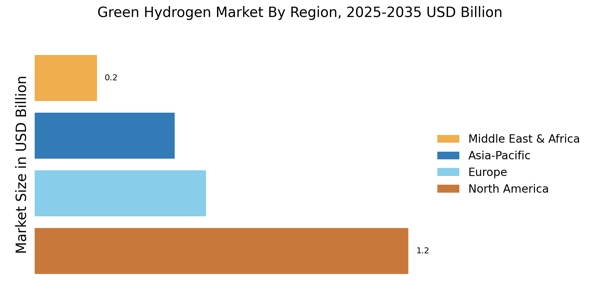
North America is witnessing a surge in demand for green hydrogen, driven by increasing investments in renewable energy and supportive government policies. The market size reached $600.0 million in 2026, reflecting a robust growth trajectory. Regulatory frameworks are evolving to promote hydrogen as a clean energy source, with initiatives aimed at reducing carbon emissions and enhancing energy security. The United States leads the region, with significant contributions from companies like Air Products and Plug Power. Canada is also emerging as a key player, focusing on hydrogen production and infrastructure development. The competitive landscape is characterized by collaborations among industry leaders and research institutions, fostering innovation and technological advancements in green hydrogen production and utilization.

Europe : Leading the Green Transition

Europe is at the forefront of the green hydrogen market, holding the largest share at $900.0 million in 2026. The region's growth is propelled by ambitious climate targets and substantial investments in renewable energy technologies. Regulatory support, including the European Green Deal, aims to facilitate the transition to a hydrogen economy, enhancing energy independence and sustainability across member states. Germany, France, and the Netherlands are leading countries in this sector, with major players like Linde and Siemens Energy driving innovation. The competitive landscape is marked by strategic partnerships and investments in hydrogen infrastructure, positioning Europe as a global leader in green hydrogen production and technology development. The European Commission emphasizes the importance of hydrogen in achieving climate neutrality by 2050.

Asia-Pacific : Emerging Market Potential

The Asia-Pacific region is rapidly emerging as a significant player in the green hydrogen market, with a market size of $400.0 million in 2026. The growth is driven by increasing energy demands, government initiatives promoting clean energy, and investments in hydrogen technologies. Countries are focusing on reducing reliance on fossil fuels, with hydrogen seen as a viable alternative to meet energy needs sustainably. Japan, South Korea, and Australia are leading the charge in green hydrogen development, supported by key players like Nel ASA and ITM Power. The competitive landscape is evolving, with a focus on innovation and collaboration among governments and private sectors to enhance hydrogen production and distribution networks. The region's commitment to sustainability is paving the way for a robust hydrogen economy.

Middle East and Africa : Resource-Rich Hydrogen Frontier

The Middle East and Africa region is beginning to explore the potential of green hydrogen, with a market size of $100.0 million in 2026. The growth is driven by abundant renewable resources, particularly solar and wind energy, which can be harnessed for hydrogen production. Governments are increasingly recognizing hydrogen's role in diversifying energy sources and reducing carbon footprints, leading to supportive policies and initiatives. Countries like Saudi Arabia and South Africa are taking the lead in developing hydrogen projects, with investments aimed at establishing a hydrogen economy. The competitive landscape is characterized by emerging partnerships between local and international firms, focusing on technology transfer and capacity building to enhance hydrogen production capabilities. The region's strategic location also positions it as a potential hub for hydrogen exports.

Green Hydrogen Market Regional Image

Key Players and Competitive Insights

The Green Hydrogen Market is currently characterized by a dynamic competitive landscape, driven by increasing global demand for sustainable energy solutions and stringent regulatory frameworks aimed at reducing carbon emissions. Key players such as Air Products (US), Linde (DE), and Siemens Energy (DE) are strategically positioning themselves through innovation and partnerships, which collectively shape the competitive environment. Air Products (US) has focused on expanding its production capabilities, while Linde (DE) emphasizes technological advancements in hydrogen production and distribution. Siemens Energy (DE) is leveraging its expertise in renewable energy to enhance its hydrogen solutions, indicating a trend towards integrated energy systems.

In terms of business tactics, companies are increasingly localizing manufacturing and optimizing supply chains to enhance efficiency and reduce costs. The market appears moderately fragmented, with a mix of established players and emerging startups. The collective influence of these key players is significant, as they drive technological advancements and set industry standards, thereby shaping the overall market structure.

In January 2026, Air Products (US) announced a strategic partnership with a leading renewable energy firm to develop a large-scale green hydrogen production facility in the Gulf Coast region. This move is likely to enhance their production capacity and position them as a leader in the North American market. The partnership underscores the importance of collaboration in scaling up hydrogen production and meeting growing demand.

In December 2025, Linde (DE) unveiled a new hydrogen refueling station in Germany, which is part of its broader strategy to expand its hydrogen infrastructure across Europe. This initiative not only supports the growing hydrogen vehicle market but also reinforces Linde's commitment to sustainable transportation solutions. The establishment of such infrastructure is crucial for the adoption of hydrogen as a viable alternative fuel.

In November 2025, Siemens Energy (DE) launched a pilot project aimed at integrating artificial intelligence (AI) into its hydrogen production processes. This initiative is expected to optimize operational efficiency and reduce costs, reflecting a broader trend towards digitalization in the energy sector. The integration of AI could potentially revolutionize how hydrogen is produced and managed, enhancing competitiveness in the market.

As of February 2026, current trends in the Green Hydrogen Market indicate a strong focus on digitalization, sustainability, and technological integration. Strategic alliances are increasingly shaping the competitive landscape, as companies recognize the need for collaboration to drive innovation. Moving forward, competitive differentiation is likely to evolve from traditional price-based competition to a focus on innovation, technology, and supply chain reliability, as firms seek to establish themselves as leaders in this rapidly growing market.

Key Companies in the Green Hydrogen Market include

Industry Developments

  • Q2 2024: Siemens Energy and Air Liquide inaugurate Europe’s largest electrolyzer factory in Germany Siemens Energy and Air Liquide opened a new gigawatt-scale electrolyzer manufacturing facility in Berlin, aiming to ramp up green hydrogen production capacity for European industrial decarbonization.
  • Q2 2024: Plug Power secures $1.6 billion loan for U.S. green hydrogen plant expansion Plug Power announced it has received a $1.6 billion loan from the U.S. Department of Energy to expand its green hydrogen production facilities, supporting the company’s goal to become a leading supplier in North America.
  • Q2 2024: BP and Iberdrola sign $1 billion green hydrogen partnership in Spain BP and Iberdrola entered a strategic partnership to invest $1 billion in developing large-scale green hydrogen projects in Spain, targeting decarbonization of heavy industry and transport sectors.
  • Q3 2024: NextEra Energy launches 500 MW green hydrogen facility in Texas NextEra Energy announced the commissioning of a 500 MW green hydrogen production plant in Texas, one of the largest in the U.S., to supply clean fuel for industrial and transportation customers.
  • Q3 2024: Shell wins contract to supply green hydrogen to Rotterdam port Shell secured a multi-year contract to supply green hydrogen to the Port of Rotterdam, supporting the port’s transition to renewable energy and reducing emissions from shipping and logistics operations.
  • Q3 2024: Siemens Energy appoints Dr. Anne-Laure de Chammard as Head of Green Hydrogen Market Division Siemens Energy announced the appointment of Dr. Anne-Laure de Chammard as the new Head of its Green Hydrogen Market Division, strengthening its leadership team to accelerate growth in the sector.
  • Q4 2024: TotalEnergies acquires H2V Normandy green hydrogen project TotalEnergies completed the acquisition of the H2V Normandy green hydrogen project, expanding its portfolio of renewable energy assets and advancing its net-zero strategy.
  • Q4 2024: Linde and BASF announce joint venture for green hydrogen plant in Germany Linde and BASF formed a joint venture to build and operate a large-scale green hydrogen production facility in Germany, aiming to supply clean hydrogen to chemical and industrial customers.
  • Q1 2025: Hyundai Motor launches commercial green hydrogen refueling stations in South Korea Hyundai Motor opened its first commercial green hydrogen refueling stations in Seoul and Busan, supporting the rollout of hydrogen-powered vehicles and infrastructure in South Korea.
  • Q1 2025: Air Products secures $2 billion contract for green hydrogen supply to Saudi Arabia’s NEOM project Air Products announced a $2 billion contract to supply green hydrogen to the NEOM city project in Saudi Arabia, marking one of the largest green hydrogen deals globally.
  • Q2 2025: Enel Green Power and Eni sign partnership for green hydrogen production in Italy Enel Green Power and Eni entered a partnership to develop green hydrogen production facilities in Italy, targeting decarbonization of refining and chemical operations.
  • Q2 2025: Fortescue Metals Group opens Australia’s largest green hydrogen plant in Western Australia Fortescue Metals Group inaugurated a large-scale green hydrogen production facility in Western Australia, aiming to supply clean fuel for mining operations and export markets.

Future Outlook

Green Hydrogen Market Future Outlook

The Green Hydrogen Market is projected to grow at a 54.69% CAGR from 2024 to 2035, driven by technological advancements, regulatory support, and increasing demand for clean energy solutions.

New opportunities lie in:

  • Development of hydrogen refueling infrastructure for transportation fleets.
  • Investment in electrolysis technology to enhance production efficiency.
  • Partnerships with industrial sectors for hydrogen integration in manufacturing processes.

By 2035, the Green Hydrogen Market is expected to be a pivotal component of the global energy landscape.

Market Segmentation

Green Hydrogen Market End Use Outlook

  • Fuel Cells
  • Refineries
  • Ammonia Production
  • Metal Processing

Green Hydrogen Market Application Outlook

  • Transportation
  • Industrial Processes
  • Power Generation
  • Energy Storage

Green Hydrogen Market Production Method Outlook

  • Electrolysis
  • Steam Methane Reforming
  • Biomass Gasification
  • Thermochemical Water Splitting

Green Hydrogen Market Distribution Method Outlook

  • Pipeline Transport
  • Compressed Hydrogen Transport
  • Liquid Hydrogen Transport

Report Scope

MARKET SIZE 20242000.0(USD Million)
MARKET SIZE 20253093.84(USD Million)
MARKET SIZE 2035242760.01(USD Million)
COMPOUND ANNUAL GROWTH RATE (CAGR)54.69% (2024 - 2035)
REPORT COVERAGERevenue Forecast, Competitive Landscape, Growth Factors, and Trends
BASE YEAR2024
Market Forecast Period2025 - 2035
Historical Data2019 - 2024
Market Forecast UnitsUSD Million
Key Companies ProfiledAir Products (US), Linde (DE), Nel ASA (NO), Siemens Energy (DE), Plug Power (US), ITM Power (GB), Hydrogenics (CA), Ballard Power Systems (CA), McPhy Energy (FR)
Segments CoveredApplication, End Use, Production Method, Distribution Method
Key Market OpportunitiesExpansion of renewable energy sources enhances production potential in the Green Hydrogen Market.
Key Market DynamicsRising investments in renewable energy technologies drive the expansion of the green hydrogen market amid regulatory support.
Countries CoveredNorth America, Europe, APAC, South America, MEA

Market Highlights

Author
Chitranshi Jaiswal
Research Analyst Level I

In her 3 years of experience in the market research field, she has handled critical cross-domain projects. She has an in-depth knowledge of market estimation & analysis, problem-solving, primary as well as secondary research, and team management.She holds an engineering degree and is an MBA professional from a well-known university, capable of evaluating the market and competitive conditions. An exceptional strategist with excellent communication skills and a passion for delivering cutting-edge & practical insights for the market. Proficient in multi-tasking, and can successfully deal with competing demands, while maintaining complete confidentiality. Generated business through active client and project development, networking, and high-quality responses. Her knowledge and skills have helped in making solid business decisions, securing funding from investors, and avoiding business failures.

Leave a Comment

FAQs

What is the current valuation of the US-UAE green hydrogen market?

As of 2024, the US-UAE green hydrogen market was valued at 210.0 USD Million.

What is the projected market size for the US-UAE green hydrogen market by 2035?

The market is projected to reach approximately 16,475.55 USD Million by 2035.

What is the expected CAGR for the US-UAE green hydrogen market during the forecast period?

The expected CAGR for the US-UAE green hydrogen market from 2025 to 2035 is 48.68%.

Which companies are considered key players in the US-UAE green hydrogen market?

Key players include Air Products, Plug Power, NextEra Energy, Siemens Energy, and Abu Dhabi National Oil Company.

What are the main applications of green hydrogen in the US-UAE market?

Main applications include transportation, power generation, industrial processes, and energy storage.

How does the valuation of the transportation segment compare to other applications?

The transportation segment was valued at 2,500.0 USD Million, which is lower than power generation and industrial processes.

What production methods are utilized in the US-UAE green hydrogen market?

Production methods include electrolysis, thermochemical water splitting, biomass gasification, and photoelectrochemical water splitting.

What are the primary distribution methods for green hydrogen in this market?

Primary distribution methods include pipeline transport, compressed hydrogen transport, and liquid hydrogen transport.

What storage methods are employed for green hydrogen in the US-UAE market?

Storage methods include compressed hydrogen storage, liquid hydrogen storage, and metal hydride storage.

How does the US-UAE green hydrogen market's growth potential compare to other energy sectors?

The rapid growth potential, indicated by a projected valuation increase to 16,475.55 USD Million by 2035, suggests a robust future for the green hydrogen sector.

Download Free Sample

Kindly complete the form below to receive a free sample of this Report

Compare Licence

×
Features License Type
Single User Multiuser License Enterprise User
Price $4,950 $5,950 $7,250
Maximum User Access Limit 1 User Upto 10 Users Unrestricted Access Throughout the Organization
Free Customization
Direct Access to Analyst
Deliverable Format
Platform Access
Discount on Next Purchase 10% 15% 15%
Printable Versions