×
Request Free Sample ×

Kindly complete the form below to receive a free sample of this Report

* Please use a valid business email

Leading companies partner with us for data-driven Insights

clients tt-cursor
Hero Background

Russia Ferro Alloys Market

ID: MRFR/CnM/42445-HCR
111 Pages
Chitranshi Jaiswal
February 2026

Russia Ferro Alloys Market Research Report: By Application (Steel, Construction, Electronics, Automotive Transportation, Others), By Product Type (Ferro-Manganese, Silico-Manganese, Ferro-Silicon, Ferro-Chrome, Ferro-Molybdenum, Ferro-Vanadium, Ferro-Tungsten, Magnesium Ferro-Silicon, Ferro-Silicon-Zirconium, Ferro-Titanium, Ferro-Boron, Ferro-Niobium) and By End User Industry (Steel, Construction, Electronics, Automotive Transportation, Others) - Forecast to 2035

Share:
Download PDF ×

We do not share your information with anyone. However, we may send you emails based on your report interest from time to time. You may contact us at any time to opt-out.

Russia Ferro Alloys Market Infographic
Purchase Options

Russia Ferro Alloys Market Summary

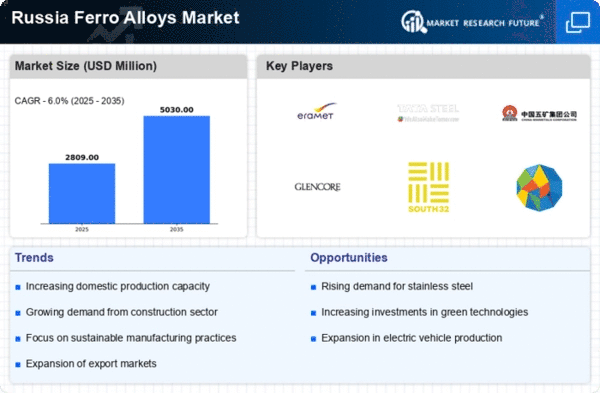
As per Market Research Future analysis, the Ferro Alloys market Size was estimated at 2650.0 USD Million in 2024. The ferro alloys market is projected to grow from 2809.0 USD Million in 2025 to 5030.0 USD Million by 2035, exhibiting a compound annual growth rate (CAGR) of 6% during the forecast period 2025 - 2035

Key Market Trends & Highlights

The Russia ferro alloys market is experiencing a shift towards sustainable practices and technological advancements.

  • Sustainable production practices are increasingly prioritized in the Russia ferro alloys market.
  • Technological advancements are driving efficiency and reducing costs in ferro alloys production.
  • The steel industry remains the largest segment, while the demand for specialty alloys is the fastest-growing segment.
  • Rising demand from the steel industry and government initiatives are key drivers of market growth.

Market Size & Forecast

2024 Market Size 2650.0 (USD Million)
2035 Market Size 5030.0 (USD Million)
CAGR (2025 - 2035) 6.0%

Major Players

Eramet (FR), Tata Steel (IN), China Minmetals Corporation (CN), Glencore (CH), South32 (AU), Ferroglobe (ES), Nippon Denko (JP), Mitsubishi Corporation (JP), Manganese Metal Company (ZA)

Our Impact
Enabled $4.3B Revenue Impact for Fortune 500 and Leading Multinationals
Partnering with 2000+ Global Organizations Each Year
30K+ Citations by Top-Tier Firms in the Industry

Russia Ferro Alloys Market Trends

The ferro alloys market is currently experiencing a dynamic phase characterized by evolving demand and supply dynamics. The market is influenced by various factors, including the growth of the steel industry, which relies heavily on ferro alloys for production. Additionally, the increasing focus on sustainable practices and the transition towards greener technologies are shaping the landscape. As industries seek to reduce their carbon footprint, the demand for low-carbon ferro alloys is likely to rise, indicating a shift in production methods and sourcing strategies. Furthermore, geopolitical factors and trade policies may also impact the availability and pricing of raw materials, creating a complex environment for stakeholders. In the present context, the ferro alloys market appears to be adapting to these changes, with manufacturers exploring innovative solutions to meet the evolving needs of their clients. The emphasis on quality and performance is becoming more pronounced, as end-users demand higher-grade products. This trend suggests that companies may need to invest in research and development to enhance their offerings. Overall, the market is poised for transformation, driven by technological advancements and changing consumer preferences, which could redefine competitive dynamics in the coming years.

Sustainable Production Practices

The ferro alloys market is witnessing a notable shift towards sustainable production methods. Manufacturers are increasingly adopting technologies that minimize environmental impact, aligning with global trends towards sustainability. This transition is likely driven by regulatory pressures and consumer demand for greener products, suggesting a potential increase in the market share of low-carbon ferro alloys.

Technological Advancements

Innovations in production techniques are reshaping the ferro alloys market. The introduction of advanced smelting technologies and automation is enhancing efficiency and reducing costs. These advancements may enable producers to offer higher-quality products, thereby meeting the stringent requirements of various industries, particularly in steel manufacturing.

Geopolitical Influences

The ferro alloys market is significantly affected by geopolitical factors, including trade policies and international relations. Changes in tariffs and export regulations can impact the availability of raw materials, influencing pricing and supply chains. Stakeholders must remain vigilant to navigate these complexities, as they could affect market stability and growth.

Market Segment Insights

By Production: Blast Furnace (Largest) vs. Electric Arc Furnace (Fastest-Growing)

The production segment in the Russia ferro alloys market exhibits a diversified share distribution, with Blast Furnace technology leading as the largest contributor. This segment benefits from established processes and a strong foundation in the manufacturing ecosystem. Electric Arc Furnace, while smaller in terms of current market share, demonstrates significant potential for growth due to its increasing adoption in environmentally friendly steel production practices. Growth trends for the production segment are influenced by various factors, including technological advancements and regulatory policies aimed at sustainability. The Electric Arc Furnace segment is particularly gaining traction owing to its lower carbon emissions and energy efficiency compared to traditional methods. As industrial players focus on sustainable practices, Electric Arc Furnace is predicted to witness the fastest growth, driven by investments in modernizing production processes.

Production Method: Blast Furnace (Dominant) vs. Electric Arc Furnace (Emerging)

The Blast Furnace method remains dominant in the production segment, capitalizing on its ability to process large volumes of raw materials efficiently. This traditional approach utilizes coke for high temperature and smelting, making it a staple in the ferro alloys production landscape. Conversely, the Electric Arc Furnace represents an emerging alternative, characterized by its ability to recycle scrap and utilize lower-quality feeds. Its flexibility in operation and reduced environmental impact position it as a favorable option among manufacturers increasingly aligning with sustainability goals. As industries transition, the Electric Arc Furnace is poised to capture market share, driven by technological innovations and shifts toward greener production practices.

By Type: Ferro-Manganese (Largest) vs. Ferro-Silicon (Fastest-Growing)

In the Russia ferro alloys market, Ferro-Manganese holds the largest market share among various types, driven by its essential role in steelmaking and the production of alloys. Silico-Manganese follows, offering a balanced combination of manganese and silicon for diverse applications. Other segments, such as Ferro-Silicon and Ferro-Chrome, are also significant but trail behind in terms of overall market share. Growth trends indicate that the demand for Ferro-Silicon is on the rise due to its increasing use in steel and foundry applications. The market is also witnessing a surge in Ferro-Vanadium and Ferro-Molybdenum usage owing to their critical role in enhancing steel strength and performance. This trend is fueled by expanding construction and automotive industries in the region, pushing for higher-quality steel products.

Ferro-Manganese (Dominant) vs. Ferro-Silicon (Emerging)

Ferro-Manganese is a dominant segment in the market, primarily utilized as a deoxidizer and alloying agent in steel production, enhancing the strength and durability of steel products. Its established presence in the market makes it a cornerstone for manufacturers, ensuring a consistent demand driven by the expanding steel industry. On the other hand, Ferro-Silicon, while emerging, is rapidly gaining traction due to its critical application in the production of silicon steel, which is increasingly sought after in electrical applications. This segment benefits from innovation and technological advancements aimed at improving its efficiency and performance, positioning it as a significant player in the future landscape of the Russia ferro alloys market.

By End User Industry: Steel (Largest) vs. Construction (Fastest-Growing)

In the Russia ferro alloys market, the dominant end user industry is the steel sector, which holds the largest share due to its extensive use of ferro alloys as essential raw materials for steel production. This sector benefits from the increasing demand for steel in various applications, including infrastructure and manufacturing. In comparison, the construction industry, while currently trailing behind steel, is experiencing rapid growth, fueled by significant investments in infrastructure development and housing projects in the region. The growth trends in the end user sectors are characterized by a shift towards sustainable and higher-quality solutions, pushing the automotive and electronics sectors to explore innovative ferro alloy applications. The increasing demand for lightweight materials in the automotive industry and advanced alloys in electronics is projected to enhance the market prospects for ferro alloys. As industries strive for improved performance and sustainability, the construction and automotive sectors are anticipated to witness substantial growth in their contribution to the overall market.

Steel (Dominant) vs. Construction (Emerging)

The steel sector stands as the dominant player in the Russia ferro alloys market, primarily because of its essential role in producing high-strength and durable materials vital for various manufacturing processes. This sector utilizes ferro alloys to enhance the mechanical properties of steel, ensuring that it meets the stringent requirements of modern applications. On the other hand, the construction sector is emerging as a significant force, driven by booming infrastructure projects and an increasing focus on sustainable construction practices. As new regulations favor eco-friendly materials, the demand for specialized ferro alloys in constructions, such as those used in reinforced concrete and structural applications, is expected to rise, marking its ascension within the market.

Get more detailed insights about Russia Ferro Alloys Market

Key Players and Competitive Insights

The competitive dynamics of the ferro alloys market in Russia are characterized by a blend of established players and emerging strategies aimed at enhancing operational efficiency and market share. Key growth drivers include the increasing demand for high-quality ferro alloys in steel production and the ongoing technological advancements in production processes. Companies such as Eramet (FR), Tata Steel (IN), and Glencore (CH) are pivotal in shaping the competitive landscape. Eramet (FR) focuses on innovation and sustainability, investing in environmentally friendly production methods, while Tata Steel (IN) emphasizes regional expansion and strategic partnerships to bolster its market presence. Glencore (CH), on the other hand, is leveraging its extensive supply chain network to optimize operations and reduce costs, thereby enhancing its competitive edge.The market structure appears moderately fragmented, with several key players exerting influence over pricing and supply dynamics. Business tactics such as localizing manufacturing and optimizing supply chains are prevalent among these companies. This localized approach not only reduces transportation costs but also enhances responsiveness to market demands. The collective influence of these major players contributes to a competitive environment where agility and innovation are paramount.

In October Eramet (FR) announced a strategic partnership with a leading Russian steel manufacturer to develop low-carbon ferro alloys. This collaboration is significant as it aligns with global sustainability trends and positions Eramet (FR) as a leader in eco-friendly production. The partnership is expected to enhance both companies' capabilities in meeting the growing demand for sustainable materials in the steel industry.

In September Tata Steel (IN) expanded its operations in Russia by acquiring a local ferro alloys producer. This acquisition is likely to strengthen Tata Steel's market position and provide access to new resources, thereby enhancing its production capacity. The move reflects Tata Steel's commitment to increasing its footprint in the region and responding to the rising demand for ferro alloys in various industrial applications.

In August Glencore (CH) launched a new digital platform aimed at optimizing its supply chain management for ferro alloys. This initiative is indicative of the growing trend towards digitalization in the industry, as it seeks to enhance operational efficiency and reduce lead times. By integrating advanced technologies, Glencore (CH) is positioning itself to better respond to market fluctuations and customer needs.

As of November the competitive trends in the ferro alloys market are increasingly defined by digitalization, sustainability, and the integration of artificial intelligence. Strategic alliances are becoming more prevalent, as companies recognize the need to collaborate to enhance innovation and operational efficiency. The shift from price-based competition to a focus on technology, reliability, and sustainable practices is likely to shape the future landscape of the market, where differentiation will hinge on the ability to innovate and adapt to changing consumer preferences.


Key Companies in the Russia Ferro Alloys Market include

Industry Developments

The Russia Ferro Alloys Market has witnessed significant developments recently, with particular attention paid to major players like MMC Norilsk Nickel and Uralskaya Stal. In September 2023, a strategic partnership between VSMPO-AVISMA and MMC Norilsk Nickel was announced, aiming to enhance production capabilities and supply chain efficiencies. Additionally, the Ural Ferroalloy Plant has reported an increase in demand for ferrosilicon, triggering a production expansion plan. The market valuation of companies within the sector has seen a positive trend, with Metalloinvest showcasing substantial growth attributed to rising global steel production demands.

Over the last two years, the Russian ferro alloys industry has experienced fluctuating raw material prices, impacting profit margins and prompting companies like the Pechenganickel and Kola Mining and Metallurgy Company to adjust operational strategies. Notably, in October 2022, the Olenegorsk Mining and Processing Plant announced a significant upgrade to its facilities, enhancing production efficiency and lowering environmental impacts, reflecting ongoing trends toward sustainability within the sector.

Future Outlook

Russia Ferro Alloys Market Future Outlook

The ferro alloys market is projected to grow at a 6.0% CAGR from 2025 to 2035, driven by increasing demand in steel production and technological advancements.

New opportunities lie in:

  • Investment in advanced smelting technologies to enhance production efficiency.
  • Development of eco-friendly ferro alloys to meet regulatory standards.
  • Expansion into emerging markets through strategic partnerships and local sourcing.

By 2035, the ferro alloys market is expected to achieve robust growth and increased competitiveness.

Market Segmentation

Russia Ferro Alloys Market Type Outlook

  • Ferro-Manganese
  • Silico-Manganese
  • Ferro-Silicon
  • Ferro-Chrome
  • Ferro-Molybdenum
  • Ferro-Vanadium
  • Ferro-Tungsten
  • Magnesium Ferro-Silicon
  • Ferro-Silicon-Zirconium
  • Ferro-Titanium
  • Ferro-Boron
  • Ferro-Niobium

Russia Ferro Alloys Market Production Outlook

  • Blast Furnace
  • Electric Arc Furnace

Russia Ferro Alloys Market End User Industry Outlook

  • Steel
  • Construction
  • Electronics
  • Automotive & Transportation
  • Others

Report Scope

MARKET SIZE 2024 2650.0(USD Million)
MARKET SIZE 2025 2809.0(USD Million)
MARKET SIZE 2035 5030.0(USD Million)
COMPOUND ANNUAL GROWTH RATE (CAGR) 6.0% (2025 - 2035)
REPORT COVERAGE Revenue Forecast, Competitive Landscape, Growth Factors, and Trends
BASE YEAR 2024
Market Forecast Period 2025 - 2035
Historical Data 2019 - 2024
Market Forecast Units USD Million
Key Companies Profiled Eramet (FR), Tata Steel (IN), China Minmetals Corporation (CN), Glencore (CH), South32 (AU), Ferroglobe (ES), Nippon Denko (JP), Mitsubishi Corporation (JP), Manganese Metal Company (ZA)
Segments Covered Production, Type, End User Industry
Key Market Opportunities Growing demand for low-carbon ferro alloys driven by environmental regulations and sustainable practices.
Key Market Dynamics Shifts in regulatory frameworks are reshaping the competitive landscape of the ferro alloys market in Russia.
Countries Covered Russia
Leave a Comment

FAQs

What is the expected market size of the Russia Ferro Alloys Market in 2024?

The Russia Ferro Alloys Market is expected to be valued at 3.1 USD Billion in 2024.

What will be the market size of the Russia Ferro Alloys Market in 2035?

By 2035, the overall market size is projected to reach 4.76 USD Billion.

What is the expected CAGR for the Russia Ferro Alloys Market from 2025 to 2035?

The market is anticipated to grow at a CAGR of 3.83 percent from 2025 to 2035.

Which application sector holds the largest share in the Russia Ferro Alloys Market for 2024?

The Steel application sector is expected to dominate with a valuation of 1.3 USD Billion in 2024.

What will be the value of the Ferro Alloys Market for the Construction application segment in 2035?

The Construction application segment is projected to reach a value of 1.01 USD Billion by 2035.

Who are the key players in the Russia Ferro Alloys Market?

Major players include Uralskaya Stal, MMC Norilsk Nickel, and Ural Ferroalloy Plant among others.

What are the projected values for the Electronics application in the Russia Ferro Alloys Market by 2035?

The Electronics application segment is expected to valued at 0.73 USD Billion in 2035.

How much is the Automotive & Transportation application segment projected to be worth in 2024?

In 2024, the Automotive & Transportation application segment is expected to be valued at 0.4 USD Billion.

What are the expected challenges and opportunities in the Russia Ferro Alloys Market?

Emerging trends and growth drivers pose both challenges and opportunities in market dynamics.

What will be the market value for the Others application by 2035?

The Others application segment is anticipated to grow to 0.35 USD Billion by 2035.

Download Free Sample

Kindly complete the form below to receive a free sample of this Report

Compare Licence

×
Features License Type
Single User Multiuser License Enterprise User
Price $4,950 $5,950 $7,250
Maximum User Access Limit 1 User Upto 10 Users Unrestricted Access Throughout the Organization
Free Customization
Direct Access to Analyst
Deliverable Format
Platform Access
Discount on Next Purchase 10% 15% 15%
Printable Versions