×
Request Free Sample ×

Kindly complete the form below to receive a free sample of this Report

* Please use a valid business email

Leading companies partner with us for data-driven Insights

clients tt-cursor
Hero Background

Russia Artificial Turf Market

ID: MRFR/CnM/45755-HCR
200 Pages
Chitranshi Jaiswal
February 2026

Russia Artificial Turf Market Research Report By Material (Polyethylene, Polypropylene, Nylon) and By Application (RESIDENTIAL, Commercial, Sports) - Forecast to 2035

Share:
Download PDF ×

We do not share your information with anyone. However, we may send you emails based on your report interest from time to time. You may contact us at any time to opt-out.

Russia Artificial Turf Market Infographic
Purchase Options

Russia Artificial Turf Market Summary

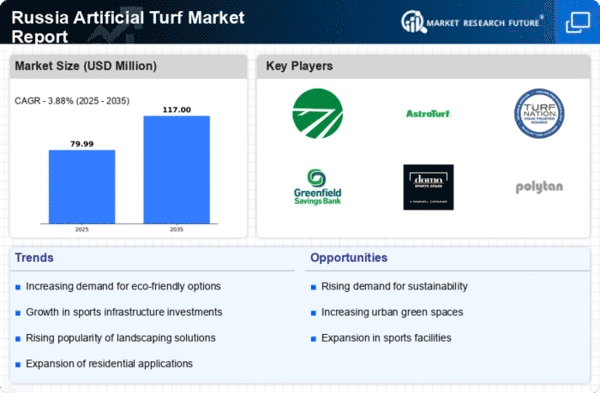
As per Market Research Future analysis, the Russia artificial turf market Size was estimated at 77.0 USD Million in 2024. The Russia artificial turf market is projected to grow from 79.99 USD Million in 2025 to 117.0 USD Million by 2035, exhibiting a compound annual growth rate (CAGR) of 3.8% during the forecast period 2025 - 2035

Key Market Trends & Highlights

The Russia artificial turf market is experiencing a robust growth trajectory driven by sustainability and technological advancements.

  • The market is witnessing a strong emphasis on sustainability, with eco-friendly materials gaining traction.
  • Technological innovations in turf production are enhancing performance and durability, appealing to various sectors.
  • The sports infrastructure segment remains the largest, while the residential segment is emerging as the fastest-growing area.
  • Rising demand for sports facilities and stringent environmental regulations are key drivers propelling market expansion.

Market Size & Forecast

2024 Market Size 77.0 (USD Million)
2035 Market Size 117.0 (USD Million)
CAGR (2025 - 2035) 3.88%

Major Players

FieldTurf (US), AstroTurf (US), Turf Nation (US), GreenFields (NL), Domo Sports Grass (BE), Polytan (DE), A-Turf (US), SportGroup (DE)

Our Impact
Enabled $4.3B Revenue Impact for Fortune 500 and Leading Multinationals
Partnering with 2000+ Global Organizations Each Year
30K+ Citations by Top-Tier Firms in the Industry

Russia Artificial Turf Market Trends

The artificial turf market is experiencing notable growth, driven by various factors including urbanization and the increasing demand for sustainable landscaping solutions. In recent years, there has been a marked shift towards the adoption of synthetic grass in both residential and commercial applications. This trend appears to be influenced by the need for low-maintenance alternatives that offer aesthetic appeal without the environmental costs associated with natural grass. Furthermore, advancements in technology have led to the development of more durable and realistic products, which may enhance consumer acceptance and preference. Additionally, the artificial turf market is likely to benefit from the rising popularity of sports facilities and recreational areas. As cities expand and the population increases, the need for versatile and resilient surfaces for sports and leisure activities becomes more pressing. This demand is further supported by government initiatives aimed at promoting sports and outdoor activities, which could lead to increased investments in infrastructure. Overall, the landscape of the artificial turf market appears to be evolving, with a focus on innovation and sustainability, suggesting a promising future for stakeholders in this sector.

Sustainability Focus

There is a growing emphasis on environmentally friendly products within the artificial turf market. Consumers and businesses are increasingly seeking options that minimize ecological impact, leading to innovations in materials and manufacturing processes. This trend may result in the development of turf products that are recyclable or made from recycled materials, aligning with broader sustainability goals.

Technological Advancements

The artificial turf market is witnessing significant technological improvements that enhance product quality and performance. Innovations in fiber technology and infill materials are contributing to more realistic appearances and better durability. These advancements could potentially attract a wider range of customers, from sports organizations to residential users.

Increased Sports Infrastructure

Investment in sports infrastructure is on the rise, which is likely to drive demand for artificial turf. As cities prioritize the development of sports facilities, the need for high-quality, durable surfaces becomes essential. This trend may lead to partnerships between local governments and turf manufacturers, fostering growth in the market.

Russia Artificial Turf Market Drivers

Urbanization and Land Use Changes

The rapid urbanization in Russia significantly impacts the artificial turf market. As cities expand and land becomes scarcer, the demand for versatile and space-efficient solutions increases. Urban planners and developers are increasingly turning to artificial turf for parks, playgrounds, and recreational areas, as it allows for the creation of green spaces in densely populated environments. The artificial turf market is likely to benefit from this trend, as urban areas seek to enhance their aesthetic appeal while minimizing maintenance costs. Furthermore, the ability of artificial turf to withstand heavy foot traffic makes it an ideal choice for urban settings. As urbanization continues to reshape landscapes, the market is expected to grow, driven by the need for innovative solutions that cater to the demands of modern city living.

Rising Demand for Sports Facilities

The artificial turf market in Russia experiences a notable surge in demand due to the increasing number of sports facilities being constructed. This trend is driven by a growing emphasis on sports and recreational activities among the population. According to recent data, the number of sports complexes has increased by approximately 15% over the past five years. This expansion necessitates the installation of durable and low-maintenance surfaces, which artificial turf provides. The artificial turf market is thus poised to benefit from this rising demand, as municipalities and private investors seek to enhance their sports infrastructure. Furthermore, the appeal of artificial turf in terms of year-round usability and reduced maintenance costs makes it an attractive option for facility managers. As a result, the market is likely to see sustained growth in the coming years, driven by this increasing focus on sports facilities.

Environmental Regulations and Standards

In Russia, the artificial turf market is influenced by stringent environmental regulations aimed at promoting sustainable practices. The government has implemented various standards that encourage the use of eco-friendly materials in construction and landscaping. This regulatory framework is likely to drive the adoption of artificial turf, which is often perceived as a more sustainable alternative to natural grass. The artificial turf market is adapting to these regulations by developing products that meet environmental standards, such as those that are recyclable or made from recycled materials. As awareness of environmental issues continues to grow, consumers and businesses are increasingly inclined to choose artificial turf solutions that align with these regulations. This shift not only supports the market's growth but also enhances the reputation of manufacturers committed to sustainability.

Increased Awareness of Health and Safety

The artificial turf market in Russia is experiencing growth due to heightened awareness of health and safety concerns associated with traditional grass surfaces. Parents, schools, and sports organizations are increasingly recognizing the benefits of artificial turf, which offers a safer playing environment for children and athletes. The artificial turf market is responding to this demand by providing products that are designed to reduce the risk of injuries, such as those caused by uneven surfaces or mud. Additionally, artificial turf eliminates the need for harmful pesticides and fertilizers, further enhancing its appeal. As educational institutions and sports clubs prioritize safety, the market is likely to see an uptick in the adoption of artificial turf solutions, contributing to its overall growth in the region.

Technological Innovations in Turf Production

Technological advancements in the production of artificial turf are playing a crucial role in shaping the market in Russia. Innovations such as improved manufacturing processes and the development of advanced materials are enhancing the quality and performance of artificial turf products. The artificial turf market is witnessing the introduction of turf that mimics the look and feel of natural grass more closely, which appeals to consumers seeking realistic alternatives. Furthermore, advancements in durability and UV resistance are making artificial turf a more viable option for various applications, from sports fields to residential lawns. As manufacturers continue to invest in research and development, the market is expected to expand, driven by the introduction of high-quality, technologically advanced products that meet the evolving needs of consumers.


Market Segment Insights

By Application: Sports (Largest) vs. Landscape (Fastest-Growing)

In the Russia artificial turf market, the application segments showcase diverse uses, with Sports leading the way in market share. It accounts for a significant portion of the total demand, attributed to the growing prevalence of outdoor and indoor sports facilities requiring durable playing surfaces. Landscape applications are notably expanding, driven by a trend toward low-maintenance solutions and aesthetic improvements in both residential and commercial environments. The growth trends indicate a strong upward trajectory, particularly in Landscape applications, which are gaining momentum as urban areas prioritize green spaces and recreational facilities. Factors such as increased investments in sports infrastructure, the demand for environmentally friendly and water-saving solutions, and the rising number of playgrounds and golf courses contribute to this segment's dynamic growth and its potential as a key player in the market.

Sports: Synthetic Turf (Dominant) vs. Playgrounds (Emerging)

Sports applications have solidified their position in the artificial turf sector as the dominant force, facilitating numerous athletic disciplines from soccer to field hockey. The synthetic turf used in these applications is engineered for high durability and performance, ensuring player safety and enhancing game quality. Conversely, Playgrounds represent an emerging segment characterized by a shift towards safer, all-weather surfaces that inhibit injuries. This segment caters to schools and public parks that prioritize child safety and comfort, reflecting the growing emphasis on maintaining active lifestyles for children and families. The innovative materials used in playground turf contribute to its appeal, ensuring it attracts significant attention from stakeholders in the education and recreation sectors.

By Material: Polyethylene (Largest) vs. Nylon (Fastest-Growing)

The material segment of the Russia artificial turf market is predominantly composed of Polyethylene, which commands a significant share due to its versatility and durability. In contrast, Polypropylene and Nylon also contribute to market dynamics, but at a relatively lower scale. The presence of 'Other Synthetic Fibers' adds diversity, although it remains a minor player compared to the established materials. This distribution highlights how Polyethylene's established foothold enables it to remain the preferred choice for many applications. Growth trends indicate that while Polyethylene remains the leader, Nylon is emerging rapidly, driven by increasing demand for high-performance turf solutions that offer improved resilience and aesthetic qualities. Additionally, the rising popularity of innovative synthetic materials is shaping the segment, appealing to both residential and commercial users who prioritize quality and performance. The evolution of manufacturing techniques also plays a crucial role in facilitating this growth, making Nylon a key focus area for future investments.

Polyethylene (Dominant) vs. Nylon (Emerging)

Polyethylene stands as the dominant material in the market due to its well-known benefits such as cost-effectiveness, low maintenance, and capability to withstand harsh weather conditions. Its characteristics make it suitable for various applications, including sports fields and landscaping. In contrast, Nylon, while currently seen as an emerging alternative, is gaining traction due to its superior strength and durability, making it particularly popular for high-end applications like professional sports venues. Both materials, despite their differences, are crucial to the market's development, with Polyethylene appealing to cost-sensitive segments and Nylon serving high-performance needs.

By End-use: Residential (Largest) vs. Commercial (Fastest-Growing)

In the Russia artificial turf market, the distribution of market share among various end-use segments reflects distinct trends. Residential applications dominate, capturing a significant portion of the market due to increased urbanization and a rising preference for low-maintenance landscaping options. Meanwhile, commercial applications follow closely, benefiting from an expanding interest in the aesthetic enhancement of public and private commercial spaces, such as offices and retail environments. Growth trends in the end-use segment of the Russia artificial turf market are influenced by multiple factors. The residential segment is driven by homeowners seeking sustainable and visually appealing solutions for their lawns and gardens, while the commercial segment experiences rapid growth due to the need for versatile, durable, and cost-effective solutions in outdoor areas. Greater awareness of environmental benefits, along with the push for greener spaces, is propelling institutional and municipal uses as well.

Residential: Dominant vs. Commercial: Emerging

The residential segment stands as the dominant player in the Russia artificial turf market, largely attributed to the increasing number of homeowners preferring synthetic grass for its durability and low-maintenance features. Customers value the aesthetic appeal and practicality of artificial turf in private gardens and yards. Conversely, the commercial segment is emerging rapidly, tapping into the trend of enhancing urban landscapes and recreational areas. Various industries, including hospitality and sports, are investing in artificial turf for its versatility, ease of installation, and reduced long-term maintenance costs. This contrast portrays the residential segment's established importance and the commercial segment's potential for significant growth, driven by evolving market demands.

By Installation Type: Outdoor Installation (Largest) vs. DIY Installation (Fastest-Growing)

In the Russia artificial turf market, the installation type segment reveals significant diversity among its components. The Outdoor Installation segment dominates the market, driven by increasing demand for landscaping in public and private spaces. In contrast, the DIY Installation segment is gaining traction, appealing to homeowners seeking manageable projects that allow for customization and personal engagement with their spaces. Growth trends indicate a shift towards more sustainable and versatile solutions, with innovations enhancing the quality and appeal of artificial turf. Factors driving this expansion include rising awareness of water conservation and maintenance ease associated with artificial grass, alongside a burgeoning interest in DIY home improvement projects. As consumers prioritize outdoor aesthetics and functionality, these segments continue to evolve and reshape the market landscape.

Outdoor Installation (Dominant) vs. DIY Installation (Emerging)

The Outdoor Installation segment holds a significant position within the Russia artificial turf market, characterized by extensive applications in residential lawns, parks, and sports fields. This segment's strength stems from its capacity to deliver durability and aesthetics to outdoor environments. On the other hand, the DIY Installation segment is emerging rapidly, driven by an increase in home improvement initiatives. This segment appeals particularly to younger consumers and those looking for cost-effective and creative solutions for their spaces. DIY Installation products are designed for easy handling and installation, thus encouraging homeowners to engage with their surroundings while offering flexibility in design and usage.

Get more detailed insights about Russia Artificial Turf Market

Key Players and Competitive Insights

The artificial turf market in Russia exhibits a dynamic competitive landscape characterized by a blend of innovation, strategic partnerships, and regional expansion. Key players such as FieldTurf (US), AstroTurf (US), and GreenFields (NL) are actively shaping the market through their distinct operational focuses. FieldTurf (US) emphasizes technological advancements in product development, aiming to enhance performance and durability. AstroTurf (US) has positioned itself as a leader in sustainability, integrating eco-friendly materials into its offerings. Meanwhile, GreenFields (NL) focuses on expanding its footprint in Eastern Europe, leveraging its expertise in high-quality turf solutions. Collectively, these strategies contribute to a competitive environment that prioritizes innovation and sustainability, reflecting broader market trends.In terms of business tactics, companies are increasingly localizing manufacturing to reduce costs and improve supply chain efficiency. This approach not only enhances responsiveness to market demands but also mitigates risks associated with global supply chain disruptions. The market structure appears moderately fragmented, with several key players vying for market share. However, the influence of major companies remains substantial, as they set benchmarks for quality and innovation that smaller firms strive to meet.

In October FieldTurf (US) announced a partnership with a leading Russian sports organization to develop customized turf solutions for local sports facilities. This strategic move underscores FieldTurf's commitment to tailoring its products to meet regional needs, thereby enhancing its competitive edge. By aligning with local stakeholders, the company not only strengthens its market presence but also fosters brand loyalty among consumers.

In September AstroTurf (US) launched a new line of environmentally sustainable turf products, which utilize recycled materials and advanced manufacturing processes. This initiative reflects the growing consumer demand for sustainable options and positions AstroTurf as a frontrunner in eco-conscious innovation. The strategic importance of this launch lies in its potential to attract environmentally aware customers, thereby expanding the company's market share in a competitive landscape increasingly focused on sustainability.

In August GreenFields (NL) secured a significant contract to supply artificial turf for a major sports complex in Moscow. This contract not only enhances GreenFields' visibility in the Russian market but also demonstrates its capability to deliver high-quality solutions for large-scale projects. The strategic importance of this contract lies in its potential to establish GreenFields as a trusted partner for future developments in the region, thereby solidifying its competitive position.

As of November the competitive trends in the artificial turf market are increasingly defined by digitalization, sustainability, and the integration of advanced technologies such as AI. Strategic alliances are becoming more prevalent, as companies seek to leverage complementary strengths to enhance their market offerings. Looking ahead, competitive differentiation is likely to evolve from traditional price-based competition to a focus on innovation, technological advancements, and supply chain reliability. This shift suggests that companies that prioritize these aspects will be better positioned to thrive in an increasingly competitive environment.

Key Companies in the Russia Artificial Turf Market include

Industry Developments

Recent developments in the Russia Artificial Turf Market indicate a growing interest in sustainable and high-quality turf solutions. As of November 2023, companies such as Sporturf and FieldTurf have expanded their operations, introducing advanced technology in their products to enhance durability and performance. 

Greenfield and Polytan are also notable players, focusing on eco-friendly materials to cater to the increasing demand for sustainable sports infrastructure. A significant acquisition occurred in September 2023 when Domo Sports Grass was acquired by Turf Solutions, enhancing its product range and market presence in Russia. 

Additionally, Act Global has partnered with various local manufacturers to boost production capabilities, showcasing a trend of collaboration within the industry. The market saw a valuation increase of approximately 10% over the past eighteen months, driven by investments in sports facilities and urban development projects supported by the Russian government. 

This enhanced investment climate is fostering competition among turf manufacturers, with SIS Pitches also gaining traction via strategic partnerships and being involved in several high-profile sports projects across the nation. Overall, the ongoing trends reflect a robust growth trajectory and increased competition in the Russian Artificial Turf Market.

Artificial Turf Market Segmentation Insights

Artificial Turf Market Material Outlook

    • Polyethylene
    • Polypropylene
    • Nylon

Artificial Turf Market Application Outlook

  • RESIDENTIAL

  • Commercial

    • Sports

Future Outlook

Russia Artificial Turf Market Future Outlook

The artificial turf market in Russia is projected to grow at a 3.88% CAGR from 2025 to 2035, driven by urbanization, sports infrastructure development, and environmental sustainability initiatives.

New opportunities lie in:

  • Expansion into eco-friendly turf materials for sustainability-focused clients.
  • Development of smart turf solutions integrated with IoT for enhanced user experience.
  • Partnerships with local sports organizations for exclusive turf supply contracts.

By 2035, the market is expected to solidify its position as a key player in the sports and landscaping sectors.

Market Segmentation

Russia Artificial Turf Market End-use Outlook

  • Residential
  • Commercial
  • Institutional
  • Municipal

Russia Artificial Turf Market Material Outlook

  • Polyethylene
  • Polypropylene
  • Nylon
  • Other Synthetic Fibers

Russia Artificial Turf Market Application Outlook

  • Sports
  • Landscape
  • Playgrounds
  • Tennis Courts
  • Golf Courses

Russia Artificial Turf Market Installation Type Outlook

  • Landscape Installation
  • Indoor Installation
  • Outdoor Installation
  • DIY Installation

Report Scope

MARKET SIZE 2024 77.0(USD Million)
MARKET SIZE 2025 79.99(USD Million)
MARKET SIZE 2035 117.0(USD Million)
COMPOUND ANNUAL GROWTH RATE (CAGR) 3.88% (2025 - 2035)
REPORT COVERAGE Revenue Forecast, Competitive Landscape, Growth Factors, and Trends
BASE YEAR 2024
Market Forecast Period 2025 - 2035
Historical Data 2019 - 2024
Market Forecast Units USD Million
Key Companies Profiled FieldTurf (US), AstroTurf (US), Turf Nation (US), GreenFields (NL), Domo Sports Grass (BE), Polytan (DE), A-Turf (US), SportGroup (DE)
Segments Covered Application, Material, End-use, Installation Type
Key Market Opportunities Growing demand for sustainable landscaping solutions drives innovation in the artificial turf market.
Key Market Dynamics Growing demand for sustainable artificial turf solutions driven by environmental regulations and consumer preferences in Russia.
Countries Covered Russia
Leave a Comment

FAQs

What is the projected market size of the Russia Artificial Turf Market in 2024?

The projected market size of the Russia Artificial Turf Market in 2024 is expected to be valued at 154.0 million USD.

How much is the Russia Artificial Turf Market expected to grow by 2035?

By 2035, the Russia Artificial Turf Market is expected to reach a valuation of 306.0 million USD.

What is the expected compound annual growth rate (CAGR) for the Russia Artificial Turf Market between 2025 and 2035?

The expected CAGR for the Russia Artificial Turf Market from 2025 to 2035 is 6.441%.

Which material holds the largest market share in the Russia Artificial Turf Market?

Polyethylene holds the largest market share in the Russia Artificial Turf Market, with a valuation of 70.0 million USD in 2024.

What are the projected values for polypropylene in the Russia Artificial Turf Market in 2024 and 2035?

The projected value for polypropylene in the Russia Artificial Turf Market is 40.0 million USD in 2024 and 85.0 million USD in 2035.

What is the expected market value for nylon in the Russia Artificial Turf Market by 2035?

The expected market value for nylon in the Russia Artificial Turf Market is anticipated to be 91.0 million USD by 2035.

Who are the major players in the Russia Artificial Turf Market?

Major players in the Russia Artificial Turf Market include Sporturf, Greenfield, SIS Pitches, Ecosoft, and FieldTurf.

What are the growth opportunities in the Russia Artificial Turf Market?

Growth opportunities in the Russia Artificial Turf Market are driven by increasing demand for synthetic grass in various applications including sports and landscaping.

How is the Russia Artificial Turf Market expected to perform regionally?

Regionally, the Russia Artificial Turf Market is expected to exhibit robust growth due to urbanization and development in sports infrastructure.

What are the challenges facing the Russia Artificial Turf Market?

Challenges facing the Russia Artificial Turf Market include fluctuating raw material prices and competition from natural grass options.

Download Free Sample

Kindly complete the form below to receive a free sample of this Report

Compare Licence

×
Features License Type
Single User Multiuser License Enterprise User
Price $4,950 $5,950 $7,250
Maximum User Access Limit 1 User Upto 10 Users Unrestricted Access Throughout the Organization
Free Customization
Direct Access to Analyst
Deliverable Format
Platform Access
Discount on Next Purchase 10% 15% 15%
Printable Versions