×
Request Free Sample ×

Kindly complete the form below to receive a free sample of this Report

* Please use a valid business email

Leading companies partner with us for data-driven Insights

clients tt-cursor
Hero Background

Russia Activated Carbon Market

ID: MRFR/CnM/43997-HCR
111 Pages
Chitranshi Jaiswal
February 2026

Russia Activated Carbon Market Research Report: By Product Type (Powdered, Granular, Others), By Raw Material (Coal, Coconut, Wood, Peat, Others), By Application (Liquid-Phase, Gas-Phase) andBy End User (Water Treatment, FoodBeverage Processing, PharmaceuticalMedical, Automotive, Air Purification, Mining, Textiles, Electronics, Others)- Forecast to 2035

Share:
Download PDF ×

We do not share your information with anyone. However, we may send you emails based on your report interest from time to time. You may contact us at any time to opt-out.

Russia Activated Carbon Market Infographic
Purchase Options

Russia Activated Carbon Market Summary

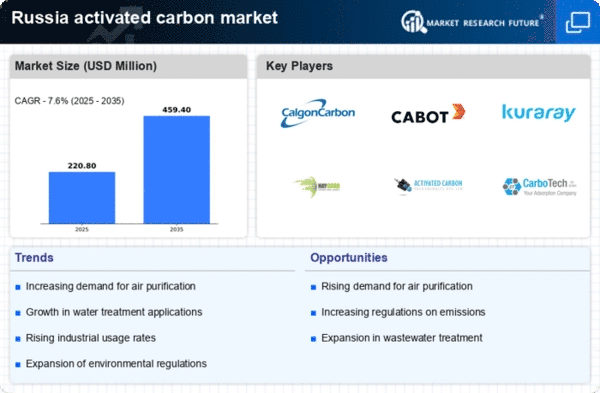
As per Market Research Future analysis, the Activated Carbon market size was estimated at 205.2 USD Million in 2024. The Russia activated carbon market is projected to grow from 220.8 USD Million in 2025 to 459.4 USD Million by 2035, exhibiting a compound annual growth rate (CAGR) of 7% during the forecast period 2025 - 2035

Key Market Trends & Highlights

The Russia activated carbon market is experiencing robust growth driven by increasing demand for water treatment and air purification solutions.

  • The market is witnessing a rising demand for water treatment solutions, particularly in urban areas.
  • Technological innovations in production processes are enhancing the efficiency and quality of activated carbon.
  • Regulatory pressures and environmental standards are shaping market dynamics, pushing for higher quality products.
  • Key market drivers include the increasing industrial applications and growing environmental awareness, particularly in wastewater treatment facilities.

Market Size & Forecast

2024 Market Size 205.2 (USD Million)
2035 Market Size 459.4 (USD Million)
CAGR (2025 - 2035) 7.6%

Major Players

Calgon Carbon Corporation (US), Cabot Corporation (US), Kuraray Co Ltd (JP), Haycarb PLC (LK), Activated Carbon Technologies (US), Carbotech AC GmbH (DE), Carbon Resources LLC (US), Ingevity Corporation (US), Evoqua Water Technologies LLC (US)

Our Impact
Enabled $4.3B Revenue Impact for Fortune 500 and Leading Multinationals
Partnering with 2000+ Global Organizations Each Year
30K+ Citations by Top-Tier Firms in the Industry

Russia Activated Carbon Market Trends

The activated carbon market in Russia is experiencing notable developments driven by various factors. The increasing demand for air and water purification technologies has led to a surge in the utilization of activated carbon across multiple sectors. Industries such as water treatment, pharmaceuticals, and food processing are increasingly adopting this versatile material due to its superior adsorption properties. Furthermore, the regulatory landscape is evolving, with stricter environmental standards prompting companies to seek effective solutions for pollution control. This shift is likely to enhance the market's growth trajectory as businesses invest in advanced filtration systems that incorporate activated carbon. In addition, the domestic production of activated carbon is gaining momentum, supported by local manufacturers who are expanding their capabilities. This trend may reduce reliance on imports and foster a more self-sufficient market. Moreover, innovations in production techniques and the development of specialized activated carbon products tailored for specific applications are emerging. These advancements could potentially improve performance and broaden the scope of applications, thereby attracting new customers. Overall, The activated carbon market in Russia appears poised for growth, driven by technological advancements and increasing environmental awareness.

Rising Demand for Water Treatment Solutions

The activated carbon market is witnessing a surge in demand for water treatment solutions. This trend is largely influenced by the need for clean drinking water and effective wastewater management. As municipalities and industries prioritize water quality, activated carbon is becoming a preferred choice for filtration and purification processes.

Technological Innovations in Production

Innovations in production techniques are shaping the activated carbon market. Manufacturers are exploring advanced methods to enhance the efficiency and effectiveness of activated carbon. These technological advancements may lead to the development of specialized products that cater to specific industrial needs, thereby expanding market opportunities.

Regulatory Pressures and Environmental Standards

Increasing regulatory pressures regarding environmental protection are impacting the activated carbon market. Stricter standards for air and water quality are prompting industries to adopt activated carbon solutions for pollution control. This trend indicates a growing recognition of the importance of sustainable practices in various sectors.

Market Segment Insights

By Application: Water Treatment (Largest) vs. Air Purification (Fastest-Growing)

In the Russia activated carbon market, the application segment is predominantly characterized by water treatment, which captures the largest market share due to increasing demand for clean and safe drinking water. Following closely, air purification is rapidly gaining traction as environmental concerns escalate, leading to significant investments in technologies that enhance air quality. This competitive landscape is further influenced by sectors like food and beverage processing, pharmaceuticals, and gold recovery, which also contribute to the overall demand for activated carbon. Growth trends in the application segment reveal that water treatment continues to be the backbone of the market, driven by regulatory standards and consumer awareness. Conversely, air purification is recognized as the fastest-growing area, spurred by urbanization and industrial emissions that necessitate efficient filtration solutions. The food and beverage processing sector also demonstrates stable growth fueled by the need for quality assurance, while pharmaceuticals and gold recovery are benefiting from technological advancements and innovative applications, respectively.

Water Treatment (Dominant) vs. Air Purification (Emerging)

Water treatment remains the dominant application in the Russia activated carbon market, as it addresses essential needs for potable water and wastewater management. This segment employs activated carbon for its superior adsorption properties to remove contaminants, ensuring compliance with health standards. In contrast, air purification is an emerging application, reflecting a rising awareness of air quality issues amid industrial growth and urban population increases. This segment harnesses activated carbon for its effectiveness in removing volatile organic compounds (VOCs) and particulate matter, thus catering to both residential and commercial markets. The adaptability of activated carbon facilitates innovation in these applications, presenting opportunities for market players to develop customized solutions that meet specific consumer demands.

By Type: Granular Activated Carbon (Largest) vs. Powdered Activated Carbon (Fastest-Growing)

In the Russia activated carbon market, the distribution of market share among the segment values clearly highlights Granular Activated Carbon as the dominant player, capturing a significant portion of the market. Powdered Activated Carbon follows but has been gaining traction recently due to its growing applications in various industrial processes. Extruded Activated Carbon holds a smaller share but is valued for its increased efficiency in certain niche applications. The growth trends within this segment are driven by rising environmental regulations and the demand for cleaner technologies. Granular Activated Carbon remains indispensable for air and water purification, while Powdered Activated Carbon is witnessing rapid adoption in the food and beverage sector due to its effective contaminant removal capabilities. The innovative developments in manufacturing processes are further bolstering the market potential of these activated carbon types.

Granular Activated Carbon (Dominant) vs. Extruded Activated Carbon (Emerging)

Granular Activated Carbon has established itself as the dominant form in the Russia activated carbon market due to its versatile applications, particularly in water treatment and air purification. Its effectiveness in adsorbing a range of contaminants makes it indispensable in various industries. Conversely, Extruded Activated Carbon, while emerging, is becoming increasingly popular due to its unique structure, which offers higher mechanical strength and resistance to abrasion. This makes it especially effective in certain filtration applications where durability is critical. As industries look for efficient and sustainable solutions, both Granular and Extruded Activated Carbons are expected to grow, albeit at different rates, shaping the future of the market.

By End-use: Industrial (Largest) vs. Residential (Fastest-Growing)

In the Russia activated carbon market, the industrial segment dominates with a substantial share, driven by its widespread applications in water treatment, air purification, and industrial processes. This segment enjoys a competitive edge due to the high demand from various industrial sectors that prioritize effective filtration solutions. In contrast, the residential segment, though smaller, is witnessing rapid growth as more households recognize the importance of air and water quality, driven by health consciousness and environmental concerns. Growth trends in this segment indicate a shifting focus towards sustainable and efficient filtration systems. The rising awareness of health-related issues linked to air and water quality is propelling demand for activated carbon solutions in residential settings. This trend is further supported by innovations in product development aimed at enhancing the effectiveness of activated carbon for home use, making it an increasingly attractive option for consumers looking to improve their living environments.

Industrial (Dominant) vs. Residential (Emerging)

The industrial segment in the Russia activated carbon market is characterized by its extensive application across various sectors, including manufacturing, chemical processing, and environmental protection. This segment is currently dominant due to its reliance on activated carbon for effective pollution control and resource recovery. The technology employed in industrial applications is sophisticated, involving high-efficiency carbon filtration systems that cater to large-scale operations. On the other hand, the residential segment is emerging rapidly as consumers become more health-conscious and seek environmentally-friendly solutions for air and water purification. This shift is promoting the development of user-friendly products designed specifically for home use, appealing to a growing demographic that prioritizes sustainability and safety in their living spaces.

By Production Method: Physical Activation (Largest) vs. Chemical Activation (Fastest-Growing)

In the Russia activated carbon market, the production method segment is primarily dominated by Physical Activation, which holds a significant market share. This method utilizes thermal processes to generate activated carbon, appealing to industries requiring a highly efficient adsorbent. Chemical Activation, while smaller in share, is rapidly gaining traction due to its ability to produce activated carbons with tailored pore structures and properties, making it attractive for niche applications. The growth trends for these production methods indicate a shift towards more sustainable and efficient manufacturing processes. Increased environmental regulations and the demand for high-performance activated carbons in various industrial applications are supporting the rise of Chemical Activation. In contrast, Physical Activation continues to thrive due to its established technology and cost-effectiveness in producing activated carbon with consistent quality.

Production Method: Physical Activation (Dominant) vs. Chemical Activation (Emerging)

Physical Activation remains the dominant production method in the Russia activated carbon market, owing to its mature technology and cost-effectiveness. This method employs high temperatures, often above 800°C, to convert carbonaceous materials into activated carbon, resulting in materials with a well-defined pore structure. Conversely, Chemical Activation is emerging rapidly, leveraging specific activating agents to enhance the porosity and surface area of the final product. This method is particularly appealing for specialized applications that require modified adsorption properties, such as gas treatment and water purification. As industries seek innovative solutions for filtration and separation processes, the potential for Chemical Activation is expanding, thus driving investment and research in this area.

Get more detailed insights about Russia Activated Carbon Market

Key Players and Competitive Insights

The activated carbon market in Russia is characterized by a competitive landscape that is increasingly shaped by innovation, sustainability, and strategic partnerships. Key players such as Calgon Carbon Corporation (US), Kuraray Co Ltd (JP), and Ingevity Corporation (US) are actively pursuing strategies that enhance their market positioning. Calgon Carbon Corporation (US) focuses on expanding its product portfolio through technological advancements, while Kuraray Co Ltd (JP) emphasizes sustainable practices in its manufacturing processes. Ingevity Corporation (US) is leveraging its expertise in environmental solutions to cater to the growing demand for eco-friendly products. Collectively, these strategies contribute to a dynamic competitive environment, where companies are not only vying for market share but also striving to meet evolving consumer expectations.In terms of business tactics, localizing manufacturing and optimizing supply chains appear to be pivotal for success in this market. The competitive structure is moderately fragmented, with several players holding significant market shares. This fragmentation allows for a diverse range of products and services, catering to various industrial applications. The influence of key players is substantial, as they set benchmarks for quality and innovation, thereby shaping market trends and consumer preferences.

In October Calgon Carbon Corporation (US) announced the launch of a new line of activated carbon products designed specifically for air purification applications. This strategic move is significant as it aligns with the increasing regulatory focus on air quality and environmental sustainability. By diversifying its product offerings, Calgon Carbon Corporation (US) not only addresses a critical market need but also positions itself as a leader in the air treatment segment, potentially capturing a larger share of the market.

In September Kuraray Co Ltd (JP) entered into a partnership with a leading Russian environmental firm to enhance its distribution network within the region. This collaboration is strategically important as it allows Kuraray Co Ltd (JP) to leverage local expertise and improve its market penetration. The partnership is expected to facilitate the introduction of innovative products tailored to the specific needs of the Russian market, thereby strengthening Kuraray's competitive edge.

In August Ingevity Corporation (US) expanded its production capacity in Russia by investing in a new manufacturing facility. This expansion is indicative of Ingevity's commitment to meeting the growing demand for activated carbon products in the region. By increasing its production capabilities, Ingevity Corporation (US) aims to enhance supply chain reliability and reduce lead times, which are critical factors in maintaining customer satisfaction and loyalty.

As of November current trends in the activated carbon market are increasingly defined by digitalization, sustainability, and the integration of advanced technologies such as AI. Strategic alliances are playing a crucial role in shaping the competitive landscape, enabling companies to pool resources and expertise. Looking ahead, it is likely that competitive differentiation will evolve from traditional price-based competition to a focus on innovation, technological advancements, and supply chain resilience. This shift underscores the importance of adaptability and forward-thinking strategies in navigating the complexities of the market.


Key Companies in the Russia Activated Carbon Market include

Industry Developments

Recent developments in the Russia Activated Carbon Market highlight significant market activity and ongoing changes impacting major players. In September 2023, Mitsubishi Chemical Corporation announced the expansion of its activated carbon production facilities in Russia to meet growing environmental regulations and increasing demand from the water treatment sector. Simultaneously, Ingevity Corporation is focusing on innovation within its carbon products tailored for industrial applications, positioning itself strategically in the Russian market. Notably, Silcarbon Aktivkohle GmbH has entered a partnership with local firms to enhance its supply chain logistics amidst geopolitical tensions, ensuring more seamless operations.

The market valuation of companies such as Calgon Carbon Corporation and Jacobi Carbons has seen growth due to rising investments in air pollution control technologies across Russia, responding to the government's heightened environmental initiatives in recent years. Furthermore, in early 2023, Ecoproducts strengthened its market presence by acquiring a regional distribution center to optimize its service delivery. These developments reflect the dynamic state of the activated carbon sector in Russia, with players adapting to both local challenges and global industry trends.

Future Outlook

Russia Activated Carbon Market Future Outlook

The activated carbon market in Russia is projected to grow at a 7.6% CAGR from 2025 to 2035, driven by increasing environmental regulations and demand for air and water purification.

New opportunities lie in:

  • Expansion of activated carbon production facilities in key industrial regions.
  • Development of specialized activated carbon for emerging applications in pharmaceuticals.
  • Partnerships with local governments for waste management solutions using activated carbon.

By 2035, the activated carbon market is expected to achieve substantial growth and innovation.

Market Segmentation

Russia Activated Carbon Market Type Outlook

  • Granular Activated Carbon
  • Powdered Activated Carbon
  • Extruded Activated Carbon

Russia Activated Carbon Market End-use Outlook

  • Industrial
  • Residential
  • Commercial

Russia Activated Carbon Market Application Outlook

  • Water Treatment
  • Air Purification
  • Food and Beverage Processing
  • Pharmaceuticals
  • Gold Recovery

Russia Activated Carbon Market Production Method Outlook

  • Physical Activation
  • Chemical Activation

Report Scope

MARKET SIZE 2024 205.2(USD Million)
MARKET SIZE 2025 220.8(USD Million)
MARKET SIZE 2035 459.4(USD Million)
COMPOUND ANNUAL GROWTH RATE (CAGR) 7.6% (2025 - 2035)
REPORT COVERAGE Revenue Forecast, Competitive Landscape, Growth Factors, and Trends
BASE YEAR 2024
Market Forecast Period 2025 - 2035
Historical Data 2019 - 2024
Market Forecast Units USD Million
Key Companies Profiled Calgon Carbon Corporation (US), Cabot Corporation (US), Kuraray Co Ltd (JP), Haycarb PLC (LK), Activated Carbon Technologies (US), Carbotech AC GmbH (DE), Carbon Resources LLC (US), Ingevity Corporation (US), Evoqua Water Technologies LLC (US)
Segments Covered Application, Type, End-use, Production Method
Key Market Opportunities Growing demand for sustainable water treatment solutions drives innovation in the activated carbon market.
Key Market Dynamics Rising demand for activated carbon in water treatment drives innovation and competition among local manufacturers.
Countries Covered Russia
Leave a Comment

FAQs

What is the expected market size of the Russia Activated Carbon Market in 2024?

The Russia Activated Carbon Market is expected to be valued at 171.0 million USD in 2024.

What will be the market size of the Russia Activated Carbon Market by 2035?

By 2035, the Russia Activated Carbon Market is projected to reach 422.0 million USD.

What is the expected compound annual growth rate (CAGR) for the Russia Activated Carbon Market from 2025 to 2035?

The expected CAGR for the Russia Activated Carbon Market from 2025 to 2035 is 8.559%.

Which product type dominates the Russia Activated Carbon Market in 2024?

In 2024, the Granular product type is valued at 80.0 million USD, making it a dominant segment.

What is the market value for powdered activated carbon in 2035?

The powdered activated carbon segment is projected to be valued at 150.0 million USD by 2035.

Who are some of the key players in the Russia Activated Carbon Market?

Major players in the market include Mitsubishi Chemical Corporation, Ingevity Corporation, and Calgon Carbon Corporation.

What is the market size for the 'Others' category of activated carbon in 2024?

The 'Others' category in the activated carbon market is expected to be valued at 31.0 million USD in 2024.

What challenges might the Russia Activated Carbon Market face in the coming years?

Potential challenges may include regulatory changes and fluctuating raw material prices impacting market growth.

What future opportunities exist for the Russia Activated Carbon Market?

Opportunities may arise from growing environmental regulations and increased demand in various industrial applications.

What is the expected market growth rate for Granular activated carbon from 2025 to 2035?

The Granular activated carbon segment is anticipated to grow significantly as part of the overall market expansion during the forecast period.

Download Free Sample

Kindly complete the form below to receive a free sample of this Report

Compare Licence

×
Features License Type
Single User Multiuser License Enterprise User
Price $4,950 $5,950 $7,250
Maximum User Access Limit 1 User Upto 10 Users Unrestricted Access Throughout the Organization
Free Customization
Direct Access to Analyst
Deliverable Format
Platform Access
Discount on Next Purchase 10% 15% 15%
Printable Versions