×
Hero Background
English
Chinese
French
Japanese
Korean
German
Spanish

Polyetherimide Market Trends

ID: MRFR/CnM/6439-HCR
140 Pages
Priya Nagrale
October 2025

Polyetherimide Market Research Report Information by Process (Injection Molding, Blow Molding, Foam Molding and Extrusion), Type (Unreinforced and Reinforced), Form (Sheets, Rods, Granules and Films), End-Use Industry (Automotive, Medical, Food & Beverage, Aerospace, Marine, Telecommunication, Electrical & Electronics and others) and Region (North America, Europe, Latin America, Asia-Pacific and the Middle East & Africa) - Forecast till 2035

Share:
Download PDF ×

We do not share your information with anyone. However, we may send you emails based on your report interest from time to time. You may contact us at any time to opt-out.

Polyetherimide Market Infographic
Purchase Options

Market Trends

Key Emerging Trends in the Polyetherimide Market

The market of Polyetherimide (PEI) is experiencing important trends in today's world which reflects that the market of polymers is dynamic since many players are entering in the market every week. Polyetherimide is a high- performance thermoplastic considered very sturdy because of its high heat resistance, mechanical strength, and fire retardancy. The first main market trend which is contributing to the increase in demand for PEI is that it serves as a versatile material in several industries, for example, automotive, electronics, aerospace, and healthcare industries.

In the automotive area, the elevated focus on the use of light materials to up gas mileage and to lower emissions has led to the adoption of the use of Polyetherimide. Industry producers are now practically introducing PEI for the invention of part of the components and whole car structure. The qualities such as the high temperature resistance and mechanical strength make PMR see a preference in automotive industry which then is the major driving force for the PEI market

The application of electronics devices is driven by the need for highly functional yet miniature polymers such as PEI due to the increasing trend of fabrication of devices with minimal sizes and high functionalities. Factors such as PEI’s low smoke generation or self-extinguishment along with the fire-retardant effect while thermal stability make it capable to be used in a variety of product applications like connectors, insulators, and other electrical components. With the improvement in the style of electronics and the coming up of new features, the polyetherimide industry is expected to actively grow in this area.

Aerospace has advancing its shape as PEI is becoming more recognized in this industry. The airweight charateristics, along with the material’s ability to maintain structural integrity in the harshest circumstances, are the reasons why it has a wide range of applications in aerospace. Peace engineering initiatives are now involved with interior parts as well as structural elements of the aircraft that are already on the market, and therefore propelling positive trends in the sector. A polymereimide, which combines the satisfactory performance characteristics with the necessary weight reduction, is what the aerospace industry is persistently requesting.

PEI has gradually taken a surge trend in the medical sector, precisely, in medical devices and tools, with this growth attributed to more economies of scale. Bioresorbable biocompatibility, resistance to sterilization methods, stamina and durability make it suitable for medical devices (surgical instruments, diagnostic instruments, and delivery systems of the drugs). The healthcare industry around the world keeps marching ahead with the advancements in Polyetherimide and it is anticipated that the market for the same will have more demand from its sector.

As more voices of environmental sustainability are being heard, the Polyetherimide market is also shaped by this trend. Along with knowledge on the trace of these products back to mineral sources, it is essential to pay more attention to the development of sustainable and green polymers. Producers begin research on rising up the recyclability and biodepgradability of Polyetherimide striving the tendency in the industry toward eco-friendly.
Author
Priya Nagrale
Senior Research Analyst

With an experience of over five years in market research industry (Chemicals & Materials domain), I gather and analyze market data from diverse sources to produce results, which are then presented back to a client. Also, provide recommendations based on the findings. As a Senior Research Analyst, I perform quality checks (QC) for market estimations, QC for reports, and handle queries and work extensively on client customizations. Also, handle the responsibilities of client proposals, report planning, report finalization, and execution

Leave a Comment

FAQs

How much is the global Polyetherimide Market worth in the future?

Valuation of the global Polyetherimide Market is estimated to reach USD 870 MN by the end of 2035.

At what CAGR is the global Polyetherimide Market projected to grow during the forecast period?

Polyetherimide Market is projected to expand at over 7% CAGR during the assessment period

Which is the largest end-use industry segment in the global Polyetherimide Market?

Automotive is the largest end-use industry segment in the global Polyetherimide Market.

Which region holds the largest share in the global Polyetherimide Market?

Asia Pacific holds the largest share in the global Polyetherimide Market, followed by Europe and North America, respectively.

Who are the top players in the global Polyetherimide Market?

SABIC (Saudi Arabia), Ensinger (India), Westlake Plastics Company (US), Mitsubishi Chemical Advanced Materials (Japan), Aetna Plastics (US), RTP Company (US), Aikolon Oy (Finland), PolyOne Corporation (US), Centroplast Engineering Plastics GmbH (Germany), Röchling SE & Co. KG (Germany), and Lehmann&Voss&Co. (Germany), are some of the major players operating in the Polyetherimide Market.

Market Summary

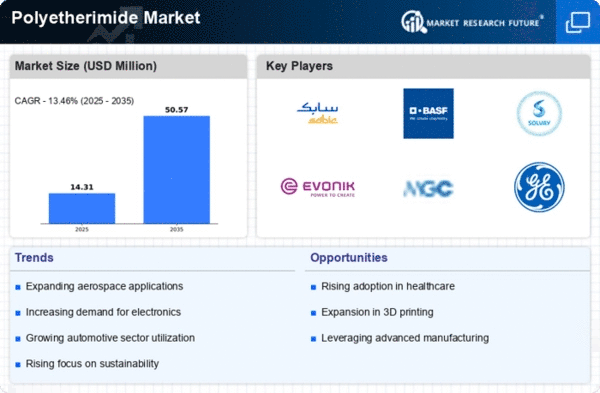
As per MRFR analysis, the Polyetherimide Market Size was estimated at 12.61 USD Million in 2024. The Polyetherimide industry is projected to grow from 14.3 in 2025 to 50.57 by 2035, exhibiting a compound annual growth rate (CAGR) of 13.46 during the forecast period 2025 - 2035.

Key Market Trends & Highlights

The Polyetherimide Market is experiencing robust growth driven by diverse applications and technological advancements.

  • The aerospace sector remains the largest market for polyetherimide, reflecting its critical role in high-performance applications.
  • Asia-Pacific is identified as the fastest-growing region, driven by increasing industrialization and demand for advanced materials.
  • The electronics segment is witnessing rapid growth, fueled by the rising need for lightweight and energy-efficient components.
  • Key market drivers include the expansion in automotive lightweighting initiatives and the increasing focus on energy efficiency.

Market Size & Forecast

2024 Market Size 12.61 (USD Million)
2035 Market Size 50.57 (USD Million)
CAGR (2025 - 2035) 13.46%
Largest Regional Market Share in 2024 North America

Major Players

<p>Sabic (SA), BASF (DE), Solvay (BE), Evonik Industries (DE), Mitsubishi Gas Chemical (JP), General Electric (US), RTP Company (US), Rohm and Haas (US)</p>

Market Trends

The Polyetherimide Market is currently experiencing a notable transformation, driven by advancements in material science and increasing demand across various industries. This high-performance thermoplastic is recognized for its exceptional thermal stability, chemical resistance, and mechanical strength, making it suitable for applications in aerospace, automotive, and electronics. As industries seek to enhance product performance and sustainability, the adoption of polyetherimide is likely to rise, reflecting a shift towards innovative materials that meet stringent regulatory standards. Furthermore, the growing emphasis on lightweight materials in manufacturing processes appears to bolster the market's expansion, as polyetherimide offers a compelling alternative to traditional materials. In addition to its technical attributes, the Polyetherimide Market is influenced by evolving consumer preferences and environmental considerations. Manufacturers are increasingly focusing on developing eco-friendly solutions, which may lead to the introduction of bio-based polyetherimide variants. This trend suggests a potential alignment with global sustainability goals, as industries strive to reduce their carbon footprint. Moreover, the ongoing research and development efforts in polymer technology indicate that the market could witness the emergence of enhanced formulations that cater to specific application needs, further diversifying the product offerings available to consumers. Overall, the Polyetherimide Market is poised for growth, driven by innovation and a commitment to sustainability.

Rising Demand in Aerospace and Automotive Sectors

The Polyetherimide Market is witnessing increased interest from the aerospace and automotive industries, where lightweight and durable materials are essential. This trend indicates a shift towards high-performance polymers that can withstand extreme conditions while contributing to fuel efficiency.

Focus on Sustainable Solutions

There is a growing emphasis on sustainability within the Polyetherimide Market, as manufacturers explore eco-friendly alternatives. This trend suggests a potential rise in the development of bio-based polyetherimide, aligning with global environmental initiatives.

Advancements in Polymer Technology

Ongoing research in polymer science is likely to lead to innovative formulations of polyetherimide. This trend may enhance the material's properties, catering to specific industry requirements and expanding its application range.

Polyetherimide Market Market Drivers

Market Growth Projections

The Global Polyetherimide Market Industry is poised for substantial growth, with projections indicating a market size of 670 USD Million in 2024 and an anticipated increase to 1220.2 USD Million by 2035. This growth trajectory reflects a compound annual growth rate (CAGR) of 5.6% from 2025 to 2035. The increasing adoption of polyetherimide across various sectors, including aerospace, automotive, and electronics, suggests a robust demand for this high-performance polymer. As industries continue to innovate and prioritize advanced materials, the polyetherimide market is likely to thrive, driven by technological advancements and evolving consumer preferences.

Advancements in Electronics

In the realm of electronics, the Global Polyetherimide Market Industry is witnessing substantial growth due to the increasing adoption of polyetherimide in electrical insulation and components. The material's excellent dielectric properties and thermal stability make it suitable for applications in circuit boards and connectors. As consumer electronics evolve, the demand for high-performance materials is likely to rise, further propelling the market. The anticipated growth rate of 5.6% CAGR from 2025 to 2035 underscores the potential for polyetherimide to play a pivotal role in the electronics sector, catering to the needs of modern technology.

Growth in Automotive Applications

The automotive industry significantly influences the Global Polyetherimide Market Industry, as manufacturers seek lightweight materials to enhance fuel efficiency and reduce emissions. Polyetherimide Market's durability and resistance to chemicals make it an attractive option for various automotive components, including interior parts and electrical housings. With the global push towards electric vehicles, the demand for high-performance materials is expected to escalate. This trend aligns with the market's projected growth, reaching 1220.2 USD Million by 2035, indicating a strong correlation between automotive advancements and polyetherimide utilization.

Rising Demand in Aerospace Sector

The Global Polyetherimide Market Industry experiences a notable surge in demand from the aerospace sector, where lightweight and high-performance materials are crucial. Polyetherimide Market's exceptional thermal stability and mechanical strength make it an ideal choice for aircraft components, contributing to fuel efficiency and reduced emissions. As the aerospace industry continues to innovate, the demand for polyetherimide is projected to grow significantly, with the market expected to reach 670 USD Million in 2024. This trend indicates a robust growth trajectory, driven by the need for advanced materials that can withstand extreme conditions while ensuring safety and performance.

Increasing Focus on Sustainability

Sustainability initiatives are reshaping the Global Polyetherimide Market Industry, as industries strive to reduce their environmental footprint. Polyetherimide Market, being a recyclable material, aligns with the growing emphasis on eco-friendly practices. Companies are increasingly adopting polyetherimide for applications that require both performance and sustainability, such as packaging and consumer goods. This shift towards sustainable materials is likely to drive demand, as organizations seek to meet regulatory requirements and consumer expectations. The market's growth trajectory suggests that sustainability will play a crucial role in shaping the future of polyetherimide applications.

Emerging Markets and Industrial Growth

Emerging markets are becoming pivotal in the Global Polyetherimide Market Industry, as industrialization accelerates in regions such as Asia-Pacific and Latin America. These regions are witnessing a surge in demand for high-performance materials across various sectors, including healthcare, aerospace, and automotive. The increasing investments in infrastructure and manufacturing capabilities are expected to bolster the demand for polyetherimide, contributing to the market's expansion. As these markets develop, the potential for polyetherimide applications appears promising, indicating a favorable outlook for the industry in the coming years.

Market Segment Insights

By Application: Aerospace (Largest) vs. Electronics (Fastest-Growing)

<p>The Polyetherimide market's application segment exhibits varying market shares with Aerospace leading as the largest sector due to its extensive use in aircraft components, insulation, and structural applications. Automotive and Industrial applications also capture significant shares of the market, driven by the demand for lightweight, high-performance materials. Electronics follows closely, reflecting increasing adoption in consumer electronics and other tech industries, contributing notably to the segment dynamics.</p>

<p>Aerospace (Dominant) vs. Medical (Emerging)</p>

<p>The Aerospace application stands out in the Polyetherimide market, characterized by high-performance requirements, such as thermal stability and chemical resistance, making it ideal for critical aerospace components. In contrast, the Medical sector is emerging as a promising application area where Polyetherimide is increasingly used in medical devices and equipment due to its biocompatibility and sterilization capabilities. The growing demand for advanced medical technologies and innovations in this sector is paving the way for Polyetherimide's expanding role, driven by stringent regulatory standards and the need for durable materials in healthcare.</p>

By End Use: Electrical Insulation (Largest) vs. Thermal Management (Fastest-Growing)

<p>The Polyetherimide (PEI) market is segmented into Electrical Insulation, Structural Components, Fluid Handling, and Thermal Management. Among these, Electrical Insulation holds the largest market share due to its extensive use in electrical and electronic applications where dielectric strength is crucial. Thermal Management is gaining traction as the fastest-growing segment, spurred by increasing demand for efficient thermal interface materials in high-performance applications such as electric vehicles and advanced electronic devices, emphasizing thermal stability and performance resilience.</p>

<p>Electrical Insulation (Dominant) vs. Thermal Management (Emerging)</p>

<p>Electrical Insulation is a dominant segment within the Polyetherimide market, known for its exceptional dielectric properties, making it an ideal choice for components in projects requiring high thermal stability and electric insulating capabilities. Industries such as aerospace, automotive, and electronics extensively utilize PEI for insulation purposes, promoting its strong foothold. On the other hand, Thermal Management, identified as an emerging segment, is witnessing rapid growth due to advancements in technology and increasing applications in automotive and electronics sectors, particularly with the rise of electric vehicles where heat dissipation is critical. This segment focuses on innovative solutions that enhance the performance and longevity of electronic components, thus attracting significant investments.</p>

By Form: Films (Largest) vs. Sheets (Fastest-Growing)

<p>The Polyetherimide market's 'Form' segment exhibits a diverse distribution, with Films holding the largest market share due to their versatile applications across various industries, especially in electronics and automotive. Sheets follow closely, gaining traction for their adaptability in different manufacturing processes. Resins and Powders, while integral, play supporting roles in this competitive landscape, serving niche applications and contributing to the segment's overall vitality.</p>

<p>Films (Dominant) vs. Powder (Emerging)</p>

<p>Films are characterized by their exceptional thermal stability and mechanical strength, making them the dominant force in the Polyetherimide segment. Their application in high-performance industries such as aerospace and electronics underscores their critical importance. In contrast, Powders are emerging as a vital player due to their growing use in additive manufacturing and specialized coatings. This trend highlights a shift toward innovative applications facilitated by powders, positioning them as an essential component of the Polyetherimide market's evolution.</p>

By Processing Method: Injection Molding (Largest) vs. 3D Printing (Fastest-Growing)

<p>In the Polyetherimide Market, the processing method segment showcases distinct dynamics among its key players: Injection Molding, Extrusion, 3D Printing, and Compression Molding. Injection Molding holds the largest market share due to its extensive applicability across various industries, particularly in automotive and aerospace, where high precision and repeatability are essential. Meanwhile, while Extrusion remains significant, its growth is outpaced by the rapidly expanding 3D Printing segment, which is gaining traction due to technological advancements and increased adoption in prototyping and customization.</p>

<p>Injection Molding (Dominant) vs. 3D Printing (Emerging)</p>

<p>Injection Molding stands out as the dominant processing method in the Polyetherimide Market. Its ability to produce complex geometries with high efficiency makes it the preferred choice for large-scale manufacturing. It is widely adopted in industries requiring highly durable and heat-resistant components. Conversely, 3D Printing, while emerging, is rapidly evolving with advancements in additive manufacturing technologies. It offers unique benefits such as design flexibility and reduced lead times, which appeal to industries focusing on innovation and customization. Its continuous growth and ability to address niche applications are contributing to its strong market presence, positioning it as a key player in the processing method segment.</p>

By Property: High Thermal Stability (Largest) vs. Chemical Resistance (Fastest-Growing)

<p>In the Polyetherimide Market, High Thermal Stability holds a significant share as the largest property segment, dominating the preferences of industries such as aerospace and automotive. This property is recognized for its ability to withstand high temperatures without losing mechanical integrity or becoming deformed, which is crucial for applications that require reliability in extreme conditions. Chemical Resistance is emerging as the fastest-growing segment driven by increasing demand in industries such as healthcare and electronics. The ability of polyetherimide to resist corrosion and degradation in the presence of harsh chemicals is propelling its adoption. As regulatory requirements intensify, manufacturers are turning towards materials that meet these stringent standards, thus elevating this segment's growth trajectory.</p>

<p>High Thermal Stability (Dominant) vs. Electrical Insulation (Emerging)</p>

<p>High Thermal Stability remains the dominant property in the Polyetherimide Market due to its unparalleled performance in high-temperature applications. Its robustness makes it ideal for various sectors, ensuring longevity and reliability. In contrast, Electrical Insulation is categorized as an emerging segment, gaining traction due to innovations in electronic devices that require materials capable of maintaining performance under electrical stress. While Electrical Insulation possesses essential properties for safe and effective use in advanced electronics, High Thermal Stability continues to overshadow it by serving the more established sectors that demand durability under extreme conditions.</p>

Get more detailed insights about Polyetherimide Market Research Report - Global Forecast Till 2035

Regional Insights

North America : Market Leader in Polyetherimide

North America is poised to maintain its leadership in the Polyetherimide market, holding a significant share of 5.5 in 2024. The region's growth is driven by robust demand from aerospace, automotive, and electronics sectors, alongside stringent regulations promoting high-performance materials. The increasing focus on lightweight and durable materials is further propelling market expansion. The United States stands as the primary contributor, with key players like General Electric and RTP Company leading the charge. The competitive landscape is characterized by innovation and strategic partnerships among major companies such as Sabic and BASF. This dynamic environment fosters advancements in Polyetherimide applications, ensuring sustained growth in the region.

Europe : Emerging Market with Growth Potential

Europe's Polyetherimide market is on an upward trajectory, with a market size of 3.8 in 2024. The region benefits from a strong regulatory framework that encourages the use of advanced materials in various industries, including healthcare and automotive. The push for sustainability and energy efficiency is also driving demand for high-performance polymers, positioning Europe as a key player in the global market. Germany and France are leading countries in this sector, with significant contributions from companies like BASF and Solvay. The competitive landscape is marked by innovation and collaboration among industry leaders, enhancing the region's capabilities in Polyetherimide production. As the market evolves, Europe is expected to leverage its technological advancements to capture a larger share of the global market.

Asia-Pacific : Rapid Growth in Emerging Markets

The Asia-Pacific region is witnessing rapid growth in the Polyetherimide market, with a size of 2.8 in 2024. This growth is fueled by increasing industrialization, urbanization, and rising demand for high-performance materials in electronics and automotive sectors. Government initiatives aimed at boosting manufacturing capabilities and innovation are also significant drivers of market expansion. China and Japan are at the forefront, with major players like Mitsubishi Gas Chemical and Evonik Industries leading the market. The competitive landscape is evolving, with new entrants and established companies focusing on R&D to enhance product offerings. As the region continues to develop, the demand for Polyetherimide is expected to rise, further solidifying its market position.

Middle East and Africa : Emerging Frontier for Polyetherimide

The Middle East and Africa (MEA) region presents a nascent but promising market for Polyetherimide, with a market size of 0.51 in 2024. The growth is primarily driven by increasing investments in infrastructure and manufacturing, alongside a growing awareness of advanced materials in various applications. Regulatory support for industrial development is also fostering a conducive environment for market growth. Countries like South Africa and the UAE are emerging as key players in this sector, with local and international companies exploring opportunities in Polyetherimide production. The competitive landscape is gradually evolving, with a focus on innovation and sustainability. As the region develops its industrial base, the demand for high-performance materials is expected to rise significantly.

Key Players and Competitive Insights

The Polyetherimide Market is currently characterized by a dynamic competitive landscape, driven by increasing demand for high-performance polymers across various industries, including aerospace, automotive, and electronics. Key players such as Sabic (SA), BASF (DE), and Solvay (BE) are strategically positioned to leverage their extensive research and development capabilities, focusing on innovation and sustainability. These companies are actively pursuing partnerships and collaborations to enhance their product offerings and expand their market reach, thereby shaping a competitive environment that emphasizes technological advancement and customer-centric solutions.

In terms of business tactics, companies are increasingly localizing manufacturing to reduce lead times and optimize supply chains. The market structure appears moderately fragmented, with several players vying for market share. However, the collective influence of major companies like Evonik Industries (DE) and Mitsubishi Gas Chemical (JP) is notable, as they implement strategies that enhance operational efficiencies and foster competitive advantages.

In November 2025, Sabic (SA) announced the launch of a new line of polyetherimide products designed specifically for the aerospace sector. This strategic move is significant as it aligns with the growing demand for lightweight and durable materials in aviation, potentially positioning Sabic as a leader in this niche market. The introduction of these products is expected to enhance their portfolio and attract new customers seeking advanced material solutions.

In October 2025, BASF (DE) revealed its plans to invest €50 million in expanding its production capacity for polyetherimide in Europe. This investment underscores BASF's commitment to meeting the rising demand for high-performance polymers in the region. By increasing production capacity, BASF aims to strengthen its market position and respond more effectively to customer needs, thereby enhancing its competitive edge.

In September 2025, Solvay (BE) entered into a strategic partnership with a leading automotive manufacturer to develop innovative polyetherimide solutions for electric vehicles. This collaboration is indicative of Solvay's focus on sustainability and innovation, as it seeks to provide materials that contribute to the efficiency and performance of electric vehicles. Such partnerships are likely to enhance Solvay's reputation as a forward-thinking player in the market.

As of December 2025, current competitive trends in the Polyetherimide Market are increasingly defined by digitalization, sustainability, and the integration of artificial intelligence in production processes. Strategic alliances are becoming more prevalent, as companies recognize the value of collaboration in driving innovation and enhancing supply chain reliability. Looking ahead, the competitive differentiation in this market is expected to evolve, shifting from price-based competition to a focus on technological advancements and sustainable practices, which will be crucial for long-term success.

Key Companies in the Polyetherimide Market market include

Industry Developments

August 2022: SABIC broadens its range of ULTEM resin optical materials to facilitate the fast adoption of single-mode fiber optics. This new polyetherimide (PEI) resin has a much lower coefficient of thermal expansion (CTE) than standard ULTEM grades. The ability of ULTEM 3310TD resin to be efficiently produced using high-volume molding eliminates the need for expensive secondary operations, enhances design flexibility, and reduces part weight.

In March 2022, Airbus Atlantic consolidated resources and expertise from Airbus’s facilities in Nantes and Montoir-de-Bretagne, France, with STELIA Aerospace sites worldwide. Airbus Atlantic is going to be a key member within the group’s value chain as it plays a major role in the aerostructure supply chain with more than 500 direct suppliers (flying products) and more than 2,000 indirect suppliers (general procurement products)

Target Audience

    • Manufactures of polyetherimide
    • Traders and distributors of polyetherimide
    • Research institute/education institute
    • Potential investors

Future Outlook

Polyetherimide Market Future Outlook

<p>The Polyetherimide Market is projected to grow at a 13.46% CAGR from 2024 to 2035, driven by advancements in aerospace, automotive, and electronics sectors.</p>

New opportunities lie in:

  • <p>Development of high-performance polyetherimide composites for aerospace applications.</p>
  • <p>Expansion into emerging markets with tailored polyetherimide solutions.</p>
  • <p>Investment in recycling technologies for sustainable polyetherimide production.</p>

<p>By 2035, the Polyetherimide Market is expected to achieve robust growth, solidifying its position as a key material in various industries.</p>

Market Segmentation

Polyetherimide Market Form Outlook

  • Films
  • Sheets
  • Resins
  • Powders

Polyetherimide Market End Use Outlook

  • Electrical Insulation
  • Structural Components
  • Fluid Handling
  • Thermal Management

Polyetherimide Market Property Outlook

  • High Thermal Stability
  • Chemical Resistance
  • Mechanical Strength
  • Electrical Insulation

Polyetherimide Market Application Outlook

  • Aerospace
  • Automotive
  • Electronics
  • Medical
  • Industrial

Polyetherimide Market Processing Method Outlook

  • Injection Molding
  • Extrusion
  • 3D Printing
  • Compression Molding

Report Scope

MARKET SIZE 202412.61(USD Million)
MARKET SIZE 202514.3(USD Million)
MARKET SIZE 203550.57(USD Million)
COMPOUND ANNUAL GROWTH RATE (CAGR)13.46% (2024 - 2035)
REPORT COVERAGERevenue Forecast, Competitive Landscape, Growth Factors, and Trends
BASE YEAR2024
Market Forecast Period2025 - 2035
Historical Data2019 - 2024
Market Forecast UnitsUSD Million
Key Companies ProfiledSabic (SA), BASF (DE), Solvay (BE), Evonik Industries (DE), Mitsubishi Gas Chemical (JP), General Electric (US), RTP Company (US), Rohm and Haas (US)
Segments CoveredApplication, End Use, Form, Processing Method, Property
Key Market OpportunitiesGrowing demand for lightweight, high-performance materials in aerospace and automotive sectors drives Polyetherimide Market expansion.
Key Market DynamicsRising demand for lightweight, high-performance materials drives innovation in the Polyetherimide market.
Countries CoveredNorth America, Europe, APAC, South America, MEA

FAQs

How much is the global Polyetherimide Market worth in the future?

Valuation of the global Polyetherimide Market is estimated to reach USD 870 MN by the end of 2035.

At what CAGR is the global Polyetherimide Market projected to grow during the forecast period?

Polyetherimide Market is projected to expand at over 7% CAGR during the assessment period

Which is the largest end-use industry segment in the global Polyetherimide Market?

Automotive is the largest end-use industry segment in the global Polyetherimide Market.

Which region holds the largest share in the global Polyetherimide Market?

Asia Pacific holds the largest share in the global Polyetherimide Market, followed by Europe and North America, respectively.

Who are the top players in the global Polyetherimide Market?

SABIC (Saudi Arabia), Ensinger (India), Westlake Plastics Company (US), Mitsubishi Chemical Advanced Materials (Japan), Aetna Plastics (US), RTP Company (US), Aikolon Oy (Finland), PolyOne Corporation (US), Centroplast Engineering Plastics GmbH (Germany), Röchling SE &amp; Co. KG (Germany), and Lehmann&amp;Voss&amp;Co. (Germany), are some of the major players operating in the Polyetherimide Market.

  1. Executive Summary
  2. Market Introduction
    1. Market Definition
    2. Scope of the Study
    3. List of Assumptions
    4. Markets Structure
  3. Market Research Methodology
    1. Research Process
    2. Primary Research
    3. Secondary Research
    4. Market Size Estimation
    5. Forecast Model
  4. Market Dynamics of Global Polyetherimide Market
    1. Introduction
    2. Drivers
    3. Restraints
    4. Opportunities
    5. Challenges
    6. Trends/Technology
  5. Market Factor Analysis of Global
    1. Polyetherimide Market
    2. Supply Chain Analysis
      1. Raw Material Suppliers
      2. Manufacturers/Producers
      3. Distributors/Retailers/Wholesalers/E-Commerce
      4. End Users
    3. Porter’s Five Forces Analysis
      1. Threat
      2. Bargaining Power of Buyers
      3. Bargaining Power
      4. Threat of Substitutes
      5. Intensity of Competitive
    4. of New Entrants
    5. of Suppliers
    6. Rivalry
    7. Pricing Analysis
  6. Global Polyetherimide Market, by Process
    1. Introduction
    2. Injection Molding
      1. Market Estimates &
      2. Market Estimates & Forecast, by Region,
    3. Forecast, 2020−2027
    4. Blow Molding
      1. Market Estimates & Forecast,
      2. Market Estimates & Forecast, by Region, 2020−2027
    5. Foam Molding
      1. Market Estimates & Forecast, 2020−2027
      2. Market Estimates & Forecast, by Region, 2020−2027
    6. Extrusion
      1. Market Estimates & Forecast, 2020−2027
      2. Market Estimates
    7. & Forecast, by Region, 2020−2027
  7. Global Polyetherimide Market,
    1. by Type
    2. Introduction
    3. Unreinforced
      1. Market Estimates
      2. Market Estimates & Forecast, by Region,
    4. & Forecast, 2020−2027
    5. Reinforced
      1. Market Estimates & Forecast,
      2. Market Estimates & Forecast, by Region, 2020−2027
  8. Global Polyetherimide Market,
    1. by Form
    2. Introduction
    3. Sheets
      1. Market Estimates &
      2. Market Estimates & Forecast, by Region,
    4. Forecast, 2020−2027
    5. Rods
      1. Market Estimates & Forecast, 2020−2027
      2. Market Estimates & Forecast, by Region, 2020−2027
    6. Granules
      1. Market Estimates & Forecast, 2020−2027
      2. Market Estimates
    7. & Forecast, by Region, 2020−2027
    8. Films
      1. Market Estimates
      2. Market Estimates & Forecast, by Region,
    9. & Forecast, 2020−2027
  9. Global Polyetherimide Market, by End-Use Industry
    1. Introduction
    2. Automotive
      1. Market Estimates & Forecast, 2020−2027
      2. Market Estimates & Forecast, by Region, 2020−2027
    3. Medical
      1. Market Estimates & Forecast, 2020−2027
      2. Market Estimates
    4. & Forecast, by Region, 2020−2027
    5. Food & Beverages
      1. Market Estimates &
    6. Market Estimates & Forecast, 2020−2027
    7. Forecast, by Region, 2020−2027
    8. Aerospace
      1. Market Estimates
      2. Market Estimates & Forecast, by Region,
    9. & Forecast, 2020−2027
    10. Marine
      1. Market Estimates & Forecast, 2020−2027
      2. Market Estimates & Forecast, by Region, 2020−2027
    11. Telecommunication
      1. Market Estimates & Forecast, 2020−2027
      2. Market Estimates
    12. & Forecast, by Region, 2020−2027
    13. Electrical & Electronics
      1. Market Estimates & Forecast, 2020−2027
      2. Market Estimates
    14. & Forecast, by Region, 2020−2027
    15. Others
      1. Market Estimates
      2. Market Estimates & Forecast, by Region,
    16. & Forecast, 2020−2027
  10. Global Polyetherimide Market, by Region
    1. Introduction
    2. North America
      1. Market Estimates & Forecast, 2020−2027
      2. Market Estimates & Forecast, by Process, 2020−2027
  11. Market Estimates & Forecast, by Type, 2020−2027
    1. & Forecast, by Form, 2020−2027
    2. by End-Use Industry, 2020−2027
    3. & Forecast, 2020−2027
    4. Process, 2020−2027
  12. Market Estimates
  13. Market Estimates & Forecast,
  14. US
  15. Market Estimates
  16. Market Estimates & Forecast, by
  17. Market Estimates & Forecast, by Type,
  18. Market Estimates & Forecast, by Form, 2020−2027
  19. Market Estimates & Forecast, by End-Use Industry, 2020−2027
  20. Canada
  21. Market Estimates & Forecast, 2020−2027
  22. Market Estimates & Forecast, by Process, 2020−2027
  23. Market Estimates & Forecast, by Type, 2020−2027
    1. & Forecast, by Form, 2020−2027
    2. by End-Use Industry, 2020−2027
    3. & Forecast, 2020−2027
    4. Process 2020−2027
    5. Estimates & Forecast, by End-Use Industry, 2020−2027
    6. Estimates & Forecast, by Process, 2020−2027
    7. & Forecast, by Type, 2020−2027
    8. by Form, 2020−2027
    9. Industry, 2020−2027
    10. Forecast, 2020−2027
  24. Market Estimates
  25. Market Estimates & Forecast,
    1. Europe
      1. Market Estimates
      2. Market Estimates & Forecast, by
      3. Market Estimates & Forecast, by Type, 2020−2027
      4. Market Estimates & Forecast, by Form, 2020−2027
      5. Market
      6. Germany
      7. France
  26. Market Estimates & Forecast, by End-Use Industry, 2020−2027
    1. Italy
  27. Market Estimates & Forecast, 2020−2027
  28. Market Estimates & Forecast, by Process, 2020−2027
    1. Estimates & Forecast, by Type, 2020−2027
    2. & Forecast, by Form, 2020−2027
    3. by End-Use Industry, 2020−2027
    4. & Forecast, 2020−2027
    5. Process, 2020−2027
  29. Market
  30. Market Estimates
  31. Market Estimates & Forecast,
  32. Spain
  33. Market Estimates
  34. Market Estimates & Forecast, by
  35. Market Estimates & Forecast, by Type,
  36. Market Estimates & Forecast, by Form, 2020−2027
  37. Market Estimates & Forecast, by End-Use Industry, 2020−2027
  38. UK
  39. Market Estimates & Forecast, 2020−2027
  40. Market Estimates & Forecast, by Process, 2020−2027
  41. Market Estimates & Forecast, by Type, 2020−2027
    1. Estimates & Forecast, by Form, 2020−2027
    2. & Forecast, by End-Use Industry, 2020−2027
    3. Market Estimates & Forecast, 2020−2027
    4. & Forecast, by Process, 2020−2027
    5. Forecast, by Type, 2020−2027
    6. by Form, 2020−2027
    7. Industry, 2020−2027
    8. Forecast, 2020−2027
  42. Market
  43. Market Estimates
  44. Russia
  45. Market Estimates
  46. Market Estimates &
  47. Market Estimates & Forecast,
  48. Market Estimates & Forecast, by End-Use
  49. Poland
  50. Market Estimates &
  51. Market Estimates & Forecast, by Process,
  52. Market Estimates & Forecast, by Type, 2020−2027
  53. Market Estimates & Forecast, by Form, 2020−2027
  54. Market Estimates & Forecast, by End-Use Industry, 2020−2027
    1. Rest of Europe
  55. Market Estimates & Forecast, 2020−2027
  56. Market Estimates & Forecast, by Process, 2020−2027
  57. Market Estimates & Forecast, by Type, 2020−2027
    1. Estimates & Forecast, by Form, 2020−2027
    2. & Forecast, by End-Use Industry, 2020−2027
    3. Market Estimates & Forecast, 2020−2027
    4. Forecast, by Process, 2020−2027
    5. by Type, 2020−2027
    6. Market Estimates & Forecast by Type, 2020−2027
    7. & Forecast, by Form, 2020−2027
    8. by End-Use Industry, 2020−2027
    9. & Forecast, 2020−2027
    10. Process, 2020−2027
  58. Market
  59. Market Estimates
    1. Asia-Pacific
      1. Market Estimates &
      2. Market Estimates & Forecast,
      3. Market Estimates & Forecast, by Form, 2020−2027
      4. Market Estimates & Forecast, by End-Use Industry, 2020−2027
      5. China
      6. India
      7. Japan
  60. Market Estimates & Forecast, by Type, 2020−2027
    1. & Forecast, by Form, 2020−2027
    2. by End-Use Industry, 2020−2027
    3. Estimates & Forecast, by Process, 2020−2027
    4. & Forecast, by Type, 2020−2027
    5. by Form, 2020−2027
    6. Industry, 2020−2027
    7. Estimates & Forecast, 2020−2027
    8. Forecast, by Process, 2020−2027
    9. by Type, 2020−2027
    10. & Forecast, 2020−2027
    11. Process, 2020−2027
    12. Estimates & Forecast, by End-Use Industry, 2020−2027
    13. Estimates & Forecast, by Process, 2020−2027
    14. & Forecast, by Type, 2020−2027
    15. by Form, 2020−2027
    16. Industry, 2020−2027
    17. Forecast, 2020−2027
  61. Market Estimates
  62. Market Estimates & Forecast,
  63. Australia & New Zealand
  64. Market Estimates & Forecast, 2020−2027
  65. Market
  66. Market Estimates
  67. Market Estimates & Forecast,
  68. Market Estimates & Forecast, by End-Use
  69. Rest of Asia-Pacific
  70. Market
  71. Market Estimates &
  72. Market Estimates & Forecast,
  73. Market Estimates & Forecast, by Form,
  74. Market Estimates & Forecast, by End-Use Industry,
    1. Middle East & Africa
      1. Market Estimates
      2. Market Estimates & Forecast, by
      3. Market Estimates & Forecast, by Type, 2020−2027
      4. Market Estimates & Forecast, by Form, 2020−2027
      5. Market
      6. GCC
      7. Israel
  75. Market Estimates & Forecast, by End-Use Industry, 2020−2027
    1. North Africa
  76. Market Estimates & Forecast, 2020−2027
  77. Market Estimates & Forecast, by Process, 2020−2027
  78. Market Estimates & Forecast, by Type, 2020−2027
    1. & Forecast, by Form, 2020−2027
    2. by End-Use Industry, 2020−2027
    3. & Forecast, 2020−2027
    4. Process, 2020−2027
    5. Forecast, 2020−2027
  79. Market Estimates
  80. Market Estimates & Forecast,
  81. Turkey
  82. Market Estimates
  83. Market Estimates & Forecast, by
  84. Market Estimates & Forecast, by Type,
  85. Market Estimates & Forecast, by Form, 2020−2027
  86. Market Estimates & Forecast, by End-Use Industry, 2020−2027
  87. Rest of Middle East & Africa
  88. Market Estimates &
  89. Market Estimates & Forecast, by Process,
  90. Market Estimates & Forecast, by Type, 2020−2027
  91. Market Estimates & Forecast, by Form, 2020−2027
  92. Market Estimates & Forecast, by End-Use Industry, 2020−2027
    1. Latin America
  93. Market Estimates & Forecast, 2020−2027
  94. Market Estimates & Forecast, by Process, 2020−2027
    1. Estimates & Forecast, by Type, 2020−2027
    2. & Forecast, by Form, 2020−2027
    3. by End-Use Industry, 2020−2027
    4. & Forecast, 2020−2027
    5. Process, 2020−2027
  95. Market
  96. Market Estimates
  97. Market Estimates & Forecast,
  98. Brazil
  99. Market Estimates
  100. Market Estimates & Forecast, by
  101. Market Estimates & Forecast, by Type,
  102. Market Estimates & Forecast, by Form, 2020−2027
  103. Market Estimates & Forecast, by End-Use Industry, 2020−2027
  104. Mexico
  105. Market Estimates & Forecast, 2020−2027
  106. Market Estimates & Forecast, by Process, 2020−2027
  107. Market Estimates & Forecast, by Type, 2020−2027
    1. & Forecast, by Form, 2020−2027
    2. by End-Use Industry, 2020−2027
    3. Estimates & Forecast, 2020−2027
    4. by Process, 2020−2027
  108. Market Estimates
  109. Market Estimates & Forecast,
  110. Argentina
  111. Market
  112. Market Estimates & Forecast,
  113. Market Estimates & Forecast, by Type,
  114. Market Estimates & Forecast, by Form, 2020−2027
  115. Market Estimates & Forecast, by End-Use Industry, 2020−2027
  116. Rest of Latin America
  117. Market Estimates & Forecast, 2020−2027
  118. Market Estimates & Forecast, by Process, 2020−2027
  119. Market Estimates & Forecast, by Type, 2020−2027
    1. & Forecast, by Form, 2020−2027
    2. by End-Use Industry, 2020−2027
  120. Market Estimates
  121. Market Estimates & Forecast,
  122. Company Landscape
    1. Introduction
    2. Market Strategy
    3. Key Development Analysis
    4. (Expansions/Mergers
    5. & Acquisitions/Joint Ventures/New Product Developments/Agreements/Investments)
  123. Company Profiles
    1. SABIC
      1. Company Overview
      2. Products Offered
      3. Key Developments
      4. SWOT Analysis
      5. Strategy
    2. Financial Overview
    3. Aetna Plastics
      1. Financial Overview
      2. Products Offered
      3. Key Developments
      4. SWOT Analysis
      5. Strategy
      6. Company Overview
      7. Financial Overview
      8. Products Offered
      9. Key Developments
      10. SWOT Analysis
      11. Strategy
    4. Company Overview
    5. Westlake Plastics Company
    6. PolyOne Corporation
      1. Company Overview
      2. Financial Overview
      3. Products Offered
      4. Key Developments
      5. SWOT Analysis
      6. Strategy
    7. Ensinger
      1. Company
      2. Financial Overview
      3. Products Offered
      4. SWOT Analysis
      5. Strategy
    8. Overview
    9. Key Developments
    10. Röchling
      1. Company Overview
      2. Financial Overview
      3. Products Offered
      4. Key Developments
      5. SWOT Analysis
      6. Strategy
    11. SE & Co. KG
    12. RTP Company
      1. Company Overview
      2. Products Offered
      3. Key Developments
      4. SWOT Analysis
      5. Strategy
    13. Financial Overview
    14. Centroplast Engineering Plastics
      1. Company Overview
      2. Financial Overview
      3. Products
      4. Key Developments
      5. SWOT Analysis
      6. Strategy
    15. GmbH
    16. Offered
    17. Lehmann&Voss&Co
      1. Company Overview
      2. Financial
      3. Products Offered
      4. Key Developments
      5. Strategy
    18. Overview
    19. SWOT Analysis
    20. Aikolon Oy
      1. Company Overview
      2. Financial Overview
      3. Products Offered
      4. Key Developments
      5. SWOT Analysis
      6. Strategy
    21. Mitsubishi Chemical Advanced
      1. Company Overview
      2. Financial Overview
      3. Key Developments
      4. SWOT Analysis
    22. Materials
    23. Products Offered
    24. Strategy
  124. Conclusion
  125. LIST OF TABLES
  126. Global Polyetherimide
  127. Market, by Region, 2020−2027
  128. North America: Polyetherimide Market,
    1. by Country, 2020−2027
  129. Europe: Polyetherimide Market, by Country,
  130. Asia-Pacific: Polyetherimide Market, by Country, 2020−2027
  131. Middle East & Africa: Polyetherimide Market, by Country, 2020−2027
  132. Latin America: Polyetherimide Market, by Country, 2020−2027
  133. Global Polyetherimide by Process Market, by Regions, 2020−2027
  134. North America: Polyetherimide by Process Market, by Country, 2020−2027
  135. Europe: Polyetherimide by Process Market, by Country, 2020−2027
  136. Table10 Asia-Pacific: Polyetherimide by Process Market, by Country, 2020−2027
  137. Table10 Middle East & Africa: Polyetherimide by Process Market, by Country,
    1. Table12 Latin America: Polyetherimide by Process Market, by
    2. Country, 2020−2027
  138. Table12 Global Polyetherimide Type Market, by Regions,
  139. Table14 North America: Polyetherimide Type Market, by Country,
  140. Table15 Europe: Polyetherimide Type Market, by Country, 2020−2027
  141. Table16 Asia-Pacific: Polyetherimide Type Market, by Country, 2020−2027
  142. Table17 Middle East & Africa: Polyetherimide Type Market, by Country,
  143. Table18 Latin America: Polyetherimide Type Market, by Country,
  144. Table19 Global Polyetherimide Form Market, by Regions, 2020−2027
  145. Table20 North America: Polyetherimide Form Market, by Country, 2020−2027
  146. Table21 Europe: Polyetherimide Form Market, by Country, 2020−2027
  147. Table22 Asia-Pacific: Polyetherimide Form Market, by Country, 2020−2027
  148. Table23 Middle East & Africa: Polyetherimide Form Market, by Country,
  149. Table24 Latin America: Polyetherimide Form Market, by Country,
  150. Global Polyetherimide End-Use Industry Market, by
    1. Regions, 2020−2027
  151. North America: Polyetherimide End-Use Industry
  152. Market, by Country, 2020−2027
  153. Europe: Polyetherimide End-Use
  154. Industry Market, by Country, 2020−2027
  155. Asia-Pacific: Polyetherimide
  156. End-Use Industry Market, by Country, 2020−2027
  157. Middle East
  158. & Africa: Polyetherimide End-Use Industry Market, by Country, 2020−2027
  159. Latin America: Polyetherimide End-Use Industry Market, by Country,
  160. Global Process Market, by Region, 2020−2027
  161. Global Type Market, by Region, 2020−2027
  162. Global
  163. Form Market, by Region, 2020−2027
  164. Global End-Use Industry Market,
    1. by Region, 2020−2027
  165. North America: Polyetherimide Market,
    1. by Country, 2020−2027
  166. North America: Polyetherimide Market,
    1. by Process, 2020−2027
  167. North America: Polyetherimide Market,
    1. by Type, 2020−2027
  168. North America: Polyetherimide Market, by
    1. Form, 2020−2027
  169. North America: Polyetherimide Market, by End-Use
    1. Industry, 2020−2027
  170. Europe: Polyetherimide Market, by Country,
  171. Europe: Polyetherimide Market, by Process, 2020−2027
  172. Europe: Polyetherimide Market, by Type, 2020−2027
    1. Table 43
  173. Europe: Polyetherimide Market, by Form, 2020−2027
  174. Europe: Polyetherimide
  175. Market, by End-Use Industry, 2020−2027
  176. Asia-Pacific: Polyetherimide
  177. Market, by Country, 2020−2027
  178. Asia-Pacific: Polyetherimide Market,
    1. by Process, 2020−2027
  179. Asia-Pacific: Polyetherimide Market, by
    1. Type, 2020−2027
  180. Asia-Pacific: Polyetherimide Market, by Form,
  181. Asia-Pacific: Polyetherimide Market, by End-Use Industry,
  182. Middle East & Africa: Polyetherimide Market, by
    1. Country, 2020−2027
  183. Middle East & Africa: Polyetherimide
  184. Market, by Process, 2020−2027
  185. Middle East & Africa: Polyetherimide
  186. Market, by Type, 2020−2027
  187. Middle East & Africa: Polyetherimide
  188. Market, by Form, 2020−2027
  189. Middle East & Africa: Polyetherimide
  190. Market, by End-Use Industry, 2020−2027
  191. Latin America: Polyetherimide
  192. Market, by Country, 2020−2027
  193. Latin America: Polyetherimide
  194. Market, by Process, 2020−2027
  195. Latin America: Polyetherimide
  196. Market, by Type, 2020−2027
  197. Latin America: Polyetherimide Market,
    1. by Form, 2020−2027
  198. Latin America: Polyetherimide Market, by
    1. End-Use Industry, 2020−2027
  199. LIST OF FIGURES
  200. Global
    1. Polyetherimide Market Segmentation
  201. Forecast Research Methodology
  202. Five Forces Analysis of Global Polyetherimide Market
  203. Value
    1. Chain of Global Polyetherimide Market
  204. Share of Global Polyetherimide
  205. Market in 2020, by Country (%)
  206. Global Polyetherimide Market, 2020−2027,
  207. Global Polyetherimide Market Size, by Process, 2020
  208. Share
  209. of Global Polyetherimide Market, by Process, 2020−2027
  210. Global
  211. Polyetherimide Market Size, by Type, 2020
  212. Share of Global Polyetherimide
  213. Market, by Type, 2020−2027
  214. Global Polyetherimide Market Size,
    1. by Form, 2020
  215. Share of Global Polyetherimide Market, by Form, 2020−2027
  216. Figure12 Global Polyetherimide Market Size, by End-Use Industry, 2020
    1. Figure
  217. Share of Global Polyetherimide Market, by End-Use Industry, 2020−2027

Polyetherimide Market Segmentation

Market Segmentation Overview

  • Detailed segmentation data will be available in the full report
  • Comprehensive analysis by multiple parameters
  • Regional and country-level breakdowns
  • Market size forecasts by segment
Infographic

Free Sample Request

Kindly complete the form below to receive a free sample of this Report

Get Free Sample

Customer Strories

Compare Licence

×
Features License Type
Single User Multiuser License Enterprise User
Price $4,950 $5,950 $7,250
Maximum User Access Limit 1 User Upto 10 Users Unrestricted Access Throughout the Organization
Free Customization
Direct Access to Analyst
Deliverable Format
Platform Access
Discount on Next Purchase 10% 15% 15%
Printable Versions