×
Request Free Sample ×

Kindly complete the form below to receive a free sample of this Report

* Please use a valid business email

Leading companies partner with us for data-driven Insights

clients tt-cursor
Hero Background
English
Chinese
French
Japanese
Korean
German
Spanish

Oleoresins Market Trends

ID: MRFR/FnB/1547-HCR
110 Pages
Sakshi Gupta
October 2025

Oleoresins Market Size, Share, Industry Trend & Analysis Research Report Information by Product (Black Pepper, Paprika, Capsicum, Turmeric and others), Raw Material (Leaves, Seeds, Flowers, Roots and others), Application (Food & Beverages, Pharmaceutical and others) and Region - Forecast till 2035

Share:
Download PDF ×

We do not share your information with anyone. However, we may send you emails based on your report interest from time to time. You may contact us at any time to opt-out.

Oleoresins Market Infographic
×
Oleoresins Market Infographic Full View
Purchase Options

Market Trends

Key Emerging Trends in the Oleoresins Market

The Oleoresins Market is experiencing notable trends that are reshaping the dynamics of this industry. One significant trend contributing to market growth is the increasing adoption of oleoresins as natural flavoring and coloring agents. With consumers leaning towards cleaner labels and natural ingredients, oleoresins, derived from spices through non-aqueous solvents, have gained popularity for their ability to provide authentic flavors without synthetic additives. This trend aligns with the broader consumer shift towards healthier and more natural food options, propelling the use of oleoresins across various sectors, including food and beverages, pharmaceuticals, and cosmetics.

Sustainability has become a key focus in the Oleoresins Market, reflecting a broader global trend towards eco-friendly practices. Companies in the industry are increasingly emphasizing responsible sourcing of raw materials, efficient extraction processes, and eco-conscious packaging. This sustainability trend not only caters to environmentally conscious consumers but also enhances the overall image and market positioning of oleoresin products. As consumers prioritize products with a reduced environmental footprint, the adoption of sustainable practices is becoming a crucial aspect of market trends. The advancement in oleoresins technology proves to be not only cost-effective but also yields superior results with minimal quantities, thereby fostering market growth. This innovation introduces efficiencies that contribute to cost savings while delivering enhanced outcomes. As consumer preferences shift towards the consumption of natural and organic food products, there is a corresponding surge in the demand for non-synthetic flavoring agents within the food and beverage industry. This evolving trend is expected to be a substantial driver for market growth in the foreseeable future. The market is poised to benefit from the increasing awareness and inclination towards natural alternatives, positioning oleoresins as a favored choice for industries seeking high-quality, authentic flavors with economic advantages. The Oleoresins Market is witnessing a surge in demand due to the versatile applications of oleoresins in the creation of ethnic and exotic cuisines. The unique flavor profiles of oleoresins from various spices, such as Indian, Thai, and Mexican, make them valuable ingredients for food manufacturers looking to cater to diverse culinary preferences. This trend aligns with the increasing consumer appetite for authentic and adventurous food experiences, driving the use of oleoresins in the development of innovative and globally-inspired dishes.

A notable trend in the Oleoresins Market is the focus on technological advancements in extraction methods. Continuous innovation in extraction technologies, including supercritical fluid extraction and solvent-free methods, enhances the efficiency of oleoresin production. These advancements not only contribute to higher yields but also ensure the preservation of desired flavor and aroma profiles. The integration of cutting-edge extraction technologies reflects the industry's commitment to delivering high-quality oleoresin products and staying ahead in a competitive market.

The market is also influenced by the trend towards reducing food waste. Oleoresins play a role in this trend by offering a concentrated and long-lasting flavoring solution. As these extracts have an extended shelf life compared to fresh or dried spices, they contribute to the development of products with longer durability, reducing the need for frequent replacements and minimizing food waste. This aligns with the broader global goal of creating a more sustainable and resource-efficient food supply chain.

The growing popularity of plant-based diets is impacting the Oleoresins Market, as these extracts serve as valuable components in creating savory and aromatic plant-based dishes. With an increasing number of consumers adopting vegetarian and vegan lifestyles, oleoresins contribute to the development of meat alternatives and plant-based protein products, capitalizing on the demand for flavorful and nutritious plant-based options


Author
Sakshi Gupta
Research Analyst Level II

I have about two years of experience working in the consumer goods and retail industries and I am a biotech graduate.A tech-savvy analytically focused professional with a strong capabilities in identification, concept generation, and strategy evaluation. I can produce data-driven solutions while fusing unusual viewpoints with original concepts. I have been extensively working on business case studies, competitive & comparative analyses, and strategic reports. My primary areas of experience include client management, financial analysis, supply chain evaluation, market entry strategy evaluation, and estimating and forecasting market size.

Leave a Comment

FAQs

Which industry is expected to show high adoption of Oleoresins?

The fragrances & flavors industry shows the high adoption of Oleoresins.

Who are the top players in the global oleoresins market?

Oleoresin Company (India), Jean Gazignaire SA (France), Silverline Chemicals Ltd (India), Qingdao Ruibang Biotechnology Co., Ltd (China), Shijiazhuang City Bio Technology co., ltd (China), Agnes Herbs (India), Adani Pharmachem Private Limited (India), Ozone Naturals (India), Kancor Ingredients Limited (India), and Plant Lipids (India), are some of the top players operating in the global Oleoresins market.

Which region holds the largest share in the global oleoresins industry?

Europe holds the largest share in the global oleoresins industry, followed by the Asia Pacific and North America, respectively.

What are the major tailwinds pushing the growth of the global Oleoresins market?

Increasing demand for high quality fragrances & flavors and rising usages in cosmetics, aromatherapy, personal care, and pharmaceuticals industries, are major tailwinds pushing the growth of the global Oleoresins market.

What are the key growth strategies of players operating in the global Oleoresins market?

Strategic initiatives such as mergers & acquisitions, collaborations, expansion, and technology/ product launch are some of the growth strategies that players operating in the global Oleoresins market adopt to gain a larger competitive advantage.

Market Summary

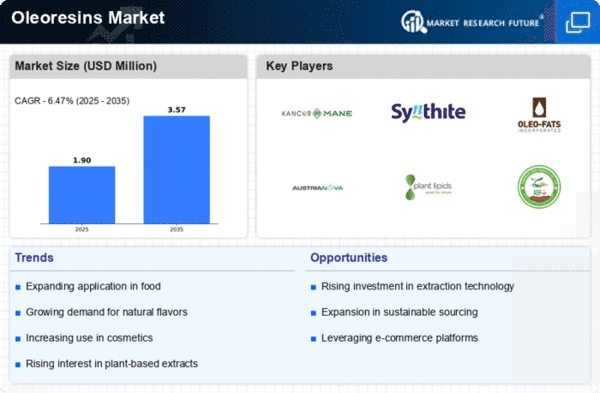
As per MRFR analysis, the Oleoresins Market Size was estimated at 1.78 USD Million in 2024. The Oleoresins industry is projected to grow from 1.92 in 2025 to 3.57 by 2035, exhibiting a compound annual growth rate (CAGR) of 6.47 during the forecast period 2025 - 2035.

Key Market Trends & Highlights

The Oleoresins Market is experiencing robust growth driven by natural ingredient demand and technological advancements.

  • The market is witnessing a rising demand for natural ingredients, particularly in North America, which remains the largest market.
  • Technological advancements in extraction processes are enhancing the quality and efficiency of oleoresin production.
  • The growth of plant-based diets is propelling the nutraceuticals segment, which is currently the fastest-growing in the market.
  • Increasing applications in the food industry and a rising interest in natural personal care products are key drivers of market expansion.

Market Size & Forecast

2024 Market Size 1.78 (USD Million)
2035 Market Size 3.57 (USD Million)
CAGR (2025 - 2035) 6.47%
Largest Regional Market Share in 2024 North America

Major Players

Kancor Ingredients Limited (IN), Synthite Industries Ltd (IN), Oleo Fats, Inc. (PH), Austrianova (SG), Plant Lipids (IN), Agro Products and Agencies (IN), Givaudan (CH), Kalsec Inc. (US), Döhler (DE)

Market Trends

The Oleoresins Market is currently experiencing a notable transformation, driven by increasing consumer demand for natural and organic products. This shift is largely attributed to a growing awareness of health and wellness, prompting manufacturers to seek alternatives to synthetic additives. As a result, oleoresins, which are concentrated extracts derived from spices and herbs, are gaining traction across various industries, including food and beverages, cosmetics, and pharmaceuticals. The versatility of oleoresins, coupled with their ability to enhance flavor and aroma, positions them as a preferred choice for many producers. Furthermore, the trend towards clean label products is influencing the market, as consumers increasingly favor transparency in ingredient sourcing and processing. In addition to health-conscious trends, the Oleoresins Market is also witnessing advancements in extraction technologies. Innovations in extraction methods are enhancing the efficiency and quality of oleoresin production, thereby expanding the range of applications. This evolution is likely to attract new players into the market, fostering competition and potentially leading to further product development. Moreover, the growing popularity of plant-based diets is expected to bolster the demand for oleoresins, as they serve as natural flavoring agents that align with vegetarian and vegan preferences. Overall, the Oleoresins Market appears poised for growth, driven by consumer preferences for natural ingredients and technological advancements in production processes.

Rising Demand for Natural Ingredients

The Oleoresins Market is witnessing a surge in demand for natural ingredients, as consumers increasingly prioritize health and wellness. This trend is prompting manufacturers to replace synthetic additives with oleoresins, which offer concentrated flavors and aromas derived from natural sources.

Technological Advancements in Extraction

Innovations in extraction technologies are transforming the Oleoresins Market by improving the efficiency and quality of production. Enhanced methods are enabling producers to create a wider variety of oleoresins, thus expanding their applications across different sectors.

Growth of Plant-Based Diets

The rising popularity of plant-based diets is contributing to the Oleoresins Market's expansion. Oleoresins serve as natural flavoring agents that cater to vegetarian and vegan preferences, aligning with the increasing consumer shift towards plant-derived products.

Oleoresins Market Market Drivers

Market Growth Projections

The Global Oleoresins Market Industry is projected to experience substantial growth over the coming years. With a market value anticipated to reach 1.07 USD Billion in 2024 and further expand to 2.71 USD Billion by 2035, the industry is on a promising trajectory. This growth is underpinned by a compound annual growth rate (CAGR) of 8.77% from 2025 to 2035. Such projections indicate a robust demand for oleoresins across various applications, driven by trends in natural ingredients and health consciousness. The market's expansion reflects broader shifts in consumer behavior and industry practices, positioning oleoresins as a key component in the formulation of diverse products.

Growing Awareness of Health Benefits

The growing awareness of health benefits associated with natural extracts is a significant driver for the Global Oleoresins Market Industry. Oleoresins Market are recognized for their antioxidant, anti-inflammatory, and antimicrobial properties, making them attractive to health-conscious consumers. This awareness is particularly pronounced in dietary supplements and functional foods, where oleoresins are incorporated for their health-promoting attributes. As consumers increasingly seek products that contribute to overall well-being, the demand for oleoresins is expected to rise. This trend not only supports the market's growth but also encourages innovation in product formulations, further solidifying the role of oleoresins in the health and wellness sector.

Expansion of Food Processing Industry

The Global Oleoresins Market Industry is significantly influenced by the expansion of the food processing sector. As food manufacturers seek to enhance product quality and shelf life, oleoresins are increasingly utilized for their flavor and preservative properties. The global food processing industry is projected to grow steadily, which in turn drives the demand for oleoresins. This growth is expected to be reflected in the market's trajectory, with projections indicating a rise to 2.71 USD Billion by 2035. The incorporation of oleoresins in processed foods not only meets consumer expectations for flavor but also aligns with regulatory standards for natural ingredients, thereby reinforcing their market position.

Rising Demand for Natural Ingredients

The Global Oleoresins Market Industry experiences a notable surge in demand for natural ingredients across various sectors, including food and beverages, cosmetics, and pharmaceuticals. Consumers increasingly prefer products derived from natural sources, which has led to a shift away from synthetic additives. This trend is particularly evident in the food industry, where oleoresins serve as natural flavoring agents and colorants. As a result, the market is projected to reach 1.07 USD Billion in 2024, reflecting a growing inclination towards health-conscious choices. The Global Oleoresins Market Industry is thus poised to benefit from this shift, as manufacturers adapt to meet consumer preferences.

Regulatory Support for Natural Products

Regulatory support for natural products significantly influences the Global Oleoresins Market Industry. Governments worldwide are increasingly promoting the use of natural ingredients in food and cosmetics, aligning with consumer preferences for safer and healthier options. This regulatory environment fosters innovation and encourages manufacturers to invest in the development of oleoresin-based products. As regulations evolve to support natural extracts, the market is likely to experience accelerated growth. This supportive framework not only enhances consumer trust but also facilitates the entry of new players into the Global Oleoresins Market Industry, thereby expanding its competitive landscape.

Technological Advancements in Extraction Methods

Technological advancements in extraction methods play a pivotal role in shaping the Global Oleoresins Market Industry. Innovations such as supercritical fluid extraction and cold pressing have enhanced the efficiency and quality of oleoresin production. These methods allow for the extraction of high-quality oleoresins with minimal loss of flavor and aroma compounds. As a result, manufacturers can offer superior products that meet the increasing quality demands of consumers. The adoption of these advanced techniques is likely to contribute to the projected CAGR of 8.77% from 2025 to 2035, indicating a robust growth trajectory for the Global Oleoresins Market Industry.

Market Segment Insights

By Application: Food Flavoring (Largest) vs. Nutraceuticals (Fastest-Growing)

The Oleoresins Market demonstrates a diverse application landscape, with food flavoring taking the largest share. This segment capitalizes on the growing demand for natural and organic ingredients in food production, contributing significantly to market dynamics. In contrast, sectors like cosmetics and pharmaceuticals also hold notable portions, but the growth trajectory of nutraceuticals highlights its increasing prevalence as consumers shift towards health-conscious choices. Growth trends within the Oleoresins Market are primarily driven by the rising inclination towards natural ingredients among consumers across various applications. The nutraceuticals segment is projected to expand rapidly due to the increasing awareness of health benefits coupled with a demand for dietary supplements. The incorporation of oleoresins into products for these segments, including functional foods and wellness products, reflects evolving consumer preferences and innovative formulations in the market.

Food Flavoring (Dominant) vs. Animal Feed (Emerging)

In the Oleoresins Market, food flavoring stands as the dominant segment, significantly influencing consumer choices and preferences in the food sector. This segment boasts broad applications in enhancing flavor and aroma while adhering to clean label trends. Meanwhile, the animal feed segment is gaining traction as an emerging value, driven by the need for natural additives to improve the health and growth of livestock. As regulatory pressures steer the industry towards safer, organic components, oleoresins are positioned to fulfill these market requirements. The trend towards sustainable practices is shaping both segments, making them critical to understanding the broader market landscape.

By Source: Spices (Largest) vs. Herbs (Fastest-Growing)

In the Oleoresins Market, the source segment is primarily composed of spices, herbs, seeds, fruits, and vegetables. Spices hold the largest market share due to their extensive use in food processing and flavoring industries, which continue to drive demand for oleoresins. Following spices, herbs are gaining traction, contributing significantly as consumers increasingly seek herbal products for their medicinal properties and natural flavors. Seeds, fruits, and vegetables represent a smaller portion of the market but still contribute to the overall diversity of oleoresin sources.

Spices (Dominant) vs. Herbs (Emerging)

Spices have established themselves as the dominant segment within the Oleoresins Market, largely due to their essential role in culinary applications. They are favored for their ability to enhance flavors and preserve food, making them integral to various industries. In contrast, herbs represent an emerging segment characterized by a growing consumer interest in health and wellness, pushing for more natural and organic options. This rising trend towards herbal products is driven by increased awareness of their health benefits, such as anti-inflammatory and antioxidant properties, positioning herbs as a critical segment with significant growth potential in the coming years.

By Form: Liquid (Largest) vs. Powder (Fastest-Growing)

In the Oleoresins Market, the 'By Form' segment displays a diverse distribution among its values, with liquid oleoresins leading the charge as the largest segment. Liquid forms are favored for their versatility and ease of incorporation into products. Following closely is the powder segment, which is experiencing significant growth due to increasing demand for natural and convenient food ingredients. The paste and granules segments, while smaller, also contribute to the overall market dynamics as they cater to specific applications.

Liquid (Dominant) vs. Powder (Emerging)

Liquid oleoresins hold a dominant position in the market due to their extensive use in food processing, perfumery, and pharmaceuticals, emphasizing their adaptability and functionality. This form is preferred for its ability to blend seamlessly with other components, making it ideal for flavoring and coloring. On the other hand, powder oleoresins are emerging rapidly, driven by the need for natural products and convenience in usage. They offer advantages in terms of shelf stability and ease of transport, appealing to manufacturers focused on minimizing processing costs and delivering high-quality ingredients.

By End Use: Food Industry (Largest) vs. Cosmetics Industry (Fastest-Growing)

The oleoresins market shows varied distribution of market share among its end-use segments, with the food industry leading as the largest contributor. This sector has embraced oleoresins due to their flavoring and coloring properties, essential for enhancing food products. In contrast, the cosmetics industry is witnessing rapid growth as consumers increasingly prioritize natural ingredients, leading to a surge in the use of oleoresins in beauty products.

Food Industry (Dominant) vs. Cosmetics Industry (Emerging)

The food industry stands as the dominant segment in the oleoresins market, leveraging these natural extracts for their flavor-enhancing capabilities in a wide array of products. Their versatility and compliance with clean labeling trends make oleoresins a preferred choice for food manufacturers. On the other hand, the cosmetics industry is emerging as a vital segment, propelled by the growing demand for organic and natural beauty products. This trend is driven by shifting consumer preferences towards sustainable and health-conscious formulations, providing a significant growth trajectory for oleoresins in skincare, haircare, and fragrance applications.

Get more detailed insights about Oleoresins Market Research Report - Forecast to 2035

Regional Insights

Key Players and Competitive Insights

The Oleoresins Market is currently characterized by a dynamic competitive landscape, driven by increasing demand for natural flavoring agents and the growing trend towards clean-label products. Key players are actively engaging in strategic initiatives to enhance their market positioning. For instance, Kancor Ingredients Limited (IN) has focused on innovation in product development, particularly in the extraction of high-quality oleoresins from spices, which aligns with the rising consumer preference for natural ingredients. Similarly, Givaudan (CH) has been investing in digital transformation to streamline its operations and improve customer engagement, thereby enhancing its competitive edge in the market.The business tactics employed by these companies often include localizing manufacturing to reduce costs and optimize supply chains. The Oleoresins Market appears to be moderately fragmented, with several players vying for market share. However, the collective influence of major companies like Synthite Industries Ltd (IN) and Kalsec Inc. (US) is notable, as they leverage their extensive distribution networks and established brand reputations to maintain a competitive advantage.

In November Synthite Industries Ltd (IN) announced the launch of a new line of organic oleoresins, catering to the growing demand for organic products in the food and beverage sector. This strategic move not only enhances their product portfolio but also positions them favorably in a market increasingly focused on health and sustainability. The introduction of organic options is likely to attract a broader customer base, thereby driving revenue growth.

In October Kalsec Inc. (US) expanded its production capabilities by investing in a new facility dedicated to the extraction of oleoresins from various herbs and spices. This expansion is significant as it allows Kalsec to meet the rising global demand while ensuring product quality and consistency. The facility is expected to enhance their operational efficiency and reduce lead times, which is crucial in a competitive market.

In September Oleo Fats, Inc. (PH) entered into a strategic partnership with a leading food manufacturer to supply customized oleoresin solutions. This collaboration is indicative of a trend where companies are increasingly seeking tailored solutions to meet specific customer needs. Such partnerships not only enhance product offerings but also strengthen market presence through shared resources and expertise.

As of December the competitive trends in the Oleoresins Market are heavily influenced by digitalization, sustainability, and the integration of AI technologies. Companies are increasingly forming strategic alliances to enhance their innovation capabilities and market reach. The shift from price-based competition to a focus on technological advancement and supply chain reliability is evident. Moving forward, competitive differentiation is likely to hinge on the ability to innovate and adapt to changing consumer preferences, with a strong emphasis on sustainability and quality.

Key Companies in the Oleoresins Market include

Industry Developments

  • November 2023- A Kochi-based B2B marketplace for spices, Growcoms, has made headlines by ensuring USD 3.5 million in funding led by Arali Ventures and JSW Ventures. The funding round also witnessed involvement from present investor InfoEdge Ventures. According to the startup, the recently raised funds will be utilized to improve its product offerings and technology infrastructure. The startup strategizes to concentrate on enabling traceability for exports, developing capabilities, and development of value-added spices. The deal signifies the foray of JSW and Arali Ventures into agritech investments. Established by Bibin Mathews, George Kurian, and Narendranath P in 2020, Growcoms is a Kochi-based B2B marketplace for spices connecting sellers and buyers in the spice market, also offering a suite of additional features. Thriving with a mission to transform the spice market, the startup guarantees traceability and quality through blockchain technology, thereby improving the efficiency of the entire value chain. In terms of growth, the co-founder and CEO of Growcoms, George Kurian, underlined the organization's target to enhance the spice value chain. The startup focuses on doing this by boosting production capacities, supplying traceable spices to global markets digitally, and empowering farmers. He further added that the funding and collaboration with like-minded investors will help Growcoms empower its global presence and enhance efficiencies throughout the value chain. The startup's set of services includes product development, quality inspection, and, most notably, traceability, which are vital for allowing exports of high-value spices. Along with the spices, the Kochi-based startup also supplies oils, seasonings, oleoresins, and powders. In 2022, Growcoms raised USD1 million (around Rs 7.8 crore) in a pre-series A round of fundingled by Info Edge.
  • September 21, 2023: The EU Commission modified regulations for labeling and usage conditions of novel food astaxanthin-rich oleoresin from Haematococcus pluvialis algae, responding to a request from NAXA. This opens up new opportunities for companies involved in this specific type of oleoresin
  • In June 2021, one of the leading enterprises, Algatechnologies introduced an all-natural patented oleoresin named ‘Fucovital’ from which three percent fucoxanthin oleoresin is produced and extracted from microalgae.
  • In January 2021, a famous vendor, Givaudan started a new Flavours technical and commercial center to meet the evolving needs of its African customers with a new taste and flavor solutions in Casablanca, Morocco.
  • In December 2021, a popular company PT. Indesso Aroma announced the launch of a new R & D center at the Cileungsi plant in Indonesia that would support the company’s vision in developing the new ingredients for the flavor, food, and fragrance industry.

Report Outlook

Globally, the oleoresins market research includes the Market Overview, COVID-19 analysis, Market Dynamics, Study Objectives, Segment Overview, Regional Analysis, Competitive Landscape, Recent developments, Segmentation Table, and FAQs. The market scenario includes the oleoresins market drivers, restraints, challenges, and opportunities. The oleoresins industry forecast segments are product, raw material, application, and region.

Future Outlook

Oleoresins Market Future Outlook

The Oleoresins Market is projected to grow at a 6.47% CAGR from 2025 to 2035, driven by increasing demand in food, pharmaceuticals, and cosmetics.

New opportunities lie in:

  • Expansion into emerging markets with tailored product offerings.
  • Development of sustainable extraction technologies to enhance product quality.
  • Strategic partnerships with food manufacturers for customized oleoresin solutions.

By 2035, the Oleoresins Market is expected to achieve robust growth, solidifying its position as a key ingredient sector.

Market Segmentation

Oleoresins Market Form Outlook

  • Liquid
  • Powder
  • Paste
  • Granules

Oleoresins Market Source Outlook

  • Spices
  • Herbs
  • Seeds
  • Fruits
  • Vegetables

Oleoresins Market End Use Outlook

  • Food Industry
  • Cosmetics Industry
  • Pharmaceutical Industry
  • Agriculture Industry

Oleoresins Market Application Outlook

  • Food Flavoring
  • Cosmetic Products
  • Pharmaceuticals
  • Nutraceuticals
  • Animal Feed

Report Scope

MARKET SIZE 20241.78(USD Million)
MARKET SIZE 20251.92(USD Million)
MARKET SIZE 20353.57(USD Million)
COMPOUND ANNUAL GROWTH RATE (CAGR)6.47% (2025 - 2035)
REPORT COVERAGERevenue Forecast, Competitive Landscape, Growth Factors, and Trends
BASE YEAR2024
Market Forecast Period2025 - 2035
Historical Data2019 - 2024
Market Forecast UnitsUSD Million
Key Companies ProfiledKancor Ingredients Limited (IN), Synthite Industries Ltd (IN), Oleo Fats, Inc. (PH), Austrianova (SG), Plant Lipids (IN), Agro Products and Agencies (IN), Givaudan (CH), Kalsec Inc. (US), Döhler (DE)
Segments CoveredApplication, Source, Form, End Use
Key Market OpportunitiesGrowing demand for natural flavoring agents drives innovation in the Oleoresins Market.
Key Market DynamicsRising demand for natural flavoring agents drives innovation and competition in the oleoresins market.
Countries CoveredNorth America, Europe, APAC, South America, MEA

FAQs

Which industry is expected to show high adoption of Oleoresins?

The fragrances & flavors industry shows the high adoption of Oleoresins.

Who are the top players in the global oleoresins market?

Oleoresin Company (India), Jean Gazignaire SA (France), Silverline Chemicals Ltd (India), Qingdao Ruibang Biotechnology Co., Ltd (China), Shijiazhuang City Bio Technology co., ltd (China), Agnes Herbs (India), Adani Pharmachem Private Limited (India), Ozone Naturals (India), Kancor Ingredients Limited (India), and Plant Lipids (India), are some of the top players operating in the global Oleoresins market.

Which region holds the largest share in the global oleoresins industry?

Europe holds the largest share in the global oleoresins industry, followed by the Asia Pacific and North America, respectively.

What are the major tailwinds pushing the growth of the global Oleoresins market?

Increasing demand for high quality fragrances & flavors and rising usages in cosmetics, aromatherapy, personal care, and pharmaceuticals industries, are major tailwinds pushing the growth of the global Oleoresins market.

What are the key growth strategies of players operating in the global Oleoresins market?

Strategic initiatives such as mergers & acquisitions, collaborations, expansion, and technology/ product launch are some of the growth strategies that players operating in the global Oleoresins market adopt to gain a larger competitive advantage.

  1. SECTION I: EXECUTIVE SUMMARY AND KEY HIGHLIGHTS
    1. | 1.1 EXECUTIVE SUMMARY
    2. | 1.1.1 Market Overview
    3. | 1.1.2 Key Findings
    4. | 1.1.3 Market Segmentation
    5. | 1.1.4 Competitive Landscape
    6. | 1.1.5 Challenges and Opportunities
    7. | 1.1.6 Future Outlook
  2. SECTION II: SCOPING, METHODOLOGY AND MARKET STRUCTURE
    1. | 2.1 MARKET INTRODUCTION
    2. | 2.1.1 Definition
    3. | 2.1.2 Scope of the study
    4. |-- 2.1.2.1 Research Objective
    5. |-- 2.1.2.2 Assumption
    6. |-- 2.1.2.3 Limitations
    7. | 2.2 RESEARCH METHODOLOGY
    8. | 2.2.1 Overview
    9. | 2.2.2 Data Mining
    10. | 2.2.3 Secondary Research
    11. | 2.2.4 Primary Research
    12. |-- 2.2.4.1 Primary Interviews and Information Gathering Process
    13. |-- 2.2.4.2 Breakdown of Primary Respondents
    14. | 2.2.5 Forecasting Model
    15. | 2.2.6 Market Size Estimation
    16. |-- 2.2.6.1 Bottom-Up Approach
    17. |-- 2.2.6.2 Top-Down Approach
    18. | 2.2.7 Data Triangulation
    19. | 2.2.8 Validation
  3. SECTION III: QUALITATIVE ANALYSIS
    1. | 3.1 MARKET DYNAMICS
    2. | 3.1.1 Overview
    3. | 3.1.2 Drivers
    4. | 3.1.3 Restraints
    5. | 3.1.4 Opportunities
    6. | 3.2 MARKET FACTOR ANALYSIS
    7. | 3.2.1 Value chain Analysis
    8. | 3.2.2 Porter's Five Forces Analysis
    9. |-- 3.2.2.1 Bargaining Power of Suppliers
    10. |-- 3.2.2.2 Bargaining Power of Buyers
    11. |-- 3.2.2.3 Threat of New Entrants
    12. |-- 3.2.2.4 Threat of Substitutes
    13. |-- 3.2.2.5 Intensity of Rivalry
    14. | 3.2.3 COVID-19 Impact Analysis
    15. |-- 3.2.3.1 Market Impact Analysis
    16. |-- 3.2.3.2 Regional Impact
    17. |-- 3.2.3.3 Opportunity and Threat Analysis
  4. SECTION IV: QUANTITATIVE ANALYSIS
    1. | 4.1 Food, Beverages & Nutrition, BY Application (USD Million)
    2. | 4.1.1 Food Flavoring
    3. | 4.1.2 Cosmetic Products
    4. | 4.1.3 Pharmaceuticals
    5. | 4.1.4 Nutraceuticals
    6. | 4.1.5 Animal Feed
    7. | 4.2 Food, Beverages & Nutrition, BY Source (USD Million)
    8. | 4.2.1 Spices
    9. | 4.2.2 Herbs
    10. | 4.2.3 Seeds
    11. | 4.2.4 Fruits
    12. | 4.2.5 Vegetables
    13. | 4.3 Food, Beverages & Nutrition, BY Form (USD Million)
    14. | 4.3.1 Liquid
    15. | 4.3.2 Powder
    16. | 4.3.3 Paste
    17. | 4.3.4 Granules
    18. | 4.4 Food, Beverages & Nutrition, BY End Use (USD Million)
    19. | 4.4.1 Food Industry
    20. | 4.4.2 Cosmetics Industry
    21. | 4.4.3 Pharmaceutical Industry
    22. | 4.4.4 Agriculture Industry
    23. | 4.5 Food, Beverages & Nutrition, BY Region (USD Million)
    24. | 4.5.1 North America
    25. |-- 4.5.1.1 US
    26. |-- 4.5.1.2 Canada
    27. | 4.5.2 Europe
    28. |-- 4.5.2.1 Germany
    29. |-- 4.5.2.2 UK
    30. |-- 4.5.2.3 France
    31. |-- 4.5.2.4 Russia
    32. |-- 4.5.2.5 Italy
    33. |-- 4.5.2.6 Spain
    34. |-- 4.5.2.7 Rest of Europe
    35. | 4.5.3 APAC
    36. |-- 4.5.3.1 China
    37. |-- 4.5.3.2 India
    38. |-- 4.5.3.3 Japan
    39. |-- 4.5.3.4 South Korea
    40. |-- 4.5.3.5 Malaysia
    41. |-- 4.5.3.6 Thailand
    42. |-- 4.5.3.7 Indonesia
    43. |-- 4.5.3.8 Rest of APAC
    44. | 4.5.4 South America
    45. |-- 4.5.4.1 Brazil
    46. |-- 4.5.4.2 Mexico
    47. |-- 4.5.4.3 Argentina
    48. |-- 4.5.4.4 Rest of South America
    49. | 4.5.5 MEA
    50. |-- 4.5.5.1 GCC Countries
    51. |-- 4.5.5.2 South Africa
    52. |-- 4.5.5.3 Rest of MEA
  5. SECTION V: COMPETITIVE ANALYSIS
    1. | 5.1 Competitive Landscape
    2. | 5.1.1 Overview
    3. | 5.1.2 Competitive Analysis
    4. | 5.1.3 Market share Analysis
    5. | 5.1.4 Major Growth Strategy in the Food, Beverages & Nutrition
    6. | 5.1.5 Competitive Benchmarking
    7. | 5.1.6 Leading Players in Terms of Number of Developments in the Food, Beverages & Nutrition
    8. | 5.1.7 Key developments and growth strategies
    9. |-- 5.1.7.1 New Product Launch/Service Deployment
    10. |-- 5.1.7.2 Merger & Acquisitions
    11. |-- 5.1.7.3 Joint Ventures
    12. | 5.1.8 Major Players Financial Matrix
    13. |-- 5.1.8.1 Sales and Operating Income
    14. |-- 5.1.8.2 Major Players R&D Expenditure. 2023
    15. | 5.2 Company Profiles
    16. | 5.2.1 Kancor Ingredients Limited (IN)
    17. |-- 5.2.1.1 Financial Overview
    18. |-- 5.2.1.2 Products Offered
    19. |-- 5.2.1.3 Key Developments
    20. |-- 5.2.1.4 SWOT Analysis
    21. |-- 5.2.1.5 Key Strategies
    22. | 5.2.2 Synthite Industries Ltd (IN)
    23. |-- 5.2.2.1 Financial Overview
    24. |-- 5.2.2.2 Products Offered
    25. |-- 5.2.2.3 Key Developments
    26. |-- 5.2.2.4 SWOT Analysis
    27. |-- 5.2.2.5 Key Strategies
    28. | 5.2.3 Oleo Fats, Inc. (PH)
    29. |-- 5.2.3.1 Financial Overview
    30. |-- 5.2.3.2 Products Offered
    31. |-- 5.2.3.3 Key Developments
    32. |-- 5.2.3.4 SWOT Analysis
    33. |-- 5.2.3.5 Key Strategies
    34. | 5.2.4 Austrianova (SG)
    35. |-- 5.2.4.1 Financial Overview
    36. |-- 5.2.4.2 Products Offered
    37. |-- 5.2.4.3 Key Developments
    38. |-- 5.2.4.4 SWOT Analysis
    39. |-- 5.2.4.5 Key Strategies
    40. | 5.2.5 Plant Lipids (IN)
    41. |-- 5.2.5.1 Financial Overview
    42. |-- 5.2.5.2 Products Offered
    43. |-- 5.2.5.3 Key Developments
    44. |-- 5.2.5.4 SWOT Analysis
    45. |-- 5.2.5.5 Key Strategies
    46. | 5.2.6 Agro Products and Agencies (IN)
    47. |-- 5.2.6.1 Financial Overview
    48. |-- 5.2.6.2 Products Offered
    49. |-- 5.2.6.3 Key Developments
    50. |-- 5.2.6.4 SWOT Analysis
    51. |-- 5.2.6.5 Key Strategies
    52. | 5.2.7 Givaudan (CH)
    53. |-- 5.2.7.1 Financial Overview
    54. |-- 5.2.7.2 Products Offered
    55. |-- 5.2.7.3 Key Developments
    56. |-- 5.2.7.4 SWOT Analysis
    57. |-- 5.2.7.5 Key Strategies
    58. | 5.2.8 Kalsec Inc. (US)
    59. |-- 5.2.8.1 Financial Overview
    60. |-- 5.2.8.2 Products Offered
    61. |-- 5.2.8.3 Key Developments
    62. |-- 5.2.8.4 SWOT Analysis
    63. |-- 5.2.8.5 Key Strategies
    64. | 5.2.9 Döhler (DE)
    65. |-- 5.2.9.1 Financial Overview
    66. |-- 5.2.9.2 Products Offered
    67. |-- 5.2.9.3 Key Developments
    68. |-- 5.2.9.4 SWOT Analysis
    69. |-- 5.2.9.5 Key Strategies
    70. | 5.3 Appendix
    71. | 5.3.1 References
    72. | 5.3.2 Related Reports

Food, Beverages & Nutrition Market Segmentation

Food, Beverages & Nutrition By Application (USD Million, 2025-2035)

  • Food Flavoring
  • Cosmetic Products
  • Pharmaceuticals
  • Nutraceuticals
  • Animal Feed

Food, Beverages & Nutrition By Source (USD Million, 2025-2035)

  • Spices
  • Herbs
  • Seeds
  • Fruits
  • Vegetables

Food, Beverages & Nutrition By Form (USD Million, 2025-2035)

  • Liquid
  • Powder
  • Paste
  • Granules

Food, Beverages & Nutrition By End Use (USD Million, 2025-2035)

  • Food Industry
  • Cosmetics Industry
  • Pharmaceutical Industry
  • Agriculture Industry
Infographic

Free Sample Request

Kindly complete the form below to receive a free sample of this Report

Get Free Sample

Customer Strories

Compare Licence

×
Features License Type
Single User Multiuser License Enterprise User
Price $4,950 $5,950 $7,250
Maximum User Access Limit 1 User Upto 10 Users Unrestricted Access Throughout the Organization
Free Customization
Direct Access to Analyst
Deliverable Format
Platform Access
Discount on Next Purchase 10% 15% 15%
Printable Versions