×
Request Free Sample ×

Kindly complete the form below to receive a free sample of this Report

* Please use a valid business email

Leading companies partner with us for data-driven Insights

clients tt-cursor
Hero Background
English
Chinese
French
Japanese
Korean
German
Spanish

Mouth Fresheners Market Size

ID: MRFR/CG/6713-HCR
128 Pages
Pradeep Nandi
October 2025

Mouth Fresheners Market Size, Share, Industry Trend & Analysis Research Report Information by Type (Mouth Sprays, Flavored Candies, Breath Strips, Chewing Gums and others), by Category (Sugar Free and Conventional), by Distribution Channel (Store Based (SuperMarket Size, Share, Industry Trend & Analysis & Hypermarket, Convenience Store and others) and Non-Store-Based) and Region (North America, Europe, Asia-Pacific and the Rest of the World) - Forecast 2030

Share:
Download PDF ×

We do not share your information with anyone. However, we may send you emails based on your report interest from time to time. You may contact us at any time to opt-out.

Mouth Fresheners Market Infographic
×
Mouth Fresheners Market Infographic Full View
Purchase Options

Mouth Fresheners Size

Mouth Fresheners Market Growth Projections and Opportunities

The market of mouth fresheners is a fluid one that is controlled by various factors and in turn shapes the preference of consumers and trends within the industry. At its core this market is driven by consumer quest for fresh breath as well as oral hygiene, hence they are looking for simple and enjoyable solutions. One significant aspect defining dynamic nature of this market is broad range of flavors consumers prefer. The market satisfies variety needs from conventional mint flavors to exotic ones such as fruit-based or herbal blends where individuals can buy breath refreshers based on their taste preferences. Lifestyle changes and a growing concern for health and wellness are highly influential in shaping mouth freshener market dynamics. There has been an increase in customer demand for sugar-free or natural ingredient based mouth fresheners due to shifts towards healthier options in the food and beverage sector. In order to meet this increasing demand, manufacturers have come up with products that do more than just giving you fresh breath. Some mouth refresher brands currently contain herbs like fennel or mint that aid with digestion naturally or reduce anxiety. In addition, cultural influences also determine how mouth freshener markets operate with some regions preferring different flavors and ingredients from others. While certain cultures find it appropriate to put traditional spices into mouth fresheners, others prefer fruity flavours while some may enjoy menthol’s coolness . This cultural diversity makes it very versatile thus adaptable to the tastes and preferences existing in each region.

Moreover, packaging and presentation greatly influence consumer choices made in the mouth fresheners market. Packaging that stands out on the shelf, convenience formats as well as portability are vital when customers look for products fitting into their busy lives. Besides, manufactures have employed innovative methods of packaging such pocket dispensers among other eco-friendly devices aimed at improving both aesthetic appeal and sustainability of their items. Brand loyalty as well as marketing strategies have substantial impacts on these dynamics making most customers go back to those companies which provide quality. In this regard advertising campaigns and social media engagement are some of the marketing efforts which strongly affect consumer perception as they help in creating awareness about companies’ brands. The mouth fresheners market is a combination of big firms and new entrants thus fostering both competition as well as innovation. Established brands often focus on expanding their product portfolios through research and development, while smaller players may emphasize niche markets or artisanal offerings to carve out a distinctive identity.
Mouth Fresheners Market Size Graph
Author
Pradeep Nandi
Senior Research Analyst

I have a bachelor's degree in mechanical engineering and an MBA. I have more than two years of expertise in the retail, food, and beverage, chemical, and material industries, and hence have developed a sound cross-domain expertise. A firm believer in lifelong learning and sharing of knowledge. Having a proclivity for hatching ideas and trying to absorb as much information as possible in a short amount of time. Introducing corporates to the data and insight, which enables them to move from probability to possibility, has been my key areas of interest. 

Leave a Comment

FAQs

What is the predicted growth rate of the Mouth Fresheners Market?

Mouth Fresheners Market is expected to expand at 5.80% CAGR from 2021 to 2028

What is the valuation of the Mouth Fresheners Market?

Mouth Fresheners Market size can reach USD 6440.1 Million by 2030

Who is the notable players of the Mouth Fresheners Market?

Ferrero (Italy), Nestlé (Switzerland), Perfetti Van Melle Group B.V. (Italy), Johnson & Johnson Services Inc. (US), Cipla Inc. (India), Harsh Nutricare (India), Mondelēz International (US), Mars Incorporated (US), Ferndale Confectionery Pty Ltd. (Australia), Haribo GmbH & Co. Kg (Germany)

Market Summary

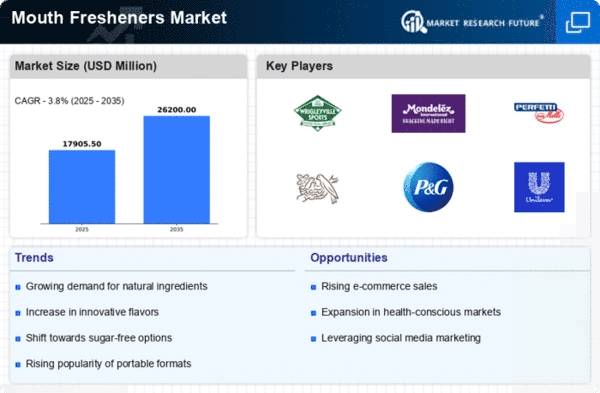
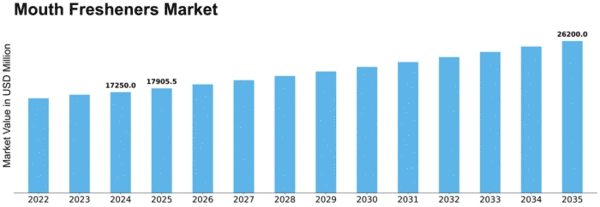
As per MRFR analysis, the Mouth Fresheners Market Size was estimated at 17250.0 USD Million in 2024. The Mouth Fresheners industry is projected to grow from 18050.0 in 2025 to 26200.0 by 2035, exhibiting a compound annual growth rate (CAGR) of 3.8 during the forecast period 2025 - 2035.

Key Market Trends & Highlights

The Mouth Fresheners Market is experiencing a dynamic evolution driven by health trends and innovative solutions.

  • The market is witnessing a notable shift towards natural ingredients, reflecting consumer preferences for healthier options.
  • E-commerce is rapidly gaining traction, facilitating broader access to mouth fresheners across diverse demographics.
  • In North America, the breath freshening segment remains the largest, while the Asia-Pacific region is recognized as the fastest-growing market.
  • Rising health consciousness and the growing influence of social media are key drivers propelling the demand for innovative mouth fresheners.

Market Size & Forecast

2024 Market Size 17250.0 (USD Million)
2035 Market Size 26200.0 (USD Million)
CAGR (2025 - 2035) 3.8%
Largest Regional Market Share in 2024 North America

Major Players

Wrigley (US), Mondelez International (US), Perfetti Van Melle (NL), Nestle (CH), Procter & Gamble (US), Unilever (GB), Mars (US), Reckitt Benckiser (GB), Colgate-Palmolive (US)

Market Trends

Mouth Fresheners

Mouth Fresheners Market Market Drivers

Market Growth Projections

The Global mouth fresheners Market Industry is projected to experience substantial growth over the next decade. With a market value anticipated to reach 3.71 USD Billion in 2024 and further expand to 8.54 USD Billion by 2035, the industry is poised for a robust trajectory. This growth is underpinned by a compound annual growth rate (CAGR) of 7.86% from 2025 to 2035. Such projections indicate a strong demand for mouth fresheners, driven by evolving consumer preferences and lifestyle changes. The market's expansion reflects the increasing importance of oral hygiene and fresh breath in daily life.

Rising Health Consciousness

The Global Mouth Fresheners Market Industry is experiencing a notable shift driven by increasing health consciousness among consumers. As individuals become more aware of oral hygiene and its impact on overall health, the demand for mouth fresheners that offer not only fresh breath but also health benefits is on the rise. Products containing natural ingredients and those that promote dental health are particularly appealing. This trend is expected to contribute to the market's growth, with projections indicating a market value of 3.71 USD Billion in 2024. The emphasis on health-oriented products is likely to shape consumer preferences in the coming years.

Growing E-commerce Platforms

The rise of e-commerce platforms is transforming the Global Mouth Fresheners Market Industry by providing consumers with easy access to a wide range of products. Online shopping allows for greater convenience, enabling consumers to explore various mouth freshener options from the comfort of their homes. This trend is particularly beneficial for niche products that may not be available in local stores. As e-commerce continues to expand, it is expected to drive market growth, with more consumers opting for online purchases. The accessibility of diverse products through digital channels is likely to enhance consumer engagement and boost sales in the mouth freshener segment.

Innovative Product Offerings

Innovation plays a crucial role in the Global Mouth Fresheners Market Industry, as manufacturers continuously develop new flavors, formats, and delivery mechanisms to attract consumers. The introduction of unique flavor combinations and functional mouth fresheners that provide additional benefits, such as whitening or antibacterial properties, enhances consumer interest. For instance, products that combine traditional mint flavors with exotic fruits are gaining traction. This innovation is expected to drive market growth, with a projected CAGR of 7.86% from 2025 to 2035. As companies invest in research and development, the variety of offerings will likely expand, catering to diverse consumer preferences.

Increased Focus on Oral Hygiene

The Global Mouth Fresheners Market Industry is witnessing a heightened focus on oral hygiene, driven by increasing awareness of the importance of maintaining fresh breath and overall dental health. Educational campaigns and initiatives by health organizations are emphasizing the role of mouth fresheners in oral care routines. This growing awareness is likely to influence consumer purchasing behavior, as individuals seek products that not only provide immediate freshness but also contribute to long-term oral health. As a result, the market is expected to experience sustained growth, aligning with the broader trend of prioritizing health and wellness in consumer choices.

Urbanization and Lifestyle Changes

Urbanization is a significant driver of the Global Mouth Fresheners Market Industry, as more individuals move to urban areas where fast-paced lifestyles prevail. In urban settings, the demand for convenient and portable mouth fresheners is increasing, as consumers seek quick solutions for freshening breath on the go. This trend is particularly evident among busy professionals and students who prioritize convenience. The market is projected to grow to 8.54 USD Billion by 2035, reflecting the changing dynamics of consumer lifestyles. As urban populations continue to rise, the demand for mouth fresheners that fit seamlessly into daily routines is likely to increase.

Market Segment Insights

By Application: Breath Freshening (Largest) vs. Dental Care (Fastest-Growing)

In the Mouth Fresheners Market, the application segment is prominently characterized by Breath Freshening, which holds the largest share due to consumer preferences for instant freshness. This segment capitalizes on the growing demand for convenience and immediate results in oral care, leading to a significant market presence. On the other hand, Dental Care is gaining traction, as awareness around oral health and hygiene accelerates, prompting more consumers to invest in specialized solutions. This shift is contributing to a dynamic landscape where freshening agents are essential for daily routines.

Breath Freshening (Dominant) vs. Dental Care (Emerging)

Breath Freshening is established as the dominant application in the Mouth Fresheners Market, driven by a wide range of products designed for quick freshness, including mints, sprays, and chewing gums. Consumers increasingly seek products that offer not only immediate freshness but also long-lasting effects. Conversely, Dental Care is emerging as a significant player, with products focused on anti-bacterial properties and promoting overall oral health. The rising trend of health-conscious consumers is transforming this segment, encouraging brands to innovate with natural ingredients and efficacy in dental hygiene. As such, both segments showcase unique selling points aligned with consumer demand.

By Form: Mints (Largest) vs. Sprays (Fastest-Growing)

In the Mouth Fresheners Market, Mints represent the largest segment, holding a significant portion of the market share due to their widespread popularity for instant freshness and convenience. Following closely are Sprays, which have gained traction thanks to their innovative delivery methods and ease of use, appealing particularly to younger demographics. Gums and Lozenges also contribute to the market, yet they tend to occupy a smaller share, driven by niche consumer preferences for longer-lasting refreshment and health-conscious formulations.

Mints (Dominant) vs. Sprays (Emerging)

Mints have established themselves as the dominant force in the Mouth Fresheners Market, favored for their classic appeal and ability to provide immediate freshness. Their compact size and portability make them a go-to choice for consumers seeking on-the-go solutions. On the other hand, Sprays are emerging rapidly in popularity, particularly among younger consumers who appreciate the convenience and refreshing experience they offer. With diverse flavor options and portable packaging, Sprays are addressing evolving consumer preferences for quick and effective oral freshness. As a result, they are positioning themselves to capture a growing share of the market.

By Distribution Channel: Supermarkets (Largest) vs. Online Retail (Fastest-Growing)

In the Mouth Fresheners Market, supermarkets hold the largest share among distribution channels, showcasing their importance in driving consumer access and choice. With their vast reach and extensive product ranges, these retail giants dominate the sector, attracting a significant volume of buyers. <a href="https://www.marketresearchfuture.com/reports/convenience-stores-market-22842" target="_blank">convenience stores</a> and pharmacies also play vital roles, providing localized access to mouth freshening products, yet their market shares remain comparatively smaller than that of supermarkets. The rapid growth of online retail is reshaping the landscape of the mouth fresheners market, reflecting a shift in consumer purchasing behaviors. E-commerce platforms are gaining traction, driven by factors such as convenience and variety. Consumers increasingly prefer online shopping for mouth fresheners due to promotional offers, detailed product information, and home delivery options, which indicate a growing trend towards digital purchasing in this sector.

Supermarkets (Dominant) vs. Online Retail (Emerging)

Supermarkets are a dominant force in the Mouth Fresheners Market due to their wide product selections and established trust among consumers. Their extensive supply chains and in-store promotions further enhance their market position, making them a go-to destination for various mouth freshening products. Conversely, online retail is emerging rapidly, appealing to tech-savvy consumers who favor the flexibility of shopping from home. This segment benefits from personalized marketing, user reviews, and comparative shopping options, all of which cater to the evolving needs of modern consumers. Together, these two segments illustrate the competitive dynamics of the distribution landscape, with traditional retail still holding strong while e-commerce adapts to meet changing consumer preferences.

By Target Audience: Adults (Largest) vs. Health-Conscious Consumers (Fastest-Growing)

In the Mouth Fresheners Market, adults represent the largest segment, comprising a significant portion of the overall consumption. Their preference for a variety of flavors and formulations drives a substantial share within this market. Following adults, health-conscious consumers are increasingly gaining market presence, seeking mouth fresheners that align with their lifestyle choices, particularly those that are organic or contain natural ingredients. Moreover, the teenager segment is also noteworthy; however, its market share is notably smaller when compared to adults and health-conscious consumers. It is primarily influenced by trends from social media and peer recommendations. Meanwhile, children represent a smaller but essential sector, predominantly driven by parental choices, focusing on flavors that appeal to young taste buds.

Adults (Dominant) vs. Health-Conscious Consumers (Emerging)

The adult segment in the Mouth Fresheners Market is characterized by its diverse preferences, including various flavors, types, and packaging options. Adults typically seek convenience and efficacy in products, often opting for those that not only freshen breath but also promote oral health. This demographic values innovation and is more likely to try new products, contributing heavily to the segment's dominance. In contrast, health-conscious consumers, emerging within this market, prioritize products that emphasize ingredients beneficial for overall health. They lean towards mouth fresheners that are sugar-free, organic, and free from artificial additives. This group is influenced by growing health trends and is expected to propel the segment's growth in the coming years, indicating a shift towards more mindful consumption.

Get more detailed insights about Mouth Fresheners Market Research Report - Forecast till 2035

Regional Insights

North America : Market Leader in Mouth Fresheners

North America is poised to maintain its leadership in the mouth fresheners market, holding a significant share of $6900.0 million in 2024. The growth is driven by increasing consumer awareness regarding oral hygiene and the rising demand for innovative flavors and formats. Regulatory support for health-oriented products further catalyzes market expansion, as consumers increasingly seek products that align with their health-conscious lifestyles. The competitive landscape in North America is robust, featuring key players such as Wrigley, Mondelez International, and Procter & Gamble. These companies leverage advanced marketing strategies and product diversification to capture consumer interest. The U.S. remains the largest market, with Canada and Mexico also contributing to regional growth. The presence of established brands ensures a dynamic market environment, fostering continuous innovation and competition.

Europe : Emerging Trends in Europe

Europe's mouth fresheners market is valued at $5000.0 million, reflecting a growing trend towards health and wellness. The increasing focus on oral hygiene and the demand for natural ingredients are key drivers of this market. Regulatory frameworks in the EU promote transparency and safety in product formulations, encouraging brands to innovate while adhering to strict guidelines. This regulatory environment supports the growth of health-oriented mouth fresheners, appealing to a more conscious consumer base. Leading countries in this region include Germany, France, and the UK, where brands like Perfetti Van Melle and Unilever are prominent. The competitive landscape is characterized by a mix of established players and emerging brands, all vying for market share. The presence of diverse consumer preferences drives companies to offer a variety of flavors and formats, enhancing market dynamism. The focus on sustainability and eco-friendly packaging is also gaining traction among consumers.

Asia-Pacific : Rapid Growth in Emerging Markets

The Asia-Pacific mouth fresheners market, valued at $4000.0 million, is experiencing rapid growth driven by urbanization and changing consumer lifestyles. The increasing disposable income and a growing middle class are propelling demand for premium mouth fresheners. Additionally, the rise in awareness regarding oral hygiene is influencing purchasing decisions, with consumers seeking products that offer both freshness and health benefits. Regulatory initiatives aimed at improving food safety standards further support market growth in this region. Key players in the Asia-Pacific market include Nestle and Colgate-Palmolive, with significant contributions from local brands. Countries like China and India are leading the charge, showcasing a diverse range of products tailored to local tastes. The competitive landscape is vibrant, with companies focusing on innovative marketing strategies and product differentiation to capture the attention of a diverse consumer base. The market is expected to continue expanding as consumer preferences evolve.

Middle East and Africa : Emerging Market Opportunities

The Middle East and Africa mouth fresheners market, valued at $1350.0 million, is on the rise, driven by increasing urbanization and changing consumer habits. The growing awareness of oral hygiene and the demand for convenient, on-the-go products are key factors contributing to market growth. Regulatory bodies are also playing a crucial role in ensuring product safety and quality, which is essential for building consumer trust in this emerging market. Leading countries in this region include South Africa and the UAE, where the presence of both international and local brands is notable. Companies like Reckitt Benckiser and Mars are actively expanding their product lines to cater to diverse consumer preferences. The competitive landscape is evolving, with a focus on innovative flavors and packaging solutions that appeal to younger consumers. As the market matures, opportunities for growth are expected to increase significantly.

Key Players and Competitive Insights

The Mouth Fresheners Market is currently characterized by a dynamic competitive landscape, driven by evolving consumer preferences and an increasing emphasis on health and wellness. Key players such as Wrigley (US), Mondelez International (US), and Perfetti Van Melle (NL) are strategically positioned to leverage innovation and product diversification. Wrigley (US) focuses on expanding its product line to include sugar-free options, appealing to health-conscious consumers. Mondelez International (US) emphasizes regional expansion, particularly in emerging markets, to capture a broader customer base. Perfetti Van Melle (NL) is investing in digital transformation to enhance customer engagement and streamline operations, thereby shaping a competitive environment that prioritizes adaptability and responsiveness to market trends.The Mouth Fresheners Market exhibits a moderately fragmented structure, with several key players competing for market share. Companies are increasingly localizing manufacturing to reduce costs and optimize supply chains, which appears to be a critical tactic in maintaining competitiveness. The collective influence of these major players fosters a competitive atmosphere where innovation and operational efficiency are paramount, allowing them to respond swiftly to changing consumer demands.

In November Wrigley (US) launched a new line of organic mouth fresheners, which reflects a growing trend towards natural ingredients. This strategic move not only aligns with consumer preferences for healthier options but also positions Wrigley (US) as a leader in the organic segment of the market. The introduction of this product line is likely to enhance brand loyalty and attract a new demographic of health-conscious consumers.

In October Mondelez International (US) announced a partnership with a leading e-commerce platform to enhance its online distribution capabilities. This collaboration is significant as it allows Mondelez International (US) to tap into the growing trend of online shopping, particularly among younger consumers. By improving its digital presence, the company is poised to increase its market penetration and drive sales growth in the increasingly competitive online space.

In September Perfetti Van Melle (NL) acquired a regional competitor to strengthen its market position in Asia. This acquisition is indicative of a broader trend towards consolidation within the industry, as companies seek to enhance their operational capabilities and expand their geographic reach. By integrating the acquired company’s distribution network, Perfetti Van Melle (NL) is likely to improve its supply chain efficiency and increase its market share in a rapidly growing region.

As of December the Mouth Fresheners Market is witnessing trends such as digitalization, sustainability, and the integration of AI technologies. Strategic alliances are increasingly shaping the competitive landscape, enabling companies to pool resources and expertise. The shift from price-based competition to a focus on innovation, technology, and supply chain reliability is becoming evident. Moving forward, competitive differentiation will likely hinge on the ability to innovate and adapt to consumer preferences, with companies that prioritize sustainability and digital engagement poised to lead the market.

Key Companies in the Mouth Fresheners Market include

Industry Developments

15th July 2021- Ferndale Confectionery, a key player in the global mouth fresheners market, is set to build a new facility in Ballarat.

Report Overview

Future Outlook

Mouth Fresheners Market Future Outlook

The Mouth Fresheners Market is projected to grow at a 3.8% CAGR from 2025 to 2035, driven by increasing consumer awareness and demand for oral hygiene products.

New opportunities lie in:

  • Expansion into e-commerce platforms for direct consumer sales.
  • Development of organic and natural mouth fresheners to meet health trends.
  • Partnerships with dental clinics for product endorsements and promotions.

By 2035, the Mouth Fresheners Market is expected to achieve robust growth and diversification.

Market Segmentation

Mouth Fresheners Market Form Outlook

  • Mints
  • Sprays
  • Gums
  • Lozenges

Mouth Fresheners Market Application Outlook

  • Breath Freshening
  • Dental Care
  • Oral Hygiene
  • Flavoring Agent

Mouth Fresheners Market Target Audience Outlook

  • Adults
  • Teenagers
  • Children
  • Health-Conscious Consumers

Mouth Fresheners Market Distribution Channel Outlook

  • Supermarkets
  • Convenience Stores
  • Online Retail
  • Pharmacies

Report Scope

MARKET SIZE 202417250.0(USD Million)
MARKET SIZE 202518050.0(USD Million)
MARKET SIZE 203526200.0(USD Million)
COMPOUND ANNUAL GROWTH RATE (CAGR)3.8% (2025 - 2035)
REPORT COVERAGERevenue Forecast, Competitive Landscape, Growth Factors, and Trends
BASE YEAR2024
Market Forecast Period2025 - 2035
Historical Data2019 - 2024
Market Forecast UnitsUSD Million
Key Companies ProfiledWrigley (US), Mondelez International (US), Perfetti Van Melle (NL), Nestle (CH), Procter & Gamble (US), Unilever (GB), Mars (US), Reckitt Benckiser (GB), Colgate-Palmolive (US)
Segments CoveredApplication, Form, Distribution Channel, Target Audience
Key Market OpportunitiesGrowing demand for natural ingredients in the Mouth Fresheners Market presents significant product development opportunities.
Key Market DynamicsRising consumer preference for natural ingredients drives innovation and competition in the mouth fresheners market.
Countries CoveredNorth America, Europe, APAC, South America, MEA

FAQs

What is the predicted growth rate of the Mouth Fresheners Market?

Mouth Fresheners Market is expected to expand at 5.80% CAGR from 2021 to 2028

What is the valuation of the Mouth Fresheners Market?

Mouth Fresheners Market size can reach USD 6440.1 Million by 2030

Who is the notable players of the Mouth Fresheners Market?

Ferrero (Italy), Nestlé (Switzerland), Perfetti Van Melle Group B.V. (Italy), Johnson &amp; Johnson Services Inc. (US), Cipla Inc. (India), Harsh Nutricare (India), Mondelēz International (US), Mars Incorporated (US), Ferndale Confectionery Pty Ltd. (Australia), Haribo GmbH &amp; Co. Kg (Germany)

  1. SECTION I: EXECUTIVE SUMMARY AND KEY HIGHLIGHTS
    1. | 1.1 EXECUTIVE SUMMARY
    2. | 1.1.1 Market Overview
    3. | 1.1.2 Key Findings
    4. | 1.1.3 Market Segmentation
    5. | 1.1.4 Competitive Landscape
    6. | 1.1.5 Challenges and Opportunities
    7. | 1.1.6 Future Outlook
  2. SECTION II: SCOPING, METHODOLOGY AND MARKET STRUCTURE
    1. | 2.1 MARKET INTRODUCTION
    2. | 2.1.1 Definition
    3. | 2.1.2 Scope of the study
    4. |-- 2.1.2.1 Research Objective
    5. |-- 2.1.2.2 Assumption
    6. |-- 2.1.2.3 Limitations
    7. | 2.2 RESEARCH METHODOLOGY
    8. | 2.2.1 Overview
    9. | 2.2.2 Data Mining
    10. | 2.2.3 Secondary Research
    11. | 2.2.4 Primary Research
    12. |-- 2.2.4.1 Primary Interviews and Information Gathering Process
    13. |-- 2.2.4.2 Breakdown of Primary Respondents
    14. | 2.2.5 Forecasting Model
    15. | 2.2.6 Market Size Estimation
    16. |-- 2.2.6.1 Bottom-Up Approach
    17. |-- 2.2.6.2 Top-Down Approach
    18. | 2.2.7 Data Triangulation
    19. | 2.2.8 Validation
  3. SECTION III: QUALITATIVE ANALYSIS
    1. | 3.1 MARKET DYNAMICS
    2. | 3.1.1 Overview
    3. | 3.1.2 Drivers
    4. | 3.1.3 Restraints
    5. | 3.1.4 Opportunities
    6. | 3.2 MARKET FACTOR ANALYSIS
    7. | 3.2.1 Value chain Analysis
    8. | 3.2.2 Porter's Five Forces Analysis
    9. |-- 3.2.2.1 Bargaining Power of Suppliers
    10. |-- 3.2.2.2 Bargaining Power of Buyers
    11. |-- 3.2.2.3 Threat of New Entrants
    12. |-- 3.2.2.4 Threat of Substitutes
    13. |-- 3.2.2.5 Intensity of Rivalry
    14. | 3.2.3 COVID-19 Impact Analysis
    15. |-- 3.2.3.1 Market Impact Analysis
    16. |-- 3.2.3.2 Regional Impact
    17. |-- 3.2.3.3 Opportunity and Threat Analysis
  4. SECTION IV: QUANTITATIVE ANALYSIS
    1. | 4.1 Consumer and Retail, BY Application (USD Million)
    2. | 4.1.1 Breath Freshening
    3. | 4.1.2 Dental Care
    4. | 4.1.3 Oral Hygiene
    5. | 4.1.4 Flavoring Agent
    6. | 4.2 Consumer and Retail, BY Form (USD Million)
    7. | 4.2.1 Mints
    8. | 4.2.2 Sprays
    9. | 4.2.3 Gums
    10. | 4.2.4 Lozenges
    11. | 4.3 Consumer and Retail, BY Distribution Channel (USD Million)
    12. | 4.3.1 Supermarkets
    13. | 4.3.2 Convenience Stores
    14. | 4.3.3 Online Retail
    15. | 4.3.4 Pharmacies
    16. | 4.4 Consumer and Retail, BY Target Audience (USD Million)
    17. | 4.4.1 Adults
    18. | 4.4.2 Teenagers
    19. | 4.4.3 Children
    20. | 4.4.4 Health-Conscious Consumers
    21. | 4.5 Consumer and Retail, BY Region (USD Million)
    22. | 4.5.1 North America
    23. |-- 4.5.1.1 US
    24. |-- 4.5.1.2 Canada
    25. | 4.5.2 Europe
    26. |-- 4.5.2.1 Germany
    27. |-- 4.5.2.2 UK
    28. |-- 4.5.2.3 France
    29. |-- 4.5.2.4 Russia
    30. |-- 4.5.2.5 Italy
    31. |-- 4.5.2.6 Spain
    32. |-- 4.5.2.7 Rest of Europe
    33. | 4.5.3 APAC
    34. |-- 4.5.3.1 China
    35. |-- 4.5.3.2 India
    36. |-- 4.5.3.3 Japan
    37. |-- 4.5.3.4 South Korea
    38. |-- 4.5.3.5 Malaysia
    39. |-- 4.5.3.6 Thailand
    40. |-- 4.5.3.7 Indonesia
    41. |-- 4.5.3.8 Rest of APAC
    42. | 4.5.4 South America
    43. |-- 4.5.4.1 Brazil
    44. |-- 4.5.4.2 Mexico
    45. |-- 4.5.4.3 Argentina
    46. |-- 4.5.4.4 Rest of South America
    47. | 4.5.5 MEA
    48. |-- 4.5.5.1 GCC Countries
    49. |-- 4.5.5.2 South Africa
    50. |-- 4.5.5.3 Rest of MEA
  5. SECTION V: COMPETITIVE ANALYSIS
    1. | 5.1 Competitive Landscape
    2. | 5.1.1 Overview
    3. | 5.1.2 Competitive Analysis
    4. | 5.1.3 Market share Analysis
    5. | 5.1.4 Major Growth Strategy in the Consumer and Retail
    6. | 5.1.5 Competitive Benchmarking
    7. | 5.1.6 Leading Players in Terms of Number of Developments in the Consumer and Retail
    8. | 5.1.7 Key developments and growth strategies
    9. |-- 5.1.7.1 New Product Launch/Service Deployment
    10. |-- 5.1.7.2 Merger & Acquisitions
    11. |-- 5.1.7.3 Joint Ventures
    12. | 5.1.8 Major Players Financial Matrix
    13. |-- 5.1.8.1 Sales and Operating Income
    14. |-- 5.1.8.2 Major Players R&D Expenditure. 2023
    15. | 5.2 Company Profiles
    16. | 5.2.1 Wrigley (US)
    17. |-- 5.2.1.1 Financial Overview
    18. |-- 5.2.1.2 Products Offered
    19. |-- 5.2.1.3 Key Developments
    20. |-- 5.2.1.4 SWOT Analysis
    21. |-- 5.2.1.5 Key Strategies
    22. | 5.2.2 Mondelez International (US)
    23. |-- 5.2.2.1 Financial Overview
    24. |-- 5.2.2.2 Products Offered
    25. |-- 5.2.2.3 Key Developments
    26. |-- 5.2.2.4 SWOT Analysis
    27. |-- 5.2.2.5 Key Strategies
    28. | 5.2.3 Perfetti Van Melle (NL)
    29. |-- 5.2.3.1 Financial Overview
    30. |-- 5.2.3.2 Products Offered
    31. |-- 5.2.3.3 Key Developments
    32. |-- 5.2.3.4 SWOT Analysis
    33. |-- 5.2.3.5 Key Strategies
    34. | 5.2.4 Nestle (CH)
    35. |-- 5.2.4.1 Financial Overview
    36. |-- 5.2.4.2 Products Offered
    37. |-- 5.2.4.3 Key Developments
    38. |-- 5.2.4.4 SWOT Analysis
    39. |-- 5.2.4.5 Key Strategies
    40. | 5.2.5 Procter & Gamble (US)
    41. |-- 5.2.5.1 Financial Overview
    42. |-- 5.2.5.2 Products Offered
    43. |-- 5.2.5.3 Key Developments
    44. |-- 5.2.5.4 SWOT Analysis
    45. |-- 5.2.5.5 Key Strategies
    46. | 5.2.6 Unilever (GB)
    47. |-- 5.2.6.1 Financial Overview
    48. |-- 5.2.6.2 Products Offered
    49. |-- 5.2.6.3 Key Developments
    50. |-- 5.2.6.4 SWOT Analysis
    51. |-- 5.2.6.5 Key Strategies
    52. | 5.2.7 Mars (US)
    53. |-- 5.2.7.1 Financial Overview
    54. |-- 5.2.7.2 Products Offered
    55. |-- 5.2.7.3 Key Developments
    56. |-- 5.2.7.4 SWOT Analysis
    57. |-- 5.2.7.5 Key Strategies
    58. | 5.2.8 Reckitt Benckiser (GB)
    59. |-- 5.2.8.1 Financial Overview
    60. |-- 5.2.8.2 Products Offered
    61. |-- 5.2.8.3 Key Developments
    62. |-- 5.2.8.4 SWOT Analysis
    63. |-- 5.2.8.5 Key Strategies
    64. | 5.2.9 Colgate-Palmolive (US)
    65. |-- 5.2.9.1 Financial Overview
    66. |-- 5.2.9.2 Products Offered
    67. |-- 5.2.9.3 Key Developments
    68. |-- 5.2.9.4 SWOT Analysis
    69. |-- 5.2.9.5 Key Strategies
    70. | 5.3 Appendix
    71. | 5.3.1 References
    72. | 5.3.2 Related Reports

Consumer and Retail Market Segmentation

Consumer and Retail By Application (USD Million, 2025-2035)

  • Breath Freshening
  • Dental Care
  • Oral Hygiene
  • Flavoring Agent

Consumer and Retail By Form (USD Million, 2025-2035)

  • Mints
  • Sprays
  • Gums
  • Lozenges

Consumer and Retail By Distribution Channel (USD Million, 2025-2035)

  • Supermarkets
  • Convenience Stores
  • Online Retail
  • Pharmacies

Consumer and Retail By Target Audience (USD Million, 2025-2035)

  • Adults
  • Teenagers
  • Children
  • Health-Conscious Consumers
Infographic

Free Sample Request

Kindly complete the form below to receive a free sample of this Report

Get Free Sample

Customer Strories

Compare Licence

×
Features License Type
Single User Multiuser License Enterprise User
Price $4,950 $5,950 $7,250
Maximum User Access Limit 1 User Upto 10 Users Unrestricted Access Throughout the Organization
Free Customization
Direct Access to Analyst
Deliverable Format
Platform Access
Discount on Next Purchase 10% 15% 15%
Printable Versions