×
Request Free Sample ×

Kindly complete the form below to receive a free sample of this Report

* Please use a valid business email

Leading companies partner with us for data-driven Insights

clients tt-cursor
Hero Background

Mexico Ceramic Additive Manufacturing Market

ID: MRFR/CnM/45313-HCR
111 Pages
Chitranshi Jaiswal
February 2026

Mexico Ceramic Additive Manufacturing Market Research Report By Type of Ceramic (Oxide Ceramics, Non-Oxide Ceramics, Bioceramics, Others), By Process (Pellet Material Extrusion, Filament Material Extrusion, Powder, Dispersion) and By End-Use Industry (Automotive, Consumer Electronic, Healthcare, Construction, Aerospace & Defense, Oil & Gas, Energy & Power, Semiconductor, Others)- Forecast to 2035

Share:
Download PDF ×

We do not share your information with anyone. However, we may send you emails based on your report interest from time to time. You may contact us at any time to opt-out.

Mexico Ceramic Additive Manufacturing Market Infographic
Purchase Options

Mexico Ceramic Additive Manufacturing Market Summary

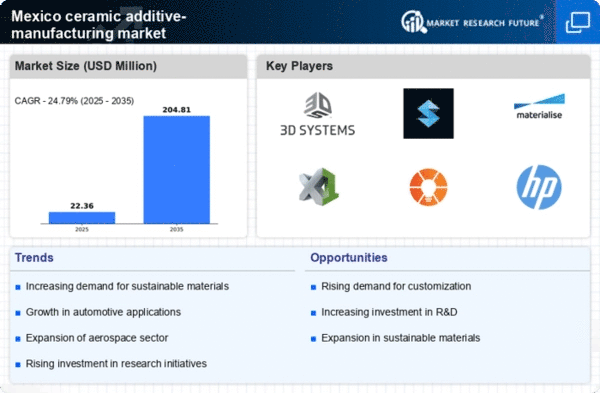
As per Market Research Future analysis, the Mexico ceramic additive-manufacturing market size was estimated at 17.92 USD Million in 2024. The Mexico ceramic additive-manufacturing market is projected to grow from 22.36 USD Million in 2025 to 204.81 USD Million by 2035, exhibiting a compound annual growth rate (CAGR) of 24.7% during the forecast period 2025 - 2035

Key Market Trends & Highlights

The Mexico ceramic additive-manufacturing market is poised for growth driven by technological advancements and sustainability initiatives.

  • Technological advancements are enhancing production efficiency and product quality in the ceramic additive-manufacturing sector.
  • Sustainability initiatives are increasingly influencing market dynamics, with a focus on eco-friendly materials and processes.
  • The largest segment in this market is likely the construction sector, while the fastest-growing segment appears to be the aerospace industry.
  • Rising demand for customization and government support are key drivers propelling the market forward.

Market Size & Forecast

2024 Market Size 17.92 (USD Million)
2035 Market Size 204.81 (USD Million)
CAGR (2025 - 2035) 24.79%

Major Players

3D Systems (US), Stratasys (US), Materialise (BE), ExOne (US), EOS (DE), HP (US), GE Additive (US), Sculpteo (FR), Voxels (US)
Our Impact
Enabled $4.3B Revenue Impact for Fortune 500 and Leading Multinationals
Partnering with 2000+ Global Organizations Each Year
30K+ Citations by Top-Tier Firms in the Industry

Mexico Ceramic Additive Manufacturing Market Trends

The market is currently experiencing notable growth, driven by advancements in technology and increasing demand for customized products. The integration of additive manufacturing techniques in ceramics allows for greater design flexibility and efficiency in production processes. This shift is particularly relevant in sectors such as aerospace, automotive, and healthcare, where precision and material properties are critical. Furthermore, the emphasis on sustainability is prompting manufacturers to explore eco-friendly materials and processes, aligning with broader environmental goals. As a result, the market landscape is evolving, with companies investing in research and development to enhance their capabilities and offerings. In addition, the ceramic additive-manufacturing market is witnessing a rise in collaboration between industry players and research institutions. This trend fosters innovation and accelerates the development of new applications and materials. The focus on education and training in additive manufacturing technologies is also gaining traction, ensuring a skilled workforce is available to meet the demands of this evolving market. Overall, the ceramic additive-manufacturing market appears poised for continued expansion, driven by technological advancements and a commitment to sustainability.

Technological Advancements

This market is benefiting from rapid technological innovations. New printing techniques and materials are enhancing production capabilities, allowing for more complex designs and improved material properties. This trend is likely to attract a wider range of industries seeking to leverage these advancements for their specific applications.

Sustainability Initiatives

There is a growing emphasis on sustainability within the ceramic additive-manufacturing market. Companies are increasingly adopting eco-friendly materials and processes to reduce their environmental impact. This shift not only aligns with global sustainability goals but also appeals to consumers who prioritize environmentally responsible products.

Collaborative Research Efforts

This market is seeing increased collaboration between manufacturers and academic institutions. These partnerships aim to drive innovation and develop new materials and applications. Such collaborations are essential for advancing the technology and ensuring that the market remains competitive and responsive to emerging trends.

Market Segment Insights

By Type of Ceramic: Oxide Ceramics (Largest) vs. Bioceramics (Fastest-Growing)

In the Mexico ceramic additive-manufacturing market, Oxide Ceramics currently hold the largest share among the segment values, benefiting from their extensive use in various applications, including electronics and aerospace. Non-Oxide Ceramics and Others follow, contributing to the diversity of materials available. Bioceramics, while smaller in market share, are rapidly gaining traction due to their applications in the medical field, particularly in implants and prosthetics. The growth trends within the ceramic segment are driven by technological advancements and increased demand in sectors like healthcare and electronics. Bioceramics are particularly notable for their innovative properties, appealing to a growing market focused on sustainable and high-performance materials. As industries evolve, the emphasis on lightweight and durable materials further supports the expansion of both Oxide and Bioceramics, marking a significant shift towards advanced manufacturing processes.

Oxide Ceramics (Dominant) vs. Bioceramics (Emerging)

Oxide Ceramics are the dominant segment in the market, characterized by their versatility and effectiveness in high-performance applications. These materials are well-established, known for their reliability and superior thermal and electrical insulating properties. Industries such as aerospace, automotive, and electronics heavily utilize Oxide Ceramics, giving them a strong market position. In contrast, Bioceramics are emerging as a vital segment, driven by their unique bioactive properties and biodegradable nature. They are becoming increasingly popular in the medical and dental sectors for applications such as bone implants and tissue engineering. This emerging segment is poised for growth as technological advancements continue to enhance their performance and expand their applications.

By Process: Powder (Largest) vs. Filament Material Extrusion (Fastest-Growing)

In the Mexico ceramic additive-manufacturing market, the market share distribution among segment values reveals a strong preference for Powder as the largest segment, demonstrating enhanced capabilities in producing high-quality ceramics with advanced precision. Meanwhile, Filament Material Extrusion has witnessed a rapid rise in adoption, appealing to manufacturers seeking innovative and efficient production techniques. Growth trends within this segment are driven by increasing demand for customized and complex ceramic components in various industries, alongside the technological advancements in manufacturing processes. Factors such as sustainability, cost-effectiveness, and the shift towards integrated systems are propelling the growth of Filament Material Extrusion, making it increasingly popular among manufacturers looking to optimize their production workflows.

Powder (Dominant) vs. Filament Material Extrusion (Emerging)

Powder as a dominant segment in the Mexico ceramic additive-manufacturing market is characterized by its ability to create intricate ceramic structures and components while maintaining superior mechanical properties. This segment serves a diverse range of applications, from aerospace to biomedical technologies, where performance is critical. On the other hand, Filament Material Extrusion is emerging rapidly, offering flexibility and lower production costs, appealing to startups and small manufacturers. This method allows for rapid prototyping and customization, aligning with market trends favoring agility in production. As both segments continue to evolve, collaboration and technology-sharing are expected to enhance their respective capabilities, catering to the evolving needs of various industries.

By End-Use Industry: Automotive (Largest) vs. Aerospace & Defense (Fastest-Growing)

The market share distribution in the end-use industry segment reveals that the automotive sector holds the largest share, primarily driven by the growing demand for lightweight and high-performance materials. Following closely are segments like consumer electronics and healthcare, which also demonstrate significant market activity, reflecting the versatility and adaptability of ceramic additives across various applications. As we look towards the future, the aerospace & defense sector is identified as the fastest-growing segment, propelled by advancements in technology and increasing investments in innovative materials. The construction and energy & power sectors are also expected to experience notable growth, fueled by the rising focus on sustainable practices and efficient resource utilization in manufacturing.

Automotive: Dominant vs. Aerospace & Defense: Emerging

The automotive sector is currently the dominant player in the end-use industry segment within the Mexico ceramic additive-manufacturing market, characterized by its robust demand for high-performance ceramics that cater to advancements in vehicle design and functionality. The materials are integral in applications such as lightweight components and improved thermal stability. In contrast, the aerospace & defense industry represents an emerging opportunity, driven by the need for advanced materials that meet stringent safety and performance standards. This segment is witnessing rapid growth due to increased government expenditures and a surge in aerospace projects, highlighting the industry's shift toward high-tech, reliable solutions that leverage the unique properties of ceramic additives.

Get more detailed insights about Mexico Ceramic Additive Manufacturing Market

Key Players and Competitive Insights

The ceramic additive-manufacturing market in Mexico is characterized by a dynamic competitive landscape, driven by technological advancements and increasing demand for customized solutions. Key players such as 3D Systems (US), Stratasys (US), and EOS (DE) are at the forefront, each adopting distinct strategies to enhance their market presence. 3D Systems (US) focuses on innovation through continuous development of advanced materials and processes, while Stratasys (US) emphasizes partnerships with local manufacturers to expand its reach. EOS (DE) is leveraging its expertise in industrial 3D printing to cater to the growing needs of the automotive and aerospace sectors, thereby shaping a competitive environment that prioritizes technological prowess and strategic collaborations.
The market structure appears moderately fragmented, with several players vying for market share. Key business tactics include localizing manufacturing to reduce lead times and optimize supply chains. This approach not only enhances operational efficiency but also aligns with the increasing demand for sustainable practices. The collective influence of these major players fosters a competitive atmosphere where innovation and responsiveness to market needs are paramount.
In September 2025, 3D Systems (US) announced a strategic partnership with a leading Mexican ceramics manufacturer to co-develop new ceramic materials tailored for additive manufacturing. This collaboration is expected to enhance local production capabilities and reduce costs, thereby positioning 3D Systems (US) as a key player in the region. The strategic importance of this partnership lies in its potential to accelerate the adoption of additive manufacturing technologies in traditional ceramics industries.
In October 2025, Stratasys (US) launched a new line of ceramic 3D printers specifically designed for the Mexican market, targeting industries such as healthcare and consumer goods. This move signifies Stratasys's commitment to addressing local market needs and expanding its product offerings. The introduction of these printers is likely to enhance the accessibility of advanced manufacturing technologies for local businesses, fostering innovation and growth.
In August 2025, EOS (DE) expanded its operations in Mexico by establishing a new facility dedicated to research and development of ceramic additive manufacturing technologies. This facility aims to support local businesses in adopting advanced manufacturing techniques. The strategic importance of this expansion is underscored by EOS's focus on sustainability and efficiency, which aligns with global trends towards environmentally friendly manufacturing practices.
As of November 2025, current trends in the ceramic additive-manufacturing market include a strong emphasis on digitalization, sustainability, and the integration of AI technologies. Strategic alliances among key players are shaping the competitive landscape, fostering innovation and collaboration. The shift from price-based competition to a focus on technological differentiation and supply chain reliability is evident. Moving forward, companies that prioritize innovation and sustainable practices are likely to gain a competitive edge, as the market continues to evolve.

Key Companies in the Mexico Ceramic Additive Manufacturing Market include

Industry Developments

The Mexico Ceramic Additive Manufacturing Market has recently seen significant developments, driven by advancements in technology and demand for innovative solutions in various industries. Companies like EOS and HP are enhancing their manufacturing capabilities with new techniques, while Sculpteo and Ceramic 3D are focusing on improving customization and accessibility of ceramic products. 

Merger and acquisition activity has been relatively quiet in the sector, with no substantial announcements involving key players such as 3D Systems or GE Additive in the region in recent months. However, market valuations are experiencing notable growth, catalyzed by increased adoption of additive manufacturing technologies in sectors like aerospace and automotive. For instance, in August 2022, Voxeljet launched new strategic initiatives to capitalize on market opportunities, further strengthening its position in Mexico. 

Over the past couple of years, the market has expanded as industries recognize the potential of ceramic additive manufacturing to reduce waste and enhance production efficiency. Major competitive investments and collaborations between local and international firms have also paved the way for innovation and growth, reinforcing Mexico's role as a significant player in the global ceramic additive manufacturing landscape.

Future Outlook

Mexico Ceramic Additive Manufacturing Market Future Outlook

The ceramic additive-manufacturing market is projected to grow at a 24.79% CAGR from 2025 to 2035, driven by technological advancements and increasing demand for customized solutions.

New opportunities lie in:

  • Development of advanced ceramic composites for aerospace applications.
  • Integration of AI-driven design software for enhanced product customization.
  • Establishment of regional production hubs to reduce logistics costs.

By 2035, the market is expected to achieve substantial growth, positioning itself as a leader in innovative manufacturing solutions.

Market Segmentation

Mexico Ceramic Additive Manufacturing Market Process Outlook

  • Pellet Material Extrusion
  • Filament Material Extrusion
  • Powder
  • Dispersion

Mexico Ceramic Additive Manufacturing Market Type of Ceramic Outlook

  • Oxide Ceramics
  • Non-Oxide Ceramics
  • Bioceramics
  • Others

Mexico Ceramic Additive Manufacturing Market End-Use Industry Outlook

  • Automotive
  • Consumer Electronic
  • Healthcare
  • Construction
  • Aerospace & Defense
  • Oil & Gas
  • Energy & Power
  • Semiconductor
  • Others

Report Scope

MARKET SIZE 2024 17.92(USD Million)
MARKET SIZE 2025 22.36(USD Million)
MARKET SIZE 2035 204.81(USD Million)
COMPOUND ANNUAL GROWTH RATE (CAGR) 24.79% (2025 - 2035)
REPORT COVERAGE Revenue Forecast, Competitive Landscape, Growth Factors, and Trends
BASE YEAR 2024
Market Forecast Period 2025 - 2035
Historical Data 2019 - 2024
Market Forecast Units USD Million
Key Companies Profiled 3D Systems (US), Stratasys (US), Materialise (BE), ExOne (US), EOS (DE), HP (US), GE Additive (US), Sculpteo (FR), Voxels (US)
Segments Covered Type of Ceramic, Process, End-Use Industry
Key Market Opportunities Growing demand for sustainable materials drives innovation in the ceramic additive-manufacturing market.
Key Market Dynamics Technological advancements drive innovation in ceramic additive-manufacturing, enhancing production efficiency and product quality.
Countries Covered Mexico
Leave a Comment

FAQs

What is the expected market size of the Mexico Ceramic Additive Manufacturing Market in 2024?

The Mexico Ceramic Additive Manufacturing Market is expected to be valued at 17.92 million USD in 2024.

What is the projected market size of the Mexico Ceramic Additive Manufacturing Market by 2035?

By 2035, the market is anticipated to reach a value of 44.48 million USD.

What is the expected CAGR for the Mexico Ceramic Additive Manufacturing Market from 2025 to 2035?

The expected CAGR for the market during this period is 8.616%.

Which type of ceramic is expected to have the largest market share in 2024?

Oxide ceramics are expected to dominate the market, valued at 6.78 million USD in 2024.

What will be the market value of Non-Oxide Ceramics in 2035?

The market value for Non-Oxide Ceramics is projected to be 10.77 million USD in 2035.

Who are some key players in the Mexico Ceramic Additive Manufacturing Market?

Major players include EOS, Sculpteo, Ceramic 3D, and 3D Systems, among others.

What are the expected market trends impacting the Mexico Ceramic Additive Manufacturing Market?

Key trends include technological advancements and increasing applications in various industries.

What challenges could affect the growth of the Mexico Ceramic Additive Manufacturing Market?

Challenges may arise from competition and technological barriers in ceramic additive manufacturing.

How much is the Bioceramics segment valued at in 2024?

The Bioceramics segment is valued at 3.58 million USD in 2024.

What is the expected market size for 'Others' category ceramics in 2035?

The 'Others' category is expected to reach a market size of 8.49 million USD by 2035.

Download Free Sample

Kindly complete the form below to receive a free sample of this Report

Compare Licence

×
Features License Type
Single User Multiuser License Enterprise User
Price $4,950 $5,950 $7,250
Maximum User Access Limit 1 User Upto 10 Users Unrestricted Access Throughout the Organization
Free Customization
Direct Access to Analyst
Deliverable Format
Platform Access
Discount on Next Purchase 10% 15% 15%
Printable Versions