×
Request Free Sample ×

Kindly complete the form below to receive a free sample of this Report

* Please use a valid business email

Leading companies partner with us for data-driven Insights

clients tt-cursor
Hero Background

Mexico Breakfast Cereals Market

ID: MRFR/FnB/45024-HCR
128 Pages
Snehal Singh
February 2026

Mexico Breakfast Cereals Market Size, Share, Industry Trend & Analysis Research Report By Source (Wheat, Rice, Corn, Barley, Others), By Packaging (Boxes, Pouches, Others) and By Distribution Channel (Store-based, Non-store based)-Forecast to 2035

Share:
Download PDF ×

We do not share your information with anyone. However, we may send you emails based on your report interest from time to time. You may contact us at any time to opt-out.

Mexico Breakfast Cereals Market Infographic
Purchase Options

Mexico Breakfast Cereals Market Summary

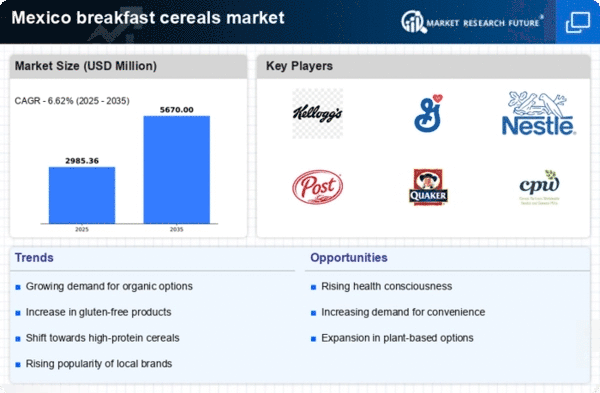
As per Market Research Future analysis, the Mexico Breakfast Cereals Market size was estimated at 2800.0 USD Million in 2024. The Breakfast Cereals market industry is projected to grow from 2985.36 USD Million in 2025 to 5670.0 USD Million by 2035, exhibiting a compound annual growth rate (CAGR) of 6.6% during the forecast period 2025 - 2035

Key Market Trends & Highlights

The Mexico breakfast cereals market is experiencing a dynamic shift towards health-oriented and convenient options.

  • The largest segment in the Mexico breakfast cereals market is the health-focused category, driven by rising health consciousness among consumers.
  • The fastest-growing segment is the on-the-go options, reflecting the increasing demand for convenience in urban lifestyles.
  • Diverse flavors and dietary options are becoming more prevalent, catering to a wider range of consumer preferences and dietary needs.
  • Key market drivers include rising health consciousness and increased urbanization, which are shaping product offerings and consumer choices.

Market Size & Forecast

2024 Market Size 2800.0 (USD Million)
2035 Market Size 5670.0 (USD Million)
CAGR (2025 - 2035) 6.62%

Major Players

Kellogg's (US), General Mills (US), Nestlé (CH), Post Holdings (US), Quaker Oats Company (US), Cereal Partners Worldwide (CH), Weetabix (GB), PepsiCo (US), Sunbelt Bakery (US)

Our Impact
Enabled $4.3B Revenue Impact for Fortune 500 and Leading Multinationals
Partnering with 2000+ Global Organizations Each Year
30K+ Citations by Top-Tier Firms in the Industry

Mexico Breakfast Cereals Market Trends

The Mexico Breakfast Cereals Market in Mexico is currently experiencing a dynamic transformation, driven by evolving consumer preferences and increasing health consciousness. As individuals become more aware of nutrition, there is a noticeable shift towards products that offer health benefits, such as whole grains, low sugar content, and added vitamins. This trend is further supported by a growing demand for organic and natural ingredients, reflecting a broader movement towards clean eating. Additionally, the convenience factor plays a crucial role, as busy lifestyles prompt consumers to seek quick and easy meal options that do not compromise on quality. Moreover, the market is witnessing a rise in innovative flavors and product formats, catering to diverse tastes and dietary needs. Manufacturers are responding to this demand by introducing gluten-free, high-protein, and plant-based cereals, appealing to a wider audience. The influence of social media and digital marketing also cannot be overlooked, as brands leverage these platforms to engage with consumers and promote their offerings. Overall, the breakfast cereals market is poised for continued growth, driven by these multifaceted trends that align with the changing landscape of consumer behavior.

Health and Wellness Focus

There is a growing emphasis on health and wellness within the breakfast cereals market. Consumers increasingly seek products that provide nutritional benefits, such as high fiber, low sugar, and fortified options. This trend reflects a broader societal shift towards healthier eating habits.

Convenience and On-the-Go Options

The demand for convenience is reshaping the breakfast cereals market. As lifestyles become busier, consumers prefer ready-to-eat or easy-to-prepare cereals that fit seamlessly into their daily routines. This trend highlights the importance of quick meal solutions.

Diverse Flavors and Dietary Options

Innovation in flavors and dietary options is becoming prominent in the breakfast cereals market. Manufacturers are introducing a variety of unique flavors and catering to specific dietary needs, such as gluten-free and plant-based cereals, to attract a wider consumer base.

Mexico Breakfast Cereals Market Drivers

Increased Urbanization

Urbanization in Mexico is contributing significantly to the dynamics of the breakfast cereals market. As more people migrate to urban areas, lifestyles are changing, leading to a greater need for convenient and quick meal solutions. The fast-paced life in cities often leaves little time for traditional breakfast preparation, thus driving the demand for ready-to-eat cereals. Recent statistics indicate that urban areas have seen a 20% increase in cereal consumption over the past five years. This trend suggests that manufacturers may need to focus on developing products that cater to the busy urban consumer, potentially leading to innovations in packaging and product offerings within the breakfast cereals market.

Growing E-commerce Adoption

The rise of e-commerce in Mexico is reshaping the breakfast cereals market by providing consumers with greater access to a variety of products. Online shopping platforms are increasingly popular, allowing consumers to purchase breakfast cereals conveniently from their homes. This shift is particularly appealing to younger demographics who prefer the ease of online shopping. Data shows that online sales of breakfast cereals have surged by 30% in the last year, indicating a significant change in purchasing behavior. As e-commerce continues to grow, it is likely that brands will invest more in digital marketing strategies to capture this expanding market segment, thereby influencing the overall landscape of the breakfast cereals market.

Rising Health Consciousness

The increasing awareness of health and nutrition among consumers in Mexico appears to be a pivotal driver for the breakfast cereals market. As individuals become more informed about the benefits of a balanced diet, there is a noticeable shift towards healthier breakfast options. This trend is reflected in the growing demand for cereals that are low in sugar and high in fiber. According to recent data, the market for health-oriented breakfast cereals has expanded by approximately 15% in the last year alone. Consumers are actively seeking products that offer nutritional benefits, such as whole grains and added vitamins. This shift in consumer preferences is likely to encourage manufacturers to innovate and reformulate their products to meet these demands, thereby shaping the breakfast cereals market in Mexico.

Innovations in Product Offerings

Innovation within the breakfast cereals market is a crucial driver, as manufacturers strive to differentiate their products in a competitive landscape. The introduction of unique flavors, organic ingredients, and functional cereals that cater to specific dietary needs is becoming increasingly common. For instance, cereals fortified with probiotics or those targeting specific health concerns are gaining traction among consumers. Recent market analysis suggests that innovative products account for nearly 25% of total sales in the breakfast cereals market. This trend indicates that companies must prioritize research and development to create appealing and health-oriented options that resonate with the evolving preferences of Mexican consumers.

Influence of Marketing and Advertising

Marketing strategies play a vital role in shaping consumer perceptions and preferences within the breakfast cereals market. Effective advertising campaigns that highlight the nutritional benefits and convenience of cereals can significantly influence purchasing decisions. In Mexico, brands are increasingly utilizing social media and influencer partnerships to reach a broader audience, particularly younger consumers. Recent surveys indicate that approximately 40% of consumers are swayed by marketing efforts when choosing breakfast cereals. This suggests that companies must invest in innovative marketing techniques to effectively communicate their product offerings and engage with consumers, ultimately impacting the growth trajectory of the breakfast cereals market.


Market Segment Insights

By Type: Ready-to-Eat Cereals (Largest) vs. Instant Cereals (Fastest-Growing)

In the Mexico breakfast cereals market, the market share distribution showcases Ready-to-Eat Cereals as the largest segment, capturing a significant portion of consumer preference due to their convenience and variety. Cooked and Hot Cereals follow, providing a strong niche for traditional breakfast options. Instant Cereals, although smaller in overall share, are gaining traction, especially among younger consumers seeking quick meal solutions. Growth trends are strongly influenced by changing lifestyles and an increasing demand for convenience foods. Health-conscious trends are driving innovation in Ready-to-Eat Cereals, with a focus on nutritional value, while Instant Cereals are becoming popular for their quick preparation time. The rise in e-commerce also supports growth across all segments, enhancing accessibility and product availability.

Ready-to-Eat Cereals: Dominant vs. Instant Cereals: Emerging

Ready-to-Eat Cereals dominate the market due to their appeal to busy consumers seeking nutritious options without extensive preparation. This segment boasts a variety of flavors and formats, catering to different preferences and dietary needs. In contrast, Instant Cereals are emerging as a convenient alternative for consumers who prioritize speed and ease in their breakfast choices. Instant Cereals typically appeal to younger demographics, with innovative options being introduced to meet their demand for quick, healthy meals. The dynamic between these two segments illustrates the balance between established preferences for convenience and the growing trend towards healthy, quick food solutions.

By Ingredients: Whole Grain (Largest) vs. Gluten-Free (Fastest-Growing)

The Mexico breakfast cereals market exhibits a diverse range of ingredients, with Whole Grain leading the segment due to its established consumer demand and health awareness. Together with Organic and High Fiber options, these segments showcase a competitive landscape where Whole Grain holds a significant share, appealing to health-conscious consumers seeking nutritious options. Gluten-Free is rapidly gaining traction, propelled by rising awareness of gluten intolerance among consumers and an increased inclination toward healthier dietary choices. Growth trends reaffirms the shift toward alternative ingredients as consumers prioritize health benefits. Organic and High Fiber have seen a steady increase in demand, reflecting a growing trend among younger generations who are willing to invest in healthy eating. The combination of clean-label trends and lifestyle changes further bolsters these segments, driving innovation and variety in the Mexico breakfast cereals market.

Whole Grain: Dominant vs. Gluten-Free: Emerging

Whole Grain is considered the dominant player in the ingredients segment, thanks to its longstanding recognition for promoting heart health and overall wellness. It often appeals to a broad demographic of health-focused consumers. In contrast, Gluten-Free is emerging rapidly, fueled by rising consumer awareness of gluten-related health issues. Brands are increasingly innovating to offer appealing gluten-free options, which not only cater to dietary restrictions but also attract those seeking variety in their meals. As trends evolve, both segments are crucial, showcasing the broader inclination of consumers towards nutritious and accessible breakfast alternatives in the Mexico breakfast cereals market.

By End User: Children (Largest) vs. Seniors (Fastest-Growing)

In the Mexico breakfast cereals market, the distribution of market share among end users shows that children represent the largest segment. This demographic enjoys a wide variety of sugary and fortified cereals, appealing to both parents looking for nutrition and children craving taste. Following behind are adults, who opt for healthier, whole-grain options, and seniors, who seek easy-to-digest cereals with added health benefits. Growth trends indicate that while children remain the dominant group, the senior segment is experiencing the fastest growth. The increasing focus on health among older consumers is driving this rise, as they prefer cereals fortified with vitamins and minerals. Additionally, targeted marketing campaigns aimed at seniors and their nutritional needs are helping to propel their segment forward, making it an increasingly important part of the overall market.

Children: Dominant vs. Seniors: Emerging

The children segment is characterized by a broad appeal for vibrant, colorful cereals often marketed with popular cartoon characters, which drives its dominance in the Mexico breakfast cereals market. Manufacturers focus on taste and branding to attract this demographic, leading to a plethora of sugary options. On the other hand, the seniors segment is emerging with a shift towards health-conscious choices, featuring cereals that offer whole grains, low sugar, and added nutrients. This segment is becoming increasingly vital as it responds to the growing health awareness among older adults, thereby shaping product innovation and marketing strategies to cater to their preferences.

By Distribution Channel: Supermarkets/Hypermarkets (Largest) vs. Online Retail (Fastest-Growing)

The distribution of the breakfast cereals market reveals that Supermarkets and Hypermarkets hold a substantial share, dominating the landscape of the market. These outlets become the go-to option for consumers due to their extensive product ranges and convenient shopping experience. In contrast, Online Retail has emerged as a significant player, gradually increasing its share as consumers shift toward e-commerce, driven by the growing preference for online shopping convenience. The growth dynamics within this segment indicate a strong trend toward digital transformation, where Online Retail is experiencing the fastest growth. This shift is propelled by technological advancements and changing consumer behaviors, especially post-pandemic, as more shoppers prioritize safety and convenience. As a result, Online Retail is poised to capture a larger market share, leaving traditional outlets to innovate to maintain their competitive edge.

Supermarkets/Hypermarkets (Dominant) vs. Online Retail (Emerging)

Supermarkets and Hypermarkets serve as the dominant distribution channel for breakfast cereals, offering a wide variety of options that cater to diverse consumer preferences. Their well-established presence allows for effective marketing strategies such as promotions and discounts, attracting a large customer base. These physical stores facilitate easy access, making it a significantly preferred choice for bulk purchases. Conversely, Online Retail is quickly emerging as a competitive channel, capitalizing on the convenience it offers to consumers who value the ability to shop from home. As technology advances and logistics improve, Online Retail is set to gain a larger footprint, appealing to younger, tech-savvy consumers who favor digital shopping experiences over traditional methods.

Get more detailed insights about Mexico Breakfast Cereals Market

Key Players and Competitive Insights

The breakfast cereals market in Mexico exhibits a dynamic competitive landscape characterized by a blend of established players and emerging brands. Key growth drivers include increasing health consciousness among consumers, a rising demand for convenient breakfast options, and a shift towards organic and natural ingredients. Major companies such as Kellogg's (US), General Mills (US), and Nestlé (CH) are strategically positioned to leverage these trends. Kellogg's (US) focuses on innovation in product formulations, particularly in the realm of health-oriented cereals, while General Mills (US) emphasizes sustainability in sourcing and packaging. Nestlé (CH) is actively expanding its portfolio to include plant-based options, thereby appealing to a broader consumer base. Collectively, these strategies contribute to a competitive environment that is increasingly focused on health, sustainability, and innovation.In terms of business tactics, companies are localizing manufacturing to reduce costs and enhance supply chain efficiency. This approach not only mitigates logistical challenges but also allows for quicker response times to market demands. The market structure appears moderately fragmented, with several key players holding substantial market shares. However, the influence of these major companies is significant, as they set trends and standards that smaller brands often follow.

In October Kellogg's (US) announced a partnership with a local organic grain supplier to enhance its product offerings with locally sourced ingredients. This move is strategically important as it aligns with the growing consumer preference for transparency and sustainability in food sourcing. By integrating local ingredients, Kellogg's (US) not only supports local agriculture but also strengthens its brand image as a health-conscious choice.

In September General Mills (US) launched a new line of gluten-free cereals aimed at the growing segment of health-conscious consumers. This initiative reflects the company's commitment to innovation and responsiveness to dietary trends. The introduction of gluten-free options is likely to attract a new customer base, thereby enhancing market share and reinforcing General Mills' position as a leader in the health-focused segment of the market.

In August Nestlé (CH) expanded its distribution network in Mexico by partnering with local retailers to improve accessibility to its breakfast cereals. This strategic move is crucial as it not only increases market penetration but also enhances brand visibility in a competitive landscape. By ensuring that its products are readily available, Nestlé (CH) positions itself favorably against competitors, potentially increasing sales and customer loyalty.

As of November current competitive trends in the breakfast cereals market are heavily influenced by digitalization, sustainability, and the integration of artificial intelligence in product development and marketing strategies. Strategic alliances among companies are shaping the landscape, allowing for shared resources and knowledge that enhance innovation. The competitive differentiation is likely to evolve from traditional price-based competition to a focus on technological advancements, product innovation, and supply chain reliability. This shift indicates a future where companies that prioritize sustainability and health-oriented products may gain a competitive edge.

Key Companies in the Mexico Breakfast Cereals Market include

Industry Developments

The Mexico Breakfast Cereals Market has seen various developments in recent months. The popularity of cereals such as Special K and Quaker Oats continues to rise, driven by increasing health awareness among consumers. In recent years, notable growth has been reported in the market, particularly since December 2021, when General Mills launched a new line of health-focused cereal products tailored specifically for Mexican consumers. In July 2023, Kellogg's announced an investment to expand its operations in Mexico, aiming to enhance production capacities, indicating a strong demand for breakfast cereals in the region.

Acquisitions have also marked the landscape; in August 2022, Post Holdings acquired a significant stake in an up-and-coming cereal brand, which has bolstered its presence in the Mexican market. Meanwhile, PepsiCo continues to innovate within its product line, focusing on sustainable practices and nutritional benefits. The competitive environment is further intensified by local players like Bimbo and Doria, who are adapting global trends to suit local tastes. The Mexican breakfast cereals market shows resilience and adaptability, with a steady inclination towards organic and health-conscious offerings amidst changing consumer preferences.

Future Outlook

Mexico Breakfast Cereals Market Future Outlook

The Breakfast Cereals Market in Mexico is projected to grow at a 6.62% CAGR from 2025 to 2035, driven by health trends, innovation, and increasing consumer demand.

New opportunities lie in:

  • Development of gluten-free and organic cereal lines
  • Expansion of e-commerce distribution channels
  • Introduction of personalized nutrition-based cereal products

By 2035, the market is expected to achieve robust growth and diversification.

Market Segmentation

Mexico Breakfast Cereals Market Type Outlook

  • Ready-to-Eat Cereals
  • Cooked Cereals
  • Instant Cereals
  • Hot Cereals

Mexico Breakfast Cereals Market End User Outlook

  • Children
  • Adults
  • Seniors

Mexico Breakfast Cereals Market Ingredients Outlook

  • Whole Grain
  • Gluten-Free
  • Organic
  • High Fiber

Mexico Breakfast Cereals Market Distribution Channel Outlook

  • Supermarkets/Hypermarkets
  • Online Retail
  • Convenience Stores
  • Specialty Stores

Report Scope

MARKET SIZE 2024 2800.0(USD Million)
MARKET SIZE 2025 2985.36(USD Million)
MARKET SIZE 2035 5670.0(USD Million)
COMPOUND ANNUAL GROWTH RATE (CAGR) 6.62% (2025 - 2035)
REPORT COVERAGE Revenue Forecast, Competitive Landscape, Growth Factors, and Trends
BASE YEAR 2024
Market Forecast Period 2025 - 2035
Historical Data 2019 - 2024
Market Forecast Units USD Million
Key Companies Profiled Kellogg's (US), General Mills (US), Nestlé (CH), Post Holdings (US), Quaker Oats Company (US), Cereal Partners Worldwide (CH), Weetabix (GB), PepsiCo (US), Sunbelt Bakery (US)
Segments Covered Type, Ingredients, End User, Distribution Channel
Key Market Opportunities Growing demand for health-oriented breakfast cereals aligns with shifting consumer preferences towards nutritious options.
Key Market Dynamics Rising health consciousness drives demand for nutritious breakfast cereals, reshaping consumer preferences in Mexico.
Countries Covered Mexico
Leave a Comment

FAQs

What was the expected market size of the Mexico Breakfast Cereals Market in 2024?

The Mexico Breakfast Cereals Market was valued at 2.8 USD billion in 2024.

What is the projected market size for the Mexico Breakfast Cereals Market by 2035?

By 2035, the Mexico Breakfast Cereals Market is projected to reach a valuation of 6.89 USD billion.

What is the expected CAGR for the Mexico Breakfast Cereals Market from 2025 to 2035?

The market is expected to grow at a CAGR of 8.53% from 2025 to 2035.

Who are the key players in the Mexico Breakfast Cereals Market?

Major players in the market include General Mills, Kellogg's, Nestle, and Pepsico.

What will be the market value for wheat-based breakfast cereals in 2035?

The market for wheat-based breakfast cereals is anticipated to be valued at 2.054 USD billion in 2035.

What is the projected market value for rice-based breakfast cereals by 2035?

Rice-based breakfast cereals are expected to reach a market value of 1.558 USD billion by 2035.

What is the growth potential for corn-based breakfast cereals in the coming years?

Corn-based breakfast cereals are projected to have a market value of 1.55 USD billion by 2035.

What is the expected market size for barley-based breakfast cereals by 2035?

The expected market size for barley-based breakfast cereals is anticipated to reach 1.046 USD billion by 2035.

How significant is the 'Others' segment in the Mexico Breakfast Cereals Market?

The 'Others' segment is projected to grow to a market value of 0.682 USD billion by 2035.

What factors are driving the growth of the Mexico Breakfast Cereals Market?

Growth is driven by rising health awareness, changing consumer preferences, and increasing demand for convenient breakfast options.

Download Free Sample

Kindly complete the form below to receive a free sample of this Report

Compare Licence

×
Features License Type
Single User Multiuser License Enterprise User
Price $4,950 $5,950 $7,250
Maximum User Access Limit 1 User Upto 10 Users Unrestricted Access Throughout the Organization
Free Customization
Direct Access to Analyst
Deliverable Format
Platform Access
Discount on Next Purchase 10% 15% 15%
Printable Versions