×
Request Free Sample ×

Kindly complete the form below to receive a free sample of this Report

* Please use a valid business email

Leading companies partner with us for data-driven Insights

clients tt-cursor
Hero Background

Japan Respiratory Drugs Market

ID: MRFR/Pharma/43770-HCR
200 Pages
Rahul Gotadki
February 2026

Japan Respiratory Drugs Market Research Report By Drug Class (Short-Acting Beta2-Agonists (SABA), Long-Acting Beta2-Agonists (LABA), Inhaled Corticosteroids (ICS), Anticholinergics, Antihistamines, Vasodilators, Combination Drugs, Others), By Disease Type (Asthma, Chronic Bronchitis, Chronic Obstructive Pulmonary Disease (COPD), Pleural Effusion, Others), By Route of Administration (Inhalation, Enteral, Parenteral) and By Distribution Channel (Hospital Pharmacies, Retail Pharmacies, Online Pharmacies) - Growth & Industry Forecast 2025 To 2035

Share:
Download PDF ×

We do not share your information with anyone. However, we may send you emails based on your report interest from time to time. You may contact us at any time to opt-out.

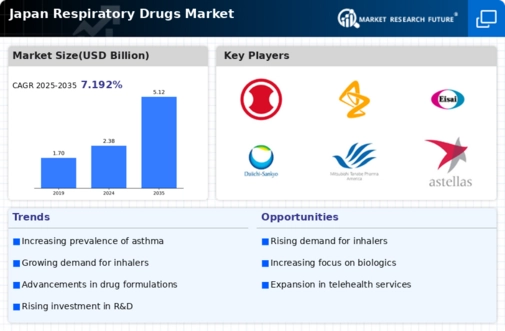
Japan Respiratory Drugs Market Infographic
Purchase Options

Japan Respiratory Drugs Market Summary

As per Market Research Future analysis, the Japan respiratory drugs market size was estimated at 2146.5 USD Million in 2024. The Japan respiratory drugs market is projected to grow from 2281.51 USD Million in 2025 to 4200.0 USD Million by 2035, exhibiting a compound annual growth rate (CAGR) of 6.2% during the forecast period 2025 - 2035

Key Market Trends & Highlights

The Japan respiratory drugs market is poised for growth driven by demographic changes and technological innovations.

  • The aging population in Japan is contributing to a rising incidence of respiratory diseases, thereby increasing demand for respiratory drugs.
  • Technological advancements in drug development are enhancing treatment options and improving patient outcomes in the respiratory segment.
  • Regulatory support is facilitating market expansion, particularly in the largest segment of asthma and COPD treatments.
  • Rising air pollution levels and increased healthcare expenditure are key drivers propelling the growth of the respiratory drugs market.

Market Size & Forecast

2024 Market Size 2146.5 (USD Million)
2035 Market Size 4200.0 (USD Million)
CAGR (2025 - 2035) 6.29%

Major Players

Pfizer (US), Boehringer Ingelheim (DE), GlaxoSmithKline (GB), AstraZeneca (GB), Novartis (CH), Teva Pharmaceutical Industries (IL), Sanofi (FR), Merck & Co. (US), Roche (CH)

Our Impact
Enabled $4.3B Revenue Impact for Fortune 500 and Leading Multinationals
Partnering with 2000+ Global Organizations Each Year
30K+ Citations by Top-Tier Firms in the Industry

Japan Respiratory Drugs Market Trends

The respiratory drugs market in Japan is currently experiencing notable developments driven by various factors. The aging population, which is increasingly susceptible to respiratory conditions, is a primary driver of demand for effective treatments. Furthermore, advancements in pharmaceutical research and technology are leading to the introduction of innovative therapies, enhancing patient outcomes. Regulatory support from government bodies is also facilitating the approval and distribution of new medications, thereby expanding the market landscape. As healthcare systems evolve, there is a growing emphasis on personalized medicine, which may further influence treatment approaches in this sector. In addition, the rising awareness of respiratory diseases among the general public is prompting increased healthcare spending. Patients are becoming more proactive in seeking treatment options, which could lead to a shift in market dynamics. The integration of digital health solutions, such as telemedicine and mobile health applications, is also transforming how patients access respiratory care. Overall, the respiratory drugs market appears poised for growth, with various trends indicating a shift towards more comprehensive and patient-centered care.

Aging Population and Increased Incidence of Respiratory Diseases

Japan's demographic trends indicate a significant rise in the elderly population, which correlates with a higher prevalence of respiratory ailments. This demographic shift is likely to drive demand for respiratory drugs, as older individuals often experience chronic conditions such as asthma and chronic obstructive pulmonary disease (COPD). Consequently, pharmaceutical companies may focus on developing targeted therapies to address the specific needs of this age group.

Technological Advancements in Drug Development

The respiratory drugs market is witnessing a surge in technological innovations, particularly in drug formulation and delivery systems. New inhalation devices and smart inhalers are being developed to improve medication adherence and efficacy. These advancements may enhance patient experiences and outcomes, potentially leading to increased market penetration of novel respiratory therapies.

Regulatory Support and Market Expansion

The Japanese government is actively promoting the development and approval of new respiratory medications through streamlined regulatory processes. This support may encourage pharmaceutical companies to invest in research and development, resulting in a broader range of treatment options for patients. As a result, the respiratory drugs market could experience significant growth, driven by the introduction of innovative therapies.

Japan Respiratory Drugs Market Drivers

Rising Air Pollution Levels

The respiratory drugs market in Japan is experiencing growth due to increasing air pollution levels. Urbanization and industrial activities have led to a rise in particulate matter and other pollutants, which exacerbate respiratory conditions such as asthma and chronic obstructive pulmonary disease (COPD). According to the Ministry of the Environment, air quality in major cities often exceeds safe limits, prompting a higher demand for effective respiratory medications. This trend is likely to continue, as the population becomes more aware of the health impacts of pollution. Consequently, pharmaceutical companies are focusing on developing innovative treatments to address these challenges, thereby driving the respiratory drugs market.

Advancements in Telemedicine

The rise of telemedicine in Japan is transforming the respiratory drugs market by improving patient access to healthcare services. With the increasing adoption of digital health technologies, patients can now consult healthcare professionals remotely, facilitating timely diagnosis and treatment of respiratory conditions. This trend is particularly beneficial for individuals living in rural areas, where access to specialized care may be limited. As telemedicine continues to evolve, it is likely to enhance the distribution and prescription of respiratory medications, thereby contributing to market growth. The integration of technology in healthcare is expected to streamline patient management and improve treatment outcomes.

Focus on Personalized Medicine

The respiratory drugs market is witnessing a shift towards personalized medicine, which tailors treatments to individual patient needs. This approach is gaining traction in Japan, where advancements in genomics and biotechnology are enabling the development of targeted therapies for respiratory diseases. By understanding the genetic and environmental factors that contribute to these conditions, pharmaceutical companies are creating more effective and safer medications. This trend is likely to enhance patient adherence to treatment regimens and improve overall health outcomes, thereby driving growth in the respiratory drugs market. The emphasis on personalized approaches may also lead to increased investment in research and development.

Increased Healthcare Expenditure

Japan's healthcare expenditure has been on the rise, which positively influences the respiratory drugs market. The government has been investing heavily in healthcare infrastructure and services, with total healthcare spending reaching approximately $500 billion in recent years. This increase in funding allows for better access to medications and treatments for respiratory diseases. Furthermore, as the population ages, the demand for respiratory drugs is expected to grow, leading to a projected market expansion of around 6% annually. This financial commitment from both the government and private sectors is likely to enhance the availability of advanced respiratory therapies.

Growing Awareness of Respiratory Health

There is a notable increase in public awareness regarding respiratory health in Japan, which is significantly impacting the respiratory drugs market. Campaigns aimed at educating the population about the risks associated with respiratory diseases have led to a higher rate of diagnosis and treatment. As individuals become more informed about conditions like asthma and COPD, they are more likely to seek medical advice and appropriate medications. This shift in consumer behavior is expected to drive market growth, as healthcare providers respond to the rising demand for effective respiratory treatments.


Market Segment Insights

By Drug Class: Inhaled Corticosteroids (Largest) vs. Combination Drugs (Fastest-Growing)

In the Japan respiratory drugs market, the distribution of market share among the drug classes reveals that Inhaled Corticosteroids (ICS) hold the largest portion due to their efficacy in managing chronic respiratory conditions such as asthma and COPD. Following ICS, Short-Acting Beta2-Agonists (SABA) and Long-Acting Beta2-Agonists (LABA) also account for significant shares, yet they primarily serve as bronchodilators. Combination drugs, which blend different therapeutic mechanisms, are gradually increasing their presence as they respond to the need for more personalized therapy. The growth trends within the market indicate a robust increase in demand for Combination Drugs, particularly as healthcare professionals seek to optimize treatment regimens for patients with coexisting respiratory diseases. This trend is driven by ongoing advancements in drug formulation technology and a better understanding of patient needs. Anticholinergics and Antihistamines continue to show steady demand, although their growth is relatively stable compared to the rising popularity of Combination Drugs, which are increasingly seen as necessary for effective respiratory management.

Inhaled Corticosteroids (Dominant) vs. Combination Drugs (Emerging)

Inhaled Corticosteroids (ICS) are recognized as the dominant force in the Japan respiratory drugs market, praised for their role in reducing inflammation and preventing asthma attacks. They have a well-established efficacy and are widely prescribed for chronic management. In contrast, Combination Drugs, which offer the advantage of dual action by combining corticosteroids with bronchodilators, are rapidly emerging as essential options for tailored therapies. These drugs address the complexities of treating multifaceted respiratory issues and have gained popularity due to their convenience and effectiveness. As a result, the dynamics between these two segments symbolize a shift towards more integrated treatment approaches in respiratory health.

By Disease Type: Asthma (Largest) vs. Chronic Obstructive Pulmonary Disease (Fastest-Growing)

In the Japan respiratory drugs market, the distribution of market share among disease types reveals Asthma as the largest segment, capturing a significant portion of the market. Following Asthma, Chronic Obstructive Pulmonary Disease (COPD) exhibits a strong presence, while Chronic Bronchitis and Pleural Effusion have moderate shares. The 'Others' category, encompassing various less common respiratory conditions, completes the market landscape, though it remains comparatively smaller. Growth trends indicate a rising awareness and prevalence of respiratory diseases, particularly among aging populations. COPD is recognized as the fastest-growing segment, driven by increased smoking rates and environmental factors contributing to respiratory conditions. Continuous advancements in drug formulations and delivery systems are also propelling growth, alongside improved healthcare access and a focus on early diagnosis and management.

Asthma (Dominant) vs. Chronic Obstructive Pulmonary Disease (Emerging)

Asthma stands as the dominant segment in the market, characterized by a wide range of treatment options and a high patient awareness level. Its established therapies are critical in managing symptoms and enhancing quality of life for patients. In contrast, Chronic Obstructive Pulmonary Disease (COPD) is emerging rapidly, driven by the increasing recognition of its impact on public health. COPD treatments are advancing, with innovative therapies and combination inhalers gaining traction. Both segments emphasize patient adherence and education, yet the market dynamics for COPD are shifting, reflecting a growing need for effective long-term management solutions. The treatment landscape is thus evolving, with both segments gaining prominence in the Japan respiratory drugs market.

By Route of Administration: Inhalation (Largest) vs. Parenteral (Fastest-Growing)

In the Japan respiratory drugs market, inhalation therapy holds the largest share due to its effectiveness and patient convenience, transforming the treatment of chronic respiratory conditions. Enteral and parenteral routes also play roles within the segment, with enteral remaining relevant for specific cases where inhalation is not suitable. However, parenteral administration is emerging as a formidable option, capturing attention owing to advancements in drug delivery technologies. Growth trends in this segment are primarily driven by increasing prevalence of respiratory disorders, along with rising consumer awareness regarding inhalation therapies. The introduction of novel inhalers and parenteral formulations, coupled with ongoing research initiatives, greatly accelerates market expansion. Moreover, the shift towards personalized medicine is further propelling the development of customizable products across these administration routes.

Inhalation (Dominant) vs. Parenteral (Emerging)

Inhalation remains the dominant route of administration in the Japan respiratory drugs market, favored for its direct delivery to the lungs, allowing for prompt therapeutic action with minimal systemic side effects. This route is characterized by a variety of devices, including metered-dose inhalers and dry powder inhalers, catering to diverse patient needs. Parenteral administration, on the other hand, is gaining momentum, particularly with innovations in injectable formulations and biologics that offer alternatives for patients unable to utilize inhalers. This emerging segment is expected to witness significant growth due to its capacity to deliver drugs with high efficacy, thus it becomes essential for addressing complex respiratory conditions and achieving favorable clinical outcomes.

By Distribution Channel: Retail Pharmacies (Largest) vs. Online Pharmacies (Fastest-Growing)

In the Japan respiratory drugs market, the distribution channels demonstrate varied market share dynamics. Retail pharmacies hold the largest share, serving as key access points for patients needing respiratory treatments. Conversely, hospital pharmacies also play a significant role, but they are comparatively smaller in share. The growing trust in online pharmacies is reshaping the landscape, reflecting a shift in consumer preference towards convenience and accessibility. Growth trends in this segment are heavily influenced by digital transformation and changing consumer behavior. Online pharmacies, being the fastest-growing segment, are gaining traction due to their ease of access and ability to cater to patient needs efficiently. This transition is further supported by an increase in telehealth services and online consultations, enhancing the appeal of online purchasing. As a result, the distribution channel dynamics are evolving, emphasizing the need for traditional retail and hospital pharmacies to adapt to these trends.

Retail Pharmacies (Dominant) vs. Online Pharmacies (Emerging)

Retail pharmacies are the dominant force in the distribution of respiratory drugs, characterized by their widespread accessibility and comprehensive product offerings. They provide patients with immediate access to necessary medications, supported by knowledgeable staff who can offer advice and support. In contrast, online pharmacies are emerging rapidly, driven by their innovative logistics and service models that provide convenience and competitive pricing. This shift is attracting a tech-savvy consumer base that prioritizes efficiency. The ability of online pharmacies to provide home delivery and easy prescription renewals positions them as a formidable competitor. As both segments adapt to changing market dynamics, their roles within the Japan respiratory drugs market are becoming increasingly significant, with retail pharmacies focusing on patient engagement and online platforms expanding their service capabilities.

Get more detailed insights about Japan Respiratory Drugs Market

Key Players and Competitive Insights

The respiratory drugs market in Japan is characterized by a dynamic competitive landscape, driven by increasing prevalence of respiratory diseases and a growing demand for innovative therapies. Key players such as Pfizer (US), AstraZeneca (GB), and Boehringer Ingelheim (DE) are strategically positioned to leverage their extensive research and development capabilities. Pfizer (US) focuses on expanding its portfolio through innovative drug formulations, while AstraZeneca (GB) emphasizes partnerships to enhance its market reach. Boehringer Ingelheim (DE) is committed to advancing its pipeline of biologics, which collectively shapes a competitive environment that prioritizes innovation and strategic collaborations.In terms of business tactics, companies are increasingly localizing manufacturing to enhance supply chain efficiency and reduce costs. The market structure appears moderately fragmented, with several players vying for market share. However, the collective influence of major companies like Novartis (CH) and Merck & Co. (US) suggests a trend towards consolidation, as these firms seek to optimize their operations and expand their geographic footprint.

In October AstraZeneca (GB) announced a strategic partnership with a leading Japanese biotechnology firm to co-develop a novel inhaled therapy for chronic obstructive pulmonary disease (COPD). This collaboration is significant as it not only enhances AstraZeneca's product pipeline but also allows for localized expertise in addressing specific patient needs in Japan. Such partnerships are likely to accelerate the development and commercialization of targeted therapies in the region.

In September Boehringer Ingelheim (DE) launched a new digital health platform aimed at improving patient adherence to respiratory medications. This initiative underscores the company's commitment to integrating technology into healthcare solutions, potentially transforming patient management and outcomes. The strategic importance of this move lies in its potential to enhance patient engagement and optimize treatment pathways, thereby reinforcing Boehringer Ingelheim's competitive position.

In November Pfizer (US) unveiled a new initiative focused on sustainability in its manufacturing processes for respiratory drugs. This initiative is indicative of a broader trend towards environmentally responsible practices within the pharmaceutical industry. By prioritizing sustainability, Pfizer not only addresses regulatory pressures but also aligns with the growing consumer demand for eco-friendly products, which may enhance its brand reputation and market appeal.

As of November current trends in the respiratory drugs market are increasingly defined by digitalization, sustainability, and the integration of artificial intelligence in drug development. Strategic alliances are shaping the competitive landscape, enabling companies to pool resources and expertise. Looking ahead, competitive differentiation is likely to evolve from traditional price-based competition to a focus on innovation, technological advancements, and supply chain reliability, suggesting a transformative shift in how companies approach market challenges.

Key Companies in the Japan Respiratory Drugs Market include

Industry Developments

The Japan Respiratory Drugs Market has seen significant developments recently. In October 2023, Shionogi reported progress in its research on respiratory syncytial virus (RSV), which has been a crucial focus given the seasonal impacts of respiratory illnesses in Japan. Furthermore, AstraZeneca launched its newer formulation of asthma management drug in September 2023, which has been welcomed by healthcare professionals for its potential to enhance patient compliance. In the realm of mergers and acquisitions, Chugai Pharmaceutical and Roche announced their strategic collaboration to advance inhaled therapies in August 2023, an effort aimed at consolidating their market position in the respiratory segment.

Growth trends indicate that Mitsubishi Tanabe Pharma has experienced a valuation increase due to its recent approval of a novel drug for chronic obstructive pulmonary disease (COPD) in early 2023, thereby enhancing treatment options available in the market. The Japanese government continues to support pharmacological innovations, highlighting a focus on improving chronic respiratory disease management, which bodes well for companies like Daiichi Sankyo and Takeda Pharmaceutical as they innovate within this vital health sector.

Future Outlook

Japan Respiratory Drugs Market Future Outlook

The Respiratory Drugs Market in Japan is projected to grow at a 6.29% CAGR from 2025 to 2035, driven by increasing prevalence of respiratory diseases, technological advancements, and rising healthcare expenditure.

New opportunities lie in:

  • Development of personalized inhalation therapies for chronic conditions.
  • Expansion of telehealth services for respiratory drug management.
  • Investment in AI-driven drug discovery platforms for faster development.

By 2035, the respiratory drugs market is expected to achieve substantial growth and innovation.

Market Segmentation

Japan Respiratory Drugs Market Drug Class Outlook

  • Short-Acting Beta2-Agonists (SABA)
  • Long-Acting Beta2-Agonists (LABA)
  • Inhaled Corticosteroids (ICS)
  • Anticholinergics
  • Antihistamines
  • Vasodilators
  • Combination Drugs
  • Others

Japan Respiratory Drugs Market Disease Type Outlook

  • Asthma
  • Chronic Bronchitis
  • Chronic Obstructive Pulmonary Disease (COPD)
  • Pleural Effusion
  • Others

Japan Respiratory Drugs Market Distribution Channel Outlook

  • Hospital Pharmacies
  • Retail Pharmacies
  • Online Pharmacies

Japan Respiratory Drugs Market Route of Administration Outlook

  • Inhalation
  • Enteral
  • Parenteral

Report Scope

MARKET SIZE 2024 2146.5(USD Million)
MARKET SIZE 2025 2281.51(USD Million)
MARKET SIZE 2035 4200.0(USD Million)
COMPOUND ANNUAL GROWTH RATE (CAGR) 6.29% (2025 - 2035)
REPORT COVERAGE Revenue Forecast, Competitive Landscape, Growth Factors, and Trends
BASE YEAR 2024
Market Forecast Period 2025 - 2035
Historical Data 2019 - 2024
Market Forecast Units USD Million
Key Companies Profiled Pfizer (US), Boehringer Ingelheim (DE), GlaxoSmithKline (GB), AstraZeneca (GB), Novartis (CH), Teva Pharmaceutical Industries (IL), Sanofi (FR), Merck & Co. (US), Roche (CH)
Segments Covered Drug Class, Disease Type, Route of Administration, Distribution Channel
Key Market Opportunities Advancements in personalized medicine enhance treatment efficacy in the respiratory drugs market.
Key Market Dynamics Rising demand for innovative therapies drives competition and regulatory adaptations in Japan's respiratory drugs market.
Countries Covered Japan
Leave a Comment

FAQs

What is the expected market size of the Japan Respiratory Drugs Market in 2024?

The expected market size of the Japan Respiratory Drugs Market in 2024 is valued at 2.38 USD Billion.

What is the projected market size of the Japan Respiratory Drugs Market by 2035?

By 2035, the projected market size of the Japan Respiratory Drugs Market is expected to reach 5.12 USD Billion.

What is the expected CAGR for the Japan Respiratory Drugs Market from 2025 to 2035?

The expected CAGR for the Japan Respiratory Drugs Market from 2025 to 2035 is 7.192%.

What is the market value of Short-Acting Beta2-Agonists (SABA) in 2024?

The market value of Short-Acting Beta2-Agonists (SABA) in 2024 is estimated at 0.45 USD Billion.

What is the projected market value of Long-Acting Beta2-Agonists (LABA) by 2035?

The projected market value of Long-Acting Beta2-Agonists (LABA) by 2035 is 0.8 USD Billion.

Which companies are major players in the Japan Respiratory Drugs Market?

Major players in the Japan Respiratory Drugs Market include Shionogi, Chugai Pharmaceutical, AstraZeneca, and GlaxoSmithKline.

What is the market value of Inhaled Corticosteroids (ICS) in 2024?

In 2024, the market value of Inhaled Corticosteroids (ICS) is valued at 0.76 USD Billion.

What will be the market value of Anticholinergics in 2035?

The market value of Anticholinergics in 2035 is expected to be 0.85 USD Billion.

What growth opportunities exist in the Japan Respiratory Drugs Market?

Significant growth opportunities exist in the Japan Respiratory Drugs Market due to increasing incidence of respiratory diseases.

What challenges may the Japan Respiratory Drugs Market face in the coming years?

The Japan Respiratory Drugs Market may face challenges related to stringent regulations and the rising cost of drug development.

Download Free Sample

Kindly complete the form below to receive a free sample of this Report

Compare Licence

×
Features License Type
Single User Multiuser License Enterprise User
Price $4,950 $5,950 $7,250
Maximum User Access Limit 1 User Upto 10 Users Unrestricted Access Throughout the Organization
Free Customization
Direct Access to Analyst
Deliverable Format
Platform Access
Discount on Next Purchase 10% 15% 15%
Printable Versions