×
Request Free Sample ×

Kindly complete the form below to receive a free sample of this Report

* Please use a valid business email

Leading companies partner with us for data-driven Insights

clients tt-cursor
Hero Background

Japan Paints Coatings Market

ID: MRFR/CnM/43958-HCR
111 Pages
Chitranshi Jaiswal
February 2026

Japan Paints and Coatings Market Research Report By Resin Type (Acrylic, Alkyd, Epoxy, Polyurethane, Polyester, Fluoropolymer, Polyether Ether ketone (PEEK), Polyether Ketone (PEK), Polyaryl Etherketone (PAEK), others) and By Application (Architectural, Industrial)-Forecast to 2035

Share:
Download PDF ×

We do not share your information with anyone. However, we may send you emails based on your report interest from time to time. You may contact us at any time to opt-out.

Japan Paints Coatings Market Infographic
Purchase Options

Japan Paints Coatings Market Summary

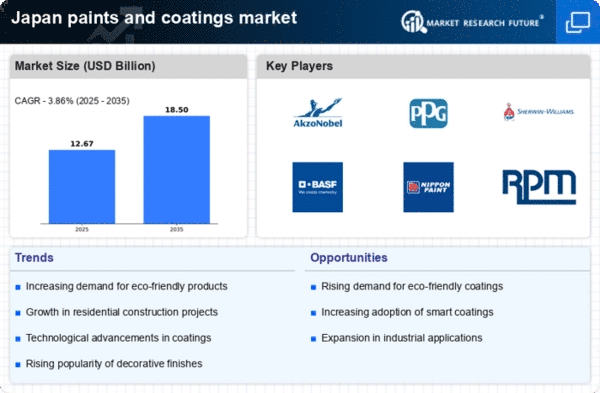
As per Market Research Future analysis, the Japan paints and coatings market size was estimated at 12.2 USD Billion in 2024. The Japan paints coatings market is projected to grow from 12.67 USD Billion in 2025 to 18.5 USD Billion by 2035, exhibiting a compound annual growth rate (CAGR) of 3.8% during the forecast period 2025 - 2035

Key Market Trends & Highlights

The Japan paints coatings market is experiencing a transformative shift towards sustainability and innovation.

  • The market is increasingly driven by a focus on sustainability, with eco-friendly products gaining traction.
  • Technological advancements are enhancing the performance and application of coatings, particularly in the automotive sector.
  • Urbanization and infrastructure development are propelling demand, making the construction sector the largest segment.
  • Regulatory compliance and rising demand in the construction sector are key drivers influencing market growth.

Market Size & Forecast

2024 Market Size 12.2 (USD Billion)
2035 Market Size 18.5 (USD Billion)
CAGR (2025 - 2035) 3.86%

Major Players

AkzoNobel (NL), PPG Industries (US), Sherwin-Williams (US), BASF (DE), Nippon Paint (JP), RPM International (US), Valspar (US), Asian Paints (IN), Kansai Paint (JP)

Our Impact
Enabled $4.3B Revenue Impact for Fortune 500 and Leading Multinationals
Partnering with 2000+ Global Organizations Each Year
30K+ Citations by Top-Tier Firms in the Industry

Japan Paints Coatings Market Trends

The paints coatings market in Japan is currently experiencing a dynamic evolution, driven by various factors including technological advancements and changing consumer preferences. The demand for eco-friendly and sustainable products is on the rise, as consumers become increasingly aware of environmental issues. This shift is prompting manufacturers to innovate and develop water-based and low-VOC paints & coatings, which are perceived as safer alternatives. Additionally, the construction and automotive sectors are significant contributors to market growth, as they require high-performance coatings that offer durability and aesthetic appeal. Moreover, the trend towards urbanization and infrastructure development in Japan is likely to further stimulate the paints and coatings market. As urban areas expand, the need for protective and decorative coatings in residential and commercial buildings becomes more pronounced. This is coupled with a growing interest in home improvement projects, which is encouraging consumers to invest in quality paints and coatings. Overall, the paints coatings market appears poised for continued growth, with a focus on sustainability and innovation shaping its future trajectory.

Sustainability Focus

There is a notable shift towards sustainable practices within the paints coatings market. Manufacturers are increasingly prioritizing eco-friendly formulations, such as water-based and low-VOC options, to meet consumer demand for environmentally responsible products. This trend reflects a broader societal movement towards sustainability, influencing purchasing decisions.

Technological Advancements

Innovations in technology are transforming the paints coatings market. Advanced application techniques and improved product formulations are enhancing performance characteristics, such as durability and resistance to environmental factors. These advancements are likely to attract both commercial and residential consumers seeking high-quality solutions.

Urbanization and Infrastructure Development

The ongoing urbanization in Japan is driving demand for paints and coatings in construction and renovation projects. As cities expand and infrastructure develops, the need for protective and decorative coatings becomes increasingly critical. This trend suggests a robust market outlook as investments in urban development continue.

Market Segment Insights

By Type: Water-Based Coatings (Largest) vs. Powder Coatings (Fastest-Growing)

The market share distribution in the Japan paints coatings market reveals that water-based coatings lead, holding a significant portion of overall sales. They are favored for their eco-friendly characteristics and low volatile organic compound (VOC) emissions, appealing to environmentally conscious consumers. Following closely, solvent-based coatings maintain a steady presence, while powder coatings have rapidly gained interest due to their efficiency and minimal waste production. Specialty coatings, while smaller in market share, cater to specific needs and niches, contributing to market diversity. Growth trends indicate a strong favor towards water-based coatings, driven by stringent environmental regulations and a shift in consumer preferences towards sustainable products. Furthermore, the powder coatings segment is emerging as the fastest-growing area due to its durability and versatility in various applications. The specialty coatings segment is also witnessing growth, propelled by technological advancements and increased demand for high-performance products across different industries.

Water-Based Coatings (Dominant) vs. Specialty Coatings (Emerging)

Water-based coatings dominate the segment due to their superior environmental profile, ease of use, and versatility across a variety of applications, from residential to industrial. Their rapid drying times and minimal odor further enhance their appeal among consumers. In contrast, specialty coatings are slowly but steadily emerging, targeting niche markets that require specific functionalities, such as corrosion resistance or heat insulation. These coatings are often tailored for unique applications, making them essential for sectors like automotive, aerospace, and construction. The dual focus on environmental sustainability and advanced performance features keeps both segments critically relevant in the evolving market landscape.

By Application: Architectural (Largest) vs. Automotive (Fastest-Growing)

In the Japan paints coatings market, the architectural segment holds the largest share, driven by robust construction activities and continuous demand for residential and commercial buildings. Meanwhile, the automotive segment is witnessing rapid growth, spurred by the increasing production of vehicles and a rising focus on vehicle aesthetics and durability. The decorative segment also contributes significantly, catering to the home improvement trend, while the industrial segment plays a vital role in protective and functional applications. The growth trends in these segments reflect changes in consumer preferences, innovation in product formulations, and environmental regulations. The architectural segment thrives on the increasing emphasis on energy-efficient buildings, while the automotive segment is rapidly evolving with advancements in technology such as electric vehicles. Additionally, eco-friendly formulations and sustainable practices are driving the development of both architectural and automotive coatings, promoting a shift towards greener solutions in the market.

Architectural (Dominant) vs. Industrial (Emerging)

The architectural segment is characterized by its dominance in the Japan paints coatings market, driven by consistent demand from the residential and commercial sectors. It focuses on functional benefits such as durability, weather resistance, and aesthetic appeal. In contrast, the industrial segment, while emerging, plays a crucial role in protective coatings for manufacturing processes, machinery, and equipment. The latter is gradually gaining traction due to increased industrial activity and a focus on process efficiency. Both segments are leveraging advancements in technology and materials to enhance performance, with architectural coatings adapting to sustainability trends and industrial coatings prioritizing functionality and compliance with regulations.

By End Use: Residential (Largest) vs. Industrial (Fastest-Growing)

In the Japan paints coatings market, the end-use segment is diversified, comprising Residential, Commercial, Industrial, and Automotive applications. Residential usage holds the largest market share due to the increasing population and a constant demand for housing renovations and new constructions. Conversely, the Industrial segment is rapidly gaining traction, driven by increased manufacturing activities and infrastructure projects, positioning itself as a key player in the market. The growth trends in the Japan paints coatings market are primarily influenced by factors such as urbanization, rising disposable incomes, and changing consumer preferences towards eco-friendly products. The Industrial segment is expected to witness the fastest growth as industries shift towards sustainable practices and advanced technologies. Additionally, government initiatives focusing on infrastructure development and construction will further boost demand in both Residential and Industrial sectors.

Residential (Dominant) vs. Industrial (Emerging)

The Residential segment is characterized by high demand for decorative coatings, driven by aesthetic preferences and the desire for home improvements among consumers. This segment benefits from a strong emphasis on product variety and innovative finishes that cater to urban housing needs. On the other hand, the Industrial segment represents an emerging opportunity, characterized by rapid growth due to increased investment in industrial activities and modernization efforts. The focus on durability and functionality in coatings used for machinery and equipment makes this segment appealing, as it aligns with the ongoing trends of efficiency and sustainability in manufacturing.

By Formulation: Acrylic (Largest) vs. Polyurethane (Fastest-Growing)

In the Japan paints coatings market, the formulation segment features a balanced distribution among various types, with acrylic paints taking the lead as the largest segment. Their popularity stems from their versatility and compatibility with various substrates, leading to their widespread usage in residential and commercial sectors. Alkyd and epoxy paints hold notable shares as well, catering to specific industrial applications due to their durability and resistance properties. The growth trends within this segment highlight a rising demand for environmentally friendly and low-VOC formulations. Polyurethane coatings are on the rise, fueled by their excellent finish and resistance to wear and tear, making them particularly appealing in automotive and furniture applications. The shift towards sustainable practices is further driving innovation and growth across these formulation categories in the market.

Acrylic (Dominant) vs. Polyurethane (Emerging)

Acrylic formulations are recognized for their dominant position in the Japan paints coatings market, owing to their ease of application, quick drying times, and excellent color retention. They are suitable for diverse environments, making them the preferred choice for both interior and exterior applications. Conversely, polyurethane formulations represent an emerging trend, particularly favored in high-performance coatings due to their superior chemical resistance and hardness. As industries increasingly demand durable finishes, polyurethane's growth trajectory is accelerated by innovations aimed at enhancing their environmental compliance, positioning them strongly as a competitive alternative to traditional coatings.

Get more detailed insights about Japan Paints Coatings Market

Key Players and Competitive Insights

The paints coatings market in Japan is characterized by a dynamic competitive landscape, driven by innovation, sustainability, and regional expansion. Major players such as Nippon Paint (Japan), AkzoNobel (NL), and PPG Industries (US) are actively shaping the market through strategic initiatives. Nippon Paint (Japan) focuses on enhancing its product portfolio with eco-friendly solutions, which aligns with the growing consumer demand for sustainable products. AkzoNobel (NL) emphasizes digital transformation and innovation, investing in advanced technologies to improve product performance and customer engagement. PPG Industries (US) is pursuing strategic partnerships to expand its market reach and enhance its competitive positioning, indicating a trend towards collaboration in the industry.The business tactics employed by these companies include localizing manufacturing and optimizing supply chains to enhance operational efficiency. The market structure appears moderately fragmented, with several key players exerting significant influence. This fragmentation allows for a diverse range of products and services, catering to various customer needs while fostering competition among established and emerging players.


In October Nippon Paint (Japan) announced a strategic partnership with a local technology firm to develop smart coatings that integrate IoT capabilities. This move is likely to position Nippon Paint at the forefront of innovation, enabling it to offer advanced solutions that meet the evolving demands of the construction and automotive sectors. The integration of technology into coatings could enhance functionality and open new market opportunities.


In September AkzoNobel (NL) launched a new line of sustainable paints aimed at reducing environmental impact. This initiative underscores the company's commitment to sustainability and reflects a broader industry trend towards eco-friendly products. By prioritizing sustainability, AkzoNobel not only addresses regulatory pressures but also aligns with consumer preferences, potentially enhancing its market share.


In August PPG Industries (US) expanded its manufacturing capabilities in Japan by investing in a new facility dedicated to producing high-performance coatings. This expansion is indicative of PPG's strategy to strengthen its presence in the region and respond to increasing demand for specialized coatings. Such investments are crucial for maintaining competitive advantage in a rapidly evolving market.


As of November current competitive trends in the paints coatings market include a strong emphasis on digitalization, sustainability, and the integration of artificial intelligence. Strategic alliances are increasingly shaping the landscape, allowing companies to leverage complementary strengths and enhance innovation. The shift from price-based competition to a focus on technological advancement and supply chain reliability is evident, suggesting that future differentiation will hinge on the ability to innovate and deliver sustainable solutions.


Key Companies in the Japan Paints Coatings Market include

Industry Developments

Significant developments have recently shaped the Japan Paints and Coatings Market. Companies like Mitsubishi Materials and Kansai Paint are focusing on sustainability, aligning with regulatory measures emphasizing eco-friendly products. In September 2023, Nippon Paint Holdings launched a new line of low-VOC paints, enhancing its market presence as consumer demand for safer alternatives grows. Additionally, AkzoNobel announced a collaboration with local firms in October 2023 to innovate in decorative and industrial paints, further bolstering its competitive edge. Notably, in June 2023, BASF expanded its production capacity in Japan, a move that underscores the demand for advanced coating solutions in various sectors.

Discussions around mergers and acquisitions continue in this sector, with a notable partnership between Hempel and local distributors in August 2023 aimed at enhancing supply chain efficiency. Japan's government has also been promoting initiatives for digital transformation in manufacturing, which paints a promising future for companies like Sherwin-Williams and Jotun as they adapt their business strategies. Over the past two years, the market has seen a consistent push towards innovation and sustainability in product offerings, reflecting changing consumer preferences and regulatory necessities.

Japan Paints and Coatings Market Segmentation Insights

  • Paints and Coatings Market Resin Type Outlook
  • Acrylic
  • Alkyd
  • Epoxy
  • Polyurethane
  • Polyester
  • Fluoropolymer
  • Polyether Ether ketone (PEEK)
  • Polyether Ketone (PEK)
  • PolyarylEtherketone (PAEK)
  • others
  • Paints and Coatings Market Application Outlook
  • Architectural
  • Industrial

Future Outlook

Japan Paints Coatings Market Future Outlook

The paints coatings market in Japan is projected to grow at a 3.86% CAGR from 2025 to 2035, driven by urbanization, technological advancements, and sustainability initiatives.

New opportunities lie in:

  • Development of eco-friendly coatings with low VOC emissions Expansion into smart coatings for industrial applications Investment in automated application technologies for efficiency

By 2035, the market is expected to achieve robust growth, driven by innovation and sustainability.

Market Segmentation

Japan Paints Coatings Market Type Outlook

  • Water-Based Coatings
  • Solvent-Based Coatings
  • Powder Coatings
  • Specialty Coatings

Japan Paints Coatings Market End Use Outlook

  • Residential
  • Commercial
  • Industrial
  • Automotive

Japan Paints Coatings Market Application Outlook

  • Architectural
  • Industrial
  • Decorative
  • Automotive

Japan Paints Coatings Market Formulation Outlook

  • Acrylic
  • Alkyd
  • Epoxy
  • Polyurethane

Report Scope

MARKET SIZE 2024 12.2(USD Billion)
MARKET SIZE 2025 12.67(USD Billion)
MARKET SIZE 2035 18.5(USD Billion)
COMPOUND ANNUAL GROWTH RATE (CAGR) 3.86% (2025 - 2035)
REPORT COVERAGE Revenue Forecast, Competitive Landscape, Growth Factors, and Trends
BASE YEAR 2024
Market Forecast Period 2025 - 2035
Historical Data 2019 - 2024
Market Forecast Units USD Billion
Key Companies Profiled AkzoNobel (NL), PPG Industries (US), Sherwin-Williams (US), BASF (DE), Nippon Paint (JP), RPM International (US), Valspar (US), Asian Paints (IN), Kansai Paint (JP)
Segments Covered Type, Application, End Use, Formulation
Key Market Opportunities Adoption of eco-friendly formulations driven by regulatory changes and consumer demand in the paints coatings market.
Key Market Dynamics Rising demand for eco-friendly coatings in Japan drives innovation and regulatory compliance in the paints coatings market.
Countries Covered Japan
Leave a Comment

FAQs

What is the projected market size of the Japan Paints Coatings Market in 2024?

The Japan Paints Coatings Market is expected to be valued at 11.95 USD Billion in 2024.

What will be the market size of the Japan Paints Coatings Market by 2035?

By 2035, the market is anticipated to reach a value of 16.03 USD Billion.

What is the expected CAGR for the Japan Paints Coatings Market from 2025 to 2035?

The market is expected to grow at a CAGR of 2.712 percent from 2025 to 2035.

Which resin type will dominate the Japan Paints Coatings Market in terms of revenue in 2024?

Acrylic is expected to dominate the market with a valuation of 3.252 USD Billion in 2024.

What are the expected market sizes for Alkyd and Epoxy resins in 2024?

The Alkyd resin is valued at 2.761 USD Billion and Epoxy resin at 2.423 USD Billion in 2024.

Who are the key players in the Japan Paints Coatings Market?

Major players include Mitsubishi Materials, PPG Industries, and AkzoNobel among others.

What growth opportunities exist within the Japan Paints Coatings Market?

Opportunities include emerging trends in eco-friendly products and innovative application techniques.

How does the polyurethane resin segment compare in terms of market size in 2024?

The polyurethane resin segment is valued at 2.314 USD Billion in 2024.

What challenges might impact growth in the Japan Paints Coatings Market?

Challenges may arise from fluctuating raw material prices and regulatory compliance.

What is the expected market size for the Polyester resin segment in 2024?

The Polyester resin segment is expected to be valued at 1.2 USD Billion in 2024.

Download Free Sample

Kindly complete the form below to receive a free sample of this Report

Compare Licence

×
Features License Type
Single User Multiuser License Enterprise User
Price $4,950 $5,950 $7,250
Maximum User Access Limit 1 User Upto 10 Users Unrestricted Access Throughout the Organization
Free Customization
Direct Access to Analyst
Deliverable Format
Platform Access
Discount on Next Purchase 10% 15% 15%
Printable Versions