×
Request Free Sample ×

Kindly complete the form below to receive a free sample of this Report

* Please use a valid business email

Leading companies partner with us for data-driven Insights

clients tt-cursor
Hero Background

Japan Ophthalmic Drugs Market

ID: MRFR/Pharma/43559-HCR
200 Pages
Rahul Gotadki
February 2026

Japan Ophthalmic Drugs Market Research Report By Dosage Form (Eye Drops, Eye Ointments, Eye Solutions, Gels, Capsules Tablets, Others), By Product Type (Prescription Drug, OTC Drug), By Drug Class (Antibiotics, Anti-Inflammatory, Anti-Glaucoma, Others), By Indication (Glaucoma, Retinal Disorder, Dry Eye, Eye Allergy, Others) and By Distribution Channels (Hospital pharmacies, Drug stores, Online pharmacies, Others) - Growth & Industry Forecast 2025 To 2035

Share:
Download PDF ×

We do not share your information with anyone. However, we may send you emails based on your report interest from time to time. You may contact us at any time to opt-out.

Japan Ophthalmic Drugs Market Infographic
Purchase Options

Japan Ophthalmic Drugs Market Summary

As per Market Research Future analysis, the Japan ophthalmic drugs market size was estimated at $2337.75 Million in 2024. The Japan ophthalmic drugs market is projected to grow from 2485.73 $ Million in 2025 to 4590.0 $ Million by 2035, exhibiting a compound annual growth rate (CAGR) of 6.3% during the forecast period 2025 - 2035

Key Market Trends & Highlights

The Japan ophthalmic drugs market is experiencing robust growth driven by innovative therapies and an aging population.

  • The market is witnessing a rising demand for innovative therapies to address various eye disorders.
  • The aging population in Japan is contributing to an increase in the prevalence of eye diseases, particularly among older adults.
  • Integration of digital health technologies is becoming more prevalent, enhancing patient monitoring and treatment adherence.
  • Key market drivers include the increasing prevalence of eye diseases and advancements in drug formulations, which are likely to propel market growth.

Market Size & Forecast

2024 Market Size 2337.75 (USD Million)
2035 Market Size 4590.0 (USD Million)
CAGR (2025 - 2035) 6.33%

Major Players

Novartis (CH), Allergan (IE), Bausch Health (CA), Regeneron Pharmaceuticals (US), Santen Pharmaceutical (JP), Hoya Corporation (JP), Akorn (US), Ocular Therapeutix (US)

Our Impact
Enabled $4.3B Revenue Impact for Fortune 500 and Leading Multinationals
Partnering with 2000+ Global Organizations Each Year
30K+ Citations by Top-Tier Firms in the Industry

Japan Ophthalmic Drugs Market Trends

The ophthalmic drugs market in Japan is currently experiencing notable growth, driven by an increasing prevalence of eye disorders and a rising aging population. The demand for innovative therapies and advanced treatment options is on the rise, as patients seek effective solutions for conditions such as glaucoma, dry eye syndrome, and age-related macular degeneration. Furthermore, the Japanese government is actively promoting research and development initiatives, which may enhance the availability of novel ophthalmic drugs. This supportive regulatory environment appears to foster collaboration between pharmaceutical companies and research institutions, potentially leading to breakthroughs in treatment methodologies. In addition, the market is witnessing a shift towards personalized medicine, where tailored therapies are developed based on individual patient profiles. This trend may improve treatment outcomes and patient satisfaction. The integration of digital health technologies, such as telemedicine and mobile health applications, is also gaining traction, allowing for better patient monitoring and adherence to treatment regimens. As the ophthalmic drugs market evolves, stakeholders must remain vigilant to emerging trends and adapt strategies accordingly to meet the changing needs of patients and healthcare providers.

Rising Demand for Innovative Therapies

The ophthalmic drugs market is experiencing a surge in demand for innovative therapies, particularly for chronic eye conditions. This trend is likely influenced by advancements in drug formulation and delivery systems, which may enhance treatment efficacy and patient compliance.

Aging Population and Eye Disorders

Japan's aging population is contributing to an increase in eye disorders, thereby driving the need for effective ophthalmic treatments. This demographic shift suggests a growing market for drugs targeting age-related conditions, such as cataracts and macular degeneration.

Integration of Digital Health Technologies

The incorporation of digital health technologies into the ophthalmic drugs market has become more prevalent. This trend may facilitate improved patient engagement and monitoring, potentially leading to better adherence to treatment plans and enhanced health outcomes.

Japan Ophthalmic Drugs Market Drivers

Rising Healthcare Expenditure

The increasing healthcare expenditure in Japan is a significant driver for the ophthalmic drugs market. As the population ages and the prevalence of chronic eye conditions rises, healthcare spending on ophthalmic treatments is expected to grow. In 2025, healthcare expenditure in Japan is projected to reach approximately ¥50 trillion, with a notable portion allocated to eye care. This financial commitment reflects the prioritization of eye health within the broader healthcare system. Additionally, the willingness of patients to invest in advanced treatments further fuels market demand. As healthcare budgets expand, the ophthalmic drugs market is likely to benefit from increased funding for research, development, and the availability of innovative therapies, ultimately enhancing patient outcomes.

Growing Awareness of Eye Health

The growing awareness of eye health among the Japanese population is a vital driver for the ophthalmic drugs market. Public health campaigns and educational initiatives have significantly increased knowledge regarding the importance of regular eye check-ups and early intervention for eye diseases. This heightened awareness encourages individuals to seek medical advice and treatment, leading to an uptick in prescriptions for ophthalmic drugs. Moreover, the integration of eye health education into school curriculums and community programs fosters a culture of proactive eye care. As more people recognize the impact of eye health on overall well-being, the demand for effective ophthalmic treatments is likely to rise, thereby propelling the growth of the ophthalmic drugs market.

Advancements in Drug Formulations

Innovations in drug formulations are significantly influencing the ophthalmic drugs market. The introduction of novel delivery systems, such as sustained-release formulations and nanotechnology-based products, enhances the efficacy and safety of ophthalmic medications. For instance, the development of eye drops that provide prolonged therapeutic effects reduces the frequency of administration, improving patient compliance. Additionally, the emergence of biologics and gene therapies offers new avenues for treating previously challenging conditions. The Japanese pharmaceutical industry is actively investing in research and development to create these advanced formulations, which could potentially lead to a surge in market growth. As a result, the ophthalmic drugs market is expected to witness a transformation, driven by these technological advancements that promise better outcomes for patients.

Government Initiatives and Support

Government initiatives aimed at improving healthcare access and affordability are pivotal for the ophthalmic drugs market. In Japan, the government has implemented various policies to enhance the availability of essential medications, including ophthalmic drugs. Programs that subsidize the cost of treatments and promote research into eye diseases are likely to stimulate market growth. Furthermore, the Japanese Ministry of Health, Labour and Welfare has been actively encouraging collaborations between public and private sectors to foster innovation in drug development. This supportive regulatory environment not only facilitates the introduction of new ophthalmic drugs but also ensures that existing treatments remain accessible to patients. Consequently, the ophthalmic drugs market is poised for expansion, bolstered by these proactive government measures.

Increasing Prevalence of Eye Diseases

The rising incidence of eye diseases in Japan is a crucial driver for the ophthalmic drugs market. Conditions such as glaucoma, diabetic retinopathy, and age-related macular degeneration are becoming more prevalent, particularly among the aging population. According to recent health statistics, approximately 3.5 million individuals in Japan are affected by glaucoma alone. This growing patient base necessitates the development and availability of effective ophthalmic drugs, thereby propelling market growth. Furthermore, the increasing awareness of eye health and the importance of early diagnosis contribute to the demand for innovative treatment options. As healthcare providers emphasize the need for regular eye examinations, the ophthalmic drugs market is likely to expand, catering to the needs of a larger segment of the population suffering from various eye disorders.


Market Segment Insights

By Drug Class: Anti-Inflammatory Drugs (Largest) vs. Anti-Infective Drugs (Fastest-Growing)

In the Japan ophthalmic drugs market, the distribution of market share among various drug classes reveals that anti-inflammatory drugs hold the largest share due to their critical role in disease management and patient care. This segment is followed closely by anti-infective drugs, glaucoma drugs, ophthalmic anesthetics, and artificial tears, each contributing to the overall market dynamics with varying levels of demand and application. Growth trends indicate that anti-infective drugs are the fastest-growing segment, driven by increasing incidences of infections and a rising aging population susceptible to eye diseases. Additionally, advancements in drug formulations and expanded indications for use are enhancing the appeal of glaucoma drugs. These trends, combined with a growing awareness of eye health, are expected to fuel further growth across all drug classes in the market.

Anti-Inflammatory Drugs (Dominant) vs. Anti-Infective Drugs (Emerging)

Anti-inflammatory drugs are the dominant force in the market, characterized by their widespread use in treating various ocular conditions, including post-operative care and inflammatory eye diseases. Their efficacy and established presence contribute to sustained demand. On the other hand, anti-infective drugs, while currently emerging, are rapidly gaining traction due to the rise in bacterial and viral infections affecting the eyes. This segment is enhanced by innovative therapies and a growing focus on infection control, making them a vital area of growth in the Japan ophthalmic drugs market.

By Formulation Type: Eye Drops (Largest) vs. Gel (Fastest-Growing)

The formulation type segment in the Japan ophthalmic drugs market showcases a diverse range of options, with eye drops holding a significant share due to their convenience and widespread usage among patients. This segment also includes ointments, which, while historically important, account for a smaller portion of market share compared to the rising popularity of liquid formulations such as gels and sustained release products. Gel formulations, although currently lesser in market share, are carving out a niche due to their unique properties and patient compliance rates. Growth trends in this segment are primarily driven by the increasing prevalence of eye-related conditions and the aging population in Japan. The preference for self-administered, easy-to-use treatments has catapulted eye drops to the forefront. Meanwhile, gel formulations are expected to witness the fastest growth as they provide prolonged release and enhanced comfort for patients, addressing unmet needs in the market. Manufacturers are focusing on innovative formulations, thereby fueling competition and expansion in the segment.

Gel (Dominant) vs. Ointment (Emerging)

In the formulation type segment of the Japan ophthalmic drugs market, gels are recognized as a dominant player due to their efficacy in delivering medications while minimizing patient discomfort. Gels offer a viscous consistency that adheres better to the ocular surface, leading to improved therapeutic outcomes and patient satisfaction. On the other hand, ointments are categorized as an emerging formulation type. Although they have traditionally been used for their protective qualities and moisture retention, they are gradually being overshadowed by more advanced formulations such as gels. Despite this, ointments remain relevant for specific applications, particularly in managing chronic ocular conditions, as they provide longer-lasting effects even though they may not be as patient-friendly as gels.

By Therapeutic Application: Allergic Conjunctivitis (Largest) vs. Dry Eye Syndrome (Fastest-Growing)

In the Japan ophthalmic drugs market, the therapeutic application segment showcases a diverse range of conditions with varying market shares. Allergic Conjunctivitis currently holds the largest share, driven by high prevalence rates and consistent demand for effective treatment options. Other significant conditions include Cataracts, Glaucoma, and Intraocular Infections, each contributing to the overall market dynamics and highlighting the importance of targeted therapies for these diseases. Growth trends indicate that the therapeutic application segment is evolving rapidly, particularly with Dry Eye Syndrome gaining traction as the fastest-growing segment. Factors such as an aging population, increased screen time leading to dry eye conditions, and rising awareness of ocular diseases are driving this expansion. Innovative therapies and advancements in drug formulations further enhance market potential, making the segment one to watch.

Allergic Conjunctivitis (Dominant) vs. Dry Eye Syndrome (Emerging)

Allergic Conjunctivitis remains a dominant player in the therapeutic application segment, characterized by a high incidence rate and established treatment protocols. This condition has garnered significant attention from pharmaceutical companies, resulting in a diversified portfolio of antihistamines and anti-inflammatory medications. On the other hand, Dry Eye Syndrome is emerging rapidly, primarily due to lifestyle changes and environmental factors. This segment appeals to a younger demographic increasingly affected by digital eye strain. With ongoing research and emerging treatment options, Dry Eye Syndrome is anticipated to capture a more substantial market share, positioning it as a vital focus area for future innovation and investment.

By Route of Administration: Topical (Largest) vs. Intraocular (Fastest-Growing)

In the Japan ophthalmic drugs market, three primary routes of administration dominate: topical, intraocular, and systemic. Among these, the topical route holds the largest share, favored for its convenience and efficacy in delivering medications directly to the eye. Intraocular, while currently smaller in market share, is rapidly gaining traction as technological advancements enhance its safety and effectiveness. Systemic administration, while less common, plays a role in addressing certain ocular conditions that require broader systemic treatment. Growth trends within the segment reveal a shift toward intraocular delivery systems, fueled by innovation and rising consumer awareness regarding eye health. The aging population in Japan further accelerates this trend, as age-related eye disorders become more prevalent, necessitating effective treatment options. Additionally, increasing investments in research and development for ophthalmic products drive competition in the market, prompting brands to diversify and enhance their offerings across all routes of administration.

Topical (Dominant) vs. Intraocular (Emerging)

Topical administration remains the dominant route in the Japan ophthalmic drugs market, primarily due to its user-friendly nature and swift absorption in ocular tissues. This method allows for direct application of medications, ensuring localized effects with minimal systemic exposure, which is advantageous for patient safety. In contrast, intraocular administration is emerging as a promising alternative, particularly for severe ocular conditions that require sustained drug release and deeper penetration of therapeutic agents. The development of innovative delivery systems, such as implants and injectable formulations, positions intraocular administration to capture greater market share. As a result, while topical products continue to lead, intraocular options are on the brink of expanding significantly, shaping the future landscape of the market.

Get more detailed insights about Japan Ophthalmic Drugs Market

Key Players and Competitive Insights

The ophthalmic drugs market in Japan is characterized by a dynamic competitive landscape, driven by increasing demand for innovative therapies and a growing aging population. Key players such as Novartis (CH), Santen Pharmaceutical (JP), and Allergan (IE) are strategically positioned to leverage their extensive research and development capabilities. Novartis (CH) focuses on advancing its portfolio through innovative drug formulations, while Santen Pharmaceutical (JP) emphasizes localized manufacturing and partnerships to enhance its market presence. Allergan (IE), on the other hand, is actively pursuing mergers and acquisitions to expand its therapeutic offerings, thereby shaping a competitive environment that is increasingly reliant on innovation and strategic collaborations.The business tactics employed by these companies reflect a concerted effort to optimize supply chains and localize manufacturing processes. The market appears moderately fragmented, with several players vying for market share. However, the collective influence of major companies like Regeneron Pharmaceuticals (US) and Bausch Health (CA) suggests a trend towards consolidation, as these firms seek to enhance operational efficiencies and expand their geographic reach.

In October Santen Pharmaceutical (JP) announced a strategic partnership with a leading technology firm to develop AI-driven solutions for personalized ophthalmic treatments. This collaboration is likely to enhance Santen's capabilities in delivering tailored therapies, thereby positioning the company at the forefront of innovation in the ophthalmic sector. The integration of AI into treatment protocols may significantly improve patient outcomes and streamline clinical workflows.

In September Novartis (CH) launched a new ophthalmic drug aimed at treating age-related macular degeneration, which is expected to capture a substantial share of the market. This launch underscores Novartis's commitment to addressing unmet medical needs and reflects a broader trend towards developing targeted therapies that cater to specific patient populations. The potential for this drug to improve vision in affected individuals could solidify Novartis's competitive edge in the market.

In August Allergan (IE) completed the acquisition of a smaller biotech firm specializing in ocular therapeutics, thereby expanding its product pipeline. This acquisition is indicative of Allergan's strategy to bolster its market position through strategic investments in innovative therapies. By integrating new technologies and expertise, Allergan aims to enhance its competitive standing and respond more effectively to evolving market demands.

As of November the competitive trends in the ophthalmic drugs market are increasingly defined by digitalization, sustainability, and the integration of advanced technologies such as AI. Strategic alliances are becoming pivotal in shaping the landscape, as companies recognize the need for collaboration to drive innovation. The shift from price-based competition to a focus on technological advancement and supply chain reliability is evident, suggesting that future competitive differentiation will hinge on the ability to deliver innovative solutions that meet the complex needs of patients.

Key Companies in the Japan Ophthalmic Drugs Market include

Industry Developments

The Japan Ophthalmic Drugs Market has recently seen various notable developments. In August 2023, Santen Pharmaceutical announced the launch of a new formulation aimed at treating allergic conjunctivitis, indicating a focus on enhancing patient care through innovative options. Additionally, Astellas Pharma has made strides in expanding its portfolio with a new monoclonal antibody therapy for age-related macular degeneration, reflecting the rising demand for effective treatments in this aging population.

Market valuation has been positively impacted due to an increase in the prevalence of ocular diseases coupled with technological advancements in drug delivery systems, which are driving growth for companies like Novartis and Allergan. Recent mergers and acquisitions have also shaped the landscape; for instance, in September 2023, Roche completed its acquisition of a smaller biotech company specializing in ophthalmic drug research, which is expected to bolster its development pipeline. This trend indicates a strategic approach by major players to consolidate resources and expertise within the Japanese market.

The continuous collaboration between established firms such as Pfizer, Merck, and Bausch Health further enhances innovation, ensuring competitive dynamics within the market.

Future Outlook

Japan Ophthalmic Drugs Market Future Outlook

The Ophthalmic Drugs Market in Japan is projected to grow at a 6.33% CAGR from 2025 to 2035, driven by increasing prevalence of eye disorders and advancements in drug formulations.

New opportunities lie in:

  • Development of personalized medicine for ocular diseases
  • Expansion of telemedicine platforms for remote consultations
  • Investment in AI-driven drug discovery for ophthalmic applications

By 2035, the ophthalmic drugs market is expected to achieve substantial growth and innovation.

Market Segmentation

Japan Ophthalmic Drugs Market Drug Class Outlook

  • Anti-Inflammatory Drugs
  • Anti-Infective Drugs
  • Glaucoma Drugs
  • Ophthalmic Anesthetics
  • Artificial Tears

Japan Ophthalmic Drugs Market Formulation Type Outlook

  • Liquid
  • Ointment
  • Eye Drops
  • Gel
  • Sustained Release

Japan Ophthalmic Drugs Market Route of Administration Outlook

  • Topical
  • Intraocular
  • Systemic

Japan Ophthalmic Drugs Market Therapeutic Application Outlook

  • Allergic Conjunctivitis
  • Cataracts
  • Glaucoma
  • Dry Eye Syndrome
  • Intraocular Infections

Report Scope

MARKET SIZE 2024 2337.75(USD Million)
MARKET SIZE 2025 2485.73(USD Million)
MARKET SIZE 2035 4590.0(USD Million)
COMPOUND ANNUAL GROWTH RATE (CAGR) 6.33% (2025 - 2035)
REPORT COVERAGE Revenue Forecast, Competitive Landscape, Growth Factors, and Trends
BASE YEAR 2024
Market Forecast Period 2025 - 2035
Historical Data 2019 - 2024
Market Forecast Units USD Million
Key Companies Profiled Novartis (CH), Allergan (IE), Bausch Health (CA), Regeneron Pharmaceuticals (US), Santen Pharmaceutical (JP), Hoya Corporation (JP), Akorn (US), Ocular Therapeutix (US)
Segments Covered Drug Class, Formulation Type, Therapeutic Application, Route of Administration
Key Market Opportunities Advancements in personalized medicine and digital health technologies enhance treatment options in the ophthalmic drugs market.
Key Market Dynamics Rising demand for innovative ophthalmic therapies drives competition and regulatory adaptations in Japan's ophthalmic drugs market.
Countries Covered Japan
Leave a Comment

FAQs

What is the projected market size of the Japan Ophthalmic Drugs Market in 2024?

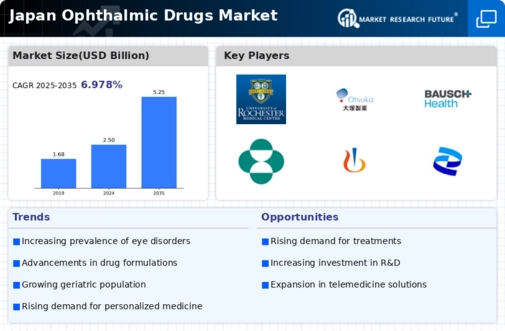
The Japan Ophthalmic Drugs Market is expected to be valued at 2.5 USD Billion in 2024.

What is the expected market value of the Japan Ophthalmic Drugs Market in 2035?

By 2035, the Japan Ophthalmic Drugs Market is projected to reach a value of 5.25 USD Billion.

What is the expected compound annual growth rate (CAGR) for the Japan Ophthalmic Drugs Market from 2025 to 2035?

The market is expected to grow at a CAGR of 6.978% from 2025 to 2035.

Which companies are the major players in the Japan Ophthalmic Drugs Market?

Major players in the market include Allergan, Roche, Hoya Corporation, and Otsuka Pharmaceutical.

What will be the market value for eye drops in 2035 within the Japan Ophthalmic Drugs Market?

The market value for eye drops is expected to reach 2.044 USD Billion by 2035.

How much revenue is expected from eye ointments in the Japan Ophthalmic Drugs Market in 2024?

Eye ointments are expected to generate 0.333 USD Billion in revenue in 2024.

What market size is expected for eye solutions in 2035?

By 2035, the market size for eye solutions is projected to be 1.026 USD Billion.

What is the anticipated market value for gels in the Japan Ophthalmic Drugs Market in 2024?

The market value for gels is expected to be 0.25 USD Billion in 2024.

What specific growth opportunity exists within the eye drops segment of the Japan Ophthalmic Drugs Market?

The eye drops segment shows significant growth potential, expected to reach 2.044 USD Billion by 2035.

What is the projected market value for capsules and tablets in the Japan Ophthalmic Drugs Market in 2035?

Capsules and tablets are expected to have a market value of 0.978 USD Billion in 2035.

Download Free Sample

Kindly complete the form below to receive a free sample of this Report

Compare Licence

×
Features License Type
Single User Multiuser License Enterprise User
Price $4,950 $5,950 $7,250
Maximum User Access Limit 1 User Upto 10 Users Unrestricted Access Throughout the Organization
Free Customization
Direct Access to Analyst
Deliverable Format
Platform Access
Discount on Next Purchase 10% 15% 15%
Printable Versions