×
Request Free Sample ×

Kindly complete the form below to receive a free sample of this Report

* Please use a valid business email

Leading companies partner with us for data-driven Insights

clients tt-cursor
Hero Background

Japan MICE Market

ID: MRFR/CG/44986-HCR
129 Pages
Pradeep Nandi
February 2026

Japan MICE Market Size, Share, Industry Trend & Analysis Research Report By Event Type (Meetings, Incentives, Conferences, Exhibitions) and By Booking Mode (Online, Offline)-Forecast to 2035 \n

Share:
Download PDF ×

We do not share your information with anyone. However, we may send you emails based on your report interest from time to time. You may contact us at any time to opt-out.

Japan MICE Market Infographic
Purchase Options

Japan MICE Market Summary

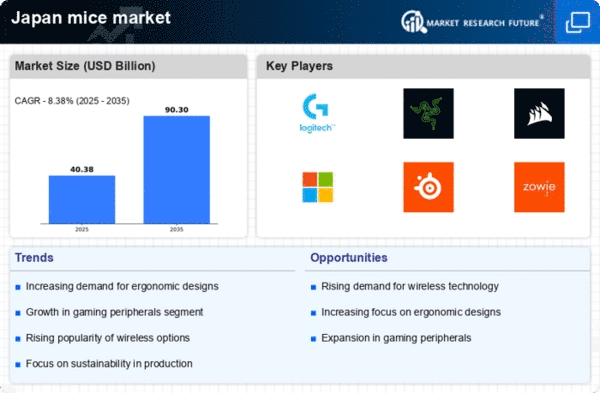
As per Market Research Future analysis, the Japan mice market Size was estimated at 37.25 USD Billion in 2024. The Mice market is projected to grow from 40.38 USD Billion in 2025 to 90.3 USD Billion by 2035, exhibiting a compound annual growth rate (CAGR) of 8.3% during the forecast period 2025 - 2035

Key Market Trends & Highlights

The Japan mice market is experiencing a dynamic shift towards ergonomic and sustainable designs, driven by technological advancements and the growing gaming culture.

  • The demand for ergonomic designs in mice is increasing as consumers prioritize comfort and health.
  • Gaming mice are gaining popularity, reflecting the rise of e-sports and gaming culture in Japan.
  • Sustainability initiatives are becoming a focal point, with consumers seeking eco-friendly products.
  • Technological advancements and the rising e-sports culture are key drivers propelling market growth.

Market Size & Forecast

2024 Market Size 37.25 (USD Billion)
2035 Market Size 90.3 (USD Billion)
CAGR (2025 - 2035) 8.38%

Major Players

Logitech (CH), Razer (SG), Corsair (US), Microsoft (US), SteelSeries (DK), Zowie (BE), HyperX (US), Cooler Master (TW)

Our Impact
Enabled $4.3B Revenue Impact for Fortune 500 and Leading Multinationals
Partnering with 2000+ Global Organizations Each Year
30K+ Citations by Top-Tier Firms in the Industry

Japan MICE Market Trends

The mice market in Japan is currently experiencing a dynamic evolution, driven by technological advancements and changing consumer preferences. The increasing demand for ergonomic designs and wireless connectivity is reshaping product offerings. As more individuals work remotely, the need for high-quality, comfortable devices has surged. This shift is prompting manufacturers to innovate, focusing on features that enhance user experience, such as customizable buttons and improved battery life. Furthermore, the rise of gaming culture in Japan is influencing the market, with specialized gaming mice gaining traction among enthusiasts. In addition to ergonomic and gaming trends, sustainability is becoming a focal point for consumers. There is a growing awareness regarding environmental impact, leading to a preference for products made from eco-friendly materials. Companies are responding by developing mice that not only perform well but also align with consumers' values. This trend indicates a potential shift in purchasing behavior, as buyers increasingly seek products that reflect their commitment to sustainability. Overall, the mice market in Japan is poised for continued growth, driven by innovation and a focus on consumer-centric design.

Ergonomic Design Demand

There is a notable increase in consumer preference for ergonomic mice, as users prioritize comfort during prolonged usage. This trend is particularly relevant for remote workers and gamers, who require devices that minimize strain and enhance productivity.

Gaming Mice Popularity

The rise of gaming culture in Japan has led to a surge in demand for specialized gaming mice. These products often feature advanced sensors, customizable settings, and aesthetic designs that appeal to gamers, indicating a shift in market focus.

Sustainability Initiatives

Consumers are increasingly favoring eco-friendly products, prompting manufacturers to explore sustainable materials and practices. This trend reflects a broader societal shift towards environmental consciousness, influencing purchasing decisions in the mice market.

Japan MICE Market Drivers

Rising E-Sports and Gaming Culture

The burgeoning e-sports and gaming culture in Japan significantly influences the mice market. With an increasing number of gamers seeking specialized equipment, the demand for high-performance gaming mice has escalated. Recent statistics suggest that the gaming segment constitutes approximately 40% of the total mice market in Japan. This growth is fueled by the popularity of competitive gaming events and the rise of streaming platforms, which have created a vibrant community of gamers. As a result, manufacturers are focusing on developing mice tailored for gaming, featuring customizable buttons, RGB lighting, and ergonomic designs. This trend not only enhances the gaming experience but also drives sales in the mice market, indicating a robust future for this segment.

Increased Focus on Health and Wellness

The growing awareness of health and wellness among consumers is impacting the mice market in Japan. As individuals become more conscious of the effects of prolonged computer use, there is a rising demand for ergonomic mice designed to reduce strain and discomfort. Recent data suggests that sales of ergonomic mice have increased by 20% in the past year, indicating a shift in consumer preferences. This trend is likely to continue as more people seek products that promote better posture and reduce the risk of repetitive strain injuries. Manufacturers are responding by developing mice that incorporate ergonomic features, thereby aligning with the health-conscious mindset of consumers. This focus on wellness is expected to drive further growth in the mice market.

Sustainability and Eco-Friendly Products

The emphasis on sustainability is becoming increasingly relevant in the mice market. Japanese consumers are showing a preference for eco-friendly products, prompting manufacturers to explore sustainable materials and production methods. Recent reports indicate that approximately 30% of consumers are willing to pay a premium for environmentally friendly mice. This trend is encouraging companies to innovate and create products that minimize environmental impact, such as using recycled materials and reducing packaging waste. As awareness of environmental issues continues to rise, the demand for sustainable options in the mice market is likely to grow, influencing product development and marketing strategies.

Technological Advancements in Mice Market

The rapid evolution of technology plays a pivotal role in shaping the mice market. Innovations such as wireless connectivity, enhanced sensor accuracy, and customizable features are increasingly appealing to consumers. In Japan, the demand for high-performance mice has surged, with a reported growth rate of 15% in the last year alone. This trend indicates a shift towards more sophisticated devices that cater to both professional and casual users. As manufacturers invest in research and development, the introduction of smart mice equipped with AI capabilities is anticipated, further driving the market. The integration of advanced technologies not only enhances user experience but also positions the mice market as a competitive segment within the broader electronics industry.

Shift Towards Remote Work and Home Offices

The shift towards remote work has transformed the landscape of the mice market in Japan. As more individuals establish home offices, the demand for ergonomic and multifunctional mice has increased. Recent surveys indicate that approximately 60% of remote workers prioritize comfort and functionality in their choice of peripherals. This trend has prompted manufacturers to innovate and offer products that cater to the needs of home office users. The mice market is witnessing a surge in sales, with a projected growth rate of 10% over the next year. This shift not only reflects changing work habits but also highlights the importance of investing in quality equipment to enhance productivity in a home setting.


Market Segment Insights

By Event Type: Conferences (Largest) vs. Exhibitions (Fastest-Growing)

The market share distribution in the Japan mice market reveals that conferences hold the largest share among the various event types, reflecting their critical role in the professional and academic landscape. Exhibitions, while smaller in share, are gaining traction due to the increasing emphasis on interactive and experiential marketing platforms, drawing more participants and exhibitors alike. Growth in this segment is primarily driven by the resurgence of in-person events post-pandemic, as organizations seek to foster networking and collaboration. Additionally, the integration of digital technology in event planning and execution has enhanced participant engagement, making exhibitions particularly attractive. These trends indicate a promising outlook for both conferences and exhibitions, with a growing emphasis on innovation and attendee experience shaping their development in the coming years.

Conferences: Dominant vs. Exhibitions: Emerging

Conferences are established as the dominant event type in the Japan mice market, serving as essential forums for knowledge exchange and networking opportunities among industry professionals. They cater to diverse fields such as technology, healthcare, and finance, drawing significant attendance due to the value they provide in terms of education and collaboration. On the other hand, exhibitions are emerging as a vital segment, leveraging unique formats and interactive installations to captivate audiences. With evolving consumer preferences leaning towards immersive experiences, exhibitions are adapting swiftly, making them a key player in attracting new participants, and driving innovation in event formats. Their adaptability and focus on engagement position them for substantial growth in the coming years.

By Service Type: Venue Rental (Largest) vs. Catering Services (Fastest-Growing)

In the Japan mice market, the venue rental segment holds a commanding share, making it the largest service type. Catering services are quickly gaining traction, reflecting evolving consumer preferences towards specialized event dining experiences. Audio-visual equipment and event management services follow closely, each contributing significantly to the total market landscape. Transportation services, while essential, represent a smaller fraction, primarily supporting the logistics of major events. The growth of catering services is driven by increasing demands for customized and high-quality food offerings at events. As organizations prioritize unique and memorable experiences for attendees, catering has emerged as a key differentiator in event planning. Additionally, the rise of technology integration in audio-visual equipment and efficient event management services is aiding in operational improvements. These factors combined indicate a dynamic shift within the segment, especially towards more experiential approaches in event execution.

Venue Rental: Dominant vs. Catering Services: Emerging

The venue rental segment remains dominant in the Japan mice market, characterized by its extensive variety of locations catering to diverse event needs, from corporate gatherings to large-scale conferences. This segment's success can be attributed to the rich culture and unique architectural styles found in Japan, appealing to international clients seeking exclusive settings. In contrast, catering services are emerging as a critical factor in event success, with a focus on quality and innovation in food presentation. As the demand for personalized experiences increases, catering services are evolving, integrating local ingredients, and focusing on sustainability, thereby enhancing their market position among clients looking for unique dining experiences.

By Industry: Corporate (Largest) vs. Technology (Fastest-Growing)

In the Japan mice market, the industry segment is primarily dominated by Corporate, holding the largest market share among its peers. This sector reflects well-established demand due to the increasing number of corporate events, meetings, and incentives that have seen steady growth over the years. The Healthcare and Education sectors also hold significant shares, driven by conferences and seminars aimed at medical professionals and educational institutions respectively. On the other hand, Technology is emerging as the fastest-growing sector, fueled by the rapid advancement in digital solutions and innovative event formats that cater to tech-savvy audiences. Additionally, the integration of virtual platforms has transformed how events are hosted, contributing to the overall growth, while Finance shows robust performance as financial institutions seek to leverage events for networking and branding opportunities.

Corporate: Leading (Dominant) vs. Technology (Emerging)

The Corporate segment stands out as the dominant force in the Japan mice market, characterized by its reliance on traditional meeting formats and a solid base of established businesses and organizations. This segment benefits from a high volume of corporate gatherings, fostering business relationships and collaborations. In contrast, the Technology sector is rapidly emerging, driven by a surge in innovation and interest in integrating technology into event experiences. As tech companies seek fresh engagement methods, they are increasingly investing in experiential events that showcase their products and ideas. This dynamic creates a distinct contrast between the established revenue streams of the Corporate sector and the innovative approaches dominating the Technology sector.

By Attendee Type: Delegates (Largest) vs. Exhibitors (Fastest-Growing)

In the Japan mice market, the segment distribution reveals that Delegates hold the largest share, reflecting the core audience attending events. Exhibitors follow as a significant contributor, while Sponsors, Speakers, and Organizers represent specialized roles that complement the main attendee types. The diversity in attendee types showcases the multifaceted nature of events, from large conferences to niche exhibitions, reinforcing the importance of understanding each group's unique needs. Looking ahead, the growth trends indicate a notable rise in Exhibitors, driven by increasing demand for interactive and experiential marketing strategies. Sponsors are also projected to expand their footprint, with brands placing higher importance on event engagement. The focus on hybrid events and virtual participation is reshaping the traditional dynamics, influencing how each attendee type interacts within the overall ecosystem.

Delegates: Dominant vs. Exhibitors: Emerging

Delegates are characterized as the backbone of the Japan mice market, representing the primary audience who engage directly with content, networking, and learning opportunities during events. Their stable presence ensures that events are meaningful and relevant. Conversely, Exhibitors are emerging as a vital force, adapting quickly to trends in technology and marketing techniques. They are increasingly seen as essential partners for creating stimulating environments that foster interactions between delegates and brands. This dynamic illustrates a shift where Exhibitors not only showcase products but also play a significant role in enhancing attendee experience, signaling a trend towards collaborative event strategies.

Get more detailed insights about Japan MICE Market

Key Players and Competitive Insights

The mice market exhibits a dynamic competitive landscape characterized by rapid technological advancements and evolving consumer preferences. Key players such as Logitech (CH), Razer (SG), and Microsoft (US) are at the forefront, leveraging innovation and strategic partnerships to enhance their market positions. Logitech (CH) focuses on sustainability and user-centric design, while Razer (SG) emphasizes high-performance gaming peripherals. Microsoft (US) integrates its devices with software ecosystems, enhancing user experience and engagement. Collectively, these strategies foster a competitive environment that prioritizes innovation and customer satisfaction.In terms of business tactics, companies are increasingly localizing manufacturing to reduce lead times and optimize supply chains. The market structure appears moderately fragmented, with several players vying for market share. However, the influence of major companies is substantial, as they set trends and standards that smaller firms often follow. This competitive structure encourages continuous improvement and adaptation among all market participants.

In October Logitech (CH) announced a partnership with a leading gaming studio to develop exclusive gaming mice tailored for competitive esports. This collaboration is likely to enhance Logitech's brand visibility within the gaming community and solidify its position as a leader in high-performance peripherals. The strategic importance of this move lies in its potential to attract a dedicated user base, thereby driving sales and fostering brand loyalty.

In September Razer (SG) launched a new line of eco-friendly gaming mice, utilizing sustainable materials and packaging. This initiative not only aligns with global sustainability trends but also positions Razer as a forward-thinking brand committed to environmental responsibility. The strategic significance of this launch may resonate with environmentally conscious consumers, potentially expanding Razer's market reach and enhancing its competitive edge.

In August Microsoft (US) unveiled a new adaptive mouse designed specifically for users with disabilities. This product reflects Microsoft's commitment to inclusivity and accessibility, which could open new market segments and enhance brand reputation. The strategic importance of this initiative lies in its alignment with social responsibility trends, potentially attracting a diverse customer base and fostering goodwill.

As of November current competitive trends in the mice market include a strong emphasis on digitalization, sustainability, and AI integration. Strategic alliances are increasingly shaping the landscape, as companies collaborate to enhance product offerings and market reach. Looking ahead, competitive differentiation is likely to evolve from traditional price-based competition to a focus on innovation, technology, and supply chain reliability. This shift suggests that companies prioritizing these aspects will be better positioned to thrive in an increasingly competitive environment.

Key Companies in the Japan MICE Market include

Industry Developments

The Japan MICE Market has seen notable developments recently. The Japan National Tourism Organization continues promoting Tokyo as a premier meeting destination, aiming to boost visitor numbers post-pandemic. In October 2023, Secom acquired a stake in a technology firm, enhancing security solutions for large-scale events, which directly impacts the MICE sector. JTB Corporation has also expanded its offerings in experiential travel, reinforcing its position in business events and incentive travel. Major players like Tokyo Disney Resort are enhancing their facilities to attract corporate events, aiming to diversify their revenue streams.

Recent acquisitions, including Marubeni Corporation's strategic partnerships for logistics in MICE services, are designed to streamline operations and improve service delivery. Moreover, companies like Nippon Travel Agency and Kinki Nippon Railway are investing heavily in creating seamless travel experiences for MICE participants. The Tokyo Convention and Visitors Bureau has reported an increase in international events scheduled for 2024, reflecting a resurgence in international travel. Notably, the market valuation of industry players like Mitsubishi Estate and Mitsui Fudosan has seen growth, driven by increased demand for conference facilities and venues in major cities like Tokyo and Osaka.

Future Outlook

Japan MICE Market Future Outlook

The MICE Market in Japan is projected to grow at an 8.38% CAGR from 2025 to 2035, driven by technological advancements and increasing consumer demand.

New opportunities lie in:

  • Development of ergonomic gaming mice for competitive gamers.
  • Expansion of wireless charging solutions for mice.
  • Introduction of customizable mice with programmable features for professionals.

By 2035, the mice market is expected to achieve substantial growth and innovation.

Market Segmentation

Japan MICE Market Industry Outlook

  • Corporate
  • Healthcare
  • Education
  • Technology
  • Finance

Japan MICE Market Event Type Outlook

  • Conferences
  • Exhibitions
  • Incentive Travel
  • Meetings
  • Seminars

Japan MICE Market Service Type Outlook

  • Venue Rental
  • Catering Services
  • Audio-Visual Equipment
  • Event Management Services
  • Transportation Services

Japan MICE Market Attendee Type Outlook

  • Delegates
  • Exhibitors
  • Sponsors
  • Speakers
  • Organizers

Report Scope

MARKET SIZE 2024 37.25(USD Billion)
MARKET SIZE 2025 40.38(USD Billion)
MARKET SIZE 2035 90.3(USD Billion)
COMPOUND ANNUAL GROWTH RATE (CAGR) 8.38% (2025 - 2035)
REPORT COVERAGE Revenue Forecast, Competitive Landscape, Growth Factors, and Trends
BASE YEAR 2024
Market Forecast Period 2025 - 2035
Historical Data 2019 - 2024
Market Forecast Units USD Billion
Key Companies Profiled Logitech (CH), Razer (SG), Corsair (US), Microsoft (US), SteelSeries (DK), Zowie (BE), HyperX (US), Cooler Master (TW)
Segments Covered Event Type, Service Type, Industry, Attendee Type
Key Market Opportunities Integration of advanced ergonomic designs and wireless technology in the mice market.
Key Market Dynamics Rising demand for ergonomic designs drives innovation and competition in the mice market in Japan.
Countries Covered Japan
Leave a Comment

FAQs

What is the expected market size of the Japan MICE Market in 2024?

The Japan MICE Market is expected to be valued at 37.25 USD Billion in the year 2024.

What is the projected market value of the Japan MICE Market by 2035?

By the year 2035, the Japan MICE Market is expected to reach a value of 90.3 USD Billion.

What is the expected Compound Annual Growth Rate (CAGR) for the Japan MICE Market from 2025 to 2035?

The Japan MICE Market is expected to grow at a CAGR of 8.382 percent from 2025 to 2035.

Which event type has the highest projected market value in 2035?

Meetings have the highest projected market value, expected to reach 28.5 USD Billion in 2035.

What are the projected values for Incentives in the Japan MICE Market by 2035?

Incentives are projected to have a market value of 18.0 USD Billion by the year 2035.

How much is the market for Conferences expected to grow by 2035?

The market for Conferences is expected to grow to 22.0 USD Billion by 2035.

What will the projected market size for Exhibitions be in 2035?

Exhibitions are expected to reach a market value of 21.8 USD Billion in the year 2035.

Who are some key players in the Japan MICE Market?

Key players in the Japan MICE Market include well-known organizations such as JTB Corporation, Tokyo Disney Resort, and the Japan National Tourism Organization.

What growth drivers are influencing the Japan MICE Market?

Key growth drivers include increasing business travel and investment in tourism infrastructure.

What challenges does the Japan MICE Market currently face?

Challenges in the Japan MICE Market include high competition and fluctuations in global economic conditions.

Download Free Sample

Kindly complete the form below to receive a free sample of this Report

Compare Licence

×
Features License Type
Single User Multiuser License Enterprise User
Price $4,950 $5,950 $7,250
Maximum User Access Limit 1 User Upto 10 Users Unrestricted Access Throughout the Organization
Free Customization
Direct Access to Analyst
Deliverable Format
Platform Access
Discount on Next Purchase 10% 15% 15%
Printable Versions