×
Request Free Sample ×

Kindly complete the form below to receive a free sample of this Report

* Please use a valid business email

Leading companies partner with us for data-driven Insights

clients tt-cursor
Hero Background

Japan Generic Pharmaceuticals Market

ID: MRFR/MED/43791-HCR
200 Pages
Garvit Vyas
February 2026

Japan Generic Pharmaceuticals Market Research Report: Size, Share, Trend Analysis By Types (Simple Generics, Specialty Generics, Biosimilars), By Applications (Central Nervous System Disorders, Respiratory Diseases, HormonesRelated Diseases, Gastrointestinal Diseases, Cardiovascular Diseases, Infectious Diseases, Cancer, Diabetes, Others), By Product (Small Molecule, Large Molecule), By Route of Administration (Oral, Injectable, Inhalable, Others) andBy Distribution Channel (Online Pharmacies, Retail Pharmacies, Hospital Pharmacies) - Growth Outlook & Industry Forecast 2025 To 2035

Share:
Download PDF ×

We do not share your information with anyone. However, we may send you emails based on your report interest from time to time. You may contact us at any time to opt-out.

Japan Generic Pharmaceuticals Market Infographic
Purchase Options

Japan Generic Pharmaceuticals Market Summary

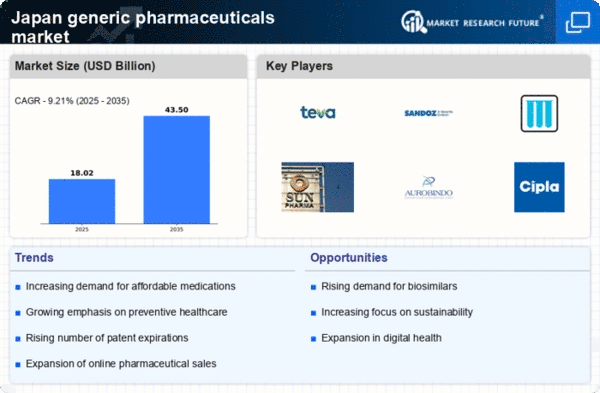
As per Market Research Future analysis, the Japan generic pharmaceuticals market size was estimated at 16.5 USD Billion in 2024. The Japan generic pharmaceuticals market is projected to grow from 18.02 USD Billion in 2025 to 43.5 USD Billion by 2035, exhibiting a compound annual growth rate (CAGR) of 9.2% during the forecast period 2025 - 2035

Key Market Trends & Highlights

The Japan generic pharmaceuticals market is experiencing robust growth driven by various factors.

  • The market is witnessing an increased adoption of generic drugs, reflecting a shift towards cost-effective healthcare solutions.
  • Regulatory support and policy changes are facilitating the entry of generic drugs into the market, enhancing competition.
  • Technological advancements in manufacturing are improving the efficiency and quality of generic drug production.
  • Key market drivers include rising healthcare costs and an aging population, which are propelling demand for affordable medication.

Market Size & Forecast

2024 Market Size 16.5 (USD Billion)
2035 Market Size 43.5 (USD Billion)
CAGR (2025 - 2035) 9.21%

Major Players

Teva Pharmaceutical Industries (IL), Sandoz (CH), Mylan (US), Sun Pharmaceutical Industries (IN), Aurobindo Pharma (IN), Cipla (IN), Lupin (IN), Amgen (US), Hikma Pharmaceuticals (GB)

Our Impact
Enabled $4.3B Revenue Impact for Fortune 500 and Leading Multinationals
Partnering with 2000+ Global Organizations Each Year
30K+ Citations by Top-Tier Firms in the Industry

Japan Generic Pharmaceuticals Market Trends

The generic pharmaceuticals market in Japan is characterized by a robust framework that supports the development and distribution of cost-effective medications. This sector has gained traction due to the increasing demand for affordable healthcare solutions among the population. Regulatory bodies in Japan have implemented policies that encourage the use of generic drugs, thereby enhancing accessibility for patients. The market is also influenced by the aging demographic, which necessitates a greater focus on chronic disease management and long-term treatment options. As a result, the generic pharmaceuticals market is poised for continued growth, driven by both policy support and consumer demand. In addition, the competitive landscape of the generic pharmaceuticals market is evolving, with numerous domestic and international players vying for market share. The emphasis on research and development is evident, as companies strive to innovate and improve existing formulations. Furthermore, partnerships between pharmaceutical firms and healthcare providers are becoming increasingly common, facilitating better distribution channels and enhancing patient access to generic medications. Overall, the market appears to be on a positive trajectory, with various factors contributing to its expansion and sustainability.

Increased Adoption of Generic Drugs

The trend towards greater acceptance of generic medications is evident in Japan, as healthcare providers and patients recognize the benefits of cost savings without compromising quality. This shift is supported by educational initiatives aimed at informing stakeholders about the efficacy and safety of generics.

Regulatory Support and Policy Changes

Recent policy adjustments by the Japanese government have fostered a more favorable environment for generic pharmaceuticals. These changes include incentives for healthcare professionals to prescribe generics, which may lead to increased market penetration and utilization.

Technological Advancements in Manufacturing

Innovations in manufacturing processes are transforming the production of generic drugs. Enhanced technologies are likely to improve efficiency and reduce costs, thereby making generics more accessible to a broader segment of the population.

Japan Generic Pharmaceuticals Market Drivers

Aging Population

Japan's demographic landscape is characterized by a rapidly aging population, which significantly impacts the generic pharmaceuticals market. With over 28% of the population aged 65 and older, the demand for medications, particularly for chronic conditions, is on the rise. This demographic shift necessitates a greater reliance on affordable generic drugs, as older adults often face fixed incomes. The generic pharmaceuticals market is likely to see increased growth as healthcare providers and patients alike prioritize cost-effective treatment options. In 2025, it is projected that the market for generics will expand by 15%, driven by the needs of this aging demographic.

Increased Competition

The competitive landscape within the generic pharmaceuticals market is intensifying, which serves as a significant driver for growth. Numerous domestic and international companies are entering the market, leading to a wider array of generic options for consumers. This influx of competition is likely to result in lower prices and improved accessibility for patients. In 2025, it is anticipated that the number of generic drug manufacturers in Japan will increase by 20%, further stimulating the market. The generic pharmaceuticals market is thus poised to thrive as competition fosters innovation and enhances the quality of available products.

Government Initiatives

The Japanese government has implemented various initiatives aimed at promoting the use of generic medications, which is a crucial driver for the generic pharmaceuticals market. Policies such as the 'Generic Drug Promotion Law' encourage healthcare providers to prescribe generics, thereby increasing their market share. In 2025, the government aims to raise the generic drug utilization rate to 80%, up from 60% in 2023. This proactive approach not only supports the healthcare system but also enhances the generic pharmaceuticals market by fostering a competitive environment that benefits consumers. As a result, the market is expected to witness substantial growth in the coming years.

Rising Chronic Diseases

The prevalence of chronic diseases in Japan is a critical factor influencing the generic pharmaceuticals market. Conditions such as diabetes, hypertension, and cardiovascular diseases are becoming increasingly common, necessitating ongoing medication management. As the population grapples with these health challenges, the demand for affordable generic alternatives is likely to surge. In 2025, it is estimated that the market for chronic disease medications will account for over 50% of the total pharmaceutical expenditure, with generics playing a pivotal role. The generic pharmaceuticals market is expected to expand significantly as healthcare providers and patients seek effective and economical treatment options.

Rising Healthcare Costs

The escalating costs associated with healthcare in Japan are driving the demand for the generic pharmaceuticals market. As patients and healthcare providers seek cost-effective alternatives to branded medications, generic drugs present a viable solution. In 2024, the expenditure on pharmaceuticals in Japan reached approximately $40 billion, with generics accounting for nearly 30% of this market. This trend is likely to continue as the government encourages the use of generics to alleviate financial burdens on the healthcare system. The generic pharmaceuticals market is thus positioned to benefit from this shift towards affordability, as more patients opt for generics to manage their health without incurring excessive costs.


Market Segment Insights

By Type: Small Molecule Drugs (Largest) vs. Biologics (Fastest-Growing)

In the Japan generic pharmaceuticals market, Small Molecule Drugs continue to dominate, capturing a significant share of the market. This segment benefits from their established presence, affordability, and widespread use across various therapeutic areas. In contrast, Biologics, although currently smaller in market share, are rapidly gaining traction due to advancements in biotechnology and a growing focus on personalized medicine. The shift towards biologics is influenced by their effectiveness in treating complex diseases that traditional small molecules may not adequately address. The growth trends in these segments reflect their divergent capabilities and market dynamics. Small Molecule Drugs are projected to maintain steady growth driven by ongoing patent expirations and the resultant opportunities for generic manufacturers. Conversely, the Biologics segment is witnessing accelerated growth, fueled by increasing investments in research and development, coupled with favorable regulatory environments that encourage innovation in biopharmaceuticals. This trend suggests a shift in market focus, positioning Biologics as a crucial area for future investments and development in the Japan generic pharmaceuticals market.

Small Molecule Drugs (Dominant) vs. Biologics (Emerging)

Small Molecule Drugs are characterized by their low molecular weight, making them easier to manufacture and distribute. Their long-standing dominance in the market stems from their affordability and established therapeutic applications, which encompass a wide range of diseases, from chronic to acute. Conversely, Biologics, derived from living organisms, represent an emerging segment increasingly recognized for their ability to specifically target disease processes. This class of drugs is instrumental in advancing treatment paradigms, particularly for conditions such as cancer and autoimmune disorders. While Small Molecule Drugs offer reliability and cost-effectiveness, the growing preference for Biologics reflects a broader shift towards innovative therapies in the Japan generic pharmaceuticals market.

By Formulation Type: Tablets (Largest) vs. Injectables (Fastest-Growing)

In the Japan generic pharmaceuticals market, the formulation type segment is characterized by a dynamic distribution of market shares across various categories. Tablets dominate the market significantly, attributed to their widespread acceptance due to convenience and ease of administration. Injectables, while smaller in market share, are gaining momentum as healthcare settings increasingly adopt advanced delivery methods, enhancing treatment effectiveness. Growth trends in this segment are propelled by an aging population and rising prevalence of chronic diseases, which necessitate more efficient drug delivery systems. The shift towards biologics and the development of biosimilars are also contributing factors, with injectables being recognized for their faster action and potential for targeted therapy. Regulatory support further boosts innovation, allowing the emergence of effective solutions that cater to patient needs.

Tablets: Dominant vs. Injectables: Emerging

Tablets hold a dominant position in the formulation type segment, primarily due to their practicality and patient compliance features. They are often preferred for their stability, cost-effectiveness, and ease of mass production. In contrast, injectables are classified as an emerging category, experiencing rapid growth as they offer advantages like immediate bioavailability and precise dosage control. The evolving healthcare landscape, with a focus on personalized medicine and advanced therapeutic options, is creating opportunities for injectables. As technology progresses, innovations in injectable formulations, such as depots and controlled-release technologies, are positioning them favorably in the market, indicating a thriving future alongside the established tablet segment.

By Therapeutic Area: Cardiovascular Diseases (Largest) vs. Diabetes (Fastest-Growing)

In the Japan generic pharmaceuticals market, the distribution of market share among therapeutic areas reveals that cardiovascular diseases dominate with a significant portion of the overall market. Following closely are diabetes and cancer, which also hold substantial shares. CNS disorders and infectious diseases, while important, contribute less to the market dynamics. The disparities in market share indicate not only the prevalence of these conditions in Japan but also the varied focus of pharmaceutical development in addressing them. Growth trends within this segment are heavily influenced by the rising prevalence of lifestyle diseases, particularly cardiovascular issues and diabetes. The aging population in Japan further drives the demand for effective generic treatments in these areas. Additionally, innovation in drug formulations and an increased emphasis on affordable healthcare solutions are spurring growth, with diabetes emerging as the fastest-growing segment in response to escalating incidence rates and a need for long-term management options.

Cardiovascular Diseases (Dominant) vs. Diabetes (Emerging)

Cardiovascular diseases remain the dominant therapeutic area within the Japan generic pharmaceuticals market, characterized by a robust pipeline of generic drugs aimed at managing heart-related conditions. This dominance is rooted in the high prevalence of hypertension and heart ailments among the population. Conversely, diabetes is emerging as a critical segment, driven by lifestyle changes and a growing number of diagnosed cases. Generic medications for diabetes offer cost-effective alternatives, helping to enhance patient accessibility to essential treatments. The competition in this area is intensifying with ongoing research and development, leading to the introduction of various formulations designed for improved patient adherence and outcomes.

By Distribution Channel: Retail Pharmacy (Largest) vs. Online Pharmacy (Fastest-Growing)

In the Japan generic pharmaceuticals market, the distribution of market share among various channels is heavily skewed towards retail pharmacies, which hold the largest portion of the market. This dominance is supported by the widespread availability and convenience they offer to consumers for purchasing generic medications. Conversely, online pharmacies are emerging as a significant player in this segment, gradually capturing a larger share thanks to the increasing acceptance of e-commerce in healthcare. The growth trends within this segment are influenced by changing consumer behavior and technological advancements. Retail pharmacies are adapting to competition by enhancing their service offerings, while online pharmacies are benefiting from a surge in demand for digital health solutions. Factors such as increased internet penetration, changing shopping habits, and the growing preference for convenience drive the expansion of online pharmacies, solidifying their position as the fastest-growing distribution channel in the market.

Retail Pharmacy: Dominant vs. Online Pharmacy: Emerging

Retail pharmacies are characterized by their extensive network and critical role in the distribution of generic pharmaceuticals, making them a staple for patients seeking convenient access to medications. They benefit from established trust and personal interactions, enabling effective patient education and support. On the other hand, online pharmacies present a dynamic and modern approach to pharmaceuticals, often attracting tech-savvy consumers who prefer the ease of home delivery. While retail pharmacies continue to dominate the market due to their long-standing presence, online pharmacies are leveraging digital platforms to create convenience and accessibility, representing a shift that highlights evolving consumer preferences in the Japan generic pharmaceuticals market.

Get more detailed insights about Japan Generic Pharmaceuticals Market

Key Players and Competitive Insights

The competitive dynamics within the generic pharmaceuticals market in Japan are characterized by a blend of innovation, strategic partnerships, and regional expansion. Key players such as Teva Pharmaceutical Industries (IL), Sandoz (CH), and Mylan (US) are actively shaping the landscape through their distinct operational focuses. Teva, for instance, emphasizes a robust pipeline of generic products, aiming to enhance its market share through continuous innovation and strategic collaborations. Sandoz, a division of Novartis, appears to be concentrating on expanding its biosimilars portfolio, which could potentially redefine its competitive edge. Mylan, on the other hand, is likely leveraging its extensive distribution network to penetrate deeper into the Japanese market, thereby enhancing accessibility to its generic offerings.
The market structure is moderately fragmented, with several players vying for dominance. Key business tactics such as localizing manufacturing and optimizing supply chains are prevalent among these companies. This localized approach not only reduces operational costs but also enhances responsiveness to market demands. The collective influence of these major players contributes to a competitive environment where agility and adaptability are paramount.
In October 2025, Teva Pharmaceutical Industries (IL) announced a strategic partnership with a local Japanese biotech firm to co-develop a new line of generic biologics. This collaboration is significant as it not only strengthens Teva's position in the biologics segment but also aligns with Japan's increasing focus on innovative therapies. Such partnerships may enhance Teva's ability to navigate regulatory landscapes while tapping into local expertise.
In September 2025, Sandoz (CH) launched a new generic version of a widely used cardiovascular medication in Japan, which is expected to capture a substantial market share. This move underscores Sandoz's commitment to addressing critical healthcare needs while reinforcing its competitive stance against other generics. The introduction of this product may also reflect a broader trend towards increasing access to essential medications in the region.
In August 2025, Mylan (US) expanded its manufacturing capabilities in Japan by investing in a new facility aimed at producing high-demand generics. This strategic investment is likely to enhance Mylan's production efficiency and supply chain reliability, positioning the company favorably in a market that increasingly values local production. Such expansions may also indicate a shift towards more sustainable practices in the industry.
As of November 2025, current trends in the generic pharmaceuticals market are increasingly defined by digitalization, sustainability, and the integration of artificial intelligence. Strategic alliances are becoming more prevalent, as companies recognize the need to collaborate to enhance innovation and operational efficiency. The competitive landscape is evolving, with a noticeable shift from traditional price-based competition towards differentiation through technology, innovation, and supply chain reliability. This evolution suggests that companies that can effectively leverage these trends will likely secure a competitive advantage in the future.

Key Companies in the Japan Generic Pharmaceuticals Market include

Industry Developments

Recent developments in the Japan Generic Pharmaceuticals Market have been marked by a significant push towards increasing domestic production and innovation. As of September 2023, the Japanese government launched initiatives aimed at boosting the generics share in the pharmaceutical market, aiming for 80% by 2025. Companies like Meiji Seika Pharma and Chugai Pharmaceutical are ramping up their RD efforts to expand their generics portfolios. In terms of mergers and acquisitions, July 2023 saw Daiichi Sankyo acquiring part of Aurobindo Pharma’s generic division, a move to enhance its market presence.

Takeda Pharmaceutical Company continues to explore partnerships to fortify its generics pipeline, while Sandoz, a subsidiary of Novartis, is enhancing its operations in Japan to capture a larger market share. The market's valuation has surged, attributed to the COVID-19 pandemic's impact on healthcare spending, and as of August 2023, generic drugs accounted for approximately 66% of total pharmaceutical sales in Japan, highlighting the growing acceptance and reliance on generics. Such developments reflect a broader trend towards driving down healthcare costs and improving access to essential medications in Japan.


Future Outlook

Japan Generic Pharmaceuticals Market Future Outlook

The Generic Pharmaceuticals Market in Japan is projected to grow at a 9.21% CAGR from 2025 to 2035, driven by increasing healthcare costs, patent expirations, and rising demand for affordable medications.

New opportunities lie in:

  • Expansion of telepharmacy services to enhance patient access.
  • Development of biosimilars to capture new market segments.
  • Strategic partnerships with healthcare providers for integrated care solutions.

By 2035, the market is expected to solidify its position as a key player in Japan's healthcare landscape.

Market Segmentation

Japan Generic Pharmaceuticals Market Type Outlook

  • Small Molecule Drugs
  • Biologics
  • Biosimilars

Japan Generic Pharmaceuticals Market Formulation Type Outlook

  • Tablets
  • Injectables
  • Topicals
  • Capsules
  • Solutions

Japan Generic Pharmaceuticals Market Therapeutic Area Outlook

  • Cardiovascular Diseases
  • Diabetes
  • Cancer
  • CNS Disorders
  • Infectious Diseases

Japan Generic Pharmaceuticals Market Distribution Channel Outlook

  • Retail Pharmacy
  • Hospital Pharmacy
  • Online Pharmacy
  • Wholesalers

Report Scope

MARKET SIZE 2024 16.5(USD Billion)
MARKET SIZE 2025 18.02(USD Billion)
MARKET SIZE 2035 43.5(USD Billion)
COMPOUND ANNUAL GROWTH RATE (CAGR) 9.21% (2025 - 2035)
REPORT COVERAGE Revenue Forecast, Competitive Landscape, Growth Factors, and Trends
BASE YEAR 2024
Market Forecast Period 2025 - 2035
Historical Data 2019 - 2024
Market Forecast Units USD Billion
Key Companies Profiled Teva Pharmaceutical Industries (IL), Sandoz (CH), Mylan (US), Sun Pharmaceutical Industries (IN), Aurobindo Pharma (IN), Cipla (IN), Lupin (IN), Amgen (US), Hikma Pharmaceuticals (GB)
Segments Covered Type, Formulation Type, Therapeutic Area, Distribution Channel
Key Market Opportunities Expansion of digital health technologies enhances access to generic pharmaceuticals in Japan.
Key Market Dynamics Rising demand for cost-effective medications drives competition and innovation in the generic pharmaceuticals market.
Countries Covered Japan
Leave a Comment

FAQs

What is the expected market size of the Japan Generic Pharmaceuticals Market in 2024?

The Japan Generic Pharmaceuticals Market is expected to be valued at 21.89 billion USD in 2024.

What is the projected market value for the Japan Generic Pharmaceuticals Market by 2035?

By 2035, the Japan Generic Pharmaceuticals Market is projected to reach a value of 45.0 billion USD.

What is the expected compound annual growth rate (CAGR) for the Japan Generic Pharmaceuticals Market from 2025 to 2035?

The expected CAGR for the Japan Generic Pharmaceuticals Market is 6.768% from 2025 to 2035.

Which segment of the Japan Generic Pharmaceuticals Market is expected to have the largest value in 2024?

The Simple Generics segment is expected to have the largest value at 10.95 billion USD in 2024.

What will be the value of the Specialty Generics segment in 2035?

The Specialty Generics segment is projected to be valued at 12.0 billion USD by 2035.

Who are the major players in the Japan Generic Pharmaceuticals Market?

Key players include Meiji Seika Pharma, Chugai Pharmaceutical, Mylan N.V., and Takeda Pharmaceutical Company.

What is the expected market value for Biosimilars in 2024?

Biosimilars are expected to be valued at 4.4 billion USD in 2024.

What growth opportunities exist within the Japan Generic Pharmaceuticals Market from 2025 to 2035?

There are significant growth opportunities driven by increasing healthcare demands and cost-effective solutions in the market.

How does the growth rate vary between different segments of the Japan Generic Pharmaceuticals Market?

Each segment, including Simple Generics, Specialty Generics, and Biosimilars, is projected to grow at varying rates contributing to the overall market CAGR.

What challenges are faced by the Japan Generic Pharmaceuticals Market in the current landscape?

Challenges include market competition, regulatory hurdles, and the need for continuous innovation to meet healthcare needs.

Download Free Sample

Kindly complete the form below to receive a free sample of this Report

Compare Licence

×
Features License Type
Single User Multiuser License Enterprise User
Price $4,950 $5,950 $7,250
Maximum User Access Limit 1 User Upto 10 Users Unrestricted Access Throughout the Organization
Free Customization
Direct Access to Analyst
Deliverable Format
Platform Access
Discount on Next Purchase 10% 15% 15%
Printable Versions