×
Request Free Sample ×

Kindly complete the form below to receive a free sample of this Report

* Please use a valid business email

Leading companies partner with us for data-driven Insights

clients tt-cursor
Hero Background

Japan Dravet Syndrome Market

ID: MRFR/HC/43536-HCR
200 Pages
Garvit Vyas
February 2026

Japan Dravet Syndrome Market Research Report: Size, Share, Trend Analysis By Types of Seizures (Myoclonic seizures, Atonic seizures, Partial seizures, Absence seizures, Tonic seizures, Photosensitive seizures, Others), By Disease Diagnosis (Magnetic Resonance Imaging, Electroencephalography, SCN1A testing, Others), By Treatment Management (Seizure Medications, Ketogenic Diet, Vagus Nerve Stimulation, Others) and By End-User (Pharmaceutical Companies, Hospitals, Diagnostic Laboratories, AcademicResearch institutes, Others) - Growth Outlook & Industry Forecast 2025 To 2035

Share:
Download PDF ×

We do not share your information with anyone. However, we may send you emails based on your report interest from time to time. You may contact us at any time to opt-out.

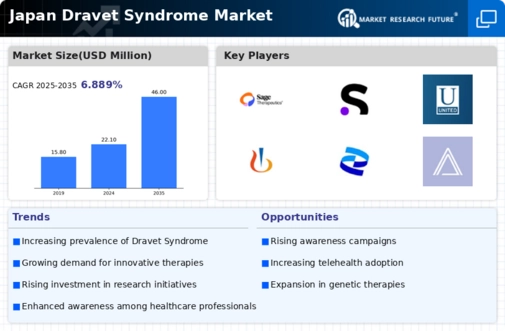
Japan Dravet Syndrome Market Infographic
Purchase Options

Japan Dravet Syndrome Market Summary

As per Market Research Future analysis, the Japan dravet syndrome market Size was estimated at $22.12 Million in 2024. The Japan dravet syndrome market is projected to grow from $24.54 Million in 2025 to $69.02 Million by 2035, exhibiting a compound annual growth rate (CAGR) of 10% during the forecast period 2025 - 2035

Key Market Trends & Highlights

The Japan Dravet syndrome market is poised for growth driven by innovative therapies and increased awareness.

  • The market is witnessing the emergence of novel therapies that target Dravet syndrome more effectively.
  • Increased research funding is facilitating advancements in treatment options and patient care.
  • A focus on patient-centric approaches is reshaping the landscape of Dravet syndrome management.
  • The rising incidence of Dravet syndrome and advancements in genetic research are key drivers of market growth.

Market Size & Forecast

2024 Market Size 22.12 (USD Million)
2035 Market Size 69.02 (USD Million)
CAGR (2025 - 2035) 10.9%

Major Players

Zogenix (US), GW Pharmaceuticals (GB), Eisai (JP), Marinus Pharmaceuticals (US), UCB (BE), Biogen (US), Novartis (CH), Ovid Therapeutics (US), Sage Therapeutics (US)

Our Impact
Enabled $4.3B Revenue Impact for Fortune 500 and Leading Multinationals
Partnering with 2000+ Global Organizations Each Year
30K+ Citations by Top-Tier Firms in the Industry

Japan Dravet Syndrome Market Trends

The dravet syndrome market is currently experiencing notable developments, particularly in Japan, where the prevalence of this rare form of epilepsy has garnered increased attention from healthcare professionals and researchers. The condition, characterized by severe seizures beginning in infancy, has led to a growing demand for effective treatment options. Recent advancements in pharmacological therapies, including the introduction of novel antiepileptic drugs, appear to be reshaping the therapeutic landscape. Furthermore, the Japanese government has been proactive in supporting research initiatives aimed at understanding the underlying mechanisms of dravet syndrome, which may lead to innovative treatment strategies in the near future. In addition to pharmacological advancements, there is a rising focus on patient-centered care within the dravet syndrome market. Healthcare providers are increasingly recognizing the importance of tailored treatment plans that address the unique needs of individuals affected by this condition. This shift towards personalized medicine is likely to enhance patient outcomes and improve quality of life. Moreover, the collaboration between academic institutions and pharmaceutical companies in Japan seems to be fostering a conducive environment for the development of new therapies, potentially accelerating the availability of effective solutions for patients suffering from dravet syndrome.

Emergence of Novel Therapies

The dravet syndrome market is witnessing the emergence of innovative therapies that target the specific needs of patients. Recent developments in drug formulations and delivery methods indicate a shift towards more effective treatment options. These advancements may enhance seizure control and reduce side effects, thereby improving overall patient compliance.

Increased Research Funding

There appears to be a significant increase in research funding dedicated to understanding dravet syndrome. Government initiatives and private sector investments are likely to drive scientific exploration, potentially leading to breakthroughs in treatment and management strategies. This trend may foster a more robust pipeline of therapies in the coming years.

Focus on Patient-Centric Approaches

The emphasis on patient-centric approaches within the dravet syndrome market is becoming more pronounced. Healthcare providers are increasingly adopting strategies that prioritize individualized care, which may lead to better management of symptoms and improved quality of life for patients. This trend suggests a shift towards holistic treatment paradigms.

Japan Dravet Syndrome Market Drivers

Growing Awareness and Advocacy

Growing awareness and advocacy for Dravet syndrome are pivotal drivers of the dravet syndrome market. Patient advocacy groups in Japan are actively working to educate the public and healthcare professionals about the challenges faced by individuals with this condition. Increased awareness leads to earlier diagnosis and intervention, which is crucial for managing symptoms effectively. Moreover, these advocacy efforts often result in greater funding for research and development, as well as improved healthcare policies. The heightened visibility of Dravet syndrome may also encourage pharmaceutical companies to invest in the market, recognizing the potential for new therapies. Consequently, the dravet syndrome market is likely to expand as more stakeholders become engaged in addressing the needs of affected individuals.

Advancements in Genetic Research

Advancements in genetic research are significantly influencing the dravet syndrome market. With the identification of specific genetic mutations associated with Dravet syndrome, there is a growing emphasis on targeted therapies. In Japan, research institutions are increasingly focusing on understanding the genetic underpinnings of this condition, which could lead to the development of personalized medicine approaches. The potential for gene therapy and other innovative treatments is becoming more apparent, as clinical trials are underway to evaluate their efficacy. This focus on genetic research not only enhances treatment options but also raises awareness about the condition, potentially increasing patient enrollment in clinical studies. As a result, the dravet syndrome market is likely to experience growth driven by these scientific advancements.

Government Initiatives and Support

Government initiatives and support play a crucial role in shaping the dravet syndrome market in Japan. The Japanese government has implemented various policies aimed at improving healthcare access for patients with rare diseases, including Dravet syndrome. These initiatives often include financial assistance for treatment and incentives for pharmaceutical companies to develop new therapies. For instance, the orphan drug designation provides benefits such as market exclusivity and tax incentives, which can stimulate research and development efforts. As a result, the dravet syndrome market is likely to benefit from increased investment in innovative treatments and improved patient access to existing therapies. This supportive regulatory environment may encourage more companies to enter the market, further enhancing treatment options for patients.

Rising Incidence of Dravet Syndrome

The increasing incidence of Dravet syndrome in Japan is a notable driver for the dravet syndrome market. Recent studies indicate that the prevalence of this rare genetic epilepsy disorder is approximately 1 in 15,700 live births. This rising incidence necessitates enhanced healthcare services and treatment options, thereby expanding the market. As awareness grows among healthcare professionals and families, the demand for effective therapies is likely to increase. Furthermore, the Japanese government has been proactive in recognizing rare diseases, which may lead to improved funding and support for research and development in the dravet syndrome market. This trend suggests a potential for growth in both the pharmaceutical and healthcare sectors, as more patients seek specialized care and innovative treatments.

Emergence of Innovative Treatment Options

The emergence of innovative treatment options is transforming the landscape of the dravet syndrome market. Recent developments in antiepileptic drugs and novel therapies, such as cannabidiol (CBD) products, have shown promise in managing seizures associated with Dravet syndrome. In Japan, the approval of new medications has provided patients with additional choices, enhancing their quality of life. The ongoing research into combination therapies and personalized medicine approaches further indicates a shift towards more effective treatment paradigms. As these innovative options become available, the dravet syndrome market is likely to witness increased demand from patients and healthcare providers seeking better management strategies. This trend suggests a dynamic and evolving market landscape, driven by the need for effective solutions.


Market Segment Insights

By Type of Seizures: Myoclonic Seizures (Largest) vs. Atonic Seizures (Fastest-Growing)

In the Japan dravet syndrome market, the distribution of seizure types reveals that myoclonic seizures hold the largest share, representing a significant portion of diagnosed cases. Atonic seizures follow closely behind, carving out a notable market presence. Other types, including partial and absence seizures, contribute to the segment but do not exhibit the same dominance as the leading seizure types. Market dynamics show that while myoclonic seizures remain prevalent, awareness and diagnosis of atonic seizures are on the rise. Growth trends in the Japan dravet syndrome market indicate a notable increase in the prevalence of atonic seizures. This rise is driven by greater awareness among healthcare professionals and advancements in diagnostic technologies, enabling more accurate detection of these seizures. Additionally, evolving treatment options are contributing to the growth of the atonic seizure segment, as patients and caregivers seek effective management strategies. Overall, both segments are crucial, but the upward trajectory of atonic seizures highlights changing patient demographics and medical practices.

Myoclonic Seizures (Dominant) vs. Atonic Seizures (Emerging)

Myoclonic seizures represent the dominant segment in the Japan dravet syndrome market, characterized by their abrupt and brief muscle jerks, which are often more noticeable during wakefulness. This prominence is likely attributed to the established understanding of myoclonic seizures among clinicians and families affected by dravet syndrome. On the other hand, atonic seizures, though currently recognized as an emerging segment, are gaining traction due to increased diagnoses and treatment awareness. These seizures, marked by sudden lapses in muscle tone that can lead to falls, are becoming a focal point for research and therapy innovation. As the clinical landscape evolves, both segments will play integral roles in shaping the management of dravet syndrome.

By Treatment and Management: Seizure Medications (Largest) vs. Ketogenic Diet (Fastest-Growing)

In the Japan dravet syndrome market, the segment values are prominently distributed between seizure medications, ketogenic diet, vagus nerve stimulation, and others. Seizure medications hold the largest market share due to their established use in managing Dravet syndrome symptoms. Meanwhile, the ketogenic diet is gaining traction as a preferred non-pharmacological approach, appealing to families seeking alternative management strategies. Growth trends are significantly influenced by an increasing awareness of Dravet syndrome and its treatment options among healthcare professionals and caregivers. The ketogenic diet is becoming the fastest-growing segment, driven by positive patient outcomes and rising endorsement from medical communities. Technological advancements in vagus nerve simulation techniques also contribute to market dynamics as they provide new avenues for treatment, attracting interest from both patients and healthcare providers.

Seizure Medications (Dominant) vs. Ketogenic Diet (Emerging)

Seizure medications are recognized as the dominant segment within the Japan dravet syndrome market, being the primary choice for managing seizures associated with the condition. These medications are often prescribed based on their efficacy and proven track record. In contrast, the ketogenic diet represents an emerging option for families seeking more holistic management approaches. This diet, which emphasizes high-fat and low-carbohydrate intake, has shown potential in reducing seizure frequency in children with Dravet syndrome. Both segments cater to different patient needs, with seizure medications focusing on immediate symptom control while the ketogenic diet appeals to those looking for long-term management strategies.

By Diagnosis: SCN1A testing (Largest) vs. Electroencephalography (Fastest-Growing)

The Japan dravet syndrome market displays a diverse array of diagnostic methods, with SCN1A testing capturing the largest share due to its critical role in identifying genetic mutations associated with the condition. Following closely behind, Electroencephalography is gaining traction as it enables real-time monitoring of electrical activity in the brain, making it indispensable for managing seizures. Other diagnostic methods like Magnetic Resonance Imaging and Others hold smaller shares but contribute to the overall landscape of diagnostic options available. Recent trends show that the demand for Electroencephalography is rising rapidly as healthcare professionals increasingly recognize its importance in diagnosing and monitoring Dravet syndrome. The integration of advanced technologies in EEG, such as mobile applications and cloud-based data analysis, is driving this growth. Meanwhile, SCN1A testing remains essential and stable, fueling ongoing research to better understand genetic factors influencing Dravet syndrome, thus ensuring its sustained market relevance during the forecast period.

SCN1A testing (Dominant) vs. Electroencephalography (Emerging)

SCN1A testing stands as a dominant force within the Japan dravet syndrome market, playing a pivotal role in genetic diagnosis. This diagnostic method focuses on analyzing the SCN1A gene, which, when mutated, contributes significantly to the manifestation of Dravet syndrome. Its efficacy in identifying affected individuals has solidified its position. Conversely, Electroencephalography, an emerging diagnostic tool, enhances understanding of seizure activity through continuous monitoring of electrical brain activity. This method's growing adoption in clinical settings is driven by advancements in technology and its application in personalized treatment strategies, paving the way for improved patient outcomes.

By End-user: Pharmaceutical Companies (Largest) vs. Hospitals (Fastest-Growing)

In the Japan dravet syndrome market, the distribution of market share among end-users shows that pharmaceutical companies hold the largest share, significantly influencing treatment options and drug development. Hospitals follow closely, leveraging their role in direct patient care and therapeutic interventions. Diagnostic laboratories and academic & research institutes also play a crucial role, albeit with a smaller market presence. This landscape supports a collaborative environment where various stakeholders contribute to advancing treatments for Dravet syndrome. The growth trends in this segment highlight the increasing reliance on pharmaceutical companies for innovative therapies. Meanwhile, hospitals are rapidly emerging as the fastest-growing sector; their growing focus on specialized care for Dravet syndrome patients is driving demand. Additionally, research institutes and diagnostic laboratories are gaining traction, as advancements in genetic testing and novel therapeutics create new opportunities for collaborations within the healthcare ecosystem.

Pharmaceutical Companies (Dominant) vs. Hospitals (Emerging)

Pharmaceutical companies dominate the landscape of the Japan dravet syndrome market due to their pivotal role in developing specialized therapies and medications tailored for patients. Their extensive investment in research and development ensures a steady pipeline of innovative treatments, thus reinforcing their market position. Conversely, hospitals are emerging as a vital sector as they provide critical frontline care for Dravet syndrome patients. Their increasing specialization in handling such complex cases enhances their capabilities, thus fulfilling a significant gap in the market. As hospitals adopt more targeted treatment protocols and engage in collaborations with pharmaceutical firms, their contribution to patient outcomes is expected to grow, further solidifying their emerging role.

Get more detailed insights about Japan Dravet Syndrome Market

Key Players and Competitive Insights

The dravet syndrome market exhibits a dynamic competitive landscape characterized by a blend of innovation, strategic partnerships, and regional expansion. Key players such as Zogenix (US), GW Pharmaceuticals (GB), and Eisai (JP) are at the forefront, each employing distinct strategies to enhance their market presence. Zogenix (US) focuses on the development of its lead product, ZX008, which has shown promise in clinical trials, indicating a strong commitment to innovation. Meanwhile, GW Pharmaceuticals (GB) leverages its expertise in cannabinoid-based therapies, positioning itself as a pioneer in this niche segment. Eisai (JP), with its robust pipeline and emphasis on regional expansion, aims to solidify its foothold in the Japanese market, reflecting a strategic focus on localized solutions that cater to specific patient needs.The business tactics employed by these companies reveal a trend towards localizing manufacturing and optimizing supply chains to enhance efficiency and responsiveness. The market structure appears moderately fragmented, with several players vying for market share, yet the collective influence of these key companies shapes a competitive environment that is both challenging and ripe for innovation. Their strategies not only drive individual growth but also contribute to a broader market evolution that prioritizes patient-centric solutions.

In October Zogenix (US) announced a strategic partnership with a leading Japanese pharmaceutical firm to enhance the distribution of ZX008 in Japan. This collaboration is likely to facilitate faster market entry and improve access for patients, thereby reinforcing Zogenix's competitive position. The partnership underscores the importance of local expertise in navigating regulatory landscapes and optimizing market strategies.

In September GW Pharmaceuticals (GB) launched a new clinical trial for its cannabinoid-based therapy targeting dravet syndrome, aiming to expand its therapeutic offerings. This initiative not only reflects GW's commitment to research and development but also positions the company to capture a larger share of the market by addressing unmet medical needs. The trial's outcomes could potentially validate the efficacy of cannabinoid therapies, further solidifying GW's market leadership.

In August Eisai (JP) unveiled a new patient support program designed to assist families affected by dravet syndrome. This initiative highlights Eisai's focus on enhancing patient engagement and education, which may foster brand loyalty and improve treatment adherence. By prioritizing patient support, Eisai is likely to differentiate itself in a competitive landscape where patient-centric approaches are increasingly valued.

As of November current trends in the dravet syndrome market indicate a shift towards digitalization, sustainability, and the integration of AI technologies. Strategic alliances are becoming pivotal in shaping the competitive landscape, as companies seek to leverage complementary strengths. The evolution of competitive differentiation appears to be moving away from price-based competition towards a focus on innovation, technological advancements, and supply chain reliability. This shift suggests that companies that prioritize these elements may be better positioned to thrive in an increasingly complex market.

Key Companies in the Japan Dravet Syndrome Market include

Industry Developments

Recent developments in the Japan Dravet Syndrome Market have been significant, particularly with advances in therapeutic options. Companies such as GW Pharmaceuticals and UCB have focused on expanding their product portfolios tailored to the unique needs of patients in Japan, where the prevalence of Dravet Syndrome continues to garner clinical attention. In September 2023, Sage Therapeutics announced the commencement of a new clinical trial for their investigational treatment designed for Dravet patients, which reflects a dedicated effort to improve therapeutic efficacy.

Additionally, a notable acquisition took place in August 2023 when Novartis announced its acquisition of a smaller biotech firm focused on innovative treatments for rare epilepsy syndromes, further consolidating its position in the Japanese market. The Japanese pharmaceutical industry has witnessed a stronger emphasis on personalized medicine and regulatory pathways tailored specifically for rare disorders like Dravet Syndrome, with government entities actively promoting the need for advanced therapies. Various stakeholders, including pharmaceutical giants like Takeda Pharmaceutical and Sanofi, have been collaborating with local research institutions to enhance RD efforts, influencing market growth and the valuation of the companies involved.

Over the past few years, the increase in awareness around Dravet Syndrome in Japan has led to a significant push towards developing targeted treatment options.

Future Outlook

Japan Dravet Syndrome Market Future Outlook

The Dravet Syndrome Market in Japan is projected to grow at a 10.9% CAGR from 2025 to 2035, driven by advancements in treatment options and increased awareness.

New opportunities lie in:

  • Development of targeted gene therapies for Dravet syndrome patients.
  • Expansion of telehealth services for remote patient monitoring.
  • Partnerships with local hospitals for clinical trial recruitment.

By 2035, the market is expected to achieve substantial growth, enhancing treatment accessibility and innovation.

Market Segmentation

Japan Dravet Syndrome Market End-user Outlook

  • Pharmaceutical Companies
  • Hospitals
  • Diagnostic Laboratories
  • Academic & research institutes
  • Others

Japan Dravet Syndrome Market Diagnosis Outlook

  • Magnetic Resonance Imaging
  • Electroencephalography
  • SCN1A testing
  • Others

Japan Dravet Syndrome Market Type of Seizures Outlook

  • Myoclonic seizures
  • Atonic seizures
  • Partial seizures
  • Absence seizures
  • Tonic seizures
  • Photosensitive seizures
  • Others

Japan Dravet Syndrome Market Treatment and Management Outlook

  • Seizure Medications
  • Ketogenic Diet
  • Vagus Nerve Stimulation
  • Others

Report Scope

MARKET SIZE 2024 22.12 (USD Million)
MARKET SIZE 2025 24.54 (USD Million)
MARKET SIZE 2035 69.02 (USD Million)
COMPOUND ANNUAL GROWTH RATE (CAGR) 10.9% (2025 - 2035)
REPORT COVERAGE Revenue Forecast, Competitive Landscape, Growth Factors, and Trends
BASE YEAR 2024
Market Forecast Period 2025 - 2035
Historical Data 2019 - 2024
Market Forecast Units USD Million
Key Companies Profiled Zogenix (US), GW Pharmaceuticals (GB), Eisai (JP), Marinus Pharmaceuticals (US), UCB (BE), Biogen (US), Novartis (CH), Ovid Therapeutics (US), Sage Therapeutics (US)
Segments Covered Type of Seizures, Treatment and Management, Diagnosis, End-user
Key Market Opportunities Advancements in gene therapy and personalized medicine enhance treatment options in the dravet syndrome market.
Key Market Dynamics Rising demand for innovative therapies drives competition and regulatory scrutiny in the Dravet syndrome market.
Countries Covered Japan
Leave a Comment

FAQs

What is the expected market size of the Japan Dravet Syndrome Market in 2024?

The Japan Dravet Syndrome Market is expected to be valued at 22.12 million USD in 2024.

What will be the market value of the Japan Dravet Syndrome Market by 2035?

By 2035, the Japan Dravet Syndrome Market is projected to reach a value of 46.04 million USD.

What is the expected CAGR for the Japan Dravet Syndrome Market from 2025 to 2035?

The expected CAGR for the Japan Dravet Syndrome Market from 2025 to 2035 is 6.889%.

Which seizure type is anticipated to have the highest value in the Japan Dravet Syndrome Market by 2035?

Myoclonic seizures are expected to have the highest market value of 11.99 million USD by 2035.

What is the forecasted market value for partial seizures in the Japan Dravet Syndrome Market by 2035?

The market value for partial seizures is anticipated to be 12.07 million USD by 2035.

Who are the key players in the Japan Dravet Syndrome Market?

Major players in the Japan Dravet Syndrome Market include Sage Therapeutics, Sanofi, UCB, Novartis, and Pfizer.

What is the projected market value for atonic seizures in 2024?

The projected market value for atonic seizures in 2024 is estimated to be 4.39 million USD.

How much is the market for absence seizures expected to grow by 2035?

The market for absence seizures is expected to grow to 7.79 million USD by 2035.

What challenges may affect the growth of the Japan Dravet Syndrome Market?

Potential challenges include regulatory hurdles and competition from emerging therapies.

What market growth opportunities exist for the Japan Dravet Syndrome Market?

Growth opportunities may arise from advancements in treatment options and increasing awareness of Dravet Syndrome.

Download Free Sample

Kindly complete the form below to receive a free sample of this Report

Compare Licence

×
Features License Type
Single User Multiuser License Enterprise User
Price $4,950 $5,950 $7,250
Maximum User Access Limit 1 User Upto 10 Users Unrestricted Access Throughout the Organization
Free Customization
Direct Access to Analyst
Deliverable Format
Platform Access
Discount on Next Purchase 10% 15% 15%
Printable Versions