×
Request Free Sample ×

Kindly complete the form below to receive a free sample of this Report

* Please use a valid business email

Leading companies partner with us for data-driven Insights

clients tt-cursor
Hero Background

Japan Dental 3D Printing Market

ID: MRFR/MED/43684-HCR
200 Pages
Garvit Vyas
February 2026

Japan Dental 3D Printing Market Research Report By Product and Service (Equipment, Materials, Services), By Technology (Vat Photopolymerization, Other Technologies) and By Application (Prosthodontics, Orthodontics) - Growth & Industry Forecast 2025 To 2035

Share:
Download PDF ×

We do not share your information with anyone. However, we may send you emails based on your report interest from time to time. You may contact us at any time to opt-out.

Japan Dental 3D Printing Market Infographic
Purchase Options

Japan Dental 3D Printing Market Summary

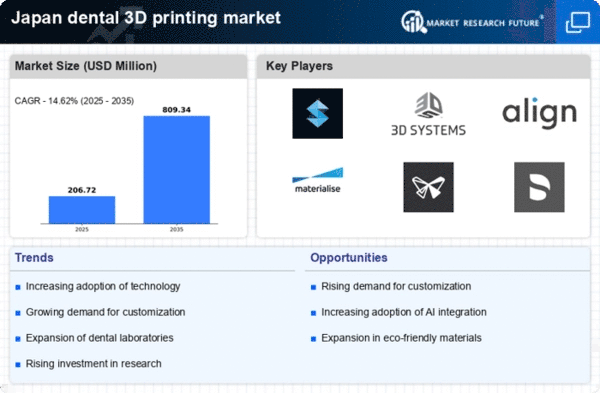
As per Market Research Future analysis, the Japan dental 3D printing market size was estimated at 180.35 USD Million in 2024. The Japan dental 3d-printing market is projected to grow from 206.72 USD Million in 2025 to 809.34 USD Million by 2035, exhibiting a compound annual growth rate (CAGR) of 14.6% during the forecast period 2025 - 2035

Key Market Trends & Highlights

The Japan dental 3D printing market is poised for growth driven by customization and technological advancements.

  • Customization and personalization are becoming increasingly prevalent in the dental 3D-printing market.
  • Material innovation is enhancing the quality and range of dental products available.
  • Integration with digital workflows is streamlining processes and improving efficiency.
  • Technological advancements in 3D printing and rising demand for aesthetic dentistry are key drivers of market growth.

Market Size & Forecast

2024 Market Size 180.35 (USD Million)
2035 Market Size 809.34 (USD Million)
CAGR (2025 - 2035) 14.62%

Major Players

Stratasys (US), 3D Systems (US), Align Technology (US), Materialise (BE), Formlabs (US), Dentsply Sirona (US), EnvisionTEC (DE), Carbon (US)

Our Impact
Enabled $4.3B Revenue Impact for Fortune 500 and Leading Multinationals
Partnering with 2000+ Global Organizations Each Year
30K+ Citations by Top-Tier Firms in the Industry

Japan Dental 3D Printing Market Trends

The dental 3D printing market is experiencing notable advancements, particularly in Japan, where technological innovation is reshaping the landscape of dental care. The integration of 3D printing technology into dental practices is enhancing the efficiency and precision of dental procedures. This shift is driven by the increasing demand for customized dental solutions, which are becoming more accessible due to advancements in materials and printing techniques. Furthermore, the growing emphasis on patient-centric care is prompting dental professionals to adopt these technologies, as they allow for tailored treatments that meet individual needs. In addition, the regulatory environment in Japan appears to be supportive of innovations in the dental sector, facilitating the introduction of new materials and methods. This regulatory framework, combined with a strong focus on research and development, suggests a promising future for the dental 3d-printing market. As dental practitioners continue to embrace these technologies, the potential for improved patient outcomes and operational efficiencies becomes increasingly apparent. The market is likely to witness further growth as awareness and acceptance of 3D printing in dentistry expand among both professionals and patients.

Customization and Personalization

The trend towards customization in the dental 3d-printing market is gaining momentum. Patients are increasingly seeking personalized dental solutions, which 3D printing can provide. This technology allows for the creation of tailored dental implants, crowns, and aligners that fit individual anatomical requirements, enhancing comfort and effectiveness.

Material Innovation

Innovations in materials used for dental 3d-printing are transforming the market. New biocompatible materials are being developed, which not only improve the quality of dental products but also expand the range of applications. This evolution in material science is crucial for meeting the diverse needs of dental professionals.

Integration with Digital Workflows

The integration of dental 3d-printing with digital workflows is becoming increasingly prevalent. This trend streamlines the process from diagnosis to treatment, allowing for more efficient case management. Digital tools enhance accuracy in design and production, ultimately leading to better patient outcomes.

Japan Dental 3D Printing Market Drivers

Cost Efficiency and Waste Reduction

Cost efficiency is a critical driver for the dental 3d-printing market in Japan. Traditional dental manufacturing processes often involve significant material waste and high labor costs. In contrast, 3D printing technology minimizes waste by using only the necessary amount of material, which can lead to cost savings of up to 30%. Additionally, the ability to produce dental products on-demand reduces inventory costs for dental practices. As dental professionals become more aware of these financial benefits, the adoption of 3D printing is expected to increase, thereby enhancing the overall market landscape.

Rising Demand for Aesthetic Dentistry

The growing consumer preference for aesthetic dentistry is significantly influencing the dental 3d-printing market in Japan. Patients are increasingly seeking customized solutions for dental implants, crowns, and aligners that enhance their appearance. This trend is reflected in the market data, which indicates that the aesthetic segment accounts for nearly 40% of the total dental procedures. As a result, dental practitioners are turning to 3D printing to meet this demand, allowing for the production of tailored dental solutions that align with individual patient needs. This shift towards aesthetic-focused treatments is likely to propel the market further.

Technological Advancements in 3D Printing

The dental 3d-printing market in Japan is experiencing a surge due to rapid technological advancements. Innovations in 3D printing technologies, such as improved resolution and speed, are enhancing the quality of dental products. For instance, the introduction of high-precision printers allows for the creation of intricate dental models and prosthetics. This has led to a notable increase in the adoption of 3D printing in dental practices, with a reported growth rate of approximately 25% annually. As dental professionals seek to provide better patient outcomes, the integration of advanced 3D printing technologies is becoming essential, thereby driving the market forward.

Increased Investment in Dental Technologies

Investment in dental technologies is a significant driver for the dental 3d-printing market in Japan. Both private and public sectors are channeling funds into research and development of advanced dental solutions. Recent reports indicate that investments in dental technology have increased by over 15% in the past year. This influx of capital is facilitating the development of new materials and techniques for 3D printing, which enhances the capabilities of dental practices. As more resources are allocated to this sector, the market is poised for substantial growth, reflecting the increasing importance of technological innovation in dentistry.

Regulatory Support and Standards Development

The dental 3d-printing market in Japan is benefiting from supportive regulatory frameworks and the establishment of industry standards. The Japanese government is actively promoting the use of advanced manufacturing technologies, including 3D printing, in healthcare. This support is evident in initiatives aimed at streamlining the approval processes for new dental products. Furthermore, the development of standards for 3D-printed dental devices ensures safety and efficacy, which is crucial for gaining consumer trust. As regulatory bodies continue to foster an environment conducive to innovation, the market is likely to see accelerated growth.


Market Segment Insights

By Product and Service: Equipment (Largest) vs. Materials (Fastest-Growing)

In the Japan dental 3d-printing market, the distribution of market share among the segment values reveals that equipment holds the largest share, reflecting its critical role in driving the sector forward. In contrast, materials are rapidly gaining traction, showcasing the evolving nature of the market. As dental practices increasingly adopt 3D printing technology, the demand for advanced equipment remains strong, maintaining its dominant position across the segment. The trend towards integrating more sophisticated materials is notably the fastest-growing aspect of the market. This growth is primarily driven by advancements in material science, which enable the production of more precise and durable dental solutions. Moreover, the rising preference among practitioners for innovative and efficient practices amplifies the demand for high-quality materials, further fueling this segment's expansion.

Equipment (Dominant) vs. Materials (Emerging)

Equipment in the dental 3d-printing market is characterized by high-end printers and related devices that enhance operational efficiency and output quality. This segment maintains a dominant position, as it meets the increasing demand for precision and speed in dental processes. On the other hand, materials represent an emerging trend, featuring a variety of biocompatible and durable options designed for specific dental applications. These materials are becoming increasingly integral to the workflow, influencing the overall effectiveness of the 3d-printing process. Their wide range of properties, combined with a focus on innovation, highlights their position as essential components for future developments in the market.

By Technology: Vat Photopolymerization (Largest) vs. Other Technologies (Fastest-Growing)

In the Japan dental 3d-printing market, the segment values display a diverse distribution, with Vat Photopolymerization holding the largest share due to its precise manufacturing capabilities and durability of printed dental products. Other Technologies, while not leading in market share, are rapidly gaining traction as the need for diversified printing solutions continues to rise. As innovations emerge, these alternatives contribute to a dynamic competitive landscape. The growth trends within this segment highlight an increasing demand for customized dental solutions and efficiency in production. Vat Photopolymerization benefits from advanced material properties, which enhance the quality of dental applications. Meanwhile, Other Technologies are driven by the need for cost-effective solutions and versatility, appealing to a broader range of dental practices looking to adopt 3D printing technologies in their workflows.

Technology: Vat Photopolymerization (Dominant) vs. Other Technologies (Emerging)

Vat Photopolymerization stands out as the dominant technology in the segment, known for its ability to produce high-fidelity dental components that meet stringent quality standards. This method utilizes photopolymer resins that cure under light exposure, resulting in smooth finishes and precise details essential for dental restorations. On the other hand, Other Technologies are emerging to fulfill niche market needs, including laser sintering and material extrusion, which offer varied benefits such as lower costs and faster production times. These alternative technologies cater to specific dental applications, allowing practices to adopt 3D printing with tailored solutions that fit their operational needs.

By Application: Prosthodontics (Largest) vs. Orthodontics (Fastest-Growing)

In the Japan dental 3d-printing market, Prosthodontics holds the largest share, demonstrating significant demand for dental restorations and prosthetics. Orthodontics, however, is rapidly gaining traction, reflecting a shift towards customized aligners and braces. The Other category, while smaller, includes niche applications that contribute to overall market diversity. The growth trends in this market segment are driven by advancements in 3D printing technologies and increasing adoption among dental professionals. Factors such as the demand for personalized dental solutions and the efficiency of 3D printing in producing accurate dental models are propelling Orthodontics as the fastest-growing segment. Additionally, rising oral health awareness and improved aesthetic preferences further bolster market dynamics.

Prosthodontics (Dominant) vs. Orthodontics (Emerging)

Prosthodontics remains the dominant segment in the Japan dental 3d-printing market, characterized by its wide application in creating dental crowns, bridges, and dentures that cater to patient-specific needs. The utilization of advanced materials and technologies ensures high precision and patient satisfaction, reinforcing its market leadership. On the other hand, Orthodontics is emerging as a significant contender, driven by increasing consumer interest in cosmetic dentistry and the growing trend of clear aligners. Innovations in scanning and printing techniques enhance customizability and comfort, attracting a younger demographic. Both segments exhibit a strong synergy, with advancements in one often benefitting the other, positioning the market for sustained growth.

Get more detailed insights about Japan Dental 3D Printing Market

Key Players and Competitive Insights

The dental 3D-printing market in Japan is characterized by a dynamic competitive landscape, driven by technological advancements and increasing demand for customized dental solutions. Key players such as Stratasys (US), 3D Systems (US), and Align Technology (US) are at the forefront, each adopting distinct strategies to enhance their market presence. Stratasys (US) focuses on innovation through continuous product development, particularly in biocompatible materials, while 3D Systems (US) emphasizes partnerships with dental laboratories to streamline workflows. Align Technology (US) leverages its expertise in digital orthodontics to expand its offerings, indicating a trend towards specialization in niche markets. Collectively, these strategies contribute to a competitive environment that is increasingly centered on technological differentiation and customer-centric solutions.
In terms of business tactics, companies are localizing manufacturing to reduce lead times and optimize supply chains, which appears crucial in a market that demands rapid delivery of customized products. The competitive structure of the dental 3D-printing market is moderately fragmented, with several players vying for market share. However, the influence of major companies is significant, as they set benchmarks for innovation and operational efficiency that smaller firms often strive to emulate.
In October 2025, Stratasys (US) announced a strategic partnership with a leading Japanese dental laboratory to co-develop advanced 3D printing solutions tailored for the local market. This collaboration is expected to enhance Stratasys's operational capabilities and strengthen its foothold in Japan, reflecting a broader trend of localized partnerships that cater to specific regional needs. Such moves not only bolster product offerings but also foster trust and reliability among local practitioners.
In September 2025, 3D Systems (US) launched a new line of dental resins designed for high-precision printing, aimed at improving the quality of dental prosthetics. This product introduction is significant as it aligns with the growing demand for high-quality, durable dental solutions, positioning 3D Systems (US) as a leader in innovation within the market. The emphasis on material science indicates a shift towards enhancing the functional properties of printed products, which could redefine standards in dental applications.
In August 2025, Align Technology (US) expanded its digital platform by integrating AI-driven analytics to optimize treatment planning for orthodontic patients. This strategic move not only enhances the user experience but also positions Align Technology (US) at the intersection of digital transformation and personalized healthcare. The integration of AI suggests a future where data-driven insights will play a pivotal role in shaping treatment outcomes, thereby increasing patient satisfaction and operational efficiency.
As of November 2025, the competitive trends in the dental 3D-printing market are increasingly defined by digitalization, sustainability, and the integration of AI technologies. Strategic alliances are becoming more prevalent, as companies recognize the value of collaboration in driving innovation and expanding market reach. Looking ahead, competitive differentiation is likely to evolve from traditional price-based competition to a focus on technological innovation, supply chain reliability, and the ability to deliver customized solutions efficiently. This shift underscores the importance of agility and responsiveness in a rapidly changing market landscape.

Key Companies in the Japan Dental 3D Printing Market include

Industry Developments

The Japan Dental 3D Printing Market has recently witnessed significant developments, enhancing its growth trajectory. Companies like Align Technology, known for its innovative approaches, continue to expand their market presence, while Stratasys and Formlabs are actively promoting advanced 3D printing technologies specifically tailored for dental applications. The last few years have seen a notable growth in valuation for these companies, driven by rising demand for customized dental solutions. In June 2023, Dental Wings announced a collaborative agreement with local dental clinics to enhance its service offerings, addressing the growing need for efficient dental solutions in the country.

Additionally, there have been prominent mergers and acquisitions, notably in July 2023, when 3D Systems acquired a local technology firm to expand its capabilities in Japan. This acquisition is seen as a strategic move, allowing for a broader range of products to cater to the increasing patient needs. Significant market activities have defined the landscape, showing the commitment of these companies, like Panthera Dental and Sirona Dental Systems, towards innovation and meeting the evolving demands within Japan's dental industry.

Future Outlook

Japan Dental 3D Printing Market Future Outlook

The Dental 3D Printing Market in Japan is poised for growth at 14.62% CAGR from 2025 to 2035, driven by technological advancements and increasing demand for customized dental solutions.

New opportunities lie in:

  • Development of biocompatible materials for dental applications.
  • Integration of AI for enhanced design and production efficiency.
  • Expansion of direct-to-consumer 3D printing services for dental products.

By 2035, the market is expected to achieve substantial growth, driven by innovation and consumer demand.

Market Segmentation

Japan Dental 3D Printing Market Technology Outlook

  • Vat Photopolymerization
  • Other Technologies

Japan Dental 3D Printing Market Application Outlook

  • Prosthodontics
  • Orthodontics
  • Others

Japan Dental 3D Printing Market Product and Service Outlook

  • Equipment
  • Materials
  • Services

Report Scope

MARKET SIZE 2024 180.35(USD Million)
MARKET SIZE 2025 206.72(USD Million)
MARKET SIZE 2035 809.34(USD Million)
COMPOUND ANNUAL GROWTH RATE (CAGR) 14.62% (2025 - 2035)
REPORT COVERAGE Revenue Forecast, Competitive Landscape, Growth Factors, and Trends
BASE YEAR 2024
Market Forecast Period 2025 - 2035
Historical Data 2019 - 2024
Market Forecast Units USD Million
Key Companies Profiled Stratasys (US), 3D Systems (US), Align Technology (US), Materialise (BE), Formlabs (US), Dentsply Sirona (US), EnvisionTEC (DE), Carbon (US)
Segments Covered Product and Service, Technology, Application
Key Market Opportunities Advancements in biocompatible materials enhance customization in the dental 3d-printing market.
Key Market Dynamics Technological advancements drive competitive dynamics in Japan's dental 3D-printing market, enhancing efficiency and customization.
Countries Covered Japan
Leave a Comment

FAQs

What is the expected market size of the Japan Dental 3D Printing Market in 2024?

The Japan Dental 3D Printing Market is expected to be valued at 135.75 million USD in 2024.

What will the market size be in 2035?

By 2035, the Japan Dental 3D Printing Market is projected to reach a value of 569.44 million USD.

What is the expected CAGR for the Japan Dental 3D Printing Market from 2025 to 2035?

The market is forecasted to grow at a CAGR of 13.923% from 2025 to 2035.

What are the key product segments in the Japan Dental 3D Printing Market?

The key product segments include Equipment, Materials, and Services.

How much is the Equipment segment expected to be valued in 2035?

The Equipment segment of the Japan Dental 3D Printing Market is expected to be valued at 188.0 million USD in 2035.

What is the projected market size for the Materials segment in 2024?

In 2024, the Materials segment is anticipated to be valued at 40.0 million USD.

Who are the major players in the Japan Dental 3D Printing Market?

Key players in the market include companies like Dentca, Dental Wings, and Sirona Dental Systems.

What is the expected value for the Services segment in 2035?

The Services segment of the Japan Dental 3D Printing Market is projected to be valued at 221.44 million USD in 2035.

What are some key growth drivers for the Japan Dental 3D Printing Market?

Technological advancements and increased demand for customized dental solutions are key growth drivers.

How is the competitive landscape shaping up in the Japan Dental 3D Printing Market?

The competitive landscape features a number of established players and emerging companies continuously innovating to gain market share.

Download Free Sample

Kindly complete the form below to receive a free sample of this Report

Compare Licence

×
Features License Type
Single User Multiuser License Enterprise User
Price $4,950 $5,950 $7,250
Maximum User Access Limit 1 User Upto 10 Users Unrestricted Access Throughout the Organization
Free Customization
Direct Access to Analyst
Deliverable Format
Platform Access
Discount on Next Purchase 10% 15% 15%
Printable Versions