×
Request Free Sample ×

Kindly complete the form below to receive a free sample of this Report

* Please use a valid business email

Leading companies partner with us for data-driven Insights

clients tt-cursor
Hero Background

Japan Denim Market

ID: MRFR/CG/44655-HCR
128 Pages
Pradeep Nandi
February 2026

Japan Denim Market Size, Share, Industry Trend & Analysis Research Report: By Distribution Channel (Online, Offline) and By End User (Men, Women, Children)- Forecast to 2035

Share:
Download PDF ×

We do not share your information with anyone. However, we may send you emails based on your report interest from time to time. You may contact us at any time to opt-out.

Japan Denim Market Infographic
Purchase Options

Japan Denim Market Summary

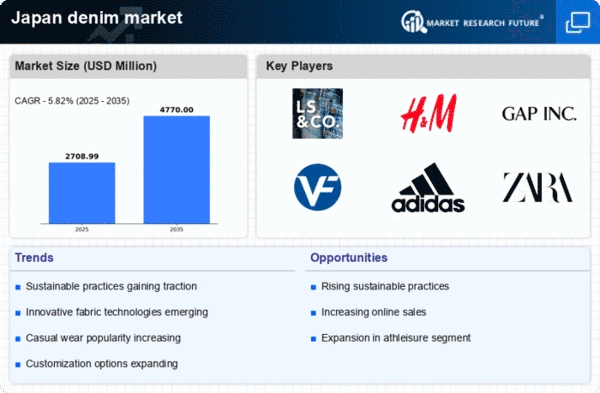
As per Market Research Future analysis, the Japan denim market Size was estimated at 2560.0 USD Million in 2024. The Japan denim market is projected to grow from 2708.99 USD Million in 2025 to 4770.0 USD Million by 2035, exhibiting a compound annual growth rate (CAGR) of 5.8% during the forecast period 2025 - 2035

Key Market Trends & Highlights

The Japan denim market is experiencing a transformative shift towards sustainability and personalization.

  • Sustainability initiatives are becoming increasingly prevalent, reflecting a broader consumer demand for eco-friendly products.
  • Customization and personalization are gaining traction, allowing consumers to express their individuality through unique denim pieces.
  • The influence of streetwear culture continues to shape denim styles, particularly among younger demographics.
  • Rising demand for eco-friendly products and technological advancements in fabric production are key drivers propelling market growth.

Market Size & Forecast

2024 Market Size 2560.0 (USD Million)
2035 Market Size 4770.0 (USD Million)
CAGR (2025 - 2035) 5.82%

Major Players

Levi Strauss & Co (US), H&M (SE), Gap Inc (US), VF Corporation (US), Adidas AG (DE), Zara (ES), American Eagle Outfitters (US), Diesel S.p.A. (IT), Uniqlo (JP)

Our Impact
Enabled $4.3B Revenue Impact for Fortune 500 and Leading Multinationals
Partnering with 2000+ Global Organizations Each Year
30K+ Citations by Top-Tier Firms in the Industry

Japan Denim Market Trends

The denim market in Japan is currently experiencing a dynamic evolution, characterized by shifting consumer preferences and innovative production techniques. As sustainability becomes a focal point for many consumers, brands are increasingly adopting eco-friendly practices, such as using organic cotton and reducing water consumption during manufacturing. This trend aligns with a broader global movement towards responsible consumption, which appears to resonate strongly with Japanese consumers who are becoming more environmentally conscious. Furthermore, the rise of e-commerce has transformed the way denim products are marketed and sold, allowing brands to reach a wider audience while providing consumers with greater convenience and variety. In addition to sustainability, the denim market is witnessing a growing interest in customization and personalization. Consumers are seeking unique products that reflect their individual styles, prompting brands to offer tailored options. This trend is particularly evident among younger demographics, who value self-expression through fashion. Moreover, the influence of streetwear culture continues to shape denim styles, with an emphasis on relaxed fits and bold designs. As these trends unfold, the denim market in Japan is poised for continued growth, driven by innovation and a deepening connection between brands and consumers.

Sustainability Initiatives

Brands are increasingly focusing on eco-friendly practices, such as using organic materials and minimizing water usage during production. This shift reflects a growing consumer demand for environmentally responsible products.

Customization and Personalization

There is a rising trend towards offering customized denim products, allowing consumers to express their individuality. This is particularly appealing to younger consumers who seek unique styles.

Influence of Streetwear Culture

Streetwear continues to impact denim styles, with a preference for relaxed fits and bold designs. This cultural influence shapes consumer choices and drives demand for innovative denim products.

Japan Denim Market Drivers

Cultural Shifts Towards Casual Wear

Cultural shifts in Japan are contributing to the evolving landscape of the denim market. The increasing acceptance of casual wear in various settings, including workplaces and social gatherings, is driving demand for versatile denim products. As of 2025, it is anticipated that casual denim styles will represent a significant portion of the market, with an estimated growth rate of 20% annually. This trend reflects a broader societal change towards comfort and practicality in fashion choices. Brands that successfully cater to this demand by offering stylish yet comfortable denim options are likely to thrive in the competitive denim market. This cultural evolution not only influences consumer purchasing behavior but also shapes the overall direction of the industry.

Rising Demand for Eco-Friendly Products

The denim market in Japan is experiencing a notable shift towards eco-friendly products. Consumers are increasingly prioritizing sustainability, leading to a surge in demand for denim made from organic cotton and recycled materials. This trend is reflected in the market, where eco-conscious brands are gaining traction. In 2025, it is estimated that the eco-friendly denim segment could account for approximately 30% of total sales in the denim market. This shift not only aligns with consumer preferences but also encourages manufacturers to adopt sustainable practices, thereby enhancing their brand image. As a result, the denim market is likely to see a rise in innovative production techniques that minimize environmental impact, further driving growth in this segment.

Growth of E-Commerce and Online Retailing

The expansion of e-commerce is transforming the denim market in Japan. With the increasing penetration of the internet and mobile devices, consumers are increasingly turning to online platforms for their shopping needs. In 2025, it is projected that online sales could account for over 25% of total denim sales in Japan. This shift presents both opportunities and challenges for traditional retailers, who must adapt to the changing landscape. E-commerce allows for a broader reach and the ability to offer personalized shopping experiences, which are becoming essential in the denim market. As brands invest in their online presence, the competition is likely to intensify, pushing them to innovate in their marketing and distribution strategies.

Technological Advancements in Fabric Production

Technological innovations are playing a crucial role in shaping the denim market in Japan. Advanced manufacturing techniques, such as laser technology and 3D weaving, are enhancing the quality and durability of denim products. These advancements allow for the creation of unique textures and finishes, appealing to a broader consumer base. Furthermore, the integration of smart textiles into denim is gaining attention, with features such as moisture-wicking and temperature regulation. As of 2025, it is projected that the adoption of these technologies could increase the overall market value of the denim market by approximately 15%. This technological evolution not only meets consumer demands for high-performance apparel but also positions brands as leaders in innovation.

Influence of Fashion Trends and Celebrity Endorsements

Fashion trends and celebrity endorsements significantly impact the denim market in Japan. The rise of social media platforms has amplified the influence of fashion icons, leading to rapid shifts in consumer preferences. Denim styles, such as high-waisted jeans and distressed finishes, are often popularized by celebrities, driving sales in the market. In 2025, it is estimated that approximately 40% of consumers in Japan are influenced by celebrity fashion choices when purchasing denim products. This trend underscores the importance of marketing strategies that leverage celebrity partnerships to enhance brand visibility and appeal. Consequently, brands that effectively engage with influencers are likely to see increased market share in the competitive denim market.


Market Segment Insights

By Fabric Type: Cotton Denim (Largest) vs. Organic Denim (Fastest-Growing)

In the Japan denim market, Cotton Denim dominates the fabric type segment, holding the largest market share due to its widespread appeal and traditional use in denim garments. Stretch Denim follows closely, driven by consumer preferences for comfort and versatility. On the other hand, Recycled Denim and Organic Denim are gaining traction as sustainability takes center stage, appealing to environmentally conscious consumers looking for eco-friendly options in their apparel choices. The growth trends indicate a significant shift towards sustainable materials, with Organic Denim emerging as the fastest-growing segment. This is propelled by increasing awareness of environmental issues and a shift in consumer behavior towards sustainable fashion practices. As brands innovate with eco-friendly materials and processes, both Recycled and Organic Denim are expected to see a surge in demand, marking a transformation in the fabric preferences of the Japan denim market.

Cotton Denim (Dominant) vs. Organic Denim (Emerging)

Cotton Denim remains the dominant fabric type in the Japan denim market, renowned for its durability, comfort, and classic appeal. It is widely used across various styles and fits, making it a staple for consumers of all ages. In contrast, Organic Denim is considered an emerging segment, characterized by its production using sustainable practices and materials. This fabric appeals to a rising demographic of consumers who prioritize ethical and environmentally friendly choices. Organic Denim, while still smaller in market share compared to Cotton Denim, is rapidly gaining traction, particularly among younger consumers seeking stylish yet sustainable options. The contrast between Cotton's traditional dominance and Organic's emerging presence highlights a dynamic shift in consumer preferences.

By Product Type: Jeans (Largest) vs. Jackets (Fastest-Growing)

In the Japan denim market, the segment of jeans holds a dominant position, leading the market share due to its widespread popularity and versatility. This beloved staple of casual wear consistently appeals to a broad demographic, establishing itself as a must-have in every wardrobe. Jackets, while traditionally seen as a seasonal item, have rapidly gained traction among consumers, showcasing innovative designs and styles that attract younger audiences, contributing to a significant rise in market presence. The projected growth trends for the denim segment indicate that jackets will experience the fastest growth rate, largely driven by the increasing influence of street fashion and a trend towards layering and unique styles. Consumers are becoming more experimental with their attire, seeking not just functional but fashionable pieces. This shift indicates a potential pivot in market demand, with jackets positioned to steal some spotlight from the traditionally dominant jeans segment, reinforcing the evolving landscape of the Japan denim market.

Jeans (Dominant) vs. Jackets (Emerging)

Jeans remain the dominant force in the Japan denim market, embodying durable quality and timeless fashion that caters to both men and women. Their varied styles, from skinny to baggy, allow for a broad appeal across different age groups and fashion preferences. In contrast, jackets are emerging as a trendy segment, increasingly favored by consumers seeking a statement piece that transcends seasonal wear. This shift towards jackets is characterized by unique cuts, collaborations with designers, and eco-friendly materials, making them a favored choice among socially conscious shoppers. The evolving consumer behavior coupled with innovative marketing strategies positions jackets as an exciting, albeit emerging, competitor to the traditional supremacy of jeans.

By End Use: Men (Largest) vs. Women (Fastest-Growing)

In the Japan denim market, the distribution of market share among the 'End Use' segments reveals that men’s denim is the largest segment, dominating the landscape with a significant share. This is largely attributed to the strong fashion inclination among males, leading to a diverse range of styles and fits available in the market. In contrast, the women's segment is rapidly gaining traction as brands increasingly cater to female consumers with innovative designs and styles that resonate with current fashion trends. Moreover, the growth trends indicate that while men's denim remains a stalwart, women's denim is on the rise, driven by changing consumer preferences and a growing emphasis on sustainability. The kids segment, although smaller, is also experiencing growth fueled by increasing disposable income among families and a rising interest in fashionable clothing for children. These factors collectively influence the dynamics of the denim market.

Men: Dominant vs. Women: Emerging

The men's denim segment stands out as the dominant force in the Japan denim market, characterized by a rich variety of styles catering to diverse consumer profiles, from casual wear to formal outfits. Men’s denim products often emphasize durability and quality, appealing to a consumer base that values practicality alongside fashion. In contrast, the women's denim segment is emerging rapidly, showing unique growth patterns driven by a greater awareness of trends and preferences among female shoppers. Women’s denim often highlights aesthetics, comfort, and versatility, with brands introducing innovative materials and designs that reflect current fashion statements. This dynamic interplay positions men as the dominant segment while women continually challenge this hierarchy with their fast-growing market presence.

By Distribution Channel: Online (Largest) vs. Offline (Fastest-Growing)

In the Japan denim market, the distribution channels have been crucial in shaping consumer access to products. Online sales have emerged as the largest segment, attracting a significant share of the market due to convenience and a wide range of choices. Conversely, the offline channel remains strong, particularly in urban areas where consumers prefer tactile experiences before making purchases. Department stores also play a role, offering curated selections that appeal to specific customer segments. Growth trends in the distribution channels indicate a significant shift towards online shopping, driven by the increasing penetration of mobile devices and the proliferation of e-commerce platforms. The offline segment, particularly through department stores, is adapting by enhancing the in-store experience and integrating online elements, thus attracting more customers. This dynamic landscape reflects changing consumer behavior and technological advancements influencing shopping preferences.

Online (Dominant) vs. Offline (Emerging)

Online distribution channels continue to dominate the Japan denim market due to their ability to offer convenience and a vast selection of products to consumers. The rise of mobile shopping and targeted digital marketing strategies has reinforced this dominance, enabling brands to reach consumers directly. Meanwhile, offline channels, especially department stores, are emerging by reinventing their shopping environments to enhance customer experiences. These stores are focusing on providing personalized service and exclusive in-store collections to attract shoppers. While online sales are leading the market, the offline segment is increasingly incorporating digital tools to stay competitive, reflecting an adaptive approach to evolving consumer preferences.

Get more detailed insights about Japan Denim Market

Key Players and Competitive Insights

The denim market in Japan exhibits a competitive landscape characterized by a blend of traditional and innovative strategies among key players. Major companies such as Uniqlo (JP), Levi Strauss & Co (US), and H&M (SE) are actively shaping the market dynamics through their distinct operational focuses. Uniqlo (JP) emphasizes a strategy of localizing production to enhance supply chain efficiency, while Levi Strauss & Co (US) is known for its commitment to sustainability and innovation in denim technology. H&M (SE) continues to push for digital transformation, integrating e-commerce with physical retail to create a seamless shopping experience. Collectively, these strategies contribute to a moderately fragmented market, where competition is driven by both product differentiation and operational excellence.In terms of business tactics, companies are increasingly localizing manufacturing to reduce lead times and enhance responsiveness to consumer trends. This approach not only optimizes supply chains but also aligns with growing consumer preferences for locally produced goods. The competitive structure of the market remains moderately fragmented, with several players vying for market share, yet the influence of major brands is substantial, often dictating trends and setting benchmarks for quality and sustainability.

In October Uniqlo (JP) announced the launch of its new eco-friendly denim line, which utilizes recycled materials and sustainable production methods. This strategic move underscores the company's commitment to environmental responsibility and positions it favorably among increasingly eco-conscious consumers. The introduction of this line is likely to enhance Uniqlo's brand image and attract a broader customer base, particularly among younger demographics who prioritize sustainability in their purchasing decisions.

In September Levi Strauss & Co (US) unveiled a partnership with a leading technology firm to develop smart denim products that integrate wearable technology. This initiative reflects the company's focus on innovation and its aim to capture the tech-savvy segment of the market. By merging fashion with technology, Levi Strauss & Co (US) is not only diversifying its product offerings but also setting a precedent for future developments in the denim sector.

In August H&M (SE) expanded its online presence by launching a dedicated denim e-commerce platform, which features personalized shopping experiences powered by AI. This strategic action is indicative of H&M's commitment to digital transformation and its recognition of the growing importance of online retail. By enhancing its digital capabilities, H&M (SE) is likely to improve customer engagement and drive sales growth in a competitive environment.

As of November the denim market is increasingly defined by trends such as digitalization, sustainability, and the integration of AI technologies. Strategic alliances among companies are becoming more prevalent, facilitating knowledge sharing and resource optimization. Looking ahead, competitive differentiation is expected to evolve, with a notable shift from price-based competition towards innovation, technological advancements, and supply chain reliability. Companies that can effectively leverage these trends will likely secure a competitive edge in the dynamic landscape of the denim market.

Key Companies in the Japan Denim Market include

Industry Developments

In recent months, the Japan Denim Market has observed a notable surge in both innovation and collaborations among key companies. Edwin has launched a new line of sustainable denim products, tapping into the growing consumer demand for eco-friendly fashion, while Fast Retailing unveiled initiatives aimed at reducing the carbon footprint associated with their denim production. In April 2023, Levi Strauss and Co. revealed plans to enhance their manufacturing capabilities in Japan, aiming to appeal to the domestic market's preference for high-quality denim.

Kuro and Nudie Jeans have also made headlines with their unique campaign celebrating craftsmanship and local artisans, emphasizing the cultural significance of denim in Japan. Additionally, there have been discussions around potential collaborations between Mizuno and various lifestyle brands to integrate functionality into denim products. Market valuation for companies like Gap Inc. has reported steady growth, reflecting rising consumer interest and increased international exports of Japanese denim, which has gained popularity for their premium quality.

The overall market has seen a recovery post-pandemic, leading to renewed interest from investors and brands alike in the Japanese denim sector, indicating a vibrant and evolving landscape.

Future Outlook

Japan Denim Market Future Outlook

The Denim Market in Japan is projected to grow at a 5.82% CAGR from 2025 to 2035, driven by sustainability trends, technological advancements, and evolving consumer preferences.

New opportunities lie in:

  • Expansion of eco-friendly denim production methods
  • Investment in smart textile technologies for enhanced functionality
  • Development of direct-to-consumer online sales platforms

By 2035, the denim market is expected to achieve robust growth and increased market share.

Market Segmentation

Japan Denim Market End Use Outlook

  • Men
  • Women
  • Kids

Japan Denim Market Fabric Type Outlook

  • Cotton Denim
  • Stretch Denim
  • Recycled Denim
  • Organic Denim

Japan Denim Market Product Type Outlook

  • Jeans
  • Jackets
  • Shirts
  • Skirts

Japan Denim Market Distribution Channel Outlook

  • Online
  • Offline
  • Department Stores

Report Scope

MARKET SIZE 2024 2560.0(USD Million)
MARKET SIZE 2025 2708.99(USD Million)
MARKET SIZE 2035 4770.0(USD Million)
COMPOUND ANNUAL GROWTH RATE (CAGR) 5.82% (2025 - 2035)
REPORT COVERAGE Revenue Forecast, Competitive Landscape, Growth Factors, and Trends
BASE YEAR 2024
Market Forecast Period 2025 - 2035
Historical Data 2019 - 2024
Market Forecast Units USD Million
Key Companies Profiled Levi Strauss & Co (US), H&M (SE), Gap Inc (US), VF Corporation (US), Adidas AG (DE), Zara (ES), American Eagle Outfitters (US), Diesel S.p.A. (IT), Uniqlo (JP)
Segments Covered Fabric Type, Product Type, End Use, Distribution Channel
Key Market Opportunities Adoption of sustainable practices and innovative materials in the denim market.
Key Market Dynamics Shifting consumer preferences towards sustainable denim products drive innovation and competition in Japan's denim market.
Countries Covered Japan
Leave a Comment

FAQs

What is the expected market size of the Japan Denim Market in 2024?

The Japan Denim Market is expected to be valued at 3.12 billion USD in 2024.

What will be the market value of the Japan Denim Market by 2035?

By 2035, the Japan Denim Market is projected to reach a value of 5.2 billion USD.

What is the expected CAGR for the Japan Denim Market from 2025 to 2035?

The Japan Denim Market is expected to witness a compound annual growth rate of 4.753 percent from 2025 to 2035.

Which distribution channel is expected to generate more revenue in the Japan Denim Market by 2035?

The offline distribution channel is anticipated to generate 3.16 billion USD in revenue by 2035.

How much is the online segment of the Japan Denim Market valued at in 2024?

The online segment of the Japan Denim Market is valued at 1.24 billion USD in 2024.

Who are the major players in the Japan Denim Market?

Major players in the Japan Denim Market include Denim Fabric Co, Edwin, Lee, and Levi Strauss and Co.

What is the expected market size for the offline segment of the Japan Denim Market in 2024?

The offline segment is expected to be valued at 1.88 billion USD in 2024.

What trends or opportunities are driving growth in the Japan Denim Market?

Emerging trends such as sustainability and online shopping are driving growth in the Japan Denim Market.

What impact do global scenarios have on the Japan Denim Market?

Current global scenarios could potentially affect supply chains and consumer behavior in the Japan Denim Market.

What will the value of the Japan Denim Market be for online sales by 2035?

The value of the Japan Denim Market for online sales is projected to reach 2.04 billion USD by 2035.

Download Free Sample

Kindly complete the form below to receive a free sample of this Report

Compare Licence

×
Features License Type
Single User Multiuser License Enterprise User
Price $4,950 $5,950 $7,250
Maximum User Access Limit 1 User Upto 10 Users Unrestricted Access Throughout the Organization
Free Customization
Direct Access to Analyst
Deliverable Format
Platform Access
Discount on Next Purchase 10% 15% 15%
Printable Versions