×
Request Free Sample ×

Kindly complete the form below to receive a free sample of this Report

* Please use a valid business email

Leading companies partner with us for data-driven Insights

clients tt-cursor
Hero Background

Italy Pasta Market

ID: MRFR/FnB/45082-HCR
128 Pages
Snehal Singh
February 2026

Italy Pasta Market Size, Share, Industry Trend & Analysis Research Report By Pasta Source (Wheat, Rice, Maize, Soy, Multigrain) and By Pasta Distribution Channel (Store-Based Supermarkets, Hypermarkets, Non-Store-Based) - Forecast to 2035.

Share:
Download PDF ×

We do not share your information with anyone. However, we may send you emails based on your report interest from time to time. You may contact us at any time to opt-out.

Italy Pasta Market Infographic
Purchase Options

Italy Pasta Market Summary

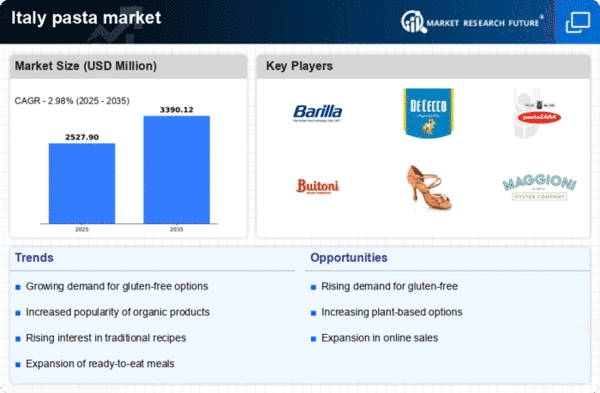
As per Market Research Future analysis, the Italy pasta market Size was estimated at 2454.75 USD Million in 2024. The Pasta market is projected to grow from 2527.9 USD Million in 2025 to 3390.12 USD Million by 2035, exhibiting a compound annual growth rate (CAGR) of 2.9% during the forecast period 2025 - 2035

Key Market Trends & Highlights

The Italy pasta market is experiencing a dynamic shift towards health-conscious and sustainable offerings.

  • Health-conscious pasta options are gaining traction, reflecting a broader trend towards wellness in food consumption.
  • Sustainability initiatives are increasingly influencing production practices, appealing to environmentally aware consumers.
  • Innovative ingredients, such as alternative flours and plant-based options, are emerging in the market, catering to diverse dietary preferences.
  • The rising demand for convenience foods and health and wellness trends are key drivers propelling market growth.

Market Size & Forecast

2024 Market Size 2454.75 (USD Million)
2035 Market Size 3390.12 (USD Million)
CAGR (2025 - 2035) 2.98%

Major Players

Barilla (IT), De Cecco (IT), Pasta Zara (IT), Buitoni (IT), Rummo (IT), Maggioni (IT), Pastificio Di Martino (IT), Colavita (IT)

Our Impact
Enabled $4.3B Revenue Impact for Fortune 500 and Leading Multinationals
Partnering with 2000+ Global Organizations Each Year
30K+ Citations by Top-Tier Firms in the Industry

Italy Pasta Market Trends

The pasta market in Italy exhibits a dynamic landscape characterized by evolving consumer preferences and innovative product offerings. As culinary traditions remain deeply rooted in Italian culture, there is a noticeable shift towards healthier options, including whole grain and gluten-free varieties. This trend appears to be driven by an increasing awareness of health and wellness among consumers, who are seeking alternatives that align with their dietary needs. Additionally, the rise of plant-based diets has influenced the market, prompting manufacturers to explore new ingredients and formulations that cater to this growing demographic. Moreover, sustainability has emerged as a pivotal factor influencing purchasing decisions within the pasta market. Consumers are increasingly inclined to support brands that prioritize eco-friendly practices, such as sustainable sourcing and minimal packaging. This shift suggests a broader movement towards environmental consciousness, which may reshape the competitive landscape. As the market continues to evolve, it is likely that innovation will play a crucial role in meeting the diverse demands of consumers, ensuring that the pasta market remains vibrant and responsive to changing trends.

Health-Conscious Offerings

There is a growing demand for healthier pasta options, including whole grain and gluten-free varieties. This trend reflects a shift in consumer preferences towards nutritious alternatives that cater to dietary restrictions and promote overall well-being.

Sustainability Initiatives

Brands are increasingly adopting sustainable practices, focusing on eco-friendly sourcing and packaging. This trend indicates a rising consumer preference for products that align with environmental values, potentially influencing brand loyalty.

Innovative Ingredients

The exploration of alternative ingredients, such as legumes and vegetables, is gaining traction in the pasta market. This trend suggests a response to the increasing popularity of plant-based diets and the desire for diverse culinary experiences.

Italy Pasta Market Drivers

Health and Wellness Trends

The pasta market in Italy is increasingly influenced by health and wellness trends, as consumers become more conscious of their dietary choices. There is a growing demand for whole grain and gluten-free pasta options, reflecting a shift towards healthier eating habits. Market Research Future suggests that sales of whole grain pasta have risen by approximately 15% in the last year, indicating a significant consumer preference for nutritious alternatives. Additionally, the rise of plant-based diets has prompted manufacturers to explore innovative ingredients, such as legume-based pasta, which offers higher protein content. This focus on health and wellness is reshaping product development within the pasta market, as brands strive to cater to the evolving preferences of health-conscious consumers. The integration of nutritional benefits into pasta products is likely to enhance their appeal and drive market growth in the coming years.

Culinary Heritage and Tradition

The pasta market in Italy is deeply rooted in the country's culinary heritage, which significantly influences consumer preferences. Traditional pasta dishes are integral to Italian culture, leading to a consistent demand for authentic products. This cultural attachment to pasta is reflected in the market, where approximately 80% of households consume pasta regularly. The emphasis on traditional recipes and regional variations fosters a strong connection between consumers and local producers. As a result, the pasta market thrives on the preservation of these culinary traditions, which not only sustains local economies but also enhances the overall appeal of pasta as a staple food. The enduring popularity of pasta dishes, such as spaghetti and lasagna, underscores the importance of culinary heritage in shaping consumer behavior and driving market growth.

Rising Demand for Convenience Foods

In recent years, the pasta market in Italy has experienced a notable shift towards convenience foods. Busy lifestyles and changing consumer habits have led to an increased preference for quick and easy meal solutions. Pre-packaged pasta products, including ready-to-cook and microwaveable options, have gained traction among consumers seeking time-saving alternatives. Market data indicates that the sales of convenience pasta products have surged by approximately 25% over the past two years. This trend is particularly evident among younger demographics, who prioritize convenience without compromising on taste. As a result, manufacturers are adapting their offerings to meet this demand, leading to innovations in packaging and product formats. The growing inclination towards convenience foods is likely to continue shaping the pasta market, as consumers seek efficient meal solutions that align with their fast-paced lifestyles.

Sustainability and Ethical Sourcing

Sustainability has emerged as a crucial driver in the pasta market in Italy, as consumers increasingly prioritize environmentally friendly products. There is a growing awareness of the impact of food production on the environment, leading to a demand for sustainably sourced ingredients and eco-friendly packaging. Market data suggests that approximately 40% of consumers are willing to pay a premium for pasta products that adhere to sustainable practices. This trend has prompted manufacturers to adopt ethical sourcing methods and implement sustainable production processes. The emphasis on sustainability not only aligns with consumer values but also enhances brand loyalty and trust. As the pasta market evolves, companies that prioritize sustainability are likely to resonate with environmentally conscious consumers, thereby driving growth and innovation in the sector.

E-commerce and Digital Transformation

The pasta market in Italy is witnessing a transformation driven by the rise of e-commerce and digital platforms. Online grocery shopping has gained popularity, particularly among younger consumers who prefer the convenience of purchasing food products online. This shift has prompted pasta manufacturers and retailers to enhance their online presence and invest in digital marketing strategies. Recent data indicates that online sales of pasta products have increased by approximately 30% in the past year, reflecting changing consumer shopping behaviors. The ability to reach a broader audience through e-commerce channels is likely to provide significant growth opportunities for the pasta market. As digital transformation continues to reshape the retail landscape, companies that effectively leverage online platforms may gain a competitive edge in the evolving market.


Market Segment Insights

By Type: Dried Pasta (Largest) vs. Fresh Pasta (Fastest-Growing)

In the Italy pasta market, the segment values are prominently distributed across dried pasta, fresh pasta, frozen pasta, and stuffed pasta. Dried pasta holds the largest market share, dominating consumer preference due to its long shelf life and convenience. Fresh pasta, while having a smaller share, is rapidly gaining popularity among consumers looking for quality and authentic dining experiences. Frozen and stuffed pasta also contribute significantly but are overshadowed by the former two segments. The growth trends in the Italy pasta market indicate a rising demand for fresh pasta, driven by increasing consumer interest in healthy eating and culinary authenticity. The convenience and quality aspects of fresh offerings are attracting more consumers, allowing it to emerge as the fastest-growing segment. Additionally, the versatility of pasta types in various culinary applications supports their sustained growth in the market.

Dried Pasta: Dominant vs. Fresh Pasta: Emerging

Dried pasta is established as the dominant segment in the Italy pasta market, widely recognized for its convenience and extended shelf life. It plays a crucial role in everyday cooking, making it a staple in many households. In contrast, fresh pasta is emerging as a key player, appealing to a niche market that values quality and freshness. Consumers are increasingly turning to fresh varieties for their culinary experiences, resulting in a growing segment that offers rich flavors and textures. The differentiation in preparation and consumption styles between these two segments underlines their unique positions within the market, highlighting the balance between convenience and quality as consumers navigate their pasta choices.

By Ingredients: Wheat (Largest) vs. Legumes (Fastest-Growing)

In the Italy pasta market, the ingredients segment shows a diverse distribution among wheat, rice, legumes, and vegetable-based alternatives. Wheat holds the largest market share due to its traditional use in pasta production, contributing to the beloved texture and flavor that consumers expect. Rice and vegetable-based options are steadily gaining traction, appealing to health-conscious customers and those with dietary restrictions. Legumes have emerged as a notable player, appealing to a growing segment of consumers seeking high-protein, gluten-free alternatives. The growth trends within this segment are largely driven by shifting consumer preferences towards healthier and more sustainable options. The rise of plant-based diets and increased awareness of gluten intolerance have positively impacted the demand for legumes and vegetable-based products. As innovation in pasta production continues, these ingredients are positioned to capture more market share, highlighting a transformative phase in consumer eating habits and preferences.

Wheat (Dominant) vs. Legumes (Emerging)

Wheat stands as the dominant ingredient in the Italy pasta market, known for delivering the classic pasta qualities such as firmness and elasticity that consumers cherish. Its historical significance and broad acceptance solidify its leading position, making it a staple ingredient among manufacturers. In contrast, legumes represent an emerging trend, catering to the health-conscious consumer demographic. As a rich source of protein and fiber, legumes are increasingly featured in pasta varieties, attracting attention for their nutritional benefits. This shift is supported by food trends emphasizing plant-based diets, where legumes serve as a promising alternative to traditional ingredients, thus enhancing their growth potential in the market.

By Distribution Channel: Supermarkets (Largest) vs. Online Retail (Fastest-Growing)

Supermarkets dominate the distribution landscape of the Italy pasta market, holding the largest share due to their widespread presence and convenience for consumers. This channel is preferred for purchasing pasta products as they often offer a variety of brands and types under one roof, catering to diverse consumer preferences. Online retail is gaining traction, driven by the increase in digital shopping habits and the demand for home delivery services, making it a significant player in the market. The growth trends in the distribution channel segment indicate a shift towards online retail as consumers increasingly seek convenience and flexible purchasing options. Convenience stores also play a crucial role, particularly in urban areas where quick access to products is essential. As specialty stores focus on unique offerings and gourmet products, they attract niche markets, while supermarkets continue to capitalize on their dominant position through promotions and loyalty programs.

Supermarkets (Dominant) vs. Online Retail (Emerging)

Supermarkets are the leading distribution channels in the Italy pasta market, characterized by their wide availability and extensive product ranges. They attract a large customer base, offering both well-known and private label pasta varieties, which cater to various consumer demands. Their strategic locations in urban and suburban areas ensure easy access for shoppers. In contrast, online retail, though still emerging, is rapidly adapting to market needs, driven by innovations in e-commerce and the growth of mobile shopping. This segment provides the advantage of home delivery and a broader selection of products that may not be available in physical stores, making it increasingly popular among consumers seeking convenience.

By End Use: Residential (Largest) vs. Food Service (Fastest-Growing)

In the Italy pasta market, the end use segment is predominantly driven by the residential sector, which commands a significant share compared to food service and catering. This dominance is supported by a strong home-cooking trend, particularly in urban areas where consumers prefer high-quality pasta for everyday meals. Food service, although a smaller segment, is witnessing increased demand as restaurants and café operators emphasize authentic Italian cuisine, which drives the use of premium pasta products. Growth trends indicate a dynamic shift in consumer behavior, with the residential segment expected to maintain its leading position through consistent demand for convenience and quality. On the other hand, the food service segment is projected to grow at the fastest rate due to the revival of dining out post-pandemic and a rise in casual dining options. Catering services are also gaining traction as more events rely on catered pasta meals, further diversifying consumption patterns.

Residential (Dominant) vs. Catering (Emerging)

The residential sector holds a dominant position in the Italy pasta market, characterized by consumers’ preference for traditional pasta types that align with authentic culinary practices. Home cooks are increasingly seeking artisanal and specialty pasta products, which contributes to the segment's robust market presence. In contrast, the catering segment is emerging, catering to a niche audience that organizes events and gatherings with a focus on diverse pasta offerings. Catering services are adapting to trends by providing customized pasta solutions that appeal to varied dietary preferences, thus carving out a unique position in the market. Both segments are crucial, but the residential market's influence remains unparalleled as the primary driver of growth and consumption.

Get more detailed insights about Italy Pasta Market

Key Players and Competitive Insights

The pasta market in Italy exhibits a dynamic competitive landscape characterized by a blend of traditional craftsmanship and modern innovation. Key players such as Barilla (IT), De Cecco (IT), and Rummo (IT) are at the forefront, each employing distinct strategies to enhance their market presence. Barilla (IT), for instance, focuses on sustainability and product diversification, aiming to cater to health-conscious consumers. De Cecco (IT) emphasizes premium quality and heritage, leveraging its long-standing reputation to attract discerning customers. Rummo (IT) is known for its artisanal approach, which appeals to a niche market that values authenticity and traditional production methods. Collectively, these strategies contribute to a competitive environment that balances heritage with modern consumer demands.In terms of business tactics, localizing manufacturing and optimizing supply chains are pivotal for these companies. The market structure appears moderately fragmented, with several players vying for market share while maintaining unique brand identities. This fragmentation allows for a variety of product offerings, catering to diverse consumer preferences. The collective influence of these key players shapes the market dynamics, as they continuously adapt to changing consumer behaviors and preferences.

In October Barilla (IT) announced a partnership with a leading technology firm to enhance its digital marketing capabilities. This strategic move is likely to bolster Barilla's online presence, enabling it to reach a broader audience and engage with consumers more effectively. The integration of advanced analytics into their marketing strategy may also provide insights into consumer preferences, allowing for more targeted product offerings.

In September De Cecco (IT) launched a new line of organic pasta products, responding to the growing demand for healthier food options. This initiative not only aligns with current health trends but also reinforces De Cecco's commitment to quality and sustainability. By expanding its product range, De Cecco (IT) positions itself to capture a larger share of the health-conscious consumer segment, potentially increasing its market competitiveness.

In August Rummo (IT) unveiled a new production facility designed to enhance its capacity for artisanal pasta production. This investment reflects Rummo's dedication to maintaining high-quality standards while meeting increasing consumer demand. The facility is expected to utilize innovative technologies that streamline production processes, thereby improving efficiency without compromising the brand's artisanal values.

As of November current competitive trends in the pasta market are increasingly defined by digitalization, sustainability, and the integration of artificial intelligence. Strategic alliances among key players are shaping the landscape, fostering innovation and collaboration. The shift from price-based competition to a focus on technological advancement and supply chain reliability is evident. Companies are likely to differentiate themselves through innovative product offerings and enhanced consumer engagement strategies, suggesting a future where quality and sustainability take precedence over mere cost considerations.

Key Companies in the Italy Pasta Market include

Industry Developments

In recent months, the Italy Pasta Market has witnessed notable developments, particularly with significant growth in consumer demand for premium brands. Companies like Giovanni Rana and Barilla have adapted their offerings to cater to the increasing preference for organic and artisanal products, reflecting a broader trend toward healthier eating.

Furthermore, La Molisana announced enhancements to its production capabilities in September 2023, which is expected to bolster its market position. In terms of mergers and acquisitions, Rummo has engaged in discussions to expand its product lines, a move supported by financial growth that the company has seen in 2023.

Additionally, De Cecco has continued its expansion strategy, collaborating with local suppliers, which not only aids in product authenticity but also enhances supply chain efficiency. The overall valuation of the Italy Pasta Market has grown due to these innovations and consumer trends, positively impacting brands such as Divella and Pasta di Gragnano.

The demand for high-quality pasta remains robust, spurred by Italy's reputation for culinary excellence, which continues to influence global markets. As we move forward, these dynamics will play a crucial role in shaping the landscape of Italy’s pasta industry.

Future Outlook

Italy Pasta Market Future Outlook

The Pasta Market in Italy is projected to grow at a 2.98% CAGR from 2025 to 2035, driven by increasing consumer demand for convenience and health-oriented products.

New opportunities lie in:

  • Expansion of gluten-free pasta lines to capture health-conscious consumers.
  • Development of ready-to-eat pasta meals for busy lifestyles.
  • Investment in sustainable packaging solutions to enhance brand image.

By 2035, the pasta market is expected to solidify its growth trajectory, reflecting evolving consumer preferences.

Market Segmentation

Italy Pasta Market Type Outlook

  • Dried Pasta
  • Fresh Pasta
  • Frozen Pasta
  • Stuffed Pasta

Italy Pasta Market End Use Outlook

  • Residential
  • Food Service
  • Catering

Italy Pasta Market Ingredients Outlook

  • Wheat
  • Rice
  • Legumes
  • Vegetable-Based

Italy Pasta Market Distribution Channel Outlook

  • Supermarkets
  • Online Retail
  • Convenience Stores
  • Specialty Stores

Report Scope

MARKET SIZE 2024 2454.75(USD Million)
MARKET SIZE 2025 2527.9(USD Million)
MARKET SIZE 2035 3390.12(USD Million)
COMPOUND ANNUAL GROWTH RATE (CAGR) 2.98% (2025 - 2035)
REPORT COVERAGE Revenue Forecast, Competitive Landscape, Growth Factors, and Trends
BASE YEAR 2024
Market Forecast Period 2025 - 2035
Historical Data 2019 - 2024
Market Forecast Units USD Million
Key Companies Profiled Barilla (IT), De Cecco (IT), Pasta Zara (IT), Buitoni (IT), Rummo (IT), Maggioni (IT), Pastificio Di Martino (IT), Colavita (IT)
Segments Covered Type, Ingredients, Distribution Channel, End Use
Key Market Opportunities Growing demand for gluten-free and organic pasta options presents a lucrative opportunity in the pasta market.
Key Market Dynamics Rising consumer preference for organic and gluten-free options drives innovation in the pasta market.
Countries Covered Italy
Leave a Comment

FAQs

What was the market size of the Italy Pasta Market in 2024?

The Italy Pasta Market was valued at 1621.95 USD Million in 2024.

What is the projected market size of the Italy Pasta Market by 2035?

By 2035, the Italy Pasta Market is projected to reach a valuation of 2500.0 USD Million.

What is the Compound Annual Growth Rate (CAGR) for the Italy Pasta Market from 2025 to 2035?

The estimated CAGR for the Italy Pasta Market from 2025 to 2035 is 4.012%.

Who are the key players in the Italy Pasta Market?

Major players in the Italy Pasta Market include Barilla, De Cecco, and Giovanni Rana, among others.

How is the market for wheat pasta expected to grow by 2035?

The market for wheat pasta is expected to increase from 975.0 USD Million in 2024 to 1500.0 USD Million by 2035.

What is the expected market growth for rice pasta between 2024 and 2035?

The rice pasta segment is anticipated to grow from 325.0 USD Million in 2024 to 450.0 USD Million in 2035.

What was the market size for maize pasta in 2024?

The maize pasta market was valued at 150.0 USD Million in 2024.

What challenges might the Italy Pasta Market face in the coming years?

Challenges may include rising ingredient costs and changing consumer preferences toward healthier options.

What opportunities exist for growth in the Italy Pasta Market?

Opportunities include the increasing demand for gluten-free and multigrain pasta options.

How is the multigrain pasta market expected to evolve by 2035?

The multigrain pasta market is anticipated to grow from 96.95 USD Million in 2024 to 250.0 USD Million by 2035.

Download Free Sample

Kindly complete the form below to receive a free sample of this Report

Compare Licence

×
Features License Type
Single User Multiuser License Enterprise User
Price $4,950 $5,950 $7,250
Maximum User Access Limit 1 User Upto 10 Users Unrestricted Access Throughout the Organization
Free Customization
Direct Access to Analyst
Deliverable Format
Platform Access
Discount on Next Purchase 10% 15% 15%
Printable Versions