×
Request Free Sample ×

Kindly complete the form below to receive a free sample of this Report

* Please use a valid business email

Leading companies partner with us for data-driven Insights

clients tt-cursor
Hero Background

Italy Host Cell Protein Testing Market

ID: MRFR/LS/43209-HCR
200 Pages
Rahul Gotadki
February 2026

Italy Host Cell Protein Testing Market Research Report By Type (PCR-Based Assays, ELISA-based Assays, Mass Spectrometry-Based Assays, Others) and By End User (Contract Research Organizations, Biopharmaceutical Companies, Others) - Growth & Industry Forecast 2025 To 2035

Share:
Download PDF ×

We do not share your information with anyone. However, we may send you emails based on your report interest from time to time. You may contact us at any time to opt-out.

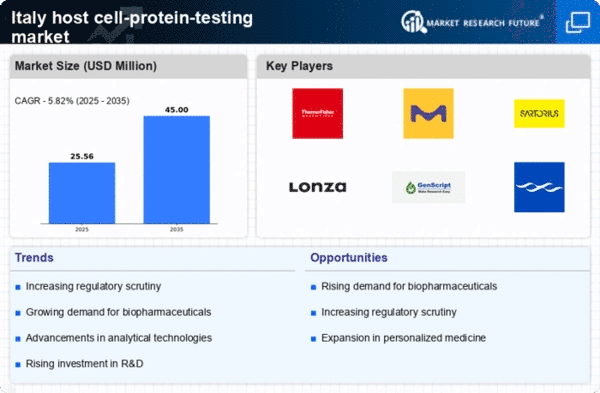
Italy Host Cell Protein Testing Market Infographic
Purchase Options

Italy Host Cell Protein Testing Market Summary

As per Market Research Future analysis, the Italy Host Cell Protein Testing Market size was estimated at 24.15 USD Million in 2024. The Host Cell-protein-testing market is projected to grow from 25.56 USD Million in 2025 to 45.0 USD Million by 2035, exhibiting a compound annual growth rate (CAGR) of 5.8% during the forecast period 2025 - 2035

Key Market Trends & Highlights

The Italy host cell-protein-testing market is poised for growth driven by regulatory compliance and technological advancements.

  • Regulatory compliance and quality assurance remain pivotal in shaping testing protocols across the market.
  • Technological advancements in testing methods are enhancing the accuracy and efficiency of host cell-protein testing.
  • The shift towards personalized medicine is driving demand for tailored therapeutic solutions, particularly in oncology and autoimmune diseases.
  • Rising biopharmaceutical production and increased focus on drug safety are key drivers propelling market expansion.

Market Size & Forecast

2024 Market Size 24.15 (USD Million)
2035 Market Size 45.0 (USD Million)
CAGR (2025 - 2035) 5.82%

Major Players

Thermo Fisher Scientific (US), Merck KGaA (DE), Sartorius AG (DE), Lonza Group (CH), GenScript Biotech Corporation (CN), Charles River Laboratories (US), WuXi AppTec (CN), Bio-Rad Laboratories (US)

Our Impact
Enabled $4.3B Revenue Impact for Fortune 500 and Leading Multinationals
Partnering with 2000+ Global Organizations Each Year
30K+ Citations by Top-Tier Firms in the Industry

Italy Host Cell Protein Testing Market Trends

The Italy Host Cell Protein Testing Market is currently experiencing notable growth. This growth is driven by the increasing demand for biopharmaceuticals and the need for stringent quality control measures. Regulatory bodies emphasize the importance of ensuring that therapeutic proteins are free from contaminants, which has led to a rise in testing activities. This market is characterized by a diverse range of testing methods, including ELISA, mass spectrometry, and Western blotting, each offering unique advantages in detecting host cell proteins. As biopharmaceutical companies expand their production capabilities, the necessity for reliable testing solutions is critical, fostering innovation and investment in this sector. In addition, advancements in technology are reshaping the landscape of the host cell-protein-testing market. Automation and high-throughput screening techniques are becoming increasingly prevalent, enhancing efficiency and accuracy in testing processes. Furthermore, the growing trend towards personalized medicine is likely to influence the demand for tailored testing solutions, as companies seek to develop therapies that cater to individual patient needs. Overall, the host cell-protein-testing market appears poised for continued expansion, driven by regulatory pressures, technological advancements, and the evolving landscape of biopharmaceutical development.

Regulatory Compliance and Quality Assurance

the emphasis on regulatory compliance drives the host cell-protein-testing market. Regulatory agencies mandate rigorous testing to ensure the safety and efficacy of biopharmaceutical products. This has led to an increased focus on quality assurance practices, prompting companies to invest in advanced testing methodologies to meet stringent guidelines.

Technological Advancements in Testing Methods

Innovations in testing technologies are transforming the host cell-protein-testing market. The integration of automation and high-throughput techniques enhances the speed and accuracy of testing processes. These advancements not only improve operational efficiency but also enable more comprehensive analysis of host cell proteins, catering to the evolving needs of the biopharmaceutical industry.

Shift Towards Personalized Medicine

the growing trend towards personalized medicine significantly influences the host cell-protein-testing market. As biopharmaceutical companies aim to develop targeted therapies, the demand for customized testing solutions is likely to rise. This shift necessitates the adaptation of testing protocols to accommodate the unique requirements of individualized treatments, thereby driving innovation in the market.

Italy Host Cell Protein Testing Market Drivers

Growing Demand for Biosimilars

The growing demand for biosimilars in Italy is a significant driver for the host cell-protein-testing market. As healthcare costs rise, there is an increasing shift towards more affordable biosimilar options, which necessitate rigorous testing to ensure their safety and efficacy. The Italian biosimilars market is projected to grow at a CAGR of 15% over the next five years, prompting manufacturers to invest in comprehensive testing protocols. This trend underscores the importance of host cell-protein testing in the development of biosimilars, as it helps to mitigate risks associated with product contamination. Consequently, the host cell-protein-testing market is likely to benefit from this surge in biosimilar production, as companies seek to validate their products through stringent testing.

Increased Focus on Drug Safety

The heightened focus on drug safety in Italy significantly influences the host cell-protein-testing market. Regulatory bodies are enforcing stringent guidelines to ensure that biopharmaceutical products are free from contaminants, including host cell proteins. This regulatory environment compels manufacturers to adopt robust testing practices, thereby driving demand for host cell-protein testing services. In recent years, the Italian Medicines Agency (AIFA) has implemented more rigorous testing requirements, which has resulted in a 20% increase in testing service utilization among biopharmaceutical companies. As the industry continues to prioritize patient safety, the host cell-protein-testing market is expected to experience sustained growth, with companies investing in advanced testing technologies to comply with these regulations.

Rising Biopharmaceutical Production

The increasing production of biopharmaceuticals in Italy is a key driver for the host cell-protein-testing market. As biopharmaceutical companies expand their operations, the demand for rigorous testing of host cell proteins becomes paramount to ensure product safety and efficacy. In 2025, the biopharmaceutical sector in Italy is projected to reach a market value of approximately €5 billion, highlighting the need for advanced testing solutions. This growth is likely to stimulate investments in testing technologies and services, thereby enhancing the overall landscape of the host cell-protein-testing market. Furthermore, the emphasis on quality control in biopharmaceutical manufacturing necessitates comprehensive testing protocols, which could lead to increased adoption of host cell-protein testing methodologies.

Investment in Research and Development

Investment in research and development (R&D) within the biopharmaceutical sector is a crucial driver for the host cell-protein-testing market. Italian companies are increasingly allocating resources towards R&D to innovate and improve their product offerings. This focus on R&D is expected to lead to the development of novel therapeutics, which will require extensive testing for host cell proteins to ensure compliance with regulatory standards. In 2025, R&D spending in the biopharmaceutical industry in Italy is projected to exceed €1 billion, indicating a robust commitment to advancing testing methodologies. As companies strive to enhance their competitive edge, the demand for host cell-protein testing services is likely to rise, further propelling market growth.

Emergence of Advanced Analytical Techniques

The emergence of advanced analytical techniques is reshaping the host cell-protein-testing market in Italy. Innovations such as mass spectrometry and high-performance liquid chromatography (HPLC) are enhancing the sensitivity and specificity of host cell-protein detection. These technologies enable more accurate quantification of host cell proteins, which is crucial for biopharmaceutical quality assurance. As of 2025, the adoption of these advanced techniques is anticipated to increase by 30%, driven by the need for precise testing in the biopharmaceutical sector. This trend not only improves testing outcomes but also encourages the development of new testing methodologies, thereby expanding the capabilities of the host cell-protein-testing market.


Market Segment Insights

By Type: ELISA-based Assays (Largest) vs. PCR-Based Assays (Fastest-Growing)

In the Italy host cell-protein-testing market, ELISA-based assays lead the segment, showcasing a robust presence due to their reliability and widespread acceptance in diagnostics. These assays account for a significant market share, driven by their ability to effectively detect and quantify proteins in various biological samples. Conversely, PCR-based assays are emerging rapidly, reflecting a growing preference among researchers for their high sensitivity and specificity, particularly in genetic and infectious disease testing. Current trends indicate a dynamic shift towards PCR-based assays, which have become the fastest-growing segment within the market. The increasing demand for rapid and accurate testing solutions, especially in the context of infectious diseases and biotechnology applications, is propelling this growth. As technology advances, the integration of automation and improved analytics in PCR methods is likely to enhance their adoption, further pushing their market position.

Assays: ELISA-based (Dominant) vs. PCR-based (Emerging)

ELISA-based assays dominate the Italy host cell-protein-testing market due to their established reliability, ease of use, and ability to handle a variety of sample types. This established method is widely utilized for protein quantification, making it a preferred choice in clinical laboratories. In contrast, PCR-based assays represent an emerging trend, characterized by their exceptional sensitivity and speed in detecting nucleic acids. Their growing popularity is fueled by advancements in technology, allowing for quicker results and higher throughput. This emerging segment is particularly favored in research and clinical settings focused on infectious diseases, thereby positioning PCR-based assays as a crucial player in the evolving landscape of protein testing.

By End User: Biopharmaceutical Companies (Largest) vs. Contract Research Organizations (Fastest-Growing)

In the Italy host cell-protein-testing market, the distribution among end users is primarily dominated by biopharmaceutical companies, which hold a substantial market share due to their extensive involvement in drug development and a growing focus on biologics. Contract research organizations (CROs) follow, leveraging their expertise and resources to support biopharmaceutical companies in testing and development processes. Others, which include academic and research institutions, play a smaller yet significant role in advancing exploratory research and innovation. The growth trends within the end user segment indicate that biopharmaceutical companies will continue to be the driving force, supported by increasing investments in R&D. Meanwhile, CROs are rapidly emerging as the fastest-growing segment due to the rising demand for outsourcing testing services and enhanced focus on cost-effective solutions among biopharmaceutical firms. As the industry evolves, collaborations between these entities are likely to further stimulate growth and innovation in the market.

Biopharmaceutical Companies (Dominant) vs. Contract Research Organizations (Emerging)

Biopharmaceutical companies represent the dominant force in the Italy host cell-protein-testing market, characterized by their investment capacity, advanced technological infrastructure, and regulatory knowledge. Their focus on biologics and personalized medicine drives the demand for accurate protein testing solutions. On the other hand, contract research organizations are considered an emerging segment, catering to the evolving needs of biopharmaceutical companies by providing specialized services. These organizations offer flexibility, scalability, and cost-effectiveness, making them an attractive option for smaller biotech firms and startups. The collaboration between these two segments is pivotal, as it leads to increased efficiencies and innovative approaches in drug development and testing protocols.

Get more detailed insights about Italy Host Cell Protein Testing Market

Key Players and Competitive Insights

The host cell-protein-testing market in Italy is characterized by a dynamic competitive landscape, driven by increasing demand for biopharmaceuticals and stringent regulatory requirements. Key players such as Thermo Fisher Scientific (US), Merck KGaA (DE), and Sartorius AG (DE) are at the forefront, leveraging innovation and strategic partnerships to enhance their market positions. These companies focus on developing advanced testing solutions that ensure the safety and efficacy of biologics, thereby shaping a competitive environment that emphasizes quality and compliance.In terms of business tactics, companies are increasingly localizing manufacturing to reduce lead times and optimize supply chains. The market appears moderately fragmented, with a mix of established players and emerging firms. The collective influence of these key players fosters a competitive structure that encourages innovation while also addressing the complexities of regulatory compliance and customer demands.

In October Thermo Fisher Scientific (US) announced the launch of a new suite of host cell protein testing kits designed to streamline the testing process for biopharmaceutical manufacturers. This strategic move is likely to enhance their product portfolio and strengthen their position in the market by providing customers with more efficient and reliable testing solutions. The introduction of these kits reflects a broader trend towards automation and efficiency in laboratory processes.

In September Merck KGaA (DE) expanded its collaboration with a leading Italian biopharmaceutical company to develop customized testing solutions for host cell proteins. This partnership not only underscores Merck's commitment to innovation but also highlights the importance of localized collaborations in addressing specific market needs. Such strategic alliances may enhance their competitive edge by allowing for tailored solutions that meet the unique requirements of regional clients.

In August Sartorius AG (DE) acquired a small biotech firm specializing in advanced analytics for host cell protein testing. This acquisition is indicative of Sartorius's strategy to bolster its capabilities in analytical testing, which is increasingly critical in the biopharmaceutical sector. By integrating these advanced technologies, Sartorius is likely to enhance its service offerings and improve its competitive positioning in the market.

As of November current trends in the host cell-protein-testing market include a strong emphasis on digitalization, sustainability, and the integration of artificial intelligence (AI) in testing processes. Strategic alliances are becoming increasingly vital, as companies seek to combine resources and expertise to drive innovation. The competitive differentiation is expected to evolve, shifting from price-based competition to a focus on technological advancements, reliability in supply chains, and the ability to meet stringent regulatory standards. This transition suggests that companies prioritizing innovation and quality will likely emerge as leaders in the market.

Key Companies in the Italy Host Cell Protein Testing Market include

Industry Developments

The Italy Host Cell Protein Testing Market has recently seen significant developments, particularly with major companies like Agilent Technologies, Merck KGaA, and Lonza making strides in advanced testing methodologies. Merck KGaA launched a new range of assays in June 2023 that significantly enhance sensitivity for detecting host cell proteins in biologics, reflecting the growing demand for more accurate testing solutions in Italy's biopharmaceutical sector. Moreover, in October 2023, Thermo Fisher Scientific announced an investment to expand its capabilities in the Italian market, focusing on the development of customized testing solutions for local pharmaceutical companies.

The Italian government's commitment to biotechnology innovation, alongside increased funding for research and development, has contributed to a positive market outlook. In terms of mergers and acquisitions, recent months have not reported any significant activity involving the major players in this specific segment. However, companies are continuously looking for partnerships that can enhance their technological capabilities, such as the collaboration between BioRad Laboratories and Eurofins Scientific, announced in March 2023, aiming to streamline host cell protein analysis.

The growing emphasis on regulatory compliance and quality assurance in the biopharmaceutical industry continues to drive the demand for advanced host cell protein testing technologies.

Future Outlook

Italy Host Cell Protein Testing Market Future Outlook

The Host Cell Protein Testing Market in Italy is projected to grow at a 5.82% CAGR from 2025 to 2035, driven by increasing biopharmaceutical production and regulatory demands.

New opportunities lie in:

  • Development of automated testing platforms for enhanced efficiency.
  • Expansion of service offerings to include comprehensive data analytics.
  • Partnerships with biotech firms for tailored testing solutions.

By 2035, the market is expected to achieve robust growth, positioning itself as a leader in biopharmaceutical quality assurance.

Market Segmentation

Italy Host Cell Protein Testing Market Type Outlook

  • PCR-Based Assays
  • ELISA-based Assays
  • Mass Spectrometry-Based Assays
  • Liquid Chromatography–Mass Spectrometry (LC–MS)
  • Tandem Mass Spectrometry (MS/MS)
  • Others

Italy Host Cell Protein Testing Market End User Outlook

  • Contract Research Organizations
  • Biopharmaceutical Companies
  • Others

Report Scope

MARKET SIZE 2024 24.15(USD Million)
MARKET SIZE 2025 25.56(USD Million)
MARKET SIZE 2035 45.0(USD Million)
COMPOUND ANNUAL GROWTH RATE (CAGR) 5.82% (2025 - 2035)
REPORT COVERAGE Revenue Forecast, Competitive Landscape, Growth Factors, and Trends
BASE YEAR 2024
Market Forecast Period 2025 - 2035
Historical Data 2019 - 2024
Market Forecast Units USD Million
Key Companies Profiled Thermo Fisher Scientific (US), Merck KGaA (DE), Sartorius AG (DE), Lonza Group (CH), GenScript Biotech Corporation (CN), Charles River Laboratories (US), WuXi AppTec (CN), Bio-Rad Laboratories (US)
Segments Covered Type, End User
Key Market Opportunities Growing demand for advanced host cell-protein-testing technologies driven by regulatory compliance and biopharmaceutical innovation.
Key Market Dynamics Rising regulatory scrutiny drives demand for advanced host cell-protein-testing solutions in Italy's biopharmaceutical sector.
Countries Covered Italy
Leave a Comment

FAQs

What is the expected market size of the Italy Host Cell Protein Testing Market in 2024?

The Italy Host Cell Protein Testing Market is expected to be valued at 34.5 million USD in 2024.

What is the projected market size for the Italy Host Cell Protein Testing Market by 2035?

By 2035, the market is anticipated to reach a value of 78.5 million USD.

What is the expected compound annual growth rate for the Italy Host Cell Protein Testing Market from 2025 to 2035?

The expected CAGR for the Italy Host Cell Protein Testing Market from 2025 to 2035 is 7.76%.

Which type of assay is expected to have the largest market value in 2035?

The ELISA-based Assays segment is projected to reach a market value of 27.5 million USD by 2035.

What will be the market value of PCR-Based Assays in 2024?

The market value for PCR-Based Assays is expected to be 10.0 million USD in 2024.

Who are the key players in the Italy Host Cell Protein Testing Market?

Major players include Agilent Technologies, Merck KGaA, and Thermo Fisher Scientific among others.

What is the significance of Mass Spectrometry-Based Assays in the market by 2035?

Mass Spectrometry-Based Assays are expected to reach a value of 18.5 million USD by 2035.

Which market segments are experiencing growth within the Italy Host Cell Protein Testing Market?

The market segments including PCR-Based Assays and ELISA-based Assays are experiencing significant growth.

What challenges are the Italy Host Cell Protein Testing Market facing as it grows?

Challenges include regulatory compliance and the need for continuous technological advancements.

How are current market trends affecting the Italy Host Cell Protein Testing Market?

Current trends in biotechnology and biopharmaceuticals are positively influencing market growth.

Download Free Sample

Kindly complete the form below to receive a free sample of this Report

Compare Licence

×
Features License Type
Single User Multiuser License Enterprise User
Price $4,950 $5,950 $7,250
Maximum User Access Limit 1 User Upto 10 Users Unrestricted Access Throughout the Organization
Free Customization
Direct Access to Analyst
Deliverable Format
Platform Access
Discount on Next Purchase 10% 15% 15%
Printable Versions