×
Request Free Sample ×

Kindly complete the form below to receive a free sample of this Report

* Please use a valid business email

Leading companies partner with us for data-driven Insights

clients tt-cursor
Hero Background

Italy Hospital Bed Market

ID: MRFR/HS/43059-HCR
200 Pages
Rahul Gotadki
February 2026

Italy Hospital Bed Market Research Report By Type (Acute Care, Long-Term Care, Psychiatric Bariatric Care, Others), By Power (Electric, Semi-Electric, Manual) and By End Users (Hospital, Clinics, Ambulatory) -Forecast to 2035

Share:
Download PDF ×

We do not share your information with anyone. However, we may send you emails based on your report interest from time to time. You may contact us at any time to opt-out.

Italy Hospital Bed Market Infographic
Purchase Options

Italy Hospital Bed Market Summary

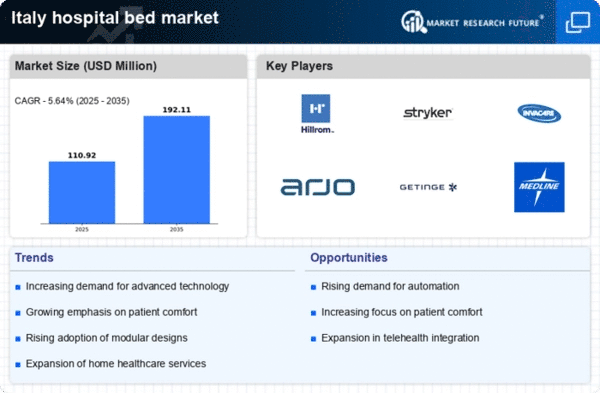
As per Market Research Future analysis, the Italy Hospital Bed Market size was estimated at 105.0 USD Million in 2024. The Hospital Bed market is projected to grow from 110.92 USD Million in 2025 to 192.11 USD Million by 2035, exhibiting a compound annual growth rate (CAGR) of 5.6% during the forecast period 2025 - 2035

Key Market Trends & Highlights

The Italy hospital bed market is experiencing a transformative shift driven by technological advancements and changing patient needs.

  • Technological advancements are reshaping the hospital bed market, enhancing patient care and operational efficiency.
  • Customization and specialization in hospital beds are becoming increasingly prevalent to meet diverse patient requirements.
  • Sustainability initiatives are gaining traction, reflecting a growing commitment to environmentally friendly healthcare solutions.
  • The aging population and rising healthcare expenditure are key drivers propelling market growth in Italy.

Market Size & Forecast

2024 Market Size 105.0 (USD Million)
2035 Market Size 192.11 (USD Million)
CAGR (2025 - 2035) 5.64%

Major Players

Hill-Rom Holdings (US), Stryker Corporation (US), Invacare Corporation (US), Arjo AB (SE), Getinge AB (SE), Medline Industries (US), Graham-Field Health Products (US), Linet spol. s r.o. (CZ), Drive DeVilbiss Healthcare (GB)

Our Impact
Enabled $4.3B Revenue Impact for Fortune 500 and Leading Multinationals
Partnering with 2000+ Global Organizations Each Year
30K+ Citations by Top-Tier Firms in the Industry

Italy Hospital Bed Market Trends

The Italy Hospital Bed Market in Italy is currently experiencing a notable transformation, driven by advancements in technology and an increasing emphasis on patient comfort and safety. The integration of smart technologies into hospital beds is becoming more prevalent, allowing for enhanced monitoring of patient conditions and improved operational efficiency. Furthermore, the growing demand for specialized beds, such as those designed for intensive care units and rehabilitation, reflects a shift towards more tailored healthcare solutions. This trend is likely influenced by the aging population and the rising incidence of chronic diseases, necessitating more sophisticated healthcare infrastructure. In addition, sustainability is emerging as a critical factor in the hospital bed market. Manufacturers are increasingly focusing on eco-friendly materials and production processes, aligning with broader environmental goals. This shift not only addresses regulatory pressures but also meets the expectations of healthcare providers and patients who are becoming more environmentally conscious. As the market evolves, it appears that innovation, sustainability, and patient-centered design will play pivotal roles in shaping the future landscape of hospital beds in Italy.

Technological Advancements

The integration of smart technologies into hospital beds is enhancing patient monitoring and operational efficiency. Features such as automated adjustments and remote monitoring capabilities are becoming standard, reflecting a shift towards more advanced healthcare solutions.

Customization and Specialization

There is a growing demand for specialized hospital beds tailored to specific patient needs, such as those in intensive care or rehabilitation. This trend indicates a move towards more personalized healthcare, driven by the increasing complexity of patient conditions.

Sustainability Initiatives

Manufacturers are prioritizing eco-friendly materials and sustainable production methods in response to environmental concerns. This trend aligns with the expectations of healthcare providers and patients, emphasizing the importance of sustainability in healthcare.

Italy Hospital Bed Market Drivers

Aging Population

The aging population in Italy is a crucial driver for the hospital bed market. As the demographic shifts towards an older age group, the demand for healthcare services, including hospital beds, is likely to increase. By 2030, it is projected that individuals aged 65 and older will constitute approximately 23% of the total population. This demographic trend necessitates the expansion of healthcare facilities and the corresponding increase in hospital bed availability. Moreover, older patients often require specialized beds that cater to their unique health needs, further propelling the hospital bed market. The Italian government has recognized this trend and is investing in healthcare infrastructure, which is expected to enhance the hospital bed market significantly.

Technological Integration

Technological integration within the hospital bed market is becoming increasingly vital. Innovations such as smart beds equipped with sensors and monitoring systems are gaining traction in Italy. These advanced beds can track patient vitals, adjust positions automatically, and enhance overall patient care. The integration of technology not only improves patient outcomes but also streamlines hospital operations, potentially reducing costs. According to recent data, the market for smart hospital beds is expected to grow at a CAGR of around 10% over the next five years. This trend indicates a shift towards more efficient healthcare delivery, thereby driving the hospital bed market forward.

Increased Patient Awareness

Increased patient awareness regarding healthcare services is influencing the hospital bed market in Italy. As patients become more informed about their health and treatment options, there is a growing expectation for better facilities and services. This awareness drives hospitals to invest in modern hospital beds that offer enhanced comfort and functionality. Surveys indicate that approximately 70% of patients prioritize hospital amenities when choosing healthcare providers. This shift in patient expectations compels hospitals to upgrade their infrastructure, thereby stimulating growth in the hospital bed market. As a result, the demand for high-quality hospital beds is likely to rise, reflecting the evolving landscape of patient care.

Rising Healthcare Expenditure

Rising healthcare expenditure in Italy is a notable driver for the hospital bed market. With healthcare spending projected to reach €200 billion by 2026, there is a clear indication of increased investment in healthcare infrastructure. This rise in expenditure is likely to facilitate the acquisition of advanced hospital beds, which are essential for providing quality patient care. Furthermore, as hospitals strive to meet the growing demand for services, the need for additional beds becomes apparent. Consequently, the hospital bed market is expected to benefit from this upward trend in healthcare spending, as facilities seek to enhance their capabilities.

Government Healthcare Policies

Government healthcare policies in Italy play a significant role in shaping the hospital bed market. Recent reforms aimed at improving healthcare access and quality have led to increased funding for hospitals and healthcare facilities. The Italian government has allocated approximately €2 billion for healthcare infrastructure improvements, which includes the procurement of new hospital beds. These policies are designed to enhance patient care and reduce waiting times, thereby increasing the demand for hospital beds. As hospitals expand and modernize, the hospital bed market is likely to experience substantial growth, driven by these supportive governmental initiatives.


Market Segment Insights

By Type: Acute Care (Largest) vs. Long-Term Care (Fastest-Growing)

In the Italy hospital bed market, the segment distribution shows that Acute Care holds the largest share, attributed to its critical role in addressing the immediate healthcare needs of patients. Long-Term Care follows as an emerging segment, reflecting a growing demand within aging populations that require extended care solutions. Growth trends indicate that while Acute Care remains dominant, Long-Term Care is witnessing rapid expansion driven by demographic shifts and the increasing prevalence of chronic conditions. The focus on home healthcare and rehabilitation services is likely to further propel the growth of Long-Term Care, positioning it as the fastest-growing segment in the market.

Acute Care (Dominant) vs. Long-Term Care (Emerging)

Acute Care beds are designed for short-term treatments, prioritizing functionality and patient turnover, which aligns with the urgent needs of hospitals. These beds are often equipped with advanced technology to support critical patient care. In contrast, Long-Term Care beds cater to patients with prolonged healthcare needs, featuring more comfort-driven designs aimed at enhancing the quality of life for residents. The rising older population and increased preference for in-home and assisted living facilities are contributing to the growth of Long-Term Care, making it a vital part of the overall Italy hospital bed market.

By Power: Electric (Largest) vs. Semi-Electric (Fastest-Growing)

In the Italy hospital bed market, the power segment is primarily dominated by electric beds, which hold a significant market share due to their extensive use in both private and public healthcare facilities. Following behind are semi-electric beds, which are gaining traction owing to their balanced features between functionality and cost. Manual beds, while still in use, have been steadily losing share as healthcare providers seek more advanced solutions. Growth in this segment is primarily driven by technological advancements and an increasing demand for better patient care solutions. The electric beds are praised for their ease of use, allowing caregivers to adjust positions with minimal effort, thus enhancing patient comfort. Meanwhile, semi-electric beds are attracting interest due to their cost-effectiveness and moderate technological adoption, making them a favorable option for many healthcare institutions.

Electric (Dominant) vs. Semi-Electric (Emerging)

Electric beds are currently the dominant force in the power segment, characterized by their sophisticated control systems that enable precise adjustments for patient comfort and care. This type of bed is widely embraced in hospitals due to their automation capabilities, contributing to better patient outcomes and increased operational efficiency. Conversely, semi-electric beds are emerging as a popular choice, providing a blend of manual adjustments with some electric functionality, which appeals to budget-conscious facilities. This segment is gaining momentum due to the rising demand for versatile healthcare solutions that do not compromise on quality, enabling healthcare providers to enhance their service delivery without exorbitant costs.

By End User: Hospitals (Largest) vs. Clinics (Fastest-Growing)

In the Italy hospital bed market, hospitals represent the largest segment, commanding a significant market share due to their higher demand for advanced medical equipment and patient care solutions. Clinics, while smaller in comparative size, exhibit rapid growth, driven by increasing outpatient procedures and the need for specialized care. The growth trends in this market segment are influenced by several factors including an aging population, advancements in healthcare technology, and an increased focus on patient comfort and recovery. Clinics are emerging as vital players, leveraging innovative solutions to cater to outpatient needs, while hospitals continue to invest heavily in infrastructure and advanced hospital bed technologies to enhance patient outcomes.

Hospitals (Dominant) vs. Clinics (Emerging)

Hospitals form the cornerstone of the Italy hospital bed market, characterized by their substantial infrastructure and extensive capabilities to accommodate a variety of patient needs. The dominant position of hospitals is underpinned by high patient turnover and the necessity for advanced medical solutions. In contrast, clinics represent an emerging segment, focusing on specialized and outpatient care, which is becoming increasingly important. These facilities are adapting quickly to the changing healthcare landscape, incorporating new technologies to provide efficient patient management. This shift is reflective of broader trends towards outpatient services, positioning clinics as increasingly relevant in the healthcare ecosystem.

Get more detailed insights about Italy Hospital Bed Market

Key Players and Competitive Insights

The hospital bed market in Italy is characterized by a competitive landscape that is increasingly shaped by innovation, strategic partnerships, and a focus on enhancing patient care. Key players such as Hill-Rom Holdings (US), Stryker Corporation (US), and Arjo AB (SE) are at the forefront, each employing distinct strategies to solidify their market positions. Hill-Rom Holdings (US) emphasizes technological advancements in its product offerings, particularly in smart hospital beds that integrate with hospital information systems, thereby enhancing operational efficiency and patient monitoring. Meanwhile, Stryker Corporation (US) focuses on expanding its product portfolio through strategic acquisitions, which allows it to diversify its offerings and cater to a broader range of healthcare facilities. Arjo AB (SE) is also notable for its commitment to sustainability, integrating eco-friendly practices into its manufacturing processes, which resonates well with the growing demand for environmentally responsible healthcare solutions.The business tactics employed by these companies reflect a trend towards localizing manufacturing and optimizing supply chains to enhance responsiveness to market demands. The competitive structure of the market appears moderately fragmented, with several players vying for market share, yet the influence of major companies remains substantial. This dynamic fosters an environment where innovation and operational efficiency are paramount, as companies strive to differentiate themselves in a crowded marketplace.

In September Hill-Rom Holdings (US) announced a partnership with a leading Italian healthcare provider to implement its advanced hospital bed technology across multiple facilities. This collaboration is strategically significant as it not only enhances Hill-Rom's presence in the Italian market but also allows for real-time data collection and analysis, improving patient outcomes and operational efficiencies. Such partnerships are indicative of a broader trend where companies leverage local expertise to enhance their service offerings.

In October Stryker Corporation (US) launched a new line of modular hospital beds designed for rapid customization based on patient needs. This strategic move is crucial as it addresses the increasing demand for personalized healthcare solutions, allowing hospitals to adapt quickly to varying patient requirements. The modular design also facilitates easier upgrades, aligning with the trend towards long-term sustainability in healthcare equipment.

In August Arjo AB (SE) unveiled its latest eco-friendly hospital bed model, which utilizes sustainable materials and energy-efficient manufacturing processes. This initiative not only positions Arjo as a leader in sustainable healthcare solutions but also responds to the growing regulatory pressures and consumer preferences for environmentally responsible products. The introduction of such innovations is likely to enhance brand loyalty and attract environmentally conscious healthcare providers.

As of November the competitive trends in the hospital bed market are increasingly defined by digitalization, sustainability, and the integration of artificial intelligence (AI) into healthcare solutions. Strategic alliances are becoming more prevalent, as companies recognize the value of collaboration in enhancing technological capabilities and market reach. Looking ahead, competitive differentiation is expected to evolve from traditional price-based competition towards a focus on innovation, technology integration, and supply chain reliability. This shift underscores the importance of adaptability and forward-thinking strategies in maintaining a competitive edge in the hospital bed market.

Key Companies in the Italy Hospital Bed Market include

Industry Developments

The Italy Hospital Bed Market has experienced notable developments in recent months, with increasing demand driven largely by the ongoing challenges presented by the healthcare sector post-COVID-19. Companies such as KMedic, Stryker, and Arjo have been expanding their product ranges to focus on innovative designs that improve patient comfort and usability, particularly in long-term care facilities. Additionally, Medline and Hillrom reported advancements in their smart hospital bed technologies, integrating IoT features to enhance patient monitoring and hospital operational efficiency.

In September 2023, it was reported that FernoWashington expanded its distribution network in Italy, aiming to improve access to its advanced patient transportation solutions. Currently, Invacare is experiencing growth in its market valuation, which has positively impacted overall market perception and competitive landscape. Furthermore, in August 2023, it was disclosed that Drive DeVilbiss Healthcare entered into a strategic partnership with local distributors to bolster its market presence in Italy, facilitating healthcare access in emerging regions.

Over the past couple of years, Italy’s government initiatives to upgrade healthcare infrastructure amidst an aging population have further catalyzed advancements in the hospital bed sector, addressing both acute care and rehabilitation needs.

Future Outlook

Italy Hospital Bed Market Future Outlook

The Hospital Bed Market in Italy is projected to grow at a 5.64% CAGR from 2025 to 2035, driven by technological advancements, increasing healthcare demands, and an aging population.

New opportunities lie in:

  • Development of smart hospital beds with integrated monitoring systems.
  • Expansion of rental services for hospital beds in home care settings.
  • Investment in eco-friendly materials for sustainable bed manufacturing.

By 2035, the hospital bed market is expected to achieve substantial growth and innovation.

Market Segmentation

Italy Hospital Bed Market Type Outlook

  • Acute Care
  • Long-Term Care
  • Psychiatric & Bariatric Care
  • Others

Italy Hospital Bed Market Power Outlook

  • Electric
  • Semi-Electric
  • Manual

Italy Hospital Bed Market End User Outlook

  • Hospitals
  • Clinics
  • Ambulatory

Report Scope

MARKET SIZE 2024 105.0(USD Million)
MARKET SIZE 2025 110.92(USD Million)
MARKET SIZE 2035 192.11(USD Million)
COMPOUND ANNUAL GROWTH RATE (CAGR) 5.64% (2025 - 2035)
REPORT COVERAGE Revenue Forecast, Competitive Landscape, Growth Factors, and Trends
BASE YEAR 2024
Market Forecast Period 2025 - 2035
Historical Data 2019 - 2024
Market Forecast Units USD Million
Key Companies Profiled Hill-Rom Holdings (US), Stryker Corporation (US), Invacare Corporation (US), Arjo AB (SE), Getinge AB (SE), Medline Industries (US), Graham-Field Health Products (US), Linet spol. s r.o. (CZ), Drive DeVilbiss Healthcare (GB)
Segments Covered Type, Power, End User
Key Market Opportunities Integration of smart technology in hospital bed market enhances patient care and operational efficiency.
Key Market Dynamics Technological advancements and regulatory changes drive innovation and competition in the hospital bed market.
Countries Covered Italy
Leave a Comment

FAQs

What is the expected market size of the Italy Hospital Bed Market in 2024?

In 2024, the Italy Hospital Bed Market is expected to be valued at 126.0 million USD.

What is the projected market size for the Italy Hospital Bed Market by 2035?

By 2035, the Italy Hospital Bed Market is expected to reach a valuation of 301.0 million USD.

What is the expected compound annual growth rate (CAGR) for the Italy Hospital Bed Market from 2025 to 2035?

The expected CAGR for the Italy Hospital Bed Market from 2025 to 2035 is 8.238 percent.

What is the expected market size for Acute Care hospital beds in 2024 and 2035?

The Acute Care segment is valued at 52.0 million USD in 2024 and is projected to reach 125.0 million USD by 2035.

What is the market size for Long-Term Care hospital beds in 2024 and 2035?

In 2024, the Long-Term Care segment is valued at 38.0 million USD and is expected to grow to 90.0 million USD by 2035.

What is the valuation for Psychiatric & Bariatric Care hospital beds in 2024 and 2035?

The Psychiatric & Bariatric Care market is expected to be valued at 25.0 million USD in 2024 and 60.0 million USD in 2035.

What are the key players dominating the Italy Hospital Bed Market?

Major players in the Italy Hospital Bed Market include KMedic, Stryker, Arjo, Nursing Bed, and Medline.

What is the projected market size for the 'Others' category of hospital beds in 2024 and 2035?

The 'Others' segment of the Italy Hospital Bed Market is valued at 11.0 million USD in 2024 and is expected to be 26.0 million USD by 2035.

What are the opportunities and challenges currently facing the Italy Hospital Bed Market?

Emerging trends, aging populations, and technological advancements present opportunities, while regulatory challenges and cost pressures are significant hurdles.

How does the projected growth of the Italy Hospital Bed Market compare to other segments?

The Acute Care segment shows the highest projected growth, indicating a significant demand for hospital beds in critical care settings during the coming decade.

Download Free Sample

Kindly complete the form below to receive a free sample of this Report

Compare Licence

×
Features License Type
Single User Multiuser License Enterprise User
Price $4,950 $5,950 $7,250
Maximum User Access Limit 1 User Upto 10 Users Unrestricted Access Throughout the Organization
Free Customization
Direct Access to Analyst
Deliverable Format
Platform Access
Discount on Next Purchase 10% 15% 15%
Printable Versions