×
Request Free Sample ×

Kindly complete the form below to receive a free sample of this Report

* Please use a valid business email

Leading companies partner with us for data-driven Insights

clients tt-cursor
Hero Background

Italy Biologics Market

ID: MRFR/HC/43088-HCR
200 Pages
Garvit Vyas
February 2026

Italy Biologics Market Research Report: By Product Service (Monoclonal Antibody, Interleukins, Vaccines, Growth Factors, Gene Therapy, Others) and By Disease Indication (Rheumatoid Arthritis, Psoriasis/Psoriatic Arthritis, Cancer, Diabetes, Others) - Growth & Industry Forecast 2025 To 2035

Share:
Download PDF ×

We do not share your information with anyone. However, we may send you emails based on your report interest from time to time. You may contact us at any time to opt-out.

Italy Biologics Market Infographic
Purchase Options

Italy Biologics Market Summary

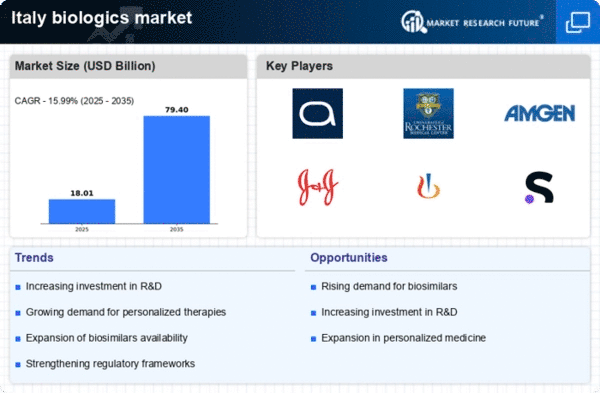
As per Market Research Future analysis, the Italy biologics market Size was estimated at 15.53 USD Billion in 2024. The Italy biologics market is projected to grow from 18.01 USD Billion in 2025 to 79.4 USD Billion by 2035, exhibiting a compound annual growth rate (CAGR) of 15.9% during the forecast period 2025 - 2035

Key Market Trends & Highlights

The Italy biologics market is poised for substantial growth driven by innovation and regulatory support.

  • Investment in biologics research is on the rise, indicating a robust future for the sector.
  • The regulatory environment is increasingly supportive, facilitating the development and approval of biologics.
  • Personalized medicine is gaining traction, with a focus on tailored therapies for patients.
  • Key market drivers include increasing demand for biologics and advancements in manufacturing processes.

Market Size & Forecast

2024 Market Size 15.53 (USD Billion)
2035 Market Size 79.4 (USD Billion)
CAGR (2025 - 2035) 15.99%

Major Players

AbbVie (US), Roche (CH), Amgen (US), Johnson & Johnson (US), Novartis (CH), Sanofi (FR), Bristol-Myers Squibb (US), Gilead Sciences (US), Merck & Co. (US)

Our Impact
Enabled $4.3B Revenue Impact for Fortune 500 and Leading Multinationals
Partnering with 2000+ Global Organizations Each Year
30K+ Citations by Top-Tier Firms in the Industry

Italy Biologics Market Trends

The biologics market in Italy is currently experiencing notable growth, driven by advancements in biotechnology and increasing demand for innovative therapies. The landscape is characterized by a diverse range of products, including monoclonal antibodies, vaccines, and cell and gene therapies. Regulatory frameworks in Italy are evolving to support the development and commercialization of biologics, which may enhance the market's potential. Furthermore, collaborations between academic institutions and industry players appear to be fostering innovation, leading to the emergence of new biologic products that address unmet medical needs. In addition, the Italian healthcare system is increasingly prioritizing personalized medicine, which could further propel the biologics market. The focus on tailored therapies aligns with the growing understanding of genetic and molecular factors in disease treatment. As healthcare providers and patients alike seek more effective treatment options, the demand for biologics is likely to rise. Overall, the biologics market in Italy seems poised for continued expansion, supported by a favorable regulatory environment and a commitment to advancing healthcare solutions.

Rising Investment in Biologics Research

Investment in biologics research is on the rise, as both public and private sectors recognize the potential of biologics in treating complex diseases. This trend indicates a commitment to fostering innovation and enhancing the development of new therapies.

Regulatory Support for Biologics

The regulatory landscape in Italy is adapting to facilitate the approval and commercialization of biologics. Streamlined processes and supportive policies may encourage more companies to enter the biologics market, potentially increasing competition and innovation.

Focus on Personalized Medicine

There is a growing emphasis on personalized medicine within the biologics market. This trend reflects a shift towards therapies tailored to individual patient profiles, which may improve treatment outcomes and patient satisfaction.

Italy Biologics Market Drivers

Increasing Demand for Biologics

The biologics market in Italy is experiencing a notable surge in demand, driven by the growing prevalence of chronic diseases and the aging population. As healthcare providers seek more effective treatment options, biologics are becoming increasingly favored due to their targeted mechanisms of action. In 2025, the market is projected to reach approximately €10 billion, reflecting a compound annual growth rate (CAGR) of around 8%. This trend indicates a shift in treatment paradigms, where biologics are seen as essential components in managing complex health conditions. The increasing demand is further supported by patient advocacy for innovative therapies, which is likely to propel the biologics market forward in Italy.

Regulatory Framework Enhancements

The regulatory landscape for the biologics market in Italy is evolving, with enhancements aimed at expediting the approval process for new biologics. The Italian Medicines Agency (AIFA) is actively working to streamline regulations, which is likely to facilitate faster market entry for innovative therapies. In 2025, these regulatory improvements are expected to reduce the time from development to market by approximately 20%. This proactive approach not only encourages investment in biologics but also ensures that patients have timely access to cutting-edge treatments. As a result, the biologics market is likely to experience accelerated growth due to these favorable regulatory conditions.

Rising Public Awareness and Education

Public awareness and education regarding biologics are on the rise in Italy, significantly influencing the biologics market. Increased access to information through digital platforms and healthcare campaigns is empowering patients to make informed decisions about their treatment options. This heightened awareness is likely to lead to greater demand for biologics, as patients seek out these advanced therapies for chronic conditions. In 2025, it is estimated that public engagement initiatives will contribute to a 15% increase in the adoption of biologics among patients. Consequently, the biologics market is expected to benefit from this trend, as informed patients advocate for their treatment choices.

Advancements in Biologics Manufacturing

Technological advancements in biologics manufacturing are significantly impacting the biologics market in Italy. Innovations such as continuous manufacturing processes and improved bioprocessing techniques are enhancing production efficiency and reducing costs. These advancements are crucial as they allow for the scalable production of biologics, meeting the rising demand without compromising quality. In 2025, the market is expected to benefit from these efficiencies, potentially increasing profit margins for manufacturers. Furthermore, the integration of automation and artificial intelligence in production lines is likely to streamline operations, thereby fostering a more robust biologics market in Italy.

Growing Investment in Biopharmaceutical Startups

The biologics market in Italy is witnessing a surge in investment directed towards biopharmaceutical startups. Venture capital and private equity firms are increasingly recognizing the potential of innovative biologics, leading to a vibrant ecosystem for research and development. In 2025, investments in this sector are anticipated to exceed €1 billion, reflecting a growing confidence in the future of biologics. This influx of capital is likely to accelerate the development of novel therapies, enhancing the overall competitiveness of the biologics market. As startups emerge with groundbreaking solutions, the landscape of biologics in Italy is poised for transformation.


Market Segment Insights

By Type: Monoclonal Antibodies (Largest) vs. Cell and Gene Therapy (Fastest-Growing)

In the Italy biologics market, Monoclonal Antibodies hold a significant share, dominating the market landscape with widespread applications in various therapeutic areas such as oncology and autoimmune diseases. Vaccines and Recombinant Proteins are also crucial players, albeit with a smaller share, while Cell and Gene Therapy is rapidly gaining traction among healthcare providers and patients. The growth trends in this segment are influenced by several factors, including advances in biotechnology, increasing R&D investments, and a growing prevalence of chronic diseases. The demand for innovative treatment solutions is driving the expansion of Cell and Gene Therapy, making it the fastest-growing segment in the market. Additionally, regulatory approvals and collaborations are further propelling the growth of these segment values.

Monoclonal Antibodies: Dominant vs. Cell and Gene Therapy: Emerging

Monoclonal Antibodies are well-established in the Italy biologics market, known for their effectiveness in targeting specific cells, thereby minimizing side effects associated with traditional therapies. Their strong market presence is supported by high levels of investment in research and development, leading to continuous innovation and product launches. Conversely, Cell and Gene Therapy represents the emerging frontier in biologics, with groundbreaking techniques allowing for personalized treatment approaches that can potentially cure previously untreatable conditions. This innovative segment attracts significant attention from investors and researchers alike, fostering a competitive landscape that encourages rapid technological advancements and strategic partnerships.

By Application: Oncology (Largest) vs. Autoimmune Disorders (Fastest-Growing)

In the Italy biologics market, the oncology segment holds the largest market share, reflecting a significant focus on cancer treatments. It is followed closely by infectious diseases and autoimmune disorders, which are gradually gaining traction among healthcare providers and patients alike. Cardiovascular and neurological disorders round out the segment, showcasing a diverse landscape that caters to various critical health challenges. The growth trends in this market are prominently driven by advances in biotechnology, increased research activities, and a rising prevalence of chronic diseases. The demand for biologics is accelerating as innovative therapies emerge, particularly in oncology and autoimmune disorders, which are capturing a growing number of clinical trials. Furthermore, the ongoing shift towards personalized medicine is shaping the developmental trajectory of these segments, making them crucial areas of investment and research.

Oncology: Dominant vs. Autoimmune Disorders: Emerging

Oncology represents the dominant segment within the Italy biologics market, driven by substantial investments and continuous research in cancer treatments and therapeutics. This segment benefits from a well-established pipeline of biologic drugs that target various forms of cancer, reflecting the critical healthcare priority this area holds. On the other hand, autoimmune disorders are emerging as a rapidly growing segment, fueled by rising awareness and advancements in treatment options, including monoclonal antibodies and biologic therapies. This growth is expected to continue as more effective therapies are developed, allowing for improved patient outcomes and satisfaction. The contrasting dynamics between these segments highlight the multifaceted nature of the biologics market, where innovation and patient needs drive progress.

By End User: Hospitals (Largest) vs. Research Institutes (Fastest-Growing)

In the Italy biologics market, the end user segment is primarily dominated by hospitals, which play a crucial role in the administration of biologics for various treatments. Hospitals capture a significant market share due to their extensive infrastructure and capability to deliver innovative therapies to patients. On the other hand, research institutes are emerging as a vital segment, growing quickly as they expand their focus on the development and testing of biologic products, thereby gaining increasing traction in this market. The growth trends for the end user segment are driven by several factors. The increasing prevalence of chronic diseases and the rising need for advanced therapeutic options are pushing hospitals to adopt more biologics in their treatment protocols. Furthermore, research institutes are leveraging new technologies and collaborations with pharmaceutical companies, thereby accelerating their growth trajectory within the Italy biologics market. This dynamic environment fosters a competitive landscape that encourages innovation and enhances patient care.

Hospitals: Dominant vs. Research Institutes: Emerging

Hospitals are currently the dominant end user in the Italy biologics market, characterized by their comprehensive services and ability to cater to a large patient population. They have established strong relationships with pharmaceutical companies, allowing for streamlined access to cutting-edge biologics. In contrast, research institutes are emerging as key players, focusing on novel research and clinical trials that support the development of new biologic therapies. Their agility in research and collaboration with hospitals enhances their position in the market, making them important contributors to the ecosystem of biologics, particularly in the advancement of treatment modalities and technology.

By Source: Mammalian (Largest) vs. Microbial (Fastest-Growing)

In the Italy biologics market, the source segment is predominantly characterized by the mammalian cell-derived products, which account for the largest share. These products are favored due to their complex protein structures that closely mimic human proteins, making them ideal for therapeutic applications. Meanwhile, the microbial-derived biologics have gained traction for their cost-effectiveness and ability to offer faster production times, contributing significantly to their emerging position in the market. Currently, the growth trends in the source segment are being driven by the increasing demand for therapeutic proteins, including monoclonal antibodies and recombinant proteins. The trend towards personalized medicine is pushing the development of biologics derived from both mammalian and microbial sources, with innovations in cell culture technology further enhancing production efficiencies. Additionally, regulatory support for biologics is fostering growth, allowing for quicker market access for new products.

Mammalian (Dominant) vs. Microbial (Emerging)

Mammalian-derived biologics dominate the source segment due to their ability to produce complex proteins that are essential for various therapeutic applications. This dominance is attributed to established production processes and regulatory frameworks that favor these products. Conversely, microbial biologics, which include bacterial and yeast-derived options, are emerging as cost-effective solutions that can be produced rapidly and at scale. The versatility of microbial systems allows for the swift adaptation to different biopharmaceutical needs, making them an attractive option for companies looking to innovate. As the market evolves, the competition between these sources will likely intensify, with each offering unique benefits tailored to specific therapeutic requirements.

Get more detailed insights about Italy Biologics Market

Key Players and Competitive Insights

The biologics market in Italy is characterized by a dynamic competitive landscape, driven by innovation, strategic partnerships, and a focus on patient-centric solutions. Major players such as AbbVie (US), Roche (CH), and Amgen (US) are actively shaping the market through their distinct operational strategies. AbbVie (US) emphasizes research and development, particularly in immunology and oncology, while Roche (CH) leverages its strong diagnostics capabilities to enhance its biologics portfolio. Amgen (US) focuses on expanding its biosimilars segment, indicating a strategic shift towards more cost-effective treatment options. Collectively, these strategies foster a competitive environment that prioritizes innovation and patient access, thereby enhancing market growth.Key business tactics within the biologics market include localizing manufacturing and optimizing supply chains to improve efficiency and reduce costs. The market structure appears moderately fragmented, with several key players holding substantial market shares. This fragmentation allows for a diverse range of products and services, while the collective influence of these major companies drives advancements in technology and treatment options.

In October Roche (CH) announced a strategic partnership with a leading Italian biotech firm to co-develop a novel monoclonal antibody for the treatment of autoimmune diseases. This collaboration not only enhances Roche's product pipeline but also signifies a commitment to leveraging local expertise in drug development. Such partnerships are crucial in accelerating innovation and ensuring that therapies are tailored to meet regional healthcare needs.

In September AbbVie (US) launched a new biologic therapy aimed at treating chronic inflammatory conditions, which has shown promising results in clinical trials. This launch underscores AbbVie's focus on expanding its therapeutic offerings and reinforces its position as a leader in the biologics sector. The introduction of this therapy is expected to significantly impact patient outcomes and market share in the coming years.

In August Amgen (US) expanded its biosimilars portfolio by acquiring a small biotech company specializing in biosimilar development. This acquisition is indicative of Amgen's strategy to enhance its competitive edge in the biologics market by diversifying its product offerings and increasing its market presence. The move is likely to strengthen Amgen's position in the rapidly growing biosimilars segment, which is becoming increasingly important in the Italian healthcare landscape.

As of November current competitive trends in the biologics market include a strong emphasis on digitalization, sustainability, and the integration of artificial intelligence (AI) in drug development processes. Strategic alliances are increasingly shaping the landscape, enabling companies to pool resources and expertise to drive innovation. Looking ahead, competitive differentiation is expected to evolve, with a shift from price-based competition towards a focus on innovation, technological advancements, and supply chain reliability. This transition may redefine how companies position themselves in the market, ultimately benefiting patients through improved access to cutting-edge therapies.

Key Companies in the Italy Biologics Market include

Industry Developments

In recent developments, the Italy Biologics Market has experienced significant activity, with companies like AbbVie, Johnson Johnson, and Biogen leading the charge in innovation and product development. As of August 2023, AbbVie announced advancements in its immunology pipeline, which is aimed at addressing various auto-immune conditions prevalent in the Italian population.

Moreover, Bristol Myers Squibb reported a strategic focus on enhancing its oncology therapies, indicating an intent to cater to the specific health concerns of Italian patients. In terms of acquisitions, Gilead Sciences completed the acquisition of a biotech firm specializing in gene therapy in July 2023, which is expected to strengthen its position in the European market, including Italy. Growth in market valuation is reflected through increased investments in biopharmaceutical manufacturing facilities in Italy, with AstraZeneca and Eli Lilly expanding their production capabilities. 

Such expansions have been crucial in addressing the local demand for biologics, particularly amid rising healthcare challenges. For context, the Italian pharmaceutical market has been projected to grow at a compound annual growth rate of approximately 4-5% from 2022 to 2025, bolstered by government initiatives aimed at fostering biotechnological advancements.


Future Outlook

Italy Biologics Market Future Outlook

The Biologics Market in Italy is projected to grow at a 15.99% CAGR from 2025 to 2035, driven by innovation, increasing demand for personalized medicine, and advancements in biotechnology.

New opportunities lie in:

  • Investment in biomanufacturing facilities to enhance production capacity.
  • Development of biosimilars to capture market share from branded biologics.
  • Partnerships with tech firms for digital health solutions in biologics.

By 2035, the biologics market is expected to achieve substantial growth, positioning itself as a leader in innovative healthcare solutions.

Market Segmentation

Italy Biologics Market Type Outlook

  • Monoclonal Antibodies
  • Vaccines
  • Cell and Gene Therapy
  • Recombinant Proteins
  • Hormones

Italy Biologics Market Source Outlook

  • Microbial
  • Mammalian
  • Plant
  • Transgenic Animals

Italy Biologics Market End User Outlook

  • Hospitals
  • Pharmaceutical Companies
  • Research Institutes
  • Diagnostics Laboratories

Italy Biologics Market Application Outlook

  • Oncology
  • Infectious Diseases
  • Autoimmune Disorders
  • Cardiovascular Diseases
  • Neurological Disorders

Report Scope

MARKET SIZE 202415.53(USD Billion)
MARKET SIZE 202518.01(USD Billion)
MARKET SIZE 203579.4(USD Billion)
COMPOUND ANNUAL GROWTH RATE (CAGR)15.99% (2025 - 2035)
REPORT COVERAGERevenue Forecast, Competitive Landscape, Growth Factors, and Trends
BASE YEAR2024
Market Forecast Period2025 - 2035
Historical Data2019 - 2024
Market Forecast UnitsUSD Billion
Key Companies ProfiledAbbVie (US), Roche (CH), Amgen (US), Johnson & Johnson (US), Novartis (CH), Sanofi (FR), Bristol-Myers Squibb (US), Gilead Sciences (US), Merck & Co. (US)
Segments CoveredType, Application, End User, Source
Key Market OpportunitiesAdvancements in personalized medicine and biologics manufacturing processes present growth opportunities in the biologics market.
Key Market DynamicsRising demand for personalized medicine drives innovation and competition in the biologics market.
Countries CoveredItaly
Leave a Comment

FAQs

What is the projected market size of the Italy Biologics Market in 2024?

The Italy Biologics Market is expected to be valued at 15.41 USD Billion in 2024.

What is the expected market size of the Italy Biologics Market by 2035?

By 2035, the Italy Biologics Market is projected to reach a value of 84.38 USD Billion.

What is the Compound Annual Growth Rate (CAGR) for the Italy Biologics Market from 2025 to 2035?

The expected CAGR for the Italy Biologics Market from 2025 to 2035 is 16.718%.

Which product segment dominates the Italy Biologics Market in 2024?

The Monoclonal Antibody segment leads the Italy Biologics Market with a valuation of 4.0 USD Billion in 2024.

What is the market value for the Vaccines segment in the Italy Biologics Market by 2035?

The Vaccines segment is expected to reach a value of 20.0 USD Billion in the Italy Biologics Market by 2035.

Who are the major players in the Italy Biologics Market?

Key players in the Italy Biologics Market include AbbVie, Johnson and Johnson, and Biogen among others.

What is the projected growth for the Interleukins segment in the Italy Biologics Market from 2024 to 2035?

The Interleukins segment is anticipated to grow from 2.5 USD Billion in 2024 to 12.0 USD Billion by 2035.

How much is the Gene Therapy segment valued at in the Italy Biologics Market in 2024?

The Gene Therapy segment is valued at 3.0 USD Billion in the Italy Biologics Market in 2024.

What are the growth drivers for the Italy Biologics Market?

The growth drivers include technological advancements and increasing investments in research and development.

What is the anticipated market size for the Growth Factors segment in the Italy Biologics Market by 2035?

The Growth Factors segment is projected to reach 14.0 USD Billion in the Italy Biologics Market by 2035.

Download Free Sample

Kindly complete the form below to receive a free sample of this Report

Compare Licence

×
Features License Type
Single User Multiuser License Enterprise User
Price $4,950 $5,950 $7,250
Maximum User Access Limit 1 User Upto 10 Users Unrestricted Access Throughout the Organization
Free Customization
Direct Access to Analyst
Deliverable Format
Platform Access
Discount on Next Purchase 10% 15% 15%
Printable Versions