×
Request Free Sample ×

Kindly complete the form below to receive a free sample of this Report

* Please use a valid business email

Leading companies partner with us for data-driven Insights

clients tt-cursor
Hero Background

Industrial Pu Elastomer Market

ID: MRFR/CnM/38756-HCR
111 Pages
Garvit Vyas
February 2026

Industrial Pu Elastomer Market Research Report By Material Composition (Polyether Polyols, Polyester Polyols, Others), By Application (Automotive, Construction, Footwear, Medical, Others), By Process (Injection Molding, Extrusion, Casting, Others), By Hardness (Soft (70 Shore A), Medium (70-85 Shore A), Hard (>85 Shore A)) and By Regional (North America, Europe, South America, Asia Pacific, Middle East and Africa) - Forecast to 2035.

Share:
Download PDF ×

We do not share your information with anyone. However, we may send you emails based on your report interest from time to time. You may contact us at any time to opt-out.

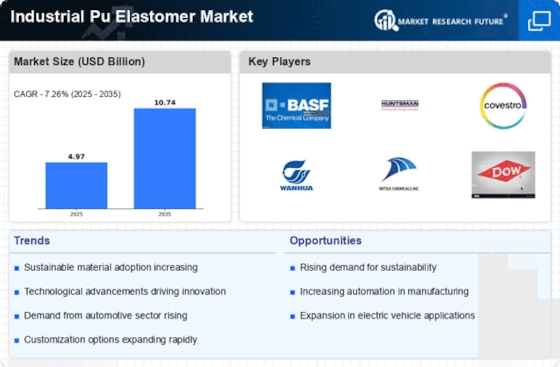
Industrial Pu Elastomer Market Infographic
Purchase Options

Industrial Pu Elastomer Market Summary

As per Market Research Future analysis, the Industrial Pu Elastomer Market Size was estimated at 4.966 USD Billion in 2024. The Industrial Pu Elastomer industry is projected to grow from 5.327 USD Billion in 2025 to 10.74 USD Billion by 2035, exhibiting a compound annual growth rate (CAGR) of 7.26% during the forecast period 2025 - 2035

Key Market Trends & Highlights

The Industrial PU Elastomer Market is poised for robust growth driven by sustainability and technological advancements.

  • North America remains the largest market for industrial PU elastomers, driven by diverse application areas and strong demand.
  • The Asia-Pacific region is emerging as the fastest-growing market, fueled by rapid industrialization and increasing investments.
  • Polyether polyols dominate the market, while polyester polyols are witnessing the fastest growth due to their superior properties.
  • Rising demand from the automotive sector and expansion in construction applications are key drivers propelling market growth.

Market Size & Forecast

2024 Market Size 4.966 (USD Billion)
2035 Market Size 10.74 (USD Billion)
CAGR (2025 - 2035) 7.26%

Major Players

BASF SE (DE), Huntsman Corporation (US), Covestro AG (DE), Wanhua Chemical Group Co Ltd (CN), Mitsui Chemicals Inc (JP), Dow Inc (US), Kraton Corporation (US), Evonik Industries AG (DE), SABIC (SA)

Our Impact
Enabled $4.3B Revenue Impact for Fortune 500 and Leading Multinationals
Partnering with 2000+ Global Organizations Each Year
30K+ Citations by Top-Tier Firms in the Industry

Industrial Pu Elastomer Market Trends

The Industrial Pu Elastomer Market is currently experiencing a dynamic evolution, driven by various factors that influence its growth trajectory. The increasing demand for high-performance materials across diverse industries, such as automotive, construction, and consumer goods, appears to be a primary catalyst. These elastomers are recognized for their superior mechanical properties, flexibility, and resistance to wear and tear, making them suitable for a wide range of applications. Furthermore, the ongoing advancements in manufacturing technologies and processes are likely to enhance the production efficiency and quality of these materials, thereby expanding their market reach. In addition, sustainability concerns are prompting manufacturers to explore eco-friendly alternatives and formulations within the Industrial Pu Elastomer Market. This shift towards greener solutions may not only align with regulatory requirements but also cater to the growing consumer preference for environmentally responsible products. As industries continue to innovate and adapt, the Industrial Pu Elastomer Market is poised for substantial growth, reflecting the interplay of technological advancements and evolving market demands.

Sustainability Initiatives

The Industrial Pu Elastomer Market is witnessing a notable shift towards sustainable practices. Manufacturers are increasingly focusing on developing eco-friendly formulations and production methods that minimize environmental impact. This trend aligns with global efforts to reduce carbon footprints and adhere to stricter regulations, potentially enhancing the market's appeal to environmentally conscious consumers.

Technological Advancements

Innovations in manufacturing technologies are significantly influencing the Industrial Pu Elastomer Market. Enhanced production techniques are likely to improve the efficiency and quality of elastomer products. These advancements may lead to the development of new applications, thereby expanding the market's scope and attracting a broader range of industries.

Diverse Application Areas

The versatility of Industrial Pu Elastomers is driving their adoption across various sectors. From automotive components to construction materials, the range of applications continues to grow. This trend suggests that as industries evolve, the demand for specialized elastomer solutions will likely increase, further propelling market growth.

Industrial Pu Elastomer Market Drivers

Diverse End-User Industries

The Industrial Pu Elastomer Market is characterized by its diverse range of end-user industries, including automotive, construction, healthcare, and consumer goods. This diversity provides a robust foundation for market growth, as fluctuations in one sector can be offset by stability or growth in another. For instance, the healthcare sector's demand for high-performance elastomers in medical devices is on the rise, while the automotive sector continues to innovate with lightweight materials. In 2025, the interplay between these various industries is likely to create a dynamic market environment, fostering opportunities for manufacturers and suppliers of Industrial Pu elastomers.

Growing Focus on Sustainability

The increasing emphasis on sustainability is influencing the Industrial Pu Elastomer Market. Manufacturers are under pressure to develop eco-friendly products that minimize environmental impact. Industrial Pu elastomers, known for their recyclability and lower carbon footprint compared to traditional materials, are becoming more attractive to companies aiming to meet sustainability targets. In 2025, the market is expected to benefit from this trend, as more industries adopt sustainable practices and seek materials that align with their environmental goals. This shift could lead to a significant increase in the demand for Industrial Pu elastomers, further propelling market growth.

Rising Demand from Automotive Sector

The automotive sector is experiencing a notable increase in demand for Industrial Pu Elastomer Market products. This is primarily due to the growing need for lightweight materials that enhance fuel efficiency and reduce emissions. Industrial Pu elastomers are favored for their excellent mechanical properties, durability, and resistance to wear and tear. In 2025, the automotive industry is projected to account for a significant share of the overall market, driven by the shift towards electric vehicles and advanced manufacturing techniques. As manufacturers seek to improve vehicle performance and sustainability, the adoption of Industrial Pu elastomers is likely to rise, indicating a robust growth trajectory for the market.

Expansion in Construction Applications

The construction industry is increasingly utilizing Industrial Pu Elastomer Market materials due to their superior properties, such as flexibility, durability, and resistance to harsh environmental conditions. These elastomers are employed in various applications, including sealants, coatings, and flooring systems. The market for construction-related applications is expected to grow as infrastructure projects expand and the demand for high-performance materials increases. In 2025, the construction sector is anticipated to contribute significantly to the overall market growth, as more builders and contractors recognize the advantages of using Industrial Pu elastomers in their projects, thereby enhancing the market's potential.

Technological Innovations in Manufacturing

Technological advancements in the manufacturing processes of Industrial Pu Elastomer Market products are driving market growth. Innovations such as 3D printing and advanced mixing techniques are enabling manufacturers to produce elastomers with enhanced properties and tailored performance characteristics. These innovations not only improve production efficiency but also reduce waste, aligning with sustainability goals. As manufacturers adopt these technologies, the market is likely to witness an increase in the variety and quality of Industrial Pu elastomers available, catering to diverse industry needs. This trend suggests a promising future for the market as it adapts to evolving consumer demands.


Market Segment Insights

By Material Composition: Polyether Polyols (Largest) vs. Polyester Polyols (Fastest-Growing)

The Industrial Polyurethane (Pu) Elastomer market is predominantly driven by the material composition of polyether and polyester polyols. Polyether polyols maintain a significant market share due to their versatility and moisture resistance, positioning them as the largest segment in the industry. On the other hand, polyester polyols are gaining traction, enjoying an increase in uptake in various applications owing to their superior mechanical properties and elasticity, making them a strong contender as the fastest-growing segment. Growth trends within the material composition segment are shaped by rising end-user demand in sectors such as automotive, construction, and consumer goods. As sustainability becomes more integral to market dynamics, biodegradable and eco-friendly formulations are seeing a surge. The adaptability of polyether polyols for various applications creates stability, while polyester polyols are poised for growth due to innovations and technological advancements leading to enhanced products that meet specific application requirements.

Polyether Polyols (Dominant) vs. Polyester Polyols (Emerging)

In the Industrial Pu Elastomer Market, polyether polyols are considered the dominant material due to their excellent flexibility, durability, and resistance to hydrolysis. They are primarily utilized in applications where moisture resistance is critical, such as in coatings and adhesives, which contributes to their prevailing position. Conversely, polyester polyols are emerging as a competitive alternative, characterized by their superior mechanical strength and heat resistance. They are increasingly favored in applications demanding high resilience and performance. This shift is indicative of a market trend where end-users seek versatile materials, leading to a growing acceptance of polyester polyols in high-end applications. The development of innovative formulations in polyester polyols is driving their adoption, establishing them as a notable player in this segment.

By Application: Automotive (Largest) vs. Medical (Fastest-Growing)

In the Industrial PU Elastomer Market, the application segment reveals a diverse distribution of market share among various sectors. The automotive sector stands out as the largest segment, driven by the increasing demand for lightweight and durable materials in vehicle manufacturing. Following automotive, the construction industry showcases notable contributions, although at a lesser scale, primarily focused on insulation and sealing applications. Footwear and medical applications are also significant but account for a smaller share of the overall market.

Automotive (Dominant) vs. Medical (Emerging)

The automotive segment is characterized by its extensive use of polyurethane elastomers in components like seals, gaskets, and interior materials, providing excellent durability, resistance, and lightweight properties essential for modern vehicles. The demand in this sector is significantly driven by trends toward electric vehicles, which require advanced materials to meet performance standards. Conversely, the medical application segment, while smaller, is emerging rapidly due to increased healthcare spending and innovation in medical devices. Polyurethane elastomers in the medical field are prized for their biocompatibility and flexibility, making them suitable for items like catheters and prosthetics, thereby showcasing a dynamic growth trajectory.

By Process: Injection Molding (Largest) vs. Extrusion (Fastest-Growing)

The 'Process' segment in the Industrial Pu Elastomer Market is characterized by distinct applications, with Injection Molding holding the largest share. It dominates the market due to its versatility in producing complex shapes and designs, making it a preferred choice across various industries. In contrast, Extrusion is rapidly emerging as the fastest-growing process, favored for its efficiency in continuous production and cost-effectiveness, driving innovations in material processing and product development.

Injection Molding (Dominant) vs. Extrusion (Emerging)

Injection Molding is a dominant process in the Industrial Pu Elastomer Market, known for its ability to create intricately designed components with high precision. It is extensively used in various applications, ranging from automotive parts to consumer goods, owing to its scalability and efficient production capabilities. Conversely, Extrusion is becoming an emerging process, increasingly utilized for its speed and continuous production advantages. This technique enables the creation of long, uniform shapes and is ideal for applications like seals and profiles. Both processes exhibit unique advantages, catering to different segment needs while contributing to market growth.

By Hardness: Soft (70 Shore A) vs. Medium (70-85 Shore A) (Largest)

The Industrial Pu Elastomer Market displays a significant distribution in the hardness segment, with the Soft (70 Shore A) category holding a substantial share. This segment is highly favored for various applications that require flexibility and impact resistance, making it an attractive choice for many manufacturers. Following closely is the Medium (70-85 Shore A) hardness category, which appeals to those seeking a balance between flexibility and rigidity, further highlighting its essential role in this market.

Soft (70 Shore A) (Dominant) vs. Hard (>85 Shore A) (Emerging)

The Soft (70 Shore A) hardness segment is dominant in the Industrial Pu Elastomer Market due to its excellent cushioning properties, which are highly valued in industries such as automotive and consumer goods. This segment offers outstanding flexibility and elastic recovery, making it ideal for shock-absorbing applications. In contrast, the Hard (>85 Shore A) category is deemed emerging, catering to niche applications that demand higher rigidity and durability. While gaining traction, hard elastomers are increasingly utilized in manufacturing protective components and high-performance seals, indicating a trend toward tailored solutions gaining popularity across specific sectors.

Get more detailed insights about Industrial Pu Elastomer Market

Regional Insights

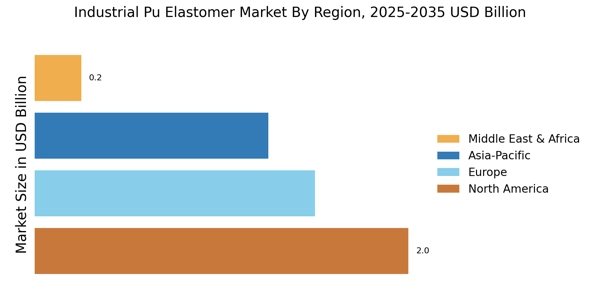
The Industrial Pu Elastomer Market is segmented into North America, Europe, APAC, South America and MEA. Among these regions, APAC is projected to hold the largest market share in the coming years. The growth of the industrial Pu Elastomer market in APAC can be attributed to the increasing demand for industrial Pu Elastomer products in countries such as China, India and Japan.

The rapid industrialization and urbanization in these countries are driving the demand for industrial Pu Elastomer products, which are used in a wide range of applications, including automotive, construction and electronics.The growing population and disposable income in the region are also contributing to the growth of the industrial Pu Elastomer market.

Source Primary Research, Secondary Research, Market Research Future Database and Analyst Review

Industrial Pu Elastomer Market Regional Image

Key Players and Competitive Insights

Major players in Industrial Pu Elastomer Market industry are focusing on expanding their product portfolio and geographical reach. Leading Industrial Pu Elastomer Market players are investing in research and development to develop new and innovative products. For instance, in 2023, BASF expanded its Elastollan range of thermoplastic polyurethane (TPU) elastomers with the launch of Elastollan 785A10 HPM. This new product is designed for use in demanding applications such as footwear, automotive, and industrial components.
Industrial Pu Elastomer Market development is driven by the increasing demand for lightweight, durable and cost-effective materials.A prominent competitor in the Industrial Pu Elastomer Market is Covestro, which offers a wide range of TPU products under the Desmopan brand. Covestro's TPUs are known for their high performance and versatility and are used in a variety of applications, including automotive parts, footwear, and medical devices. Covestro has a  presence with production facilities in Europe, Asia, and the Americas.
The company is focused on sustainability and has developed a number of eco-friendly TPU products.Another key competitor in the Industrial Pu Elastomer Market is Huntsman, which offers a broad portfolio of TPU products under the Irogran brand. Huntsman's TPUs are used in a variety of applications, including automotive, footwear and wire and cable. The company has a  presence with production facilities in Europe, Asia and the Americas. Huntsman is focused on innovation and has developed a number of new TPU products in recent years, including a range of bio-based TPUs.

Key Companies in the Industrial Pu Elastomer Market include

Industry Developments

The  industrial PU elastomer market is projected to reach USD 8.7 billion by 2032, exhibiting a CAGR of 7.26% during the forecast period. Rising demand for PU elastomers in various industries, including automotive, construction and footwear, is driving market growth. The increasing adoption of PU elastomers in lightweight and durable components is further fueling market expansion.Recent developments include the launch of new PU elastomer grades by major manufacturers, such as BASF and Covestro, to meet the specific requirements of different applications.

Strategic partnerships and acquisitions are also shaping the market landscape, with companies seeking to expand their product offerings and geographical reach. Technological advancements, such as the development of bio-based PU elastomers, are creating new opportunities for market growth.

Future Outlook

Industrial Pu Elastomer Market Future Outlook

The Industrial PU Elastomer Market is projected to grow at a 7.26% CAGR from 2025 to 2035, driven by increasing demand in automotive, construction, and consumer goods sectors.

New opportunities lie in:

  • Development of bio-based PU elastomers for sustainable applications.
  • Expansion into emerging markets with tailored product offerings.
  • Investment in advanced manufacturing technologies to enhance production efficiency.

By 2035, the market is expected to achieve robust growth, solidifying its position as a key player in industrial materials.

Market Segmentation

Industrial Pu Elastomer Market Process Outlook

  • Injection Molding
  • Extrusion
  • Casting
  • Others

Industrial Pu Elastomer Market Hardness Outlook

  • Soft (70 Shore A)
  • Medium (70-85 Shore A)
  • Hard (>85 Shore A)

Industrial Pu Elastomer Market Application Outlook

  • Automotive
  • Construction
  • Footwear
  • Medical
  • Others

Industrial Pu Elastomer Market Material Composition Outlook

  • Polyether Polyols
  • Polyester Polyols
  • Others

Report Scope

MARKET SIZE 20244.966(USD Billion)
MARKET SIZE 20255.327(USD Billion)
MARKET SIZE 203510.74(USD Billion)
COMPOUND ANNUAL GROWTH RATE (CAGR)7.26% (2025 - 2035)
REPORT COVERAGERevenue Forecast, Competitive Landscape, Growth Factors, and Trends
BASE YEAR2024
Market Forecast Period2025 - 2035
Historical Data2019 - 2024
Market Forecast UnitsUSD Billion
Key Companies ProfiledBASF SE (DE), Huntsman Corporation (US), Covestro AG (DE), Wanhua Chemical Group Co Ltd (CN), Mitsui Chemicals Inc (JP), Dow Inc (US), Kraton Corporation (US), Evonik Industries AG (DE), SABIC (SA)
Segments CoveredMaterial Composition, Application, Process, Hardness, Regional
Key Market OpportunitiesGrowing demand for sustainable materials drives innovation in the Industrial Pu Elastomer Market.
Key Market DynamicsRising demand for lightweight materials drives innovation and competition in the Industrial Polyurethane Elastomer sector.
Countries CoveredNorth America, Europe, APAC, South America, MEA
Leave a Comment

FAQs

What is the projected market valuation of the Industrial PU Elastomer Market by 2035?

The Industrial PU Elastomer Market is projected to reach a valuation of 10.74 USD Billion by 2035.

What was the market valuation of the Industrial PU Elastomer Market in 2024?

In 2024, the market valuation of the Industrial PU Elastomer Market was 4.966 USD Billion.

What is the expected CAGR for the Industrial PU Elastomer Market during the forecast period 2025 - 2035?

The expected CAGR for the Industrial PU Elastomer Market during the forecast period 2025 - 2035 is 7.26%.

Which companies are considered key players in the Industrial PU Elastomer Market?

Key players in the Industrial PU Elastomer Market include BASF SE, Huntsman Corporation, Covestro AG, and others.

What are the main segments of the Industrial PU Elastomer Market based on material composition?

The main segments based on material composition are Polyether Polyols, Polyester Polyols, and Others.

How much is the Automotive application segment valued at in 2024?

The Automotive application segment was valued at 1.5 USD Billion in 2024.

What is the projected value of the Medium hardness segment by 2035?

The Medium hardness segment is projected to reach a value of 3.35 USD Billion by 2035.

What was the valuation of the Extrusion process segment in 2024?

In 2024, the Extrusion process segment was valued at 1.2 USD Billion.

Which application segment is expected to grow the most by 2035?

The Construction application segment is expected to grow significantly, reaching a projected value of 2.5 USD Billion by 2035.

What is the projected value of the Others segment in the Material Composition category by 2035?

The Others segment in the Material Composition category is projected to reach a value of 3.14 USD Billion by 2035.

Download Free Sample

Kindly complete the form below to receive a free sample of this Report

Compare Licence

×
Features License Type
Single User Multiuser License Enterprise User
Price $4,950 $5,950 $7,250
Maximum User Access Limit 1 User Upto 10 Users Unrestricted Access Throughout the Organization
Free Customization
Direct Access to Analyst
Deliverable Format
Platform Access
Discount on Next Purchase 10% 15% 15%
Printable Versions