×
Request Free Sample ×

Kindly complete the form below to receive a free sample of this Report

* Please use a valid business email

Leading companies partner with us for data-driven Insights

clients tt-cursor
Hero Background
English
Chinese
French
Japanese
Korean
German
Spanish

Industrial Enzymes Market Size

ID: MRFR/FnB/6622-CR
110 Pages
Snehal Singh
November 2022

Industrial Enzymes Market Size, Share, Industry Trend & Analysis Research Report Information by Source (Plant and Animal), Type (Chocolate, Proteases, and Lipases), Application (Food & Beverages, Animal Feed, Detergent & Cleaners, Personal Care, and Pharmaceuticals & Nutraceuticals), and Region (North America, Europe, Asia-Pacific & Rest of the World) -Forecast till 2030

Share:
Download PDF ×

We do not share your information with anyone. However, we may send you emails based on your report interest from time to time. You may contact us at any time to opt-out.

Industrial Enzymes Market Infographic
Purchase Options

Industrial Enzymes Size

Industrial Enzymes Market Growth Projections and Opportunities

The Industrial Enzymes Market is significantly influenced by various market factors that play a crucial role in shaping its dynamics. One of the primary drivers of this market is the increasing demand for sustainable and eco-friendly solutions in various industries. As industries strive to minimize their environmental impact, the adoption of industrial enzymes has gained momentum due to their ability to enhance efficiency and reduce the need for harsh chemicals. The Global Industrial Enzymes Market, with an initial valuation of USD 7.10 million in 2022, is projected to exhibit a Compound Annual Growth Rate (CAGR) of 6.27% throughout the forecast period spanning from 2022 to 2030. This market's significant growth is attributed to the escalating demand for industrial enzymes across various sectors. Industrial enzymes serve as catalysts in biochemical processes, finding extensive applications in industries such as food and beverage, textiles, biofuels, and pharmaceuticals.

The robust CAGR reflects the increasing recognition of industrial enzymes as essential elements in optimizing manufacturing processes and enhancing product quality. Their role in improving efficiency, reducing energy consumption, and promoting sustainability aligns with the growing emphasis on eco-friendly and cost-effective industrial practices.

As industries worldwide seek innovative and sustainable solutions, the Industrial Enzymes Market is poised to be a key driver of transformative changes. The market's ascent is not only indicative of its present economic significance but also points toward a future where industrial enzymes will play a pivotal role in shaping the landscape of diverse industries, addressing the evolving needs for efficiency, sustainability, and quality in manufacturing processes. Moreover, the growing awareness about the benefits of industrial enzymes in improving production processes is fueling market growth. Enzymes are known for their catalytic properties, which can accelerate chemical reactions and enhance the overall efficiency of industrial processes. This has led to increased adoption across sectors such as food and beverages, textiles, and biofuel production.

In addition to environmental considerations, the rising demand for quality products is driving the use of industrial enzymes. Enzymes play a vital role in enhancing the quality and characteristics of various end products. In the food and beverage industry, for instance, enzymes are utilized to improve the texture, flavor, and nutritional profile of products. This demand for high-quality end products is pushing manufacturers to incorporate industrial enzymes into their production processes.

Furthermore, advancements in biotechnology and genetic engineering have opened up new avenues for innovation in the industrial enzymes market. Researchers and companies are investing in developing novel enzymes with enhanced functionalities, making them more versatile and applicable across different industries. This continuous innovation is contributing to the expansion of the industrial enzymes market as businesses seek to stay competitive and meet evolving consumer demands.

On the flip side, challenges such as regulatory constraints and high production costs can impede the growth of the industrial enzymes market. Strict regulations governing the use of enzymes in certain industries, particularly in the food sector, can create barriers for market players. Compliance with these regulations requires substantial investments in research and development to ensure that enzymes meet safety and quality standards.

Moreover, the cost of production, especially for genetically modified enzymes, can be a limiting factor for widespread adoption. The initial investment in developing and producing enzymes using advanced biotechnological methods can be high, impacting the overall pricing of these enzymes in the market. However, as technology advances and economies of scale come into play, it is expected that the cost of production will decrease, making industrial enzymes more accessible to a broader range of industries.
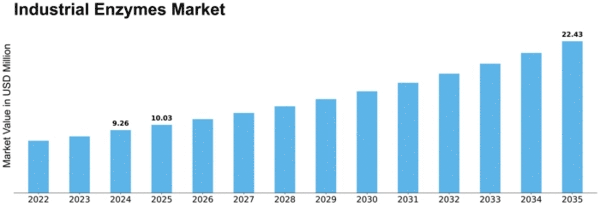

Industrial Enzymes Market Size Graph
Author
Snehal Singh
Assistant Manager - Research

High acumen in analyzing complex macro & micro markets with more than 6 years of work experience in the field of market research. By implementing her analytical skills in forecasting and estimation into market research reports, she has expertise in Packaging, Construction, and Equipment domains. She handles a team size of 20-25 resources and ensures smooth running of the projects, associated marketing activities, and client servicing.

Leave a Comment

FAQs

How Industrial enzymes market Is Growing Globally ?

Industrial Enzymes Market Size is Anticipated to at Reach CAGR of 6.27% with USD 10,807.10 million by 2022-2030.

Who are the major key players of the global industrial enzymes market?

Incorporated (US), Codexis Incorporated (US), BASF SE (Germany), Associated British Foods PLC (UK), Chr. Hansen Holding A/S (Denmark), Koninklijke DSM N.V. (Netherlands), Dyadic International Inc. (US), Advanced Enzyme Technologies Ltd (India), Lesaffre (France), Adisseo (China), Amano Enzyme Inc. (Japan), AB Enzymes (Germany), Novozymes A/S (Denmark), BioResource International Inc. (US), Cargill, and DowDuPont (US).

What are the various types of applications of the global industrial enzymes market?

Textiles, feed, pharmaceuticals & nutraceuticals, food & beverages, detergents & cleaning, and others.

Which region is leading the global industrial enzymes market analysis?

North America is Dominated Region In Industrial enzymes market

Market Summary

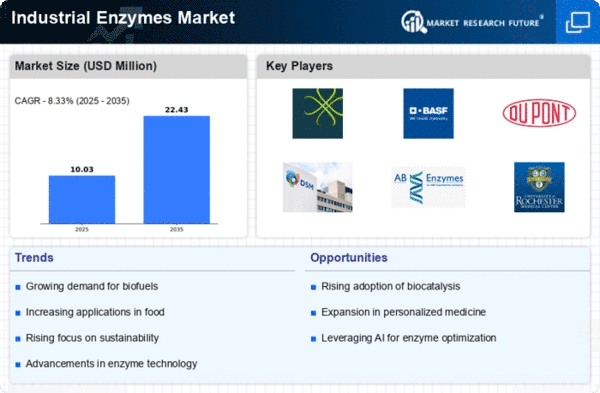
As per MRFR analysis, the Industrial Enzymes Market Size was estimated at 9.26 USD Million in 2024. The Industrial Enzymes industry is projected to grow from 10.14 in 2025 to 22.43 by 2035, exhibiting a compound annual growth rate (CAGR) of 8.33 during the forecast period 2025 - 2035.

Key Market Trends & Highlights

The Industrial Enzymes Market is poised for robust growth driven by sustainability and technological advancements.

  • The market is increasingly characterized by a strong focus on sustainability initiatives, particularly in North America. Technological advancements are facilitating the customization and specialization of enzyme products, enhancing their application across various industries. The Food and Beverage segment remains the largest market, while the Biofuels segment is emerging as the fastest-growing area in the industry. Rising demand in the Food and Beverage sector and growing awareness of health benefits are key drivers propelling market expansion.

Market Size & Forecast

2024 Market Size 9.26 (USD Million)
2035 Market Size 22.43 (USD Million)
CAGR (2025 - 2035) 8.33%
Largest Regional Market Share in 2024 North America

Major Players

Novozymes (DK), BASF (DE), DuPont (US), DSM (NL), AB Enzymes (DE), Roche (CH), <a href="https://www.amano-enzyme.com/">Amano Enzyme</a> (JP), Kraft Heinz (US), Genomatica (US)

Market Trends

The Industrial Enzymes Market is currently experiencing a transformative phase, driven by advancements in biotechnology and increasing demand for sustainable solutions across various industries. The growing emphasis on eco-friendly processes has led to a surge in the adoption of enzymes in sectors such as food and beverage, textiles, and biofuels. Companies are increasingly recognizing the potential of enzymes to enhance efficiency, reduce waste, and lower energy consumption, which aligns with global sustainability goals. As a result, the market is witnessing a shift towards innovative enzyme applications that cater to specific industrial needs, thereby fostering growth and diversification. Moreover, the Industrial Enzymes Market is characterized by a dynamic competitive landscape, with numerous players striving to develop novel enzyme formulations and improve existing products. Collaborations between research institutions and industry stakeholders are becoming more prevalent, facilitating the exchange of knowledge and accelerating the development of cutting-edge enzyme technologies. This collaborative approach not only enhances product offerings but also addresses the evolving regulatory frameworks that govern enzyme usage. Overall, the Industrial Enzymes Market appears poised for continued expansion, driven by technological advancements and a collective commitment to sustainability.

Sustainability Focus

The Industrial Enzymes Market is increasingly oriented towards sustainable practices, as industries seek to minimize their environmental impact. Enzymes are being utilized to replace harsh chemicals in manufacturing processes, thereby reducing pollution and waste. This trend reflects a broader commitment to eco-friendly solutions, aligning with global sustainability initiatives.

Technological Advancements

Rapid advancements in biotechnology are reshaping the Industrial Enzymes Market. Innovations in enzyme engineering and production techniques are enabling the development of more efficient and specialized enzymes. These technological improvements are likely to enhance the performance of enzymes across various applications, driving market growth.

Customization and Specialization

There is a growing trend towards the customization of enzyme products to meet specific industrial requirements. Companies are increasingly focusing on developing specialized enzymes tailored for particular applications, which enhances their effectiveness and efficiency. This trend indicates a shift towards more targeted solutions in the Industrial Enzymes Market.

Industrial Enzymes Market Market Drivers

Market Growth Projections

The Global Industrial Enzymes Industry is poised for substantial growth, with projections indicating a rise from 12.2 USD Billion in 2024 to 23.7 USD Billion by 2035. This growth is underpinned by a compound annual growth rate of 6.27% from 2025 to 2035. Various factors contribute to this upward trend, including increasing demand across multiple sectors such as food and beverage, biofuels, and pharmaceuticals. The continuous innovation in enzyme technology and the expanding range of applications further enhance the market's potential. These projections highlight the dynamic nature of the industrial enzymes sector and its capacity to adapt to evolving market demands.

Rising Demand for Biofuels

The Global Industrial Enzymes Industry experiences a surge in demand for biofuels, driven by the need for sustainable energy sources. Enzymes play a crucial role in the conversion of biomass into biofuels, enhancing efficiency and reducing costs. As governments worldwide implement policies to promote renewable energy, the market for industrial enzymes is projected to grow significantly. In 2024, the market is valued at 12.2 USD Billion, with expectations to reach 23.7 USD Billion by 2035. This growth reflects a compound annual growth rate of 6.27% from 2025 to 2035, indicating a robust future for enzyme applications in biofuel production.

Advancements in Biotechnology

Advancements in biotechnology contribute to the expansion of the Global Industrial Enzymes Industry. Innovations in enzyme engineering and production techniques enhance the performance and specificity of enzymes, making them more effective in various industrial applications. For instance, the development of genetically modified microorganisms allows for the production of enzymes that can operate under extreme conditions, thereby broadening their applicability. This trend is likely to drive market growth as industries seek more efficient and cost-effective solutions. The increasing focus on research and development in biotechnology suggests a promising trajectory for the industrial enzymes sector.

Growing Food and Beverage Sector

The Global Industrial Enzymes Industry benefits from the growing food and beverage sector, where enzymes are integral to various processes such as brewing, baking, and dairy production. Enzymes enhance product quality, improve yield, and reduce processing times, making them indispensable in food manufacturing. As consumer preferences shift towards healthier and more natural products, the demand for enzyme-based solutions is likely to increase. This trend is reflected in the market's projected growth, with a valuation of 12.2 USD Billion in 2024 and an anticipated rise to 23.7 USD Billion by 2035, driven by the food industry's evolving needs.

Emerging Applications in Pharmaceuticals

Emerging applications in pharmaceuticals are reshaping the Global Industrial Enzymes Industry. Enzymes are increasingly utilized in drug formulation, synthesis, and production processes, enhancing efficacy and reducing side effects. The pharmaceutical sector's demand for biocatalysts is on the rise, driven by the need for more efficient and sustainable manufacturing methods. As the industry evolves, the integration of enzymes into pharmaceutical processes is likely to expand, contributing to market growth. The anticipated increase in market value from 12.2 USD Billion in 2024 to 23.7 USD Billion by 2035 reflects the potential of enzymes in addressing the pharmaceutical industry's challenges.

Environmental Regulations and Sustainability

Environmental regulations and a growing emphasis on sustainability are pivotal drivers of the Global Industrial Enzymes Industry. Industries are increasingly adopting enzyme-based processes to minimize waste and reduce environmental impact. Enzymes facilitate greener production methods, aligning with regulatory requirements and consumer expectations for sustainable practices. This shift is particularly evident in sectors such as textiles and detergents, where enzymes replace harsh chemicals, leading to eco-friendly alternatives. The market's growth trajectory, from 12.2 USD Billion in 2024 to 23.7 USD Billion by 2035, underscores the importance of sustainability in shaping the future of industrial enzymes.

Market Segment Insights

By Application: Food and Beverage (Largest) vs. Biofuels (Fastest-Growing)

The Industrial Enzymes Market is predominantly driven by the Food and Beverage sector, which captures a significant market share due to the increasing demand for processed and healthy food products. This segment utilizes enzymes to enhance flavors, improve texture, and prolong shelf life, making it integral to the industry. Following closely, the Biofuels application is gaining momentum as manufacturers seek sustainable energy solutions, utilizing enzymes for efficient biofuel production, particularly in converting biomass into ethanol.

Food and Beverage: Dominant vs. Biofuels: Emerging

The Food and Beverage sector is the dominant application within the Industrial Enzymes Market, utilizing a variety of enzymes such as amylases and proteases to optimize production processes. This segment is characterized by rigorous quality demands and a focus on nutritional content, driving innovation in enzyme application. In contrast, the Biofuels segment is emerging rapidly, propelled by the global shift toward renewable energy. Enzymes in this space facilitate the breakdown of complex carbohydrates in biomass, making biofuel production more efficient and cost-effective. As regulatory support for green energy increases, biofuels are expected to see significant growth, attracting investments and technological advancements.

By Type: Amylase (Largest) vs. Protease (Fastest-Growing)

Among the various types of industrial enzymes, amylase holds the largest market share, primarily due to its extensive application in industries such as food and beverages, textile, and biofuels. Its efficiency in breaking down starches into sugars makes it indispensable in these sectors. Protease, while smaller in market share compared to amylase, is emerging rapidly with its diverse usage in detergents and pharmaceuticals, indicating a trend towards higher demand as industries recognize its benefits. The growth trajectory of the industrial enzymes market is significantly influenced by the increasing shift towards sustainable and eco-friendly processes. The demand for protease is particularly driven by the rise of green cleaning products and the healthcare industry’s focus on biocatalysts that enhance drug efficacy. Moreover, innovation in enzyme technologies is expected to support the continuous growth of both amylase and protease, highlighting their vital roles in modern industrial applications.

Amylase (Dominant) vs. Protease (Emerging)

Amylase has established itself as a dominant force in the industrial enzymes market due to its critical role in food processing, starch liquefaction, and fermentation processes. Its strong market position is supported by robust demand from the baking, brewing, and bioethanol industries. Conversely, protease is recognized as an emerging enzyme with expanding applications, particularly in the detergent and pharmaceutical sectors. Its ability to break down proteins effectively makes it an invaluable asset in various formulations, driving innovation and growth. While amylase benefits from a mature market, protease is rapidly gaining traction, and its versatility positions it for substantial growth in the coming years.

By Source: Microbial (Largest) vs. Plant (Fastest-Growing)

In the Industrial Enzymes Market, the source segment is primarily dominated by microbial enzymes, which have established a strong foothold due to their versatility and cost-effectiveness. Microbial enzymes account for a significant portion of the market share, largely driven by their applications across various industries such as food, detergent, and biofuel. On the other hand, plant-based enzymes are gaining traction as industries lean towards more sustainable and environmentally friendly options, creating an interesting dynamic within the market.

Microbial (Dominant) vs. Plant (Emerging)

Microbial enzymes are at the forefront of the Industrial Enzymes Market, benefiting from their robust applicability and proven efficacy in numerous industrial processes. These enzymes are derived from microorganisms such as bacteria and fungi, offering high efficiency in breaking down complex substrates. In contrast, plant-based enzymes are emerging as a favored alternative, especially in sectors prioritizing sustainability. Their growth is fueled by rising consumer demand for natural ingredients and cleaner production processes. While microbial enzymes dominate due to their established use and reliability, plant enzymes are rapidly gaining interest, signaling an important trend towards greener enzymatic solutions.

By Form: Liquid (Largest) vs. Powder (Fastest-Growing)

In the Industrial Enzymes Market, the 'Form' segment is predominantly characterized by Liquid enzymes, which hold the largest market share. Liquid enzymes are favored for their ease of use and efficient application in various industrial processes. Powder enzymes follow, being significant for their long shelf life and concentration. Granular forms are also present in the market but represent a smaller share in comparison to the other forms, largely due to their specialized applications.

Liquid (Dominant) vs. Powder (Emerging)

Liquid enzymes dominate the Industrial Enzymes Market primarily because of their versatility and suitability for various applications, including food processing, agriculture, and biofuels. They offer ease of formulation and can be integrated seamlessly into existing processes. In contrast, Powder enzymes are emerging rapidly due to advancements in formulation technology that enhance their stability and efficacy. Their ability to be tailored for specific applications makes them attractive in segments where precision is critical. Despite being smaller in volume, Granular enzymes play a niche role but are seeing increased interest in specialized applications, providing distinct advantages in handling and storage.

Get more detailed insights about Industrial Enzymes Market Research Report-Global Forecast till 2035

Regional Insights

North America : Market Leader in Enzymes

North America is poised to maintain its leadership in the industrial enzymes market, holding a significant share of 4.0 in 2025. The region's growth is driven by increasing demand for sustainable solutions across various industries, including food and beverages, biofuels, and pharmaceuticals. Regulatory support for green technologies further catalyzes market expansion, as companies seek to enhance efficiency and reduce environmental impact. The competitive landscape is robust, with key players like Novozymes, DuPont, and BASF leading the charge. The U.S. is the primary market, supported by advanced research and development initiatives. The presence of major corporations fosters innovation, while collaborations and partnerships enhance product offerings. As the market evolves, North America is expected to continue attracting investments, solidifying its position as a global hub for industrial enzymes.

Europe : Innovation and Sustainability Focus

Europe's industrial enzymes market is projected to reach 2.5 by 2025, driven by a strong emphasis on sustainability and innovation. The region is witnessing a surge in demand for enzymes in sectors such as food processing, textiles, and biofuels. Regulatory frameworks promoting eco-friendly practices are pivotal in shaping market dynamics, encouraging companies to adopt enzyme-based solutions for improved efficiency and reduced waste. Leading countries like Germany, France, and the UK are at the forefront of this growth, with a competitive landscape featuring major players such as BASF and DSM. The European market is characterized by a high level of research and development, fostering innovation in enzyme applications. Collaborations between industry and academia further enhance the region's capabilities, positioning Europe as a key player in The Industrial Enzymes.

Asia-Pacific : Emerging Market Potential

The Asia-Pacific region is emerging as a significant player in the industrial enzymes market, with a projected size of 2.0 by 2025. The growth is fueled by increasing industrialization, rising consumer demand for processed foods, and a shift towards sustainable production methods. Governments are implementing supportive policies to encourage the use of enzymes, which are seen as vital for enhancing productivity and reducing environmental footprints. Countries like China, India, and Japan are leading the charge, with a competitive landscape that includes both local and international players. Companies such as Amano Enzyme and Genomatica are expanding their presence, driven by innovation and strategic partnerships. As the region continues to develop, the demand for industrial enzymes is expected to rise, creating new opportunities for growth and investment.

Middle East and Africa : Untapped Market Opportunities

The Middle East and Africa region is gradually emerging in the industrial enzymes market, with a market size of 0.76 projected for 2025. The growth is primarily driven by increasing industrial activities and a rising focus on sustainable practices. Governments are beginning to recognize the potential of enzymes in enhancing production efficiency across various sectors, including agriculture and food processing, which is expected to catalyze market growth. Countries like South Africa and the UAE are leading the way, with a growing number of local and international players entering the market. The competitive landscape is evolving, with companies exploring innovative enzyme solutions tailored to regional needs. As awareness of the benefits of enzymes increases, the Middle East and Africa are poised for significant growth in this sector, attracting investments and fostering development.

Key Players and Competitive Insights

The Industrial Enzymes Market is characterized by a dynamic competitive landscape, driven by innovation, sustainability, and the increasing demand for bio-based solutions across various industries. Key players such as Novozymes (Denmark), BASF (Germany), and DuPont (US) are strategically positioned to leverage their extensive research and development capabilities. Novozymes (Denmark) focuses on enhancing enzyme efficiency and sustainability, while BASF (Germany) emphasizes its commitment to integrating digital technologies into enzyme production. DuPont (US) is actively pursuing partnerships to expand its enzyme portfolio, particularly in the food and beverage sector. Collectively, these strategies foster a competitive environment that prioritizes technological advancement and sustainable practices.
In terms of business tactics, companies are increasingly localizing manufacturing to reduce supply chain vulnerabilities and enhance responsiveness to regional market demands. The market structure appears moderately fragmented, with a mix of established players and emerging companies vying for market share. The collective influence of these key players shapes the competitive dynamics, as they engage in strategic collaborations and innovations to maintain their market positions.
In November 2025, Novozymes (Denmark) announced a partnership with a leading agricultural firm to develop enzyme solutions aimed at improving crop yields. This collaboration is strategically significant as it aligns with the growing trend towards sustainable agriculture, potentially enhancing Novozymes' market presence in the agricultural sector and reinforcing its commitment to sustainability.
In October 2025, BASF (Germany) launched a new line of enzymes designed for the textile industry, focusing on reducing water and energy consumption during production. This initiative underscores BASF's strategy to integrate sustainability into its product offerings, positioning the company as a leader in environmentally friendly solutions within the industrial enzymes space.
In September 2025, DuPont (US) expanded its enzyme production facility in the Midwest, aiming to increase capacity for its food and beverage applications. This expansion reflects DuPont's proactive approach to meet the rising demand for enzyme-based solutions in the food sector, thereby enhancing its competitive edge and operational efficiency.
As of December 2025, current trends in the Industrial Enzymes Market indicate a strong emphasis on digitalization, sustainability, and the integration of artificial intelligence in enzyme development. Strategic alliances are increasingly shaping the landscape, enabling companies to pool resources and expertise. Looking ahead, competitive differentiation is likely to evolve from traditional price-based competition to a focus on innovation, technological advancements, and supply chain reliability, as companies strive to meet the growing demand for sustainable and efficient enzyme solutions.

Key Companies in the Industrial Enzymes Market include

Industry Developments

Few developments that occurred in recent times influencing the market growth of Industrial Enzymes Market are listed below:

In April 2021, BASF SE decided to collaborate with Sandoz GmbH, a subsidiary of Novartis AG, to invest initsKundl/Schaftenau Campus in Austria. This move will lead to an increase in the production capacity and biotechnology and enzyme product lines of BASF SE.

In February 20, 2020, BEC Feed Solutions stated it had commenced work to redevelop its Carole Park location into a new state-of-the-art manufacturing facility. The new facility will feature a manufacturing plant equipped with integrated technology unique to the premix industry, a new warehouse, and adjoining contemporary two-story office building, which will significantly increase their production.

In November 2020, DuPont Nutrition & Biosciences (DuPont) undertook a new partnership between its Food & Beverage platform and the Institute for the Future (IFTF), the world's leading future organization. The collaboration seeks to drive far-sighted food and beverage innovation that anticipates shifts in market needs

Scope of the Report

Global Industrial Enzymes Market, by Source

Plant

Animal

Microorganisms

Global Industrial Enzymes Market, By Type

Carbohydrases

Proteases

Lipases

Others

Global Industrial Enzymes Market, by Application

Food & Beverages

Animal Feed

Detergent & Cleaners

Personal Care

Pharmaceuticals and Nutraceuticals

Others

Global Industrial Enzymes Market, by Region

North America

US

Canada

Mexico

Europe

Germany

UK

France

Spain

Italy

Rest of Europe

Asia-Pacific

China

India

Japan

Australia & New Zealand

Rest of Asia-Pacific

Rest of the World

Middle East

Africa

South America

Intended Audience

Food and Beverages Manufacturers

Ingredient Industry

Detergent and Cleaners manufacturers

Personal Care industries

Animal Feed Manufacturer

Pharmaceuticals & Nutraceuticals

Retailers and Wholesalers

Government policy makers and Investors

Future Outlook

Industrial Enzymes Market Future Outlook

The Industrial Enzymes Market is projected to grow at an 8.33% CAGR from 2025 to 2035, driven by increasing demand for sustainable solutions and advancements in biotechnology.

New opportunities lie in:

  • Development of enzyme-based biocatalysts for green chemistry applications.
  • Expansion into emerging markets with tailored enzyme solutions.
  • Investment in R&amp;D for enzyme innovations in food and beverage industries.

By 2035, the Industrial Enzymes Market is expected to achieve substantial growth, reflecting evolving industry needs.

Market Segmentation

Industrial Enzymes Market Form Outlook

  • Liquid
  • Powder
  • Granular

Industrial Enzymes Market Type Outlook

  • Amylase
  • Protease
  • Lipase
  • Cellulase
  • Lactase

Industrial Enzymes Market Source Outlook

  • Microbial
  • Plant
  • Animal

Industrial Enzymes Market Application Outlook

  • Food and Beverage
  • Biofuels
  • Textiles
  • Detergents
  • Animal Feed

Report Scope

MARKET SIZE 2024 9.26(USD Million)
MARKET SIZE 2025 10.14(USD Million)
MARKET SIZE 2035 22.43(USD Million)
COMPOUND ANNUAL GROWTH RATE (CAGR) 8.33% (2025 - 2035)
REPORT COVERAGE Revenue Forecast, Competitive Landscape, Growth Factors, and Trends
BASE YEAR 2024
Market Forecast Period 2025 - 2035
Historical Data 2019 - 2024
Market Forecast Units USD Million
Key Companies Profiled Novozymes (DK), BASF (DE), DuPont (US), DSM (NL), AB Enzymes (DE), Roche (CH), Amano Enzyme (JP), Kraft Heinz (US), Genomatica (US)
Segments Covered Application, Type, Source, Form
Key Market Opportunities Advancements in biotechnology enhance efficiency and sustainability in the Industrial Enzymes Market.
Key Market Dynamics Rising demand for sustainable solutions drives innovation and competition in the industrial enzymes market.
Countries Covered North America, Europe, APAC, South America, MEA

FAQs

How Industrial enzymes market Is Growing Globally ?

Industrial Enzymes Market Size is Anticipated to at Reach CAGR of 6.27% with USD 10,807.10 million by 2022-2030.

Who are the major key players of the global industrial enzymes market?

Incorporated (US), Codexis Incorporated (US), BASF SE (Germany), Associated British Foods PLC (UK), Chr. Hansen Holding A/S (Denmark), Koninklijke DSM N.V. (Netherlands), Dyadic International Inc. (US), Advanced Enzyme Technologies Ltd (India), Lesaffre (France), Adisseo (China), Amano Enzyme Inc. (Japan), AB Enzymes (Germany), Novozymes A/S (Denmark), BioResource International Inc. (US), Cargill, and DowDuPont (US).

What are the various types of applications of the global industrial enzymes market?

Textiles, feed, pharmaceuticals &amp; nutraceuticals, food &amp; beverages, detergents &amp; cleaning, and others.

Which region is leading the global industrial enzymes market analysis?

North America is Dominated Region In Industrial enzymes market

  1. SECTION I: EXECUTIVE SUMMARY AND KEY HIGHLIGHTS
    1. | 1.1 EXECUTIVE SUMMARY
    2. | 1.1.1 Market Overview
    3. | 1.1.2 Key Findings
    4. | 1.1.3 Market Segmentation
    5. | 1.1.4 Competitive Landscape
    6. | 1.1.5 Challenges and Opportunities
    7. | 1.1.6 Future Outlook
  2. SECTION II: SCOPING, METHODOLOGY AND MARKET STRUCTURE
    1. | 2.1 MARKET INTRODUCTION
    2. | 2.1.1 Definition
    3. | 2.1.2 Scope of the study
    4. |-- 2.1.2.1 Research Objective
    5. |-- 2.1.2.2 Assumption
    6. |-- 2.1.2.3 Limitations
    7. | 2.2 RESEARCH METHODOLOGY
    8. | 2.2.1 Overview
    9. | 2.2.2 Data Mining
    10. | 2.2.3 Secondary Research
    11. | 2.2.4 Primary Research
    12. |-- 2.2.4.1 Primary Interviews and Information Gathering Process
    13. |-- 2.2.4.2 Breakdown of Primary Respondents
    14. | 2.2.5 Forecasting Model
    15. | 2.2.6 Market Size Estimation
    16. |-- 2.2.6.1 Bottom-Up Approach
    17. |-- 2.2.6.2 Top-Down Approach
    18. | 2.2.7 Data Triangulation
    19. | 2.2.8 Validation
  3. SECTION III: QUALITATIVE ANALYSIS
    1. | 3.1 MARKET DYNAMICS
    2. | 3.1.1 Overview
    3. | 3.1.2 Drivers
    4. | 3.1.3 Restraints
    5. | 3.1.4 Opportunities
    6. | 3.2 MARKET FACTOR ANALYSIS
    7. | 3.2.1 Value chain Analysis
    8. | 3.2.2 Porter's Five Forces Analysis
    9. |-- 3.2.2.1 Bargaining Power of Suppliers
    10. |-- 3.2.2.2 Bargaining Power of Buyers
    11. |-- 3.2.2.3 Threat of New Entrants
    12. |-- 3.2.2.4 Threat of Substitutes
    13. |-- 3.2.2.5 Intensity of Rivalry
    14. | 3.2.3 COVID-19 Impact Analysis
    15. |-- 3.2.3.1 Market Impact Analysis
    16. |-- 3.2.3.2 Regional Impact
    17. |-- 3.2.3.3 Opportunity and Threat Analysis
  4. SECTION IV: QUANTITATIVE ANALYSIS
    1. | 4.1 Food, Beverages & Nutrition, BY Application (USD Million)
    2. | 4.1.1 Food and Beverage
    3. | 4.1.2 Biofuels
    4. | 4.1.3 Textiles
    5. | 4.1.4 Detergents
    6. | 4.1.5 Animal Feed
    7. | 4.2 Food, Beverages & Nutrition, BY Type (USD Million)
    8. | 4.2.1 Amylase
    9. | 4.2.2 Protease
    10. | 4.2.3 Lipase
    11. | 4.2.4 Cellulase
    12. | 4.2.5 Lactase
    13. | 4.3 Food, Beverages & Nutrition, BY Source (USD Million)
    14. | 4.3.1 Microbial
    15. | 4.3.2 Plant
    16. | 4.3.3 Animal
    17. | 4.4 Food, Beverages & Nutrition, BY Form (USD Million)
    18. | 4.4.1 Liquid
    19. | 4.4.2 Powder
    20. | 4.4.3 Granular
    21. | 4.5 Food, Beverages & Nutrition, BY Region (USD Million)
    22. | 4.5.1 North America
    23. |-- 4.5.1.1 US
    24. |-- 4.5.1.2 Canada
    25. | 4.5.2 Europe
    26. |-- 4.5.2.1 Germany
    27. |-- 4.5.2.2 UK
    28. |-- 4.5.2.3 France
    29. |-- 4.5.2.4 Russia
    30. |-- 4.5.2.5 Italy
    31. |-- 4.5.2.6 Spain
    32. |-- 4.5.2.7 Rest of Europe
    33. | 4.5.3 APAC
    34. |-- 4.5.3.1 China
    35. |-- 4.5.3.2 India
    36. |-- 4.5.3.3 Japan
    37. |-- 4.5.3.4 South Korea
    38. |-- 4.5.3.5 Malaysia
    39. |-- 4.5.3.6 Thailand
    40. |-- 4.5.3.7 Indonesia
    41. |-- 4.5.3.8 Rest of APAC
    42. | 4.5.4 South America
    43. |-- 4.5.4.1 Brazil
    44. |-- 4.5.4.2 Mexico
    45. |-- 4.5.4.3 Argentina
    46. |-- 4.5.4.4 Rest of South America
    47. | 4.5.5 MEA
    48. |-- 4.5.5.1 GCC Countries
    49. |-- 4.5.5.2 South Africa
    50. |-- 4.5.5.3 Rest of MEA
  5. SECTION V: COMPETITIVE ANALYSIS
    1. | 5.1 Competitive Landscape
    2. | 5.1.1 Overview
    3. | 5.1.2 Competitive Analysis
    4. | 5.1.3 Market share Analysis
    5. | 5.1.4 Major Growth Strategy in the Food, Beverages & Nutrition
    6. | 5.1.5 Competitive Benchmarking
    7. | 5.1.6 Leading Players in Terms of Number of Developments in the Food, Beverages & Nutrition
    8. | 5.1.7 Key developments and growth strategies
    9. |-- 5.1.7.1 New Product Launch/Service Deployment
    10. |-- 5.1.7.2 Merger & Acquisitions
    11. |-- 5.1.7.3 Joint Ventures
    12. | 5.1.8 Major Players Financial Matrix
    13. |-- 5.1.8.1 Sales and Operating Income
    14. |-- 5.1.8.2 Major Players R&D Expenditure. 2023
    15. | 5.2 Company Profiles
    16. | 5.2.1 Novozymes (DK)
    17. |-- 5.2.1.1 Financial Overview
    18. |-- 5.2.1.2 Products Offered
    19. |-- 5.2.1.3 Key Developments
    20. |-- 5.2.1.4 SWOT Analysis
    21. |-- 5.2.1.5 Key Strategies
    22. | 5.2.2 BASF (DE)
    23. |-- 5.2.2.1 Financial Overview
    24. |-- 5.2.2.2 Products Offered
    25. |-- 5.2.2.3 Key Developments
    26. |-- 5.2.2.4 SWOT Analysis
    27. |-- 5.2.2.5 Key Strategies
    28. | 5.2.3 DuPont (US)
    29. |-- 5.2.3.1 Financial Overview
    30. |-- 5.2.3.2 Products Offered
    31. |-- 5.2.3.3 Key Developments
    32. |-- 5.2.3.4 SWOT Analysis
    33. |-- 5.2.3.5 Key Strategies
    34. | 5.2.4 DSM (NL)
    35. |-- 5.2.4.1 Financial Overview
    36. |-- 5.2.4.2 Products Offered
    37. |-- 5.2.4.3 Key Developments
    38. |-- 5.2.4.4 SWOT Analysis
    39. |-- 5.2.4.5 Key Strategies
    40. | 5.2.5 AB Enzymes (DE)
    41. |-- 5.2.5.1 Financial Overview
    42. |-- 5.2.5.2 Products Offered
    43. |-- 5.2.5.3 Key Developments
    44. |-- 5.2.5.4 SWOT Analysis
    45. |-- 5.2.5.5 Key Strategies
    46. | 5.2.6 Roche (CH)
    47. |-- 5.2.6.1 Financial Overview
    48. |-- 5.2.6.2 Products Offered
    49. |-- 5.2.6.3 Key Developments
    50. |-- 5.2.6.4 SWOT Analysis
    51. |-- 5.2.6.5 Key Strategies
    52. | 5.2.7 Amano Enzyme (JP)
    53. |-- 5.2.7.1 Financial Overview
    54. |-- 5.2.7.2 Products Offered
    55. |-- 5.2.7.3 Key Developments
    56. |-- 5.2.7.4 SWOT Analysis
    57. |-- 5.2.7.5 Key Strategies
    58. | 5.2.8 Kraft Heinz (US)
    59. |-- 5.2.8.1 Financial Overview
    60. |-- 5.2.8.2 Products Offered
    61. |-- 5.2.8.3 Key Developments
    62. |-- 5.2.8.4 SWOT Analysis
    63. |-- 5.2.8.5 Key Strategies
    64. | 5.2.9 Genomatica (US)
    65. |-- 5.2.9.1 Financial Overview
    66. |-- 5.2.9.2 Products Offered
    67. |-- 5.2.9.3 Key Developments
    68. |-- 5.2.9.4 SWOT Analysis
    69. |-- 5.2.9.5 Key Strategies
    70. | 5.3 Appendix
    71. | 5.3.1 References
    72. | 5.3.2 Related Reports

Food, Beverages & Nutrition Market Segmentation

Food, Beverages & Nutrition By Application (USD Million, 2025-2035)

  • Food and Beverage
  • Biofuels
  • Textiles
  • Detergents
  • Animal Feed

Food, Beverages & Nutrition By Type (USD Million, 2025-2035)

  • Amylase
  • Protease
  • Lipase
  • Cellulase
  • Lactase

Food, Beverages & Nutrition By Source (USD Million, 2025-2035)

  • Microbial
  • Plant
  • Animal

Food, Beverages & Nutrition By Form (USD Million, 2025-2035)

  • Liquid
  • Powder
  • Granular
Infographic

Free Sample Request

Kindly complete the form below to receive a free sample of this Report

Get Free Sample

Customer Strories

Compare Licence

×
Features License Type
Single User Multiuser License Enterprise User
Price $4,950 $5,950 $7,250
Maximum User Access Limit 1 User Upto 10 Users Unrestricted Access Throughout the Organization
Free Customization
Direct Access to Analyst
Deliverable Format
Platform Access
Discount on Next Purchase 10% 15% 15%
Printable Versions