×
Request Free Sample ×

Kindly complete the form below to receive a free sample of this Report

* Please use a valid business email

Leading companies partner with us for data-driven Insights

clients tt-cursor
Hero Background

India Remittance Market

ID: MRFR/ICT/44836-HCR
200 Pages
Aarti Dhapte
February 2026

India Remittance Market Size, Share and Trends Analysis Report By Mode of Transfer (Digital, Traditional (Non-digital)), By Type (Inward Remittance, Outward Remittance), By Channel (Banks, Money Transfer Operators, Online Platforms (Wallets)) and By End-use (Migrant Labor Workforce, Personal, Small Businesses, Others)-Forecast to 2035 \n

Share:
Download PDF ×

We do not share your information with anyone. However, we may send you emails based on your report interest from time to time. You may contact us at any time to opt-out.

India Remittance Market Infographic
Purchase Options

India Remittance Market Summary

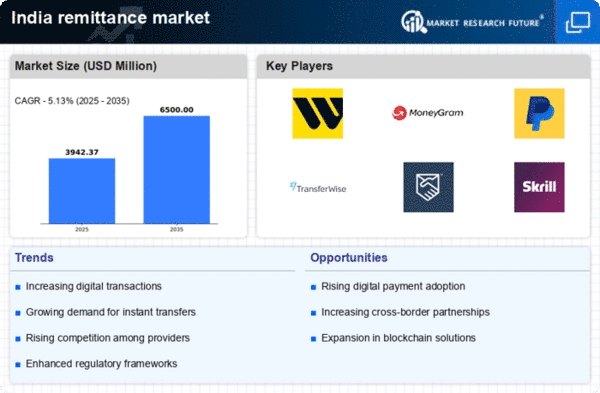
As per Market Research Future analysis, the India remittance market Size was estimated at 3750.0 USD Million in 2024. The Remittance market is projected to grow from 3942.37 USD Million in 2025 to 6500.0 USD Million by 2035, exhibiting a compound annual growth rate (CAGR) of 5.1% during the forecast period 2025 - 2035

Key Market Trends & Highlights

The India remittance market is experiencing robust growth driven by digital transformation and increasing migration trends.

  • The largest segment in the India remittance market is the digital remittance sector, which is rapidly expanding due to technological advancements.
  • The fastest-growing segment is the mobile remittance service, reflecting the increasing adoption of smartphones and mobile banking.
  • Regulatory enhancements are fostering a more secure and efficient remittance environment, encouraging greater participation from consumers.
  • Key market drivers include technological advancements in payment systems and increasing migration trends, which are significantly shaping the market landscape.

Market Size & Forecast

2024 Market Size 3750.0 (USD Million)
2035 Market Size 6500.0 (USD Million)
CAGR (2025 - 2035) 5.13%

Major Players

Western Union (US), MoneyGram (US), PayPal (US), TransferWise (GB), Remitly (US), Skrill (GB), WorldRemit (GB), Xoom (US), Revolut (GB)

Our Impact
Enabled $4.3B Revenue Impact for Fortune 500 and Leading Multinationals
Partnering with 2000+ Global Organizations Each Year
30K+ Citations by Top-Tier Firms in the Industry

India Remittance Market Trends

The remittance market in India is characterized by a dynamic landscape, driven by various factors including economic conditions, migration patterns, and technological advancements. As of November 2025, the market appears to be experiencing a notable shift towards digital platforms, which facilitate faster and more cost-effective transactions. This transition is likely influenced by the increasing smartphone penetration and internet accessibility across the country. Furthermore, the regulatory environment is evolving, with the government implementing measures to enhance transparency and security in remittance flows. These developments suggest a promising outlook for the remittance market, as it adapts to the changing needs of consumers and businesses alike. In addition to the digital transformation, the remittance market is witnessing a growing emphasis on financial inclusion. Many individuals in rural and underserved areas are gaining access to formal financial services, which could potentially increase the volume of remittances sent and received. Moreover, the rise of fintech companies is contributing to this trend by offering innovative solutions tailored to the unique requirements of the Indian population. Overall, the remittance market is poised for growth, driven by technological innovation and a commitment to enhancing financial accessibility for all segments of society.

Digital Transformation

The remittance market is undergoing a significant digital transformation, with an increasing number of transactions being conducted through online platforms and mobile applications. This shift is likely driven by the convenience and speed offered by digital solutions, appealing to both senders and recipients. As technology continues to evolve, it may further streamline processes and reduce costs associated with remittance services.

Financial Inclusion Initiatives

There is a growing focus on financial inclusion within the remittance market, as efforts are made to reach underserved populations. Initiatives aimed at providing access to banking services for rural communities could enhance the volume of remittances. This trend suggests a potential for increased participation in the formal financial system, benefiting both senders and receivers.

Regulatory Enhancements

The regulatory framework governing the remittance market is evolving, with the government implementing measures to improve transparency and security. These enhancements may foster greater trust among consumers and encourage more individuals to utilize formal channels for remittances. As regulations adapt to the changing landscape, they could play a crucial role in shaping the future of the market.

India Remittance Market Drivers

Increasing Migration Trends

Migration trends significantly influence the remittance market in India. With millions of Indians residing abroad, particularly in regions such as the Middle East and North America, the flow of remittances has become a crucial economic factor. In 2025, it is estimated that Indian migrants will send back over $80 billion, contributing to the financial stability of families and communities back home. This influx of funds supports local economies and enhances the purchasing power of recipients. The remittance market is thus closely tied to migration patterns, as the number of expatriates directly correlates with the volume of remittances sent, indicating a robust and growing market.

Enhanced Financial Literacy Programs

Financial literacy initiatives are becoming increasingly important in the context of the remittance market in India. As more individuals become aware of financial products and services, they are better equipped to utilize remittance services effectively. Programs aimed at educating migrants and their families about the benefits of formal remittance channels can lead to increased usage of regulated services, which often offer lower fees and better exchange rates. In 2025, it is anticipated that financial literacy efforts will contribute to a 15% increase in the adoption of formal remittance services, thereby enhancing the overall efficiency and transparency of the remittance market.

Economic Growth and Consumer Spending

The economic growth in India plays a pivotal role in shaping the remittance market. As the economy expands, consumer spending increases, leading to higher demand for remittance services. In 2025, India's GDP growth is projected to be around 6%, which may further stimulate the remittance market. Families receiving remittances often invest in education, healthcare, and housing, thereby driving local economic development. This relationship between economic growth and remittance inflows suggests that as the economy flourishes, the remittance market is likely to benefit from increased transaction volumes and a broader range of services offered to consumers.

Technological Advancements in Payment Systems

The remittance market in India is experiencing a notable transformation due to rapid technological advancements in payment systems. Innovations such as mobile wallets, blockchain technology, and real-time payment systems are enhancing the efficiency and security of cross-border transactions. For instance, the introduction of UPI (Unified Payments Interface) has streamlined domestic remittances, while international players are increasingly adopting blockchain to reduce transaction costs. As of 2025, the remittance market is projected to grow by approximately 10% annually, driven by these technological improvements. This evolution not only facilitates faster transactions but also attracts a younger demographic that prefers digital solutions, thereby expanding the customer base within the remittance market.

Competitive Landscape and Service Diversification

The competitive landscape of the remittance market in India is evolving, with numerous players entering the space. This competition drives innovation and service diversification, as companies strive to attract customers through improved offerings. In 2025, the market is expected to see a rise in value-added services such as insurance, investment options, and loyalty programs, which may enhance customer retention. The presence of both traditional banks and fintech companies creates a dynamic environment where consumers benefit from lower fees and better service quality. This competitive nature of the remittance market is likely to foster growth and adaptability, ensuring that it meets the changing needs of its clientele.


Market Segment Insights

By Transfer Method: Bank Transfers (Largest) vs. Mobile Wallets (Fastest-Growing)

In the India remittance market, the transfer method segment shows a diverse distribution of preferences among consumers. Bank transfers remain the largest method, capturing a significant share of the market due to their reliability and established infrastructure. Mobile wallets, however, are gaining momentum, particularly among younger demographics who favor convenience and digital solutions. Cash transfers still hold relevance, but their share is steadily declining as digital methods become more accessible. Growth trends in this segment are particularly influenced by the increasing adoption of technology and mobile payments. Factors such as enhanced smartphone penetration, reliable internet services, and government initiatives promoting digital transactions have accelerated the shift towards mobile wallets. Meanwhile, bank transfers continue to benefit from their strong presence and trust built over the years, although they face stiff competition from emerging digital solutions.

Bank Transfers: Traditional (Dominant) vs. Mobile Wallets: Digital (Emerging)

Bank transfers have maintained a dominant position in the India remittance market due to their longstanding reputation for security and reliability. They cater to a wide range of customers, including businesses and individuals, facilitating large transactions with ease. On the other hand, mobile wallets represent the emerging trend, appealing primarily to tech-savvy consumers who prioritize speed and convenience. This segment is characterized by quick transactions, user-friendly interfaces, and innovative features such as peer-to-peer payments and integration with other financial services. As digital literacy improves, mobile wallets are likely to capture a larger share of the remittance market, challenging traditional methods.

By End User: Individuals (Largest) vs. Businesses (Fastest-Growing)

In the India remittance market, Individuals dominate the end-user segment, accounting for the largest share due to their remittance needs for personal reasons, such as family support and education. This segment benefits from a wide network of agents and digital platforms that facilitate remittance transfers, making it easily accessible for people sending money abroad. Businesses follow closely, representing a growing proportion of the market as they seek to manage cross-border payments and support global operations. Emerging trends indicate a significant growth trajectory for the Business segment, primarily driven by the increasing globalization of commerce and the need for seamless transaction methods. Technological advancements such as blockchain and digital wallets are becoming essential in this segment, enhancing transaction efficiency. Moreover, as international trade expands, the need for businesses to engage in foreign remittances will likely accelerate, contributing to this segment's rapid growth dynamics.

Individuals: Dominant vs. Businesses: Emerging

The Individuals segment stands out for its robust participation in the India remittance market. This demographic primarily includes migrant workers and expatriates who regularly send money back home to support families or fund personal projects. Their remittance flows are generally consistent, making them a stable source for the market. On the other hand, the Businesses segment, characterized by a diverse range of companies from small enterprises to large corporations, is experiencing rapid growth. This part of the market is increasingly focused on streamlining their payment processes and utilizing advanced technologies to facilitate international transactions, thus emerging as a vital player in the overall dynamics of remittances.

By Destination Type: Domestic Remittances (Largest) vs. International Remittances (Fastest-Growing)

The India remittance market is characterized by a significant share of domestic remittances, which cater to the vast internal migration patterns within the country. This segment accounts for a major portion of total remittances, reflecting strong support from families for ongoing expenses and investments in education and healthcare. Conversely, international remittances are gaining momentum, driven by the increasing number of Indians working abroad, and their propensity to send money back home, enhancing the overall remittance landscape. The growth trends show that while domestic remittances continue to be a stable source of income for many households, international remittances are emerging as the fastest-growing segment. Factors contributing to this growth include improved digital payment infrastructures, competitive exchange rates, and rising awareness of the benefits of remitting through formal financial channels. As a result, the international segment is expected to grow at a much quicker pace, appealing to a younger demographic that values convenience and efficiency in money transfers.

Domestic Remittances (Dominant) vs. International Remittances (Emerging)

Domestic remittances serve as a crucial lifeline for many families within the India remittance market, providing essential financial support and fostering household stability. This segment excels due to its familiarity and accessibility, with traditional methods dominating the landscape. Meanwhile, international remittances are rapidly emerging, characterized by increased transaction volumes driven by the global diaspora. Factors such as rising labor opportunities abroad and a heightened focus on remittances for investment purposes are shaping this segment. Additionally, the introduction of innovative financial technology solutions is simplifying cross-border transactions, making international remittances an increasingly popular choice among senders. As both segments continue to evolve, the competition between them intensifies, reflecting changing consumer preferences and aspirations.

By Payer Type: Employed Individuals (Largest) vs. Immigrants (Fastest-Growing)

In the India remittance market, employed individuals represent the largest payer type segment, significantly contributing to the market's overall transaction volume. This group includes professionals and workers sending money back home to support their families, invest in properties, or ensure financial stability. Meanwhile, immigrants also form a vital segment, leveraging remittance services to support their families in their home countries, leading to notable growth due to migration trends. The growth trends in this segment are largely driven by increased employment opportunities in foreign countries and favorable exchange rates for remittances. Employed individuals continue to dominate due to their stable income, while immigrants are witnessing rapid growth as globalization enhances mobility. Additionally, technological advancements in remittance services and changing demographics are influencing these trends, making it crucial for services to cater to both segments effectively.

Employed Individuals (Dominant) vs. Immigrants (Emerging)

Employed individuals dominate the remittance landscape by consistently sending funds to their families, reflecting their financial stability and reliance on remittance services as a key means of support. This segment is characterized by systematic sending patterns and higher average transaction values. On the other hand, immigrants emerge as a rapidly growing segment, driven by the increasing numbers of individuals relocating for better opportunities. They often have varied sending habits, influenced by their financial situations and varying exchange rates. Understanding the distinct behaviors and preferences between these two segments is crucial for service providers aiming to tailor their offerings and marketing strategies effectively.

Get more detailed insights about India Remittance Market

Key Players and Competitive Insights

The remittance market exhibits a dynamic competitive landscape, characterized by rapid technological advancements and evolving consumer preferences. Key players such as Western Union (US), MoneyGram (US), and TransferWise (GB) are strategically positioned to leverage digital transformation and enhance customer experience. Western Union (US) focuses on expanding its digital services, aiming to capture a larger share of the online remittance segment. Meanwhile, MoneyGram (US) emphasizes partnerships with fintech companies to streamline operations and improve service delivery. TransferWise (GB), now known as Wise, continues to innovate with its transparent fee structure and real-time exchange rates, appealing to cost-conscious consumers. Collectively, these strategies foster a competitive environment that prioritizes efficiency and customer-centric solutions.
The remittance market's structure appears moderately fragmented, with numerous players vying for market share. Key business tactics include localizing services to cater to specific demographics and optimizing digital platforms for seamless transactions. The influence of major players is significant, as they set benchmarks for service quality and pricing, compelling smaller entities to adapt or innovate to remain competitive.
In October 2025, Western Union (US) announced a partnership with a leading mobile wallet provider to enhance its digital remittance services. This strategic move is likely to bolster its market presence by tapping into the growing mobile payment ecosystem, thereby attracting younger, tech-savvy consumers. The collaboration may also streamline transaction processes, making remittances more accessible and efficient.
In September 2025, MoneyGram (US) launched a new feature that allows users to send money directly to bank accounts in real-time. This initiative is indicative of the company's commitment to improving customer experience and reducing transaction times, which could potentially increase user retention and attract new customers. The real-time capability aligns with current consumer expectations for immediacy in financial transactions.
In August 2025, TransferWise (GB) expanded its services to include cryptocurrency transactions, allowing users to send and receive funds in various digital currencies. This strategic pivot not only diversifies its offerings but also positions the company at the forefront of the evolving financial landscape, appealing to a niche market of cryptocurrency users. The integration of cryptocurrencies may enhance TransferWise's competitive edge, particularly among younger demographics.
As of November 2025, the remittance market is increasingly defined by trends such as digitalization, sustainability, and the integration of artificial intelligence (AI). Strategic alliances among companies are shaping the competitive landscape, fostering innovation and enhancing service delivery. The shift from price-based competition to a focus on technological advancement and supply chain reliability is evident. Companies that prioritize innovation and customer experience are likely to differentiate themselves in this evolving market, suggesting a future where competitive advantage hinges on adaptability and technological prowess.

Key Companies in the India Remittance Market include

Industry Developments

The India Remittance Market has seen significant developments recently, with a strong uptick in the use of digital payment platforms. Companies like Paytm Payments Bank and Wise have gained traction among users for faster and more cost-effective cross-border transaction solutions. As of October 2023, MoneyGram and Western Union have expanded their offerings to cater to the increasing demand for remittance services, focusing on user-friendly mobile applications for seamless transactions. In the merger and acquisition landscape, there have been no major publicly reported mergers involving key players such as ICICI Bank or HDFC Bank in this sector in recent months.

Nevertheless, growth in market valuation has been noted, particularly among entities like Aditya Birla Money and Axis Bank, driven by innovative financial services and compliance with regulatory frameworks established by the Reserve Bank of India. The remittance inflow to India reached approximately $87 billion in 2021, showing steady growth over the preceding years, indicating the market's robust position amidst global economic challenges. As of 2022, the State Bank of India has been recognized for leading in foreign remittance services, which further exemplifies the competitive nature of the market.


Future Outlook

India Remittance Market Future Outlook

The remittance market in India is projected to grow at a 5.13% CAGR from 2025 to 2035, driven by digitalization, regulatory support, and increasing cross-border migration.

New opportunities lie in:

  • Development of AI-driven remittance platforms for enhanced user experience.
  • Partnerships with local banks for seamless fund transfer solutions.
  • Expansion of mobile wallet services to capture younger demographics.

By 2035, the remittance market in India is expected to achieve robust growth and increased market penetration.

Market Segmentation

India Remittance Market End User Outlook

  • Individuals
  • Businesses
  • Non-Profit Organizations

India Remittance Market Payer Type Outlook

  • Employed Individuals
  • Unemployed Individuals
  • Immigrants

India Remittance Market Transfer Method Outlook

  • Bank Transfers
  • Mobile Wallets
  • Cash Transfers
  • Online Money Transfer Services

India Remittance Market Destination Type Outlook

  • Domestic Remittances
  • International Remittances

Report Scope

MARKET SIZE 2024 3750.0(USD Million)
MARKET SIZE 2025 3942.37(USD Million)
MARKET SIZE 2035 6500.0(USD Million)
COMPOUND ANNUAL GROWTH RATE (CAGR) 5.13% (2025 - 2035)
REPORT COVERAGE Revenue Forecast, Competitive Landscape, Growth Factors, and Trends
BASE YEAR 2024
Market Forecast Period 2025 - 2035
Historical Data 2019 - 2024
Market Forecast Units USD Million
Key Companies Profiled Western Union (US), MoneyGram (US), PayPal (US), TransferWise (GB), Remitly (US), Skrill (GB), WorldRemit (GB), Xoom (US), Revolut (GB)
Segments Covered Transfer Method, End User, Destination Type, Payer Type
Key Market Opportunities Adoption of blockchain technology enhances security and reduces costs in the remittance market.
Key Market Dynamics Technological advancements and regulatory changes are reshaping competitive dynamics in the remittance market.
Countries Covered India
Leave a Comment

FAQs

What is the expected market size of the India Remittance Market in 2024?

The India Remittance Market is expected to be valued at 3.8 USD Billion in 2024.

What will be the market size of the India Remittance Market by 2035?

The market is anticipated to reach a value of 6.5 USD Billion by the year 2035.

What is the expected CAGR for the India Remittance Market from 2025 to 2035?

The expected CAGR for the market from 2025 to 2035 is 5.001%.

Which mode of transfer dominates the India Remittance Market?

The digital mode of transfer dominates the market, valued at 2.3 USD Billion in 2024.

What is the projected value for the traditional (non-digital) mode of transfer in 2035?

The traditional (non-digital) mode of transfer is projected to be valued at 2.7 USD Billion in 2035.

Who are some of the major players in the India Remittance Market?

Major players in the market include ICICI Bank, HDFC Bank, and MoneyGram among others.

What will be the market value of the digital segment in 2035?

The digital segment of the India Remittance Market is expected to be valued at 3.8 USD Billion in 2035.

What are some key applications driving the growth of the India Remittance Market?

Key applications include money transfers, payment solutions, and financial services that facilitate remittances.

What challenges does the India Remittance Market face?

Challenges include regulatory hurdles, currency fluctuations, and competition from emerging fintech players.

How does the current global scenario impact the India Remittance Market?

The current global scenario influences the remittance flows, affecting market dynamics and growth opportunities.

Download Free Sample

Kindly complete the form below to receive a free sample of this Report

Compare Licence

×
Features License Type
Single User Multiuser License Enterprise User
Price $4,950 $5,950 $7,250
Maximum User Access Limit 1 User Upto 10 Users Unrestricted Access Throughout the Organization
Free Customization
Direct Access to Analyst
Deliverable Format
Platform Access
Discount on Next Purchase 10% 15% 15%
Printable Versions