×
Request Free Sample ×

Kindly complete the form below to receive a free sample of this Report

* Please use a valid business email

Leading companies partner with us for data-driven Insights

clients tt-cursor
Hero Background

India Peripheral Nerve Stimulators Market

ID: MRFR/HC/43231-HCR
200 Pages
Rahul Gotadki
February 2026

India Peripheral Nerve Stimulators Market Research Report By Product Type (Transcutaneous, Percutaneous, Implantable), By Device (Stimulators, CPNB Catheters, Pain Pumps, Others), By Stimulating Feature (Stimulator Machines with Train of Four (TOF) Monitoring Features, Machines Without TOF Features) and By End User (Hospitals and Clinics, Ambulatory Surgical Centers, Others) - Growth & Industry Forecast 2025 To 2035

Share:
Download PDF ×

We do not share your information with anyone. However, we may send you emails based on your report interest from time to time. You may contact us at any time to opt-out.

India Peripheral Nerve Stimulators Market Infographic
Purchase Options

India Peripheral Nerve Stimulators Market Summary

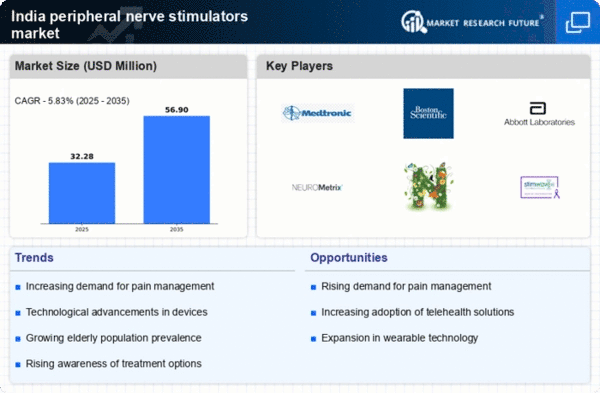
As per Market Research Future analysis, the India peripheral nerve-stimulators market size was estimated at 30.5 USD Million in 2024. The India peripheral nerve-stimulators market is projected to grow from 32.28 USD Million in 2025 to 56.9 USD Million by 2035, exhibiting a compound annual growth rate (CAGR) of 5.8% during the forecast period 2025 - 2035

Key Market Trends & Highlights

The India peripheral nerve-stimulators market is poised for substantial growth driven by technological advancements and increasing demand for non-invasive treatments.

  • Technological advancements are enhancing the efficacy and safety of peripheral nerve-stimulators, making them more appealing to healthcare providers.
  • The largest segment in the market is the neuromodulation devices segment. This segment is experiencing a surge in adoption due to its effectiveness in treating chronic pain.
  • The fastest-growing segment is anticipated to be the wearable nerve-stimulation devices, reflecting a shift towards more convenient and user-friendly treatment options.
  • Key market drivers include the increasing prevalence of neurological disorders and the rising geriatric population, which are fueling demand for innovative treatment solutions.

Market Size & Forecast

2024 Market Size 30.5 (USD Million)
2035 Market Size 56.9 (USD Million)
CAGR (2025 - 2035) 5.83%

Major Players

Medtronic (US), Boston Scientific (US), Abbott (US), NeuroMetrix (US), Nuvectra (US), Stimwave (US), Stryker (US), Halyard Health (US)

Our Impact
Enabled $4.3B Revenue Impact for Fortune 500 and Leading Multinationals
Partnering with 2000+ Global Organizations Each Year
30K+ Citations by Top-Tier Firms in the Industry

India Peripheral Nerve Stimulators Market Trends

The peripheral nerve-stimulators market is currently experiencing notable growth, driven by advancements in technology and increasing awareness of non-invasive treatments. The rise in chronic pain conditions, coupled with a growing preference for drug-free therapies, appears to be influencing the demand for these devices. Furthermore, The healthcare sector's focus on improving patient outcomes and reducing hospital stays may contribute to the expansion of the market. As healthcare providers seek innovative solutions, the integration of peripheral nerve-stimulators into treatment protocols seems to be gaining traction. In addition, regulatory support and favorable reimbursement policies may enhance market accessibility. The increasing prevalence of neurological disorders and the aging population are likely to further propel the adoption of these devices. As the market evolves, it is essential to monitor technological advancements and their implications for patient care. The peripheral nerve-stimulators market is poised for continued growth, reflecting a shift towards more holistic approaches in pain management and rehabilitation.

Technological Advancements

The peripheral nerve-stimulators market is witnessing rapid technological innovations, including the development of miniaturized devices and wireless connectivity. These advancements enhance user experience and improve treatment efficacy, making devices more appealing to both patients and healthcare providers.

Growing Demand for Non-Invasive Treatments

There is an increasing preference for non-invasive treatment options among patients suffering from chronic pain. This trend is likely to drive the adoption of peripheral nerve-stimulators, as they offer effective pain relief without the side effects associated with pharmaceuticals.

Regulatory Support and Reimbursement Policies

Supportive regulatory frameworks and favorable reimbursement policies are facilitating market growth. These measures encourage healthcare providers to incorporate peripheral nerve-stimulators into their treatment regimens, thereby increasing patient access to these innovative therapies.

India Peripheral Nerve Stimulators Market Drivers

Rising Geriatric Population

India's demographic shift towards an aging population is another significant driver for the peripheral nerve-stimulators market. By 2025, it is projected that the elderly population will exceed 140 million, leading to a higher prevalence of age-related health issues, including chronic pain and neurological disorders. This demographic trend suggests a growing need for effective pain management solutions, as older adults often experience conditions that can be alleviated through peripheral nerve stimulation. The healthcare system is likely to adapt to these needs, promoting the adoption of advanced therapeutic devices. Consequently, the peripheral nerve-stimulators market is poised for growth, as healthcare providers increasingly recognize the importance of addressing the unique challenges faced by the elderly population in India.

Advancements in Medical Technology

Technological innovations in the medical field are driving the peripheral nerve-stimulators market in India. The development of more sophisticated and user-friendly devices has made peripheral nerve stimulation a viable option for many patients. Recent advancements include wireless technology, improved battery life, and enhanced stimulation algorithms, which have made these devices more effective and easier to use. The Indian market is witnessing a surge in the introduction of these advanced devices, which are expected to improve patient outcomes significantly. As healthcare providers become more aware of these advancements, the adoption of peripheral nerve stimulators is likely to increase, further propelling market growth. The integration of technology into treatment protocols may also lead to better patient compliance and satisfaction.

Supportive Government Policies and Initiatives

India's government is increasingly recognizing the importance of advanced medical technologies, including peripheral nerve stimulators, in improving healthcare outcomes. Various initiatives aimed at enhancing healthcare infrastructure and promoting research and development in medical devices are likely to create a favorable environment for the peripheral nerve-stimulators market. Policies that facilitate easier access to medical devices and encourage innovation can significantly impact market growth. Additionally, government support for reimbursement policies related to neuromodulation therapies may further incentivize healthcare providers to adopt these technologies. As a result, the peripheral nerve-stimulators market is expected to thrive in an environment that fosters innovation and accessibility, ultimately benefiting patients across India.

Increasing Prevalence of Neurological Disorders

The rising incidence of neurological disorders in India is a crucial driver for the peripheral nerve-stimulators market. Conditions such as neuropathic pain, multiple sclerosis, and Parkinson's disease are becoming more prevalent, affecting millions. According to recent estimates, approximately 10% of the Indian population suffers from some form of neurological disorder. This growing patient base is likely to increase the demand for effective treatment options, including peripheral nerve stimulators. As healthcare providers seek innovative solutions to manage these conditions, the peripheral nerve-stimulators market is expected to expand significantly. The increasing awareness of these disorders and the need for effective pain management solutions further contribute to the market's growth, indicating a robust future for peripheral nerve-stimulators in India.

Growing Awareness and Acceptance of Neuromodulation Therapies

There is a notable increase in awareness and acceptance of neuromodulation therapies among both healthcare professionals and patients in India. Educational initiatives and outreach programs are helping to inform stakeholders about the benefits of peripheral nerve stimulation for pain management and other neurological conditions. This growing awareness is likely to lead to increased referrals and recommendations for peripheral nerve-stimulators, thereby expanding the market. Furthermore, as more success stories emerge from clinical applications, patient acceptance is expected to rise, encouraging more individuals to seek these innovative treatment options. The peripheral nerve-stimulators market stands to benefit from this trend, as it aligns with the broader movement towards personalized and effective healthcare solutions.


Market Segment Insights

By Product: Transcutaneous (Largest) vs. Implantable (Fastest-Growing)

In the analysis of the product segment in the India peripheral nerve-stimulators market, the transcutaneous devices currently hold the largest market share due to their accessibility and ease of use. They are primarily utilized for pain management, attracting a broad spectrum of patients and healthcare professionals. On the other hand, implantable peripheral nerve stimulators are starting to gain traction, albeit they account for a smaller share of the market. They offer long-term solutions for chronic pain with increasing recognition in medical circles. The growth trends are promising, particularly for the implantable segment, as advancements in technology continue to enhance the efficacy and safety of these devices. The rising prevalence of chronic pain conditions in the region is driving the demand for more sophisticated solutions. Furthermore, increasing investments in research and development, along with supportive government policies, are bolstering this market segment's growth and innovation.

Transcutaneous (Dominant) vs. Percutaneous (Emerging)

Transcutaneous stimulators are characterized by their non-invasive application, providing a convenient alternative for patients who are hesitant about surgical interventions. Their versatility in treating various conditions such as neuropathic pain and muscle stimulation makes them a preferred choice, ensuring a dominant position in the market. Conversely, percutaneous stimulators, although less common, are emerging due to their effective pain management capabilities. These devices are minimally invasive and offer targeted therapy, appealing to a segment of patients seeking quicker recovery times. As awareness and education about percutaneous options grow, they are expected to capture a larger portion of the market share in the coming years.

By Device Type: Stimulators (Largest) vs. Pain Pumps (Fastest-Growing)

In the India peripheral nerve-stimulators market, stimulators hold the largest market share, reflecting their established presence and preference among healthcare practitioners. Continuous Peripheral Nerve Blocks (CPNB) Catheters also contribute significantly to the market, yet their share is less than that of stimulators, which dominate due to their versatility in various pain management applications. Pain Pumps are emerging rapidly, showing a growing trend in usage, especially in the postoperative phase, where targeted pain relief is crucial. The growth trends within this segment are driven primarily by the increasing prevalence of chronic pain conditions and advancements in medical technology. Stimulators are increasingly favored for their non-invasive nature, while Pain Pumps are experiencing rapid adoption due to their ability to deliver continuous analgesia, enhancing patient comfort and satisfaction. Moreover, the ongoing research and development efforts in the field aim to improve the efficacy and safety profiles of these devices, further fueling market growth.

Stimulators (Dominant) vs. Pain Pumps (Emerging)

Stimulators are recognized as the dominant device type in the market, known for their effectiveness in treating neuropathic pain and promoting functional recovery. Their established technology and wide range of applications contribute to their preference among clinicians. Conversely, Pain Pumps are branded as the emerging device type, rapidly gaining popularity for their convenience and ability to minimize opioid usage through localized pain relief. This dual presence in the market showcases a dynamic interplay where stimulators maintain a strong foothold while pain pumps are poised for swift expansion, driven by innovative delivery methods and increasing patient awareness about alternative pain management options.

By Stimulating Feature: Stimulator Machines with Train of Four (TOF) Monitoring Features (Largest) vs. Machines Without TOF Features (Fastest-Growing)

In the India peripheral nerve-stimulators market, stimulator machines with Train of Four (TOF) monitoring features hold the largest market share. This segment is favored due to its ability to provide real-time monitoring of neuromuscular blockade, ensuring better patient safety and effective anesthesia management. In contrast, machines without TOF features are emerging quickly in the market. Their appeal lies in their cost-effectiveness and ease of use in various clinical settings, carving out a significant share. Growth trends in this segment are driven by advancements in technology and the increasing demand for efficient anesthesia practices. Enhanced functionalities of TOF-enabled machines have led to their dominance, while machines without TOF features are becoming popular in smaller healthcare setups and outpatient surgeries. The shift towards more reliable and user-friendly devices continues to fuel expansion in both segments, albeit at different rates.

Stimulator Machines with TOF (Dominant) vs. Machines Without TOF (Emerging)

Stimulator machines with Train of Four (TOF) monitoring features dominate the segment due to their critical role in providing real-time information on neuromuscular function, which is essential in anesthesia practices. These machines are broadly utilized in hospitals and surgical centers, ensuring patient safety during procedures. On the other hand, machines without TOF features are emerging as a practical choice for smaller clinics and outpatient settings, where cost and simplicity are prioritized. This segment appeals to a market looking for basic yet effective nerve stimulation means, contributing to a diverse range of applications across the healthcare spectrum.

By End User: Hospitals & Clinics (Largest) vs. Ambulatory Surgical Centers (Fastest-Growing)

The distribution of market share in the India peripheral nerve-stimulators market indicates that Hospitals & Clinics hold a significant portion, reflecting their central role in providing advanced medical treatments. This segment is preferred for its capacity to offer in-depth care and specialized services, contributing to its dominant position in the market. Conversely, Ambulatory Surgical Centers, while smaller in comparison, are rapidly gaining traction as they accommodate a preference for outpatient surgeries and shorter recovery times. The growth trends in the End User segment are influenced by emerging healthcare needs and technological advancements. Hospitals & Clinics are adopting innovative peripheral nerve-stimulation technologies, enhancing patient outcomes and operational efficiency. Meanwhile, Ambulatory Surgical Centers are experiencing a surge due to their cost-effectiveness and convenience, appealing to patients seeking efficient treatment options. This dual growth reflects a shift towards more adaptive healthcare delivery models, fitting evolving patient preferences.

Hospitals & Clinics (Dominant) vs. Ambulatory Surgical Centers (Emerging)

Hospitals & Clinics serve as the backbone of the India peripheral nerve-stimulators market, characterized by their comprehensive care capabilities and specialized patient services. This segment benefits from a well-established infrastructure and a high level of trust amongst patients, which contributes to its market dominance. In contrast, Ambulatory Surgical Centers, while considered an emerging segment, are distinguished by their focus on efficiency and outpatient care. These centers provide a streamlined environment for procedures, allowing patients to recover faster and return home sooner. This growing preference for minimally invasive surgeries in outpatient settings indicates a shift in patient behavior, enhancing the appeal of Ambulatory Surgical Centers within the market.

Get more detailed insights about India Peripheral Nerve Stimulators Market

Key Players and Competitive Insights

The peripheral nerve-stimulators market in India is characterized by a dynamic competitive landscape, driven by increasing demand for pain management solutions and advancements in medical technology. Key players such as Medtronic (US), Boston Scientific (US), and Abbott (US) are strategically positioned to leverage innovation and expand their market presence. Medtronic (US) focuses on enhancing its product portfolio through continuous research and development, while Boston Scientific (US) emphasizes strategic partnerships to bolster its technological capabilities. Abbott (US) appears to be concentrating on regional expansion, particularly in underserved markets, thereby shaping a competitive environment that is increasingly collaborative and innovation-driven.In terms of business tactics, companies are localizing manufacturing to reduce costs and optimize supply chains, which is crucial in a market that is moderately fragmented. This localization strategy not only enhances operational efficiency but also allows for quicker response times to market demands. The collective influence of these key players is significant, as they navigate a landscape that requires agility and responsiveness to consumer needs, thereby fostering a competitive structure that encourages innovation and collaboration.

In October Medtronic (US) announced the launch of a new peripheral nerve-stimulator device designed to improve patient outcomes in chronic pain management. This strategic move is likely to enhance Medtronic's competitive edge by addressing specific patient needs and expanding its market share in India. The introduction of this device reflects a commitment to innovation and positions Medtronic as a leader in the evolving landscape of pain management solutions.

In September Boston Scientific (US) entered into a partnership with a local Indian healthcare provider to enhance access to its nerve-stimulation technologies. This collaboration is strategically important as it not only broadens Boston Scientific's reach but also aligns with the growing trend of localized healthcare solutions. By partnering with local entities, the company is likely to gain valuable insights into regional market dynamics, thereby strengthening its competitive position.

In August Abbott (US) expanded its manufacturing capabilities in India, focusing on the production of advanced nerve-stimulation devices. This expansion is indicative of Abbott's long-term commitment to the Indian market and its strategy to meet the increasing demand for innovative medical technologies. By enhancing its manufacturing footprint, Abbott is poised to improve supply chain reliability and reduce lead times, which are critical factors in maintaining a competitive advantage.

As of November the competitive trends in the peripheral nerve-stimulators market are increasingly defined by digitalization, sustainability, and the integration of artificial intelligence (AI) into product offerings. Strategic alliances are becoming more prevalent, as companies recognize the value of collaboration in driving innovation. The competitive differentiation is likely to evolve from traditional price-based competition to a focus on technological advancements, product reliability, and supply chain efficiency. This shift underscores the importance of innovation as a key driver of success in the market.

Key Companies in the India Peripheral Nerve Stimulators Market include

Industry Developments

India Peripheral Nerve Stimulators Market has seen notable advancements and developments recently. Abbott Laboratories has expanded its portfolio in the region to cater to the increasing demand for innovative pain management solutions. Stryker Corporation has also been actively involved in enhancing its distribution networks within India to improve access to its peripheral nerve stimulator products. Furthermore, in August 2023, Medtronic announced regulatory approvals for its latest nerve stimulation devices aimed at addressing chronic pain, reflecting the dynamic regulatory environment in India.

In terms of market dynamics, the overall growth across companies like Nevro Corporation and Boston Scientific has been driven by an increased prevalence of neurological disorders and a rising geriatric population in India. There were significant movements in the market landscape as well, with Medtronic acquiring technology assets from a smaller firm in July 2022, which bolstered their research and development in nerve stimulation. The impact of these developments is substantial, with improvements in technology leading to better pain management approaches, thus enhancing patient outcomes and increasing acceptance of peripheral nerve stimulation therapy within the Indian healthcare ecosystem.

India Peripheral Nerve Stimulators Market Segmentation Insights

India Peripheral Nerve Stimulators Market Product Type Outlook

    • Transcutaneous
    • Percutaneous
    • Implantable

India Peripheral Nerve Stimulators Market Device Outlook

    • Stimulators
    • CPNB Catheters
    • Pain Pumps
    • Others

India Peripheral Nerve Stimulators Market Stimulating Feature Outlook

    • Stimulator Machines with Train of Four (TOF) Monitoring Features
    • Machines Without TOF Features

India Peripheral Nerve Stimulators Market End User Outlook

    • Hospitals and Clinics
    • Ambulatory Surgical Centers
    • Others

Future Outlook

India Peripheral Nerve Stimulators Market Future Outlook

The Peripheral Nerve Stimulators Market is projected to grow at a 5.83% CAGR from 2025 to 2035, driven by technological advancements and increasing demand for non-invasive pain management solutions.

New opportunities lie in:

  • Development of portable nerve-stimulation devices for home use
  • Partnerships with healthcare providers for integrated pain management programs
  • Expansion into telehealth services for remote patient monitoring and support

By 2035, the market is expected to achieve substantial growth, driven by innovation and strategic partnerships.

Market Segmentation

India Peripheral Nerve Stimulators Market Product Outlook

  • Transcutaneous
  • Percutaneous
  • Implantable

India Peripheral Nerve Stimulators Market End User Outlook

  • Hospitals & Clinics
  • Ambulatory Surgical Centers

India Peripheral Nerve Stimulators Market Device Type Outlook

  • Stimulators
  • Continuous Peripheral Nerve Blocks (CPNB) Catheters
  • Pain Pumps

India Peripheral Nerve Stimulators Market Stimulating Feature Outlook

  • Stimulator Machines with Train of Four (TOF) Monitoring Features
  • Machines Without TOF Features

Report Scope

MARKET SIZE 2024 30.5(USD Million)
MARKET SIZE 2025 32.28(USD Million)
MARKET SIZE 2035 56.9(USD Million)
COMPOUND ANNUAL GROWTH RATE (CAGR) 5.83% (2025 - 2035)
REPORT COVERAGE Revenue Forecast, Competitive Landscape, Growth Factors, and Trends
BASE YEAR 2024
Market Forecast Period 2025 - 2035
Historical Data 2019 - 2024
Market Forecast Units USD Million
Key Companies Profiled Medtronic (US), Boston Scientific (US), Abbott (US), NeuroMetrix (US), Nuvectra (US), Stimwave (US), Stryker (US), Halyard Health (US)
Segments Covered Product, Device Type, Stimulating Feature, End User
Key Market Opportunities Advancements in neuromodulation technologies enhance treatment options in the peripheral nerve-stimulators market.
Key Market Dynamics Rising demand for non-invasive pain management solutions drives innovation in the peripheral nerve-stimulators market.
Countries Covered India
Leave a Comment

FAQs

What is the projected market size of the India Peripheral Nerve Stimulators Market by 2035?

The India Peripheral Nerve Stimulators Market is expected to reach a value of 56.4 million USD by 2035.

What was the estimated market value of the India Peripheral Nerve Stimulators Market in 2024?

In 2024, the market is estimated to be valued at 36.5 million USD.

What is the expected CAGR for the India Peripheral Nerve Stimulators Market from 2025 to 2035?

The expected CAGR for the market from 2025 to 2035 is 4.035 percent.

What is the market size for Transcutaneous Peripheral Nerve Stimulators in 2024?

The Transcutaneous segment is valued at 12.5 million USD in 2024.

What are the expected market values for the Implantable segment by 2035?

The Implantable segment is expected to reach 22.4 million USD by 2035.

Who are the key players in the India Peripheral Nerve Stimulators Market?

Major players in the market include Abbott Laboratories, Stryker Corporation, and Boston Scientific among others.

What is the projected market value for the Percutaneous segment in 2035?

The Percutaneous segment is projected to be valued at 15.0 million USD by 2035.

Which segment is expected to have the largest share of the market in 2024?

In 2024, the Implantable segment is expected to have the largest share at 14.0 million USD.

What are the major growth drivers for the India Peripheral Nerve Stimulators Market?

The growing demand for pain management solutions is one of the major growth drivers for the market.

How is the competitive landscape of the India Peripheral Nerve Stimulators Market expected to evolve?

The competitive landscape is expected to evolve with increasing innovations and strategic partnerships among key players.

Download Free Sample

Kindly complete the form below to receive a free sample of this Report

Compare Licence

×
Features License Type
Single User Multiuser License Enterprise User
Price $4,950 $5,950 $7,250
Maximum User Access Limit 1 User Upto 10 Users Unrestricted Access Throughout the Organization
Free Customization
Direct Access to Analyst
Deliverable Format
Platform Access
Discount on Next Purchase 10% 15% 15%
Printable Versions