×
Request Free Sample ×

Kindly complete the form below to receive a free sample of this Report

* Please use a valid business email

Leading companies partner with us for data-driven Insights

clients tt-cursor
Hero Background

India Insect Pest Control Market

ID: MRFR/Agri/44792-HCR
128 Pages
Harshita Gorade
February 2026

India Insect Pest Control Market Size, Share, Industry Trend & Analysis Research Report: By Pest Type (Insects, Termites, Rodents, others), By Method (Chemical, Mechanical, Biological) andBy Application (Residential, Commercial, Industrial)- Forecast to 2035

Share:
Download PDF ×

We do not share your information with anyone. However, we may send you emails based on your report interest from time to time. You may contact us at any time to opt-out.

India Insect Pest Control Market Infographic
Purchase Options

India Insect Pest Control Market Summary

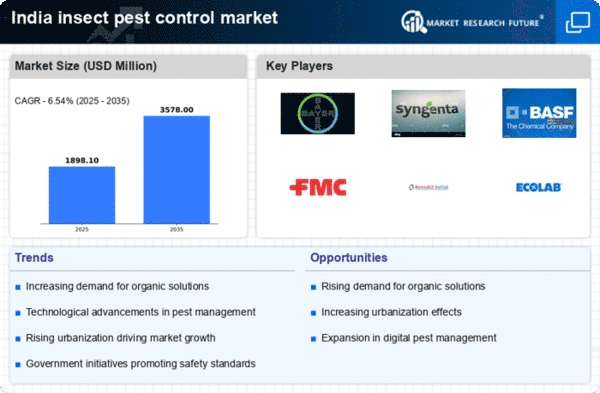
As per Market Research Future analysis, the India insect pest-control market Size was estimated at 1781.59 USD Million in 2024. The India insect pest-control market is projected to grow from 1898.1 USD Million in 2025 to 3578.0 USD Million by 2035, exhibiting a compound annual growth rate (CAGR) of 6.5% during the forecast period 2025 - 2035

Key Market Trends & Highlights

The India insect pest-control market is experiencing a transformative shift towards sustainable and technologically advanced solutions.

  • The market is witnessing a notable rise in the adoption of biopesticides, reflecting a growing preference for environmentally friendly pest control methods.
  • Technological advancements are driving innovation in pest management, enhancing efficacy and efficiency in pest control practices.
  • Regulatory support for sustainable practices is becoming increasingly prominent, encouraging the development and use of safer pest control products.
  • Key market drivers include increasing urbanization and rising health awareness, which are significantly influencing demand for effective pest management solutions.

Market Size & Forecast

2024 Market Size 1781.59 (USD Million)
2035 Market Size 3578.0 (USD Million)
CAGR (2025 - 2035) 6.54%

Major Players

Bayer AG (DE), Syngenta AG (CH), BASF SE (DE), FMC Corporation (US), Rentokil Initial plc (GB), Ecolab Inc. (US), Terminix Global Holdings Inc. (US), Rollins Inc. (US)

Our Impact
Enabled $4.3B Revenue Impact for Fortune 500 and Leading Multinationals
Partnering with 2000+ Global Organizations Each Year
30K+ Citations by Top-Tier Firms in the Industry

India Insect Pest Control Market Trends

The insect pest-control market is currently experiencing notable growth, driven by increasing agricultural activities and rising awareness regarding pest management. Farmers and agricultural professionals are increasingly recognizing the importance of effective pest control in ensuring crop yield and quality. This trend is further supported by government initiatives aimed at promoting sustainable agricultural practices, which often include integrated pest management strategies. As a result, the demand for innovative pest-control solutions is on the rise, with a focus on environmentally friendly products that minimize harm to beneficial insects and the ecosystem. Moreover, urbanization and changing lifestyles are contributing to the expansion of the insect pest-control market. As cities grow, the need for pest management in residential and commercial spaces becomes more pronounced. This shift is prompting pest-control companies to develop targeted solutions that address specific urban pest challenges. The increasing prevalence of pests in urban areas, coupled with heightened consumer awareness about health and hygiene, is likely to drive further investment in pest-control technologies and services. Overall, the insect pest-control market appears poised for continued growth, reflecting broader trends in agriculture and urban development.

Rise of Biopesticides

The pest control industry in India is undergoing rapid expansion as rising awareness of health risks, urbanization, and increasing disposable incomes drive demand for effective pest management solutions across residential, commercial, and agricultural sectors. The mosquito control market in India is a particularly dynamic segment due to the high prevalence of mosquito-borne diseases, prompting adoption of targeted strategies and innovative products that prioritize safety and sustainability. Alongside this, household pest control services in India are gaining traction among urban and semi-urban consumers seeking professional solutions for ants, cockroaches, rodents, and other common pests, supported by enhanced service delivery and digital booking platforms. Meanwhile, the agricultural pest control market in India remains a critical component of the broader industry, with farmers increasingly relying on integrated pest management, eco-friendly formulations, and precision application techniques to protect crops, improve yields, and meet growing food demand in a competitive global landscape.

There is a growing trend towards the use of biopesticides in the insect pest-control market. These products, derived from natural materials, are gaining traction due to their reduced environmental impact and safety for non-target organisms. As consumers become more environmentally conscious, the demand for biopesticides is likely to increase, aligning with sustainable agricultural practices.

Technological Advancements

Technological innovations are transforming the insect pest-control market. The integration of smart technologies, such as drones and IoT devices, is enhancing pest monitoring and management. These advancements enable more precise application of pest-control measures, improving efficiency and effectiveness while reducing chemical usage.

Regulatory Support for Sustainable Practices

Regulatory frameworks are increasingly supporting sustainable pest-control practices. Government policies are encouraging the adoption of integrated pest management strategies, which promote the use of environmentally friendly products. This regulatory support is expected to drive growth in the insect pest-control market, as stakeholders seek compliance with evolving standards.


India Insect Pest Control Market Drivers

Agricultural Expansion

India's agricultural sector is a significant driver for the insect pest-control market. With the increasing need for food security, farmers are expanding their cultivation areas, which inadvertently leads to higher pest populations. The market for pest control in agriculture is expected to reach approximately $1.5 billion by 2026, reflecting a growing reliance on pest management solutions to protect crops. The insect pest-control market is responding to this demand by offering a range of products, including insecticides and biopesticides, tailored to the specific needs of farmers. This trend highlights the critical role of pest control in enhancing agricultural productivity and sustainability.

Increasing Urbanization

The rapid urbanization in India is driving the demand for the insect pest-control market. As cities expand, the prevalence of pests such as mosquitoes, cockroaches, and termites increases, necessitating effective pest management solutions. Urban areas, with their dense populations and infrastructure, create ideal conditions for pest infestations. Consequently, the market is projected to grow at a CAGR of approximately 10% over the next few years. This growth is further fueled by the rising awareness among urban residents regarding health risks associated with pest infestations. The insect pest-control market is thus witnessing a surge in demand for both chemical and non-chemical pest control solutions to ensure public health and safety.

Rising Health Awareness

There is a growing awareness among the Indian population regarding the health risks posed by insect pests. Diseases transmitted by pests, such as dengue and malaria, have prompted individuals and communities to seek effective pest control measures. The insect pest-control market is experiencing increased demand for services and products that ensure a pest-free environment, particularly in residential and commercial spaces. This heightened awareness is likely to drive market growth, as consumers prioritize health and safety in their living and working conditions. The market is projected to grow by approximately 8% annually as more people recognize the importance of pest management in preventing disease.

Government Initiatives and Policies

The Indian government is actively promoting initiatives aimed at enhancing pest management practices, which is positively impacting the insect pest-control market. Policies that encourage sustainable agricultural practices and the use of biopesticides are gaining traction. The government has allocated funds to support research and development in pest control technologies, which is expected to foster innovation within the insect pest-control market. These initiatives not only aim to improve crop yields but also focus on reducing the environmental impact of chemical pesticides. As a result, the market is likely to see a shift towards more eco-friendly pest control solutions, aligning with national sustainability goals.

Technological Innovations in Pest Control

Technological advancements are reshaping the insect pest-control market in India. Innovations such as smart traps, drones for monitoring pest populations, and precision application techniques are becoming increasingly prevalent. These technologies enhance the efficiency and effectiveness of pest management strategies, allowing for targeted interventions that minimize chemical usage. The insect pest-control market is witnessing a shift towards integrated pest management (IPM) approaches that leverage technology for better outcomes. As these innovations continue to evolve, they are expected to drive market growth, with an estimated increase of 12% in the adoption of technology-driven pest control solutions over the next few years.

Market Segment Insights

By Pest Type: Insects (Largest) vs. Termites (Fastest-Growing)

The market share distribution in the India insect pest-control market showcases insects as the largest segment, accounting for a significant proportion of total market activity. Following insects, termites emerge as a critical segment, driven by their destructive behavior and the growing awareness among consumers regarding property protection. Rodents and others maintain smaller shares, yet they present unique challenges for pest control solutions, indicating a well-diversified market.

Insects (Dominant) vs. Termites (Emerging)

Insects represent the dominant segment in the India insect pest-control market due to their widespread presence and the diverse range of species that affect residential and commercial properties. This segment includes common pests such as ants, cockroaches, and flies, which are consistently targeted by pest control solutions. On the other hand, termites are emerging rapidly, increasingly recognized for their potential to cause substantial damage to wooden structures, prompting heightened demand for specialized treatments. The effectiveness and advancements in pest control technologies significantly fuel their growth. Addressing both segments necessitates a tailored approach, focusing on prevention and eradication strategies.

By Method: Chemical (Largest) vs. Biological (Fastest-Growing)

In the India insect pest-control market, the market share distribution among methods is notable, with chemical pest control techniques dominating the landscape due to their effectiveness and availability. Chemical methods account for a significant portion of the overall market, making up the largest segment. Mechanical and biological methods, while emerging components, hold smaller shares but are gaining traction due to increasing environmental awareness and demand for sustainable solutions. The growth trends for pest control methods indicate a paradigm shift towards biological methods, which are recognized as the fastest-growing segment, driven by consumer preference for organic and environmentally friendly solutions. Mechanically assisted techniques also witness growth but at a slower pace. Additionally, government regulations are placing restrictions on harmful chemicals, further accelerating the switch to safer alternatives in pest management strategies.

Chemical (Dominant) vs. Biological (Emerging)

The dominant chemical pest control segment continues to lead the India insect pest-control market due to its wide range of effective solutions, affordability, and established infrastructure for distribution and application. This method primarily relies on synthetic chemicals, which provide quick results in pest elimination, making it a preferred choice among both commercial and residential users. On the other hand, biological methods are emerging as a sustainable alternative, utilizing natural predators and organic substances to manage pest populations. Although they currently hold a smaller market share, their growth potential is significant as consumers increasingly seek eco-friendly options and as regulations tighten on chemical pesticides.

By Application: Residential (Largest) vs. Commercial (Fastest-Growing)

In the India insect pest-control market, the application segments are predominantly categorized into residential, commercial, and industrial sectors. The residential segment holds the largest share, driven by the increasing focus on maintaining pest-free home environments. Meanwhile, the commercial segment is rapidly expanding, as businesses prioritize hygiene and pest management in their establishments due to escalating health standards and consumer awareness. Growth trends in the application segment are significantly influenced by urbanization and the rising disposable income of households. The demand for effective and safe pest-control solutions for residential areas continues to surge, while the commercial sector experiences rapid growth in demand for integrated pest management systems. This shift is fostering innovation, leading to the development of eco-friendly products tailored for both residential and commercial use.

Residential (Dominant) vs. Commercial (Emerging)

The residential segment in the India insect pest-control market is characterized by its strong dominance, accounting for a considerable portion of usage driven by homeowners' need for effective pest prevention solutions. This segment is preferred for its ease of use and availability of DIY products. On the other hand, the commercial segment is emerging as a vital area of growth, showing significant demand from various businesses seeking professional pest management services. This segment is experiencing innovation, with firms introducing advanced solutions that cater to stricter regulations and the need for sustainable practices. The contrast between these segments illustrates a shifting landscape, where residential stability meets the dynamic needs of commercial operations.

Get more detailed insights about India Insect Pest Control Market

Key Players and Competitive Insights

The insect pest-control market in India is characterized by a dynamic competitive landscape, driven by increasing urbanization, agricultural expansion, and heightened awareness of health and hygiene. Major players such as Bayer AG (DE), Syngenta AG (CH), and Rentokil Initial plc (GB) are strategically positioned to leverage these growth drivers. Bayer AG (DE) focuses on innovation in biopesticides, aiming to enhance sustainability in pest management. Syngenta AG (CH) emphasizes regional expansion, particularly in rural areas, to cater to the growing agricultural sector. Rentokil Initial plc (GB) adopts a digital transformation strategy, utilizing technology to improve service delivery and customer engagement. Collectively, these strategies contribute to a competitive environment that is increasingly focused on sustainability and technological advancement. Key business tactics within the market include localizing manufacturing and optimizing supply chains to enhance efficiency and reduce costs. The competitive structure appears moderately fragmented, with several key players holding substantial market shares while numerous smaller firms operate in niche segments. This fragmentation allows for diverse offerings and innovation, as companies strive to differentiate themselves in a crowded marketplace. In October 2025, Bayer AG (DE) announced the launch of a new line of biopesticides designed to reduce chemical usage in agriculture. This strategic move underscores Bayer's commitment to sustainability and positions the company as a leader in environmentally friendly pest control solutions. The introduction of these products is likely to resonate with environmentally conscious consumers and farmers, potentially increasing market share. In September 2025, Syngenta AG (CH) expanded its distribution network in India by partnering with local agricultural cooperatives. This initiative aims to enhance accessibility to pest-control products for farmers in remote areas, thereby increasing market penetration. By aligning with local entities, Syngenta not only strengthens its market presence but also fosters community relationships, which could lead to long-term loyalty among customers. In August 2025, Rentokil Initial plc (GB) launched an advanced pest management platform that integrates AI technology for real-time monitoring and response. This innovation is indicative of the growing trend towards digitalization in the pest-control sector. By leveraging AI, Rentokil enhances its service efficiency and customer satisfaction, positioning itself as a forward-thinking leader in the industry. As of November 2025, current competitive trends in the insect pest-control market include a pronounced shift towards digitalization, sustainability, and the integration of AI technologies. Strategic alliances are increasingly shaping the landscape, enabling companies to pool resources and expertise for enhanced innovation. Looking ahead, competitive differentiation is likely to evolve from traditional price-based competition to a focus on technological advancements, sustainable practices, and reliable supply chains, reflecting the changing preferences of consumers and regulatory pressures.

Key Companies in the India Insect Pest Control Market include

Industry Developments

Recent developments in the India Insect Pest Control Market have shown significant growth, driven by the increasing demand for pest management services in agriculture and urban areas. Companies such as Ecolab, Bayer CropScience, and Syngenta are actively enhancing their product offerings through innovation and Research and Development initiatives. UPL Limited and FMC Corporation have reported an increase in sales attributed to their advanced pest control solutions that meet evolving consumer demands.In terms of mergers and acquisitions, in July 2023, Bayer CropScience acquired a majority stake in a local pest control company to strengthen its market position in India.

Likewise, Rentokil Initial has expanded its footprint through strategic acquisitions, enhancing its service capabilities in various regions. The market has also observed substantial investments, with Godrej Agrovet and Adama Agricultural Solutions announcing plans to expand their operations to meet growing pest management needs by September 2023. These developments highlight the sector’s focus on technological advancements and strategic partnerships within the Indian Insect Pest Control Market, paving the way for enhanced service delivery and customer satisfaction.

Future Outlook

India Insect Pest Control Market Future Outlook

The Insect Pest Control Market in India is projected to grow at a 6.54% CAGR from 2025 to 2035, driven by urbanization, agricultural expansion, and increasing health awareness.

New opportunities lie in:

  • Development of eco-friendly biopesticides for sustainable agriculture Integration of IoT technology in pest monitoring systems Expansion of subscription-based pest control services for residential customers

By 2035, the market is expected to achieve robust growth, driven by innovation and evolving consumer needs.

Market Segmentation

India Insect Pest Control Market Method Outlook

  • Chemical
  • Mechanical
  • Biological

India Insect Pest Control Market Pest Type Outlook

  • Insects
  • Termites
  • Rodents
  • Others

India Insect Pest Control Market Application Outlook

  • Residential
  • Commercial
  • Industrial

Report Scope

MARKET SIZE 2024 1781.59(USD Million)
MARKET SIZE 2025 1898.1(USD Million)
MARKET SIZE 2035 3578.0(USD Million)
COMPOUND ANNUAL GROWTH RATE (CAGR) 6.54% (2025 - 2035)
REPORT COVERAGE Revenue Forecast, Competitive Landscape, Growth Factors, and Trends
BASE YEAR 2024
Market Forecast Period 2025 - 2035
Historical Data 2019 - 2024
Market Forecast Units USD Million
Key Companies Profiled Bayer AG (DE), Syngenta AG (CH), BASF SE (DE), FMC Corporation (US), Rentokil Initial plc (GB), Ecolab Inc. (US), Terminix Global Holdings Inc. (US), Rollins Inc. (US)
Segments Covered Pest Type, Method, Application
Key Market Opportunities Adoption of biopesticides driven by increasing consumer demand for sustainable pest management solutions.
Key Market Dynamics Rising demand for eco-friendly pest control solutions drives innovation and competition in the insect pest-control market.
Countries Covered India
Leave a Comment

FAQs

What is the expected market size of the India Insect Pest Control Market in 2024?

The India Insect Pest Control Market is expected to be valued at 1.5 USD Billion in 2024.

What is the projected market size of the India Insect Pest Control Market by 2035?

By 2035, the market is projected to reach a value of 3.0 USD Billion.

What is the expected CAGR of the India Insect Pest Control Market between 2025 to 2035?

The market is expected to grow at a CAGR of 6.504% from 2025 to 2035.

Which pest type holds the largest market share within the India Insect Pest Control Market?

Insects are projected to hold the largest market share, valued at 0.6 USD Billion in 2024.

What is the market value for termite pest control in 2024?

The market for termite pest control is expected to be valued at 0.4 USD Billion in 2024.

Who are the key players in the India Insect Pest Control Market?

Major players include Ecolab, Bayer CropScience, UPL Limited, and Syngenta, among others.

What is the expected growth for the rodents segment in the India Insect Pest Control Market by 2035?

The rodent segment is expected to grow to a market value of 0.6 USD Billion by 2035.

What is the anticipated market value for other pest controls in 2024?

The market value for other pest controls is expected to reach 0.2 USD Billion in 2024.

How do current trends affect the India Insect Pest Control Market?

Current trends indicate growing demand for sustainable and eco-friendly pest control solutions.

What challenges does the India Insect Pest Control Market face in the coming years?

The market may face challenges such as regulatory issues and the rise of pesticide resistance among pests.

Download Free Sample

Kindly complete the form below to receive a free sample of this Report

Compare Licence

×
Features License Type
Single User Multiuser License Enterprise User
Price $4,950 $5,950 $7,250
Maximum User Access Limit 1 User Upto 10 Users Unrestricted Access Throughout the Organization
Free Customization
Direct Access to Analyst
Deliverable Format
Platform Access
Discount on Next Purchase 10% 15% 15%
Printable Versions