×
Request Free Sample ×

Kindly complete the form below to receive a free sample of this Report

* Please use a valid business email

Leading companies partner with us for data-driven Insights

clients tt-cursor
Hero Background

India Generic Pharmaceuticals Market

ID: MRFR/MED/43796-HCR
200 Pages
Garvit Vyas
February 2026

India Generic Pharmaceuticals Market Research Report: Size, Share, Trend Analysis By Types (Simple Generics, Specialty Generics, Biosimilars), By Applications (Central Nervous System Disorders, Respiratory Diseases, Hormones Related Diseases, Gastrointestinal Diseases, Cardiovascular Diseases, Infectious Diseases, Cancer, Diabetes, Others), By Product (Small Molecule, Large Molecule), By Route of Administration (Oral, Injectable, Inhalable, Others) and By Distribution Channel (Online Pharmacies, Retail Pharmacies, Hospital Pharmacies) - Growth Outlook & Industry Forecast 2025 To 2035

Share:
Download PDF ×

We do not share your information with anyone. However, we may send you emails based on your report interest from time to time. You may contact us at any time to opt-out.

India Generic Pharmaceuticals Market Infographic
Purchase Options

India Generic Pharmaceuticals Market Summary

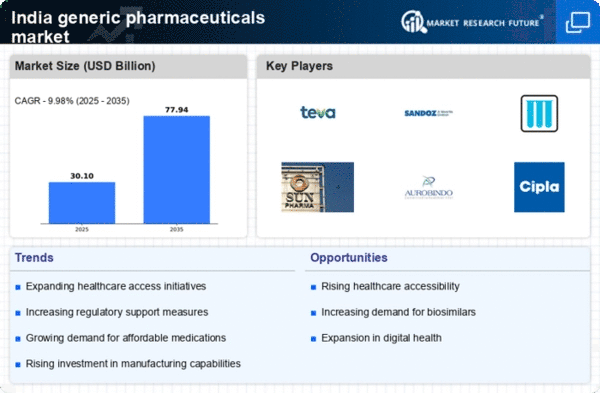
As per Market Research Future analysis, the India Generic Pharmaceuticals Market size was estimated at 27.37 USD Billion in 2024. The Generic Pharmaceuticals market is projected to grow from 30.1 USD Billion in 2025 to 77.94 USD Billion by 2035, exhibiting a compound annual growth rate (CAGR) of 9.9% during the forecast period 2025 - 2035

Key Market Trends & Highlights

The India generic pharmaceuticals market is experiencing robust growth driven by increasing demand for affordable medications and supportive government initiatives.

  • The market is characterized by a rising demand for affordable medications, reflecting a shift towards cost-effective healthcare solutions.
  • Technological advancements in manufacturing are enhancing production efficiency and quality in the generic pharmaceuticals sector.
  • The largest segment in this market is the cardiovascular drugs, while the fastest-growing segment is anticipated to be oncology generics.
  • Key market drivers include increasing healthcare expenditure and rising chronic disease prevalence, which are fueling the demand for generic medications.

Market Size & Forecast

2024 Market Size 27.37 (USD Billion)
2035 Market Size 77.94 (USD Billion)
CAGR (2025 - 2035) 9.98%

Major Players

Teva Pharmaceutical Industries (IL), Sandoz (CH), Mylan (US), Sun Pharmaceutical Industries (IN), Aurobindo Pharma (IN), Cipla (IN), Lupin (IN), Dr. Reddy's Laboratories (IN), Amgen (US), Zydus Cadila (IN)

Our Impact
Enabled $4.3B Revenue Impact for Fortune 500 and Leading Multinationals
Partnering with 2000+ Global Organizations Each Year
30K+ Citations by Top-Tier Firms in the Industry

India Generic Pharmaceuticals Market Trends

The India Generic Pharmaceuticals Market is experiencing notable growth, driven by various factors including increasing healthcare costs and a rising demand for affordable medication. The market is characterized by a diverse range of products, which cater to a wide array of therapeutic areas. As healthcare systems evolve, the emphasis on cost-effective solutions becomes more pronounced, leading to a greater acceptance of generic alternatives. This shift is further supported by government initiatives aimed at promoting the use of generics, thereby enhancing accessibility for patients. In addition, the competitive landscape of the generic pharmaceuticals market is intensifying, with numerous players striving to capture market share. This competition fosters innovation and efficiency, as companies seek to differentiate their offerings. Regulatory frameworks are also adapting to facilitate the entry of generics, ensuring that they meet safety and efficacy standards. Overall, the market appears poised for sustained expansion, reflecting a broader trend towards value-based healthcare solutions that prioritize patient access and affordability.

Rising Demand for Affordable Medications

The increasing cost of healthcare is driving a significant shift towards the adoption of generic medications. Patients and healthcare providers are increasingly recognizing the value of generics as a cost-effective alternative to branded drugs. This trend is likely to continue as more individuals seek affordable treatment options, thereby expanding the market.

Government Initiatives and Support

Government policies are playing a crucial role in promoting the use of generic medications. Initiatives aimed at enhancing accessibility and affordability are being implemented, which may lead to a more favorable environment for generic pharmaceuticals. These efforts are expected to bolster market growth and encourage the development of new generic products.

Technological Advancements in Manufacturing

Innovations in manufacturing processes are enhancing the efficiency and quality of generic pharmaceuticals. Advances in technology are enabling companies to produce generics at lower costs while maintaining high standards. This trend could lead to increased competition and a wider range of products available in the market.

India Generic Pharmaceuticals Market Drivers

Expansion of E-Pharmacy Platforms

The expansion of e-pharmacy platforms in India is emerging as a vital driver for the generic pharmaceuticals market. With the increasing penetration of the internet and mobile technology, consumers are increasingly turning to online platforms for their medication needs. E-pharmacies offer convenience, competitive pricing, and a wide range of generic options, which appeal to a tech-savvy population. As of 2025, the e-pharmacy market in India is projected to reach approximately $3 billion, indicating a robust growth potential. This trend not only enhances accessibility to generic medications but also encourages price transparency and competition among suppliers. The rise of e-pharmacies is likely to play a crucial role in shaping the future landscape of the generic pharmaceuticals market, making it easier for consumers to obtain affordable medications.

Increasing Healthcare Expenditure

The rising healthcare expenditure in India is a pivotal driver for the generic pharmaceuticals market. As the government and private sectors allocate more funds towards healthcare, the accessibility of medications improves. In 2025, healthcare spending is projected to reach approximately $370 billion, which indicates a growth trajectory that supports the demand for affordable medications. This increase in expenditure is likely to enhance the availability of generic drugs, making them a preferred choice among consumers. Furthermore, the emphasis on universal health coverage is expected to bolster the generic pharmaceuticals market, as more individuals gain access to essential medications. The growing awareness of the cost-effectiveness of generics compared to branded drugs further propels this trend, suggesting a robust future for the market in India.

Rising Chronic Disease Prevalence

The prevalence of chronic diseases in India is escalating, which significantly impacts the generic pharmaceuticals market. Conditions such as diabetes, hypertension, and cardiovascular diseases are becoming increasingly common, necessitating a steady supply of medications. Reports indicate that by 2025, around 75 million people in India are expected to be living with diabetes, creating a substantial demand for affordable treatment options. Generic drugs, known for their cost-effectiveness, are likely to be favored by patients and healthcare providers alike. This trend not only supports the growth of the generic pharmaceuticals market but also encourages pharmaceutical companies to invest in the development of generic alternatives for chronic disease management. The increasing burden of chronic illnesses thus serves as a critical driver for the market, highlighting the need for accessible and affordable healthcare solutions.

Regulatory Support for Generic Drugs

Regulatory frameworks in India are increasingly supportive of the generic pharmaceuticals market, which is a crucial driver for its growth. The Central Drugs Standard Control Organization (CDSCO) has implemented policies aimed at expediting the approval process for generic medications. This regulatory support is essential for ensuring that generic drugs reach the market swiftly, thereby enhancing competition and lowering prices. In recent years, the Indian government has also introduced initiatives to promote the use of generics, such as the Jan Aushadhi scheme, which aims to provide quality medicines at reduced prices. Such measures are likely to foster a conducive environment for the generic pharmaceuticals market, encouraging both domestic and international players to invest in the sector. The ongoing regulatory reforms suggest a promising outlook for the market, as they facilitate the entry of more affordable medication options.

Growing Awareness of Generic Medications

There is a notable increase in public awareness regarding the benefits of generic medications in India, which serves as a significant driver for the generic pharmaceuticals market. Educational campaigns by healthcare professionals and government initiatives have contributed to a better understanding of the efficacy and safety of generics. As consumers become more informed, the preference for generic drugs over branded alternatives is likely to rise. This shift in consumer behavior is supported by the fact that generics can be up to 80% cheaper than their branded counterparts, making them an attractive option for cost-conscious patients. The growing acceptance of generics among healthcare providers further reinforces this trend, suggesting that the generic pharmaceuticals market will continue to expand as awareness increases.


Market Segment Insights

By Type: Small Molecule Drugs (Largest) vs. Biologics (Fastest-Growing)

In the India generic pharmaceuticals market, Small Molecule Drugs are the largest segment, capturing a significant portion of the overall market share. These drugs are well-established, affordable, and widely prescribed across various therapeutic areas, making them a cornerstone of treatment in India. On the other hand, Biologics are gaining traction due to their innovative nature and effectiveness in treating complex conditions, although they represent a smaller share compared to small molecule drugs. The growth trends in this segment reflect a dynamic landscape, driven by increasing healthcare access and the rising demand for affordable treatments. The shift towards Biologics signifies a change in treatment paradigms, with a focus on personalized medicine and advanced therapies. Biosimilars are also becoming an essential category, offering cost-effective alternatives to original biologics, further fueling growth within the market.

Small Molecule Drugs (Dominant) vs. Biologics (Emerging)

Small Molecule Drugs dominate the India generic pharmaceuticals market due to their extensive use and cost-effectiveness. These drugs typically have lower manufacturing costs and are easier to produce, resulting in a vast array of generics available for physicians and patients. In contrast, Biologics represent an emerging segment, characterized by complex manufacturing processes and higher research and development costs. However, their ability to target specific diseases and conditions more effectively is driving their acceptance and growth. Biosimilars, associated with Biologics, provide a pathway to reduce costs and improve access to these therapies. Overall, the contrasting dynamics of these segments highlight the evolving nature of pharmaceuticals in India.

By Formulation Type: Tablets (Largest) vs. Injectables (Fastest-Growing)

The market share distribution among various formulation types in the India generic pharmaceuticals market reflects a competitive landscape. Tablets hold the largest market share due to their widespread acceptance and ease of administration. Following tablets, injectables and capsules constitute significant portions, showcasing diverse preferences among healthcare providers and patients. Topicals and solutions, while important, maintain relatively smaller shares, catering mainly to specific therapeutic needs and patient demographics. Growth trends within the formulation type segment are driven by several factors including the increasing prevalence of chronic diseases and the aging population. Tablets continue to dominate due to their cost-effectiveness and patient compliance, whereas injectables are witnessing rapid adoption driven by advancements in technology and increasing demand for biologics. The shift towards minimally invasive procedures further propels the growth of injectables, marking them as the fastest-growing formulation type.

Tablets (Dominant) vs. Injectables (Emerging)

Tablets are the dominant formulation type in the India generic pharmaceuticals market, known for their convenience and patient adherence. They are produced efficiently and are often favored for chronic disease management. In contrast, injectables, while currently an emerging segment, are rapidly gaining traction owing to their effectiveness in delivering medications, particularly for biologics and vaccines. The increasing focus on personalized medicine and advancements in injectable delivery systems contribute to their rise. The distinction between these two formulation types illustrates the evolving preferences in medication delivery, with tablets remaining steadfast while injectables are moving into the spotlight.

By Therapeutic Area: Cardiovascular Diseases (Largest) vs. Cancer (Fastest-Growing)

In the India generic pharmaceuticals market, Cardiovascular Diseases hold the largest share among therapeutic areas, reflecting the high prevalence of hypertension and heart-related conditions. Following closely are Diabetes and CNS Disorders, which also constitute significant segments. Infectious Diseases, while important, are comparatively smaller in market share. This distribution indicates the prioritization of treatment for chronic conditions as key healthcare challenges in the region. The growth trends within this segment are influenced by several factors, including an increasing aging population, lifestyle changes, and rising healthcare spending. Particularly, Cancer is emerging as the fastest-growing area due to heightened awareness and advancements in treatment. The growing incidence of lifestyle-related diseases like Diabetes and Cardiovascular conditions also drives demand for generic options, indicating promising opportunities for market players in these areas.

Cardiovascular Diseases (Dominant) vs. Cancer (Emerging)

Cardiovascular Diseases represent a dominant force in the India generic pharmaceuticals market, characterized by a broad portfolio of medications aimed at managing hypertension, cholesterol, and heart failure. This segment benefits from a well-established pipeline, with numerous generics available that cater to various patient needs. Conversely, Cancer is seen as an emerging segment, driven by innovation in treatment therapies and growing investment in research. The rise in incidence rates linked to lifestyle factors emphasizes the necessity for accessible treatment options, positioning the cancer segment for rapid expansion as the market adapts to meet these increasing demands.

By Distribution Channel: Retail Pharmacy (Largest) vs. Online Pharmacy (Fastest-Growing)

In the India generic pharmaceuticals market, the distribution channel landscape is significantly influenced by retail pharmacy, hospital pharmacy, online pharmacy, and wholesalers. Retail pharmacies currently hold the largest market share, as they are widely accessible and preferred by consumers for their immediate availability of medications. Hospital pharmacies also play a crucial role, particularly in outpatient care, while wholesalers contribute substantially to the supply chain by ensuring that pharmacies receive the necessary drugs efficiently. The growth trends in this sector are being driven by an increasing preference for online pharmacies, recognized as the fastest-growing segment. Factors such as rising internet penetration, convenience of home delivery, and a shift toward digital healthcare solutions are enhancing the appeal of online platforms. This transformation indicates a changing consumer behavior in the India generic pharmaceuticals market, where digital access is becoming crucial for patient engagement and satisfaction.

Retail Pharmacy (Dominant) vs. Online Pharmacy (Emerging)

Retail pharmacies dominate the distribution channel landscape, offering consumers easy access to both generic and branded medicines. They are strategically positioned in urban and rural areas, allowing them to cater to a wide demographic, thereby enhancing their market visibility. On the other hand, online pharmacies are emerging as a significant competitor within the distribution channel segment. Their growth is attributed to the ease of use, the convenience of ordering medications from home, and competitive pricing. Many consumers, particularly younger demographics, are more inclined to trust online platforms due to their user-friendly interfaces and the ability to access a broader range of products. As these two segments continue to evolve, the dynamics between traditional retail and digital pharmacies shape the overall competitive landscape.

Get more detailed insights about India Generic Pharmaceuticals Market

Key Players and Competitive Insights

The generic pharmaceuticals market in India is characterized by a dynamic competitive landscape, driven by factors such as increasing healthcare demands, cost-effective medication solutions, and a growing emphasis on regulatory compliance. Major players like Sun Pharmaceutical Industries (IN), Cipla (IN), and Dr. Reddy's Laboratories (IN) are strategically positioned to leverage these growth drivers. Sun Pharmaceutical Industries (IN) focuses on innovation and expanding its product portfolio, while Cipla (IN) emphasizes partnerships and collaborations to enhance its market reach. Dr. Reddy's Laboratories (IN) is actively pursuing digital transformation initiatives to streamline operations and improve customer engagement. Collectively, these strategies contribute to a competitive environment that is increasingly focused on quality, accessibility, and technological advancement.
Key business tactics within this market include localizing manufacturing and optimizing supply chains to enhance efficiency and reduce costs. The competitive structure appears moderately fragmented, with numerous players vying for market share. However, the influence of key players is substantial, as they set benchmarks for quality and pricing, thereby shaping the overall market dynamics.
In October 2025, Sun Pharmaceutical Industries (IN) announced the launch of a new biosimilar product aimed at treating autoimmune diseases. This strategic move not only diversifies its product offerings but also positions the company to capture a larger share of the growing biosimilars market, which is expected to expand significantly in the coming years. The introduction of this product reflects Sun's commitment to innovation and its ability to respond to evolving patient needs.
In September 2025, Cipla (IN) entered into a strategic partnership with a leading technology firm to enhance its digital capabilities. This collaboration aims to integrate advanced analytics and AI into its supply chain processes, thereby improving operational efficiency and reducing lead times. Such initiatives are indicative of Cipla's forward-thinking approach, as it seeks to leverage technology to maintain a competitive edge in the market.
In August 2025, Dr. Reddy's Laboratories (IN) expanded its manufacturing capabilities by investing in a new facility dedicated to producing high-demand generic medications. This expansion is crucial for meeting the increasing domestic and international demand for affordable pharmaceuticals. By enhancing its production capacity, Dr. Reddy's Laboratories (IN) is likely to strengthen its market position and ensure a reliable supply of essential medications.
As of November 2025, current trends in the generic pharmaceuticals market include a pronounced shift towards digitalization, sustainability, and the integration of AI technologies. Strategic alliances are increasingly shaping the competitive landscape, enabling companies to pool resources and expertise. Looking ahead, competitive differentiation is expected to evolve, with a notable shift from price-based competition to a focus on innovation, technological advancements, and supply chain reliability. This transition underscores the importance of adaptability and forward-thinking strategies in maintaining a competitive advantage.

Key Companies in the India Generic Pharmaceuticals Market include

Industry Developments

Recent developments in the India Generic Pharmaceuticals Market indicate a highly competitive landscape, with significant activity among leading companies. In September 2023, Sun Pharmaceutical Industries reported a strong quarterly growth driven by a robust portfolio, while Cipla focused on expanding its respiratory segment. Furthermore, Aurobindo Pharma announced a partnership aimed at enhancing its oncology offerings. Notably, in August 2023, Dr. Reddy's Laboratories acquired a U.S.-based generic pharmaceutical company to bolster its presence in the U.S. market, enhancing its revenue potential.

The Indian generic pharmaceuticals sector continues to thrive, backed by government initiatives to boost local manufacturing, highlighted by the Production Linked Incentive (PLI) scheme aimed at improving production capabilities within India. The overall market valuation has surged owing to increased domestic demand and export opportunities, particularly to emerging markets, contributing to steady growth forecasts. Major companies like Biocon and Zydus Cadila have also been diversifying their products, working on biosimilars and specialty medicines. In the last two years, several firms have ramped up RD investments, anticipating a significant shift towards innovative therapy offerings, alongside maintaining their generic drug manufacturing prowess.

Future Outlook

India Generic Pharmaceuticals Market Future Outlook

The Generic Pharmaceuticals Market in India is projected to grow at a 9.98% CAGR from 2025 to 2035, driven by increasing healthcare access, rising chronic diseases, and favorable regulatory policies.

New opportunities lie in:

  • Expansion of telepharmacy services to enhance patient access and convenience.
  • Development of biosimilars to capture emerging therapeutic markets.
  • Investment in AI-driven drug discovery to streamline R&D processes.

By 2035, the market is expected to solidify its position as a key player in the pharmaceutical landscape.

Market Segmentation

India Generic Pharmaceuticals Market Type Outlook

  • Small Molecule Drugs
  • Biologics
  • Biosimilars

India Generic Pharmaceuticals Market Formulation Type Outlook

  • Tablets
  • Injectables
  • Topicals
  • Capsules
  • Solutions

India Generic Pharmaceuticals Market Therapeutic Area Outlook

  • Cardiovascular Diseases
  • Diabetes
  • Cancer
  • CNS Disorders
  • Infectious Diseases

India Generic Pharmaceuticals Market Distribution Channel Outlook

  • Retail Pharmacy
  • Hospital Pharmacy
  • Online Pharmacy
  • Wholesalers

Report Scope

MARKET SIZE 2024 27.37(USD Billion)
MARKET SIZE 2025 30.1(USD Billion)
MARKET SIZE 2035 77.94(USD Billion)
COMPOUND ANNUAL GROWTH RATE (CAGR) 9.98% (2025 - 2035)
REPORT COVERAGE Revenue Forecast, Competitive Landscape, Growth Factors, and Trends
BASE YEAR 2024
Market Forecast Period 2025 - 2035
Historical Data 2019 - 2024
Market Forecast Units USD Billion
Key Companies Profiled Teva Pharmaceutical Industries (IL), Sandoz (CH), Mylan (US), Sun Pharmaceutical Industries (IN), Aurobindo Pharma (IN), Cipla (IN), Lupin (IN), Dr. Reddy's Laboratories (IN), Amgen (US), Zydus Cadila (IN)
Segments Covered Type, Formulation Type, Therapeutic Area, Distribution Channel
Key Market Opportunities Adoption of digital health technologies enhances access and efficiency in the generic pharmaceuticals market.
Key Market Dynamics Intensifying competition and regulatory scrutiny drive innovation and cost efficiency in the generic pharmaceuticals market.
Countries Covered India
Leave a Comment

FAQs

What is the expected market size of the India Generic Pharmaceuticals Market in 2024?

The India Generic Pharmaceuticals Market is expected to be valued at 27.5 billion USD in 2024.

What will be the projected market size of the India Generic Pharmaceuticals Market by 2035?

By 2035, the overall market is anticipated to reach 90.0 billion USD.

What is the expected CAGR for the India Generic Pharmaceuticals Market from 2025 to 2035?

The market is expected to grow at a CAGR of 11.381% from 2025 to 2035.

Which segment of the India Generic Pharmaceuticals Market has the largest projected value in 2035?

The Simple Generics segment is projected to reach a value of 56.0 billion USD by 2035.

What are the expected market values for Specialty Generics and Biosimilars in 2035?

Specialty Generics are expected to be valued at 24.0 billion USD and Biosimilars at 10.0 billion USD by 2035.

Who are the key players in the India Generic Pharmaceuticals Market?

Major players include Sun Pharmaceutical Industries, Cipla, Dr. Reddy's Laboratories, and Aurobindo Pharma among others.

What is the expected value of Simple Generics in 2024?

In 2024, the Simple Generics segment is valued at 15.5 billion USD.

How is the India Generic Pharmaceuticals Market expected to change by 2035?

The market is anticipated to experience significant growth, increasing from 27.5 billion USD in 2024 to 90.0 billion USD by 2035.

What growth opportunities exist in the India Generic Pharmaceuticals Market?

There are significant opportunities in the development of new biosimilars and specialty generics in the market.

What challenges might the India Generic Pharmaceuticals Market face in the coming years?

Challenges may include regulatory hurdles and increased competition from both domestic and global pharmaceutical companies.

Download Free Sample

Kindly complete the form below to receive a free sample of this Report

Compare Licence

×
Features License Type
Single User Multiuser License Enterprise User
Price $4,950 $5,950 $7,250
Maximum User Access Limit 1 User Upto 10 Users Unrestricted Access Throughout the Organization
Free Customization
Direct Access to Analyst
Deliverable Format
Platform Access
Discount on Next Purchase 10% 15% 15%
Printable Versions