×
Request Free Sample ×

Kindly complete the form below to receive a free sample of this Report

* Please use a valid business email

Leading companies partner with us for data-driven Insights

clients tt-cursor
Hero Background
English
Chinese
French
Japanese
Korean
German
Spanish

Hypotension Treatment Market Analysis

ID: MRFR/Pharma/4173-HCR
100 Pages
Rahul Gotadki
February 2026

Hypotension Treatment Market Research Report: Information By Products (Blood Pressure Transducers, Sphygmomanometers, Blood Pressure Devices), By End-Users (Diagnostic Centers, Home Care, Hospitals & Clinics), And By Region (North America, Europe, Asia-Pacific, And Rest Of The World) –Market Forecast Till 2035

Share:
Download PDF ×

We do not share your information with anyone. However, we may send you emails based on your report interest from time to time. You may contact us at any time to opt-out.

Hypotension Treatment Market Infographic
Purchase Options

Market Analysis

In-depth Analysis of Hypotension Treatment Market Industry Landscape

The hypotension treatment market dynamics is complex and involves various factors that influence supply, demand and overall industry growth. Hypotension or low blood pressure has become a health concern that requires lengthy care. This has led to an increased demand for effective hypotension treatments as the global population ages and cardiovascular diseases become more prevalent.

One important aspect of market dynamics is medical technologies and treatment options, which are always changing. Competitive landscape is influenced by drug development advancements such as novel pharmaceuticals and innovative therapeutic interventions. Companies that produce drugs invest in research and development to create new and improved medications targeting people with hypotension.

Additionally, regulatory environment also affects market dynamics significantly. Strict regulations for drug approvals coupled with efforts to improve patient safety have helped shape the hypotension treatment market. Compliance with regulatory standards is a significant feature that determines whether players can bring their products into the market and ensure they will be accepted by healthcare practitioners.

Economic factors that drive healthcare spending also influence market dynamics. Global economic conditions and health policies adopted by national governments can affect affordability as well as accessibility of hypotension treatments worldwide. For example, changes in reimbursement policies may impact on cost-effectiveness of treatment options thereby shaping market trends.

Furthermore, increasing awareness among health professionals as well as general public about hypotension contributes to the power of markets. More individuals are realizing signs related to low blood pressure thereby increasing diagnosis rates hence leading to increased demand for treatment alternatives. Consequently, such developments foster aggressive marketing campaigns by these firms through promotional activities while some get involved in education initiatives so as to gain larger shares.

Competitive nature within the hypertension treatment sector result from the occurrence of big companies each trying strive strategically partner up or merge with others so as to gain dominion over it. In most cases, this consolidation takes place simply because these large corporations use their financial muscles to fund more researches faster, reach out wider areas economically besides enhancing their products.

Integration of digital health technologies also shapes market dynamics. Telemedicine, remote patient monitoring, and digital health platforms are some of the new methods through which patients can be treated. These emerging technologies not only boost patient involvement but also provide players with opportunities to differentiate themselves in a highly competitive market.


Author
Rahul Gotadki
Research Manager

He holds an experience of about 9+ years in Market Research and Business Consulting, working under the spectrum of Life Sciences and Healthcare domains. Rahul conceptualizes and implements a scalable business strategy and provides strategic leadership to the clients. His expertise lies in market estimation, competitive intelligence, pipeline analysis, customer assessment, etc.

Leave a Comment

FAQs

What is the projected market valuation of the Hypotension Treatment Market by 2035?

<p>The projected market valuation for the Hypotension Treatment Market is expected to reach 2.229 USD Billion by 2035.</p>

What was the market valuation of the Hypotension Treatment Market in 2024?

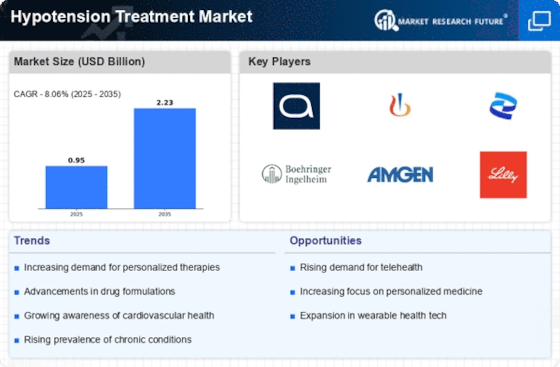
<p>The overall market valuation of the Hypotension Treatment Market was 0.95 USD Billion in 2024.</p>

What is the expected CAGR for the Hypotension Treatment Market during the forecast period 2025 - 2035?

<p>The expected CAGR for the Hypotension Treatment Market during the forecast period 2025 - 2035 is 8.06%.</p>

Which product segments are included in the Hypotension Treatment Market?

<p>The product segments in the Hypotension Treatment Market include Blood Pressure Transducers, Sphygmomanometers, and Blood Pressure Devices.</p>

What are the projected valuations for Blood Pressure Devices by 2035?

<p>The projected valuation for Blood Pressure Devices is expected to increase from 0.4 USD Billion to 0.9 USD Billion by 2035.</p>

How do diagnostic centers contribute to the Hypotension Treatment Market?

<p>Diagnostic Centers are projected to grow from 0.285 USD Billion to 0.645 USD Billion by 2035, indicating their significant role in the market.</p>

Who are the key players in the Hypotension Treatment Market?

Key players in the Hypotension Treatment Market include AbbVie, Novartis, Pfizer, Boehringer Ingelheim, and Amgen.

What is the expected growth trend for hospitals and clinics in the Hypotension Treatment Market?

Hospitals and Clinics are expected to see a valuation increase from 0.375 USD Billion to 0.939 USD Billion by 2035.

What is the significance of home care in the Hypotension Treatment Market?

Home Care is projected to grow from 0.285 USD Billion to 0.645 USD Billion by 2035, highlighting its importance in the treatment landscape.

How do the valuations of sphygmomanometers compare to other product segments?

Sphygmomanometers are expected to increase from 0.3 USD Billion to 0.7 USD Billion by 2035, reflecting a robust growth compared to other segments.

Market Summary

As per Market Research Future analysis, the Hypotension Treatment Market Size was estimated at 0.95 USD Billion in 2024. The Hypotension Treatment industry is projected to grow from USD 1.027 Billion in 2025 to USD 2.229 Billion by 2035, exhibiting a compound annual growth rate (CAGR) of 8.06% during the forecast period 2025 - 2035

Key Market Trends & Highlights

The Hypotension Treatment Market is experiencing a shift towards personalized and technology-driven solutions.

  • Personalized treatment approaches are gaining traction, reflecting a broader trend in healthcare.
  • The integration of technology in management is enhancing patient outcomes and monitoring capabilities.
  • Collaborative care models are becoming increasingly prevalent, particularly in North America.
  • Rising prevalence of hypotension and advancements in pharmaceutical research are driving market growth, especially in hospitals and clinics.

Market Size & Forecast

2024 Market Size 0.95 (USD Billion)
2035 Market Size 2.229 (USD Billion)
CAGR (2025 - 2035) 8.06%
Largest Regional Market Share in 2024 North America

Major Players

AbbVie (US), Novartis (CH), Pfizer (US), Boehringer Ingelheim (DE), Amgen (US), Eli Lilly (US), Sanofi (FR), AstraZeneca (GB), Teva Pharmaceutical Industries (IL)

Market Trends

The Hypotension Treatment Market is currently experiencing a notable evolution, driven by a combination of factors including an increasing awareness of health issues related to low blood pressure and advancements in medical technology. Healthcare providers are increasingly focusing on personalized treatment plans, which may enhance patient outcomes. Furthermore, the growing prevalence of chronic conditions that contribute to hypotension is likely to stimulate demand for effective treatment options. As a result, pharmaceutical companies are investing in research and development to create innovative therapies that address the unique needs of patients suffering from this condition. In addition, the market landscape appears to be shifting towards a more integrated approach, where multidisciplinary teams collaborate to manage hypotension effectively. This trend suggests a potential for improved patient care, as healthcare professionals from various specialties work together to devise comprehensive treatment strategies. Moreover, the rise of telemedicine and digital health solutions may facilitate better monitoring and management of hypotension, allowing for timely interventions. Overall, the Hypotension Treatment Market seems poised for growth, with a focus on enhancing patient experiences and outcomes through innovative solutions and collaborative care models.

Personalized Treatment Approaches

The Hypotension Treatment Market is witnessing a shift towards personalized treatment strategies. Healthcare providers are increasingly tailoring therapies to individual patient profiles, which may lead to improved efficacy and satisfaction. This trend reflects a broader movement in healthcare towards customized care.

Integration of Technology in Management

The integration of technology into the management of hypotension is becoming more prevalent. Digital health solutions, including telemedicine and mobile applications, are facilitating better patient monitoring and engagement. This technological advancement could enhance treatment adherence and outcomes.

Collaborative Care Models

There is a growing emphasis on collaborative care models within the Hypotension Treatment Market. Multidisciplinary teams are working together to address the complexities of hypotension, which may result in more comprehensive and effective treatment plans for patients.

Hypotension Treatment Market Market Drivers

Rising Prevalence of Hypotension

The increasing incidence of hypotension, particularly among the elderly population, is a primary driver of the Hypotension Treatment Market. As individuals age, the risk of developing low blood pressure escalates due to various factors such as comorbidities and polypharmacy. Recent studies indicate that approximately 20% of older adults experience some form of hypotension, necessitating effective treatment options. This growing demographic is likely to fuel demand for innovative therapies and management strategies within the Hypotension Treatment Market. Furthermore, the rising awareness of hypotension-related complications, such as falls and fainting, is prompting healthcare providers to prioritize early diagnosis and intervention, thereby expanding the market for hypotension treatments.

Advancements in Pharmaceutical Research

Innovations in pharmaceutical research are significantly influencing the Hypotension Treatment Market. The development of new medications, including vasopressors and mineralocorticoids, has enhanced treatment efficacy and safety profiles. Recent advancements have led to the introduction of combination therapies that target multiple pathways involved in blood pressure regulation. This diversification of treatment options is expected to cater to a broader patient population, including those with resistant hypotension. Market data suggests that the pharmaceutical segment of the Hypotension Treatment Market is projected to grow at a compound annual growth rate of 6% over the next five years, driven by ongoing research and clinical trials aimed at optimizing therapeutic outcomes.

Increased Focus on Preventive Healthcare

The shift towards preventive healthcare is reshaping the Hypotension Treatment Market. Healthcare systems are increasingly emphasizing early detection and management of hypotension to mitigate associated risks. This trend is reflected in the growing adoption of routine blood pressure monitoring and patient education initiatives. As healthcare providers recognize the importance of addressing hypotension proactively, the demand for effective treatment solutions is likely to rise. Additionally, the integration of wearable technology for continuous monitoring may further enhance patient engagement and adherence to treatment regimens. Consequently, this focus on prevention is expected to drive growth within the Hypotension Treatment Market, as stakeholders seek to improve patient outcomes and reduce healthcare costs.

Rising Awareness and Education Initiatives

The heightened awareness surrounding hypotension and its implications is a crucial driver for the Hypotension Treatment Market. Educational campaigns aimed at both healthcare professionals and the general public are fostering a better understanding of the condition. These initiatives are instrumental in promoting early diagnosis and appropriate management strategies. As awareness increases, patients are more likely to seek medical advice and treatment, thereby expanding the market. Furthermore, healthcare providers are increasingly incorporating hypotension management into their practice guidelines, which may lead to improved treatment adherence and outcomes. This growing emphasis on education is expected to contribute positively to the overall growth of the Hypotension Treatment Market.

Technological Innovations in Treatment Delivery

Technological advancements are revolutionizing treatment delivery methods within the Hypotension Treatment Market. The emergence of telemedicine and digital health platforms is facilitating remote monitoring and management of patients with hypotension. These innovations enable healthcare providers to offer personalized treatment plans and timely interventions, enhancing patient engagement. Additionally, the development of mobile applications for tracking symptoms and medication adherence is likely to empower patients in managing their condition. Market analysis indicates that the integration of technology in treatment delivery could lead to a more efficient healthcare system, ultimately driving growth in the Hypotension Treatment Market as patients benefit from improved access to care and tailored treatment options.

Market Segment Insights

By Product: Blood Pressure Transducers (Largest) vs. Sphygmomanometers (Fastest-Growing)

<p>In the Hypotension Treatment Market, Blood Pressure Transducers hold the largest share, dominating the product segment due to their widespread use in hospitals and medical facilities for real-time blood pressure monitoring. Sphygmomanometers, while currently smaller in market share, are quickly gaining traction owing to the rise in home healthcare and self-monitoring trends. Together, these products illustrate the diverse needs and evolving landscape in this segment.</p>

<p>Blood Pressure Transducers (Dominant) vs. Sphygmomanometers (Emerging)</p>

<p>Blood Pressure Transducers offer precision and efficiency in measuring blood pressure, making them indispensable in critical care and surgical settings. Their dominance stems from technological advancements and increasing demand for accuracy in hypotension management. Conversely, Sphygmomanometers represent an emerging segment, appealing to consumers looking for affordable and accessible blood pressure monitoring solutions for home use. This shift is propelled by a growing emphasis on preventive care and patient empowerment, alongside developments in device simplicity and user-friendliness. Together, these products shape the dynamics of the hypotension treatment market.</p>

By End User: Hospitals & Clinics (Largest) vs. Home Care (Fastest-Growing)

<p>In the Hypotension Treatment Market, the distribution of market share among end users shows a prominent position for Hospitals and Clinics, which account for a substantial portion of overall service utilization. With advanced facilities and a high patient intake, these institutions provide comprehensive diagnostics and treatments for hypotension, catering to a diverse patient demographic. On the other hand, Home Care is emerging as a significant segment, allowing patients to manage their conditions in a familiar environment, which promotes adherence to treatment protocols. The growth of the Hypotension Treatment Market end-user segments is driven by several factors. The increasing prevalence of chronic conditions leading to hypotension has highlighted the need for efficient and accessible diagnosis and management solutions. Additionally, the rising popularity of home healthcare services, especially following the global pandemic, is pushing Home Care to become the fastest-growing segment. This trend reflects a shift in patient preference towards convenient treatment options, supported by advancements in telemedicine and portable monitoring devices.</p>

<p>Hospitals & Clinics (Dominant) vs. Home Care (Emerging)</p>

<p>Hospitals and Clinics dominate the Hypotension Treatment Market due to their critical role in providing immediate and comprehensive care. These institutions are equipped with the latest technology and expertise necessary for diagnosing and treating hypotension effectively. They handle a significant volume of cases, often managing patients with comorbidities that require advanced interventions. Their structured protocols for treatment also ensure better patient outcomes. In contrast, Home Care is an emerging segment that appeals to patients seeking personalized and convenient treatment options. This segment is characterized by tailored care plans that allow patients to receive treatment in their homes while maintaining independence. The rise in portable healthcare technology and telehealth services supports this trend, enabling patients to engage in self-management while having access to professional guidance.</p>

Get more detailed insights about Hypotension Treatment Market Research Report - Global Forecast till 2035

Regional Insights

North America : Leading Market for Treatments

North America is the largest market for hypotension treatments, accounting for approximately 45% of the global market share. The region's growth is driven by increasing prevalence of chronic diseases, an aging population, and advancements in healthcare technology. Regulatory support from agencies like the FDA further catalyzes market expansion, ensuring the availability of innovative treatment options. The demand for effective hypotension management solutions is on the rise, fueled by heightened awareness and improved healthcare access. The United States leads the North American market, followed by Canada, with significant contributions from key players such as AbbVie, Pfizer, and Eli Lilly. The competitive landscape is characterized by a mix of established pharmaceutical companies and emerging biotech firms, all striving to innovate and capture market share. The presence of robust healthcare infrastructure and investment in research and development enhances the region's attractiveness for hypotension treatment solutions.

Europe : Regulatory Framework Enhances Growth

Europe is the second-largest market for hypotension treatments, holding around 30% of the global market share. The region's growth is propelled by increasing healthcare expenditure, a rising geriatric population, and supportive regulatory frameworks. The European Medicines Agency (EMA) plays a crucial role in facilitating the approval of new therapies, thereby enhancing market dynamics. Additionally, the growing awareness of hypotension-related health issues is driving demand for effective treatment options across member states. Germany, France, and the UK are the leading countries in this market, with a strong presence of key players like Novartis and Boehringer Ingelheim. The competitive landscape is marked by collaborations between pharmaceutical companies and healthcare providers, aimed at improving patient outcomes. The focus on innovative therapies and personalized medicine is expected to further boost market growth in the coming years.

Asia-Pacific : Emerging Market with Potential

The Asia-Pacific region is rapidly emerging as a significant market for hypotension treatments, currently holding about 20% of the global market share. Factors such as increasing urbanization, rising disposable incomes, and a growing awareness of health issues are driving demand. Additionally, government initiatives aimed at improving healthcare access and affordability are expected to further stimulate market growth. The region's diverse population presents unique challenges and opportunities for tailored treatment solutions. China and India are the leading countries in this market, with substantial investments in healthcare infrastructure and pharmaceutical research. The competitive landscape features both multinational corporations and local players, including Teva Pharmaceutical Industries and Amgen. As the region continues to develop economically, the demand for effective hypotension treatments is anticipated to rise, supported by ongoing innovations and collaborations in the healthcare sector.

Middle East and Africa : Untapped Market Opportunities

The Middle East and Africa region represents an emerging market for hypotension treatments, currently accounting for approximately 5% of the global market share. The growth in this region is driven by increasing healthcare investments, a rising prevalence of lifestyle-related diseases, and improving healthcare infrastructure. Regulatory bodies are beginning to implement frameworks that support the introduction of new therapies, which is expected to enhance market dynamics in the coming years. Countries like South Africa and the UAE are at the forefront of this market, with a growing presence of key players such as Sanofi and AstraZeneca. The competitive landscape is evolving, with local manufacturers and international companies collaborating to address the unique healthcare needs of the region. As awareness of hypotension and its treatments increases, the market is poised for significant growth, driven by both demand and innovation.

Key Players and Competitive Insights

Leading market companies are extensively spending R&D on increasing their product lines, which will help the Hypotension Treatment Market grow even more. Important market developments include new product releases, acquisitions and mergers, contractual agreements, greater investments, and collaboration with other organizations. The Hypotension Treatment industry must produce cost-effective merchandise to flourish and thrive in a more competitive and increasing market climate.Manufacturing locally to reduce operating costs is an effective business strategy manufacturers use in the worldwide Hypotension Treatment industry to serve clients and expand the market sector. The Hypotension Treatment industry has provided some of the most important benefits recently. Church & Dwight., Colgate-Palmolive, and other major companies in the Hypotension Treatment Market are aiming to enhance market demand by investing in research and development activities.Lupin is based in Mumbai, India, an international pharmaceutical firm focusing on innovation. The company creates and promotes a wide variety of branded and biotechnology products, generic formulations, and APIs in more than 100 markets in the Middle East, Asia Pacific, Europe, Latin America, and the United States, including South Africa, India, and the United States. In addition to having a strong presence in the anti-infective, gastrointestinal (GI), central nervous system (CNS), and women's health sectors, the company holds a leadership position in the anti-diabetic, cardiovascular, and respiratory segments.According to prescriptions, Lupin is the third-largest pharmaceutical firm in the US. In fiscal year 2021, the firm spent 9.6% of its sales on R&D.

In June The United States FDA has given Droxidopa Capsules, 200 mg, 100 mg, and 300 mg, the green light to go on the market.

Key Companies in the Hypotension Treatment Market include

Industry Developments

March 2022: The EMA has given Moxetumomab pasudotox-tdfk orphan medication status for treating adult orthostatic hypotension. Drugs meant to treat uncommon disorders are assigned this classification.

February 2022: Midodrine (Orvaten) now has a new FDA-approved use: treating orthostatic hypotension in kids 6 to 11. A drug called midodrine can assist in tightening blood vessels, which can help to lower blood pressure. Until recently, only persons with orthostatic hypotension were eligible for its use.

Future Outlook

Hypotension Treatment Market Future Outlook

The Hypotension Treatment Market is projected to grow at 8.06% CAGR from 2025 to 2035, driven by increasing prevalence of chronic diseases and advancements in treatment technologies.

New opportunities lie in:

  • Development of personalized hypotension management apps
  • Expansion of telehealth services for remote monitoring
  • Investment in innovative drug delivery systems for hypotension treatments

By 2035, the market is expected to achieve substantial growth, reflecting evolving treatment paradigms and increased patient engagement.

Market Segmentation

Hypotension Treatment Market Product Outlook

  • Blood Pressure Transducers
  • Sphygmomanometers
  • Blood Pressure Devices

Hypotension Treatment Market End User Outlook

  • Diagnostic Centers
  • Home Care
  • Hospitals & Clinics

Report Scope

MARKET SIZE 2024 0.95(USD Billion)
MARKET SIZE 2025 1.027(USD Billion)
MARKET SIZE 2035 2.229(USD Billion)
COMPOUND ANNUAL GROWTH RATE (CAGR) 8.06% (2025 - 2035)
REPORT COVERAGE Revenue Forecast, Competitive Landscape, Growth Factors, and Trends
BASE YEAR 2024
Market Forecast Period 2025 - 2035
Historical Data 2019 - 2024
Market Forecast Units USD Billion
Key Companies Profiled AbbVie (US), Novartis (CH), Pfizer (US), Boehringer Ingelheim (DE), Amgen (US), Eli Lilly (US), Sanofi (FR), AstraZeneca (GB), Teva Pharmaceutical Industries (IL)
Segments Covered Products, End-Users, Region
Key Market Opportunities Integration of wearable technology for real-time monitoring of hypotension symptoms.
Key Market Dynamics Rising demand for innovative therapies drives competition and regulatory scrutiny in the hypotension treatment market.
Countries Covered North America, Europe, APAC, South America, MEA

FAQs

What is the projected market valuation of the Hypotension Treatment Market by 2035?

<p>The projected market valuation for the Hypotension Treatment Market is expected to reach 2.229 USD Billion by 2035.</p>

What was the market valuation of the Hypotension Treatment Market in 2024?

<p>The overall market valuation of the Hypotension Treatment Market was 0.95 USD Billion in 2024.</p>

What is the expected CAGR for the Hypotension Treatment Market during the forecast period 2025 - 2035?

<p>The expected CAGR for the Hypotension Treatment Market during the forecast period 2025 - 2035 is 8.06%.</p>

Which product segments are included in the Hypotension Treatment Market?

<p>The product segments in the Hypotension Treatment Market include Blood Pressure Transducers, Sphygmomanometers, and Blood Pressure Devices.</p>

What are the projected valuations for Blood Pressure Devices by 2035?

<p>The projected valuation for Blood Pressure Devices is expected to increase from 0.4 USD Billion to 0.9 USD Billion by 2035.</p>

How do diagnostic centers contribute to the Hypotension Treatment Market?

<p>Diagnostic Centers are projected to grow from 0.285 USD Billion to 0.645 USD Billion by 2035, indicating their significant role in the market.</p>

Who are the key players in the Hypotension Treatment Market?

Key players in the Hypotension Treatment Market include AbbVie, Novartis, Pfizer, Boehringer Ingelheim, and Amgen.

What is the expected growth trend for hospitals and clinics in the Hypotension Treatment Market?

Hospitals and Clinics are expected to see a valuation increase from 0.375 USD Billion to 0.939 USD Billion by 2035.

What is the significance of home care in the Hypotension Treatment Market?

Home Care is projected to grow from 0.285 USD Billion to 0.645 USD Billion by 2035, highlighting its importance in the treatment landscape.

How do the valuations of sphygmomanometers compare to other product segments?

Sphygmomanometers are expected to increase from 0.3 USD Billion to 0.7 USD Billion by 2035, reflecting a robust growth compared to other segments.

  1. SECTION I: EXECUTIVE SUMMARY AND KEY HIGHLIGHTS
    1. | 1.1 EXECUTIVE SUMMARY
    2. | | 1.1.1 Market Overview
    3. | | 1.1.2 Key Findings
    4. | | 1.1.3 Market Segmentation
    5. | | 1.1.4 Competitive Landscape
    6. | | 1.1.5 Challenges and Opportunities
    7. | | 1.1.6 Future Outlook
  2. SECTION II: SCOPING, METHODOLOGY AND MARKET STRUCTURE
    1. | 2.1 MARKET INTRODUCTION
    2. | | 2.1.1 Definition
    3. | | 2.1.2 Scope of the study
    4. | | | 2.1.2.1 Research Objective
    5. | | | 2.1.2.2 Assumption
    6. | | | 2.1.2.3 Limitations
    7. | 2.2 RESEARCH METHODOLOGY
    8. | | 2.2.1 Overview
    9. | | 2.2.2 Data Mining
    10. | | 2.2.3 Secondary Research
    11. | | 2.2.4 Primary Research
    12. | | | 2.2.4.1 Primary Interviews and Information Gathering Process
    13. | | | 2.2.4.2 Breakdown of Primary Respondents
    14. | | 2.2.5 Forecasting Model
    15. | | 2.2.6 Market Size Estimation
    16. | | | 2.2.6.1 Bottom-Up Approach
    17. | | | 2.2.6.2 Top-Down Approach
    18. | | 2.2.7 Data Triangulation
    19. | | 2.2.8 Validation
  3. SECTION III: QUALITATIVE ANALYSIS
    1. | 3.1 MARKET DYNAMICS
    2. | | 3.1.1 Overview
    3. | | 3.1.2 Drivers
    4. | | 3.1.3 Restraints
    5. | | 3.1.4 Opportunities
    6. | 3.2 MARKET FACTOR ANALYSIS
    7. | | 3.2.1 Value chain Analysis
    8. | | 3.2.2 Porter's Five Forces Analysis
    9. | | | 3.2.2.1 Bargaining Power of Suppliers
    10. | | | 3.2.2.2 Bargaining Power of Buyers
    11. | | | 3.2.2.3 Threat of New Entrants
    12. | | | 3.2.2.4 Threat of Substitutes
    13. | | | 3.2.2.5 Intensity of Rivalry
    14. | | 3.2.3 COVID-19 Impact Analysis
    15. | | | 3.2.3.1 Market Impact Analysis
    16. | | | 3.2.3.2 Regional Impact
    17. | | | 3.2.3.3 Opportunity and Threat Analysis
  4. SECTION IV: QUANTITATIVE ANALYSIS
    1. | 4.1 Healthcare, BY Product (USD Billion)
    2. | | 4.1.1 Blood Pressure Transducers
    3. | | 4.1.2 Sphygmomanometers
    4. | | 4.1.3 Blood Pressure Devices
    5. | 4.2 Healthcare, BY End User (USD Billion)
    6. | | 4.2.1 Diagnostic Centers
    7. | | 4.2.2 Home Care
    8. | | 4.2.3 Hospitals & Clinics
    9. | 4.3 Healthcare, BY Region (USD Billion)
    10. | | 4.3.1 North America
    11. | | | 4.3.1.1 US
    12. | | | 4.3.1.2 Canada
    13. | | 4.3.2 Europe
    14. | | | 4.3.2.1 Germany
    15. | | | 4.3.2.2 UK
    16. | | | 4.3.2.3 France
    17. | | | 4.3.2.4 Russia
    18. | | | 4.3.2.5 Italy
    19. | | | 4.3.2.6 Spain
    20. | | | 4.3.2.7 Rest of Europe
    21. | | 4.3.3 APAC
    22. | | | 4.3.3.1 China
    23. | | | 4.3.3.2 India
    24. | | | 4.3.3.3 Japan
    25. | | | 4.3.3.4 South Korea
    26. | | | 4.3.3.5 Malaysia
    27. | | | 4.3.3.6 Thailand
    28. | | | 4.3.3.7 Indonesia
    29. | | | 4.3.3.8 Rest of APAC
    30. | | 4.3.4 South America
    31. | | | 4.3.4.1 Brazil
    32. | | | 4.3.4.2 Mexico
    33. | | | 4.3.4.3 Argentina
    34. | | | 4.3.4.4 Rest of South America
    35. | | 4.3.5 MEA
    36. | | | 4.3.5.1 GCC Countries
    37. | | | 4.3.5.2 South Africa
    38. | | | 4.3.5.3 Rest of MEA
  5. SECTION V: COMPETITIVE ANALYSIS
    1. | 5.1 Competitive Landscape
    2. | | 5.1.1 Overview
    3. | | 5.1.2 Competitive Analysis
    4. | | 5.1.3 Market share Analysis
    5. | | 5.1.4 Major Growth Strategy in the Healthcare
    6. | | 5.1.5 Competitive Benchmarking
    7. | | 5.1.6 Leading Players in Terms of Number of Developments in the Healthcare
    8. | | 5.1.7 Key developments and growth strategies
    9. | | | 5.1.7.1 New Product Launch/Service Deployment
    10. | | | 5.1.7.2 Merger & Acquisitions
    11. | | | 5.1.7.3 Joint Ventures
    12. | | 5.1.8 Major Players Financial Matrix
    13. | | | 5.1.8.1 Sales and Operating Income
    14. | | | 5.1.8.2 Major Players R&D Expenditure. 2023
    15. | 5.2 Company Profiles
    16. | | 5.2.1 AbbVie (US)
    17. | | | 5.2.1.1 Financial Overview
    18. | | | 5.2.1.2 Products Offered
    19. | | | 5.2.1.3 Key Developments
    20. | | | 5.2.1.4 SWOT Analysis
    21. | | | 5.2.1.5 Key Strategies
    22. | | 5.2.2 Novartis (CH)
    23. | | | 5.2.2.1 Financial Overview
    24. | | | 5.2.2.2 Products Offered
    25. | | | 5.2.2.3 Key Developments
    26. | | | 5.2.2.4 SWOT Analysis
    27. | | | 5.2.2.5 Key Strategies
    28. | | 5.2.3 Pfizer (US)
    29. | | | 5.2.3.1 Financial Overview
    30. | | | 5.2.3.2 Products Offered
    31. | | | 5.2.3.3 Key Developments
    32. | | | 5.2.3.4 SWOT Analysis
    33. | | | 5.2.3.5 Key Strategies
    34. | | 5.2.4 Boehringer Ingelheim (DE)
    35. | | | 5.2.4.1 Financial Overview
    36. | | | 5.2.4.2 Products Offered
    37. | | | 5.2.4.3 Key Developments
    38. | | | 5.2.4.4 SWOT Analysis
    39. | | | 5.2.4.5 Key Strategies
    40. | | 5.2.5 Amgen (US)
    41. | | | 5.2.5.1 Financial Overview
    42. | | | 5.2.5.2 Products Offered
    43. | | | 5.2.5.3 Key Developments
    44. | | | 5.2.5.4 SWOT Analysis
    45. | | | 5.2.5.5 Key Strategies
    46. | | 5.2.6 Eli Lilly (US)
    47. | | | 5.2.6.1 Financial Overview
    48. | | | 5.2.6.2 Products Offered
    49. | | | 5.2.6.3 Key Developments
    50. | | | 5.2.6.4 SWOT Analysis
    51. | | | 5.2.6.5 Key Strategies
    52. | | 5.2.7 Sanofi (FR)
    53. | | | 5.2.7.1 Financial Overview
    54. | | | 5.2.7.2 Products Offered
    55. | | | 5.2.7.3 Key Developments
    56. | | | 5.2.7.4 SWOT Analysis
    57. | | | 5.2.7.5 Key Strategies
    58. | | 5.2.8 AstraZeneca (GB)
    59. | | | 5.2.8.1 Financial Overview
    60. | | | 5.2.8.2 Products Offered
    61. | | | 5.2.8.3 Key Developments
    62. | | | 5.2.8.4 SWOT Analysis
    63. | | | 5.2.8.5 Key Strategies
    64. | | 5.2.9 Teva Pharmaceutical Industries (IL)
    65. | | | 5.2.9.1 Financial Overview
    66. | | | 5.2.9.2 Products Offered
    67. | | | 5.2.9.3 Key Developments
    68. | | | 5.2.9.4 SWOT Analysis
    69. | | | 5.2.9.5 Key Strategies
    70. | 5.3 Appendix
    71. | | 5.3.1 References
    72. | | 5.3.2 Related Reports
  6. LIST OF FIGURES
    1. | 6.1 MARKET SYNOPSIS
    2. | 6.2 NORTH AMERICA MARKET ANALYSIS
    3. | 6.3 US MARKET ANALYSIS BY PRODUCT
    4. | 6.4 US MARKET ANALYSIS BY END USER
    5. | 6.5 CANADA MARKET ANALYSIS BY PRODUCT
    6. | 6.6 CANADA MARKET ANALYSIS BY END USER
    7. | 6.7 EUROPE MARKET ANALYSIS
    8. | 6.8 GERMANY MARKET ANALYSIS BY PRODUCT
    9. | 6.9 GERMANY MARKET ANALYSIS BY END USER
    10. | 6.10 UK MARKET ANALYSIS BY PRODUCT
    11. | 6.11 UK MARKET ANALYSIS BY END USER
    12. | 6.12 FRANCE MARKET ANALYSIS BY PRODUCT
    13. | 6.13 FRANCE MARKET ANALYSIS BY END USER
    14. | 6.14 RUSSIA MARKET ANALYSIS BY PRODUCT
    15. | 6.15 RUSSIA MARKET ANALYSIS BY END USER
    16. | 6.16 ITALY MARKET ANALYSIS BY PRODUCT
    17. | 6.17 ITALY MARKET ANALYSIS BY END USER
    18. | 6.18 SPAIN MARKET ANALYSIS BY PRODUCT
    19. | 6.19 SPAIN MARKET ANALYSIS BY END USER
    20. | 6.20 REST OF EUROPE MARKET ANALYSIS BY PRODUCT
    21. | 6.21 REST OF EUROPE MARKET ANALYSIS BY END USER
    22. | 6.22 APAC MARKET ANALYSIS
    23. | 6.23 CHINA MARKET ANALYSIS BY PRODUCT
    24. | 6.24 CHINA MARKET ANALYSIS BY END USER
    25. | 6.25 INDIA MARKET ANALYSIS BY PRODUCT
    26. | 6.26 INDIA MARKET ANALYSIS BY END USER
    27. | 6.27 JAPAN MARKET ANALYSIS BY PRODUCT
    28. | 6.28 JAPAN MARKET ANALYSIS BY END USER
    29. | 6.29 SOUTH KOREA MARKET ANALYSIS BY PRODUCT
    30. | 6.30 SOUTH KOREA MARKET ANALYSIS BY END USER
    31. | 6.31 MALAYSIA MARKET ANALYSIS BY PRODUCT
    32. | 6.32 MALAYSIA MARKET ANALYSIS BY END USER
    33. | 6.33 THAILAND MARKET ANALYSIS BY PRODUCT
    34. | 6.34 THAILAND MARKET ANALYSIS BY END USER
    35. | 6.35 INDONESIA MARKET ANALYSIS BY PRODUCT
    36. | 6.36 INDONESIA MARKET ANALYSIS BY END USER
    37. | 6.37 REST OF APAC MARKET ANALYSIS BY PRODUCT
    38. | 6.38 REST OF APAC MARKET ANALYSIS BY END USER
    39. | 6.39 SOUTH AMERICA MARKET ANALYSIS
    40. | 6.40 BRAZIL MARKET ANALYSIS BY PRODUCT
    41. | 6.41 BRAZIL MARKET ANALYSIS BY END USER
    42. | 6.42 MEXICO MARKET ANALYSIS BY PRODUCT
    43. | 6.43 MEXICO MARKET ANALYSIS BY END USER
    44. | 6.44 ARGENTINA MARKET ANALYSIS BY PRODUCT
    45. | 6.45 ARGENTINA MARKET ANALYSIS BY END USER
    46. | 6.46 REST OF SOUTH AMERICA MARKET ANALYSIS BY PRODUCT
    47. | 6.47 REST OF SOUTH AMERICA MARKET ANALYSIS BY END USER
    48. | 6.48 MEA MARKET ANALYSIS
    49. | 6.49 GCC COUNTRIES MARKET ANALYSIS BY PRODUCT
    50. | 6.50 GCC COUNTRIES MARKET ANALYSIS BY END USER
    51. | 6.51 SOUTH AFRICA MARKET ANALYSIS BY PRODUCT
    52. | 6.52 SOUTH AFRICA MARKET ANALYSIS BY END USER
    53. | 6.53 REST OF MEA MARKET ANALYSIS BY PRODUCT
    54. | 6.54 REST OF MEA MARKET ANALYSIS BY END USER
    55. | 6.55 KEY BUYING CRITERIA OF HEALTHCARE
    56. | 6.56 RESEARCH PROCESS OF MRFR
    57. | 6.57 DRO ANALYSIS OF HEALTHCARE
    58. | 6.58 DRIVERS IMPACT ANALYSIS: HEALTHCARE
    59. | 6.59 RESTRAINTS IMPACT ANALYSIS: HEALTHCARE
    60. | 6.60 SUPPLY / VALUE CHAIN: HEALTHCARE
    61. | 6.61 HEALTHCARE, BY PRODUCT, 2024 (% SHARE)
    62. | 6.62 HEALTHCARE, BY PRODUCT, 2024 TO 2035 (USD Billion)
    63. | 6.63 HEALTHCARE, BY END USER, 2024 (% SHARE)
    64. | 6.64 HEALTHCARE, BY END USER, 2024 TO 2035 (USD Billion)
    65. | 6.65 BENCHMARKING OF MAJOR COMPETITORS
  7. LIST OF TABLES
    1. | 7.1 LIST OF ASSUMPTIONS
    2. | | 7.1.1
    3. | 7.2 North America MARKET SIZE ESTIMATES; FORECAST
    4. | | 7.2.1 BY PRODUCT, 2025-2035 (USD Billion)
    5. | | 7.2.2 BY END USER, 2025-2035 (USD Billion)
    6. | 7.3 US MARKET SIZE ESTIMATES; FORECAST
    7. | | 7.3.1 BY PRODUCT, 2025-2035 (USD Billion)
    8. | | 7.3.2 BY END USER, 2025-2035 (USD Billion)
    9. | 7.4 Canada MARKET SIZE ESTIMATES; FORECAST
    10. | | 7.4.1 BY PRODUCT, 2025-2035 (USD Billion)
    11. | | 7.4.2 BY END USER, 2025-2035 (USD Billion)
    12. | 7.5 Europe MARKET SIZE ESTIMATES; FORECAST
    13. | | 7.5.1 BY PRODUCT, 2025-2035 (USD Billion)
    14. | | 7.5.2 BY END USER, 2025-2035 (USD Billion)
    15. | 7.6 Germany MARKET SIZE ESTIMATES; FORECAST
    16. | | 7.6.1 BY PRODUCT, 2025-2035 (USD Billion)
    17. | | 7.6.2 BY END USER, 2025-2035 (USD Billion)
    18. | 7.7 UK MARKET SIZE ESTIMATES; FORECAST
    19. | | 7.7.1 BY PRODUCT, 2025-2035 (USD Billion)
    20. | | 7.7.2 BY END USER, 2025-2035 (USD Billion)
    21. | 7.8 France MARKET SIZE ESTIMATES; FORECAST
    22. | | 7.8.1 BY PRODUCT, 2025-2035 (USD Billion)
    23. | | 7.8.2 BY END USER, 2025-2035 (USD Billion)
    24. | 7.9 Russia MARKET SIZE ESTIMATES; FORECAST
    25. | | 7.9.1 BY PRODUCT, 2025-2035 (USD Billion)
    26. | | 7.9.2 BY END USER, 2025-2035 (USD Billion)
    27. | 7.10 Italy MARKET SIZE ESTIMATES; FORECAST
    28. | | 7.10.1 BY PRODUCT, 2025-2035 (USD Billion)
    29. | | 7.10.2 BY END USER, 2025-2035 (USD Billion)
    30. | 7.11 Spain MARKET SIZE ESTIMATES; FORECAST
    31. | | 7.11.1 BY PRODUCT, 2025-2035 (USD Billion)
    32. | | 7.11.2 BY END USER, 2025-2035 (USD Billion)
    33. | 7.12 Rest of Europe MARKET SIZE ESTIMATES; FORECAST
    34. | | 7.12.1 BY PRODUCT, 2025-2035 (USD Billion)
    35. | | 7.12.2 BY END USER, 2025-2035 (USD Billion)
    36. | 7.13 APAC MARKET SIZE ESTIMATES; FORECAST
    37. | | 7.13.1 BY PRODUCT, 2025-2035 (USD Billion)
    38. | | 7.13.2 BY END USER, 2025-2035 (USD Billion)
    39. | 7.14 China MARKET SIZE ESTIMATES; FORECAST
    40. | | 7.14.1 BY PRODUCT, 2025-2035 (USD Billion)
    41. | | 7.14.2 BY END USER, 2025-2035 (USD Billion)
    42. | 7.15 India MARKET SIZE ESTIMATES; FORECAST
    43. | | 7.15.1 BY PRODUCT, 2025-2035 (USD Billion)
    44. | | 7.15.2 BY END USER, 2025-2035 (USD Billion)
    45. | 7.16 Japan MARKET SIZE ESTIMATES; FORECAST
    46. | | 7.16.1 BY PRODUCT, 2025-2035 (USD Billion)
    47. | | 7.16.2 BY END USER, 2025-2035 (USD Billion)
    48. | 7.17 South Korea MARKET SIZE ESTIMATES; FORECAST
    49. | | 7.17.1 BY PRODUCT, 2025-2035 (USD Billion)
    50. | | 7.17.2 BY END USER, 2025-2035 (USD Billion)
    51. | 7.18 Malaysia MARKET SIZE ESTIMATES; FORECAST
    52. | | 7.18.1 BY PRODUCT, 2025-2035 (USD Billion)
    53. | | 7.18.2 BY END USER, 2025-2035 (USD Billion)
    54. | 7.19 Thailand MARKET SIZE ESTIMATES; FORECAST
    55. | | 7.19.1 BY PRODUCT, 2025-2035 (USD Billion)
    56. | | 7.19.2 BY END USER, 2025-2035 (USD Billion)
    57. | 7.20 Indonesia MARKET SIZE ESTIMATES; FORECAST
    58. | | 7.20.1 BY PRODUCT, 2025-2035 (USD Billion)
    59. | | 7.20.2 BY END USER, 2025-2035 (USD Billion)
    60. | 7.21 Rest of APAC MARKET SIZE ESTIMATES; FORECAST
    61. | | 7.21.1 BY PRODUCT, 2025-2035 (USD Billion)
    62. | | 7.21.2 BY END USER, 2025-2035 (USD Billion)
    63. | 7.22 South America MARKET SIZE ESTIMATES; FORECAST
    64. | | 7.22.1 BY PRODUCT, 2025-2035 (USD Billion)
    65. | | 7.22.2 BY END USER, 2025-2035 (USD Billion)
    66. | 7.23 Brazil MARKET SIZE ESTIMATES; FORECAST
    67. | | 7.23.1 BY PRODUCT, 2025-2035 (USD Billion)
    68. | | 7.23.2 BY END USER, 2025-2035 (USD Billion)
    69. | 7.24 Mexico MARKET SIZE ESTIMATES; FORECAST
    70. | | 7.24.1 BY PRODUCT, 2025-2035 (USD Billion)
    71. | | 7.24.2 BY END USER, 2025-2035 (USD Billion)
    72. | 7.25 Argentina MARKET SIZE ESTIMATES; FORECAST
    73. | | 7.25.1 BY PRODUCT, 2025-2035 (USD Billion)
    74. | | 7.25.2 BY END USER, 2025-2035 (USD Billion)
    75. | 7.26 Rest of South America MARKET SIZE ESTIMATES; FORECAST
    76. | | 7.26.1 BY PRODUCT, 2025-2035 (USD Billion)
    77. | | 7.26.2 BY END USER, 2025-2035 (USD Billion)
    78. | 7.27 MEA MARKET SIZE ESTIMATES; FORECAST
    79. | | 7.27.1 BY PRODUCT, 2025-2035 (USD Billion)
    80. | | 7.27.2 BY END USER, 2025-2035 (USD Billion)
    81. | 7.28 GCC Countries MARKET SIZE ESTIMATES; FORECAST
    82. | | 7.28.1 BY PRODUCT, 2025-2035 (USD Billion)
    83. | | 7.28.2 BY END USER, 2025-2035 (USD Billion)
    84. | 7.29 South Africa MARKET SIZE ESTIMATES; FORECAST
    85. | | 7.29.1 BY PRODUCT, 2025-2035 (USD Billion)
    86. | | 7.29.2 BY END USER, 2025-2035 (USD Billion)
    87. | 7.30 Rest of MEA MARKET SIZE ESTIMATES; FORECAST
    88. | | 7.30.1 BY PRODUCT, 2025-2035 (USD Billion)
    89. | | 7.30.2 BY END USER, 2025-2035 (USD Billion)
    90. | 7.31 PRODUCT LAUNCH/PRODUCT DEVELOPMENT/APPROVAL
    91. | | 7.31.1
    92. | 7.32 ACQUISITION/PARTNERSHIP
    93. | | 7.32.1

Healthcare Market Segmentation

Healthcare By Product (USD Billion, 2025-2035)

  • Blood Pressure Transducers
  • Sphygmomanometers
  • Blood Pressure Devices

Healthcare By End User (USD Billion, 2025-2035)

  • Diagnostic Centers
  • Home Care
  • Hospitals & Clinics
Infographic

Free Sample Request

Kindly complete the form below to receive a free sample of this Report

Get Free Sample

Customer Strories

Compare Licence

×
Features License Type
Single User Multiuser License Enterprise User
Price $4,950 $5,950 $7,250
Maximum User Access Limit 1 User Upto 10 Users Unrestricted Access Throughout the Organization
Free Customization
Direct Access to Analyst
Deliverable Format
Platform Access
Discount on Next Purchase 10% 15% 15%
Printable Versions