×
Hero Background
English
Chinese
French
Japanese
Korean
German
Spanish

Heart Rate Monitor Market Analysis

ID: MRFR/MED/0862-CR
110 Pages
Rahul Gotadki
February 2021

Heart Rate Monitor Market Share Analysis And Growth By Type (Wearable (Chest Strap, Wrist Strap, Strapless), Non-Wearable), Indication (Sports, Medical) End Users (Hospital & Clinics, Sport Medicine Centers, Professionals, Individuals) – Forecast Till 2035

Share:
Download PDF ×

We do not share your information with anyone. However, we may send you emails based on your report interest from time to time. You may contact us at any time to opt-out.

Heart Rate Monitor Market Infographic
Purchase Options

Market Analysis

In-depth Analysis of Heart Rate Monitor Market Industry Landscape

The Heart Rate Monitor market is witnessing dynamic trends that reflect the increasing emphasis on personal health and fitness. One significant trend driving the market is the growing awareness of the importance of monitoring heart rate for overall well-being. As individuals become more health-conscious, there is a rising demand for wearable devices equipped with heart rate monitoring capabilities. These devices, ranging from smartwatches to fitness trackers, provide users with real-time data on their heart rates, enabling them to make informed decisions about their physical activities and health.

Technological advancements play a pivotal role in shaping the market trends of Heart Rate Monitors. Continuous innovations in sensor technology, signal processing, and connectivity have led to more accurate and reliable heart rate monitoring devices. The integration of advanced features such as sleep tracking, stress monitoring, and GPS functionality further enhances the value proposition of these devices, catering to a broader spectrum of health and fitness needs. As a result, consumers are increasingly inclined to invest in Heart Rate Monitors that offer a comprehensive set of features for a holistic approach to health management.

The market is also witnessing a shift towards personalized and adaptive health monitoring. With the help of artificial intelligence and machine learning algorithms, Heart Rate Monitors can analyze individual patterns and provide personalized insights and recommendations. This trend aligns with the broader movement towards precision health, where healthcare and wellness strategies are tailored to an individual's unique characteristics and needs. The ability of Heart Rate Monitors to adapt to users' evolving health goals and provide personalized guidance positions them as essential tools in the modern approach to proactive health management.

Moreover, the integration of Heart Rate Monitors into the healthcare ecosystem is a notable trend. Healthcare professionals are increasingly recognizing the value of continuous and remote heart rate monitoring for managing chronic conditions and post-treatment recovery. The ability of Heart Rate Monitors to transmit real-time data to healthcare providers allows for more proactive and timely interventions, contributing to improved patient outcomes. This trend indicates a growing convergence of consumer health technology and clinical applications, expanding the role of Heart Rate Monitors in the broader healthcare landscape.

The market is witnessing a proliferation of diverse form factors and designs in Heart Rate Monitors, catering to different user preferences and lifestyles. From chest straps and finger sensors to wrist-worn devices, consumers have a wide array of options to choose from based on their comfort and usability preferences. This diversity in product offerings contributes to the democratization of heart rate monitoring, making these devices accessible to a broad spectrum of users with varying needs and preferences.


Author
Rahul Gotadki
Assistant Manager

He holds an experience of about 7+ years in Market Research and Business Consulting, working under the spectrum of Life Sciences and Healthcare domains. Rahul conceptualizes and implements a scalable business strategy and provides strategic leadership to the clients. His expertise lies in market estimation, competitive intelligence, pipeline analysis, customer assessment, etc. In addition to the above, his other responsibility includes strategic tracking of high growth markets & advising clients on the potential areas of focus they could direct their business initiatives

Leave a Comment

FAQs

What is the projected heart rate monitors market valuation by 2030?

The projected heart rate monitors market would grow up to a valuation of USD 13.3 Billion by 2032.

What would be the CAGR of the heart rate monitors market for the forecast period of 2022-2030?

Heart Rate Monitors market has a chance to record 5.3% CAGR during the forecast period.

What are the type-based segments included in the heart rate monitors market report?

The type-based segmentation includes wearable and non-wearable devices.

What are the applications included in the heart rate monitors market report?

The discussed applications are sports, medical, and others.

Name the end users studied in the heart rate monitors market report?

The end users are sport medicine centers, hospitals & clinics, individuals, professionals, and others.

What is the projected valuation of the heart rate monitor market by 2023?

USD 4118.08 Million by the end of 2023

What are the applications included in the heart rate monitor market report?

What are the applications included in the heart rate monitor market report?

Market Summary

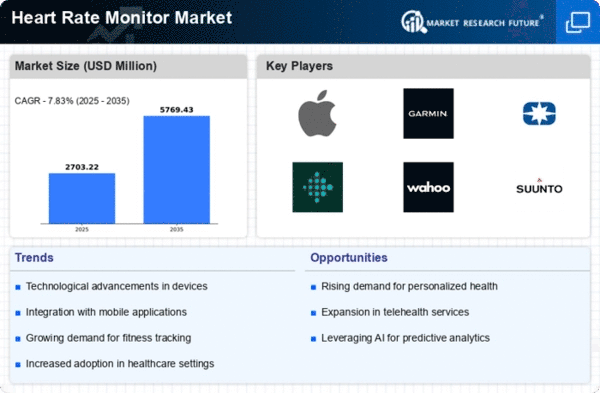
As per MRFR analysis, the Heart Rate Monitor Market Size was estimated at 2506.93 USD Million in 2024. The Heart Rate Monitor industry is projected to grow from 2731.94 in 2025 to 5769.43 by 2035, exhibiting a compound annual growth rate (CAGR) of 7.83 during the forecast period 2025 - 2035.

Key Market Trends & Highlights

The Heart Rate Monitor Market is experiencing robust growth driven by technological advancements and increasing health consciousness.

  • Technological advancements are enhancing the accuracy and functionality of heart rate monitors, appealing to a broader consumer base.
  • Integration with health platforms is becoming a standard feature, facilitating seamless data sharing and user engagement.
  • In North America, the market remains the largest, while the Asia-Pacific region is emerging as the fastest-growing market for heart rate monitors.
  • Rising health consciousness and a focus on preventive healthcare are key drivers propelling the demand in both fitness tracking and medical monitoring segments.

Market Size & Forecast

2024 Market Size 2506.93 (USD Million)
2035 Market Size 5769.43 (USD Million)
CAGR (2025 - 2035) 7.83%
Largest Regional Market Share in 2024 North America

Major Players

<p>Apple (US), Garmin (US), Polar (FI), Fitbit (US), Wahoo Fitness (US), Samsung (KR), Xiaomi (CN), Suunto (FI), Withings (FR)</p>

Market Trends

The Heart Rate Monitor Market is currently experiencing a dynamic evolution, driven by advancements in technology and an increasing focus on health and fitness. The proliferation of wearable devices has made heart rate monitoring more accessible to consumers, allowing individuals to track their cardiovascular health in real-time. This trend is further supported by a growing awareness of the importance of maintaining a healthy lifestyle, which has led to a surge in demand for personal health monitoring solutions. As consumers become more health-conscious, the Heart Rate Monitor Market is likely to expand, with innovations in design and functionality enhancing user experience. Moreover, the integration of heart rate monitors with mobile applications and fitness platforms appears to be a significant factor influencing market growth. These applications not only provide users with valuable insights into their heart health but also facilitate personalized fitness plans and health tracking. The potential for data analytics in this sector suggests that the Heart Rate Monitor Market may continue to evolve, offering more sophisticated features that cater to the needs of diverse consumer segments. As technology progresses, the market is poised for further transformation, potentially leading to new opportunities and challenges for stakeholders in the industry.

Technological Advancements

The Heart Rate Monitor Market is witnessing rapid technological advancements, particularly in sensor technology and connectivity features. Innovations such as optical sensors and Bluetooth connectivity are enhancing the accuracy and usability of heart rate monitors, making them more appealing to consumers.

Integration with Health Platforms

There is a growing trend towards the integration of heart rate monitors with various health and fitness platforms. This integration allows users to sync their data with mobile applications, providing comprehensive insights into their health and fitness journeys.

Increased Consumer Awareness

An increase in consumer awareness regarding health and wellness is driving demand for heart rate monitors. As individuals become more proactive about their health, the need for reliable monitoring solutions is likely to rise, influencing market dynamics.

Heart Rate Monitor Market Market Drivers

Rising Health Awareness

The Global Heart Rate Monitor Market Industry is experiencing growth driven by increasing health awareness among consumers. Individuals are becoming more conscious of their fitness levels and overall health, leading to a surge in demand for heart rate monitors. This trend is particularly evident in urban areas where lifestyle diseases are prevalent. As people seek to monitor their cardiovascular health, the market is projected to reach 7.05 USD Billion in 2024. This heightened awareness is likely to continue, as educational campaigns and health initiatives promote the importance of regular health monitoring.

Market Segment Insights

By Application: Fitness Tracking (Largest) vs. Medical Monitoring (Fastest-Growing)

<p>The heart rate monitor market showcases a diverse application landscape, with fitness tracking holding the largest share. This segment has gained widespread popularity due to the increasing trend of health consciousness among consumers. Meanwhile, medical monitoring, while initially a smaller segment, is rapidly gaining market share as technology improves and healthcare professionals increasingly adopt heart rate monitors for patient monitoring and diagnosis. Growth trends in the heart rate monitor application segment are robust. Fitness tracking continues to expand as wearable technologies become more sophisticated and affordable, appealing to a broader demographic. In contrast, medical monitoring is the fastest-growing application, driven by an aging population and a rising emphasis on preventive healthcare. As remote patient monitoring becomes more prevalent, the demand for medical-grade heart rate monitors is projected to surge, enhancing their market position.</p>

<p>Fitness Tracking (Dominant) vs. Medical Monitoring (Emerging)</p>

<p>Fitness tracking remains a dominant segment in the heart rate monitor market, enabled by the widespread adoption of wearable electronics and fitness apps. This segment appeals to consumers looking to maintain their health and fitness, leading to innovative features and designs that encourage daily usage and engagement. Brands continually enhance their product offerings with advanced technology, including real-time data tracking and integration with mobile devices. On the other hand, medical monitoring is an emerging segment characterized by its potential for significant growth as healthcare shifts toward more personalized and proactive approaches. The increasing reliance on digital health solutions, along with regulatory support for telehealth services, is propelling this segment forward. Medical heart rate monitors are designed with accuracy and reliability in mind, catering to healthcare providers seeking effective solutions for patient care and management.</p>

By End Use: Healthcare Providers (Largest) vs. Fitness Enthusiasts (Fastest-Growing)

<p>The Heart Rate Monitor Market displays a robust distribution across various end-use segments, with Healthcare Providers capturing the largest market share. This segment is driven by the increasing demand for health monitoring systems, especially in clinical settings where precise heart rate monitoring is essential. Generally, Fitness Enthusiasts also command a notable share, reflecting a shift towards personalized health monitoring in fitness regimes. Meanwhile, Athletes and General Consumers hold relatively smaller portions of the market, illustrating a varied focus on heart health prioritization across different consumer bases. Growth trends in the Heart Rate Monitor Market are significantly influenced by technological advancements and rising health consciousness among consumers. Healthcare Providers are increasingly adopting these devices for improved patient care, while Fitness Enthusiasts are embracing them for performance tracking. Athletes leverage these monitors to gain competitive advantages, whereas General Consumers utilize them for everyday health management. The surge in health awareness fuels demand, particularly in the fitness sector, making it the fastest-growing segment as more individuals seek to integrate technology into their health routines.</p>

<p>Healthcare Providers (Dominant) vs. Fitness Enthusiasts (Emerging)</p>

<p>Healthcare Providers represent the dominant segment in the Heart Rate Monitor Market, primarily due to their critical role in patient monitoring and chronic disease management. This group benefits from advanced technologies that provide real-time data to healthcare professionals, allowing for timely interventions and better patient outcomes. Conversely, Fitness Enthusiasts are an emerging segment, rapidly gaining traction as wearable technology becomes increasingly integrated into fitness regimens. This demographic values data-driven insights into their health, embracing heart rate monitors to optimize workouts and track performance metrics. The blend of professional healthcare applications and consumer-driven fitness trends illustrates the diverse use cases and potential of heart rate monitors across varying end-user categories.</p>

By Technology: Optical Sensors (Largest) vs. Electrocardiogram (Fastest-Growing)

<p>The Heart Rate Monitor Market showcases diverse technologies where Optical Sensors hold a significant share due to widespread adoption in wearable devices. This segment benefits from advancements in sensor technology and a growing focus on health and fitness, attracting consumers looking for reliable monitoring solutions. In contrast, the Electrocardiogram segment is emerging quickly, catering to more serious health monitoring and attracting users with its accuracy and detailed analytics. Growth trends indicate that the demand for wearable devices integrated with advanced monitoring technologies, such as Electrocardiogram, is on the rise. As consumers become more health-conscious, there is an increasing shift towards sophisticated devices offering better health insights. Additionally, the integration of mobile applications to enhance user experience is driving further growth, making ECG a key player in the future of heart monitoring technology.</p>

<p>Optical Sensors: Dominant vs. Electrocardiogram: Emerging</p>

<p>Optical Sensors are a dominant force in the Heart Rate Monitor Market, renowned for their ability to provide accurate and real-time heart rate data through advanced light-based technology. These sensors are widely used in consumer-grade fitness trackers and smartwatches, making them readily accessible and popular among health enthusiasts. Their ease of use and ability to function continuously during physical activities contribute to a growing consumer preference. On the other hand, Electrocardiogram technology is emerging rapidly, positioned as an advanced solution for individuals needing more detailed heart metrics. Often found in clinical settings and increasingly in home monitoring solutions, ECG devices are designed for precision and provide comprehensive insights into heart health, catering to a demographic focused on serious health management.</p>

By Product Type: Smartwatch Monitors (Largest) vs. Chest Strap Monitors (Fastest-Growing)

<p>In the Heart Rate Monitor Market, the distribution of market share among product types reveals that smartwatch monitors hold a dominant position, largely due to their proliferation in the consumer electronics sector. The popularity of smartwatches for fitness tracking and health monitoring has solidified their leading market share. Following behind are wristband monitors, which are favored for their balance of functionality and comfort, while chest strap monitors cater to serious athletes seeking precision. Though lower in market share, chest strap monitors are witnessing rapid growth as consumers increasingly prioritize accuracy in fitness tracking. The growth trends within the heart rate monitor segment show a noticeable shift towards convenience and multifunctionality. Smartwatch monitors, with their integration of various health metrics, are experiencing sustained growth, driven by technological advancements and consumer demand for health monitoring. On the flip side, chest strap monitors are rapidly becoming popular among fitness enthusiasts and athletes due to their high accuracy and reliability in delivering precise heart rate data, positioning them as an emerging player in the market.</p>

<p>Smartwatch Monitors (Dominant) vs. Chest Strap Monitors (Emerging)</p>

<p>Smartwatch monitors have established themselves as the dominant player in the Heart Rate Monitor Market, blending stylish design with extensive functionality beyond just heart rate tracking. They cater to a tech-savvy customer base looking for integrated health tech solutions that also include GPS, notifications, and various sports tracking features. This versatility aids in retaining customer interest and loyalty. In contrast, chest strap monitors are gaining traction as an emerging force, particularly among serious athletes who value precision and data accuracy. They provide real-time heart rate readings with minimal lag, making them essential for optimizing performance during training. As fitness awareness grows, the demand for these accuracy-focused devices is increasingly bolstered by expert endorsements, driving their adoption and growth.</p>

Get more detailed insights about Heart Rate Monitor Market Research Report – Forecast to 2035

Regional Insights

North America : Market Leader in Innovation

North America continues to lead the heart rate monitor market, holding a significant share of 1250.0M in 2025. The growth is driven by increasing health awareness, technological advancements, and a rising trend in fitness activities. Regulatory support for health tech innovations further fuels this demand, making it a vibrant market for both consumers and manufacturers. The United States stands out as the primary market, with key players like Apple, Garmin, and Fitbit dominating the landscape. The competitive environment is characterized by continuous product innovation and strategic partnerships. As health monitoring becomes integral to personal fitness, the presence of established brands ensures a robust market dynamic.

Europe : Emerging Health Consciousness

Europe's heart rate monitor market is projected at 750.0M in 2025, reflecting a growing trend towards health and fitness. Factors such as an aging population, increased awareness of cardiovascular health, and supportive regulations are driving this growth. The European Union's initiatives to promote health technology adoption further enhance market potential, making it a key region for innovation. Leading countries like Germany, France, and the UK are at the forefront, with brands such as Polar and Withings making significant impacts. The competitive landscape is marked by a mix of established companies and emerging startups, fostering innovation and diverse product offerings. This dynamic environment positions Europe as a critical player in The Heart Rate Monitor.

Asia-Pacific : Rapidly Growing Market

The Asia-Pacific heart rate monitor market is valued at 400.0M in 2025, showcasing rapid growth driven by increasing health awareness and a surge in fitness activities. Countries like China and India are witnessing a rise in demand for wearable health technology, supported by government initiatives promoting health and wellness. This region's diverse population and varying income levels create unique market opportunities. Key players such as Xiaomi and Samsung are capitalizing on this growth, offering affordable yet advanced products. The competitive landscape is evolving, with local manufacturers emerging alongside global brands. As the market matures, innovation and affordability will be crucial for capturing the growing consumer base in this region.

Middle East and Africa : Untapped Market Potential

The Middle East and Africa heart rate monitor market is valued at 106.93M in 2025, representing significant untapped potential. Factors such as increasing health awareness, rising disposable incomes, and government initiatives to promote fitness are driving market growth. The region's diverse demographics present unique opportunities for tailored health solutions, making it an attractive market for investment. Countries like South Africa and the UAE are leading the way, with a growing presence of international brands. The competitive landscape is characterized by a mix of local and global players, fostering innovation. As health technology gains traction, the region is poised for substantial growth in the heart rate monitor market.

Key Players and Competitive Insights

The Heart Rate Monitor Market is currently characterized by a dynamic competitive landscape, driven by technological advancements and an increasing consumer focus on health and fitness. Major players such as Apple (US), Garmin (US), and Polar (FI) are at the forefront, each adopting distinct strategies to enhance their market presence. Apple (US) continues to leverage its ecosystem of devices, integrating heart rate monitoring into its broader health initiatives, while Garmin (US) emphasizes its expertise in outdoor and fitness technology, appealing to a niche market of athletes and outdoor enthusiasts. Polar (FI) focuses on innovation in heart rate technology, particularly in sports performance, which positions it uniquely against competitors. Collectively, these strategies contribute to a competitive environment that is increasingly focused on innovation and user experience.

Key business tactics within the Heart Rate Monitor Market include localizing manufacturing and optimizing supply chains to enhance efficiency and reduce costs. The market structure appears moderately fragmented, with several key players holding substantial market shares while numerous smaller companies also vie for attention. This fragmentation allows for diverse product offerings and innovation, as companies strive to differentiate themselves in a crowded marketplace.

In November 2025, Apple (US) announced a significant update to its Apple Watch series, enhancing its heart rate monitoring capabilities with advanced algorithms that provide more accurate readings during workouts. This strategic move not only reinforces Apple's commitment to health technology but also positions the company to capture a larger share of the fitness-conscious consumer segment. The integration of these features is likely to enhance user engagement and loyalty, further solidifying Apple's market position.

In October 2025, Garmin (US) launched a new line of heart rate monitors specifically designed for triathletes, featuring advanced metrics and connectivity options. This targeted approach reflects Garmin's strategy to cater to specialized markets, thereby enhancing its competitive edge. By focusing on the unique needs of triathletes, Garmin may strengthen its brand loyalty and attract a dedicated customer base, which is crucial in a competitive landscape.

In September 2025, Polar (FI) entered into a partnership with a leading fitness app to integrate its heart rate monitoring technology, allowing users to track their performance seamlessly. This collaboration underscores Polar's strategy of enhancing user experience through strategic alliances, which may lead to increased market penetration and brand visibility. Such partnerships are essential in a market where consumer preferences are rapidly evolving.

As of December 2025, current trends in the Heart Rate Monitor Market include a pronounced shift towards digitalization, sustainability, and the integration of artificial intelligence (AI) in product offerings. Strategic alliances are increasingly shaping the competitive landscape, enabling companies to pool resources and expertise. Looking ahead, competitive differentiation is likely to evolve from traditional price-based competition to a focus on innovation, technology, and supply chain reliability. Companies that can effectively leverage these trends will likely secure a more robust market position.

Key Companies in the Heart Rate Monitor Market market include

Industry Developments

Future Outlook

Heart Rate Monitor Market Future Outlook

<p>The Heart Rate Monitor Market is projected to grow at a 7.83% CAGR from 2024 to 2035, driven by technological advancements, increasing health awareness, and rising demand for fitness tracking.</p>

New opportunities lie in:

  • <p>Integration of AI-driven analytics for personalized health insights.</p>
  • <p>Expansion into telehealth services for remote patient monitoring.</p>
  • <p>Development of wearable devices with advanced biometric sensors.</p>

<p>By 2035, the market is expected to be robust, driven by innovation and diverse applications.</p>

Market Segmentation

Heart Rate Monitor Market End Use Outlook

  • Healthcare Providers
  • Fitness Enthusiasts
  • Athletes
  • General Consumers

Heart Rate Monitor Market Technology Outlook

  • Optical Sensors
  • Electrocardiogram
  • Wearable Devices
  • Mobile Applications

Heart Rate Monitor Market Application Outlook

  • Fitness Tracking
  • Medical Monitoring
  • Sports Performance
  • Wellness Management

Heart Rate Monitor Market Product Type Outlook

  • Chest Strap Monitors
  • Wristband Monitors
  • Smartwatch Monitors
  • Fitness Tracker Monitors

Report Scope

MARKET SIZE 20242506.93(USD Million)
MARKET SIZE 20252731.94(USD Million)
MARKET SIZE 20355769.43(USD Million)
COMPOUND ANNUAL GROWTH RATE (CAGR)7.83% (2024 - 2035)
REPORT COVERAGERevenue Forecast, Competitive Landscape, Growth Factors, and Trends
BASE YEAR2024
Market Forecast Period2025 - 2035
Historical Data2019 - 2024
Market Forecast UnitsUSD Million
Key Companies ProfiledApple (US), Garmin (US), Polar (FI), Fitbit (US), Wahoo Fitness (US), Samsung (KR), Xiaomi (CN), Suunto (FI), Withings (FR)
Segments CoveredApplication, End Use, Technology, Product Type
Key Market OpportunitiesIntegration of advanced wearable technology enhances user engagement in the Heart Rate Monitor Market.
Key Market DynamicsTechnological advancements and rising health consciousness drive demand for innovative heart rate monitoring solutions.
Countries CoveredNorth America, Europe, APAC, South America, MEA

FAQs

What is the projected heart rate monitors market valuation by 2030?

The projected heart rate monitors market would grow up to a valuation of USD 13.3 Billion by 2032.

What would be the CAGR of the heart rate monitors market for the forecast period of 2022-2030?

Heart Rate Monitors market has a chance to record 5.3% CAGR during the forecast period.

What are the type-based segments included in the heart rate monitors market report?

The type-based segmentation includes wearable and non-wearable devices.

What are the applications included in the heart rate monitors market report?

The discussed applications are sports, medical, and others.

Name the end users studied in the heart rate monitors market report?

The end users are sport medicine centers, hospitals &amp; clinics, individuals, professionals, and others.

What is the projected valuation of the heart rate monitor market by 2023?

USD 4118.08 Million by the end of 2023

What are the applications included in the heart rate monitor market report?

What are the applications included in the heart rate monitor market report?

  1. Report Prologue
  2. Market Introduction
    1. Scope of Study 16
    2. Research Objective 16
    3. Assumptions & Limitations 16
      1. Limitations 16
    4. Assumptions 16
    5. Market Structure 17
    6. Research Methodology
    7. Primary Research Methodology 19
    8. Secondary
    9. Research Methodology 20
    10. Market Share Analysis 21
    11. Trade Analysis
    12. Market Pricing Approach 21
  3. Market Dynamics
    1. Introduction
    2. Drivers 23
      1. Increasing Prevalence of Cardiovascular Diseases
      2. Favourable Reimbursement Policies 24
      3. Increasing Geriatric
    3. Population 25
    4. Restraints 26
      1. High Cost of Smart Heart Rate Monitors
    5. such as Smart Watches and Availability of Similar Health Tracking Apps in Smart
    6. Phones 26
  4. Market Factor Analysis
    1. Porter’s Five Forces
      1. Bargaining Power of Suppliers 28
      2. Bargaining Power
      3. Threat of New Entrants 28
      4. Threat of Substitutes
      5. Intensity of Rivalry 28
    2. Model 27
    3. of Buyers 28
    4. Value Chain Analysis 29
      1. App developers 30
      2. Network providers/
      3. Healthcare providers 30
      4. Patients 31
    5. Device manufacturers 30
    6. Mobile operators 30
  5. Heart Rate Monitors Market, By Type
    1. Introduction 32
    2. Wearable HR Monitors 33
    3. Non-wearable HR Monitors 34
  6. Heart
  7. Rate Monitors Market, by Application
    1. Introduction 35
    2. Sports 36
    3. Medical 37
    4. Others 37
  8. Heart Rate Monitors Market, by
    1. End User
    2. Introduction 38
    3. Hospitals & Clinics 39
    4. Sport
    5. Medicine Centers 40
    6. Professionals 41
    7. Individuals 42
  9. Global Heart Rate Monitors Market, By Region
    1. Introduction 43
    2. Americas
  10. Heart Rate Monitors Market, By Type
    1. Heart Rate Monitors Market, by
    2. Application
  11. Heart Rate Monitors Market, by End User
    1. Heart
  12. U.S. 48
  13. Rate Monitors Market, By Type
  14. Heart Rate Monitors Market, by Application
  15. Heart Rate Monitors Market, by End User
    1. Heart Rate Monitors
  16. Canada 49
  17. Market, By Type
  18. Heart Rate Monitors Market, by Application
    1. Heart Rate
  19. Monitors Market, by End User
    1. Heart Rate Monitors
  20. South America 51
  21. Market, By Type
  22. Heart Rate Monitors Market, by Application
    1. Heart Rate
  23. Monitors Market, by End User
    1. Europe 53
    2. Heart Rate Monitors Market,
    3. By Type
  24. Heart Rate Monitors Market, by Application
    1. Heart Rate Monitors
  25. Market, by End User
  26. Germany 56
  27. Heart Rate Monitors Market, By Type
  28. Heart Rate Monitors Market, by Application
    1. Heart Rate Monitors Market, by
    2. End User
  29. France 57
  30. Heart Rate Monitors Market, By Type
    1. Heart
  31. Rate Monitors Market, by Application
  32. Heart Rate Monitors Market, by End User
  33. U.K 59
  34. Heart Rate Monitors Market, By Type
    1. Heart Rate Monitors
  35. Market, by Application
  36. Heart Rate Monitors Market, by End User
  37. Italy
  38. Heart Rate Monitors Market, By Type
    1. Heart Rate Monitors Market, by
    2. Application
  39. Heart Rate Monitors Market, by End User
  40. Spain 62
  41. Heart Rate Monitors Market, By Type
  42. Heart Rate Monitors Market, by Application
  43. Heart Rate Monitors Market, by End User
  44. Rest of Western Europe 63
  45. Heart Rate Monitors Market, By Type
  46. Heart Rate Monitors Market, by Application
  47. Heart Rate Monitors Market, by End User
    1. Heart
  48. Eastern Europe 65
  49. Rate Monitors Market, By Type
  50. Heart Rate Monitors Market, by Application
  51. Heart Rate Monitors Market, by End User
    1. Asia Pacific 67
    2. Heart Rate
  52. Monitors Market, By Type
  53. Heart Rate Monitors Market, by Application
    1. Heart
  54. Rate Monitors Market, by End User
    1. Heart Rate Monitors Market,
    2. By Type
  55. Japan 70
  56. Heart Rate Monitors Market, by Application
    1. Heart Rate Monitors
  57. Market, by End User
  58. China 71
  59. Heart Rate Monitors Market, By Type
  60. Heart Rate Monitors Market, by Application
    1. Heart Rate Monitors Market, by
    2. End User
  61. India 73
  62. Heart Rate Monitors Market, By Type
    1. Heart
  63. Rate Monitors Market, by Application
  64. Heart Rate Monitors Market, by End User
  65. Australia 74
  66. Heart Rate Monitors Market, By Type
    1. Heart Rate Monitors
  67. Market, by Application
  68. Heart Rate Monitors Market, by End User
    1. of Korea 76
  69. Republic
  70. Heart Rate Monitors Market, By Type
    1. Heart Rate Monitors Market,
    2. by Application
  71. Heart Rate Monitors Market, by End User
    1. Pacific 77
  72. Rest of Asia
  73. Heart Rate Monitors Market, By Type
    1. Heart Rate Monitors Market,
    2. by Application
  74. Heart Rate Monitors Market, by End User
    1. Middle East
    2. & Africa 79
  75. Heart Rate Monitors Market, By Type
    1. Heart Rate Monitors
  76. Market, by Application
  77. Heart Rate Monitors Market, by End User
    1. East 82
  78. Middle
  79. Heart Rate Monitors Market, By Type
    1. Heart Rate Monitors Market,
    2. by Application
  80. Heart Rate Monitors Market, by End User
  81. Africa 83
  82. Heart Rate Monitors Market, By Type
  83. Heart Rate Monitors Market, by Application
  84. Heart Rate Monitors Market, by End User
  85. Competitive Landscape
    1. Introduction 85
    2. Company Share Analysis 86
    3. Key Developments 87
  86. Company Profiles
    1. Fitbit, Inc. 88
      1. Company Overview
      2. Financials 88
      3. Products 88
      4. Strategy 88
      5. Key Developments 88
    2. Apple 89
      1. Company Overview 89
      2. Financials 89
      3. Products 89
      4. Strategy 89
    3. Key Developments 89
    4. Samsung Electronics Co., Ltd. 90
      1. Company
      2. Financials 90
      3. Products 90
      4. Strategy
      5. Key Developments 90
    5. Overview 90
    6. Nike 91
      1. Company Overview
      2. Financials 91
      3. Products 91
      4. Strategy 91
      5. Key Developments 91
    7. Garmin Ltd. 92
      1. Company Overview
      2. Financials 92
      3. Products 92
      4. Strategy 92
      5. Key Developments 92
    8. Motorola Solutions, Inc. 93
      1. Company
      2. Financials 93
      3. Products 93
      4. Strategy
      5. Key Developments 93
    9. Overview 93
    10. Polar Electro 94
      1. Company
      2. Financials 94
      3. Products 94
      4. Strategy
      5. Key Developments 94
    11. Overview 94
    12. Sony 95
      1. Company Overview
      2. Financials 95
      3. Products 95
      4. Strategy 95
      5. Key Developments 95
    13. Visiomed Group 96
      1. Company Overview
      2. Financials 96
      3. Products 96
      4. Strategy 96
      5. Key Developments 96
    14. Omron Healthcare, Inc. 97
      1. Company
      2. Financials 97
      3. Products 97
      4. Strategy
      5. Key Developments 97
    15. Overview 97
    16. Beurer GmbH 98
      1. Company
      2. Financials 98
      3. Products 98
      4. Strategy
      5. Key Developments 98
    17. Overview 98
    18. TomTom International BV 99
      1. Financials 99
      2. Products 99
      3. Key Developments 99
    19. Company Overview 99
    20. Strategy 99
    21. nu-beca & maxcellent
      1. Company Overview 100
      2. Financials 100
      3. Strategy 100
      4. Key Developments 100
    22. co. 100
    23. Products 100
    24. LG Electronics 101
      1. Company Overview 101
      2. Financials
      3. Products 101
      4. Strategy 101
      5. Key Developments
    25. Mio Global 102
      1. Company Overview 102
      2. Financials
      3. Products 102
      4. Strategy 102
      5. Key Developments
  87. Conclusion
    1. Key Findings 103
      1. CEO’s
      2. Unmet Needs 103
      3. Key Companies to Watch 103
      4. Prediction of Medical Device Industry 103
    2. Viewpoint 103
  88. Appendix
    1. Discussion Blue Print 104
    2. References 106
  89. List of Tables
  90. PRIMARY INTERVIEWS 19
  91. GLOBAL HEART RATE MONITORS MARKET,
    1. BY TYPE, 2020-2027 (USD MILLION) 33
  92. GLOBAL WEARABLE HR MONITORS MARKET,
    1. BY REGION 2020-2027 (USD MILLION) 33
  93. GLOBAL NON-WEARABLE HR MONITORS
  94. MARKET, BY REGION, 2020-2027 (USD MILLION) 34
  95. GLOBAL HEART RATE MONITORS
  96. MARKET, BY APPLICATION, 2020-2027 (USD MILLION) 35
  97. GLOBAL SPORTS MARKET,
    1. BY REGION, 2020-2027 (USD MILLION) 36
  98. GLOBAL MEDICAL MARKET, BY REGION,
  99. GLOBAL HEART RATE MONITORS MARKET, END USER,
    1. BY REGION, 2020-2027 (USD MILLION) 39
  100. GLOBAL HOSPITALS & CLINICS
  101. MARKET, BY REGION, 2020-2027 (USD MILLION) 39
  102. GLOBAL SPORT MEDICINE
  103. CENTRES MARKET, BY REGION, 2020-2027 (USD MILLION) 40
  104. GLOBAL PROFESSIONALS
  105. MARKET, BY REGION, 2020-2027 (USD MILLION) 41
  106. GLOBAL INDIVIDUALS MARKET,
    1. BY REGION, 2020-2027 (USD MILLION) 42
  107. GLOBAL HEART RATE MONITORS MARKET,
    1. BY REGION, 2020-2027 (USD MILLION) 44
  108. AMERICAS HEART RATE MONITORS
  109. MARKET, BY REGION, 2020-2027 (USD MILLION) 46
  110. AMERICAS HEART RATE
    1. MONITORS MARKET, TYPE, 2020-2027 (USD MILLION) 46
  111. AMERICAS HEART RATE
    1. MONITORS MARKET, APPLICATION, 2020-2027 (USD MILLION) 47
  112. AMERICAS
    1. HEART RATE MONITORS MARKET, END USER, 2020-2027 (USD MILLION) 47
  113. U.S.
    1. HEART RATE MONITORS MARKET, TYPE, 2020-2027 (USD MILLION) 48
  114. U.S.
    1. HEART RATE MONITORS MARKET, APPLICATION, 2020-2027 (USD MILLION) 48
    2. TABLE 20
    3. U.S. HEART RATE MONITORS MARKET, END USER, 2020-2027 (USD MILLION) 49
    4. TABLE
  115. CANADA HEART RATE MONITORS MARKET, TYPE, 2020-2027 (USD MILLION) 49
    1. TABLE
  116. CANADA HEART RATE MONITORS MARKET, APPLICATION, 2020-2027 (USD MILLION) 50
  117. CANADA HEART RATE MONITORS MARKET, END USER, 2020-2027 (USD MILLION)
  118. SOUTH AMERICA HEART RATE MONITORS MARKET, TYPE, 2020-2027 (USD
    1. MILLION) 51
  119. SOUTH AMERICA HEART RATE MONITORS MARKET, APPLICATION,
  120. SOUTH AMERICA HEART RATE MONITORS MARKET,
    1. END USER, 2020-2027 (USD MILLION) 52
  121. EUROPE HEART RATE MONITORS MARKET,
    1. BY REGION, 2020-2027 (USD MILLION) 54
  122. EUROPE HEART RATE MONITORS MARKET,
    1. TYPE, 2020-2027 (USD MILLION) 54
  123. EUROPE HEART RATE MONITORS MARKET,
    1. APPLICATION, 2020-2027 (USD MILLION) 55
  124. EUROPE HEART RATE MONITORS
    1. MARKET, END USER, 2020-2027 (USD MILLION) 55
  125. GERMANY HEART RATE MONITORS
  126. MARKET, BY TYPE, 2020-2027 (USD MILLION) 56
  127. GERMANY HEART RATE MONITORS
  128. MARKET, BY APPLICATION, 2020-2027 (USD MILLION) 56
  129. GERMANY HEART RATE
  130. MONITORS MARKET, BY END USER, 2020-2027 (USD MILLION) 57
  131. FRANCE HEART
  132. RATE MONITORS MARKET, BY TYPE, 2020-2027 (USD MILLION) 57
  133. FRANCE HEART
  134. RATE MONITORS MARKET, BY APPLICATION, 2020-2027 (USD MILLION) 58
  135. FRANCE
  136. HEART RATE MONITORS MARKET, BY END USER, 2020-2027 (USD MILLION) 58
    1. TABLE 37
  137. U.K HEART RATE MONITORS MARKET, BY TYPE, 2020-2027 (USD MILLION) 59
    1. TABLE 38
  138. U.K HEART RATE MONITORS MARKET, BY APPLICATION, 2020-2027 (USD MILLION) 59
    1. TABLE
  139. U.K HEART RATE MONITORS MARKET, BY END USER, 2020-2027 (USD MILLION) 60
    1. TABLE
  140. ITALY HEART RATE MONITORS MARKET, BY TYPE, 2020-2027 (USD MILLION) 60
    1. TABLE
  141. ITALY HEART RATE MONITORS MARKET, BY APPLICATION, 2020-2027 (USD MILLION) 61
  142. ITALY HEART RATE MONITORS MARKET, BY END USER, 2020-2027 (USD MILLION)
  143. SPAIN HEART RATE MONITORS MARKET, BY TYPE, 2020-2027 (USD MILLION)
  144. SPAIN HEART RATE MONITORS MARKET, BY APPLICATION, 2020-2027 (USD
    1. MILLION) 62
  145. SPAIN HEART RATE MONITORS MARKET, BY END USER, 2020-2027
    1. (USD MILLION) 63
  146. REST OF WESTERN EUROPE HEART RATE MONITORS MARKET,
    1. BY TYPE, 2020-2027 (USD MILLION) 63
  147. REST OF WESTERN EUROPE HEART RATE
  148. MONITORS MARKET, BY APPLICATION,
  149. REST
  150. OF WESTERN EUROPE HEART RATE MONITORS MARKET, BY END USER, 2020-2027 (USD MILLION)
  151. EASTERN EUROPE HEART RATE MONITORS MARKET, BY TYPE, 2020-2027 (USD
    1. MILLION) 65
  152. EASTERN EUROPE HEART RATE MONITORS MARKET, BY APPLICATION,
  153. EASTERN EUROPE HEART RATE MONITORS MARKET,
    1. BY END USER, 2020-2027 (USD MILLION) 66
  154. ASIA PACIFIC HEART RATE MONITORS
  155. MARKET, BY REGION, 2020-2027 (USD MILLION) 68
  156. ASIA PACIFIC HEART RATE
  157. MONITORS MARKET, BY TYPE, 2020-2027 (USD MILLION) 68
  158. ASIA PACIFIC
  159. HEART RATE MONITORS MARKET, BY APPLICATION, 2020-2027 (USD MILLION) 69
    1. TABLE
  160. ASIA PACIFIC HEART RATE MONITORS MARKET, BY END USER, 2020-2027 (USD MILLION)
  161. JAPAN HEART RATE MONITORS MARKET, BY TYPE, 2020-2027 (USD MILLION)
  162. JAPAN HEART RATE MONITORS MARKET, BY APPLICATION, 2020-2027 (USD
    1. MILLION) 70
  163. JAPAN HEART RATE MONITORS MARKET, BY END USER, 2020-2027
    1. (USD MILLION) 71
  164. CHINA HEART RATE MONITORS MARKET, BY TYPE, 2020-2027
    1. (USD MILLION) 71
  165. CHINA HEART RATE MONITORS MARKET, BY APPLICATION,
  166. CHINA HEART RATE MONITORS MARKET, BY END
    1. USER, 2020-2027 (USD MILLION) 72
  167. INDIA HEART RATE MONITORS MARKET,
    1. BY TYPE, 2020-2027 (USD MILLION) 73
  168. INDIA HEART RATE MONITORS MARKET,
    1. BY APPLICATION, 2020-2027 (USD MILLION) 73
  169. INDIA HEART RATE MONITORS
  170. MARKET, BY END USER, 2020-2027 (USD MILLION) 74
  171. AUSTRALIA HEART RATE
  172. MONITORS MARKET, BY TYPE, 2020-2027 (USD MILLION) 74
  173. AUSTRALIA HEART
  174. RATE MONITORS MARKET, BY APPLICATION, 2020-2027 (USD MILLION) 75
  175. AUSTRALIA
  176. HEART RATE MONITORS MARKET, BY END USER, 2020-2027 (USD MILLION) 75
    1. TABLE 68
  177. REPUBLIC OF KOREA HEART RATE MONITORS MARKET, BY TYPE, 2020-2027 (USD MILLION) 76
  178. REPUBLIC OF KOREA HEART RATE MONITORS MARKET, BY APPLICATION, 2020-2027
    1. (USD MILLION) 76
  179. REPUBLIC OF KOREA HEART RATE MONITORS MARKET, BY
    1. END USER, 2020-2027 (USD MILLION) 77
  180. REST OF ASIA PACIFIC HEART RATE
  181. MONITORS MARKET, BY TYPE, 2020-2027 (USD MILLION) 77
  182. REST OF ASIA
  183. PACIFIC HEART RATE MONITORS MARKET, BY APPLICATION, 2020-2027 (USD MILLION) 78
  184. REST OF ASIA PACIFIC HEART RATE MONITORS MARKET, BY END USER, 2020-2027
    1. (USD MILLION) 78
  185. MIDDLE EAST & AFRICA HEART RATE MONITORS MARKET,
    1. BY REGION, 2020-2027 (USD MILLION) 80
  186. MIDDLE EAST & AFRICA HEART
  187. RATE MONITORS MARKET, BY TYPE, 2020-2027 (USD MILLION) 80
  188. MIDDLE EAST
  189. & AFRICA HEART RATE MONITORS MARKET, BY APPLICATION, 2020-2027 (USD MILLION)
  190. MIDDLE EAST & AFRICA HEART RATE MONITORS MARKET, BY END USER,
  191. MIDDLE EAST HEART RATE MONITORS MARKET,
    1. BY TYPE, 2020-2027 (USD MILLION) 82
  192. MIDDLE EAST HEART RATE MONITORS
  193. MARKET, BY APPLICATION, 2020-2027 (USD MILLION) 82
  194. MIDDLE EAST HEART
  195. RATE MONITORS MARKET, BY END USER, 2020-2027 (USD MILLION) 83
  196. AFRICA
  197. HEART RATE MONITORS MARKET, BY TYPE, 2020-2027 (USD MILLION) 83
  198. AFRICA
  199. HEART RATE MONITORS MARKET, BY APPLICATION, 2020-2027 (USD MILLION) 84
    1. TABLE
  200. AFRICA HEART RATE MONITORS MARKET, BY END USER, 2020-2027 (USD MILLION) 84
  201. List of Figures
  202. GLOBAL HEART RATE MONITORS
  203. MARKET, BY TYPE, 2020(%) 13
  204. GLOBAL HEART RATE MONITORS MARKET, BY
    1. APPLICATION, 2020(%) 13
  205. GLOBAL HEART RATE MONITORS MARKET, BY END
    1. USER, 2020(%) 14
  206. GLOBAL HEART RATE MONITORS MARKET, BY REGION, 2020(%)
  207. MARKET STRUCTURE OF GLOBAL HEART RATE MONITORS MARKET 17
    1. FIGURE
  208. RESEARCH METHODOLOGY 18
  209. MAKRET DYNAMICS 22
  210. PORTERS
    1. FIVE FORCES MODEL: GLOBAL HEART RATE MONITORS MARKET 27
  211. VALUE CHAIN:
    1. GLOBAL HEART RATE MONITORS MARKET 29
  212. GLOBAL HEART RATE MONITORS MARKET,
    1. BY TYPE, 2020& 2027 (USD MILLION) 32
  213. GLOBAL HEART RATE MONITORS
  214. MARKET, BY APPLICATION 2020& 2027 (USD MILLION) 35
  215. GLOBAL HEART
    1. RATE MONITORS MARKET BY END USER, 2020& 2027 (USD MILLION) 38
    2. FIGURE 13
  216. GLOBAL HEART RATE MONITORS MARKET, BY REGION, 2020& 2027 (USD MILLION) 43
  217. AMERICAS HEART RATE MONITORS MARKET, BY REGION, 2020(%) 45
    1. FIGURE
  218. EUROPE HEART RATE MONITORS MARKET, BY REGION, 2020(%) 53
  219. ASIA
  220. PACIFIC HEART RATE MONITORS MARKET, BY COUNTRY/REGION, 2020(%) 67
    1. FIGURE 17
  221. MIDDLE EAST & AFRICA HEART RATE MONITORS MARKET, BY REGION, 2020(%) 79
    1. FIGURE
  222. GLOBAL HEART RATE MONITORS MARKET, COMPANY SHARE ANALYSIS, 2020(%) 86

Heart Rate Monitor Market Segmentation

Market Segmentation Overview

  • Detailed segmentation data will be available in the full report
  • Comprehensive analysis by multiple parameters
  • Regional and country-level breakdowns
  • Market size forecasts by segment
Infographic

Free Sample Request

Kindly complete the form below to receive a free sample of this Report

Get Free Sample

Customer Strories

Compare Licence

×
Features License Type
Single User Multiuser License Enterprise User
Price $4,950 $5,950 $7,250
Maximum User Access Limit 1 User Upto 10 Users Unrestricted Access Throughout the Organization
Free Customization
Direct Access to Analyst
Deliverable Format
Platform Access
Discount on Next Purchase 10% 15% 15%
Printable Versions