Request Free Sample ×

Kindly complete the form below to receive a free sample of this Report

* Please use a valid business email

Leading companies partner with us for data-driven Insights

clients tt-cursor
Hero Background
English
Chinese
French
Japanese
Korean
German
Spanish

Healthcare Archiving eDiscovery Market Analysis

ID: MRFR/HCIT/0150-HCR
50 Pages
Kinjoll Dey
March 2026

Americas Healthcare Archiving and eDiscovery Market by Type (Archiving and eDiscovery) by Storage Method (On-premise system and Cloud system) and Data Storage (Revenue cycle management system, Electronic health record, Practice management system, Laboratory information system, Radiology information system and Picture archiving system) - Growth & Industry Forecast 2025 To 2035

Share:
Download PDF ×

We do not share your information with anyone. However, we may send you emails based on your report interest from time to time. You may contact us at any time to opt-out.

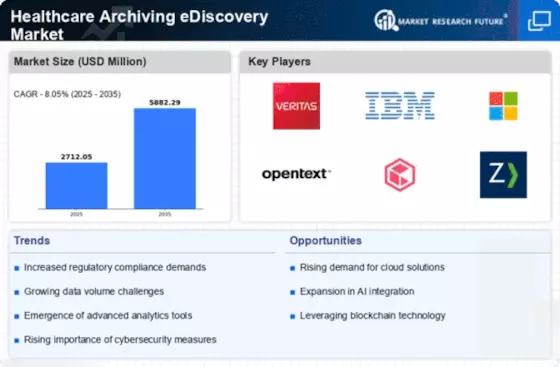
Healthcare Archiving eDiscovery Market Infographic
Purchase Options

Market Analysis

In-depth Analysis of Healthcare Archiving eDiscovery Market Industry Landscape

The Americas Healthcare Archiving and eDiscovery Market is changing because healthcare is changing, regulations are getting stricter, and more people are using digital tools to manage their healthcare data. This market, which includes both North and South America, is affected by things like the need to store data safely, follow healthcare rules, and have effective eDiscovery tools in the healthcare industry. The growing amount of healthcare data has a big effect on dynamics. As healthcare organizations create and store a lot of patient data, the market for strong storage options that can handle different types of data and make sure they are easy to find when needed is growing. The factors include following strict rules about how long to keep data. Regulatory frameworks like HIPAA in the US shape the healthcare archiving and eDiscovery market in the Americas. These frameworks stress how important it is to store patient data safely for a long time and be able to quickly answer to legal discovery requests. Dynamics include the continued shift in healthcare toward digital technology. As healthcare methods become more modern, the switch from paper records to electronic health records (EHRs) calls for more advanced storage solutions that can handle and keep digital health information safe. The connection with EHR tools changes the way things work. It is important for archiving and EHR systems to work together smoothly so that patient records, pictures, and other healthcare data can be stored and retrieved quickly, while also keeping the data's security and following all regulations. Concerns about security and privacy are growing because of dynamics. Because healthcare data is private, archive and eDiscovery solutions put strong security measures, encryption procedures, and following data protection laws at the top of their lists to keep patient information safe and privacy standards high. The factors include the need for eDiscovery methods that work well. Healthcare companies look for eDiscovery tools in their archiving solutions that make it easier to find, retrieve, and show relevant information in answer to legal requests. This makes the compliance and lawsuit processes run more smoothly. Adoption of cloud-based storage options changes the way things work. More and more people in the Americas are choosing cloud-based archiving because it is flexible, easy to access, and cheap. This is especially true for healthcare groups that need to meet legal requirements and make emergency recovery easier. Focusing on openness and data accessibility is part of dynamics. Interoperability must be a top priority for archiving solutions so that data can flow easily between healthcare systems and healthcare workers can quickly access stored information to keep care going. There is competition between vendors and mergers in the market. There is a lot of competition among companies that offer archiving and eDiscovery solutions. The market could also get smaller through mergers and acquisitions, which changes the scene and the features, price, and support services that healthcare organizations can choose from.

Training and teaching programs are also good for the market. As more healthcare organizations use new archiving and eDiscovery tools, teaching and training programs are necessary to make sure that healthcare workers know how to use these tools correctly for legal and compliance reasons. Data analytics are used to get insights in dynamics. Archiving solutions use data analytics to help healthcare groups see trends, patterns, and possible areas for growth. This helps them make better decisions and plan more strategically. Cross-border data movement is one of the factors that are taken into account. As healthcare companies in the Americas work across borders, archiving solutions need to take into account the legal and regulatory issues that come up when healthcare data is sent between countries. This is to make sure that different data security laws are followed. Dynamics includes preparation for business continuity and crisis recovery. Archiving solutions are very important for making sure that healthcare data is available in case of disasters or system breakdowns. They help businesses stay open and reduce the risk of losing data in important situations. Market dynamics include combining it with efforts to handle the health of a whole community. Archiving solutions help reach population health goals by giving researchers access to old patient data that can be analyzed. This is an important part of larger healthcare plans that aim to improve the health of the whole community.


Author
Kinjoll Dey
Senior Research Analyst

He is an extremely curious individual currently working in Healthcare and Medical Devices Domain. Kinjoll is comfortably versed in data centric research backed by healthcare educational background. He leverages extensive data mining and analytics tools such as Primary and Secondary Research, Statistical Analysis, Machine Learning, Data Modelling. His key role also involves Technical Sales Support, Client Interaction and Project management within the Healthcare team. Lastly, he showcases extensive affinity towards learning new skills and remain fascinated in implementing them.

Leave a Comment

FAQs

What is the projected market valuation for the Healthcare Archiving eDiscovery Market by 2035?

<p>The projected market valuation for the Healthcare Archiving eDiscovery Market is 5882.29 USD Million by 2035.</p>

What was the market valuation in 2024 for the Healthcare Archiving eDiscovery Market?

<p>The market valuation for the Healthcare Archiving eDiscovery Market was 2510.0 USD Million in 2024.</p>

What is the expected CAGR for the Healthcare Archiving eDiscovery Market during the forecast period 2025 - 2035?

<p>The expected CAGR for the Healthcare Archiving eDiscovery Market during the forecast period 2025 - 2035 is 8.05%.</p>

Which companies are considered key players in the Healthcare Archiving eDiscovery Market?

<p>Key players in the Healthcare Archiving eDiscovery Market include Veritas Technologies, IBM, Microsoft, OpenText, Commvault, Zywave, Civitas Solutions, Nuix, and Relativity.</p>

What are the primary applications of the Healthcare Archiving eDiscovery Market?

<p>The primary applications include Data Retention, Regulatory Compliance, Litigation Support, and Information Governance.</p>

How does the market segment by end use in the Healthcare Archiving eDiscovery Market?

<p>The market segments by end use include Healthcare Providers, Pharmaceutical Companies, Insurance Companies, and Research Institutions.</p>

What are the deployment types in the Healthcare Archiving eDiscovery Market?

<p>The deployment types in the Healthcare Archiving eDiscovery Market are On-Premises, Cloud-Based, and Hybrid.</p>

What types of data are addressed in the Healthcare Archiving eDiscovery Market?

<p>The types of data addressed include Structured Data, Unstructured Data, and Semi-Structured Data.</p>

What technologies are utilized in the Healthcare Archiving eDiscovery Market?

<p>The technologies utilized include Artificial Intelligence, Machine Learning, and Data Analytics.</p>

What was the valuation range for Data Retention in the Healthcare Archiving eDiscovery Market?

<p>The valuation range for Data Retention in the Healthcare Archiving eDiscovery Market was between 1000.0 and 2400.0 USD Million.</p>

Market Summary

As per MRFR analysis, the Healthcare Archiving eDiscovery Market Size was estimated at 2510.0 USD Million in 2024. The Healthcare Archiving eDiscovery industry is projected to grow from 2712.05 in 2025 to 5882.29 by 2035, exhibiting a compound annual growth rate (CAGR) of 8.05% during the forecast period 2025 - 2035.

Key Market Trends & Highlights

The Healthcare Archiving eDiscovery Market is poised for substantial growth driven by technological advancements and regulatory pressures.

  • The integration of advanced technologies is transforming the healthcare archiving landscape, enhancing data retrieval and management.
  • North America remains the largest market, while the Asia-Pacific region is emerging as the fastest-growing area for healthcare eDiscovery solutions.
  • The shift towards cloud-based solutions is gaining momentum, driven by the need for scalable and flexible data storage options.
  • Rising regulatory requirements and the growing volume of electronic health records are key drivers propelling market expansion.

Market Size & Forecast

2024 Market Size 2510.0 (USD Million)
2035 Market Size 5882.29 (USD Million)
CAGR (2025 - 2035) 8.05%
Largest Regional Market Share in 2024 North America

Major Players

<p>Veritas Technologies (US), IBM (US), Microsoft (US), OpenText (CA), Commvault (US), Zywave (US), Civitas Solutions (US), Nuix (AU), Relativity (US)</p>

Market Trends

The Healthcare Archiving eDiscovery Market is currently experiencing a transformative phase, driven by the increasing need for efficient data management and compliance with regulatory requirements. Organizations within the healthcare sector are recognizing the necessity of robust archiving solutions to manage vast amounts of data generated from patient records, clinical trials, and administrative processes. This market appears to be evolving as healthcare providers seek to streamline their operations while ensuring that sensitive information is securely stored and easily retrievable. The integration of advanced technologies, such as artificial intelligence and machine learning, is likely to enhance the capabilities of eDiscovery tools, making them more effective in identifying and managing relevant data during legal proceedings or audits. Moreover, the growing emphasis on data privacy and security is shaping the landscape of the Healthcare Archiving eDiscovery Market. As regulations become more stringent, organizations are compelled to adopt comprehensive archiving strategies that not only comply with legal standards but also protect patient confidentiality. This trend suggests a shift towards more sophisticated solutions that can adapt to the dynamic nature of healthcare data. Consequently, the market is poised for growth as stakeholders invest in innovative technologies and practices that facilitate efficient data management while addressing the complexities of compliance and security.

Integration of Advanced Technologies

The incorporation of artificial intelligence and machine learning into eDiscovery tools is becoming increasingly prevalent. These technologies enhance data processing capabilities, allowing for quicker identification and retrieval of relevant information, which is crucial during legal inquiries.

Focus on Data Privacy and Compliance

As regulatory frameworks tighten, there is a heightened focus on ensuring data privacy and compliance within the Healthcare Archiving eDiscovery Market. Organizations are prioritizing the development of comprehensive archiving strategies to safeguard sensitive information.

Shift Towards Cloud-Based Solutions

The trend towards cloud-based archiving solutions is gaining momentum, as healthcare organizations seek scalable and flexible options for data storage. This shift allows for improved accessibility and collaboration while reducing the burden of on-premises infrastructure.

Healthcare Archiving eDiscovery Market Market Drivers

Rising Regulatory Requirements

The increasing complexity of regulatory requirements in the healthcare sector appears to drive the Healthcare Archiving eDiscovery Market. Organizations are compelled to comply with stringent regulations such as HIPAA and GDPR, which necessitate robust archiving solutions. As a result, healthcare providers are investing in eDiscovery tools to ensure they can efficiently retrieve and manage electronic records. The market is projected to grow at a compound annual growth rate of approximately 12% over the next few years, reflecting the urgency for compliance. This trend indicates that healthcare organizations are prioritizing the implementation of effective archiving strategies to mitigate risks associated with non-compliance.

Increased Focus on Data Security

The heightened emphasis on data security within the healthcare sector is influencing the Healthcare Archiving eDiscovery Market. With cyber threats becoming more sophisticated, healthcare organizations are prioritizing the protection of sensitive patient information. This focus on security drives the demand for eDiscovery solutions that incorporate advanced encryption and access controls. According to recent studies, nearly 70% of healthcare organizations have experienced a data breach, underscoring the critical need for secure archiving practices. As a result, investments in eDiscovery technologies that enhance data security are expected to rise, reflecting a proactive approach to safeguarding patient data.

Demand for Efficient Litigation Support

The increasing frequency of litigation in the healthcare sector is propelling the Healthcare Archiving eDiscovery Market. Healthcare organizations are often required to produce extensive documentation during legal proceedings, necessitating efficient eDiscovery solutions. The ability to quickly retrieve relevant records can significantly impact the outcome of legal cases. As litigation costs continue to rise, healthcare providers are likely to seek archiving solutions that streamline the eDiscovery process. Market analysts project that the demand for litigation support tools will grow, as organizations recognize the importance of having robust archiving systems in place to facilitate timely and accurate responses to legal inquiries.

Growing Volume of Electronic Health Records

The proliferation of electronic health records (EHRs) is a significant driver of the Healthcare Archiving eDiscovery Market. As healthcare providers increasingly adopt EHR systems, the volume of data generated continues to escalate. This surge in data necessitates advanced archiving solutions capable of managing and retrieving vast amounts of information efficiently. It is estimated that The Healthcare Archiving eDiscovery will reach USD 40 billion by 2026, further emphasizing the need for effective eDiscovery tools. Consequently, healthcare organizations are likely to invest in archiving solutions that can streamline data management processes and enhance operational efficiency.

Adoption of Artificial Intelligence Technologies

The integration of artificial intelligence (AI) technologies into archiving solutions is emerging as a key driver in the Healthcare Archiving eDiscovery Market. AI can enhance data retrieval processes, enabling healthcare organizations to analyze large datasets more effectively. This capability is particularly valuable in eDiscovery, where the ability to quickly identify relevant information can save time and resources. As AI technologies continue to evolve, their adoption in healthcare archiving is expected to increase. Analysts suggest that the market for AI-driven eDiscovery solutions could witness substantial growth, as organizations seek to leverage these technologies to improve operational efficiency and reduce costs.

Market Segment Insights

By Application: Data Retention (Largest) vs. Regulatory Compliance (Fastest-Growing)

<p>In the Healthcare Archiving eDiscovery Market, Data Retention is the largest segment, holding a significant share due to the increasing volume of electronic health records and the necessity to maintain patient data over extended periods for legal and operational purposes. Following closely is the Regulatory Compliance segment, which is rapidly gaining momentum as healthcare organizations strive to meet stringent regulations and standards regarding data management.</p>

<p>Data Retention: Dominant vs. Regulatory Compliance: Emerging</p>

<p>Data Retention stands as the dominant value in the healthcare archiving segment, underscoring the critical need for organizations to secure patient information and facilitate access when required. It encompasses strategies and technologies focused on preserving data integrity and availability. Conversely, Regulatory Compliance is emerging as a vital aspect due to escalating regulations enforced by governments and health authorities, compelling organizations to integrate compliance into their eDiscovery strategies. This segment is characterized by innovations and efficient frameworks that ensure adherence to legal standards, making it a priority for healthcare providers aiming to avoid penalties.</p>

By End Use: Healthcare Providers (Largest) vs. Pharmaceutical Companies (Fastest-Growing)

<p>The Healthcare Archiving eDiscovery Market is significantly influenced by end-use categories, particularly Healthcare Providers, Pharmaceutical Companies, Insurance Companies, and Research Institutions. Among these, Healthcare Providers hold a dominant share due to their vast data management needs for patient records and compliance. Pharmaceutical Companies follow closely, adapting to regulatory demands and digital transformation, increasingly relying on eDiscovery solutions to manage clinical trial data and intellectual property documentation.</p>

<p>Healthcare Providers (Dominant) vs. Pharmaceutical Companies (Emerging)</p>

<p>Healthcare Providers are the dominant force in the Healthcare Archiving eDiscovery Market, driven by the imperative to meet regulatory requirements, maintain patient privacy, and ensure efficient handling of vast amounts of health data. Their need for robust eDiscovery solutions is underscored by increasing litigation risks and the need for compliance with healthcare regulations. Conversely, Pharmaceutical Companies represent an emerging market segment, rapidly growing as they seek advanced data management tools to cope with the complexities of drug development, patent issues, and market compliance. The technological advancements in eDiscovery solutions, specifically tailored for pharmaceuticals, are fostering innovation and responsiveness, positioning these companies for swift adaptation in the evolving healthcare landscape.</p>

By Deployment Type: Cloud-Based (Largest) vs. On-Premises (Fastest-Growing)

<p>In the Healthcare Archiving eDiscovery Market, Cloud-Based deployment has emerged as the largest segment, preferred for its scalability and cost-effectiveness. The On-Premises segment, while smaller, is witnessing a resurgence as healthcare organizations seek enhanced data security and control over their archiving processes. Hybrid deployments, which combine the benefits of both cloud and on-premises solutions, are also gaining traction as organizations look for flexible solutions tailored to their unique needs.</p>

<p>Deployment Type: Cloud-Based (Dominant) vs. On-Premises (Emerging)</p>

<p>Cloud-Based deployment continues to dominate the Healthcare Archiving eDiscovery Market, leveraging the benefits of reduced infrastructure costs and easy access to data from anywhere. Its ability to quickly adapt to the changing regulatory landscape makes it attractive to healthcare organizations striving for compliance. On the other hand, the On-Premises segment is emerging rapidly, driven by concerns over data privacy and the need for organizations to maintain control over sensitive patient information. As a result, many healthcare providers are investing in robust on-premises solutions that ensure security while facilitating full integration with their existing systems.</p>

By Data Type: Structured Data (Largest) vs. Unstructured Data (Fastest-Growing)

<p>The Healthcare Archiving eDiscovery Market is experiencing a significant distribution of market share among different data types. Structured data continues to hold the largest share due to its organized nature, which facilitates easier retrieval and analysis. Healthcare organizations heavily rely on this data type, especially in clinical settings, where information is categorized into databases that support operational efficiencies. Unstructured data, while currently holding a smaller portion of the market, is rapidly gaining traction as healthcare providers increasingly recognize the value of extracting insights from notes, imaging, and other non-traditional data forms.</p>

<p>Data Type: Structured Data (Dominant) vs. Unstructured Data (Emerging)</p>

<p>Structured data serves as the backbone of healthcare archives, comprising clear-cut, predefined fields that enable quick access and effective analysis. On the other hand, unstructured data, which encompasses various formats such as text documents, images, and audio recordings, is emerging as a critical player in healthcare archiving. The rise of AI-driven analytics tools is propelling unstructured data into the forefront, allowing healthcare providers to unlock valuable insights that were previously untapped. As electronic health records evolve, the integration of both structured and unstructured data will play a vital role in enhancing patient care and operational workflows, making it essential for organizations to adopt comprehensive eDiscovery solutions.</p>

By Technology: Artificial Intelligence (Largest) vs. Machine Learning (Fastest-Growing)

<p>Within the Healthcare Archiving eDiscovery Market, Artificial Intelligence (AI) commands a significant share. As healthcare organizations increasingly rely on efficient data management practices, AI's capabilities in automating archival processes and enhancing data retrieval have made it a predominant technology. Conversely, Machine Learning (ML), while currently smaller in market share, has shown rapid adoption trends as it offers predictive analytics and improved decision-making processes, making it a critical player for future growth.</p>

<p>Technology: AI (Dominant) vs. ML (Emerging)</p>

<p>Artificial Intelligence (AI) is the dominant force in the Healthcare Archiving eDiscovery Market, characterized by its ability to streamline processes and enhance efficiency. Its applications span across various healthcare functions, enabling organizations to automate data archiving, improve compliance, and enhance information retrieval. Conversely, Machine Learning (ML) represents an emerging trend within this space, offering advanced analytical capabilities. ML adds value by facilitating robust data analysis and providing insights that can lead to better healthcare outcomes. As these technologies evolve, their interplay is expected to drive further innovations and efficiencies in healthcare data management.</p>

Get more detailed insights about Americas Healthcare Archiving and eDiscovery Market Report- Forecast To 2035

Regional Insights

North America : Market Leader in eDiscovery

North America continues to lead the Healthcare Archiving eDiscovery market, holding a significant share of 1305.0M in 2024. The region's growth is driven by increasing regulatory requirements for data management and the rising demand for efficient archiving solutions. The healthcare sector's focus on compliance and data security further fuels this demand, supported by advancements in technology and cloud solutions. The competitive landscape is robust, with key players like Veritas Technologies, IBM, and Microsoft dominating the market. The U.S. remains the largest contributor, benefiting from a well-established healthcare infrastructure and a strong emphasis on digital transformation. The presence of innovative companies ensures continuous advancements in eDiscovery solutions, making North America a pivotal region for market growth.

Europe : Emerging Market with Growth Potential

Europe's Healthcare Archiving eDiscovery market is valued at 675.0M, reflecting a growing recognition of the importance of data management in healthcare. The region is witnessing increased demand for eDiscovery solutions driven by stringent regulations such as GDPR, which mandates robust data protection measures. This regulatory environment is a key catalyst for market growth, encouraging healthcare organizations to invest in archiving technologies. Leading countries like Germany, the UK, and France are at the forefront of this market, with a competitive landscape featuring players such as OpenText and Commvault. The European market is characterized by a mix of established firms and innovative startups, fostering a dynamic environment for eDiscovery solutions. As healthcare providers prioritize compliance and efficiency, the market is poised for significant expansion.

Asia-Pacific : Rapidly Growing Market Segment

The Asia-Pacific region, with a market size of 400.0M, is rapidly emerging in the Healthcare Archiving eDiscovery landscape. The growth is propelled by increasing healthcare digitization and the need for efficient data management solutions. Countries like China and India are investing heavily in healthcare infrastructure, which is expected to drive demand for eDiscovery services as organizations seek to comply with international standards and regulations. The competitive landscape is evolving, with both local and international players like Nuix and Relativity making significant inroads. The region's diverse healthcare needs and varying regulatory frameworks present unique challenges and opportunities. As awareness of data security and compliance grows, the Asia-Pacific market is set to expand significantly in the coming years.

Middle East and Africa : Emerging Market with Challenges

The Middle East and Africa (MEA) region, valued at 130.0M, is gradually recognizing the importance of Healthcare Archiving eDiscovery solutions. The market is driven by increasing regulatory pressures and a growing emphasis on data security in healthcare. Governments are beginning to implement regulations that require healthcare organizations to adopt better data management practices, which is a significant growth driver for the eDiscovery market. Countries like South Africa and the UAE are leading the way in adopting these solutions, although the market faces challenges such as limited infrastructure and varying regulatory environments. Key players are beginning to establish a presence in the region, focusing on tailored solutions that meet local needs. As the healthcare sector evolves, the demand for eDiscovery services is expected to rise, paving the way for future growth.

Key Players and Competitive Insights

The Healthcare Archiving eDiscovery Market is currently characterized by a dynamic competitive landscape, driven by the increasing need for compliance, data management, and digital transformation within healthcare organizations. Key players such as Veritas Technologies (US), IBM (US), and Microsoft (US) are strategically positioned to leverage their technological expertise and extensive portfolios. Veritas Technologies (US) focuses on innovation in data protection and management solutions, while IBM (US) emphasizes its cloud-based offerings and AI capabilities to enhance eDiscovery processes. Microsoft (US) continues to integrate its solutions with existing healthcare systems, thereby facilitating seamless data archiving and retrieval. Collectively, these strategies contribute to a competitive environment that is increasingly reliant on technological advancements and customer-centric solutions.

In terms of business tactics, companies are increasingly localizing their operations and optimizing supply chains to enhance service delivery and responsiveness. The market appears moderately fragmented, with a mix of established players and emerging firms vying for market share. The collective influence of these key players shapes the market structure, as they engage in strategic partnerships and collaborations to expand their reach and capabilities.

In January 2026, Veritas Technologies (US) announced a partnership with a leading healthcare provider to implement a comprehensive data archiving solution aimed at improving compliance and operational efficiency. This strategic move underscores Veritas's commitment to enhancing its service offerings and addressing the specific needs of healthcare organizations, thereby solidifying its market position.

In December 2025, IBM (US) launched an advanced AI-driven eDiscovery tool designed to streamline the data retrieval process for healthcare institutions. This innovation is significant as it not only enhances operational efficiency but also positions IBM as a leader in integrating AI technologies within the healthcare archiving space, potentially attracting new clients seeking cutting-edge solutions.

In November 2025, Microsoft (US) expanded its Azure cloud services tailored for healthcare, focusing on enhancing data security and compliance. This expansion is crucial as it aligns with the growing demand for secure and scalable archiving solutions, allowing Microsoft to strengthen its foothold in the healthcare sector and respond to evolving regulatory requirements.

As of February 2026, the competitive trends in the Healthcare Archiving eDiscovery Market are increasingly defined by digitalization, sustainability, and AI integration. Strategic alliances among key players are shaping the landscape, fostering innovation and enhancing service delivery. Looking ahead, competitive differentiation is likely to evolve from traditional price-based competition to a focus on technological innovation, reliability, and supply chain efficiency. This shift indicates a growing emphasis on delivering value through advanced solutions that meet the complex needs of healthcare organizations.

Key Companies in the Healthcare Archiving eDiscovery Market include

Industry Developments

Future Outlook

Healthcare Archiving eDiscovery Market Future Outlook

The Healthcare Archiving eDiscovery Market is projected to grow at 8.05% CAGR from 2024 to 2035, driven by regulatory compliance, data security needs, and technological advancements.

New opportunities lie in:

  • Integration of AI-driven analytics for predictive archiving solutions.
  • Development of cloud-based eDiscovery platforms for enhanced accessibility.
  • Partnerships with cybersecurity firms to bolster data protection services.

By 2035, the market is expected to be robust, driven by innovation and strategic partnerships.

Market Segmentation

Healthcare Archiving eDiscovery Market End Use Outlook

  • Healthcare Providers
  • Pharmaceutical Companies
  • Insurance Companies
  • Research Institutions

Healthcare Archiving eDiscovery Market Data Type Outlook

  • Structured Data
  • Unstructured Data
  • Semi-Structured Data

Healthcare Archiving eDiscovery Market Technology Outlook

  • Artificial Intelligence
  • Machine Learning
  • Data Analytics

Healthcare Archiving eDiscovery Market Application Outlook

  • Data Retention
  • Regulatory Compliance
  • Litigation Support
  • Information Governance

Healthcare Archiving eDiscovery Market Deployment Type Outlook

  • On-Premises
  • Cloud-Based
  • Hybrid

Report Scope

MARKET SIZE 2024 2510.0(USD Million)
MARKET SIZE 2025 2712.05(USD Million)
MARKET SIZE 2035 5882.29(USD Million)
COMPOUND ANNUAL GROWTH RATE (CAGR) 8.05% (2024 - 2035)
REPORT COVERAGE Revenue Forecast, Competitive Landscape, Growth Factors, and Trends
BASE YEAR 2024
Market Forecast Period 2025 - 2035
Historical Data 2019 - 2024
Market Forecast Units USD Million
Key Companies Profiled Veritas Technologies (US), IBM (US), Microsoft (US), OpenText (CA), Commvault (US), Zywave (US), Civitas Solutions (US), Nuix (AU), Relativity (US)
Segments Covered Application, End Use, Deployment Type, Data Type, Technology
Key Market Opportunities Integration of artificial intelligence enhances efficiency in the Healthcare Archiving eDiscovery Market.
Key Market Dynamics Rising regulatory scrutiny drives demand for efficient Healthcare Archiving eDiscovery solutions amid evolving compliance requirements.
Countries Covered North America, Europe, APAC, South America, MEA

FAQs

What is the projected market valuation for the Healthcare Archiving eDiscovery Market by 2035?

<p>The projected market valuation for the Healthcare Archiving eDiscovery Market is 5882.29 USD Million by 2035.</p>

What was the market valuation in 2024 for the Healthcare Archiving eDiscovery Market?

<p>The market valuation for the Healthcare Archiving eDiscovery Market was 2510.0 USD Million in 2024.</p>

What is the expected CAGR for the Healthcare Archiving eDiscovery Market during the forecast period 2025 - 2035?

<p>The expected CAGR for the Healthcare Archiving eDiscovery Market during the forecast period 2025 - 2035 is 8.05%.</p>

Which companies are considered key players in the Healthcare Archiving eDiscovery Market?

<p>Key players in the Healthcare Archiving eDiscovery Market include Veritas Technologies, IBM, Microsoft, OpenText, Commvault, Zywave, Civitas Solutions, Nuix, and Relativity.</p>

What are the primary applications of the Healthcare Archiving eDiscovery Market?

<p>The primary applications include Data Retention, Regulatory Compliance, Litigation Support, and Information Governance.</p>

How does the market segment by end use in the Healthcare Archiving eDiscovery Market?

<p>The market segments by end use include Healthcare Providers, Pharmaceutical Companies, Insurance Companies, and Research Institutions.</p>

What are the deployment types in the Healthcare Archiving eDiscovery Market?

<p>The deployment types in the Healthcare Archiving eDiscovery Market are On-Premises, Cloud-Based, and Hybrid.</p>

What types of data are addressed in the Healthcare Archiving eDiscovery Market?

<p>The types of data addressed include Structured Data, Unstructured Data, and Semi-Structured Data.</p>

What technologies are utilized in the Healthcare Archiving eDiscovery Market?

<p>The technologies utilized include Artificial Intelligence, Machine Learning, and Data Analytics.</p>

What was the valuation range for Data Retention in the Healthcare Archiving eDiscovery Market?

<p>The valuation range for Data Retention in the Healthcare Archiving eDiscovery Market was between 1000.0 and 2400.0 USD Million.</p>

  1. SECTION I: EXECUTIVE SUMMARY AND KEY HIGHLIGHTS
    1. | 1.1 EXECUTIVE SUMMARY
    2. | | 1.1.1 Market Overview
    3. | | 1.1.2 Key Findings
    4. | | 1.1.3 Market Segmentation
    5. | | 1.1.4 Competitive Landscape
    6. | | 1.1.5 Challenges and Opportunities
    7. | | 1.1.6 Future Outlook
  2. SECTION II: SCOPING, METHODOLOGY AND MARKET STRUCTURE
    1. | 2.1 MARKET INTRODUCTION
    2. | | 2.1.1 Definition
    3. | | 2.1.2 Scope of the study
    4. | | | 2.1.2.1 Research Objective
    5. | | | 2.1.2.2 Assumption
    6. | | | 2.1.2.3 Limitations
    7. | 2.2 RESEARCH METHODOLOGY
    8. | | 2.2.1 Overview
    9. | | 2.2.2 Data Mining
    10. | | 2.2.3 Secondary Research
    11. | | 2.2.4 Primary Research
    12. | | | 2.2.4.1 Primary Interviews and Information Gathering Process
    13. | | | 2.2.4.2 Breakdown of Primary Respondents
    14. | | 2.2.5 Forecasting Model
    15. | | 2.2.6 Market Size Estimation
    16. | | | 2.2.6.1 Bottom-Up Approach
    17. | | | 2.2.6.2 Top-Down Approach
    18. | | 2.2.7 Data Triangulation
    19. | | 2.2.8 Validation
  3. SECTION III: QUALITATIVE ANALYSIS
    1. | 3.1 MARKET DYNAMICS
    2. | | 3.1.1 Overview
    3. | | 3.1.2 Drivers
    4. | | 3.1.3 Restraints
    5. | | 3.1.4 Opportunities
    6. | 3.2 MARKET FACTOR ANALYSIS
    7. | | 3.2.1 Value chain Analysis
    8. | | 3.2.2 Porter's Five Forces Analysis
    9. | | | 3.2.2.1 Bargaining Power of Suppliers
    10. | | | 3.2.2.2 Bargaining Power of Buyers
    11. | | | 3.2.2.3 Threat of New Entrants
    12. | | | 3.2.2.4 Threat of Substitutes
    13. | | | 3.2.2.5 Intensity of Rivalry
    14. | | 3.2.3 COVID-19 Impact Analysis
    15. | | | 3.2.3.1 Market Impact Analysis
    16. | | | 3.2.3.2 Regional Impact
    17. | | | 3.2.3.3 Opportunity and Threat Analysis
  4. SECTION IV: QUANTITATIVE ANALYSIS
    1. | 4.1 Healthcare, BY Application (USD Million)
    2. | | 4.1.1 Data Retention
    3. | | 4.1.2 Regulatory Compliance
    4. | | 4.1.3 Litigation Support
    5. | | 4.1.4 Information Governance
    6. | 4.2 Healthcare, BY End Use (USD Million)
    7. | | 4.2.1 Healthcare Providers
    8. | | 4.2.2 Pharmaceutical Companies
    9. | | 4.2.3 Insurance Companies
    10. | | 4.2.4 Research Institutions
    11. | 4.3 Healthcare, BY Deployment Type (USD Million)
    12. | | 4.3.1 On-Premises
    13. | | 4.3.2 Cloud-Based
    14. | | 4.3.3 Hybrid
    15. | 4.4 Healthcare, BY Data Type (USD Million)
    16. | | 4.4.1 Structured Data
    17. | | 4.4.2 Unstructured Data
    18. | | 4.4.3 Semi-Structured Data
    19. | 4.5 Healthcare, BY Technology (USD Million)
    20. | | 4.5.1 Artificial Intelligence
    21. | | 4.5.2 Machine Learning
    22. | | 4.5.3 Data Analytics
    23. | 4.6 Healthcare, BY Region (USD Million)
    24. | | 4.6.1 North America
    25. | | | 4.6.1.1 US
    26. | | | 4.6.1.2 Canada
    27. | | 4.6.2 Europe
    28. | | | 4.6.2.1 Germany
    29. | | | 4.6.2.2 UK
    30. | | | 4.6.2.3 France
    31. | | | 4.6.2.4 Russia
    32. | | | 4.6.2.5 Italy
    33. | | | 4.6.2.6 Spain
    34. | | | 4.6.2.7 Rest of Europe
    35. | | 4.6.3 APAC
    36. | | | 4.6.3.1 China
    37. | | | 4.6.3.2 India
    38. | | | 4.6.3.3 Japan
    39. | | | 4.6.3.4 South Korea
    40. | | | 4.6.3.5 Malaysia
    41. | | | 4.6.3.6 Thailand
    42. | | | 4.6.3.7 Indonesia
    43. | | | 4.6.3.8 Rest of APAC
    44. | | 4.6.4 South America
    45. | | | 4.6.4.1 Brazil
    46. | | | 4.6.4.2 Mexico
    47. | | | 4.6.4.3 Argentina
    48. | | | 4.6.4.4 Rest of South America
    49. | | 4.6.5 MEA
    50. | | | 4.6.5.1 GCC Countries
    51. | | | 4.6.5.2 South Africa
    52. | | | 4.6.5.3 Rest of MEA
  5. SECTION V: COMPETITIVE ANALYSIS
    1. | 5.1 Competitive Landscape
    2. | | 5.1.1 Overview
    3. | | 5.1.2 Competitive Analysis
    4. | | 5.1.3 Market share Analysis
    5. | | 5.1.4 Major Growth Strategy in the Healthcare
    6. | | 5.1.5 Competitive Benchmarking
    7. | | 5.1.6 Leading Players in Terms of Number of Developments in the Healthcare
    8. | | 5.1.7 Key developments and growth strategies
    9. | | | 5.1.7.1 New Product Launch/Service Deployment
    10. | | | 5.1.7.2 Merger & Acquisitions
    11. | | | 5.1.7.3 Joint Ventures
    12. | | 5.1.8 Major Players Financial Matrix
    13. | | | 5.1.8.1 Sales and Operating Income
    14. | | | 5.1.8.2 Major Players R&D Expenditure. 2023
    15. | 5.2 Company Profiles
    16. | | 5.2.1 Veritas Technologies (US)
    17. | | | 5.2.1.1 Financial Overview
    18. | | | 5.2.1.2 Products Offered
    19. | | | 5.2.1.3 Key Developments
    20. | | | 5.2.1.4 SWOT Analysis
    21. | | | 5.2.1.5 Key Strategies
    22. | | 5.2.2 IBM (US)
    23. | | | 5.2.2.1 Financial Overview
    24. | | | 5.2.2.2 Products Offered
    25. | | | 5.2.2.3 Key Developments
    26. | | | 5.2.2.4 SWOT Analysis
    27. | | | 5.2.2.5 Key Strategies
    28. | | 5.2.3 Microsoft (US)
    29. | | | 5.2.3.1 Financial Overview
    30. | | | 5.2.3.2 Products Offered
    31. | | | 5.2.3.3 Key Developments
    32. | | | 5.2.3.4 SWOT Analysis
    33. | | | 5.2.3.5 Key Strategies
    34. | | 5.2.4 OpenText (CA)
    35. | | | 5.2.4.1 Financial Overview
    36. | | | 5.2.4.2 Products Offered
    37. | | | 5.2.4.3 Key Developments
    38. | | | 5.2.4.4 SWOT Analysis
    39. | | | 5.2.4.5 Key Strategies
    40. | | 5.2.5 Commvault (US)
    41. | | | 5.2.5.1 Financial Overview
    42. | | | 5.2.5.2 Products Offered
    43. | | | 5.2.5.3 Key Developments
    44. | | | 5.2.5.4 SWOT Analysis
    45. | | | 5.2.5.5 Key Strategies
    46. | | 5.2.6 Zywave (US)
    47. | | | 5.2.6.1 Financial Overview
    48. | | | 5.2.6.2 Products Offered
    49. | | | 5.2.6.3 Key Developments
    50. | | | 5.2.6.4 SWOT Analysis
    51. | | | 5.2.6.5 Key Strategies
    52. | | 5.2.7 Civitas Solutions (US)
    53. | | | 5.2.7.1 Financial Overview
    54. | | | 5.2.7.2 Products Offered
    55. | | | 5.2.7.3 Key Developments
    56. | | | 5.2.7.4 SWOT Analysis
    57. | | | 5.2.7.5 Key Strategies
    58. | | 5.2.8 Nuix (AU)
    59. | | | 5.2.8.1 Financial Overview
    60. | | | 5.2.8.2 Products Offered
    61. | | | 5.2.8.3 Key Developments
    62. | | | 5.2.8.4 SWOT Analysis
    63. | | | 5.2.8.5 Key Strategies
    64. | | 5.2.9 Relativity (US)
    65. | | | 5.2.9.1 Financial Overview
    66. | | | 5.2.9.2 Products Offered
    67. | | | 5.2.9.3 Key Developments
    68. | | | 5.2.9.4 SWOT Analysis
    69. | | | 5.2.9.5 Key Strategies
    70. | 5.3 Appendix
    71. | | 5.3.1 References
    72. | | 5.3.2 Related Reports
  6. LIST OF FIGURES
    1. | 6.1 MARKET SYNOPSIS
    2. | 6.2 NORTH AMERICA MARKET ANALYSIS
    3. | 6.3 US MARKET ANALYSIS BY APPLICATION
    4. | 6.4 US MARKET ANALYSIS BY END USE
    5. | 6.5 US MARKET ANALYSIS BY DEPLOYMENT TYPE
    6. | 6.6 US MARKET ANALYSIS BY DATA TYPE
    7. | 6.7 US MARKET ANALYSIS BY TECHNOLOGY
    8. | 6.8 CANADA MARKET ANALYSIS BY APPLICATION
    9. | 6.9 CANADA MARKET ANALYSIS BY END USE
    10. | 6.10 CANADA MARKET ANALYSIS BY DEPLOYMENT TYPE
    11. | 6.11 CANADA MARKET ANALYSIS BY DATA TYPE
    12. | 6.12 CANADA MARKET ANALYSIS BY TECHNOLOGY
    13. | 6.13 EUROPE MARKET ANALYSIS
    14. | 6.14 GERMANY MARKET ANALYSIS BY APPLICATION
    15. | 6.15 GERMANY MARKET ANALYSIS BY END USE
    16. | 6.16 GERMANY MARKET ANALYSIS BY DEPLOYMENT TYPE
    17. | 6.17 GERMANY MARKET ANALYSIS BY DATA TYPE
    18. | 6.18 GERMANY MARKET ANALYSIS BY TECHNOLOGY
    19. | 6.19 UK MARKET ANALYSIS BY APPLICATION
    20. | 6.20 UK MARKET ANALYSIS BY END USE
    21. | 6.21 UK MARKET ANALYSIS BY DEPLOYMENT TYPE
    22. | 6.22 UK MARKET ANALYSIS BY DATA TYPE
    23. | 6.23 UK MARKET ANALYSIS BY TECHNOLOGY
    24. | 6.24 FRANCE MARKET ANALYSIS BY APPLICATION
    25. | 6.25 FRANCE MARKET ANALYSIS BY END USE
    26. | 6.26 FRANCE MARKET ANALYSIS BY DEPLOYMENT TYPE
    27. | 6.27 FRANCE MARKET ANALYSIS BY DATA TYPE
    28. | 6.28 FRANCE MARKET ANALYSIS BY TECHNOLOGY
    29. | 6.29 RUSSIA MARKET ANALYSIS BY APPLICATION
    30. | 6.30 RUSSIA MARKET ANALYSIS BY END USE
    31. | 6.31 RUSSIA MARKET ANALYSIS BY DEPLOYMENT TYPE
    32. | 6.32 RUSSIA MARKET ANALYSIS BY DATA TYPE
    33. | 6.33 RUSSIA MARKET ANALYSIS BY TECHNOLOGY
    34. | 6.34 ITALY MARKET ANALYSIS BY APPLICATION
    35. | 6.35 ITALY MARKET ANALYSIS BY END USE
    36. | 6.36 ITALY MARKET ANALYSIS BY DEPLOYMENT TYPE
    37. | 6.37 ITALY MARKET ANALYSIS BY DATA TYPE
    38. | 6.38 ITALY MARKET ANALYSIS BY TECHNOLOGY
    39. | 6.39 SPAIN MARKET ANALYSIS BY APPLICATION
    40. | 6.40 SPAIN MARKET ANALYSIS BY END USE
    41. | 6.41 SPAIN MARKET ANALYSIS BY DEPLOYMENT TYPE
    42. | 6.42 SPAIN MARKET ANALYSIS BY DATA TYPE
    43. | 6.43 SPAIN MARKET ANALYSIS BY TECHNOLOGY
    44. | 6.44 REST OF EUROPE MARKET ANALYSIS BY APPLICATION
    45. | 6.45 REST OF EUROPE MARKET ANALYSIS BY END USE
    46. | 6.46 REST OF EUROPE MARKET ANALYSIS BY DEPLOYMENT TYPE
    47. | 6.47 REST OF EUROPE MARKET ANALYSIS BY DATA TYPE
    48. | 6.48 REST OF EUROPE MARKET ANALYSIS BY TECHNOLOGY
    49. | 6.49 APAC MARKET ANALYSIS
    50. | 6.50 CHINA MARKET ANALYSIS BY APPLICATION
    51. | 6.51 CHINA MARKET ANALYSIS BY END USE
    52. | 6.52 CHINA MARKET ANALYSIS BY DEPLOYMENT TYPE
    53. | 6.53 CHINA MARKET ANALYSIS BY DATA TYPE
    54. | 6.54 CHINA MARKET ANALYSIS BY TECHNOLOGY
    55. | 6.55 INDIA MARKET ANALYSIS BY APPLICATION
    56. | 6.56 INDIA MARKET ANALYSIS BY END USE
    57. | 6.57 INDIA MARKET ANALYSIS BY DEPLOYMENT TYPE
    58. | 6.58 INDIA MARKET ANALYSIS BY DATA TYPE
    59. | 6.59 INDIA MARKET ANALYSIS BY TECHNOLOGY
    60. | 6.60 JAPAN MARKET ANALYSIS BY APPLICATION
    61. | 6.61 JAPAN MARKET ANALYSIS BY END USE
    62. | 6.62 JAPAN MARKET ANALYSIS BY DEPLOYMENT TYPE
    63. | 6.63 JAPAN MARKET ANALYSIS BY DATA TYPE
    64. | 6.64 JAPAN MARKET ANALYSIS BY TECHNOLOGY
    65. | 6.65 SOUTH KOREA MARKET ANALYSIS BY APPLICATION
    66. | 6.66 SOUTH KOREA MARKET ANALYSIS BY END USE
    67. | 6.67 SOUTH KOREA MARKET ANALYSIS BY DEPLOYMENT TYPE
    68. | 6.68 SOUTH KOREA MARKET ANALYSIS BY DATA TYPE
    69. | 6.69 SOUTH KOREA MARKET ANALYSIS BY TECHNOLOGY
    70. | 6.70 MALAYSIA MARKET ANALYSIS BY APPLICATION
    71. | 6.71 MALAYSIA MARKET ANALYSIS BY END USE
    72. | 6.72 MALAYSIA MARKET ANALYSIS BY DEPLOYMENT TYPE
    73. | 6.73 MALAYSIA MARKET ANALYSIS BY DATA TYPE
    74. | 6.74 MALAYSIA MARKET ANALYSIS BY TECHNOLOGY
    75. | 6.75 THAILAND MARKET ANALYSIS BY APPLICATION
    76. | 6.76 THAILAND MARKET ANALYSIS BY END USE
    77. | 6.77 THAILAND MARKET ANALYSIS BY DEPLOYMENT TYPE
    78. | 6.78 THAILAND MARKET ANALYSIS BY DATA TYPE
    79. | 6.79 THAILAND MARKET ANALYSIS BY TECHNOLOGY
    80. | 6.80 INDONESIA MARKET ANALYSIS BY APPLICATION
    81. | 6.81 INDONESIA MARKET ANALYSIS BY END USE
    82. | 6.82 INDONESIA MARKET ANALYSIS BY DEPLOYMENT TYPE
    83. | 6.83 INDONESIA MARKET ANALYSIS BY DATA TYPE
    84. | 6.84 INDONESIA MARKET ANALYSIS BY TECHNOLOGY
    85. | 6.85 REST OF APAC MARKET ANALYSIS BY APPLICATION
    86. | 6.86 REST OF APAC MARKET ANALYSIS BY END USE
    87. | 6.87 REST OF APAC MARKET ANALYSIS BY DEPLOYMENT TYPE
    88. | 6.88 REST OF APAC MARKET ANALYSIS BY DATA TYPE
    89. | 6.89 REST OF APAC MARKET ANALYSIS BY TECHNOLOGY
    90. | 6.90 SOUTH AMERICA MARKET ANALYSIS
    91. | 6.91 BRAZIL MARKET ANALYSIS BY APPLICATION
    92. | 6.92 BRAZIL MARKET ANALYSIS BY END USE
    93. | 6.93 BRAZIL MARKET ANALYSIS BY DEPLOYMENT TYPE
    94. | 6.94 BRAZIL MARKET ANALYSIS BY DATA TYPE
    95. | 6.95 BRAZIL MARKET ANALYSIS BY TECHNOLOGY
    96. | 6.96 MEXICO MARKET ANALYSIS BY APPLICATION
    97. | 6.97 MEXICO MARKET ANALYSIS BY END USE
    98. | 6.98 MEXICO MARKET ANALYSIS BY DEPLOYMENT TYPE
    99. | 6.99 MEXICO MARKET ANALYSIS BY DATA TYPE
    100. | 6.100 MEXICO MARKET ANALYSIS BY TECHNOLOGY
    101. | 6.101 ARGENTINA MARKET ANALYSIS BY APPLICATION
    102. | 6.102 ARGENTINA MARKET ANALYSIS BY END USE
    103. | 6.103 ARGENTINA MARKET ANALYSIS BY DEPLOYMENT TYPE
    104. | 6.104 ARGENTINA MARKET ANALYSIS BY DATA TYPE
    105. | 6.105 ARGENTINA MARKET ANALYSIS BY TECHNOLOGY
    106. | 6.106 REST OF SOUTH AMERICA MARKET ANALYSIS BY APPLICATION
    107. | 6.107 REST OF SOUTH AMERICA MARKET ANALYSIS BY END USE
    108. | 6.108 REST OF SOUTH AMERICA MARKET ANALYSIS BY DEPLOYMENT TYPE
    109. | 6.109 REST OF SOUTH AMERICA MARKET ANALYSIS BY DATA TYPE
    110. | 6.110 REST OF SOUTH AMERICA MARKET ANALYSIS BY TECHNOLOGY
    111. | 6.111 MEA MARKET ANALYSIS
    112. | 6.112 GCC COUNTRIES MARKET ANALYSIS BY APPLICATION
    113. | 6.113 GCC COUNTRIES MARKET ANALYSIS BY END USE
    114. | 6.114 GCC COUNTRIES MARKET ANALYSIS BY DEPLOYMENT TYPE
    115. | 6.115 GCC COUNTRIES MARKET ANALYSIS BY DATA TYPE
    116. | 6.116 GCC COUNTRIES MARKET ANALYSIS BY TECHNOLOGY
    117. | 6.117 SOUTH AFRICA MARKET ANALYSIS BY APPLICATION
    118. | 6.118 SOUTH AFRICA MARKET ANALYSIS BY END USE
    119. | 6.119 SOUTH AFRICA MARKET ANALYSIS BY DEPLOYMENT TYPE
    120. | 6.120 SOUTH AFRICA MARKET ANALYSIS BY DATA TYPE
    121. | 6.121 SOUTH AFRICA MARKET ANALYSIS BY TECHNOLOGY
    122. | 6.122 REST OF MEA MARKET ANALYSIS BY APPLICATION
    123. | 6.123 REST OF MEA MARKET ANALYSIS BY END USE
    124. | 6.124 REST OF MEA MARKET ANALYSIS BY DEPLOYMENT TYPE
    125. | 6.125 REST OF MEA MARKET ANALYSIS BY DATA TYPE
    126. | 6.126 REST OF MEA MARKET ANALYSIS BY TECHNOLOGY
    127. | 6.127 KEY BUYING CRITERIA OF HEALTHCARE
    128. | 6.128 RESEARCH PROCESS OF MRFR
    129. | 6.129 DRO ANALYSIS OF HEALTHCARE
    130. | 6.130 DRIVERS IMPACT ANALYSIS: HEALTHCARE
    131. | 6.131 RESTRAINTS IMPACT ANALYSIS: HEALTHCARE
    132. | 6.132 SUPPLY / VALUE CHAIN: HEALTHCARE
    133. | 6.133 HEALTHCARE, BY APPLICATION, 2024 (% SHARE)
    134. | 6.134 HEALTHCARE, BY APPLICATION, 2024 TO 2035 (USD Million)
    135. | 6.135 HEALTHCARE, BY END USE, 2024 (% SHARE)
    136. | 6.136 HEALTHCARE, BY END USE, 2024 TO 2035 (USD Million)
    137. | 6.137 HEALTHCARE, BY DEPLOYMENT TYPE, 2024 (% SHARE)
    138. | 6.138 HEALTHCARE, BY DEPLOYMENT TYPE, 2024 TO 2035 (USD Million)
    139. | 6.139 HEALTHCARE, BY DATA TYPE, 2024 (% SHARE)
    140. | 6.140 HEALTHCARE, BY DATA TYPE, 2024 TO 2035 (USD Million)
    141. | 6.141 HEALTHCARE, BY TECHNOLOGY, 2024 (% SHARE)
    142. | 6.142 HEALTHCARE, BY TECHNOLOGY, 2024 TO 2035 (USD Million)
    143. | 6.143 BENCHMARKING OF MAJOR COMPETITORS
  7. LIST OF TABLES
    1. | 7.1 LIST OF ASSUMPTIONS
    2. | | 7.1.1
    3. | 7.2 North America MARKET SIZE ESTIMATES; FORECAST
    4. | | 7.2.1 BY APPLICATION, 2026-2035 (USD Million)
    5. | | 7.2.2 BY END USE, 2026-2035 (USD Million)
    6. | | 7.2.3 BY DEPLOYMENT TYPE, 2026-2035 (USD Million)
    7. | | 7.2.4 BY DATA TYPE, 2026-2035 (USD Million)
    8. | | 7.2.5 BY TECHNOLOGY, 2026-2035 (USD Million)
    9. | 7.3 US MARKET SIZE ESTIMATES; FORECAST
    10. | | 7.3.1 BY APPLICATION, 2026-2035 (USD Million)
    11. | | 7.3.2 BY END USE, 2026-2035 (USD Million)
    12. | | 7.3.3 BY DEPLOYMENT TYPE, 2026-2035 (USD Million)
    13. | | 7.3.4 BY DATA TYPE, 2026-2035 (USD Million)
    14. | | 7.3.5 BY TECHNOLOGY, 2026-2035 (USD Million)
    15. | 7.4 Canada MARKET SIZE ESTIMATES; FORECAST
    16. | | 7.4.1 BY APPLICATION, 2026-2035 (USD Million)
    17. | | 7.4.2 BY END USE, 2026-2035 (USD Million)
    18. | | 7.4.3 BY DEPLOYMENT TYPE, 2026-2035 (USD Million)
    19. | | 7.4.4 BY DATA TYPE, 2026-2035 (USD Million)
    20. | | 7.4.5 BY TECHNOLOGY, 2026-2035 (USD Million)
    21. | 7.5 Europe MARKET SIZE ESTIMATES; FORECAST
    22. | | 7.5.1 BY APPLICATION, 2026-2035 (USD Million)
    23. | | 7.5.2 BY END USE, 2026-2035 (USD Million)
    24. | | 7.5.3 BY DEPLOYMENT TYPE, 2026-2035 (USD Million)
    25. | | 7.5.4 BY DATA TYPE, 2026-2035 (USD Million)
    26. | | 7.5.5 BY TECHNOLOGY, 2026-2035 (USD Million)
    27. | 7.6 Germany MARKET SIZE ESTIMATES; FORECAST
    28. | | 7.6.1 BY APPLICATION, 2026-2035 (USD Million)
    29. | | 7.6.2 BY END USE, 2026-2035 (USD Million)
    30. | | 7.6.3 BY DEPLOYMENT TYPE, 2026-2035 (USD Million)
    31. | | 7.6.4 BY DATA TYPE, 2026-2035 (USD Million)
    32. | | 7.6.5 BY TECHNOLOGY, 2026-2035 (USD Million)
    33. | 7.7 UK MARKET SIZE ESTIMATES; FORECAST
    34. | | 7.7.1 BY APPLICATION, 2026-2035 (USD Million)
    35. | | 7.7.2 BY END USE, 2026-2035 (USD Million)
    36. | | 7.7.3 BY DEPLOYMENT TYPE, 2026-2035 (USD Million)
    37. | | 7.7.4 BY DATA TYPE, 2026-2035 (USD Million)
    38. | | 7.7.5 BY TECHNOLOGY, 2026-2035 (USD Million)
    39. | 7.8 France MARKET SIZE ESTIMATES; FORECAST
    40. | | 7.8.1 BY APPLICATION, 2026-2035 (USD Million)
    41. | | 7.8.2 BY END USE, 2026-2035 (USD Million)
    42. | | 7.8.3 BY DEPLOYMENT TYPE, 2026-2035 (USD Million)
    43. | | 7.8.4 BY DATA TYPE, 2026-2035 (USD Million)
    44. | | 7.8.5 BY TECHNOLOGY, 2026-2035 (USD Million)
    45. | 7.9 Russia MARKET SIZE ESTIMATES; FORECAST
    46. | | 7.9.1 BY APPLICATION, 2026-2035 (USD Million)
    47. | | 7.9.2 BY END USE, 2026-2035 (USD Million)
    48. | | 7.9.3 BY DEPLOYMENT TYPE, 2026-2035 (USD Million)
    49. | | 7.9.4 BY DATA TYPE, 2026-2035 (USD Million)
    50. | | 7.9.5 BY TECHNOLOGY, 2026-2035 (USD Million)
    51. | 7.10 Italy MARKET SIZE ESTIMATES; FORECAST
    52. | | 7.10.1 BY APPLICATION, 2026-2035 (USD Million)
    53. | | 7.10.2 BY END USE, 2026-2035 (USD Million)
    54. | | 7.10.3 BY DEPLOYMENT TYPE, 2026-2035 (USD Million)
    55. | | 7.10.4 BY DATA TYPE, 2026-2035 (USD Million)
    56. | | 7.10.5 BY TECHNOLOGY, 2026-2035 (USD Million)
    57. | 7.11 Spain MARKET SIZE ESTIMATES; FORECAST
    58. | | 7.11.1 BY APPLICATION, 2026-2035 (USD Million)
    59. | | 7.11.2 BY END USE, 2026-2035 (USD Million)
    60. | | 7.11.3 BY DEPLOYMENT TYPE, 2026-2035 (USD Million)
    61. | | 7.11.4 BY DATA TYPE, 2026-2035 (USD Million)
    62. | | 7.11.5 BY TECHNOLOGY, 2026-2035 (USD Million)
    63. | 7.12 Rest of Europe MARKET SIZE ESTIMATES; FORECAST
    64. | | 7.12.1 BY APPLICATION, 2026-2035 (USD Million)
    65. | | 7.12.2 BY END USE, 2026-2035 (USD Million)
    66. | | 7.12.3 BY DEPLOYMENT TYPE, 2026-2035 (USD Million)
    67. | | 7.12.4 BY DATA TYPE, 2026-2035 (USD Million)
    68. | | 7.12.5 BY TECHNOLOGY, 2026-2035 (USD Million)
    69. | 7.13 APAC MARKET SIZE ESTIMATES; FORECAST
    70. | | 7.13.1 BY APPLICATION, 2026-2035 (USD Million)
    71. | | 7.13.2 BY END USE, 2026-2035 (USD Million)
    72. | | 7.13.3 BY DEPLOYMENT TYPE, 2026-2035 (USD Million)
    73. | | 7.13.4 BY DATA TYPE, 2026-2035 (USD Million)
    74. | | 7.13.5 BY TECHNOLOGY, 2026-2035 (USD Million)
    75. | 7.14 China MARKET SIZE ESTIMATES; FORECAST
    76. | | 7.14.1 BY APPLICATION, 2026-2035 (USD Million)
    77. | | 7.14.2 BY END USE, 2026-2035 (USD Million)
    78. | | 7.14.3 BY DEPLOYMENT TYPE, 2026-2035 (USD Million)
    79. | | 7.14.4 BY DATA TYPE, 2026-2035 (USD Million)
    80. | | 7.14.5 BY TECHNOLOGY, 2026-2035 (USD Million)
    81. | 7.15 India MARKET SIZE ESTIMATES; FORECAST
    82. | | 7.15.1 BY APPLICATION, 2026-2035 (USD Million)
    83. | | 7.15.2 BY END USE, 2026-2035 (USD Million)
    84. | | 7.15.3 BY DEPLOYMENT TYPE, 2026-2035 (USD Million)
    85. | | 7.15.4 BY DATA TYPE, 2026-2035 (USD Million)
    86. | | 7.15.5 BY TECHNOLOGY, 2026-2035 (USD Million)
    87. | 7.16 Japan MARKET SIZE ESTIMATES; FORECAST
    88. | | 7.16.1 BY APPLICATION, 2026-2035 (USD Million)
    89. | | 7.16.2 BY END USE, 2026-2035 (USD Million)
    90. | | 7.16.3 BY DEPLOYMENT TYPE, 2026-2035 (USD Million)
    91. | | 7.16.4 BY DATA TYPE, 2026-2035 (USD Million)
    92. | | 7.16.5 BY TECHNOLOGY, 2026-2035 (USD Million)
    93. | 7.17 South Korea MARKET SIZE ESTIMATES; FORECAST
    94. | | 7.17.1 BY APPLICATION, 2026-2035 (USD Million)
    95. | | 7.17.2 BY END USE, 2026-2035 (USD Million)
    96. | | 7.17.3 BY DEPLOYMENT TYPE, 2026-2035 (USD Million)
    97. | | 7.17.4 BY DATA TYPE, 2026-2035 (USD Million)
    98. | | 7.17.5 BY TECHNOLOGY, 2026-2035 (USD Million)
    99. | 7.18 Malaysia MARKET SIZE ESTIMATES; FORECAST
    100. | | 7.18.1 BY APPLICATION, 2026-2035 (USD Million)
    101. | | 7.18.2 BY END USE, 2026-2035 (USD Million)
    102. | | 7.18.3 BY DEPLOYMENT TYPE, 2026-2035 (USD Million)
    103. | | 7.18.4 BY DATA TYPE, 2026-2035 (USD Million)
    104. | | 7.18.5 BY TECHNOLOGY, 2026-2035 (USD Million)
    105. | 7.19 Thailand MARKET SIZE ESTIMATES; FORECAST
    106. | | 7.19.1 BY APPLICATION, 2026-2035 (USD Million)
    107. | | 7.19.2 BY END USE, 2026-2035 (USD Million)
    108. | | 7.19.3 BY DEPLOYMENT TYPE, 2026-2035 (USD Million)
    109. | | 7.19.4 BY DATA TYPE, 2026-2035 (USD Million)
    110. | | 7.19.5 BY TECHNOLOGY, 2026-2035 (USD Million)
    111. | 7.20 Indonesia MARKET SIZE ESTIMATES; FORECAST
    112. | | 7.20.1 BY APPLICATION, 2026-2035 (USD Million)
    113. | | 7.20.2 BY END USE, 2026-2035 (USD Million)
    114. | | 7.20.3 BY DEPLOYMENT TYPE, 2026-2035 (USD Million)
    115. | | 7.20.4 BY DATA TYPE, 2026-2035 (USD Million)
    116. | | 7.20.5 BY TECHNOLOGY, 2026-2035 (USD Million)
    117. | 7.21 Rest of APAC MARKET SIZE ESTIMATES; FORECAST
    118. | | 7.21.1 BY APPLICATION, 2026-2035 (USD Million)
    119. | | 7.21.2 BY END USE, 2026-2035 (USD Million)
    120. | | 7.21.3 BY DEPLOYMENT TYPE, 2026-2035 (USD Million)
    121. | | 7.21.4 BY DATA TYPE, 2026-2035 (USD Million)
    122. | | 7.21.5 BY TECHNOLOGY, 2026-2035 (USD Million)
    123. | 7.22 South America MARKET SIZE ESTIMATES; FORECAST
    124. | | 7.22.1 BY APPLICATION, 2026-2035 (USD Million)
    125. | | 7.22.2 BY END USE, 2026-2035 (USD Million)
    126. | | 7.22.3 BY DEPLOYMENT TYPE, 2026-2035 (USD Million)
    127. | | 7.22.4 BY DATA TYPE, 2026-2035 (USD Million)
    128. | | 7.22.5 BY TECHNOLOGY, 2026-2035 (USD Million)
    129. | 7.23 Brazil MARKET SIZE ESTIMATES; FORECAST
    130. | | 7.23.1 BY APPLICATION, 2026-2035 (USD Million)
    131. | | 7.23.2 BY END USE, 2026-2035 (USD Million)
    132. | | 7.23.3 BY DEPLOYMENT TYPE, 2026-2035 (USD Million)
    133. | | 7.23.4 BY DATA TYPE, 2026-2035 (USD Million)
    134. | | 7.23.5 BY TECHNOLOGY, 2026-2035 (USD Million)
    135. | 7.24 Mexico MARKET SIZE ESTIMATES; FORECAST
    136. | | 7.24.1 BY APPLICATION, 2026-2035 (USD Million)
    137. | | 7.24.2 BY END USE, 2026-2035 (USD Million)
    138. | | 7.24.3 BY DEPLOYMENT TYPE, 2026-2035 (USD Million)
    139. | | 7.24.4 BY DATA TYPE, 2026-2035 (USD Million)
    140. | | 7.24.5 BY TECHNOLOGY, 2026-2035 (USD Million)
    141. | 7.25 Argentina MARKET SIZE ESTIMATES; FORECAST
    142. | | 7.25.1 BY APPLICATION, 2026-2035 (USD Million)
    143. | | 7.25.2 BY END USE, 2026-2035 (USD Million)
    144. | | 7.25.3 BY DEPLOYMENT TYPE, 2026-2035 (USD Million)
    145. | | 7.25.4 BY DATA TYPE, 2026-2035 (USD Million)
    146. | | 7.25.5 BY TECHNOLOGY, 2026-2035 (USD Million)
    147. | 7.26 Rest of South America MARKET SIZE ESTIMATES; FORECAST
    148. | | 7.26.1 BY APPLICATION, 2026-2035 (USD Million)
    149. | | 7.26.2 BY END USE, 2026-2035 (USD Million)
    150. | | 7.26.3 BY DEPLOYMENT TYPE, 2026-2035 (USD Million)
    151. | | 7.26.4 BY DATA TYPE, 2026-2035 (USD Million)
    152. | | 7.26.5 BY TECHNOLOGY, 2026-2035 (USD Million)
    153. | 7.27 MEA MARKET SIZE ESTIMATES; FORECAST
    154. | | 7.27.1 BY APPLICATION, 2026-2035 (USD Million)
    155. | | 7.27.2 BY END USE, 2026-2035 (USD Million)
    156. | | 7.27.3 BY DEPLOYMENT TYPE, 2026-2035 (USD Million)
    157. | | 7.27.4 BY DATA TYPE, 2026-2035 (USD Million)
    158. | | 7.27.5 BY TECHNOLOGY, 2026-2035 (USD Million)
    159. | 7.28 GCC Countries MARKET SIZE ESTIMATES; FORECAST
    160. | | 7.28.1 BY APPLICATION, 2026-2035 (USD Million)
    161. | | 7.28.2 BY END USE, 2026-2035 (USD Million)
    162. | | 7.28.3 BY DEPLOYMENT TYPE, 2026-2035 (USD Million)
    163. | | 7.28.4 BY DATA TYPE, 2026-2035 (USD Million)
    164. | | 7.28.5 BY TECHNOLOGY, 2026-2035 (USD Million)
    165. | 7.29 South Africa MARKET SIZE ESTIMATES; FORECAST
    166. | | 7.29.1 BY APPLICATION, 2026-2035 (USD Million)
    167. | | 7.29.2 BY END USE, 2026-2035 (USD Million)
    168. | | 7.29.3 BY DEPLOYMENT TYPE, 2026-2035 (USD Million)
    169. | | 7.29.4 BY DATA TYPE, 2026-2035 (USD Million)
    170. | | 7.29.5 BY TECHNOLOGY, 2026-2035 (USD Million)
    171. | 7.30 Rest of MEA MARKET SIZE ESTIMATES; FORECAST
    172. | | 7.30.1 BY APPLICATION, 2026-2035 (USD Million)
    173. | | 7.30.2 BY END USE, 2026-2035 (USD Million)
    174. | | 7.30.3 BY DEPLOYMENT TYPE, 2026-2035 (USD Million)
    175. | | 7.30.4 BY DATA TYPE, 2026-2035 (USD Million)
    176. | | 7.30.5 BY TECHNOLOGY, 2026-2035 (USD Million)
    177. | 7.31 PRODUCT LAUNCH/PRODUCT DEVELOPMENT/APPROVAL
    178. | | 7.31.1
    179. | 7.32 ACQUISITION/PARTNERSHIP
    180. | | 7.32.1

Healthcare Market Segmentation

Healthcare By Application (USD Million, 2022-2035)

  • Data Retention
  • Regulatory Compliance
  • Litigation Support
  • Information Governance

Healthcare By End Use (USD Million, 2022-2035)

  • Healthcare Providers
  • Pharmaceutical Companies
  • Insurance Companies
  • Research Institutions

Healthcare By Deployment Type (USD Million, 2022-2035)

  • On-Premises
  • Cloud-Based
  • Hybrid

Healthcare By Data Type (USD Million, 2022-2035)

  • Structured Data
  • Unstructured Data
  • Semi-Structured Data

Healthcare By Technology (USD Million, 2022-2035)

  • Artificial Intelligence
  • Machine Learning
  • Data Analytics
Infographic

Free Sample Request

Kindly complete the form below to receive a free sample of this Report

Get Free Sample

Customer Strories

Compare Licence

×
Features License Type
Single User Multiuser License Enterprise User
Price $4,950 $5,950 $7,250
Maximum User Access Limit 1 User Upto 10 Users Unrestricted Access Throughout the Organization
Free Customization
Direct Access to Analyst
Deliverable Format
Platform Access
Discount on Next Purchase 10% 15% 15%
Printable Versions