×
Request Free Sample ×

Kindly complete the form below to receive a free sample of this Report

* Please use a valid business email

Leading companies partner with us for data-driven Insights

clients tt-cursor
Hero Background
English
Chinese
French
Japanese
Korean
German
Spanish

Global Potash Ore Market Analysis

ID: MRFR/CnM/0289-HCR
205 Pages
Anshula Mandaokar
October 2025

Potash Ores Market by Mineral Extracted (Potassium Chloride, Sodium Chloride & Others), by Application (Agriculture, Chemical, Metallurgical & Other Industries) Forecast: 2025-2035

Share:
Download PDF ×

We do not share your information with anyone. However, we may send you emails based on your report interest from time to time. You may contact us at any time to opt-out.

Global Potash Ore Market Infographic
×
Global Potash Ore Market Infographic Full View
Purchase Options

Market Analysis

In-depth Analysis of Global Potash Ore Market Industry Landscape

The Potash Ore market dynamics in the United States and Europe appear promising mainly due to changing farming & business sectors and local economy. Potash is an important part of fertilizers that helps plants grow better and makes good crop results. Potash Ore is directly connected to the farm area's need for good and rich-in-nutrients fertilizers. It helps people deal with troubles better and take advantage of new chances in the best way possible. The main cause of Potash Ore market changes in the US and Europe is how much farming they depend on. The way markets work is affected by the growing number of people around the world and their need for more food. As the number of people in the world grows, making sure we have enough food to eat becomes very important. Potash, a needed nutrient for crops, is necessary to increase farming output and solve problems with food supply. Farming methods, like using crop rotation, affect how the Potash Ore market works. Rotating crops is needed for good farming practices, and Potash helps keep soil healthy. The focus on green methods boosts the need for Potash Ore in areas where these ways are common. The way Potash Ore is used goes beyond farming to include industrial purposes too. Potash is used in different ways for making things like chemicals, glass and soap. Growth in the economy of both US and Europe pushes factories, this doesn't directly change how much Potash Ore is needed. Technology changes in mining methods impact the market for Potash Ore. New ways to get potash, better processing tools and caring for the environment make Potash Ore production more useful and friendly with nature. Strict rules for protecting the environment are very important in making how markets work. Following environmental rules for Potash Ore mining and making fertilizers is very important. The focus on being sustainable and safe for the environment also changes how businesses plan their actions, it affects what happens in buying and selling. Potash is bought and sold all over the world, so things like trade routes from different countries affect its price.

Author
Anshula Mandaokar
Team Lead - Research

Anshula Mandaokar holds an academic degree in Chemical Engineering and has been contributing to the field for more than 5 years. She has expertise in Market Research and Business Consulting and serves as a Team Lead for a reputed Market Research firm under the Chemicals and Materials domain spectrum. She has worked on multiple projects, generating explicit results in a quick turnaround time. Her understanding of data interpretation justifies her role as a leader.

Leave a Comment

FAQs

What are the key factors driving the US and Europe (Global) potash ore market?

Growing demand for agriculture fertilizers and growing fertilizer industry are the key factors driving the US and Europe (Global) potash ore market.

Name the key applications of potash ore.

Some key applications of the potash ore include metallurgical industry, chemical industry, and agriculture industry.

Which region will dominate the US and Europe (Global) potash ore market?

The US will dominate the US and Europe (Global) potash ore market.

Name the key players profiled in the US and Europe (Global) potash ore market.

Key players profiled in the US and Europe (Global) potash ore market includes BHP Billiton Ltd., Encanto Potash Corp., Uralkali, PotashCorp, Elementals Minerals Limited, Israel Chemicals Ltd, K+S GmbH, JSC Belaruskali, Agrium Inc., Mining Associates, Intrepid Potash, and EuroChem.

What are strategies adopted by key players to stay ahead in the US and Europe (Global) potash ore market?

Various strategies adopted by key players to stay ahead in the US and Europe (Global) potash ore market include mergers, acquisitions, collaborations, contracts, new product launch, alliances, and partnership.

Market Summary

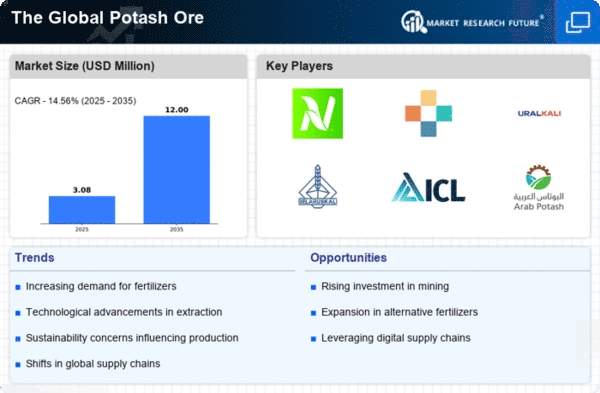
As per MRFR analysis, The Global Potash Ore Size was estimated at 2.69 USD Million in 2024. The potash industry is projected to grow from 3.08 in 2025 to 12.0 by 2035, exhibiting a compound annual growth rate (CAGR) of 14.56 during the forecast period 2025 - 2035.

Key Market Trends & Highlights

The Global Potash Ore is poised for growth driven by sustainable practices and technological advancements.

  • North America remains the largest market for potash ore, primarily due to its extensive agricultural sector.
  • Asia-Pacific is emerging as the fastest-growing region, fueled by increasing agricultural productivity and food security initiatives.
  • The fertilizers segment dominates the market, while the industrial chemicals segment is experiencing rapid growth due to diverse applications.
  • Rising demand for fertilizers and government policies supporting agriculture are key drivers propelling market expansion.

Market Size & Forecast

2024 Market Size 2.69 (USD Million)
2035 Market Size 12.0 (USD Million)
CAGR (2025 - 2035) 14.56%
Largest Regional Market Share in 2024 North America

Major Players

<p>Nutrien (CA), Mosaic (US), K+S (DE), Uralkali (RU), Belaruskali (BY), Israel Chemicals (IL), Arab Potash Company (JO), Intrepid Potash (US), Gensource Potash Corporation (CA)</p>

Market Trends

The Global Potash Ore is currently experiencing a dynamic phase characterized by evolving demand patterns and shifting supply dynamics. The agricultural sector's increasing reliance on potash as a vital nutrient for crop production appears to be a primary driver of this market's growth. As global populations expand and food security becomes a pressing concern, the need for efficient fertilizers, particularly potash, is likely to intensify. Furthermore, advancements in extraction technologies and sustainable practices may enhance production capabilities, potentially leading to a more stable supply chain. In addition to agricultural applications, The Global Potash Ore is witnessing a growing interest in alternative uses, such as in industrial processes and environmental management. This diversification of applications suggests that the market may not solely depend on traditional agricultural demand. Stakeholders in this sector are likely to explore innovative solutions that leverage potash's unique properties, thereby broadening its market appeal. As the landscape continues to evolve, understanding these trends will be crucial for stakeholders aiming to navigate the complexities of The Global Potash Ore effectively.

Sustainable Practices in Production

There is a noticeable shift towards sustainable mining practices within The Global Potash Ore. Companies are increasingly adopting environmentally friendly methods to minimize ecological impact, which may enhance their market reputation and appeal to environmentally conscious consumers.

Technological Advancements

Innovations in extraction and processing technologies are likely to reshape The Global Potash Ore. Enhanced efficiency and reduced costs associated with these advancements could lead to increased production capacity and improved product quality.

Diversification of Applications

The exploration of alternative applications for potash beyond traditional agriculture is gaining traction. Industries such as pharmaceuticals and environmental management are beginning to recognize the potential benefits of potash, which may open new avenues for market growth.

Global Potash Ore Market Market Drivers

Global Trade Dynamics

The Global Potash Ores Market Industry is significantly influenced by global trade dynamics. Trade agreements and tariffs can impact the flow of potash between countries, affecting supply and pricing. For instance, countries with abundant potash reserves, such as Canada and Russia, play a crucial role in the global supply chain. Changes in trade policies can lead to fluctuations in market prices, influencing purchasing decisions among consumers. As the global economy evolves, the interconnectedness of trade relationships will likely shape the market landscape, presenting both challenges and opportunities for stakeholders in the potash industry.

Market Trends and Projections

The Global Potash Ores Market Industry is characterized by various trends and projections that reflect its growth trajectory. Current estimates indicate a market valuation of 30.25 USD Billion in 2024, with expectations to reach 50.75 USD Billion by 2035. The projected CAGR of 4.82% from 2025 to 2035 suggests a robust growth outlook, driven by factors such as increasing agricultural demand and technological advancements. These trends highlight the evolving nature of the potash market, where stakeholders must remain agile to adapt to changing conditions and capitalize on emerging opportunities.

Rising Demand for Fertilizers

The Global Potash Ores Market Industry experiences a notable surge in demand for fertilizers, driven by the increasing global population and the need for enhanced agricultural productivity. As of 2024, the market is valued at approximately 30.25 USD Billion, reflecting the critical role of potash in crop yield improvement. Countries such as India and China are significant consumers, utilizing potash to address soil nutrient deficiencies. This trend suggests that the demand for potash fertilizers will continue to rise, potentially leading to a market value of 50.75 USD Billion by 2035, with a projected CAGR of 4.82% from 2025 to 2035.

Government Initiatives and Support

Government policies and initiatives play a pivotal role in shaping the Global Potash Ores Market Industry. Many countries are implementing supportive measures to enhance domestic potash production and reduce reliance on imports. For example, subsidies for potash fertilizer production and investments in infrastructure are common strategies employed by governments to stimulate the industry. These initiatives not only bolster local economies but also ensure food security by promoting sustainable agricultural practices. As governments recognize the importance of potash in achieving agricultural goals, the market is likely to benefit from increased funding and favorable regulations.

Technological Advancements in Mining

Technological innovations in mining processes are transforming the Global Potash Ores Market Industry. Enhanced extraction techniques, such as solution mining and selective mining, are improving efficiency and reducing environmental impact. These advancements allow for the recovery of potash from previously unviable deposits, thereby expanding the resource base. For instance, the implementation of automation and real-time data analytics in mining operations has led to increased productivity and safety. As these technologies become more widespread, they are likely to contribute to the overall growth of the market, ensuring a steady supply of potash to meet global agricultural needs.

Sustainability and Environmental Concerns

Sustainability is becoming increasingly important in the Global Potash Ores Market Industry. Stakeholders are recognizing the need for environmentally responsible mining practices and the sustainable use of potash fertilizers. This shift is driven by growing consumer awareness and regulatory pressures aimed at minimizing environmental impact. Companies are adopting practices such as land reclamation and water conservation to align with sustainability goals. As a result, the market is witnessing a transformation where environmentally friendly practices are not only beneficial for the planet but also enhance brand reputation and consumer trust, potentially leading to increased market share.

Market Segment Insights

By Application: Fertilizers (Largest) vs. Industrial Chemicals (Fastest-Growing)

<p>In The Global Potash Ore, the application segment is significantly dominated by fertilizers, which account for the largest market share. Fertilizers utilize potash due to its essential role in enhancing crop yield and quality. The agricultural sector heavily relies on potash-rich fertilizers to meet the growing food demand resulting from global population growth. Following fertilizers, industrial chemicals represent a notable segment, though they hold a smaller share within the overall application distribution. This segment includes various applications in manufacturing processes where potash is used as a key raw material. The growth trends in the potash application segment are primarily driven by the increasing demand for fertilizers in agriculture, as more farmers seek to optimize their production. Simultaneously, the industrial chemicals segment is emerging as the fastest-growing area as industries innovate and explore new applications for potash. Market dynamics, such as the shift towards sustainable agriculture and increased investments in agricultural technologies, further fuel the growth of both segments as they adapt to environmental needs and regulatory changes.</p>

<p>Fertilizers: Dominant vs. Industrial Chemicals: Emerging</p>

<p>Fertilizers stand as the dominant application in The Global Potash Ore, emphasizing their critical role in agricultural productivity. The use of potash in fertilizers not only supports healthy plant growth but also enhances resistance to disease and environmental stress, making it indispensable for farmers striving for optimal yields. In contrast, the industrial chemicals segment is considered emerging, with a growing focus on potash as a key ingredient in diverse chemical processes. This segment entails the use of potash for producing glass, ceramics, and other industrial applications. As industries evolve and seek sustainable alternatives, the reliance on potash for industrial chemicals is expected to grow, reflecting a broader trend towards innovative uses of these essential minerals.</p>

By End Use: Agriculture (Largest) vs. Food Industry (Fastest-Growing)

<p>In The Global Potash Ore, the end use of potash is predominantly driven by the agriculture sector, which holds the largest market share due to its role in enhancing crop yield and soil quality. Potash is a vital nutrient for various crops, making agriculture the key consumer of potash ore. Following agriculture, the food industry also plays a significant role, using potash for food preservation, which contributes to its growing market influence.</p>

<p>Agriculture (Dominant) vs. Food Industry (Emerging)</p>

<p>The agriculture sector remains the dominant force in the potash ore market, mainly because of its extensive use in fertilizers to boost crop production. With the increasing global demand for food, agricultural potash applications are expected to expand further. Conversely, the food industry is emerging as a critical segment, utilizing potash for food preservation and processing. As this sector grows faster, it reflects consumers' increasing focus on food quality and safety, driving innovation in potash applications for more efficient preservation methods.</p>

By Product Type: Muriate of Potash (Largest) vs. Sulfate of Potash (Fastest-Growing)

<p>In The Global Potash Ore, Muriate of Potash (MOP) dominates the product type segment, accounting for a significant share of overall consumption. Its widespread use in various crops makes it a preferred choice among farmers, thereby solidifying its leading position. Conversely, Sulfate of Potash (SOP) has been gaining traction due to its advantages in high-value crops, leading to increased demand and market presence, especially in regions focusing on sustainable agriculture practices.</p>

<p>Muriate of Potash (Dominant) vs. Potassium Nitrate (Emerging)</p>

<p>Muriate of Potash remains the dominant product in the market due to its robust application across a wide range of crops, including grains and vegetables. Its cost-effectiveness and high potassium content contribute to its preferred status among farmers worldwide. On the other hand, Potassium Nitrate has emerged as an essential player because of its dual-nutrient providing capabilities, which cater to specific plant growth needs. This emerging product is increasingly utilized in specialty crops such as fruits and vegetables, appealing to growers aiming for both quality and yield.</p>

By Distribution Channel: Direct Sales (Largest) vs. Online Sales (Fastest-Growing)

<p>In The Global Potash Ore, Direct Sales emerges as the largest distribution channel, capturing a significant share of the market. This traditional approach continues to dominate due to established relationships between producers and large-scale buyers, ensuring consistent demand and supply dynamics. On the other hand, Online Sales represent a rapidly growing segment, appealing to a broader demographic, particularly smaller buyers who prefer the convenience and accessibility of digital platforms.</p>

<p>Direct Sales (Dominant) vs. Online Sales (Emerging)</p>

<p>Direct Sales is characterized by direct transactions between producers and end-users, offering benefits such as tailored service and volume discounts. This channel supports large-scale operations in agriculture and industrial applications, leveraging established networks and logistics. Conversely, Online Sales has seen a surge in popularity owing to the rise of e-commerce and changing buyer preferences. This emerging channel taps into a more diverse consumer base, facilitating access to potash products for smaller entities and enhancing market competition. Both segments play crucial roles, yet the trend suggests a notable shift toward digital purchasing solutions as buyers seek greater convenience and efficiency.</p>

By Form: Granular (Largest) vs. Powder (Fastest-Growing)

<p>In The Global Potash Ore, the Form segment is comprised of three primary types: Granular, Powder, and Liquid. Among these, Granular potash holds the largest market share, primarily due to its widespread application in the agriculture sector. Farmers prefer Granular potash for its ease of use and effectiveness in delivering nutrients to crops. Meanwhile, Powdered potash is gaining traction, especially in specialized markets, where it serves unique applications that require finer particle sizes. As the industry evolves, Powdered potash is positioned as the fastest-growing segment, driven by increasing demand for micronutrient-filled fertilizers and soil conditioning agents. This surge reflects agricultural trends toward precision farming, as farmers seek more effective ways to enhance soil quality and crop yield. The Liquid form, while not currently leading the market, provides essential versatility for various agricultural applications, further diversifying the market landscape.</p>

<p>Granular (Dominant) vs. Fluid (Emerging)</p>

<p>Granular potash dominates the market due to its established presence and reliability in traditional agriculture. It is favored for its high solubility and ease of application, making it suitable for a wide range of crops. Farmers appreciate its consistent quality and effectiveness, which has reinforced its status as the preferred choice in many regions. On the other hand, Fluid potash, although emerging, is gaining ground for its innovative applications in fertigation and irrigation systems. Its liquid form allows for precise nutrient delivery and better absorption by plants, appealing to modern farming practices focused on efficiency. As the market trends shift towards sustainable agriculture, Fluid potash will likely see increased adoption, making it a significant player in the future.</p>

Get more detailed insights about Potash Ore Market Consumption Forecast 2025- 2035

Regional Insights

North America : Market Leader in Potash Production

North America continues to lead The Global Potash Ore, holding a significant share of 1.35 million metric tons in 2025. The region's growth is driven by robust agricultural demand, particularly in the U.S. and Canada, where potash is essential for crop yield enhancement. Regulatory support for sustainable farming practices further boosts market dynamics, ensuring a steady demand for potash fertilizers. The competitive landscape is characterized by major players such as Nutrien and Mosaic, which dominate the market. The U.S. and Canada are the leading countries, with advanced mining technologies and extensive distribution networks. The presence of key players ensures a stable supply chain, while ongoing investments in production capacity are expected to meet the rising global demand for potash fertilizers.

Europe : Emerging Market with Growth Potential

Europe's potash ore market is poised for growth, with a market size of 0.75 million metric tons in 2025. The region is experiencing increased demand for potash fertilizers driven by the need for sustainable agriculture and food security. Regulatory frameworks promoting eco-friendly farming practices are acting as catalysts for market expansion, encouraging the use of potash to enhance soil fertility and crop productivity. Leading countries in this region include Germany and Belarus, where companies like K+S and Belaruskali play pivotal roles. The competitive landscape is evolving, with a focus on innovation and sustainability. The presence of established players and new entrants is expected to drive competition, ensuring a diverse supply of potash products to meet the growing agricultural needs.

Asia-Pacific : Growing Demand in Agriculture Sector

The Asia-Pacific region is witnessing a gradual increase in potash ore demand, with a market size of 0.45 million metric tons in 2025. This growth is primarily driven by the rising agricultural sector, particularly in countries like China and India, where potash is crucial for improving crop yields. Regulatory initiatives aimed at enhancing food security and sustainable farming practices are further propelling market demand for potash fertilizers. China and India are the leading countries in this region, with significant investments in agricultural technology and fertilizer production. The competitive landscape features both local and international players, including companies like Israel Chemicals. As the region continues to modernize its agricultural practices, the demand for potash is expected to rise, creating opportunities for market expansion.

Middle East and Africa : Emerging Market with Untapped Potential

The Middle East and Africa region represents an emerging market for potash ore, with a market size of 0.14 million metric tons in 2025. The growth in this region is driven by increasing agricultural activities and the need for fertilizers to enhance crop production. Regulatory support for agricultural development is fostering a favorable environment for potash demand, particularly in countries like Jordan and South Africa. Jordan, home to the Arab Potash Company, is a key player in the region, while South Africa is also making strides in potash utilization. The competitive landscape is evolving, with a focus on local production and sustainable practices. As the region seeks to improve food security, the demand for potash is expected to grow, presenting opportunities for investment and development.

Key Players and Competitive Insights

The Global Potash Ore is characterized by a competitive landscape that is increasingly shaped by strategic innovation and operational efficiency. Key players such as Nutrien (CA), Mosaic (US), and Uralkali (RU) are at the forefront, each adopting distinct strategies to enhance their market positioning. Nutrien (CA) focuses on sustainability and digital transformation, leveraging technology to optimize its supply chain and improve product offerings. Meanwhile, Mosaic (US) emphasizes regional expansion and strategic partnerships, aiming to enhance its market reach and operational capabilities. Uralkali (RU), on the other hand, appears to prioritize cost leadership and production efficiency, which collectively influences the competitive dynamics of the market, fostering an environment where innovation and operational excellence are paramount.

The business tactics employed by these companies reflect a nuanced understanding of the market's structure, which is moderately fragmented yet dominated by a few key players. Localizing manufacturing and optimizing supply chains are common strategies that enhance responsiveness to market demands. The collective influence of these major companies shapes a competitive environment where agility and adaptability are crucial for success, as they navigate the complexities of global supply chains and fluctuating demand.

In November 2025, Nutrien (CA) announced a significant investment in a new digital platform aimed at enhancing its operational efficiency and customer engagement. This strategic move underscores the company's commitment to leveraging technology to streamline processes and improve service delivery. By integrating advanced analytics and AI into its operations, Nutrien (CA) is likely to gain a competitive edge, positioning itself as a leader in the digital transformation of the potash sector.

In October 2025, Mosaic (US) entered into a strategic partnership with a leading agricultural technology firm to develop innovative fertilizer solutions tailored to specific crop needs. This collaboration is indicative of Mosaic's proactive approach to addressing the evolving demands of the agricultural sector. By aligning with technology partners, Mosaic (US) is poised to enhance its product offerings and strengthen its market position, potentially leading to increased customer loyalty and market share.

In September 2025, Uralkali (RU) announced the expansion of its production capacity at its flagship facility, a move that is expected to bolster its output by 15%. This expansion reflects Uralkali's strategy to maintain its cost leadership while meeting the growing global demand for potash. By increasing production efficiency, Uralkali (RU) is likely to enhance its competitive positioning, particularly in price-sensitive markets.

As of December 2025, the competitive trends within The Global Potash Ore are increasingly defined by digitalization, sustainability, and the integration of AI technologies. Strategic alliances are becoming more prevalent, as companies recognize the value of collaboration in driving innovation and enhancing operational capabilities. Looking ahead, the competitive differentiation in this market is expected to evolve, with a notable shift from price-based competition towards a focus on innovation, technology, and supply chain reliability. This transition may redefine how companies compete, emphasizing the importance of sustainable practices and technological advancements in securing a competitive advantage.

Key Companies in the Global Potash Ore Market include

Industry Developments

Future Outlook

Global Potash Ore Market Future Outlook

<p>The Global Potash Ore is projected to grow at a 14.56% CAGR from 2024 to 2035, driven by increasing agricultural demand, technological advancements, and sustainable practices.</p>

New opportunities lie in:

  • <p>Development of precision agriculture technologies for optimized potash application.</p>
  • <p>Expansion into emerging markets with tailored potash products.</p>
  • <p>Investment in eco-friendly extraction methods to enhance sustainability.</p>

<p>By 2035, the market is expected to solidify its position as a leader in agricultural inputs.</p>

Market Segmentation

Global Potash Ore Market Form Outlook

  • Granular
  • Powder
  • Liquid

Global Potash Ore Market End Use Outlook

  • Agriculture
  • Manufacturing
  • Food Industry
  • Pharmaceuticals

Global Potash Ore Market Application Outlook

  • Fertilizers
  • Industrial Chemicals
  • Animal Feed
  • Food Processing

Global Potash Ore Market Product Type Outlook

  • Muriate of Potash
  • Sulfate of Potash
  • Potassium Nitrate
  • Potassium Magnesium Sulfate

Global Potash Ore Market Distribution Channel Outlook

  • Direct Sales
  • Online Sales
  • Retail Sales

Report Scope

MARKET SIZE 20242.69(USD Million)
MARKET SIZE 20253.08(USD Million)
MARKET SIZE 203512.0(USD Million)
COMPOUND ANNUAL GROWTH RATE (CAGR)14.56% (2024 - 2035)
REPORT COVERAGERevenue Forecast, Competitive Landscape, Growth Factors, and Trends
BASE YEAR2024
Market Forecast Period2025 - 2035
Historical Data2019 - 2024
Market Forecast UnitsUSD Million
Key Companies ProfiledNutrien (CA), Mosaic (US), K+S (DE), Uralkali (RU), Belaruskali (BY), Israel Chemicals (IL), Arab Potash Company (JO), Intrepid Potash (US), Gensource Potash Corporation (CA)
Segments CoveredApplication, End Use, Product Type, Distribution Channel, Form
Key Market OpportunitiesIncreasing demand for sustainable agriculture practices drives growth in The Global Potash Ore.
Key Market DynamicsRising demand for sustainable agriculture drives innovation and competition in the potash ore market.
Countries CoveredNorth America, Europe, APAC, South America, MEA

FAQs

What are the key factors driving the US and Europe (Global) potash ore market?

Growing demand for agriculture fertilizers and growing fertilizer industry are the key factors driving the US and Europe (Global) potash ore market.

Name the key applications of potash ore.

Some key applications of the potash ore include metallurgical industry, chemical industry, and agriculture industry.

Which region will dominate the US and Europe (Global) potash ore market?

The US will dominate the US and Europe (Global) potash ore market.

Name the key players profiled in the US and Europe (Global) potash ore market.

Key players profiled in the US and Europe (Global) potash ore market includes BHP Billiton Ltd., Encanto Potash Corp., Uralkali, PotashCorp, Elementals Minerals Limited, Israel Chemicals Ltd, K+S GmbH, JSC Belaruskali, Agrium Inc., Mining Associates, Intrepid Potash, and EuroChem.

What are strategies adopted by key players to stay ahead in the US and Europe (Global) potash ore market?

Various strategies adopted by key players to stay ahead in the US and Europe (Global) potash ore market include mergers, acquisitions, collaborations, contracts, new product launch, alliances, and partnership.

  1. SECTION I: EXECUTIVE SUMMARY AND KEY HIGHLIGHTS
    1. | 1.1 EXECUTIVE SUMMARY
  2. SECTION II: SCOPING, METHODOLOGY AND MARKET STRUCTURE
    1. | 2.1 MARKET INTRODUCTION
    2. | 2.2 RESEARCH METHODOLOGY
  3. SECTION III: QUALITATIVE ANALYSIS
    1. | 3.1 MARKET DYNAMICS
    2. | 3.2 MARKET FACTOR ANALYSIS
  4. SECTION IV: QUANTITATIVE ANALYSIS
    1. | 4.1 Chemicals and Materials, BY Application (USD Million)
    2. | 4.2 Chemicals and Materials, BY End Use (USD Million)
    3. | 4.3 Chemicals and Materials, BY Product Type (USD Million)
    4. | 4.4 Chemicals and Materials, BY Distribution Channel (USD Million)
    5. | 4.5 Chemicals and Materials, BY Form (USD Million)
    6. | 4.6 Chemicals and Materials, BY Region (USD Million)
  5. SECTION V: COMPETITIVE ANALYSIS
    1. | 5.1 Competitive Landscape
    2. | 5.2 Company Profiles
    3. | 5.3 Appendix

Potash Ore Market Segmentation

Market Segmentation Overview

  • Detailed segmentation data will be available in the full report
  • Comprehensive analysis by multiple parameters
  • Regional and country-level breakdowns
  • Market size forecasts by segment
Infographic

Free Sample Request

Kindly complete the form below to receive a free sample of this Report

Get Free Sample

Customer Strories

Compare Licence

×
Features License Type
Single User Multiuser License Enterprise User
Price $4,950 $5,950 $7,250
Maximum User Access Limit 1 User Upto 10 Users Unrestricted Access Throughout the Organization
Free Customization
Direct Access to Analyst
Deliverable Format
Platform Access
Discount on Next Purchase 10% 15% 15%
Printable Versions