×
Request Free Sample ×

Kindly complete the form below to receive a free sample of this Report

* Please use a valid business email

Leading companies partner with us for data-driven Insights

clients tt-cursor
Hero Background

Germany Smart Shoe Market

ID: MRFR/SEM/45323-HCR
200 Pages
Garvit Vyas
February 2026

Germany Smart Shoe Market Size, Share and Research Report By Product Type (Step counting shoes., Positioning shoes and Navigation shoes), By Distribution Channel (Online Channel, Retail Stores and Departmental Stores), and By End-User (Men Smart shoes, Women Smart shoes, Kids Smart shoes, Athlete Smart shoes) - Industry Forecast Till 2035

Share:
Download PDF ×

We do not share your information with anyone. However, we may send you emails based on your report interest from time to time. You may contact us at any time to opt-out.

Germany Smart Shoe Market Infographic
Purchase Options

Germany Smart Shoe Market Summary

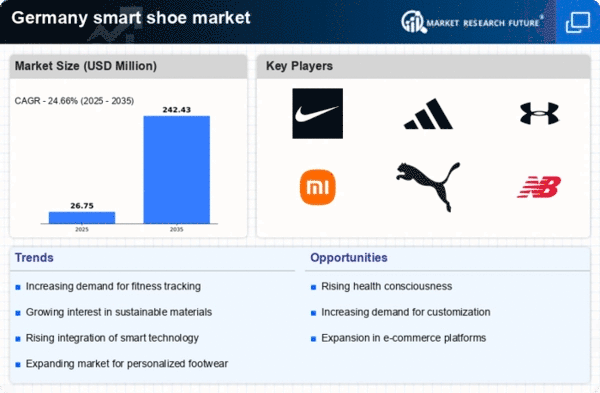
As per Market Research Future analysis, the Germany Smart Shoe Market size was estimated at 21.46 USD Million in 2024.. The Smart Shoe market is projected to grow from 26.75 USD Million in 2025 to 242.43 USD Million by 2035, exhibiting a compound annual growth rate (CAGR) of 24.6%6% during the forecast period 2025 - 2035.

Key Market Trends & Highlights

The Germany smart shoe market is experiencing a dynamic shift towards technological integration and sustainability.

  • Technological integration is becoming increasingly prevalent, enhancing user experience and functionality.
  • Sustainability focus is driving brands to adopt eco-friendly materials and production methods.
  • Customization and personalization are gaining traction, allowing consumers to tailor products to their preferences.
  • Rising health consciousness and advancements in wearable technology are key drivers propelling market growth.

Market Size & Forecast

2024 Market Size 21.46 (USD Million)
2035 Market Size 242.43 (USD Million)
CAGR (2025 - 2035) 24.66%

Major Players

Nike (US), Adidas (DE), Under Armour (US), Xiaomi (CN), Puma (DE), New Balance (US), Reebok (GB), Li-Ning (CN), ASICS (JP)

Our Impact
Enabled $4.3B Revenue Impact for Fortune 500 and Leading Multinationals
Partnering with 2000+ Global Organizations Each Year
30K+ Citations by Top-Tier Firms in the Industry

Germany Smart Shoe Market Trends

the Germany Smart Shoe Market is currently experiencing significant changes, driven by advancements in technology and changing consumer preferences.. In Germany, the integration of smart features into footwear is becoming increasingly prevalent, as consumers seek products that enhance their lifestyle and provide added functionality. This trend is characterized by the incorporation of sensors, connectivity, and health-monitoring capabilities, which appeal to a tech-savvy demographic. As a result, manufacturers are focusing on innovation to meet the demands of a market that values both performance and style. Moreover, sustainability is emerging as a critical factor influencing purchasing decisions within the smart shoe market. German consumers are becoming more environmentally conscious, prompting brands to adopt eco-friendly materials and production processes. This shift towards sustainability not only aligns with consumer values but also positions companies favorably in a competitive landscape. The combination of technological advancements and a commitment to sustainability suggests a dynamic future for the smart shoe market, where innovation and responsibility coexist to meet the evolving needs of consumers.

Technological Integration

The incorporation of advanced technology into footwear is a defining trend. Smart shoes are increasingly equipped with features such as fitness tracking, navigation assistance, and health monitoring. This integration appeals to consumers who prioritize functionality and connectivity in their daily lives.

Sustainability Focus

A growing emphasis on sustainability is shaping the smart shoe market. Brands are responding to consumer demand for eco-friendly products by utilizing sustainable materials and ethical manufacturing practices. This trend reflects a broader societal shift towards environmental responsibility.

Customization and Personalization

Consumers are increasingly seeking personalized experiences in their purchases. The smart shoe market is responding by offering customizable options, allowing individuals to tailor their footwear to their specific preferences. This trend enhances consumer engagement and satisfaction.

Germany Smart Shoe Market Drivers

Growing E-commerce Adoption

The rise of e-commerce in Germany is transforming the retail landscape, significantly impacting the smart shoe market. Consumers increasingly prefer online shopping for its convenience and variety. E-commerce platforms are providing a broader reach for smart shoe brands, allowing them to connect with a wider audience. Recent statistics indicate that online retail sales in Germany are expected to surpass €100 billion by 2025. This shift towards digital shopping is likely to enhance the visibility and accessibility of smart shoes, driving market growth as consumers seek innovative footwear solutions.

Increased Investment in R&D

The smart shoe market is experiencing a surge in research and development (R&D) investments from both established brands and startups in Germany. This influx of capital is fostering innovation and the development of new features that cater to consumer needs. Companies are focusing on creating smart shoes that not only track fitness metrics but also provide insights into gait analysis and injury prevention. The R&D expenditure in the footwear sector in Germany is projected to increase by 10% annually, indicating a robust commitment to advancing the smart shoe market. This investment is likely to yield products that resonate with health-conscious consumers.

Rising Health Consciousness

The increasing awareness of health and fitness among the German population appears to be a significant driver for the smart shoe market. As individuals become more health-conscious, they seek innovative solutions to monitor their physical activity. Smart shoes equipped with sensors that track steps, distance, and calories burned are gaining traction. According to recent data, the fitness tracking segment in Germany is projected to grow at a CAGR of 15% through 2026. This trend indicates a growing demand for smart footwear that integrates seamlessly into users' fitness routines, thereby enhancing the appeal of the smart shoe market.

Urbanization and Lifestyle Changes

Urbanization in Germany is contributing to lifestyle changes that favor the adoption of smart shoes. As more individuals reside in urban areas, the demand for convenient and multifunctional footwear increases. Smart shoes that offer navigation assistance, fitness tracking, and connectivity to smartphones align well with the fast-paced urban lifestyle. The smart shoe market is likely to benefit from this trend, as urban dwellers seek products that enhance their daily routines. With approximately 77% of the German population living in urban areas, the potential for growth in the smart shoe market is substantial.

Advancements in Wearable Technology

Technological advancements in wearable devices are likely to propel the smart shoe market forward. Innovations in sensor technology, battery life, and connectivity options have made smart shoes more appealing to consumers. In Germany, the wearable technology market is expected to reach €5 billion by 2025, with smart shoes representing a notable segment. These advancements not only improve functionality but also enhance user experience, making smart shoes more attractive to tech-savvy consumers. As the integration of AI and machine learning into wearable technology continues, the smart shoe market is poised for substantial growth.


Market Segment Insights

By Product Type: Step counting shoes (Largest) vs. Navigation shoes (Fastest-Growing)

The market distribution among the product types in the smart shoe segment shows step counting shoes as the leading category due to their popularity and widespread adoption. These shoes cater to health-conscious consumers, prioritizing fitness and wellness. Positioning shoes also maintain a notable market presence, recognized for their ability to assist users with balance and stability. Navigation shoes, while currently smaller in share, exhibit rapid growth potential as they integrate advanced technology for outdoor enthusiasts. Growth trends in the smart shoe segment are driven largely by technological advancements and increasing consumer interest in health tracking. Step counting shoes continue to evolve, offering enhanced features that attract a broad user base. Meanwhile, navigation shoes are on an upward trajectory, appealing to adventure seekers who desire reliable location tracking. This growth is supported by innovations that enhance performance and user experience across all product types.

Step counting shoes (Dominant) vs. Navigation shoes (Emerging)

Step counting shoes dominate the market as they appeal to a large demographic focused on fitness and health monitoring. Their integration with mobile applications enables users to track their activity levels, promote healthier lifestyles, and engage in social features that encourage community support. In contrast, navigation shoes are emerging as a niche yet significant category, aimed at outdoor enthusiasts and travelers. By incorporating GPS technology and real-time mapping functionalities, these shoes cater to a growing consumer demand for adventure and exploration. As the market evolves, both segments are likely to innovate further, enhancing their appeal and meeting diverse consumer needs.

By Distribution Channel: Online Channel (Largest) vs. Retail Stores (Fastest-Growing)

The distribution of market share among different channels in the Germany smart shoe market is diverse. The online channel stands out as the largest contributor, capturing a significant portion of the market share. This dominance is driven by changing consumer preferences towards e-commerce and increased digital penetration in retail, making it a popular choice for consumers looking for convenience and variety. Retail stores, while not as dominant as online channels, are witnessing rapid growth. This segment is propelled by the resurgence of in-person shopping experiences, where consumers seek to physically try on smart shoes before purchase. The experiential aspect and personalized service available in retail stores are key drivers attracting shoppers, making it the fastest-growing segment in this market.

Online Channel (Dominant) vs. Retail Stores (Emerging)

The online channel in the Germany smart shoe market serves as the dominant distribution method, characterized by a broad range of product offerings and competitive pricing. This segment appeals to tech-savvy consumers who prefer the convenience of shopping from home, facilitated by effective online marketing strategies and easy return policies. In contrast, retail stores represent an emerging channel that is gaining traction as customers increasingly value the tactile experience and immediate gratification of in-store purchasing. Retail outlets are enhancing their appeal by creating engaging shopping environments and offering expert assistance, appealing to traditional shoppers who prefer to physically inspect products before purchasing.

By End-user: Men Smart shoes (Largest) vs. Athlete Smart shoes (Fastest-Growing)

In the Germany smart shoe market, Men Smart shoes account for the largest share, reflecting a strong preference among male consumers for functionality, style, and technological integration. Women Smart shoes and Kids Smart shoes also hold significant portions of the market, catering to distinct consumer needs and fashion trends, while Athlete Smart shoes are rapidly gaining traction with fitness enthusiasts seeking high-performance footwear. The growth trend for the segment is driven primarily by innovation in smart technology, increasing health awareness, and the rising popularity of active lifestyles among various demographics. Women Smart shoes are experiencing a boost due to the expanding range of styles and features tailored for female consumers. At the same time, the Athlete Smart shoes segment is the fastest-growing, appealing to a younger audience that values fitness-related features and smart functionalities.

Men Smart shoes (Dominant) vs. Athlete Smart shoes (Emerging)

Men Smart shoes dominate the segment with their strong market presence, largely due to their versatility and integration of advanced technology, such as fitness tracking and connectivity features. This segment benefits from a well-established consumer base that values both aesthetics and functionality. Meanwhile, Athlete Smart shoes represent an emerging segment, quickly gaining popularity among sports enthusiasts and fitness aficionados who are drawn to innovative features designed to enhance athletic performance. The Athlete Smart shoes often feature lightweight materials, adaptive cushioning, and data-tracking capabilities, catering to tech-savvy consumers eager to elevate their athletic experience. Together, these segments illustrate a dynamic balance between established preferences and evolving trends.

Get more detailed insights about Germany Smart Shoe Market

Key Players and Competitive Insights

The smart shoe market in Germany exhibits a dynamic competitive landscape, characterized by rapid technological advancements and evolving consumer preferences. Key players such as Adidas (DE), Nike (US), and Puma (DE) are at the forefront, leveraging innovation and strategic partnerships to enhance their market positioning. Adidas (DE) focuses on sustainability, integrating eco-friendly materials into its smart shoe offerings, while Nike (US) emphasizes digital transformation through its advanced app ecosystem that tracks user performance. Puma (DE) appears to be carving a niche by targeting younger consumers with trendy designs and interactive features, collectively shaping a competitive environment that prioritizes innovation and consumer engagement.
In terms of business tactics, companies are increasingly localizing manufacturing to reduce lead times and enhance supply chain efficiency. The market structure is moderately fragmented, with several players vying for market share, yet the influence of major brands remains substantial. This competitive structure allows for a diverse range of products, catering to various consumer segments while fostering innovation through competition.
In October 2025, Adidas (DE) announced a partnership with a leading tech firm to develop a new line of smart shoes equipped with AI-driven performance analytics. This strategic move is likely to enhance Adidas's product offerings, providing consumers with personalized insights and fostering brand loyalty. The integration of AI technology into footwear aligns with current trends towards data-driven consumer experiences, potentially setting a new standard in the market.
In September 2025, Nike (US) launched a new version of its smart shoe, featuring enhanced connectivity with fitness apps and real-time feedback mechanisms. This initiative underscores Nike's commitment to digital innovation, aiming to create a seamless user experience that encourages active lifestyles. By continuously evolving its product line, Nike (US) reinforces its competitive edge in a market that increasingly values technological integration.
In August 2025, Puma (DE) introduced a limited-edition smart shoe collection in collaboration with a popular influencer, targeting the youth demographic. This marketing strategy not only boosts brand visibility but also taps into the growing trend of influencer partnerships in the fashion and sports sectors. By aligning with cultural trends, Puma (DE) positions itself as a forward-thinking brand that resonates with younger consumers.
As of November 2025, the competitive trends in the smart shoe market are heavily influenced by digitalization, sustainability, and AI integration. Strategic alliances are becoming increasingly vital, as companies seek to enhance their technological capabilities and market reach. The shift from price-based competition to a focus on innovation and supply chain reliability is evident, suggesting that future differentiation will hinge on the ability to deliver cutting-edge technology and sustainable practices. This evolution indicates a promising trajectory for the smart shoe market, where adaptability and forward-thinking strategies will likely dictate success.

Key Companies in the Germany Smart Shoe Market include

Industry Developments

The Germany Smart Shoe Market has witnessed significant developments recently, particularly with an increased focus on integrating technology into footwear for enhanced user experience. Companies such as Adidas and Nike have been actively launching new smart shoe models that cater to health-conscious consumers, highlighting features like activity tracking and performance monitoring. Additionally, Garmin and Samsung have been expanding their smart shoe offerings to attract sports enthusiasts. In terms of mergers and acquisitions, there have been notable activities, such as Nike acquiring a tech firm in July 2023 that specializes in wearables to enhance its product line.

This aligns with Adidas's strategy, which has also seen collaborations with tech startups to innovate smart footwear designs. The market has been growing steadily, with increasing valuation reported, attributed to rising consumer awareness of fitness and health monitoring. Furthermore, governments in Germany are supporting this innovative sector, emphasizing sustainability and technological advancement, resulting in a more dynamic environment for smart shoe manufacturers. The market's evolution over the past two to three years includes significant strides in intelligent material use and connectivity features, establishing Germany as a key player in the global smart footwear arena.

Future Outlook

Germany Smart Shoe Market Future Outlook

The smart shoe market in Germany is projected to grow at a 24.66% CAGR from 2025 to 2035, driven by technological advancements, increasing health awareness, and rising demand for personalized footwear.

New opportunities lie in:

  • Integration of AI-driven health monitoring features in smart shoes.
  • Development of subscription-based shoe maintenance services.
  • Partnerships with fitness apps for enhanced user engagement and data analytics.

By 2035, the smart shoe market is expected to achieve substantial growth and innovation.

Market Segmentation

Germany Smart Shoe Market End-user Outlook

  • Men Smart shoes
  • Women Smart shoes
  • Kids Smart shoes
  • Athlete Smart shoes

Germany Smart Shoe Market Product Type Outlook

  • Step counting shoes
  • Positioning shoes
  • Navigation shoes

Germany Smart Shoe Market Distribution Channel Outlook

  • Online Channel
  • Retail Stores
  • Departmental Stores

Report Scope

MARKET SIZE 2024 21.46(USD Million)
MARKET SIZE 2025 26.75(USD Million)
MARKET SIZE 2035 242.43(USD Million)
COMPOUND ANNUAL GROWTH RATE (CAGR) 24.66% (2025 - 2035)
REPORT COVERAGE Revenue Forecast, Competitive Landscape, Growth Factors, and Trends
BASE YEAR 2024
Market Forecast Period 2025 - 2035
Historical Data 2019 - 2024
Market Forecast Units USD Million
Key Companies Profiled Nike (US), Adidas (DE), Under Armour (US), Xiaomi (CN), Puma (DE), New Balance (US), Reebok (GB), Li-Ning (CN), ASICS (JP)
Segments Covered Product Type, Distribution Channel, End-user
Key Market Opportunities Integration of advanced health monitoring features in smart shoe market aligns with consumer wellness trends.
Key Market Dynamics Rising consumer demand for innovative features drives competition and technological advancements in the smart shoe market.
Countries Covered Germany
Leave a Comment

FAQs

What is the expected market size of the Germany Smart Shoe Market in 2024?

The Germany Smart Shoe Market is expected to be valued at 20.0 million USD in 2024.

What will be the market value of the Germany Smart Shoe Market by 2035?

By 2035, the Germany Smart Shoe Market is projected to reach a value of 280.0 million USD.

What is the expected CAGR for the Germany Smart Shoe Market from 2025 to 2035?

The expected CAGR for the Germany Smart Shoe Market from 2025 to 2035 is 27.114%.

What segment of the smart shoe market is expected to dominate by 2035?

By 2035, step counting shoes are expected to dominate with an estimated market size of 112.0 million USD.

How much is the positioning and navigation shoes segment expected to be valued in 2024?

The positioning and navigation shoes segment is expected to be valued at 12.0 million USD in 2024.

What are some of the major players in the Germany Smart Shoe Market?

Key players in the Germany Smart Shoe Market include Garmin, Samsung, Reebok, Nike, and Adidas.

Which product type is projected to experience the most significant growth from 2025 to 2035?

Step counting shoes are projected to experience the most significant growth during the forecast period from 2025 to 2035.

What opportunities exist in the Germany Smart Shoe Market?

Increasing health awareness and technological advancements present significant opportunities in the Germany Smart Shoe Market.

What challenges does the Germany Smart Shoe Market face?

The Germany Smart Shoe Market faces challenges such as high production costs and competition from traditional footwear brands.

What is the expected market growth for the smart shoe segment in Germany?

The overall Germany Smart Shoe Market is expected to experience substantial growth, reaching 280.0 million USD by 2035.

Download Free Sample

Kindly complete the form below to receive a free sample of this Report

Compare Licence

×
Features License Type
Single User Multiuser License Enterprise User
Price $4,950 $5,950 $7,250
Maximum User Access Limit 1 User Upto 10 Users Unrestricted Access Throughout the Organization
Free Customization
Direct Access to Analyst
Deliverable Format
Platform Access
Discount on Next Purchase 10% 15% 15%
Printable Versions