×
Request Free Sample ×

Kindly complete the form below to receive a free sample of this Report

* Please use a valid business email

Leading companies partner with us for data-driven Insights

clients tt-cursor
Hero Background

Germany Precision Medical Device Market

ID: MRFR/MED/42217-HCR
200 Pages
Rahul Gotadki
February 2026

Germany Precision Medical Device Market Research Report By Ecosystem Players Outlook (Pharmaceuticals and Biotechnology Companies Diagnostic Companies Healthcare IT Specialists/Big Data Companies Clinical Laboratories) By Sub-Markets Outlook (Companion Diagnostics Biomarker-Based Test Targeted Therapeutics Pharmacogenomics (PGX) Molecular Diagnostics) and By Therapeutics Outlook (Cancer/Oncology Cardiovascular Disease (CVD) Central Nervous System Infectious Diseases) - Growth & Industry Forecast 2025 To 2035

Share:
Download PDF ×

We do not share your information with anyone. However, we may send you emails based on your report interest from time to time. You may contact us at any time to opt-out.

Germany Precision Medical Device Market Infographic
Purchase Options

Germany Precision Medical Device Market Summary

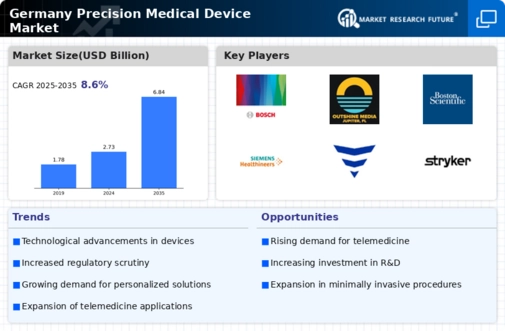
As per MRFR analysis, The Germany Precision Medical Device Market is projected to grow from USD 2.13 Billion in 2025 to USD 3.85 Billion by 2035, exhibiting a compound annual growth rate (CAGR) of 6.15% during the forecast period (2025 - 2035).

Key Market Trends & Highlights

The Germany precision medical device market is poised for growth driven by technological advancements and demographic shifts.

  • Surgical instruments represent the largest segment in the Germany precision medical device market, reflecting a robust demand for advanced surgical solutions.
  • Diagnostic devices are currently the fastest-growing segment, indicating a shift towards early detection and personalized healthcare.
  • Hospitals remain the largest end-user segment, while home care settings are emerging as the fastest-growing area, driven by changing patient preferences.
  • Key market drivers include the rising demand for minimally invasive procedures and the integration of artificial intelligence and machine learning in medical devices.

Market Size & Forecast

2024 Market Size 2.0 (USD Billion)
2035 Market Size 3.85 (USD Billion)
CAGR (2025 - 2035) 6.15%

Major Players

Siemens Healthineers (DE), B. Braun Melsungen AG (DE), Fresenius Medical Care AG & Co. KGaA (DE), Carl Zeiss AG (DE), Drägerwerk AG & Co. KGaA (DE), Medtronic GmbH (DE), Philips GmbH (DE), GE Healthcare (US), Johnson & Johnson (US)

Our Impact
Enabled $4.3B Revenue Impact for Fortune 500 and Leading Multinationals
Partnering with 2000+ Global Organizations Each Year
30K+ Citations by Top-Tier Firms in the Industry

Germany Precision Medical Device Market Trends

The Germany Precision Medical Device Market is characterized by a robust framework of innovation and regulatory compliance. Germany, being a leader in engineering and technology, has established itself as a hub for the development and manufacturing of precision medical devices. The market is driven by a combination of factors, including an aging population, increasing prevalence of chronic diseases, and a strong emphasis on research and development. The regulatory environment in Germany is stringent, ensuring that devices meet high safety and efficacy standards. This focus on quality has fostered trust among healthcare providers and patients alike, contributing to the market's growth. In addition, the integration of advanced technologies such as artificial intelligence and robotics into medical devices is reshaping the landscape of healthcare in Germany. These innovations not only enhance the precision and effectiveness of treatments but also improve patient outcomes. Furthermore, collaboration between academic institutions and industry players is likely to spur further advancements in the sector. As the demand for personalized medicine continues to rise, the germany precision medical device market appears poised for sustained growth, driven by technological advancements and a commitment to quality care.

Technological Advancements

The germany precision medical device market is witnessing a surge in technological innovations. The integration of artificial intelligence, machine learning, and robotics into medical devices is enhancing diagnostic accuracy and treatment efficacy. This trend is likely to continue as manufacturers invest in research and development to create more sophisticated devices that cater to the evolving needs of healthcare providers.

Regulatory Compliance

Stringent regulatory frameworks in Germany ensure that precision medical devices meet high safety and efficacy standards. This focus on compliance not only fosters trust among healthcare professionals and patients but also encourages manufacturers to prioritize quality in their product offerings. As regulations evolve, companies may need to adapt quickly to maintain their competitive edge.

Aging Population and Chronic Diseases

Germany's demographic trends indicate a growing aging population, which is likely to increase the demand for precision medical devices. Additionally, the rising prevalence of chronic diseases necessitates advanced medical solutions. This demographic shift presents opportunities for manufacturers to develop targeted devices that address the specific health needs of older adults and those with chronic conditions.

Germany Precision Medical Device Market Drivers

Focus on Personalized Medicine

The shift towards personalized medicine is emerging as a significant driver in the Germany precision medical device market. As healthcare providers increasingly recognize the importance of tailored treatment plans, the demand for precision devices that facilitate personalized approaches is on the rise. Technologies such as genetic testing and targeted therapies are gaining traction, leading to the development of specialized medical devices. In 2025, the market for personalized medical devices in Germany was estimated to be worth over 2 billion euros, reflecting a growing emphasis on individualized patient care. This trend not only enhances treatment efficacy but also positions the precision medical device industry as a key player in the future of healthcare.

Government Initiatives and Funding

Government initiatives aimed at promoting innovation in healthcare are pivotal in shaping the Germany precision medical device market. The German government has launched several funding programs to support research and development in medical technology. For example, the 'Innovationsfonds' program allocates substantial financial resources to projects that enhance healthcare delivery through advanced medical devices. In 2025, funding for medical technology research reached approximately 500 million euros, underscoring the commitment to fostering innovation. Such initiatives not only stimulate the development of cutting-edge precision devices but also encourage collaboration between academia and industry, thereby strengthening the overall market landscape.

Rising Demand for Minimally Invasive Procedures

The increasing preference for minimally invasive procedures is a notable driver in the Germany precision medical device market. Patients and healthcare providers alike are gravitating towards techniques that promise reduced recovery times and lower risk of complications. This trend is reflected in the growing sales of precision devices such as robotic surgical systems and advanced imaging technologies. In 2025, the market for minimally invasive surgical devices in Germany was valued at approximately 3 billion euros, indicating a robust growth trajectory. As healthcare facilities invest in state-of-the-art equipment to meet patient expectations, the demand for precision medical devices is likely to surge, further propelling the industry forward.

Increased Investment in Healthcare Infrastructure

The ongoing investment in healthcare infrastructure is a crucial driver for the Germany precision medical device market. As the government and private sector allocate resources to modernize hospitals and clinics, the demand for advanced medical devices is expected to rise. In 2025, healthcare expenditure in Germany reached approximately 400 billion euros, with a significant portion directed towards upgrading medical facilities. This investment not only enhances the quality of care but also creates opportunities for the adoption of innovative precision devices. As healthcare providers seek to improve patient outcomes, the integration of state-of-the-art medical technology becomes imperative, thereby fueling growth in the precision medical device market.

Integration of Artificial Intelligence and Machine Learning

The integration of artificial intelligence (AI) and machine learning (ML) into precision medical devices is transforming the landscape of the Germany precision medical device market. These technologies enhance diagnostic accuracy and operational efficiency, enabling healthcare professionals to make informed decisions swiftly. For instance, AI-driven imaging systems are being adopted in radiology departments across Germany, improving the detection rates of various conditions. The market for AI-based medical devices is projected to grow significantly, with estimates suggesting a compound annual growth rate of over 20% in the coming years. This technological evolution not only streamlines workflows but also elevates patient care standards, thereby driving the demand for precision medical devices.


Market Segment Insights

By Application: Surgical Instruments (Largest) vs. Diagnostic Devices (Fastest-Growing)

In the Germany precision medical device market, Surgical Instruments account for the largest share, reflecting their critical role in a wide range of medical procedures. The steady demand for innovative and high-quality surgical tools contributes significantly to this dominance, ensuring that healthcare professionals have access to the latest technologies. Diagnostic Devices, on the other hand, exhibit rapid growth, driven by the increasing emphasis on early disease detection and preventive healthcare measures. This segment is gaining momentum as advances in technology make diagnostics more accurate and less invasive. The growth trends in the application segment are largely influenced by an aging population, rising healthcare expenditure, and a surge in chronic diseases, driving the need for more precise medical interventions and timely diagnostics. Moreover, continuous research and development efforts in designing advanced technologies such as AI-driven diagnostic systems support the expansion of the Diagnostic Devices sector. Ultimately, these trends highlight a promising future for both Surgical Instruments and Diagnostic Devices within the market, catering to evolving consumer needs and expectations.

Surgical Instruments (Dominant) vs. Monitoring Equipment (Emerging)

In the Germany precision medical device market, Surgical Instruments have maintained a dominant position due to their central role in surgeries across various medical specialties. These devices encompass a broad range of tools, ensuring that medical practitioners can conduct procedures with optimal precision and safety. Furthermore, technological advancements, such as minimally invasive surgical instruments, bolster their relevance and appeal. Conversely, Monitoring Equipment is emerging as a vital segment, spurred by the increasing need for real-time patient data and home healthcare solutions. With the rise of telemedicine and remote monitoring, this segment is capitalizing on technological innovations that enhance patient care and satisfaction, opening new avenues for development and integration into healthcare systems.

By End Use: Hospitals (Largest) vs. Home Care Settings (Fastest-Growing)

In the Germany precision medical device market, the end use segment reveals a diverse distribution among key areas such as Hospitals, Clinics, Research Laboratories, Home Care Settings, and Ambulatory Surgical Centers. Hospitals continue to hold the largest share, reflecting their vital role in patient care and advanced medical procedures. Meanwhile, Home Care Settings have emerged as a significant segment, capturing the attention of healthcare providers and patients alike due to the growing trend of at-home healthcare services.

Hospitals (Dominant) vs. Home Care Settings (Emerging)

Hospitals represent the dominant force in the precision medical device market, benefiting from extensive resources, advanced technologies, and experienced personnel that allow for complex medical procedures and treatments. These facilities are equipped with leading-edge diagnostic and therapeutic devices, addressing a wide range of medical needs. On the other hand, Home Care Settings are rapidly emerging as an essential part of the healthcare continuum, driven by a shift towards more personalized care and a growing elderly population. The rise in telehealth and remote monitoring solutions is propelling this segment, with patients increasingly preferring the convenience of receiving care in their homes.

By Technology: Robotic Surgery (Largest) vs. Telemedicine (Fastest-Growing)

In the Germany precision medical device market, the technology segment is primarily dominated by Robotic Surgery, which has emerged as the largest share contributor. Minimally Invasive Surgery and 3D Printing also hold significant positions, showcasing the diversification in technological advancements. Wearable Technology is on a steady rise as consumers embrace digital health solutions, while Telemedicine is gaining traction rapidly due to increased demand for remote patient management solutions, especially post-pandemic.

Technology: Robotic Surgery (Dominant) vs. Telemedicine (Emerging)

Robotic Surgery is characterized by its precision and enhanced dexterity, allowing for minimally invasive procedures that reduce recovery time and improve surgical outcomes. This dominant technology segment enjoys wide acceptance among healthcare providers due to its effectiveness and safety profiles. Conversely, Telemedicine is emerging swiftly as a crucial player, driven by patient demand for convenient access to healthcare services and the expansion of telehealth policy initiatives. This segment leverages digital communication technologies to bridge the gap between patients and providers, showing promise for substantial growth as it gains acceptance among both healthcare professionals and patients.

By Product Type: Implants (Largest) vs. Monitoring Devices (Fastest-Growing)

In the Germany precision medical device market, the product type segment showcases significant diversity, with implants holding the largest market share. Following closely are prosthetics and diagnostic equipment, which occupy substantial niches. Surgical tools contribute to the market effectively, appealing to various healthcare specialties. Monitoring devices, while smaller in overall share, have been gaining traction due to advancements in technology and the increasing demand for remote patient care.

Implants (Dominant) vs. Monitoring Devices (Emerging)

Implants represent the dominant segment within the German precision medical device market, characterized by their essential role in various surgical procedures and patient rehabilitation. The segment encompasses a wide range of products, including orthopedic, dental, and cardiovascular implants, catering to an aging population and the rising prevalence of chronic diseases. On the other hand, monitoring devices are emerging as a key player, driven by technological innovations such as wearable technology and telehealth solutions. These devices are becoming vital in managing patient health remotely, thus improving patient outcomes. Both segments are crucial, with implants being well-established and monitoring devices responding quickly to evolving healthcare needs.

By Material: Metals (Largest) vs. Biomaterials (Fastest-Growing)

In the German precision medical device market, the materials segment is primarily driven by metals, which hold the largest market share due to their superior durability and reliability in medical applications. Metals such as stainless steel and titanium are widely used in surgical instruments and implants, making them indispensable to the industry. Meanwhile, polymers and ceramics also play a significant role by catering to specific applications, although they represent a smaller portion of the market share. Growth trends indicate a significant upward trajectory for biomaterials, reflecting their emerging prominence in medical device manufacturing. This growth is fueled by advancements in biocompatibility and innovation in material science, enabling the development of more complex devices. Furthermore, strong demand for less invasive solutions and personalized medicine is driving the adoption of biomaterials, signifying a notable shift in the landscape of medical device materials.

Metals (Dominant) vs. Polymers (Emerging)

Metals dominate the German precision medical device market, renowned for their strength and longevity, which make them suitable for essential medical devices, including surgical tools and orthopedic implants. Their ability to withstand high stresses and resist corrosion ensures that they meet the rigorous standards of the medical industry. In contrast, polymers are emerging as significant players due to their versatility, lightweight nature, and the capacity to be molded into various shapes. As innovations in polymer technology advance, these materials are increasingly applied in areas such as drug delivery systems and flexible medical devices, thus carving out an important niche within the market.

Get more detailed insights about Germany Precision Medical Device Market

Key Players and Competitive Insights

The precision medical device market in Germany is characterized by a dynamic competitive landscape, driven by technological advancements, regulatory changes, and an increasing demand for personalized healthcare solutions. Major players such as Siemens Healthineers (DE), B. Braun Melsungen AG (DE), and Fresenius Medical Care AG & Co. KGaA (DE) are at the forefront, each adopting distinct strategies to enhance their market positioning. Siemens Healthineers (DE) focuses on innovation through the development of advanced imaging technologies, while B. Braun Melsungen AG (DE) emphasizes regional expansion and partnerships to strengthen its supply chain. Fresenius Medical Care AG & Co. KGaA (DE) is leveraging digital transformation to improve patient outcomes, collectively shaping a competitive environment that prioritizes technological integration and patient-centric solutions.

Key business tactics within this market include localizing manufacturing and optimizing supply chains to enhance operational efficiency. The competitive structure appears moderately fragmented, with several key players exerting influence over market dynamics. This fragmentation allows for a diverse range of products and services, catering to various segments of the healthcare industry, while also fostering innovation as companies strive to differentiate themselves.

In November 2025, Siemens Healthineers (DE) announced the launch of a new AI-driven imaging system designed to enhance diagnostic accuracy and reduce patient wait times. This strategic move underscores the company's commitment to integrating cutting-edge technology into its offerings, potentially setting a new standard for imaging solutions in the market. The introduction of such advanced systems may not only improve patient care but also strengthen Siemens Healthineers' competitive edge in a rapidly evolving landscape.

In December 2025, B. Braun Melsungen AG (DE) expanded its partnership with a leading telehealth provider to enhance remote patient monitoring capabilities. This collaboration is strategically significant as it aligns with the growing trend towards digital health solutions, enabling B. Braun to offer comprehensive care that extends beyond traditional settings. By integrating telehealth into its service offerings, the company positions itself as a forward-thinking leader in the precision medical device sector.

In January 2026, Fresenius Medical Care AG & Co. KGaA (DE) unveiled a new platform aimed at streamlining data management for dialysis patients. This initiative reflects the company's focus on digital transformation and patient-centric care, potentially improving treatment outcomes and operational efficiencies. By harnessing data analytics, Fresenius Medical Care is likely to enhance its service delivery, thereby reinforcing its market position.

As of January 2026, current competitive trends in the precision medical device market include a pronounced emphasis on digitalization, sustainability, and the integration of artificial intelligence. Strategic alliances are increasingly shaping the landscape, allowing companies to pool resources and expertise to drive innovation. The shift from price-based competition to a focus on technological advancement and supply chain reliability is evident, suggesting that future competitive differentiation will hinge on the ability to deliver innovative solutions that meet the evolving needs of healthcare providers and patients alike.

Key Companies in the Germany Precision Medical Device Market include

Industry Developments

Recent developments in the Germany Precision Medical Device Market reflect robust growth and evolving dynamics within the sector. Notably, Medtronic has expanded its operations in Germany with a new facility dedicated to advanced robotic surgical technology, which is anticipated to bolster surgical precision and patient outcomes. Abbott Laboratories introduced a new wearable glucose monitoring device, enhancing diabetes management for patients. The market has also seen significant investment, particularly from Bosch Healthcare Solutions, which has focused on integrating AI for medical diagnostics.

Additionally, in October 2023, Siemens Healthineers completed the acquisition of a German company specializing in molecular imaging, aiming to strengthen its portfolio in personalized medicine. The precision medical device sector is projected to grow substantially, driven by trends towards minimally invasive procedures and a growing aging population. Noteworthy developments from the past couple of years include the collaboration between Drägerwerk and Boston Scientific in July 2022, aimed at advancing respiratory care technologies. Germany's innovation-friendly environment, supported by governmental funding for medical research, continues to attract investments and partnerships within the precision medical device market.

Future Outlook

Germany Precision Medical Device Market Future Outlook

The Germany precision medical device market is projected to grow at a 6.15% CAGR from 2025 to 2035, driven by technological advancements, increasing healthcare expenditure, and an aging population.

New opportunities lie in:

  • Development of AI-driven diagnostic tools for personalized medicine.
  • Expansion of telehealth platforms integrating precision devices.
  • Investment in sustainable manufacturing processes for medical devices.

By 2035, the market is expected to be robust, driven by innovation and strategic investments.

Market Segmentation

Germany Precision Medical Device Market End Use Outlook

  • Hospitals
  • Clinics
  • Research Laboratories
  • Home Care Settings
  • Ambulatory Surgical Centers

Germany Precision Medical Device Market Material Outlook

  • Metals
  • Polymers
  • Ceramics
  • Composites
  • Biomaterials

Germany Precision Medical Device Market Technology Outlook

  • Robotic Surgery
  • Minimally Invasive Surgery
  • 3D Printing
  • Wearable Technology
  • Telemedicine

Germany Precision Medical Device Market Application Outlook

  • Surgical Instruments
  • Diagnostic Devices
  • Therapeutic Devices
  • Monitoring Equipment
  • Imaging Systems

Germany Precision Medical Device Market Product Type Outlook

  • Implants
  • Prosthetics
  • Diagnostic Equipment
  • Surgical Tools
  • Monitoring Devices

Report Scope

MARKET SIZE 20242.0(USD Billion)
MARKET SIZE 20252.13(USD Billion)
MARKET SIZE 20353.85(USD Billion)
COMPOUND ANNUAL GROWTH RATE (CAGR)6.15% (2024 - 2035)
REPORT COVERAGERevenue Forecast, Competitive Landscape, Growth Factors, and Trends
BASE YEAR2024
Market Forecast Period2025 - 2035
Historical Data2019 - 2024
Market Forecast UnitsUSD Billion
Key Companies ProfiledSiemens Healthineers (DE), B. Braun Melsungen AG (DE), Fresenius Medical Care AG & Co. KGaA (DE), Carl Zeiss AG (DE), Drägerwerk AG & Co. KGaA (DE), Medtronic GmbH (DE), Philips GmbH (DE), GE Healthcare (US), Johnson & Johnson (US)
Segments CoveredApplication, End Use, Technology, Product Type, Material
Key Market OpportunitiesIntegration of artificial intelligence in diagnostics enhances efficiency in the germany precision medical device market.
Key Market DynamicsTechnological advancements drive innovation and competition in Germany's precision medical device market, enhancing patient outcomes.
Countries CoveredGermany
Leave a Comment

FAQs

What is the current valuation of the Germany precision medical device market?

The market valuation was 2.0 USD Billion in 2024.

What is the projected market size for the Germany precision medical device market by 2035?

The market is expected to reach 3.85 USD Billion by 2035.

What is the expected CAGR for the Germany precision medical device market during the forecast period?

The expected CAGR for the market from 2025 to 2035 is 6.15%.

Which companies are considered key players in the Germany precision medical device market?

Key players include Siemens Healthineers, B. Braun Melsungen AG, and Medtronic GmbH.

What are the main segments of the Germany precision medical device market?

The main segments include surgical instruments, diagnostic devices, and therapeutic devices.

How did the surgical instruments segment perform in 2024?

The surgical instruments segment was valued at 0.5 USD Billion in 2024 and is projected to grow to 0.95 USD Billion.

What is the expected growth for diagnostic devices in the Germany precision medical device market?

The diagnostic devices segment was valued at 0.6 USD Billion in 2024 and is anticipated to reach 1.15 USD Billion.

What end-use categories are included in the Germany precision medical device market?

End-use categories include hospitals, clinics, and research laboratories.

What technological advancements are influencing the Germany precision medical device market?

Technological advancements include robotic surgery, minimally invasive surgery, and wearable technology.

What materials are primarily used in the production of precision medical devices in Germany?

The primary materials include metals, polymers, and ceramics.

Download Free Sample

Kindly complete the form below to receive a free sample of this Report

Compare Licence

×
Features License Type
Single User Multiuser License Enterprise User
Price $4,950 $5,950 $7,250
Maximum User Access Limit 1 User Upto 10 Users Unrestricted Access Throughout the Organization
Free Customization
Direct Access to Analyst
Deliverable Format
Platform Access
Discount on Next Purchase 10% 15% 15%
Printable Versions