×
Request Free Sample ×

Kindly complete the form below to receive a free sample of this Report

* Please use a valid business email

Leading companies partner with us for data-driven Insights

clients tt-cursor
Hero Background

Germany Human Growth Hormone Market

ID: MRFR/HC/43244-HCR
200 Pages
Garvit Vyas
February 2026

Germany Human Growth Hormone Market Research Report By Brand (Norditropin, Genotropin, Humatrope, Saizen, Omnitrope, Skytrofa, Others), By Route of Administration (Subcutaneous, Intramuscular, Intravenous), By Application (Pediatric Growth Hormone Deficiency, Adult Growth Hormone Deficiency, Idiopathic Growth Hormone Deficiency, Small for Gestational Age, Turner Syndrome, Prader-Willi Syndrome, Others) and By Distribution Channel (Hospital Pharmacies, Retail Pharmacies, Online Pharmacy, Specialty Pharmacy) - Growth & Industry Forecast 2025 To 2035

Share:
Download PDF ×

We do not share your information with anyone. However, we may send you emails based on your report interest from time to time. You may contact us at any time to opt-out.

Germany Human Growth Hormone Market Infographic
Purchase Options

Germany Human Growth Hormone Market Summary

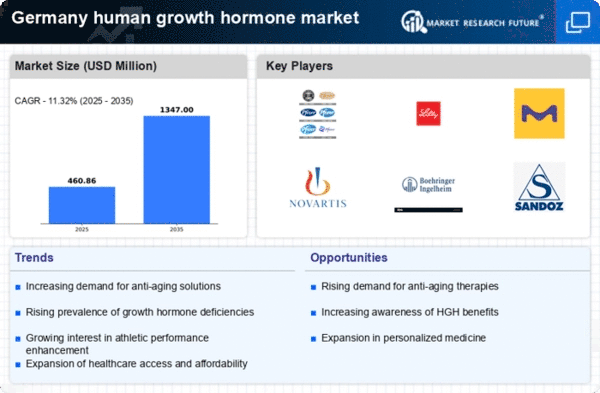
As per Market Research Future analysis, the Germany human growth hormone market size was estimated at 414.0 USD Million in 2024. The Germany human growth-hormone market is projected to grow from 460.86 USD Million in 2025 to 1347.0 USD Million by 2035, exhibiting a compound annual growth rate (CAGR) of 11.3% during the forecast period 2025 - 2035

Key Market Trends & Highlights

The Germany human growth-hormone market is experiencing notable growth driven by various factors.

  • Rising awareness of growth disorders is significantly influencing the demand for human growth hormone (HGH) therapies.
  • Technological advancements in HGH production are enhancing the efficiency and effectiveness of treatment options.
  • The evolving regulatory landscape is shaping the market dynamics, particularly in the approval processes for HGH products.
  • Increasing demand for anti-aging treatments and the rising prevalence of growth hormone deficiency are key drivers propelling market growth.

Market Size & Forecast

2024 Market Size 414.0 (USD Million)
2035 Market Size 1347.0 (USD Million)
CAGR (2025 - 2035) 11.32%

Major Players

Pfizer Inc (US), Eli Lilly and Company (US), Merck KGaA (DE), Novartis AG (CH), Boehringer Ingelheim GmbH (DE), Sandoz International GmbH (CH), HGH Medical (US), Genotropin (US)

Our Impact
Enabled $4.3B Revenue Impact for Fortune 500 and Leading Multinationals
Partnering with 2000+ Global Organizations Each Year
30K+ Citations by Top-Tier Firms in the Industry

Germany Human Growth Hormone Market Trends

The human growth-hormone market in Germany is currently experiencing notable developments, driven by increasing awareness of growth disorders and the potential benefits of hormone therapy. The demand for human growth hormone (HGH) is rising among various demographics, including children with growth deficiencies and adults seeking to enhance physical performance. This trend is further supported by advancements in biotechnology, which have improved the efficacy and safety of HGH products. Regulatory frameworks in Germany are also evolving, allowing for more streamlined access to these therapies, which may contribute to market expansion. Moreover, the growing emphasis on health and wellness is influencing consumer behavior, leading to a greater acceptance of hormone treatments. As healthcare providers become more knowledgeable about the applications of HGH, they are likely to recommend these therapies more frequently. This shift in perception, combined with ongoing research into the long-term effects of HGH, suggests a promising outlook for the human growth-hormone market. The interplay between regulatory changes, technological advancements, and consumer attitudes appears to be shaping a dynamic environment for HGH products in Germany.

Rising Awareness of Growth Disorders

There is an increasing recognition of growth disorders among the population, leading to heightened demand for human growth hormone therapies. This trend is particularly evident in pediatric care, where early diagnosis and treatment are becoming more common.

Technological Advancements in HGH Production

Innovations in biotechnology are enhancing the production processes of human growth hormone, resulting in more effective and safer products. These advancements are likely to attract both healthcare providers and patients, fostering market growth.

Evolving Regulatory Landscape

The regulatory environment surrounding human growth hormone is adapting to facilitate better access to treatments. Changes in policies may streamline approval processes, encouraging more healthcare professionals to prescribe HGH therapies.

Germany Human Growth Hormone Market Drivers

Advancements in Delivery Methods

Innovations in delivery methods for human growth hormone therapies are poised to transform the market landscape in Germany. Traditional injection methods are being supplemented by alternative delivery systems, such as oral formulations and transdermal patches, which may enhance patient compliance and convenience. These advancements could potentially lead to a broader acceptance of human growth-hormone treatments among patients who are hesitant about injections. Market analysts predict that the introduction of these novel delivery methods could increase the market share of human growth-hormone products by up to 15% over the next few years. As patient preferences evolve, the human growth-hormone market is likely to adapt, fostering a competitive environment that encourages further innovation.

Growing Investment in Sports Medicine

The human growth-hormone market is also benefiting from increased investment in sports medicine and performance enhancement. Athletes and fitness enthusiasts are increasingly turning to human growth hormone therapies to improve their physical performance, recovery times, and overall athletic capabilities. This trend is particularly evident in competitive sports, where the demand for safe and effective performance-enhancing solutions is on the rise. Regulatory bodies are closely monitoring this sector, which may lead to a more structured approach to the use of human growth hormone in sports. As a result, the human growth-hormone market could see a significant uptick in sales, driven by both legitimate medical use and the growing interest in performance enhancement among athletes.

Expansion of Healthcare Infrastructure

The expansion of healthcare infrastructure in Germany is playing a crucial role in the growth of the human growth-hormone market. With an increasing number of healthcare facilities and advancements in medical technology, access to hormone therapies is improving. This expansion is particularly beneficial in rural areas, where previously limited access to specialized care is being addressed. As healthcare providers become more equipped to diagnose and treat growth hormone deficiencies, the market is likely to experience a corresponding increase in demand for human growth-hormone therapies. Furthermore, government initiatives aimed at enhancing healthcare services may further bolster the human growth-hormone market, ensuring that more patients receive the necessary treatments.

Increasing Demand for Anti-Aging Treatments

The human growth-hormone market in Germany is experiencing a notable surge in demand for anti-aging treatments. As the population ages, there is a growing interest in therapies that can mitigate the effects of aging, such as decreased muscle mass and increased body fat. This trend is particularly pronounced among individuals aged 40 and above, who are increasingly seeking solutions to enhance their vitality and overall well-being. Market data indicates that the anti-aging segment is projected to grow at a CAGR of approximately 8% over the next five years. This increasing demand is likely to drive innovation and investment in the human growth-hormone market, as companies strive to develop effective and safe products that cater to this demographic's needs.

Rising Prevalence of Growth Hormone Deficiency

The prevalence of growth hormone deficiency in Germany is contributing significantly to the expansion of the human growth-hormone market. Conditions such as Turner syndrome, Prader-Willi syndrome, and chronic kidney disease are leading to an increased diagnosis of growth hormone deficiencies among children and adults. Recent studies suggest that approximately 1 in 3,000 children may be affected by growth hormone deficiency, creating a substantial patient population in need of treatment. This growing awareness among healthcare professionals and patients is likely to enhance the market's growth trajectory, as more individuals seek medical intervention. The human growth-hormone market is expected to see a steady increase in sales, driven by the need for effective therapies to address these deficiencies.


Market Segment Insights

By Brand: Norditropin (Largest) vs. Genotropin (Fastest-Growing)

In the Germany human growth-hormone market, the brand segment is led by Norditropin, which holds a significant share due to its established reputation and broad acceptance among healthcare providers. Following closely is Genotropin, known for its innovative formulation, which has recently gained traction and is rapidly increasing its market presence. Other notable brands such as Humatrope, Saizen, and Omnitrope also contribute to the market landscape, albeit with smaller shares. Growth trends in this segment are largely influenced by increasing awareness of growth hormone therapy, coupled with favorable regulatory environments. The rising prevalence of growth hormone deficiencies and related disorders is propelling demand for effective treatment options. Furthermore, advancements in drug formulations and delivery systems are enhancing patient compliance, thereby driving the expansion of brands like Genotropin and Skytrofa.

Norditropin (Dominant) vs. Genotropin (Emerging)

Norditropin has solidified its position as a dominant player in the Germany human growth-hormone market, attributed to its long-standing clinical use and trust among practitioners. The brand's formulation and delivery methods have been tailored to optimize patient outcomes. In contrast, Genotropin is emerging rapidly, appealing to a younger demographic with its innovative delivery system and efficacy. Its marketing strategies focus on educating both healthcare professionals and patients, contributing to its accelerated growth. While Norditropin remains the go-to for many, Genotropin's rise signals shifting preferences among users for newer, potentially more efficient therapies.

By Route of Administration: Subcutaneous (Largest) vs. Intravenous (Fastest-Growing)

In the Germany human growth-hormone market, the route of administration shows a distinctive distribution among subcutaneous, intramuscular, and intravenous methods. Subcutaneous administration leads the market, accounting for the majority market share due to its ease of use and patient compliance. Intramuscular follows close behind, while intravenous stands out due to its innovative applications in clinical settings. Overall, subcutaneous and intramuscular account for the bulk of the market, reflecting established preferences among healthcare professionals and patients alike. Growth trends within the route of administration segment are increasingly shaped by advancements in technology and user-friendly product designs. The subcutaneous route remains dominant due to its favorable profile among users, while intravenous administration is emerging rapidly, driven by its effectiveness in specific clinical scenarios. Enhanced delivery systems and ongoing research into hormone therapies are expected to propel the growth of these segments significantly, as the demand for liquid transportation and efficacy continues to rise within both healthcare settings and at-home therapies.

Subcutaneous (Dominant) vs. Intravenous (Emerging)

Subcutaneous administration is the dominant method in the Germany human growth-hormone market, prized for its user-friendly application and minimal invasiveness, fostering adherence among patients. This method allows for self-administration, which increases patient autonomy and reduces the need for frequent healthcare visits. Conversely, intravenous administration is emerging as a preferred alternative in specific therapeutic contexts, particularly for patients requiring rapid hormone levels adjustment. This route is utilized in clinical environments where monitoring is critical, and efficacy is paramount. The growing trend towards personalized medicine is likely to further integrate these administration methods, pushing for tailored approaches that meet individual patient needs.

By Application: Pediatric Growth Hormone Deficiency (Largest) vs. Adult Growth Hormone Deficiency (Fastest-Growing)

The distribution of market share among the various applications in the Germany human growth-hormone market reveals that Pediatric Growth Hormone Deficiency holds a significant portion. This segment is driven by the high prevalence of growth-related disorders in children. Following closely are Adult Growth Hormone Deficiency and Idiopathic Growth Hormone Deficiency. Smaller segments, including Turner Syndrome and Prader-Willi Syndrome, also contribute to the overall market but do not dominate the share as much as the primary categories. Growth trends indicate that the Adult Growth Hormone Deficiency segment is emerging as the fastest-growing area within this market. This surge is attributed to the increasing awareness and diagnosis of growth hormone deficiencies among adults. Additionally, the lifestyle changes and an aging population are contributing to a greater demand for treatments associated with adult growth hormone deficiencies. The Pediatric segment remains robust, propelled by consistent healthcare initiatives targeting child growth disorders.

Pediatric Growth Hormone Deficiency (Dominant) vs. Adult Growth Hormone Deficiency (Emerging)

Pediatric Growth Hormone Deficiency stands as the dominant segment in the application landscape of the Germany human growth-hormone market, characterized by a well-established treatment protocol and high patient engagement through pediatricians and endocrinologists. It fulfills a critical need for effective management of growth disorders in children, which is seen as a priority in pediatric healthcare. On the other hand, Adult Growth Hormone Deficiency is classified as an emerging segment, gaining traction due to rising awareness and targeted treatments. The growing older demographic and lifestyle-related health issues present increased opportunities in this domain. As more adults seek intervention for hormone-related deficiencies, this segment is predicted to experience rapid growth, alongside evolving therapeutic options.

By Distribution Channel: Retail Pharmacies (Largest) vs. Online Pharmacy (Fastest-Growing)

In the analysis of distribution channels within the human growth-hormone market, retail pharmacies hold the largest share, significantly contributing to the availability and accessibility of these products. This segment benefits from established relationships with consumers and healthcare professionals, ensuring a consistent demand for growth hormones. Meanwhile, hospital pharmacies and specialty pharmacies also play crucial roles, but their market shares are comparatively smaller, targeting specific patient populations and clinical settings. Looking at growth trends, the online pharmacy segment is emerging as the fastest-growing channel, driven by increasing e-commerce adoption and consumer preference for convenient purchasing options. The shift towards online platforms is aided by technological advancements and changes in consumer behavior, particularly post-pandemic. As patients seek discreet and convenient ways to access health products, the online channel is expected to capture a larger share of the market in the coming years.

Retail Pharmacies (Dominant) vs. Online Pharmacy (Emerging)

Retail pharmacies serve as the dominant distribution channel within the market, leveraging their physical presence to foster trust and provide personalized consultations regarding human growth hormone therapies. They are often the first point of contact for patients, enabling easy access to prescription medications and fostering adherence to treatment regimens. Conversely, online pharmacies represent an emerging channel that is rapidly gaining traction. They offer a plethora of choices and the convenience of home delivery, appealing to a tech-savvy demographic. This shift is attributable to consumer preferences for privacy and ease of access, making online pharmacies a formidable force in the healthcare landscape.

Get more detailed insights about Germany Human Growth Hormone Market

Key Players and Competitive Insights

The human growth-hormone market in Germany is characterized by a competitive landscape that is both dynamic and multifaceted. Key growth drivers include an increasing prevalence of growth hormone deficiencies, rising awareness regarding the benefits of hormone therapy, and advancements in biotechnology. Major players such as Pfizer Inc (US), Eli Lilly and Company (US), and Merck KGaA (DE) are strategically positioned to leverage these trends. Pfizer Inc (US) focuses on innovation through research and development, aiming to enhance the efficacy of its growth hormone products. Eli Lilly and Company (US) emphasizes partnerships with healthcare providers to improve patient access, while Merck KGaA (DE) is investing in digital transformation to streamline operations and enhance customer engagement. Collectively, these strategies contribute to a competitive environment that is increasingly centered on innovation and patient-centric solutions.In terms of business tactics, companies are localizing manufacturing to reduce costs and improve supply chain efficiency. The market structure appears moderately fragmented, with several key players holding substantial market shares. This fragmentation allows for a diverse range of products and services, fostering competition that drives innovation. The collective influence of these key players shapes market dynamics, as they continuously adapt to changing regulatory landscapes and consumer demands.

In October Pfizer Inc (US) announced a strategic partnership with a leading German biotechnology firm to co-develop a new growth hormone therapy aimed at pediatric patients. This collaboration is significant as it not only enhances Pfizer's product portfolio but also positions the company to tap into the growing pediatric market segment, which is expected to expand due to increasing awareness and diagnosis of growth disorders.

In September Eli Lilly and Company (US) launched a new digital platform designed to facilitate remote monitoring of patients undergoing growth hormone therapy. This initiative is crucial as it aligns with the ongoing trend towards digital health solutions, potentially improving patient adherence and outcomes. By integrating technology into their service offerings, Eli Lilly is likely to strengthen its competitive position in the market.

In August Merck KGaA (DE) expanded its manufacturing capabilities in Germany, investing €50 million in a new facility dedicated to the production of growth hormone products. This expansion is indicative of Merck's commitment to meeting increasing demand and enhancing supply chain reliability. By bolstering its production capacity, Merck is well-positioned to respond to market fluctuations and maintain a competitive edge.

As of November current competitive trends in the human growth-hormone market include a pronounced shift towards digitalization, sustainability, and the integration of artificial intelligence in product development and patient management. Strategic alliances are increasingly shaping the landscape, enabling companies to pool resources and expertise. Looking ahead, competitive differentiation is likely to evolve from traditional price-based competition to a focus on innovation, technological advancements, and supply chain reliability. This shift underscores the importance of agility and responsiveness in a rapidly changing market environment.

Key Companies in the Germany Human Growth Hormone Market include

Industry Developments

In recent months, the Germany Human Growth Hormone Market has seen significant developments, particularly with the increasing prevalence of growth hormone deficiency conditions, thus amplifying the demand for therapeutic products. Companies such as Genentech and Novo Nordisk are focusing on enhancing their product lines, with Novo Nordisk having launched a new formulation in February 2023 to improve patient adherence. Additionally, Ipsen recently expanded its operations in Germany to strengthen its portfolio in endocrinology, reflecting the growing market potential.

Mergers and acquisitions have also marked the landscape; in July 2023, Ferring Pharmaceuticals announced its acquisition of another biotech firm specializing in growth hormone therapies, strengthening its presence in the market. Moreover, the market valuation has been growing steadily, partially driven by regulatory support aimed at encouraging innovation in growth hormone treatments. The German Federal Ministry of Health has been reinforcing guidelines to ensure quality and safety in hormone therapies, thus positively impacting market growth. Over the last two years, significant shifts towards personalized medicine approaches in growth hormone treatments further illustrate the evolution of the market dynamics in Germany.

These factors indicate a vibrant and competitive environment for companies like Amgen, Merck, and Eli Lilly.

Future Outlook

Germany Human Growth Hormone Market Future Outlook

The Human Growth Hormone Market is projected to grow at 11.32% CAGR from 2025 to 2035, driven by increasing demand for anti-aging therapies and advancements in biotechnology.

New opportunities lie in:

  • Development of personalized growth-hormone therapies for niche markets.
  • Expansion of telehealth services for remote patient monitoring.
  • Investment in advanced delivery systems for improved patient compliance.

By 2035, the market is expected to achieve substantial growth, driven by innovation and strategic investments.

Market Segmentation

Germany Human Growth Hormone Market Brand Outlook

  • Norditropin
  • Genotropin
  • Humatrope
  • Saizen
  • Omnitrope
  • Skytrofa
  • Others

Germany Human Growth Hormone Market Application Outlook

  • Pediatric Growth Hormone Deficiency
  • Adult Growth Hormone Deficiency
  • Idiopathic Growth Hormone Deficiency
  • Small for Gestational Age
  • Turner Syndrome
  • Prader-Willi Syndrome
  • Others

Germany Human Growth Hormone Market Distribution Channel Outlook

  • Hospital Pharmacies
  • Retail Pharmacies
  • Online Pharmacy
  • Specialty Pharmacy

Germany Human Growth Hormone Market Route of Administration Outlook

  • Subcutaneous
  • Intramuscular
  • Intravenous

Report Scope

MARKET SIZE 2024 414.0(USD Million)
MARKET SIZE 2025 460.86(USD Million)
MARKET SIZE 2035 1347.0(USD Million)
COMPOUND ANNUAL GROWTH RATE (CAGR) 11.32% (2025 - 2035)
REPORT COVERAGE Revenue Forecast, Competitive Landscape, Growth Factors, and Trends
BASE YEAR 2024
Market Forecast Period 2025 - 2035
Historical Data 2019 - 2024
Market Forecast Units USD Million
Key Companies Profiled Pfizer Inc (US), Eli Lilly and Company (US), Merck KGaA (DE), Novartis AG (CH), Boehringer Ingelheim GmbH (DE), Sandoz International GmbH (CH), HGH Medical (US), Genotropin (US)
Segments Covered Brand, Route of Administration, Application, Distribution Channel
Key Market Opportunities Emerging biotechnologies and personalized therapies drive growth in the human growth-hormone market.
Key Market Dynamics Rising demand for human growth hormone therapies driven by regulatory support and increasing consumer awareness in Germany.
Countries Covered Germany
Leave a Comment

FAQs

What is the expected market size of the Germany Human Growth Hormone Market in 2024?

The Germany Human Growth Hormone Market is expected to be valued at 345.0 USD Million in 2024.

What will the market size of the Germany Human Growth Hormone Market be in 2035?

In 2035, the Germany Human Growth Hormone Market is projected to reach a value of 1200.0 USD Million.

What is the expected CAGR for the Germany Human Growth Hormone Market from 2025 to 2035?

The expected CAGR for the Germany Human Growth Hormone Market from 2025 to 2035 is 11.999%.

Which brand holds the largest market share in the Germany Human Growth Hormone Market in 2024?

The brand Omnitrope is expected to hold the largest market share, valued at 125.0 USD Million in 2024.

What is the projected market value for Genotropin by 2035?

The projected market value for Genotropin in 2035 is 240.0 USD Million.

What are key players in the Germany Human Growth Hormone Market?

Key players in the Germany Human Growth Hormone Market include Genentech, Ipsen, Ferring Pharmaceuticals, and Novo Nordisk.

What market value is expected for Norditropin in 2024?

Norditropin is expected to have a market value of 50.0 USD Million in 2024.

What challenges does the Germany Human Growth Hormone Market face?

Challenges include regulatory hurdles and the rising cost of product development.

What is the expected market value for Humatrope in 2035?

Humatrope is expected to reach a market value of 210.0 USD Million by 2035.

How is the competitive landscape of the Germany Human Growth Hormone Market characterized?

The market is characterized by strong competition among major pharmaceutical companies, driving innovation and market growth.

Download Free Sample

Kindly complete the form below to receive a free sample of this Report

Compare Licence

×
Features License Type
Single User Multiuser License Enterprise User
Price $4,950 $5,950 $7,250
Maximum User Access Limit 1 User Upto 10 Users Unrestricted Access Throughout the Organization
Free Customization
Direct Access to Analyst
Deliverable Format
Platform Access
Discount on Next Purchase 10% 15% 15%
Printable Versions